

Freeze-drying Equipment Market Analysis & Forecast: 2026-2033
Freeze-drying Equipment Market size is estimated to be valued at USD 61,749.7 Mn in 2026 and is expected to reach USD 1,28,202.4 Mn in 2033, exhibiting a compound annual growth rate (CAGR) of 11.0% from 2026 to 2033.
Key Takeaways
- By Product Type, Industrial Freeze-dryers is estimated to hold around 33.0% shares in the global freeze-drying market in 2026.
- By Region, North America leads the market with 34.8% market share, owing to advanced technological adoption.
Market Overview
The market is experiencing strong growth due to rising demand for advanced preservation methods in pharmaceuticals, vaccines, and biotechnology. Moreover, increasing R&D investment and technological advancements are expected to boost the Freeze-Drying Equipment Market growth. However, factors such as high equipment costs and the presence of alternative drying methods like spray drying are expected to hamper the growth of the global freeze-drying equipment market.
Current Events and Its Impact on the Freeze-Drying Equipment Market
Event | Description and Impact |
China's Semiconductor and Manufacturing Supply Chain Disruptions |
|
FDA and EMA Regulatory Modernization for Biologics |
|
European Energy Crisis and Sustainability Mandates |
|
Freeze-Drying Equipment Market: Pipeline Analysis
The freeze-drying equipment pipeline is expanding rapidly, driven by innovations in automation, energy efficiency, and integrated pharmaceutical manufacturing. In late-stage development, modular systems from Thermo and SP Scientific focus on compact design and reduced energy usage. GEA Group and IMA Life are scaling SCADA-equipped industrial units with real-time monitoring for GMP compliance.
Phase II innovations include AI-driven control platforms from Telstar and HOF for adaptive drying cycles, and low-emission refrigerant systems developed in response to EU Green Deal mandates. Phase I features hybrid and microwave-assisted drying models under testing by academic-industry collaborations, targeting shorter cycle times and continuous processing capability.
In the preclinical stage, research teams and OEMs like Tofflon, SP Scientific, and academic partners are exploring robotics-integrated loading systems, CT-based defect detection, and thermal modeling for radiation-optimized drying chambers. Key platforms include continuous freeze-drying, IoT-enabled monitoring, and heat recovery systems, supporting efficiency and quality in pharmaceutical and biotech applications.
Major trends include sustainability mandates, automated compliance reporting, AI-based optimization, and modular scale-up flexibility. Regulatory support is growing, with FDA and EMA guidance on continuous manufacturing accelerating adoption. These innovations reflect a strong shift toward high-throughput, digitally enabled freeze-drying solutions across life sciences and diagnostics.
- Current Industry Events of 2026
- Market Size Estimation
- Regional Breakdown
- Competitive Landscape
- Customer Intelligence
- Segmental Analysis
- Pricing Analysis
- Key Market Drivers, Challenges & Future Trends
- Customized Insights Section
Freeze-Drying Equipment Market: Patent Landscape
The freeze-drying equipment market forecast indicates continued innovation, with key players such as GEA Group, SP Industries, Azbil Telstar, and Tofflon holding a significant share of active patents driving future growth. The freeze-drying equipment market with vacuum pump integration is advancing rapidly, as innovations increasingly center on vacuum drying technologies, automated loading mechanisms, and real-time process monitoring—key features enhancing efficiency and reliability in pharmaceutical manufacturing applications.
Recent filings emphasize digital integration and sustainability—such as energy-efficient condenser designs, smart temperature control, and environmentally safe refrigerant systems. These patents align with regulatory pressures from the EU and FDA for cleaner, automated, and GMP-compliant lyophilization.
Patents in early development stages also target modular and continuous freeze-drying platforms tailored for biologics and personalized medicine. Companies are investing in real-time data acquisition systems and IoT-enabled units to meet growing demands in biopharma and diagnostics.
Geographically, the U.S., Germany, Japan, and China dominate patent filings, reflecting global competition in high-end manufacturing. This dense IP environment is shaping future collaboration and licensing opportunities while reinforcing market entry barriers for smaller firms and startups.
Reimbursement Scenario
The growing demand for scalable freeze-drying equipment models is influenced by the global reimbursement framework, which indirectly supports investment in advanced systems through the value attributed to high-quality pharmaceutical and biotechnology products reliant on efficient lyophilization processes.
In the U.S., coverage is not offered for the equipment itself but is reflected in product pricing and cost recovery through reimbursement for freeze-dried biologics and injectables under Medicare Part B and commercial payer formularies. Reimbursement rates for such therapies include process costs like lyophilization, indirectly influencing investment in high-capacity, GMP-compliant systems.
In the EU, national health authorities account for lyophilization costs during HTA (Health Technology Assessment) evaluations for injectable biologics. For instance, Germany’s G-BA and the UK's NICE factor in freeze-drying processes when reviewing cost-effectiveness for product approval and reimbursement.
In Asia-Pacific, Japan and South Korea include lyophilized formulations in the NHI and HIRA schedules respectively, but pricing reflects product-level value, not equipment use. Globally, reimbursement trends support freeze-dried product innovation through bundled payments or premium pricing, incentivizing pharmaceutical firms to invest in advanced lyophilization technology.
Freeze-Drying Equipment Market: Prescribers’ Preference
Prescriber and end-user preferences for freeze-drying equipment are largely shaped by pharmaceutical manufacturing needs. In biologics production, pharma engineers and process chemists favor equipment with real-time monitoring, CIP/SIP compliance, and automated loading systems to maintain sterility and batch consistency.
For personalized medicine and small-batch applications, R&D teams prefer compact, modular lyophilizers with flexible shelf configurations. In high-throughput commercial production, preference leans toward large-scale, energy-efficient systems with SCADA integration for regulatory compliance.
User decisions prioritize reliability, data integrity, and lifecycle service support to meet evolving GMP and sustainability standards.
Segmental Insights
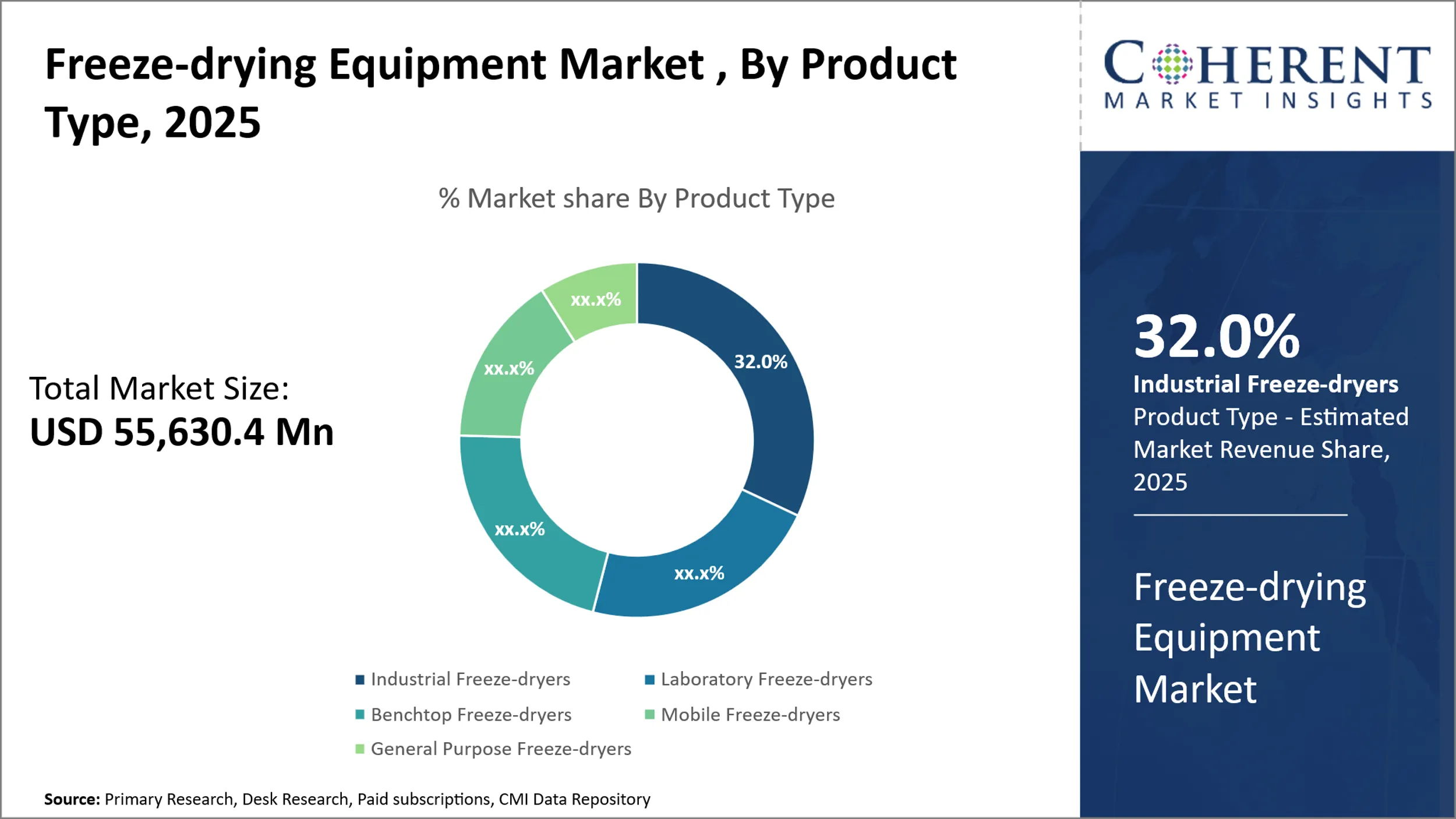
Global Freeze-drying Equipment Market Insights, By Product Type
The market is segmented into laboratory freeze-drying equipment, benchtop freeze-dryers, mobile freeze-dryers, industrial freeze-dryers, and general-purpose freeze-dryers. Out of which, the the industrial freeze-dryer is expected to dominate the global market during the forecast period, owing to increasing usage of freeze-dryers.
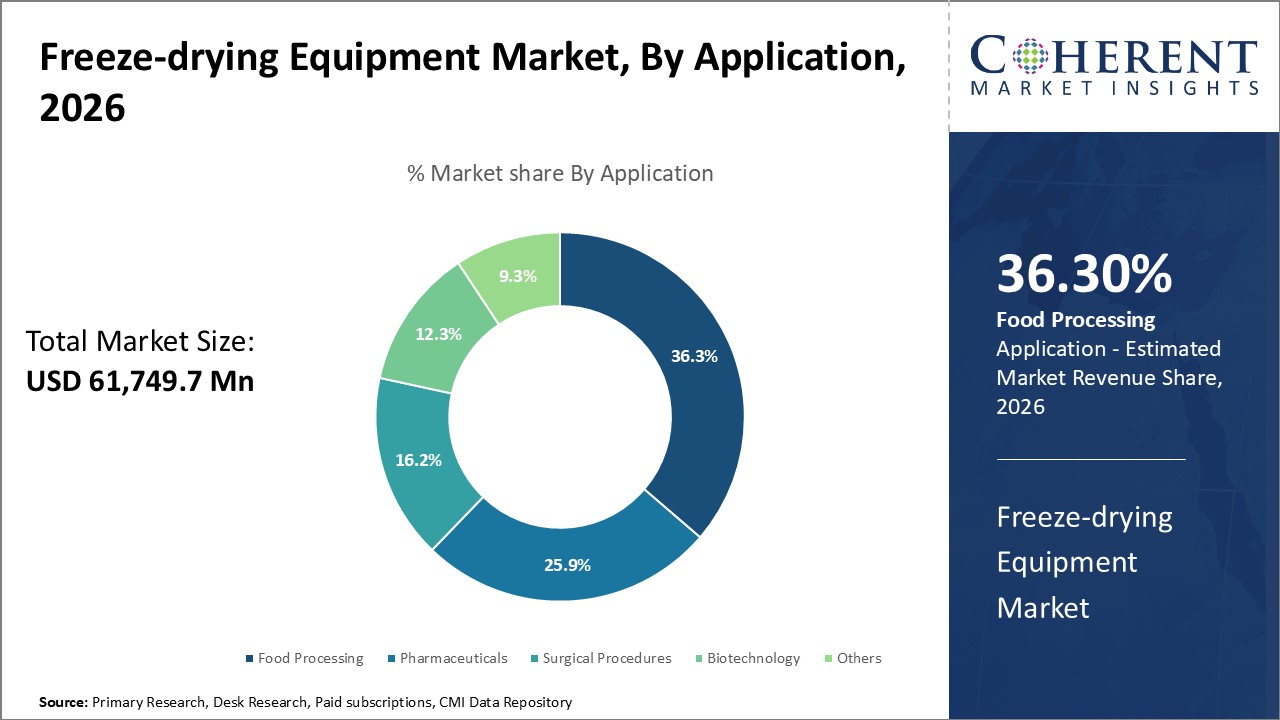
Global Freeze-drying Equipment Market Insights, By Application
The market is segmented into food processing, pharmaceuticals, and surgical procedures and Biotechnology, Others (including Leather Conversion, Flower Preservations). Out of which, the food processing and pharmaceuticals segment are expected to dominate the market over the forecast period, owing to increasing pharmaceuticals and food industries.
Regional Insights
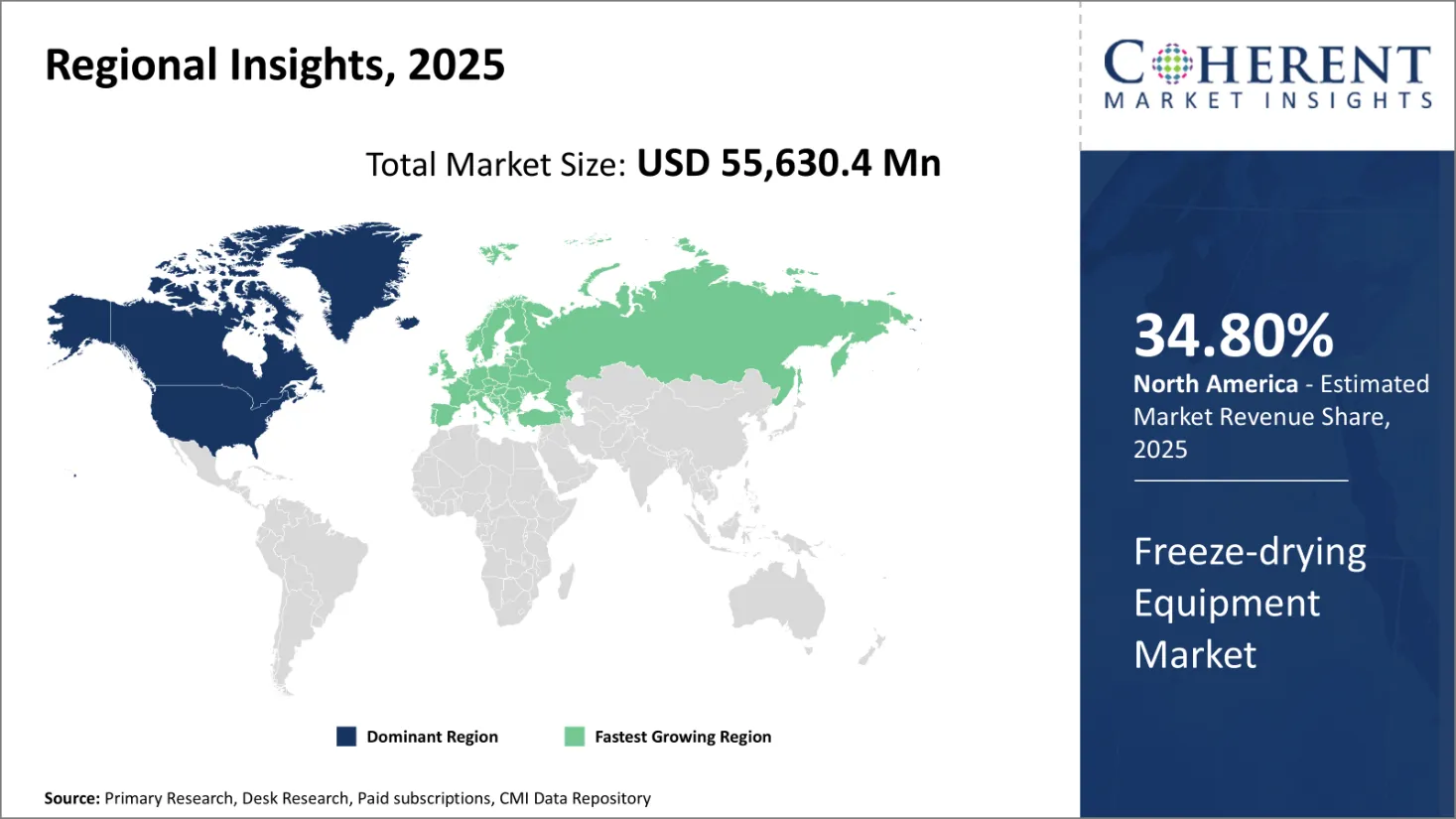
North America Freeze-drying Equipment Market Analysis and Trends
North America is expected to dominate the global market over the forecast period, owing to North America 34.80% market share and increasing collaboration by the key market players in this region. For instance, in July 2026, NJM, in collaboration with MAQUINARIA INDUSTRIAL DARA, SL, launched Dara coolvaccum freeze-drying equipment embedded with a range of lyophilization solutions that is suitable for research and development laboratories.
Europe Freeze-drying Equipment Market Analysis and Trends
Europe region is expected to be second dominating region over the forecast period, due to increasing launch of new vaccines by the key players operating in Europe, is consequently rising the demand for the freeze-drying equipment in European region, which is expected to grow the global freeze-drying equipment market over the forecast period.
For instance, in August 2022, ZeptoMetrix, LLC, a company that provides cost-effective Diagnostic Microbiology products and services, launches Recombinant Monkeypox Virus Stock, hence the launch of monkeypox vaccine is rising the need for the freeze-drying equipment in the market.
Dominating Countries in the Freeze-Drying Equipment Market
- The freeze-drying equipment market price in the United States is shaped by high demand from pharmaceutical manufacturers, rapid integration of advanced bioprocessing technologies, and stringent regulatory standards for GMP-compliant lyophilization systems, positioning the country as a market leader in 2026. Increased investment in biologics and vaccines has further solidified its market dominance.
- Germany, China, and Japan also contribute significantly due to well-established pharmaceutical sectors, rising biomanufacturing capacity, and demand for energy-efficient and automated freeze-drying solutions. The Asia Pacific region, led by China and India, is the fastest-growing segment.
Global Freeze-drying Equipment Market- Drivers
Increasing growth strategies for launch by the key market players
- Key market players are adopting growth strategies such as joint agreement, and this is expected to drive the market growth over the forecast period. For instance, in October 2021, Air Products, one of the global manufacturers of industrial gases and cryogenic technology, and Sublime Stericeuticals Corporation, a process design and equipment manufacturer, aanounced the joint agreement to develop a continuous freeze-drying equipment for vaccine and pharmaceutical industries.
- The freeze-drying equipment market outlook is positive, with key players’ increasing growth strategies—such as intensified research and development activities—expected to drive global market expansion over the forecast period. For instance, in February 2023, COOLVACUUM TECHNOLOGIES, SL, a freeze-drying provider and MAQUINARIA INDUSTRIAL DARA, SL, a pharmaceutical manufacturing company, developed the line to produce vaccines, with the help of Center to the Development of Industrial Technology (CDTI) and the European Regional Development Fund (ERDF), in terms of getting funds from the mentioned organizations.
Global Freeze-drying Equipment Market: Restraint
Key freeze-drying equipment market trends highlight challenges to growth, including the high cost of equipment and the presence of alternative technologies like spray dryers competing in the market. Pharmaceutical and Biotechnological industries are shifting towards another alternatives for low maintenance of the equipment’s.
For instance, in November 2020, a article was published in the ResearchGate GmbH., a European commercial social networking site for scientists and researchers, stated that Freeze-drying considered an extremely expensive procedure to dehydrate food or pharmaceutical products the main cost of the process is not the utilization of the freeze-dryer, but the initial investment.
Market Report Scope
Freeze-drying Equipment Market Report Coverage
| Report Coverage | Details | ||
|---|---|---|---|
| Base Year: | 2025 | Market Size in 2026: | USD 61,749.7 Mn |
| Historical Data for: | 2020 To 2024 | Forecast Period: | 2026 To 2033 |
| Forecast Period 2026 to 2033 CAGR: | 11.0% | 2033 Value Projection: | USD 1,28,202.4 Mn |
| Geographies covered: |
| ||
| Segments covered: |
| ||
| Companies covered: | Cuddon Engineering Ltd., Freezedry Specialties, Inc., GEA Group, IMA Life The Netherlands B.V., Labconco Corporation, SP Industries, Inc., Telstar, Thermo Fisher Scientific Inc., MechaTech Systems Ltd., Millrock Technology Inc., Zirbus Technology GmbH, Biopharma Process Systems Ltd., LTE Scientific Ltd., Martin Christ GmbH, Shanghai Tofflon Science and Technology Co., Ltd., and MAQUINARIA INDUSTRIAL DARA,and other prominent players. | ||
| Growth Drivers: |
| ||
| Restraints & Challenges: |
| ||
Analyst Viewpoint
- The freeze-drying equipment market demand is accelerating, driven by the pharmaceutical and biotechnology sectors’ increasing need for stable biologics, vaccines, and injectable formulations. Technological innovations—particularly in automated, energy-efficient, and GMP-compliant systems—are enhancing production reliability and reducing process variability.
- Opportunities are expanding with the adoption of continuous freeze-drying systems, IoT-enabled monitoring, and modular designs catering to flexible manufacturing needs, especially in personalized medicine and small-batch therapeutics.
- However, market growth is tempered by high capital investment, lengthy validation cycles, and strict regulatory compliance, particularly in emerging regions. Operational training and maintenance complexity also pose adoption challenges.
- North America is expected to lead the market due to advanced biomanufacturing infrastructure, while Asia-Pacific is emerging as a high-growth region driven by contract manufacturing expansion and increasing pharmaceutical exports.
Global Freeze-drying Equipment Market: Key Developments
- In February 2024, IMA Life launched a new modular freeze-drying platform designed for continuous aseptic manufacturing, offering improved scalability and compliance with EU GMP Annex 1 revisions.
- In January 2024, Telstar announced the integration of advanced SCADA systems into its industrial lyophilizers to enhance real-time monitoring and data integrity for biopharma clients.
- In October 2024, GEA Group unveiled an energy-efficient freeze-dryer model with heat recovery systems aimed at reducing operational costs and environmental impact in large-scale production.
- In February 2022, food maker Pol's handed GEA Group Aktiengesellschaft its 3rd contract to install and RAY freeze- drying equipment at the firms of 4,000 m2 vegetable & fruit freeze- drying factory in Ermenek, Turkey. This will increase the manufacturing of freeze-drying from 200 tonnes to 300 tonnes annually.
Market Segmentation
- Global Freeze-drying Equipment Market, By Product Type (Revenue, USD Mn, 2021 - 2033)
- Laboratory Freeze-drying Equipment
- Benchtop Freeze-dryers
- Mobile Freeze-dryers
- Industrial Freeze-dryers
- General Purpose Freeze-dryers
- Global Freeze-drying Equipment Market, By Application (Revenue, USD Mn, 2021 - 2033)
- Food Processing
- Pharmaceutical
- Surgical Procedures
- Biotechnology
- Other (including Leather Conversion, Flower Preservations)
- Global Freeze-drying Equipment Market, By Region (Revenue, USD Mn, 2021 - 2033)
- North America
- U.S.
- Canada
- Latin America
- Brazil
- Argentina
- Mexico
- Rest of Latin America
- Europe
- Germany
- U.K.
- Spain
- France
- Italy
- Russia
- Rest of Europe
- Asia Pacific
- China
- India
- Japan
- Australia
- South Korea
- ASEAN
- Rest of Asia Pacific
- Middle East
- GCC Countries
- Israel
- Rest of Middle East
- Africa
- South Africa
- North Africa
- Central Africa
- North America
- Company Profiles
- Cuddon Engineering Limited
- Freezedry Specialties, Inc.
- GEA Group
- IMA Life The Netherlands B.V.
- Labconco Corporation
- SP Industries
- Telstar
- Thermo Fisher Scientific Inc.
- MechaTech Systems Ltd.
- Millrock Technology Inc.
- Zirbus Technology GmbH
- Biopharma Process Systems Ltd.
- LTE Scientific Ltd.
- Martin Christ GmbH
- Shanghai Tofflon Science and Technology Co., Ltd.
- MAQUINARIA INDUSTRIAL DARA, SL
Sources
Primary Research Interviews
- Equipment Manufacturers and Suppliers
- End-user Industries (Pharmaceutical, Food & Beverage, Biotechnology Companies)
- Distributors and Retailers
- Technology Providers and System Integrators
- Others
Databases
- IBISWorld Industry Reports
- TechNavio Market Research Database
- Grand View Research Database
- Others
Magazines
- Food Engineering Magazine
- Pharmaceutical Technology Magazine
- Process Engineering Magazine
- Chemical Engineering Magazine
- Others
Journals
- Journal of Food Engineering
- International Journal of Pharmaceutics
- Drying Technology Journal
- Others
Newspapers
- Financial Times
- The Wall Street Journal
- Reuters Business News
- Food Business Magazine
- Others
Associations
- International Association for Food Protection (IAFP)
- Pharmaceutical Research and Manufacturers of America (PhRMA)
- International Pharmaceutical Excipients Council (IPEC)
- Biotechnology Innovation Organization (BIO)
- Others
Public Domain Sources
- U.S. Food and Drug Administration (FDA)
- European Medicines Agency (EMA)
- World Health Organization (WHO)
- National Institute of Standards and Technology (NIST)
- Others
Proprietary Elements
- CMI Data Analytics Tool
- Proprietary CMI Existing Repository of information for last 8 years
*Definition: Freezedrying is a process of dehydrating of subtances at low temperatures. Materials are kept at a negative temperature during the procedure. As a result, freeze drying has less impact on the original features of the product that preserves the biological activity, vitamins, flavor, taste, and appearance of the product in food industries.
Get access to 250+ pages report
Every segment, forecast, competitor profile and data table behind the analysis above — available for instant download.
- ESOMAR Member
- ISO 9001:2015 Certified
- D-U-N-S Registered
- GDPR & CCPA Compliant
Missing comfort of reading report in your local language? Find your preferred language:
Transform your Strategy with Exclusive Trending Reports
Frequently Asked Questions
The Freeze-drying Equipment Market size is estimated to be valued at USD 61,749.7 Mn in 2026, and is expected to reach USD 1,28,202.4 Mn by 2033.
The freeze-drying equipment market value is expected to grow at a compound annual growth rate (CAGR) of 11.0% between 2026 and 2033.
The freeze-drying process has three main stages: Freezing – The product's water is frozen. Primary Drying – Ice sublimates under vacuum. Secondary Drying – Remaining moisture is removed by gentle heating.
Key companies covered as a part of this study include, Cuddon Engineering Ltd., Freezedry Specialties, Inc., GEA Group, IMA Life The Netherlands B.V., Labconco Corporation, SP Industries, Inc., Telstar, Thermo Fisher Scientific Inc., MechaTech Systems Ltd., Millrock Technology Inc., Zirbus Technology GmbH, Biopharma Process Systems Ltd., LTE Scientific Ltd., Martin Christ GmbH, Shanghai Tofflon Science and Technology Co., Ltd., and MAQUINARIA INDUSTRIAL DARA, SL and other prominent players.