

Inflation Devices Market Analysis & Forecast: 2026-2033
Inflation Devices Market is estimated to be valued at USD 6.3 Mn in 2026 and is expected to reach USD 10.8 Mn in 2033, exhibiting a compound annual growth rate (CAGR) of 8.1% from 2026 to 2033.
Key Takeaways
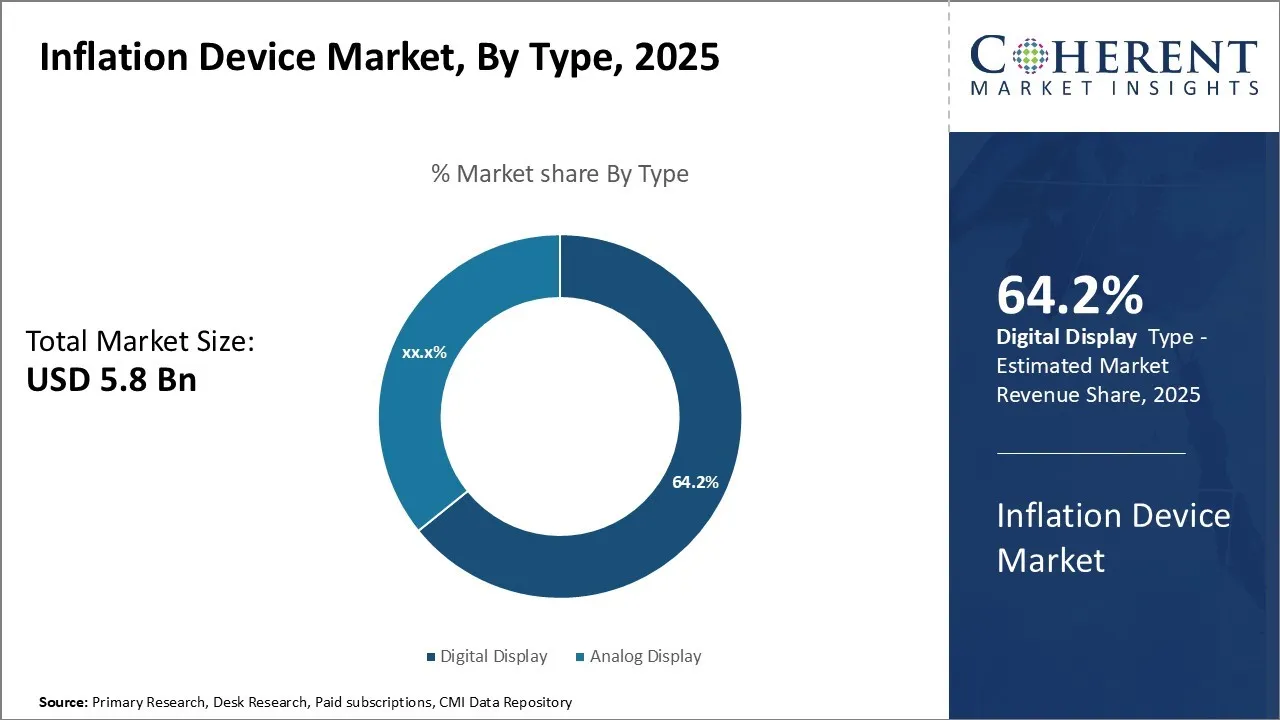
- According to Type, The Digital Display Category is anticipated to account for the largest share of 65.2% for the Inflation Devices market in 2026, due to its advanced functionality, usability, and integration potential.
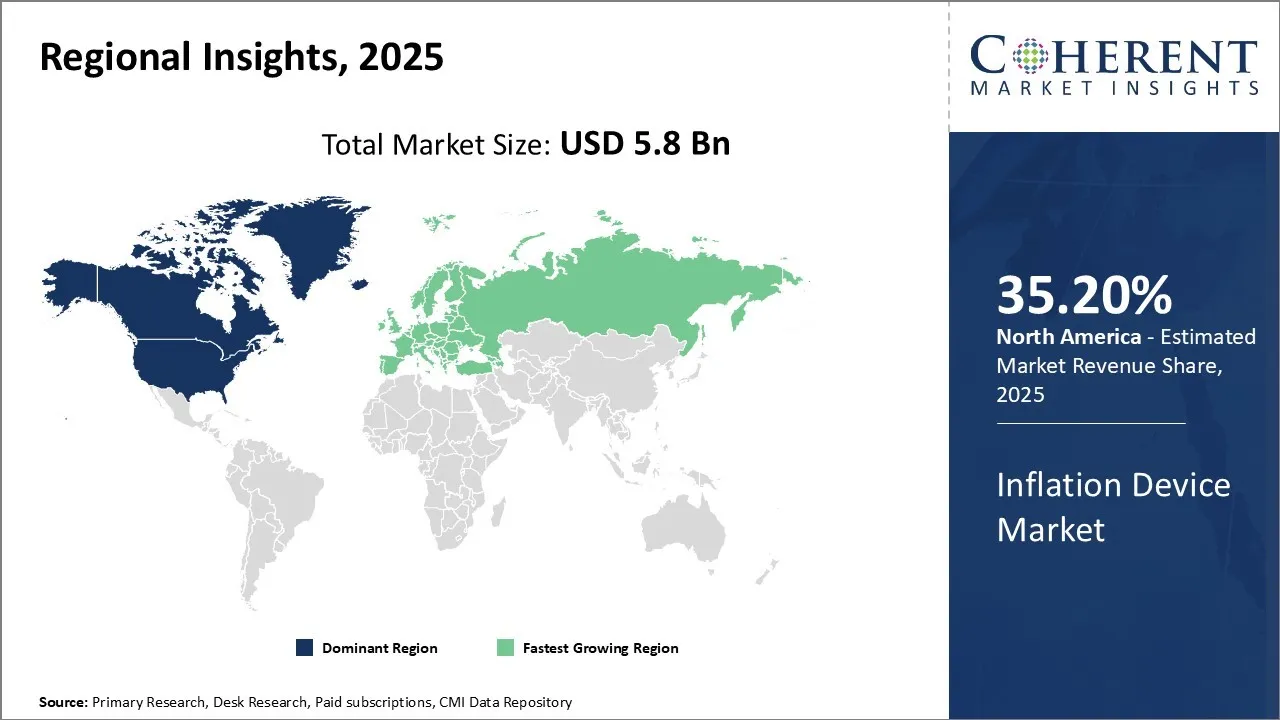
- According to region, North America holds the largest market share of 35.2% for Inflation Devices market growth by 2026, owing to high healthcare spending a big number of powerful industry players.
- Europe is considered to be the second dominating region with 28.7% market share for Inflation Devices market by 2026. Germany is expected to lead the European inflation device market’s robust, innovation driven expansion, which will be supported by the continents advanced healthcare system which changes demographics and rising desire for minimally invasive procedures.
- Asia Pacific is considered to be the third largest region with 23.5% market share by 2026 for Inflation Devices market demand, as it is driven by robust market investment, healthcare innovations, and growing demographic.
Market Overview
The Inflation Devices Market Size is boosted by the the growing elderly population, the rising incidence of gastrointestinal and cardiovascular disorders, and the increased use of minimally invasive surgical techniques. Inflation devices are used to inflate and deflate balloon catheters during angioplasty procedures to treat blocked arteries. The advantages of these devices include precise inflation control and enhanced patient safety.
Current Events and Its Impact on the Inflation Devices Market
Event | Description and Impact |
Growing Demand for Minimally Invasive Surgeries |
|
Enhanced Market Uncertainty as a Result of International Trade Conflicts |
|
Pricing Analysis with Cost Percentage
- Cost remains a critical purchasing factor: both manufacturer and end-user surveys confirm that price sensitivity is high, especially in healthcare institutions managing tighter budgets.
- Analog devices, which feature manual readings, tend to be more cost-effective, while digital devices equipped with automated systems and software integration command higher prices.
- Pricing structures indicate that the cost of materials and components can account for 40–50% of the device’s final cost, with regulatory compliance and quality assurance adding another 15–20%.
- The remainder is split between research and development, marketing, logistics, and margin for manufacturers. As the market matures and competition intensifies, cost efficiency alongside high-value features will play a decisive role in procurement and market share.
- Current Industry Events of 2026
- Market Size Estimation
- Regional Breakdown
- Competitive Landscape
- Customer Intelligence
- Segmental Analysis
- Pricing Analysis
- Key Market Drivers, Challenges & Future Trends
- Customized Insights Section
Consumer Survey, Feedback, and Unmet Needs
- Recent surveys and stakeholder feedback in the inflation devices market reveal a heightened focus on precision, efficiency, and innovation. Up to 80% of manufacturers acknowledge the need for devices that provide accurate control and efficient inflation/deflation, suggesting that clinicians continue to demand reliable equipment that streamlines minimally invasive procedures and improves patient safety.
- Around 75% of stakeholders observe increased adoption among healthcare practitioners, driven by rising cardiovascular cases and an aging population. Digital interfaces and wireless connectivity are emerging as key differentiators, as practitioners desire real-time monitoring and integration with healthcare IT systems.
- Feedback also underscores unmet needs related to environmental sustainability and regulatory compliance, with 70% of respondents emphasizing the importance of eco-friendly materials and adherence to international standards. Overall, there is clear market pressure for advanced features, connectivity, and sustainable innovation to meet evolving practitioner and institutional priorities.
Analyst Opinion
- The global inflation devices market is expected to witness steady growth over the forecast period, driven by the increasing demand for minimally invasive surgeries worldwide.
- The rising prevalence of gastrointestinal diseases and cardiology diseases and the growing geriatric population are fueling the need for efficient inflation devices.
- Developing healthcare infrastructure in emerging nations and rising medical tourism are creating new avenues for market players.
- However, the availability of alternative treatment methods for diseases may hamper the demand for inflation devices to some extent.
Speak to the analyst
Want personalized insights?
Take the findings above to one of our principal consultants, or have the report rebuilt around the segments, geographies and competitors you actually track.
Segmental Insights
Inflation Devices Market Insights, By Type
In terms of type, the digital display segment is expected to contribute largest share of 65.2% for the Inflation Devices market trends in 2026, Out of all the display kinds, the digital display segment of the inflation devices market is expected to grow at the highest rate. When compared to analog counterparts, digital devices provide this category more precision, ease of use, and advanced display features.
Digital display inflation devices are becoming more and more popular as healthcare providers and other end users look for more precise and dependable monitoring of inflation and deflation pressures. Historically, analog inflation devices have dominated the market because of their lower cost and portability.
Inflation Devices Market Insights, By Capacity
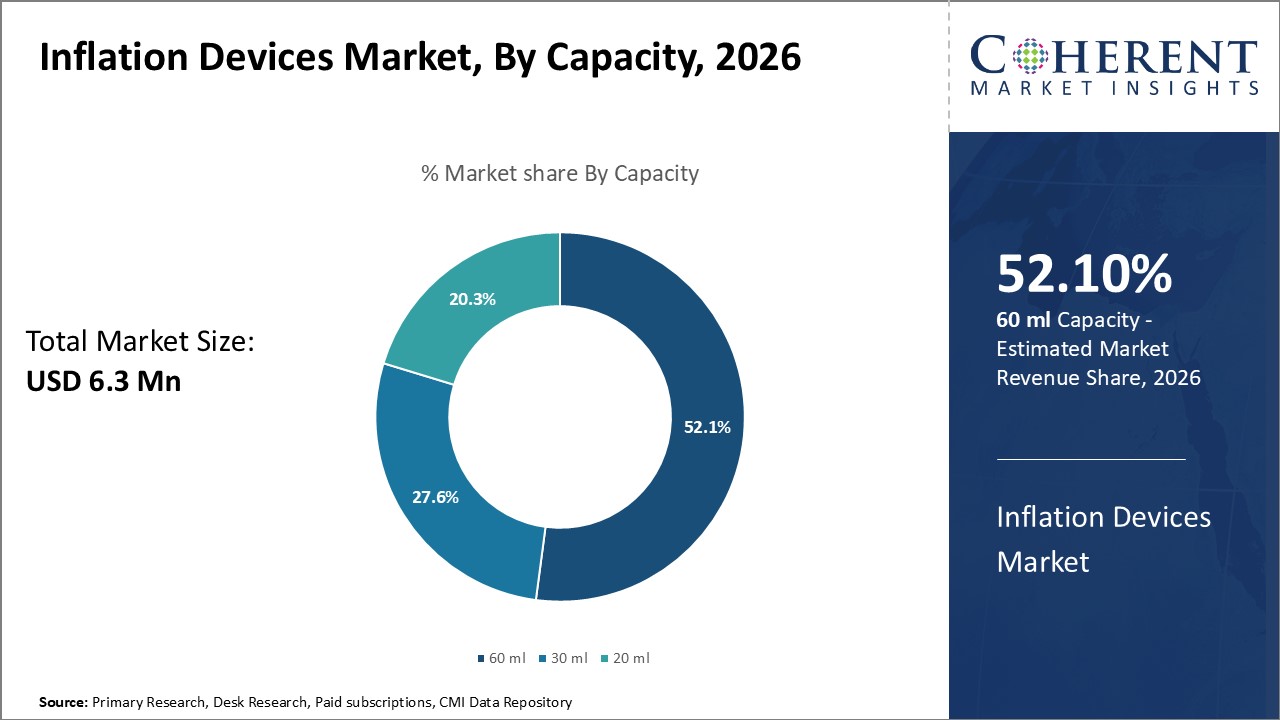
In terms of capacity, the 60ml segment is expected to contribute the largest share of the Inflation Devices market trends in 2026. One key factor driving this market is its applicability to procedures requiring bigger volumes of inflation fluid, especially in otolaryngology, gastroenterology, and pulmonary applications where larger balloons are frequently utilized and more liquid is needed for inflation.
Additionally, the inflation devices market for angiographic balloons is also witnessing growth, further supporting the demand for higher-capacity devices like the 60ml segment.
Inflation Devices Market Insights, By Application
In terms of application, the interventional cardiology segment is expected to contribute largest share of the Inflation Devices market trends in 2026. Rising prevalence of cardiovascular diseases (CVDs) particularly coronary artery disease due to aging populations and widespread risk factors such as hypertension and diabetes, has led to increased demand for interventional procedures that rely on inflation devices.
Interventional cardiology procedures, such as angioplasty, use inflation devices to inflate and deflate balloons and deploy stents, which are critical steps in restoring blood flow in blocked arteries.
Inflation Devices Market Insights, By End User
In terms of end user, the hospitals segment is expected to contribute largest share of the Inflation Devices market trends in 2026. Due to the continual expansion of the healthcare infrastructure, the rise in healthcare spending, and the ongoing innovation of top manufacturers, the market is anticipated to maintain its dominance and experience significant growth. Hospitals are more likely to use cutting-edge inflating devices, which will drive market expansion even more.
Regional Insights
North America Inflation Devices Market
North America is expected to be the largest market for inflation devices market during the forecast period, accounting for over 35.20% of the market share in 2026. The growth of the market in North America is attributed to the presence of key players and the increasing prevalence of cardiovascular diseases in the region.
Europe Inflation Devices Market
The Europe market is expected to be the second-largest market for inflation devices, accounting for over 28.7% of the market share in 2026. The growth of the market in Europe is attributed to the rising geriatric population and favorable reimbursement policies. An important factor contributing to this growth is the increasing adoption of adjustable pressure by inflation devices, which allows for greater precision and safety during medical procedures.
Inflation Devices Market In Asia Pacific
The Asia Pacific market is expected to be the fastest-growing market for inflation devices market, with a CAGR of over 23.5% during the forecast period. The growth of the market in Asia Pacific is attributed to improving healthcare infrastructure and increasing healthcare expenditure in the region.
Inflation Devices Market Dominating Countries
U.S Inflation Devices Market
The presence of significant medical device makers and a high rate of cardiovascular disorders, which fuel demand for minimally invasive treatments where inflation devices are crucial, further support the nation's leadership. Strong growth in the U.S. market is anticipated due to ongoing investments in healthcare infrastructure, rising procedure volume, and the gradual use of automated and digital inflation device technology.
India Inflation Devices Market
The growing burden of chronic diseases, particularly cardiovascular conditions, and a rapidly increasing geriatric population are catalyzing the adoption of minimally invasive procedures that use inflation devices. India's market growth is strongly supported by government and private sector initiatives aimed at upgrading hospital capabilities, expanding access to advanced procedures, and increasing awareness around early disease diagnosis.
Inflation Devices Market In China
The country is witnessing strong demand for advanced medical devices as rising urbanization, escalating incidence of chronic illnesses, and favorable government policies direct more resources to healthcare. Significant investment in hospital infrastructure, increased focus on minimally invasive surgery, and rising healthcare spending — both public and private — are accelerating market expansion.
Market Report Scope
Inflation Devices Market Report Coverage
| Report Coverage | Details | ||
|---|---|---|---|
| Base Year: | 2025 | Market Size in 2026: | USD 6.3 Mn |
| Historical Data for: | 2020 To 2024 | Forecast Period: | 2026 To 2033 |
| Forecast Period 2026 to 2033 CAGR: | 8.1% | 2033 Value Projection: | USD 10.8 Mn |
| Geographies covered: |
| ||
| Segments covered: |
| ||
| Companies covered: | Medtronic, Boston Scientific Corporation, Abbott, Teleflex Incorporated, Convatec Inc., Smiths Group plc, Cook, B. Braun SE, Cardinal Health and Stryker | ||
| Growth Drivers: |
| ||
| Restraints & Challenges: |
| ||
Inflation Devices Market: Growth Drivers
- Increasing prevalence of cardiovascular diseases: The rising prevalence of cardiovascular diseases such as coronary artery disease and heart failure is driving the demand for angioplasty procedures, which is subsequently fueling the growth of the inflation devices market. According to the World Health Organization (WHO), in June 2021, cardiovascular disease is the number one cause of death globally, responsible for over 17 million deaths per year.
- Favorable reimbursement scenario: The availability of reimbursement for angioplasty procedures is increasing the adoption of inflation devices. Public and private insurance providers are increasingly covering expenses related to cardiovascular treatments due to the risks associated with heart diseases.
- Rising minimally invasive surgeries: The shift from traditional open surgeries toward minimally invasive procedures is boosting the adoption of inflation devices used in balloon-based surgeries such as angioplasty. Minimally invasive surgeries reduce hospital stays and costs.
- Increasing healthcare expenditure: The growing healthcare spending by governments and individuals globally is leading to higher adoption of advanced cardiovascular devices and treatments, thereby driving the inflation devices market. According to Centers for Medicare & Medicaid Services, healthcare spending in the U.S. is estimated to reach US$6.2 trillion by 2028.
Inflation Devices Market: Trends
- Shift toward digital inflation technologies: Manufacturers are increasingly developing digital inflation devices integrated with electronic pressure sensors, LCD displays, and intuitive user controls. Digital interfaces allow improved visibility, accuracy, and control over inflation.
- Focus on patient safety and comfort: Key market trends include the incorporation of safety mechanisms such as pressure relief valves, ergonomic lightweight handles, and mechanisms to reduce balloon deflation time. Companies are designing patient-friendly CE Certified Inflation Devices to ensure compliance with regulatory standards while enhancing user safety and performance.
- Development of intuitive handheld devices: Trending product innovations include compact, lightweight handheld inflation devices with advanced digital interfaces, making them easier to handle and transport. Intuitive display and control panels improve usability.
Inflation Devices Market: Opportunities
- Growth prospects in emerging economies: The rising prevalence of cardiovascular diseases, along with improving healthcare infrastructure in developing nations such as India, China, Brazil, etc., is expected to create significant opportunities for inflation device manufacturers. A favorable regulatory scenario is also attracting key players to emerging markets.
- Development of smart inflation devices: Integration of technologies such as IoT, artificial intelligence, and machine learning into inflation devices can help improve patient monitoring and enable data-driven, precise inflation control. Companies are working on developing connected, smart inflation devices.
- Increasing adoption of disposable devices: The growing trend of using disposable devices to reduce cross-contamination risks presents lucrative opportunities for market players. Disposable inflation devices eliminate maintenance and sterilization costs.
- Expansion of application areas: The widening clinical applications of inflation devices in procedures such as balloon sinuplasty, airway dilation, balloon gastrointestinal procedures, etc. is creating new avenues for market growth.
Inflation Devices Market: Key Developments
- In June 6, 2023, SYNDEO Medical, a division of MDev BV, a global leader in the design and development of fully integrated custom procedural solution products, is pleased to introduce the SATURN Inflation Device. This innovative platform offers interventional physicians worldwide a new level of innovation, versatility, and choice. By seamlessly integrating into SYNDEOPack intervention packages, the SATURN Inflation Device provides healthcare professionals with a comprehensive solution that combines the benefits of both products on a single platform.
- In November 2022, Merit Medical Systems, Inc. announced the commercial launch of the basixALPHA Inflation Device in the U.S. The basixALPHA is the latest addition to the Merit portfolio of inflation devices. Products include low- and high-pressure capacity analog and digital devices for inflating, deflating, and measuring pressures in angioplasty balloons.
Market Segmentation
- Type Insights (Revenue, USD Bn, 2021 - 2033)
- Digital Display
- Analog Display
- Capacity Insights (Revenue, USD Bn, 2021 - 2033)
- 20 ml
- 30 ml
- 60 ml
- Application Insights (Revenue, USD Bn, 2021 - 2033)
- Gastroenterological Procedures
- Urological Procedures
- Intervention Cardiology & Radiology
- Peripheral Vascular Procedure
- End User Insights (Revenue, USD Bn, 2021 - 2033)
- Hospital
- Clinics
- Ambulatory Surgery Centers
- Regional Insights (Revenue, USD Bn, 2021 - 2033)
- North America
- U.S.
- Canada
- Latin America
- Brazil
- Argentina
- Mexico
- Rest of Latin America
- Europe
- Germany
- U.K.
- Spain
- France
- Italy
- Russia
- Rest of Europe
- Asia Pacific
- China
- India
- Japan
- Australia
- South Korea
- ASEAN
- Rest of Asia Pacific
- Middle East
- GCC Countries
- Israel
- Rest of Middle East
- Africa
- South Africa
- North Africa
- Central Africa
- North America
- Key Players Insights
- Medtronic
- Boston Scientific Corporation
- Abbott
- Teleflex Incorporated
- Convatec Inc.
- Smits Group plc
- Cook
- Braun SE
- Cardinal Health
- Stryker
Sources
Primary Research Interviews
- Regulatory Affairs Specialists
- Hospital Purchasing Committees
- Interventional Cardiologists
- Supply Chain Heads – Medical Distributors
Databases
- FDA MAUDE Database
- CMS (Centers for Medicare & Medicaid Services) Database
Magazines
- Medgadget
- MedCity News
- HealthTech Magazine
- MPO (Medical Product Outsourcing)
Journals
- Biomedical Engineering Online
- Journal of Biomedical Materials Research
- European Heart Journal
- Annals of Biomedical Engineering
- The Lancet Digital Health
Newspapers
- Business Standard – Medical Devices
- Mint – Pharma & Medtech
- The Hindu BusinessLine – Healthcare
- Times of India – Health
Associations
- Association for the Advancement of Medical Instrumentation (AAMI)
- Asia Pacific Society of Interventional Cardiology (APSIC)
- Advanced Medical Technology Association (AdvaMed)
- Indian Medical Device Industry Association (IMEDICA)
- Interventional Cardiovascular Technology Association (ICTA)
Proprietary Elements
- CMI Data Analytics Tool, Proprietary CMI Existing Repository of information for last 8 years
*Definition: The inflation devices market refers to the global market for medical devices used to inflate and deflate balloon catheters during various minimally invasive surgical procedures and examinations. Inflation devices allow controlled and safe inflation and deflation of angioplasty and other balloons during cardiovascular interventions as well as balloons used for gastrointestinal, urological, gynecological, and ear-nose-throat procedures. They are an indispensable part of balloon dilatation procedures. The most common types of inflation devices include syringes, pumps, bags, and automated inflation systems. Key end-users are hospitals, ambulatory surgery centers, and diagnostic imaging centers.
Get access to 250+ pages report
Every segment, forecast, competitor profile and data table behind the analysis above — available for instant download.
- ESOMAR Member
- ISO 9001:2015 Certified
- D-U-N-S Registered
- GDPR & CCPA Compliant
Missing comfort of reading report in your local language? Find your preferred language:
Transform your Strategy with Exclusive Trending Reports
Frequently Asked Questions
The Inflation Devices Market sise is estimated to be valued at USD 6.3 Mn in 2026, and is expected to reach USD 10.8 Mn by 2033.
The CAGR of the global Market is projected to be 8.1% from 2026 to 2033.
The major factors driving the market growth are rising prevalence of cardiovascular diseases and GI disorders, increasing adoption of minimally invasive surgeries, technological advancements in inflation devices, growing elderly population, and favorable reimbursement policies.
The digital display segment accounts for the largest share in the market owing to benefits like automatic pressure sensing and control.
The major players operating in the market are Medtronic, Boston Scientific Corporation, Abbott, Teleflex Incorporated, Convatec Inc., Smiths Group plc, Cook, B. Braun SE, Cardinal Health and Stryker.
North America is expected to dominate the market during the forecast period owing to high adoption of minimally invasive procedures and new product launches.