

Dermatoscope Market Analysis & Forecast: 2026-2033
Dermatoscope Market is estimated to be valued at USD 1,369.1 Mn in 2026 and is expected to reach USD 3,231.1 Mn in 2033, exhibiting a compound annual growth rate (CAGR) of 13.1% from 2026 to 2033.
Key Takeaways
- According to Product, The Contact Dermatoscope Category is anticipated to account for the largest share of 44% for the Dermatoscope market in 2026.
- According to region, North America holds the largest market share of 34.8% for Dermatoscope market growth by 2026.
Market Overview
The Dermatoscope Market Size has shown robust growth in recent years which is driven by rising prevalence of skin disease, especially skin cancer, and increasing awareness about early and acurate diagnosis. Increase in product launches by key market players is expected to drive the market growth over the forecast period. Moreover, an increase in prevalence of skin cancer such as melanoma and others is also expected to drive the market growth.
For instance, in December 2024, SmartSKN has unveiled the Muilli AI dermatoscope, a portable diagnostic device that combines artificial intelligence with advanced imaging technology to deliver precise skin analysis. The device’s launch introduces a new standard in hyper-personalized skin care, potentially transforming product development for cosmetic and personal care manufacturers.
Current Events and Its Impact
Event | Description and Impact |
Surge in Skin Cancer Prevalence |
|
Increased Healthcare Investment in Asia Pacific |
|
Pipeline Analysis
The dermatoscope market pipeline is robust, with ongoing research and development focused on integrating advanced imaging technologies, artificial intelligence, and user-friendly digital interfaces. Companies are actively working on next-generation devices that offer higher diagnostic accuracy, portability, and connectivity features, aiming to meet the rising demand for efficient and early skin disease detection.
- Current Industry Events of 2026
- Market Size Estimation
- Regional Breakdown
- Competitive Landscape
- Customer Intelligence
- Segmental Analysis
- Pricing Analysis
- Key Market Drivers, Challenges & Future Trends
- Customized Insights Section
Patent Landscape
The patent landscape for dermatoscopes is dynamic, reflecting continuous innovation in device design, imaging modalities, and diagnostic algorithms. Leading manufacturers are securing patents for technological advancements such as enhanced optics, digital integration, and AI-powered analysis, which helps them maintain a competitive edge and protect their intellectual property in a rapidly evolving market.
Reimbursement Scenario
- Reimbursement policies for dermatoscopy procedures vary by region but are gradually improving as the clinical value of early skin cancer detection gains recognition. In several developed markets, insurance coverage for dermatoscopic examinations is expanding, which encourages healthcare providers to adopt these devices and supports market growth by reducing out-of-pocket costs for patients.
Prescribers’ Preference
- Dermatologists and other healthcare professionals increasingly prefer dermatoscopes equipped with digital and AI features, as these tools enhance diagnostic accuracy and workflow efficiency.
- The shift towards portable and user-friendly devices also aligns with the growing adoption of teledermatology, reflecting prescribers’ preference for technologies that facilitate both in-clinic and remote patient assessments.
Segmental Insights
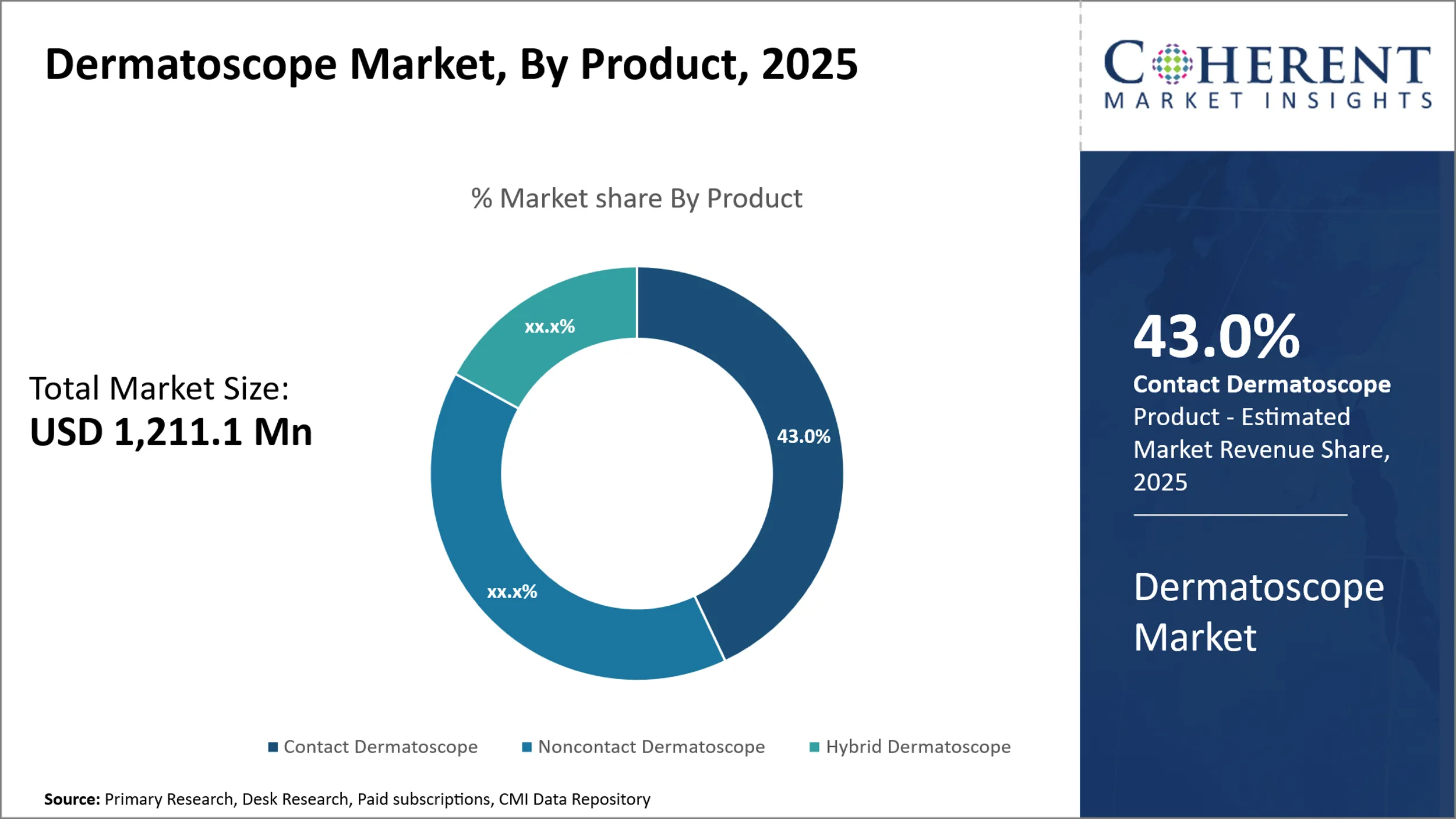
Dermatoscope Market Insights, by Product - Continuous Technological Advancements In Dermatoscopic Devices
Based on product, the market is segmented into Contact Dermatoscope, Noncontact Dermatoscope, and Hybrid Dermatoscope. Out of which, the Contact Dermatoscope segment is expected to dominate the golabl dermatoscope market during the forecast period and this is attributed to an increase in the product launches by key market players.
For instance, in June 2024, THIRTEEN e-health centres will be launched across the country this month as part of the Government’s efforts to enhance health service delivery in rural areas. The initiative is a result of a public-private partnership between the Ministry of Information Communication Technology, Postal and Courier Services, and ZimSmart Villages, a local telemedicine service provider.
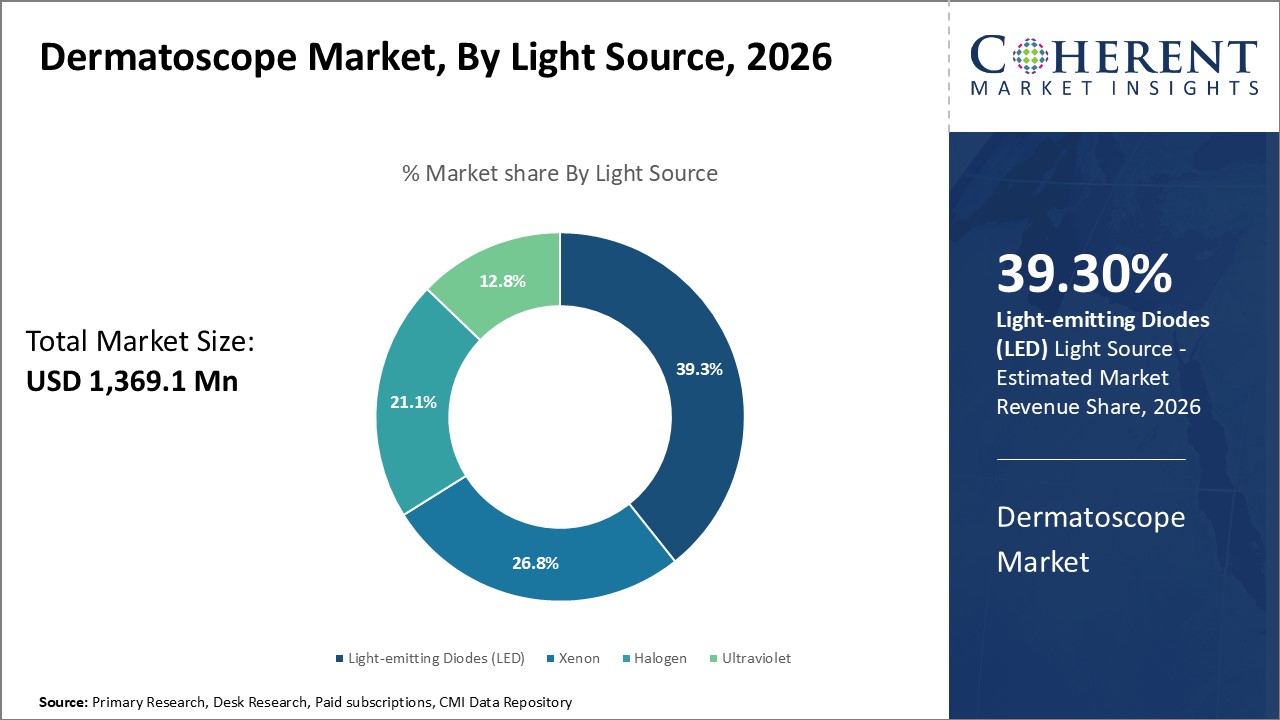
Dermatoscope Market Insights, by Light Source
Based on light source, the market is segmented into Light-emitting Diodes (LED), Xenon, Halogen, and Ultraviolet. Out of which, the Light-emitting Diodes (LED), segment is expected to dominate the market over the forecast period and this is attributed to increase in use of LED as compared to other light sources due advantages.
Dermatoscope Market Insights, by Modality
Based on modality, the market is segmented into Handheld, Trolley Mounted, and Headband. Out of which, the Handheld segment is expected to dominate the market over the forecast period and this is attributed to advantages of handheld dermatoscope as compared to others type of dermatoscope.
Dermatoscope Market Insights, by End User
Based on end user, the market is segmented into Hospitals, Dermatology Clinics, and Specialty Centers. Out of which, the hospital segment is expected to dominate the market over the forecast period and this is attributed to increase in the number of hospitals globally.
Regional Insights
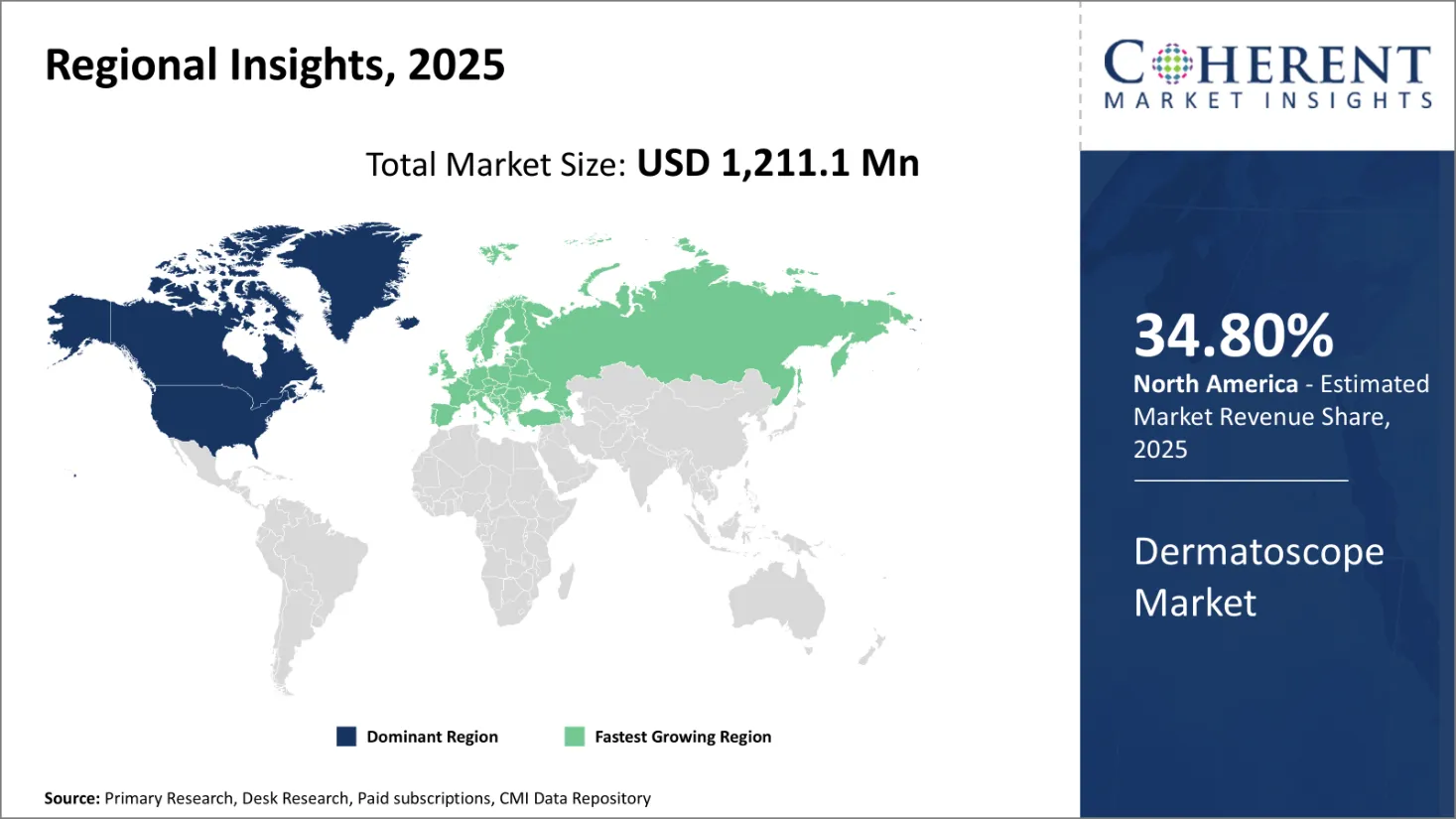
North America Dermatoscope Market
Among all regions, North America is expected to dominate the global market over the forecast period. This is attributed to North America holding a 34.8% market share and due to presence of major players such as Firefly Global, Bio-Therapeutic, Canfield Scientific, 3Gen, and others are contributing for development of dermatoscope market in North America.
Europe Dermatoscope Market
The Europe region is expected to be second dominating region over the forecast period, due to increase in technologically advance product offered by key market players. For instance, Rudolf Riester GmbH, a Germany-based manufacturer of medical devices, offers RCS-100, which is a multi-functional , portable and versatile medical camera system that can be used with a choice of lenses and adapters to assess and visualize a patient's eyes, ears, nose, throat, skin and more.
Dermatoscope Market In Asia Pacific
Government initiatives and awareness campaigns, such as Australia’s “National Skin Cancer Action Week,” are further promoting early diagnosis and boosting market adoption. Additionally, technological advancements, including digital and AI-powered dermatoscopes, and the expansion of teledermatology are enhancing diagnostic accuracy and accessibility, making Asia Pacific a promising arena for business expansion in the dermatoscope sector.
Dermatoscope Market Dominating Countries
U.S Dermatoscope Market
The U.S. market benefits from significant investments in innovation, a strong presence of key industry players, and increasing demand for both medical and cosmetic dermatological procedures, making it the largest and most mature market for dermatoscopes globally.
India Dermatoscope Market
India is emerging as a significant growth market for dermatoscopes, propelled by rising awareness of skin health, increasing incidence of skin diseases, and expanding access to healthcare services. The country is witnessing robust demand for affordable, portable, and digital dermatoscopic devices, especially in urban centers and among a growing middle class.
Dermatoscope Market In China
China represents one of the fastest-growing dermatoscope markets, driven by a surge in skin cancer cases, rising disposable incomes, and significant investments in healthcare modernization. The country’s large population base, increasing awareness of early diagnosis, and government-backed health campaigns are fueling demand for advanced diagnostic tools.
Market Report Scope
Dermatoscope Market Report Coverage
| Report Coverage | Details | ||
|---|---|---|---|
| Base Year: | 2025 | Market Size in 2026: | USD 1,369.1 Mn |
| Historical Data for: | 2020 To 2024 | Forecast Period: | 2026 To 2033 |
| Forecast Period 2026 to 2033 CAGR: | 13.1% | 2033 Value Projection: | USD 3,231.1 Mn |
| Geographies covered: |
| ||
| Segments covered: |
| ||
| Companies covered: | Canfield Scientific, Inc., ILLUCO, HEINE Optotechnik GmbH & Co. KG, Tejco Vision, 3Gen, FotoFinder Systems, Caliber Imaging and Diagnosis, Firefly Global, Bio-Therapeutic, AMD Global Telemedicine, Rudolf Riester GmbH, and Barco | ||
| Growth Drivers: |
| ||
| Restraints & Challenges: |
| ||
Dermatoscope Market: Growth Drivers
- Increase in the prevalence of skin cancer
An increase in the prevalence of skin cancer is expected to increase the demand of its early diagnosis, which in turn is expected to drive the global dermatoscope market growth during the forecast period. For instance, according to an article factsheet published by European Commission, a part of European government, in May 2021, it is estimated that skin melanoma accounted for 4% of all new cancer diagnoses in European Union (EU) countries in 2020 and melanoma accounted for 1.3% of all deaths due to cancer in EU.
- An increase in the funding by government organizations
Increase in the initiatives by various government organization for providing funding for cancer research and its screening is expected to increase the demand for dermatoscopes, which is expected to propel the global dermatoscope market growth for the forecast period. For instance, in May 2022, the U.S. Department of Health and Human Services (HHS), an U.S. federal government organization, announced the funding of US$ 5 million to promote the research of life-saving cancer screenings.
Dermatoscope Market: Trends
The dermatoscope market is witnessing several key trends that are shaping its growth trajectory. One prominent trend is the surge in product launches by leading manufacturers, particularly those integrating advanced technologies such as artificial intelligence (AI) and digital imaging, which enhance diagnostic accuracy and facilitate at-home skin assessments. The increasing prevalence of skin cancer and heightened awareness about early detection are also fueling demand for dermatoscopes globally.
Dermatoscope Market: Opportunities
The dermatoscope market is poised for significant opportunities in the coming decade, driven by rapid advancements in artificial intelligence, digital imaging, and telemedicine integration. The adoption of AI-powered dermatoscopes will enable real-time lesion analysis, expanding the use of these devices beyond dermatology specialists to general practitioners and even consumers for at-home monitoring. The proliferation of teledermatology services, combined with smartphone-compatible and wearable dermatoscopes, will further enhance access to remote diagnostics and early detection of skin conditions.
Dermatoscope Market: Key Developments
- March 2024, EMZ Partners’ portfolio company FotoFinder Systems, a global leader in skin imaging solutions, has entered into a definitive agreement to acquire DermLite, a renowned provider of handheld dermatoscopes. This strategic merger marks a major milestone in dermoscopy, uniting two companies that share a track record of setting industry standards through groundbreaking achievements and a commitment to advancing dermatological care through innovation. The acquisition marks EMZ’s first investment in the United States.
- March 2024, DermLite LLC, a premier provider of handheld dermatoscopes, is pleased to announce its acquisition by FotoFinder Systems, a global leader in skin imaging solutions. This strategic alliance signifies a milestone in the field of dermatology, bringing together two internationally acclaimed pioneers with a history of setting standards and a shared dedication to advancing dermatological care.
Analyst Opinion
- The global dermatoscope market growth can be driven by an increase in technologically advanced product offered by key market players. For instance, Sklip, Inc., a company involved in manufacturing artificial intelligence (AI) powered medical imaginginstrument, offers Sklip At-Home Dermoscope, an AI powered dermatoscope, which can be attached with smartphone for skin visualization at home.
- North America, particularly the United States, leads the market due to its advanced healthcare infrastructure, high physician adoption rates, and robust reimbursement frameworks, while Asia Pacific is emerging as the fastest-growing region, driven by urbanization, expanding dermatology services, and manufacturing capabilities.
Speak to the analyst
Want personalized insights?
Take the findings above to one of our principal consultants, or have the report rebuilt around the segments, geographies and competitors you actually track.
Market Segmentation
- Global Dermatoscope Market, By Product (Revenue, USD Mn, 2021 - 2033)
- Contact Dermatoscope
- Noncontact Dermatoscope
- Hybrid Dermatoscope
- Global Dermatoscope Market, By Light Source (Revenue, USD Mn, 2021 - 2033)
- Light-emitting Diodes (LED)
- Xenon
- Halogen
- Ultraviolet
- Global Dermatoscope Market, By Modality (Revenue, USD Mn, 2021 - 2033)
- Handheld
- Trolley Mounted
- Headband
- Global Dermatoscope Market, By End User (Revenue, USD Mn, 2021 - 2033)
- Hospitals
- Dermatology Clinics
- Specialty Centers
- Global Dermatoscope Market, By Region (Revenue, USD Mn, 2021 - 2033)
- North America
- U.S.
- Canada
- Latin America
- Brazil
- Argentina
- Mexico
- Rest of Latin America
- Europe
- Germany
- U.K.
- Spain
- France
- Italy
- Russia
- Rest of Europe
- Asia Pacific
- China
- India
- Japan
- Australia
- South Korea
- ASEAN
- Rest of Asia Pacific
- Middle East
- GCC Countries
- Israel
- Rest of Middle East
- Africa
- South Africa
- North Africa
- Central Africa
- North America
- Company Profiles
- Canfield Scientific, Inc.
- Company Highlights
- Products Portfolio
- Key Highlights
- Financial Performance
- Strategies
- ILLUCO
- HEINE Optotechnik GmbH & Co. KG
- Tejco Vision
- 3Gen
- FotoFinder Systems
- Caliber Imaging and Diagnosis.
- Firefly Global
- Bio-Therapeutic
- AMD Global Telemedicine
- Rudolf Riester GmbH
- Barco
- Canfield Scientific, Inc.
Sources
Primary Research interviews
- Dermatologists (clinical and cosmetic)
- General practitioners using dermatoscopes
- Oncologists (particularly skin cancer specialists)
- Aesthetic medicine practitioners
- Hospital procurement managers
- Private dermatology clinic owners
Databases
- Scopus
- SpringerLink
- ScienceDirect
- IEEE Xplore
- EMBASE
- GlobalData Medical Intelligence Center
Magazines
- Dermatology Times
- The Dermatologist
- Practical Dermatology
- Aesthetic Medicine
- MedTech Innovation News
Journals
- Journal of the American Academy of Dermatology
- Dermatologic Surgery
- International Journal of Dermatology
- British Journal of Dermatology
- Journal of Dermatological Science
Newspapers
- The New York Times (Health section)
- The Guardian (Healthcare Innovation)
- The Times of India (Health/Science sections)
- Economic Times Healthworld
- Business Standard (Healthcare)
Associations
- American Academy of Dermatology (AAD)
- European Academy of Dermatology and Venereology (EADV)
- International Dermoscopy Society (IDS)
- Skin Cancer Foundation
- Indian Association of Dermatologists, Venereologists and Leprologists (IADVL)
Proprietary Elements
- CMI Data Analytics Tool, Proprietary CMI Existing Repository of information for last 8 years
*Definition: Dermatologists use Dermatoscope in dermatoscopy, which includes observing skin lesions to detect skin diseases such as skin cancer (melanoma). Dermatoscope is a device that allows dermatologists to visualize the surface of skin structures that cannot be seen with the naked eye. It also helps examine the nails, scalp, and hair. The dermatoscope device contains a non-polarized light source, a magnifier, and a transparent plate that allows proper skin visualization in detail.
Get access to 250+ pages report
Every segment, forecast, competitor profile and data table behind the analysis above — available for instant download.
- ESOMAR Member
- ISO 9001:2015 Certified
- D-U-N-S Registered
- GDPR & CCPA Compliant
Missing comfort of reading report in your local language? Find your preferred language:
Transform your Strategy with Exclusive Trending Reports
Frequently Asked Questions
The Dermatoscope Market size is estimated to be valued at USD 1,369.1 Mn in 2026, and is expected to reach USD 3,231.1 Mn by 2033.
The CAGR of the Dermatoscope Industry is projected to be 13.1% from 2026 to 2033.
Increasing prevalence of skin cancer and increase in the funding by government organization are expected to drive the market.
handhel is the leading product segment in the market
The major factors that can hamper growth of the market include high cost associated with dermatoscope.
Major players operating in the market Canfield Scientific, Inc., ILLUCO, HEINE Optotechnik GmbH & Co. KG, Tejco Vision, 3Gen, FotoFinder Systems, Caliber Imaging and Diagnosis, Firefly Global, Bio-Therapeutic, AMD Global Telemedicine, Rudolf Riester GmbH, and Barco.