

Special Need Strollers Market Analysis & Forecast: 2025 to 2032
Special need strollers market is estimated to be valued at USD 418.50 Mn in 2026 and is expected to reach USD 650.0 Mn in 2033, exhibiting a compound annual growth rate (CAGR) of 6.5% from 2026 to 2033.
Key Takeaways
- Based on Product Type, the Tilt‑in‑Space Strollers segment is projected to capture 37.8% share of the market in 2025.
- Based on Technology, the Manual stroller segment is expected to hold 62.4% share of the market in 2026.
- Based on Distribution Channel, the E-commerce segment is expected to lead the market with 47.6% share in 2026.
- Based on Region, North America is set to lead the special need strollers market with 41% share in 2026. While, Asia Pacific is anticipated to be the fastest growing region.
Market Overview
Special need strollers are useful for people who cannot walk. Special need strollers provide opportunity to maximize cognitive and social development of people who suffering from physical conditions or onset of old age that is debilitating and thus, hamper mobility. The product is a boon for children with mobility issues, as at this stage of development, they are more curious and aspire to explore their environment. Special need strollers allow children to participate with their peers in community and thereby, promote proper functioning and independence. Currently, the special need strollers’ market is highly attractive due to rapidly aging population, increasing amputation cases, and paralysis. Moreover, supportive programs initiated by various governments across the globe further creates a favorable environment for market growth.
Current Events and Its Impact on the Special Need Strollers Market
Current Event | Description and its Impact |
Aging Population Demographics and Birth Rate Trends |
|
Technological Advancement and Digital Health Integration |
|
End User Feedback and Unmet Needs
Feedback | Typical user insight | Unmet need |
Fit & posture support | “Hard to get correct seating for growth.” | Modular, clinician‑guided fittings |
Cost & funding | “Too expensive without insurance or grants.” | Clear reimbursement pathways and low‑cost SKUs |
Durability & terrain | “Breaks or wears quickly outdoors.” | Robust, all‑terrain frames with warranty |
Service & parts | “Spare parts are unavailable locally.” | Local service networks and spare‑parts supply |
Ease of use & transport | “Heavy and hard to fold into cars.” | Lightweight, foldable designs with tool‑free adjustments |
- Current Industry Events of 2026
- Market Size Estimation
- Regional Breakdown
- Competitive Landscape
- Customer Intelligence
- Segmental Analysis
- Pricing Analysis
- Key Market Drivers, Challenges & Future Trends
- Customized Insights Section
Segmental Insights
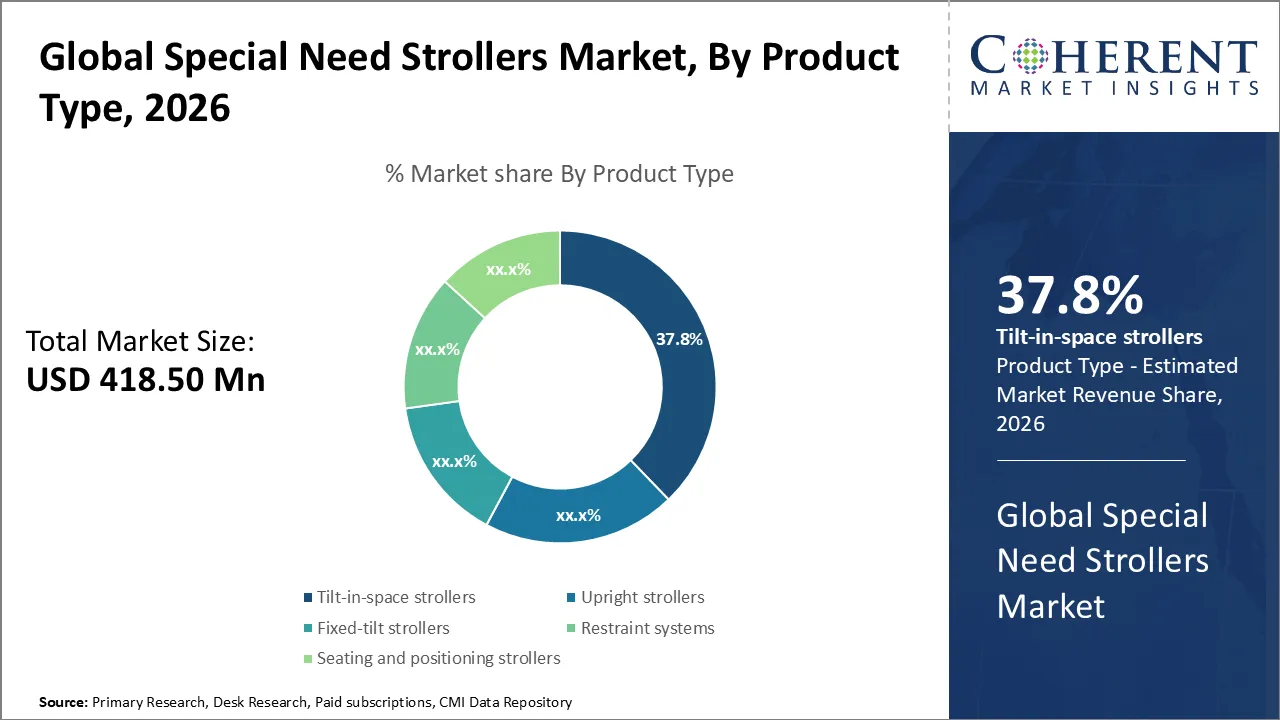
Special Need Strollers Market Insights, By Product Type: Tilt‑in‑Space Strollers Dominate Due To Superior Posture Support
In terms of product type, the tilt-in-space strollers segment is expected to lead the market with 37.8% share in 2026. Their ability to provide superior posture support, redistribute pressure, and accommodate children with severe mobility challenges makes them indispensable. Recommended by therapists and widely adopted by caregivers, they balance comfort, safety, and clinical effectiveness, driving strong demand.
Special Need Strollers Market Insights, By Technology: Manual Strollers Lead Is Driven by Affordability, Ease of Use, And Widespread Caregiver Adoption
In terms of technology, the manual strollers segment is expected to hold 62.4% share of the market in 2026. Their affordability, ease of use, and low maintenance requirements make them accessible across diverse income groups. Hospitals and rehabilitation centers prefer manual models for practicality, while caregivers value their lightweight design and reliability, ensuring widespread adoption compared to costly power strollers.
For instance, the Josi‑G2 is a manual special need stroller designed for children and adults with disabilities. Lightweight and versatile, it offers adjustable seating, posture support, and a secure harness. With accessories for cycling, jogging, hiking, and beach use, it promotes rehabilitation, comfort, and inclusive outdoor mobility for families and caregivers.
Special Need Strollers Market Insights, By Distribution Channel: E‑commerce Tops Fueled by Convenience, Variety, And Competitive Online Pricing
In terms of distribution channel, the E-commerce segment is projected to account for 47.6% share in 2026. Caregivers increasingly rely on online platforms for variety, competitive pricing, and convenience. Digital marketplaces offer broader product visibility, easy comparisons, and doorstep delivery, making them the preferred choice. Strong logistics and after-sales support further reinforce e-commerce’s leadership over hospitals and direct purchase channels.
For instance, in October 2025, Children with disabilities in Bradford County received adaptive bikes and strollers through Variety Children’s Charity and BLAST Intermediate Unit 17. These special need strollers enhance mobility, independence, and inclusion, offering families vital support. The initiative highlights growing demand for adaptive equipment and its positive impact on accessibility and everyday life.
Regional Insights
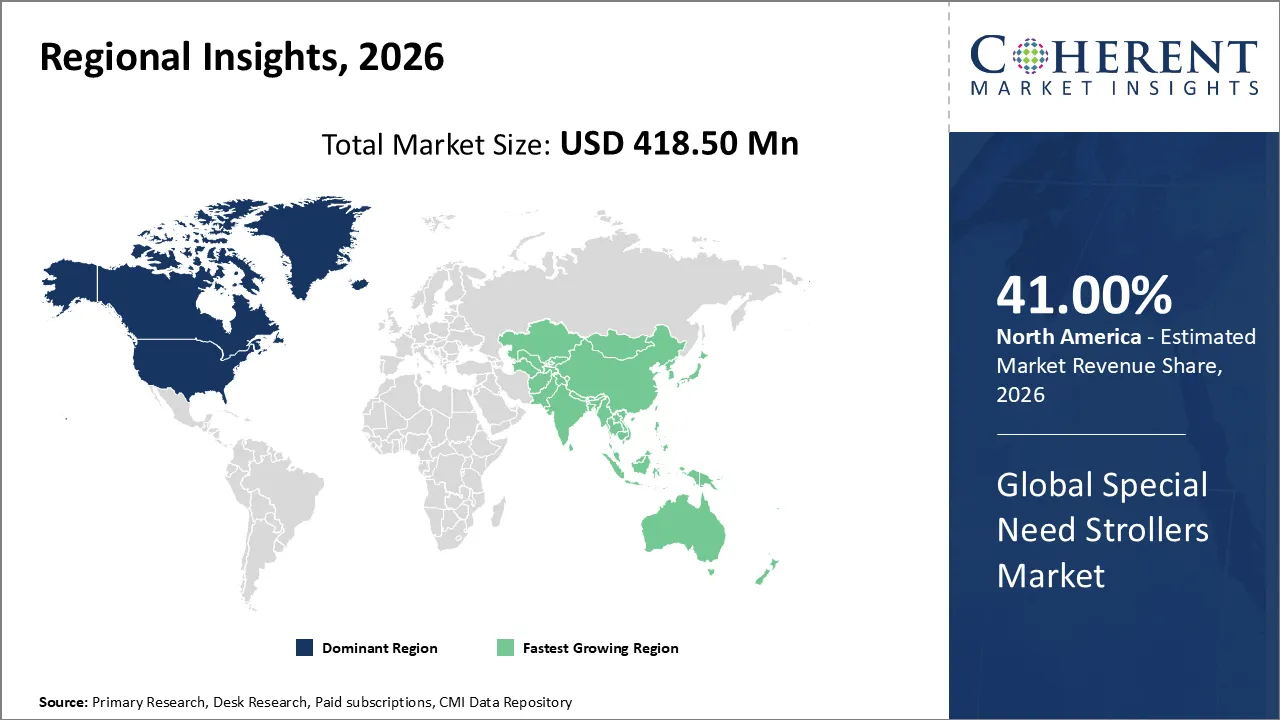
North America Special Need Strollers Market Analysis & Trends
North America expected to dominate the special need strollers market with 41% share in 2026 due to advanced healthcare infrastructure, high awareness among caregivers, and supportive reimbursement policies. Established manufacturers, clinical recommendations, and widespread adoption in hospitals and rehabilitation centers further boost market growth, making the region the dominant hub for adaptive mobility solutions.
Asia Pacific Special Need Strollers Market Analysis & Trends
Asia Pacific is anticipated to be the fastest growing region, due to increasing disability prevalence, expanding healthcare infrastructure, and growing middle-class affordability. Rapid e-commerce adoption enhances accessibility, while government initiatives in pediatric rehabilitation strengthen awareness. Urbanization and technological advancements further accelerate market growth, making the region the fastest-expanding globally.
Special Need Strollers Market Outlook Country-Wise
The U.S. Special Need Strollers Market Trends
High demand in the U.S. for special‑needs strollers in 2026 stems from rising awareness, technological advances, stronger clinical and charity funding, and expanding online retail and reimbursement pathways, boosting purchases for adaptive, all‑terrain, and medical‑grade models that improve mobility and inclusion for children with disabilities.
Japan Special Need Strollers Market Trends
Demand in Japan grows because of an aging population and higher disability prevalence, rapid technology adoption (smart, all‑terrain designs), expanding public and private funding, and increasing awareness and advocacy for inclusive mobility, making adaptive strollers more accessible and desirable for families and care institutions across urban and rural regions nationwide broadly.
Market Report Scope
Special Need Strollers Market Report Coverage
| Report Coverage | Details | ||
|---|---|---|---|
| Base Year: | 2025 | Market Size in 2026: | USD 418.50 Mn |
| Historical Data for: | 2020 To 2024 | Forecast Period: | 2026 To 2033 |
| Forecast Period 2026 to 2033 CAGR: | 6.5% | 2033 Value Projection: | USD 650.0 Mn |
| Geographies covered: |
| ||
| Segments covered: |
| ||
| Companies covered: | Sportstroller (iXROVER), R82, Leckey, Sunrise Medical, Ottobock, and Permobil | ||
| Growth Drivers: |
| ||
| Restraints & Challenges: |
| ||
Special Need Strollers Market Driver
Awareness & advocacy
Awareness and advocacy mobilize families, NGOs, and policymakers to prioritize inclusive mobility, increasing visibility for adaptive products and funding opportunities. Parent networks share experiences and success stories, prompting media coverage, charity drives, and policy attention that expand the special need strollers market share by attracting donors, retailers, and institutional buyers. Campaigns reduce stigma, normalize adaptive equipment, and encourage manufacturers to invest in accessible, evidence‑based designs. Community endorsements and social proof accelerate adoption, influence procurement decisions across healthcare and education sectors.
Clinical adoption & rehab referrals
Clinicians and rehabilitation specialists drive purchases by prescribing adaptive strollers for posture, mobility, and therapeutic goals, creating steady institutional referrals, evidence‑based use cases. Trials, case studies, and therapist endorsements validate safety and functional benefits, shaping payer policies and increasing special need strollers market demand among hospitals, schools, and families. Rehabilitation centers integrate strollers into care plans, generating repeat procurement and referrals. Training clinicians on fitting and outcomes strengthens confidence, aligns product development with therapeutic needs, and supports long‑term patient mobility.
Analyst Opinion (Expert Opinion)
The special need strollers market value is increasingly recognized as a vital segment within mobility aids, reflecting growing awareness of inclusive mobility for individuals with physical and developmental challenges. Demand is supported by a rising global prevalence of mobility impairments and advocacy for accessibility, which have highlighted the need for tailored solutions that combine comfort, safety, and maneuverability. According to recent industry insights, North America accounted for the largest portion of market activity, followed by Europe and the Asia-Pacific region, where urbanization and healthcare access are accelerating adoption of adaptive mobility products. Asia-Pacific, in particular, is emerging as a rapidly expanding region due to increasing awareness and rising disposable incomes.
Product segmentation shows a mix of manual and powered stroller designs. Manual strollers have maintained a significant share due to their relative affordability and ease of use, while electric or powered models are gaining traction thanks to enhancements in comfort and convenience for caregivers and users alike. Applications span everyday home use and rehabilitation centers, with adaptive strollers increasingly utilized in therapeutic settings to support mobility and posture management.
Innovations in adjustable seating systems, ergonomic support features, and materials are driving consumer preferences toward more customizable solutions. The combination of enhanced safety mechanisms, lightweight construction, and specialized support systems has broadened product appeal across diverse user groups, including children and adults requiring additional mobility assistance.
Speak to the analyst
Want personalized insights?
Take the findings above to one of our principal consultants, or have the report rebuilt around the segments, geographies and competitors you actually track.
Recent Developments
- In November 2025, the iXROVER All‑Terrain Special Needs Stroller is designed for children, teens, and adults with disabilities. Lightweight and durable, it offers adjustable seating, posture support, suspension, and drum brakes. Certified for safety, it enables inclusive outdoor activities like hiking, cycling, and travel, enhancing mobility, comfort, and independence for families.
Market Segmentation
- By Product Type
- Upright strollers
- Fixed-tilt strollers
- Tilt-in-space strollers
- Restraint systems
- Seating and positioning strollers
- By Technology Type
- Manual Strollers
- Power strollers
- By Distribution Channels
- Hospitals
- Ecommerce
- Direct Purchase
- By Region
- North America
- U.S.
- Canada
- Latin America
- Brazil
- Argentina
- Mexico
- Rest of Latin America
- Europe
- Germany
- U.K.
- Spain
- France
- Italy
- Russia
- Rest of Europe
- Asia Pacific
- China
- India
- Japan
- Australia
- South Korea
- ASEAN
- Rest of Asia Pacific
- Middle East & Africa
- GCC Countries
- Israel
- Rest of Middle East & Africa
- North America
- Special Need Strollers in the Market Companies
- Sportstroller (iXROVER)
- R82
- Leckey
- Sunrise Medical
- Ottobock
- Permobil
Sources
Primary Research Interviews
- Special Need Stroller Manufacturers
- Pediatric Mobility & Rehabilitation Equipment Manufacturers
- Medical Device Distributors & Importers
- Pediatric Therapists & Rehabilitation Specialists
- Assistive Mobility Product Designers & Engineers
- Special Education & Inclusive Care Consultants
- Others
Databases
- Bloomberg Terminal
- Factiva
- Others
Magazines
- Mobility Management Magazine
- Special Needs Living Magazine
- Rehab Management Magazine
- Medical Design & Outsourcing
- Parents & Caregivers Magazines (Disability-Focused)
- Others
Journals
- Journal of Pediatric Rehabilitation Medicine
- Disability and Rehabilitation Journal
- Assistive Technology Journal
- Journal of Medical Devices
- International Journal of Rehabilitation Research
- Others
Newspapers
- The New York Times
- The Guardian
- Financial Times
- Reuters
- Bloomberg News
- Others
Associations
- Rehabilitation Engineering and Assistive Technology Society of North America (RESNA)
- International Society for Prosthetics and Orthotics (ISPO)
- American Academy of Pediatrics (AAP)
- World Federation of Occupational Therapists (WFOT)
- National Disability & Caregiver Associations
- Others
Public Domain Sources
- World Health Organization (WHO) – Disability & Rehabilitation Programs
- U.S. Centers for Disease Control and Prevention (CDC)
- National Institutes of Health (NIH)
- European Commission – Health & Medical Devices Directorate
- World Bank – Disability & Inclusive Development Data
- Others
Proprietary Elements
- CMI Data Analytics Tool
- Proprietary CMI Existing Repository of Information for the Last 8 Years
Get access to 250+ pages report
Every segment, forecast, competitor profile and data table behind the analysis above — available for instant download.
- ESOMAR Member
- ISO 9001:2015 Certified
- D-U-N-S Registered
- GDPR & CCPA Compliant
Missing comfort of reading report in your local language? Find your preferred language:
Transform your Strategy with Exclusive Trending Reports
Frequently Asked Questions
The special need strollers market is estimated to be valued at USD 418.50 Mn in 2026, and is expected to reach USD 650.0 Mn by 2033.
The CAGR of the special need strollers market is projected to be 6.5% from 2026 to 2033.
Awareness & advocacy and clinical adoption and rehab referrals are expected to drive the market growth.
The is the leading cloudy lemonade by type segment in the market.
High unit cost are expected to hinder the global lemonade drinks market over the forecast period.
The major players operating in the market include Sportstroller (iXROVER), R82, Leckey, Sunrise Medical, Ottobock, and Permobil.