

GCC and Saudi Arabia Urology Stones Market Size and Forecast – 2026 To 2033
The GCC and Saudi Arabia Urology Stones Market is expected to grow from USD 156.0 Mn in 2026 to USD 252.7 Mn by 2033, registering a compound annual growth rate (CAGR) of 7.1% from 2026 to 2033. The market is experiencing significant growth, fueled by the soaring burden of kidney stone disease.
According to a study published by the National Library of Medicine in October 2019, Saudi’s population is 2.5 times more likely to develop urolithiasis, with an estimated prevalence of 9.1%, while recent studies indicate a prevalence ranging from 6.2% to 11.2%, driving sustained demand for advanced kidney stone diagnosis and minimally invasive treatment solutions.
Key Takeaways of the GCC and Saudi Arabia Urology Stones Market
- Kidney stones are projected to hold a market share of 74.6 % of the GCC and Saudi Arabia urology stones market share in 2026, making it the dominant stone type segment, owing to the high disease burden associated with dehydration, metabolic disorders, and hot climatic conditions. For instance, the Saudi Urological Association recommends performing metabolic evaluation and stone composition analysis for recurrent kidney stone formers to guide individualized prevention strategies, reflecting the continued clinical focus on renal stone management in Saudi Arabia.
- Small stones (<5 mm) is projected to hold a market share of 53.1 % of the GCC and Saudi Arabia urology stones market share in 2026, making it the dominant stone size segment, driven by the high spontaneous passage rate and preference for conservative management. For instance, the Saudi Council of Health Insurance (CHI) Clinical Indication Guidelines recommend conservative management with follow-up imaging and medical expulsive therapy for appropriately selected patients with small ureteric stones, supporting their predominant clinical management approach.
- Extracorporeal Shock Wave Lithotripsy (ESWL) are projected to hold a market share of 43.7 % of the GCC and Saudi Arabia urology stones market share in 2026, making it the dominant treatment type segment, owing to its non-invasive nature and widespread use for appropriately selected renal and ureteric calculi. For instance, the Saudi Urological Association recommends extracorporeal shock wave lithotripsy as a first-line treatment option for selected renal and proximal ureteric stones based on stone size, location, and anatomy, reinforcing its continued adoption across urology centers in Saudi Arabia.
- Growing Adoption of Laser Lithotripsy Procedures: The increasing preference for minimally invasive stone treatment is accelerating the adoption of laser lithotripsy, ureteroscopy devices, and optical fibers for laser lithotripsy across Saudi Arabia and the GCC. Rising investments in tertiary urology centers and advanced endourology equipment are expected to drive the demand for high-precision stone fragmentation technologies.
- Expansion of Kidney Stone Management Services: The growing burden of urolithiasis is increasing the utilization of kidney stone management devices, including extracorporeal shock wave lithotripsy (ESWL) devices, percutaneous nephrolithotomy (PCNL) devices, and stone retrieval devices across hospitals and specialty urology clinics in Saudi Arabia and the GCC. The expansion of specialized endourology services is further supporting procedural volumes and device adoption.
Segmental Insights
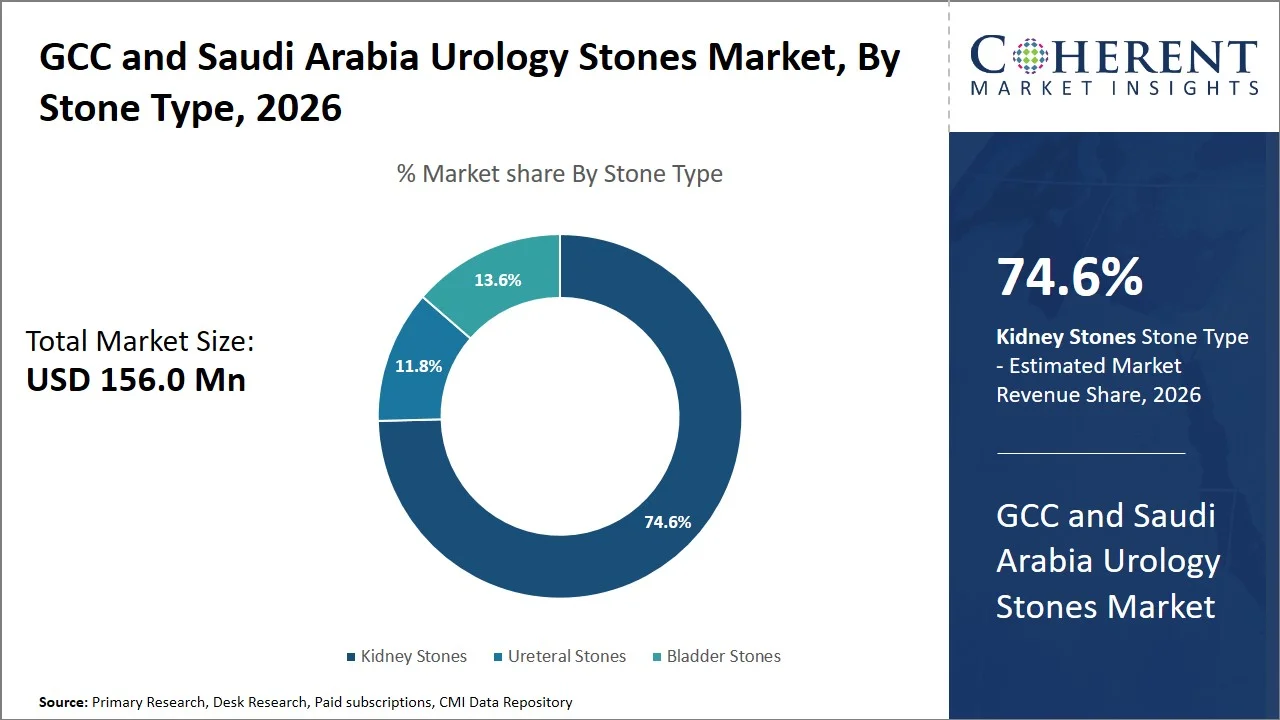
Why Do Kidney Stones Dominate the GCC and Saudi Arabia Urology Stones Market?
Kidney stones are projected to hold a market share of 74.6% in 2026, due to their high prevalence, rate of recurrence, and requirement of advanced diagnostic and minimally invasive treatment. Owing to prevalent hot climate conditions, dehydration and increasing occurrence of metabolic disorders, the prevalence of kidney stones will keep growing the demand for extracorporeal shock wave lithotripsy (ESWL), ureteroscopy, and percutaneous nephrolithotomy (PCNL) procedures in the coming years. For instance, in January 2024, a study published by the National Library of Medicine, indicated that around 85% of the renal stones in the Saudi Arabian populations were calcium oxalate stones, with a similar percentage in both males and females. This highlights the predominance of kidney stones and emphasizes the substantial clinical burden and sustained demand for specialized stone management across the Kingdom.
- Current Industry Events of 2026
- Market Size Estimation
- Regional Breakdown
- Competitive Landscape
- Customer Intelligence
- Segmental Analysis
- Pricing Analysis
- Key Market Drivers, Challenges & Future Trends
- Customized Insights Section
Why are Small Stones (<5 mm) the Most Preferred Stone Size in GCC and Saudi Arabia Urology Stones Market?
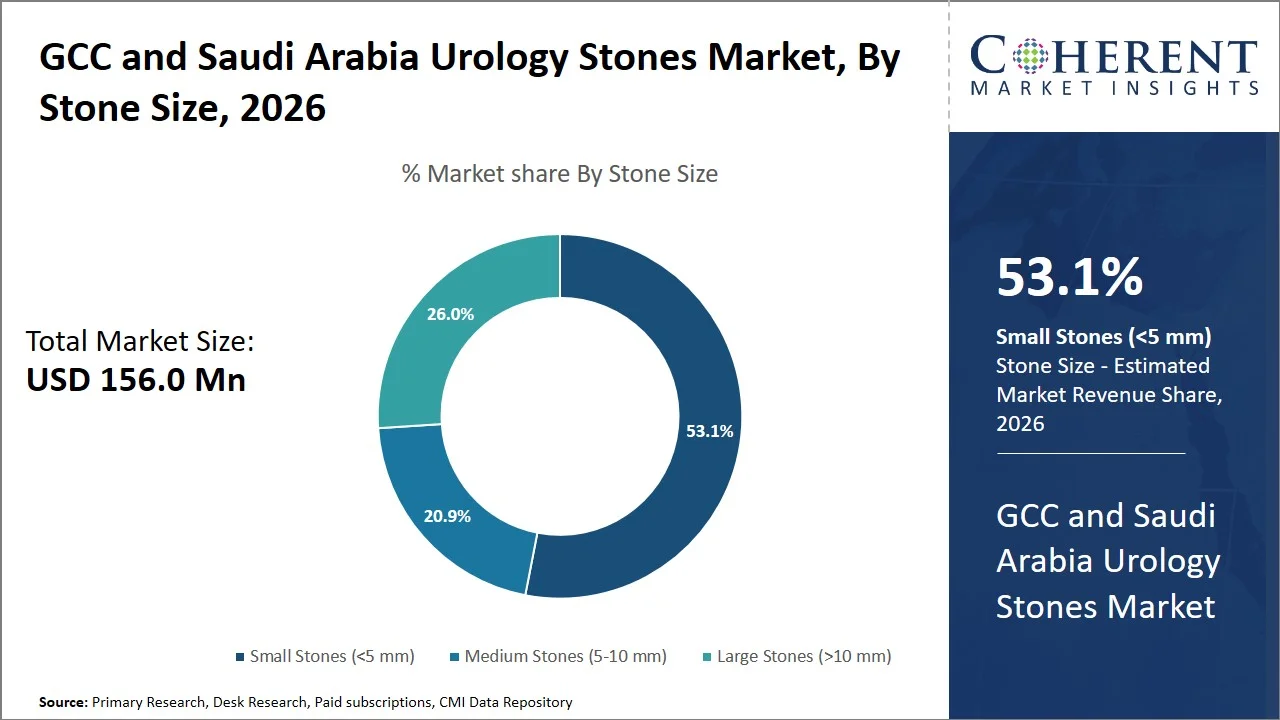
Small stones (<5 mm) is projected to hold a market share of 53.1% in 2026, due to their better visibility through common non-contrast CT scans and ultrasound, facilitating timely medical intervention to manage the condition before it progresses. Their favorable prognosis and tendency for spontaneous passage favor expectant management as first-line therapy, with extracorporeal shock wave lithotripsy (ESWL) and ureteroscopy being valuable as second-line options if necessary. For instance, the Saudi Urological Association Guidelines on Urolithiasis (January 2024) advises active surveillance as first line management of asymptomatic, non-obstructing renal stones and is accepting that small <5 mm stones are very likely to pass spontaneously, reinforcing the importance of early diagnosis and conservative management.
Extracorporeal Shock Wave Lithotripsy (ESWL) Dominates the GCC and Saudi Arabia Urology Stones Market
The Extracorporeal Shock Wave Lithotripsy (ESWL) segment is projected to hold a market share of 43.7% in 2026, due to their non-invasive nature, quicker recovery periods, and good success rates for managing simple renal and upper ureteric stones. Modernization in shock wave delivery, stones localization, and the integration of improved imaging devices, also contribute toward the growing use of extracorporeal shock wave lithotripsy (ESWL) across hospital facilities and specialty urology centers. For instance, Dornier MedTech provides Dornier DELTA III lithotripter, an ESWL system, that features the Dornier MedTech EM shock wave generator and high-accuracy imaging - dual fluoroscopic and ultrasound imaging - for precise stone localization and rapid non-invasive treatment of kidney stones and ureteral stones to increase the utilization of advanced ESWL systems.
Currents Events and their Impact
Current Events | Description and its Impact |
Saudi Food and Drug Authority (SFDA) Strengthens Regulation of Medical Device Clinical Studies (July 2025) |
|
Saudi Council of Health Insurance (CHI) Updates Clinical Indication Guideline for Renal and Ureteric Stones (June 2024) |
|
GCC and Saudi Arabia Urology Stones Market Dynamics
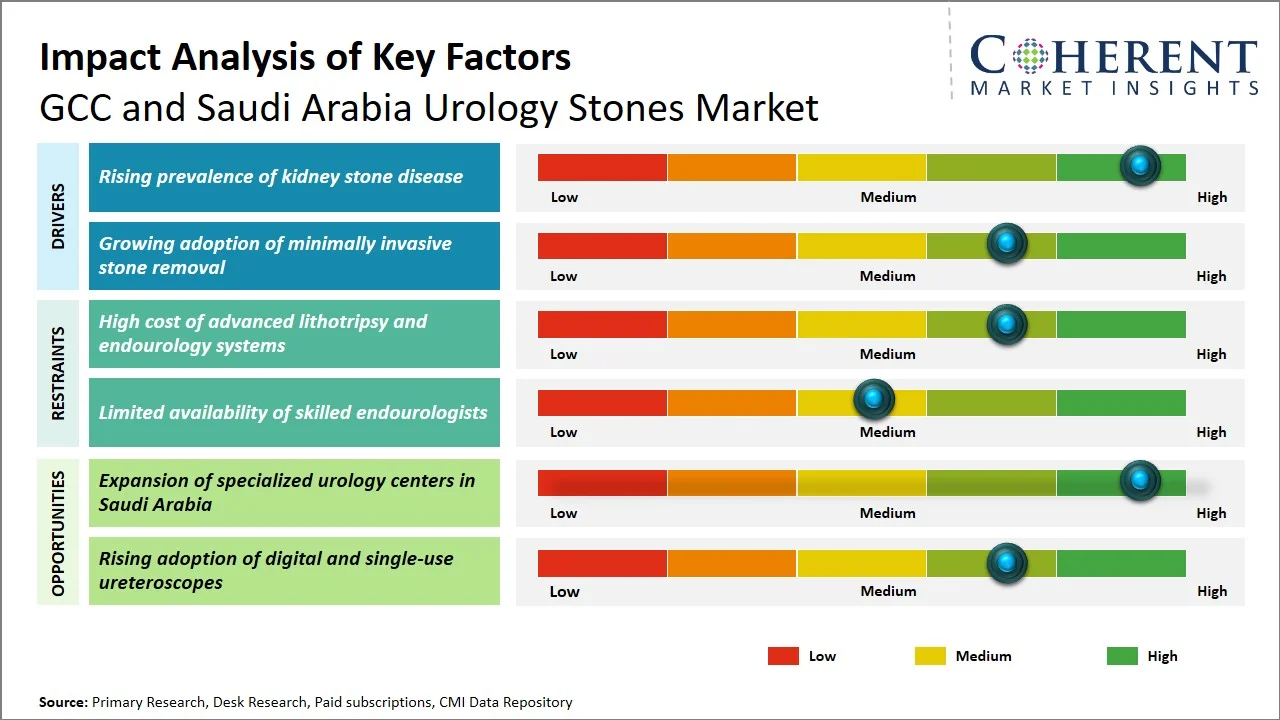
Market Drivers
- Rising prevalence of kidney stone disease: The significant burden of kidney stone disease, fueled by chronic dehydration, metabolic disorders, and the GCC's hot climate, continues to drive demand for advanced stone management technologies. Rising procedural volumes are accelerating the adoption of minimally invasive treatments such as extracorporeal shock wave lithotripsy (ESWL), ureteroscopy, and percutaneous nephrolithotomy (PCNL) across tertiary care hospitals. For instance, a study published in Urology Annals by researchers from Johns Hopkins Aramco Healthcare reported that the highest number of urinary stone cases in Eastern Saudi Arabia occurred during the hot season (May–September), highlighting the impact of climatic conditions on kidney stone incidence.
- Growing adoption of minimally invasive stone removal: The widespread adoption of extracorporeal shock wave lithotripsy (ESWL), ureteroscopy (URS), and percutaneous nephrolithotomy (PCNL) is transforming kidney stone management across the GCC and Saudi Arabia by reducing hospital stays, postoperative complications, and recovery time. Rising investments in advanced endourology services are further accelerating the shift away from conventional open surgery. For instance, in April 2024, a multicenter study published by National Library of Medicine involving 11 hospitals across Saudi Arabia reported that upper urinary tract stones accounted for nearly 57% of all urological surgical procedures, highlighting the growing reliance on minimally invasive stone removal techniques in routine clinical practice.
Emerging Trends
- Growing Adoption of Disposable Ureteroscopes: Healthcare providers across the GCC and Saudi Arabia are increasingly using single-use flexible ureteroscopes to reduce cross-contamination risks, cut reprocessing costs, and improve procedural efficiency. The trend is particularly gaining traction in tertiary hospitals and ambulatory surgical centers, where infection prevention and workflow optimization are becoming key procurement priorities.
- Increasing Integration of Digital Imaging and AI-Assisted Stone Assessment: Hospitals are increasingly using artificial intelligence (AI)-enabled imaging software with CT and ultrasound systems to improve kidney stone detection, stone characterization, and preoperative treatment planning. These technologies support faster clinical decision-making, optimize procedure selection, and enhance personalized management of complex urolithiasis cases.
Clinical Applications and Preferred Treatment Modalities in the GCC and Saudi Arabia Urology Stones Market
Clinical Application | Common Stone Characteristics | Preferred Treatment Modality | Key Growth Driver |
Small Renal Stones | <10 mm, non-obstructive | Extracorporeal Shock Wave Lithotripsy (ESWL) | High outpatient adoption and non-invasive treatment preference |
Large Kidney Stones | >20 mm or complex calculi | Percutaneous Nephrolithotomy (PCNL) | Increasing incidence of complex stone disease |
Ureteral Stones | Mid & distal ureter | Ureteroscopy (URS) with laser lithotripsy | Higher stone-free rates and minimally invasive approach |
Recurrent Stone Disease | Multiple/recurrent calculi | Metabolic evaluation + endourological intervention | Rising recurrence rates and preventive management |
Emergency Obstructive Stones | Infection/obstruction | Urgent ureteral stenting or nephrostomy followed by definitive treatment | Increasing emergency urology admissions |
How is the expansion of specialized urology centers in Saudi Arabia creating new growth opportunities in the GCC and Saudi Arabia urology stones market?
As sophisticated urology care develops, especially among hospitals in tertiary locations, minimally invasive care of stone disorders becomes more accessible for the urology stones market in Saudi Arabia and GCC. Such initiatives often include significant investment by hospitals on infrastructure that facilitates endourology, as well as on stone treatment devices that are based on technology such as laser technology, shock wave lithotripsy technology to manage the growing burden of urolithiasis. For instance, the Department of Urology at King Faisal Specialist Hospital & Research Centre offers state-of-the-art endourology services for the management of urinary stone disease and comprises all important lasers and state-of-the-art extracorporeal shock wave lithotripsy (ESWL) equipment. This capability reinforces specialty stone management capacity in Saudi Arabia.
Market Players, Key Development, and Competitive Landscape
Key Developments
- In May 2026, BD launched the Elyra Thulium Fiber Laser (TFL) System for kidney stone care, introducing Elyra and Elyra Plus configurations to enhance lithotripsy procedures. The system is designed to deliver efficient stone fragmentation, reduced retropulsion, and improved surgical precision during minimally invasive urological interventions. The launch reinforces the growing adoption of advanced laser technologies for kidney stone management across global healthcare markets.
- In April 2026, Calyxo raised USD 40 million in funding to advance its CVAC System for kidney stone clearance. The investment will support the generation of additional clinical and economic evidence and accelerate commercialization of the technology designed to improve stone fragment evacuation during ureteroscopic procedures. The funding reflects growing industry investment in next-generation kidney stone management technologies.
- In July 2024, Johns Hopkins Aramco Healthcare (JHAH) successfully performed Saudi Arabia's first robotic pyelolithotomy for the removal of a large kidney stone from an abnormally positioned kidney. The procedure demonstrated the growing adoption of robotic-assisted urological surgery for complex stone cases where conventional treatments such as ureteroscopy or extracorporeal shock wave lithotripsy (ESWL) may be unsuitable. The milestone highlights the increasing availability of advanced minimally invasive stone management technologies in Saudi Arabia.
Competitive Landscape
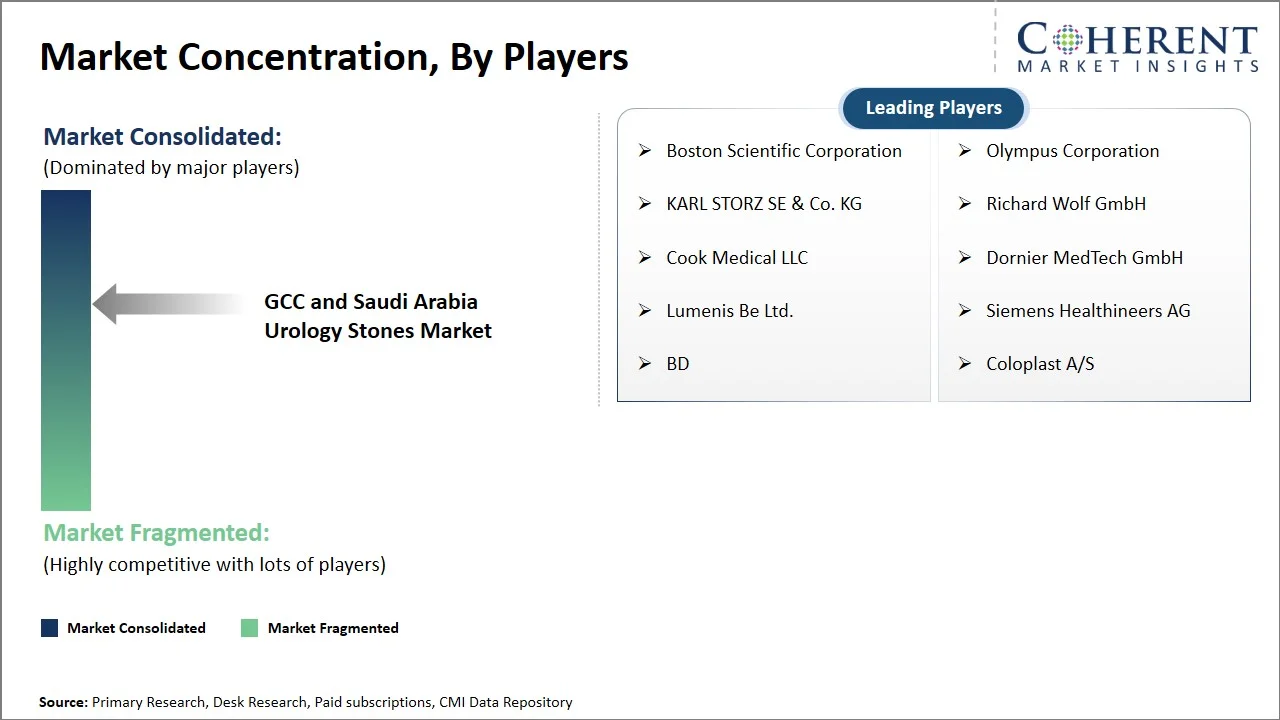
The GCC and Saudi Arabia urology stones market is moderately competitive, with global and regional medical device manufacturers competing through technologically advanced stone management solutions and strong distribution partnerships. Companies are strengthening their presence by expanding laser lithotripsy, ureteroscopy, and extracorporeal shock wave lithotripsy (ESWL) portfolios while collaborating with hospitals and specialty urology centers to improve procedural access. Continuous investments in physician training, minimally invasive endourology technologies, and after-sales technical support are further shaping market competition. Key focus areas include:
- Expansion of laser lithotripsy, ureteroscopy, and Extracorporeal Shock Wave Lithotripsy (ESWL) product portfolios
- Strategic collaborations with hospitals, specialty urology centers, and regional distributors to strengthen market presence
- Investment in physician training, endourology education, and minimally invasive kidney stone management technologies
Market Report Scope
GCC and Saudi Arabia Urology Stones Market Report Coverage
| Report Coverage | Details | ||
|---|---|---|---|
| Base Year: | 2025 | Market Size in 2026: | USD 156.0 Mn |
| Historical Data for: | 2020 To 2024 | Forecast Period: | 2026 To 2033 |
| Forecast Period 2026 to 2033 CAGR: | 7.1% | 2033 Value Projection: | USD 252.7 Mn |
| Geographies covered: |
| ||
| Segments covered: |
| ||
| Companies covered: | Boston Scientific Corporation, Olympus Corporation, KARL STORZ SE & Co. KG, Richard Wolf GmbH, Cook Medical LLC, Dornier MedTech GmbH, Lumenis Be Ltd., Siemens Healthineers AG, BD, and Coloplast A/S | ||
| Growth Drivers: |
| ||
| Restraints & Challenges: |
| ||
Analyst Opinion (Expert Opinion)
- In the coming years, the GCC and Saudi Arabia urology stones market is expected to witness sustained growth driven by the increasing burden of urolithiasis, expansion of minimally invasive endourology procedures, and continued investments in healthcare infrastructure under initiatives such as Saudi Vision 2030. The market is likely to shift toward advanced laser lithotripsy systems, digital ureteroscopes, and outpatient stone management solutions as hospitals prioritize improved clinical outcomes and shorter recovery times.
- The most promising opportunity are expected within kidney stone management through extracorporeal shock wave lithotripsy (ESWL), flexible ureteroscopy (fURS), and laser lithotripsy in Saudi Arabia, where the high prevalence of kidney stones, expanding tertiary care hospitals, and increasing adoption of advanced endourology technologies are driving procedural volumes. The UAE also presents attractive opportunities owing to its well-established medical tourism ecosystem and growing investment in specialized urology services.
- In order to gain an edge, market players should focus on expanding partnerships with leading tertiary hospitals and specialty urology centers, strengthen regional distribution and service networks, and provide physician training on next-generation stone management technologies. Companies investing in Thulium Fiber Laser (TFL) platforms, single-use ureteroscopes, AI-enabled imaging integration, and localized technical support will be well positioned to capitalize on the region's growing demand for minimally invasive kidney stone treatment.
Speak to the analyst
Want personalized insights?
Take the findings above to one of our principal consultants, or have the report rebuilt around the segments, geographies and competitors you actually track.
Market Segmentation
- Stone Type Insights (Revenue, USD Mn, 2021 - 2033)
- Kidney Stones
- Ureteral Stones
- Bladder Stones
- Stone Size Insights (Revenue, USD Mn, 2021 - 2033)
- Small Stones (<5 mm)
- Medium Stones (5-10 mm)
- Large Stones (>10 mm)
- Treatment Type Insights (Revenue, USD Mn, 2021 - 2033)
- Extracorporeal Shock Wave Lithotripsy (ESWL)
- Intracorpeal Lithotripsy Devices
- Ureteroscopy
- Percutaneous Nephrolithotomy (PCNL)
- Retrograde Endourological Procedure (RIRS)
- Laparoscopic Surgery
- Transurethral resection of the prostate (TURP)
- Others
- End User Insights (Revenue, USD Mn, 2021 - 2033)
- Hospitals and Clinics
- Ambulatory Surgery Centers
- Kidney Care Centers
- Others
- Country Insights (Revenue, USD Mn, 2021 - 2033)
- UAE
- Saudi Arabia
- Bahrain
- Kuwait
- Oman
- Qatar
- Key Players Insights
- Boston Scientific Corporation
- Olympus Corporation
- KARL STORZ SE & Co. KG
- Richard Wolf GmbH
- Cook Medical LLC
- Dornier MedTech GmbH
- Lumenis Be Ltd.
- Siemens Healthineers AG
- BD
- Coloplast A/S
Sources
Primary Research Interviews
- Head of Urology / Endourology (Saudi tertiary care hospital)
- Consultant Urologist specializing in kidney stone disease (GCC multispecialty hospital)
- Director of Urology Services (Government hospital, Saudi Arabia)
- Procurement Head (Government & private hospitals in Saudi Arabia)
- Clinical Application Specialist (Laser lithotripsy & endourology devices)
- Regional Sales Director (Urology stone management device manufacturer – GCC)
Stakeholders
- Urology Stone Device Manufacturers (Global OEMs & regional offices)
- Medical Device Distributors (Saudi Arabia & GCC)
- Hospitals & Specialty Urology Centers
- Ambulatory Surgery Centers (ASCs)
- Diagnostic & Imaging Centers
- Hospital Procurement & Group Purchasing Organizations (GPOs)
- End-use Sectors
- Government Hospitals
- Private Multi-specialty Hospitals
- Specialty Urology & Endourology Centers
- Ambulatory Surgery Centers (ASCs)
- Academic Medical Centers & Research Institutes
- Regulatory & Health Bodies
- Saudi Food and Drug Authority (SFDA), Saudi Arabia
- Ministry of Health (MOH), Saudi Arabia
- Gulf Health Council (GHC)
- Dubai Health Authority (DHA), UAE
- Department of Health – Abu Dhabi (DoH), UAE
- Ministry of Health and Prevention (MOHAP), UAE
- Qatar Ministry of Public Health (MOPH)
- Oman Ministry of Health
- Bahrain National Health Regulatory Authority (NHRA)
Databases
- Saudi Food and Drug Authority (SFDA) – Medical Device Database
- Ministry of Health (Saudi Arabia) – Health Statistical Yearbook
- Gulf Health Council – Regional Health Statistics
- World Health Organization (WHO) Global Health Observatory
- Institute for Health Metrics and Evaluation (IHME)
- World Bank Health Indicators
Magazines
- Urology Times
- Medical Device Network
- MedTech Dive
- Gulf Medical Journal
Journals
- Journal of Endourology
- European Urology
- BJU International (BJUI)
- World Journal of Urology
- Urolithiasis
Newspapers
- Arab News (Saudi healthcare & Vision 2030 updates)
- Saudi Gazette (Healthcare policy & hospital infrastructure)
- Gulf News (GCC healthcare & medical technology)
- Zawya (GCC healthcare investments & medtech)
- The National (UAE healthcare coverage)
Associations
- Saudi Urological Association (SUA)
- Emirates Urological Society (EUS)
- Gulf Health Council (GHC)
- European Association of Urology (EAU)
- American Urological Association (AUA)
Public Domain Sources
- Saudi Ministry of Health Statistical Yearbooks
- Saudi Food and Drug Authority (SFDA) Medical Device Database
- Gulf Health Council Reports
- World Health Organization (WHO)
- Institute for Health Metrics and Evaluation (IHME)
- World Bank Health Indicators
Proprietary Elements
- CMI Data Analytics Tool, Proprietary CMI Existing Repository of information for last 10 years.
Get access to 250+ pages report
Every segment, forecast, competitor profile and data table behind the analysis above — available for instant download.
- ESOMAR Member
- ISO 9001:2015 Certified
- D-U-N-S Registered
- GDPR & CCPA Compliant
Missing comfort of reading report in your local language? Find your preferred language:
Transform your Strategy with Exclusive Trending Reports
Frequently Asked Questions
The GCC and Saudi Arabia urology stones market is estimated to be valued at USD 156.0 Mn in 2026 and is expected to reach USD 252.7 Mn by 2033.
Kidney stones dominate due to their high prevalence in the region, driven by hot climatic conditions, dehydration, dietary habits, and the rising incidence of obesity and diabetes.
Urology stones are hard crystalline mineral deposits that form anywhere in the urinary tract, including the kidneys, ureters, bladder, and urethra.
The CAGR of the GCC and Saudi Arabia urology stones market is projected to be 7.1% from 2026 to 2033.
Laser lithotripsy offers high stone fragmentation efficiency, greater precision, and faster patient recovery compared to conventional treatment methods.
Percutaneous nephrolithotomy (PCNL) is typically recommended for large (>20 mm), complex, or multiple kidney stones that cannot be effectively treated using extracorporeal shock wave lithotripsy (ESWL) or ureteroscopy.
Rising prevalence of kidney stone disease, and growing adoption of minimally invasive stone removal are the major factors driving the growth of the GCC and Saudi Arabia urology stones market.