

Global Generative Engine Optimization (GEO) Platform Market Size and Forecast – 2026 To 2033
The global generative engine optimization (GEO) platform market is expected to grow from USD 2.70 Bn in 2026 to USD 26.85 Bn by 2033, registering a compound annual growth rate (CAGR) of 13.6% from 2026 to 2033. The global generative engine optimization (GEO) platform market is driven by rising demand for AI citation visibility. On May 22, 2026, NeuroRank, the AI visibility intelligence platform from Pulp Strategy Communications, opened to the public as a SaaS platform, making continuous, governed AI visibility available to brands through its Model Preference Engineering subscription.
Key Takeaways of the Global Generative Engine Optimization (GEO) Platform Market
- The GEO Software Platforms segment is expected to account for 47.0 % of the global generative engine optimization (GEO) platform market share in 2026. Increasing integration between GEO and traditional search engine optimization is driving the growth of the segment. On June 10, 2026, Conductor and Optimizely launched an integrated AEO platform. The platform integrates Conductor’s search engine optimization, GEO and AEO intelligence with Optimizely’s digital experience environment.
- The Cloud segment is estimated to capture 67.0 % of the market share in 2026. Growing demand for automated content optimization is majorly driving the growth of the segment. On July 22, 2025, Altezza launched its Service as Software platform. The platform automates sitemap administration, internal linking, structured data deployment, and AI-ready content optimization for enterprise ecommerce websites.
- The AI Visibility Monitoring segment is estimated to capture 35.0 % of the market share in 2026. Growing enterprise investment in AI search optimization is driving the growth of the segment. On July 22, 2026, Pepper released its GEO platform for enterprise marketers leveraging ChatGPT and Perplexity.
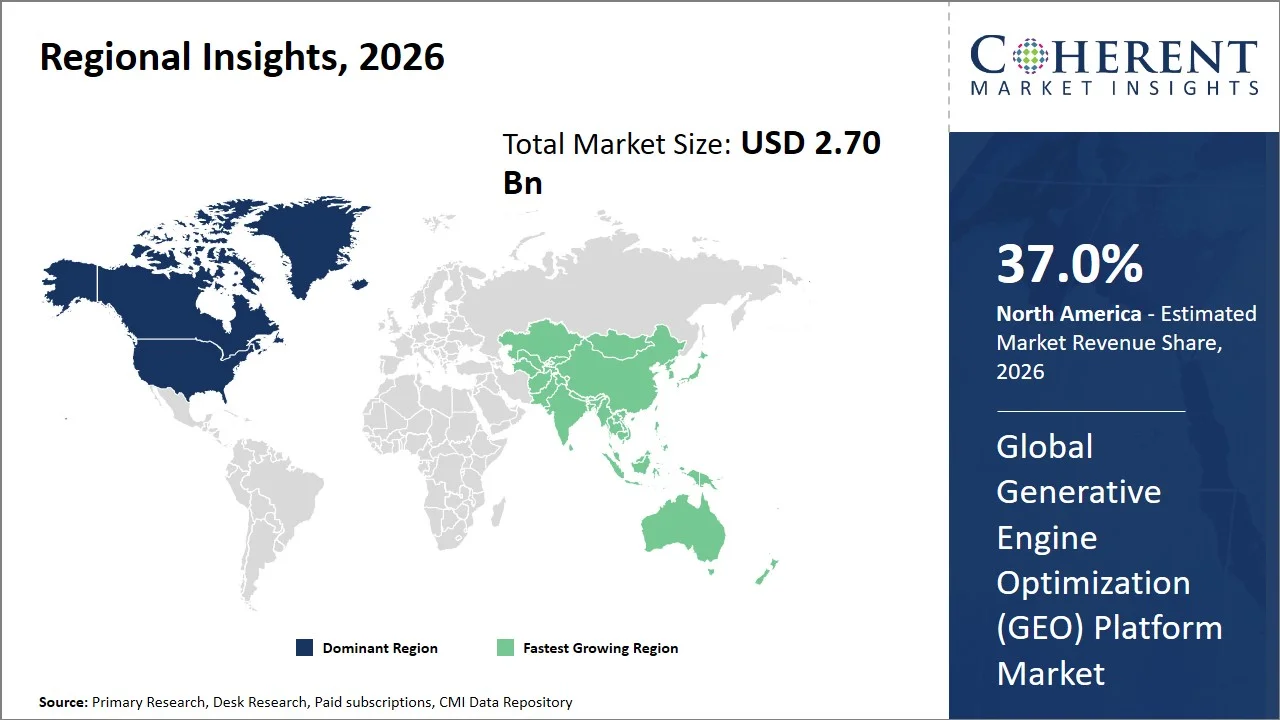
- North America is expected to dominate the generative engine optimization (GEO) platform market in 2026 with a market share of 37.0 %. Increasing GEO integration with customer relationship management platforms in North America is driving the growth of the regional market. On July 30, 2026, HubSpot launched its AEO capabilities as part of its CRM ecosystem.
- Asia Pacific is expected to account for 24.0 % share in 2026. Growing adoption of industry-specific GEO solutions in Asia Pacific is driving the growth of the regional market. On November 17, 2025, Amazon India and Flipkart started an experiment for large language model chatbots to optimize product listings. The initiative targets product discovery inside conversational shopping environments.
Segmental Insights
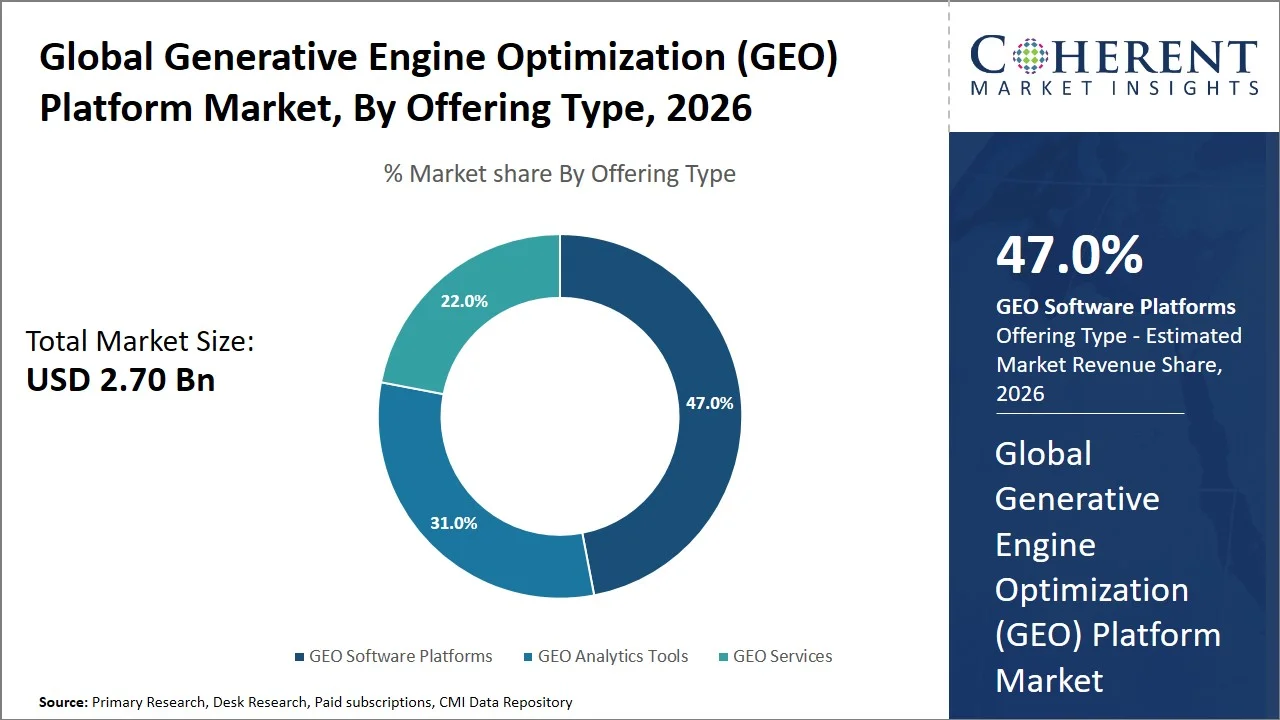
Why Does GEO Software Platforms Dominate the Global Generative Engine Optimization (GEO) Platform Market?
The GEO software platforms segment is expected to account for 47.0% of the global generative engine optimization (GEO) platform market share in 2026. GEO software platforms provide automated monitoring of brand visibility across multiple generative artificial intelligence platforms. They provide ongoing tracking of citations, mentions, rankings and content performance. The technology creates useful data to help businesses find gaps in exposure and optimize digital content. Scalable software solutions also minimize dependency on manual optimization methods and specialist consultancy services. These capabilities enable speedier decisions and drive more adoption among organizations looking for measurable generative search performance. On August 17, 2026, Botric developed a full-stack GEO platform covering ChatGPT, Gemini, Perplexity, Claude, Google AI Overviews, and Google AI Mode. Its capabilities combine prompt tracking, citation analysis, website audits, and content generation.
- Current Industry Events of 2026
- Market Size Estimation
- Regional Breakdown
- Competitive Landscape
- Customer Intelligence
- Segmental Analysis
- Pricing Analysis
- Key Market Drivers, Challenges & Future Trends
- Customized Insights Section
Why is Cloud the Most Preferred Deployment Type?
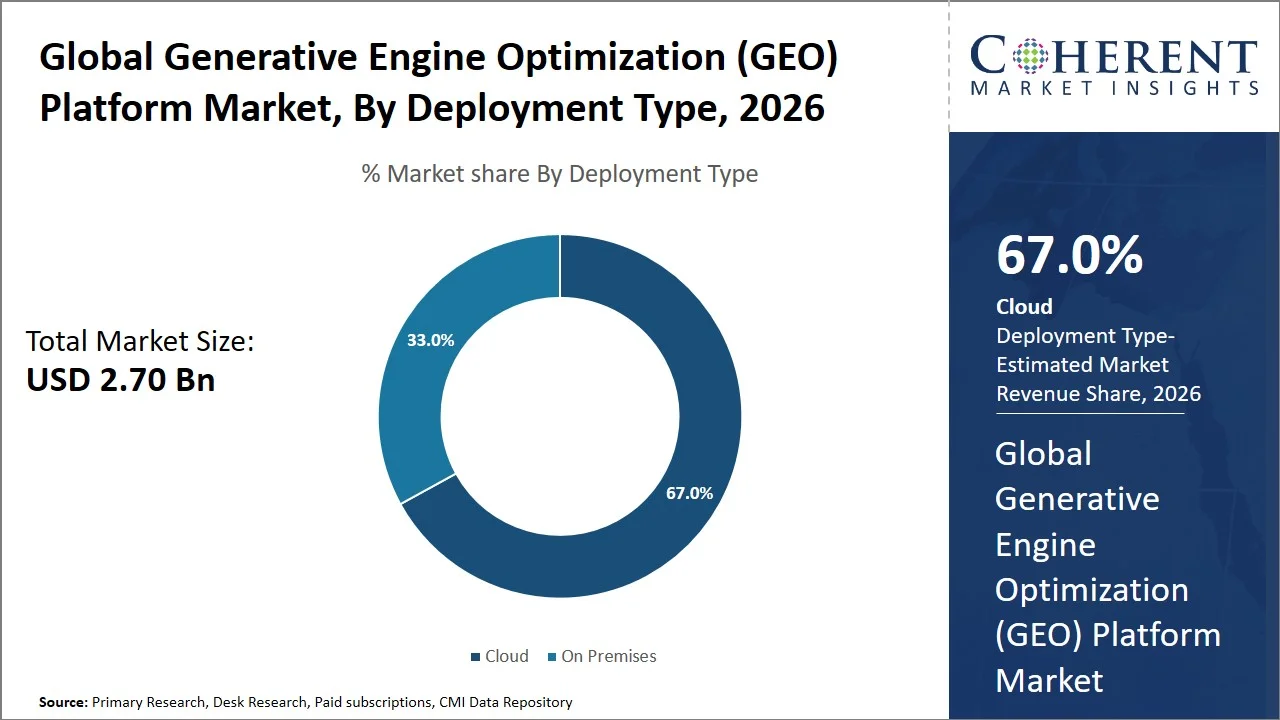
The cloud segment is expected to account for 67.0% of the global generative engine optimization (GEO) platform market share in 2026. The cloud provides a scalable infrastructure to continually handle massive volumes of generative search data. It allows companies to use GEO tools without having to have a lot of hardware on-site. Cloud systems can enable quicker software updates as generative artificial intelligence technologies evolve. And organizations can more easily link cloud-based GEO solutions with their existing marketing and analytics tools. The lower infrastructure requirements make cloud deployment particularly suitable for companies who want to use flexible GEO. In July 2025, Peec AI secured USD 8.2 million to scale its cloud-based GEO visibility technology. Its product offers dashboards, automatic reporting and AI citation tracking for enterprises without the need for on-prem implementation.
AI Visibility Monitoring Dominates the Global Generative Engine Optimization (GEO) Platform Market
The AI visibility monitoring segment is expected to account for 35.0% of the global generative engine optimization (GEO) platform market share in 2026. AI visibility tracking allows companies to track brand mentions across a range of generative AI platforms. It measures how often brands appear in artificial intelligence-generated responses. The tools also identify citation sources, mentions of competitors and changes in brand representation. This ongoing surveillance enables marketing teams to spot visibility holes and adapt content tactics in response. This is thus driving the development of visibility monitoring solutions as the demand for demonstrable AI search performance is growing. On July 16, 2025, Wix announced the launch of its AI Visibility Overview Solution to Position Brands for Discoverability in the Emerging Era of Large Language Models (LLM). It’s a piece of the larger Wix project, Generative Engine Optimization (GEO), that helps consumers understand, monitor, and proactively enhance the way their brand shows in LLM-based search engines.
Current Events and their Impact
Current Events | Description and its Impact |
European Union Artificial Intelligence Act |
|
China Measures for Labeling Artificial Intelligence Generated Synthetic Content |
|
Generative Engine Optimization (GEO) Platform Market Dynamics
Market Drivers
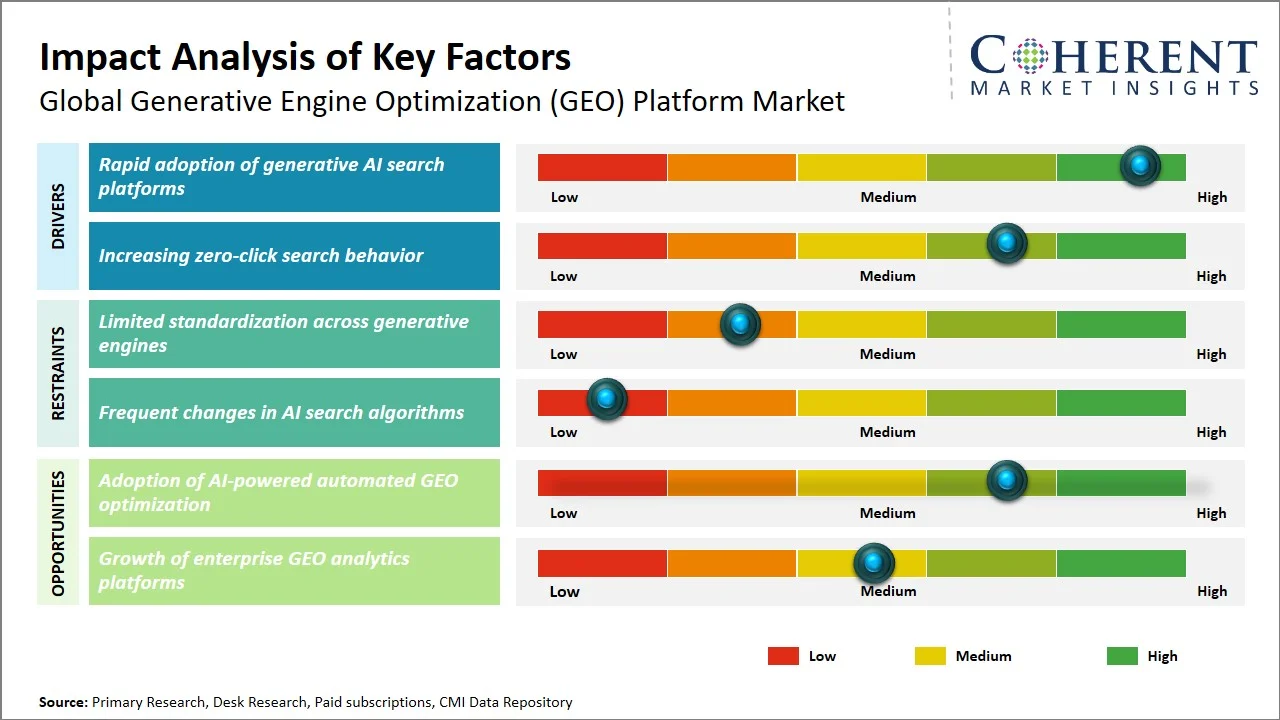
- Rapid adoption of generative AI search platforms: Generative AI search platforms are quickly becoming major discovery channels for organizations and consumers. Platforms like ChatGPT, Google Gemini, and Microsoft Copilot offer conversational responses instead of conventional search results. This change is driving the need for GEO solutions to track brand presence in generated responses. Businesses are optimizing content for artificial intelligence systems to get more citations, mentions and recommendations. On October 31, 2024, OpenAI released its new search feature, allowing free, plus, and team users to search the web live. This pivot turned the AI into a direct rival of existing search engines for locating web pages, news and products.
- Increasing zero-click search behavior: Zero-click searches deliver answers right in search interfaces, without the need to visit websites. Generative artificial intelligence platforms are advancing this habit with synthesis responses, summaries and direct recommendations. Brands need to adopt GEO tactics more than ever to make sure they are there in front of users who do not browse standard search results. This development is driving need for solutions measuring citations, mentions and brand presence across artificial intelligence answers. For instance, in their updated analysis for 2026, Ahrefs said AI Overviews led to a 58% decrease in clicks to top-ranking material. This implies heavier consumption of answers without the classic organic-result visits.
Emerging Trends
- Real-Time AI Visibility Monitoring: GEO platforms are incorporating more real-time monitoring features to track brand mentions, citations, rankings, and sentiment across generative search engines. This enables businesses to observe changes in visibility quickly and adapt content strategies to shifting AI response patterns.
- Integration With Traditional Search Engine Optimization: GEO platforms are increasingly incorporating generative search optimization into traditional search engine optimization workflows, enabling businesses to manage traditional rankings, artificial intelligence citations, content performance and keyword visibility through consolidated digital marketing environments and analytics dashboards.
- Automated Content Optimization Using Artificial Intelligence: Advanced GEO platforms are increasingly utilizing artificial intelligence to evaluate content quality, identify optimization gaps, recommend improvements and simulate generated responses to assist marketing teams in enhancing their brand presence across multiple generative artificial intelligence platforms with less manual intervention.
- Expansion Across Enterprise Marketing Technology Ecosystems: GEO platforms are being more frequently integrated with customer relationship management, content management, marketing automation, and analytics systems to enable enterprises to link artificial intelligence search visibility with broader marketing metrics for performance and develop coordinated optimization strategies across digital channels.
Regional Insights
Why is North America a Strong Market for Generative Engine Optimization (GEO) Platform?
North America is expected to account for a market share of 37.0% in 2026. North America enjoys the benefits of early adoption of artificial intelligence search by enterprises and a mature digital marketing infrastructure. In 2025, Google announced over 1.5 billion users worldwide of AI Overviews. Google AI Mode will initially be released in the US. Brands have been spurred by early adoption to monitor citations across ChatGPT, Gemini and Perplexity. Retailers are experimenting with conversational shopping and that’s also helping drive GEO demand. Walmart partnered with OpenAI for purchases within ChatGPT. Reddit citation volatility further demonstrates the need for continuous visibility monitoring. These developments are encouraging North American enterprises to treat GEO as an ongoing marketing capability.
Why Does Asia Pacific Generative Engine Optimization (GEO) Platform Market Exhibit High Growth?
Asia Pacific is expected to register the fastest growth with a CAGR of 15.3% over the forecast period. Asia Pacific is projected to account for 24.0% of the global generative engine optimization (GEO) platform market in 2026. Asia Pacific is developing a diverse GEO environment because regional markets use different artificial intelligence ecosystems and languages. China has domestic platforms including Baidu Ernie and rapidly advancing systems from Z.AI and DeepSeek. Japan and India have received localized Google AI Overviews with language support. Google reported more than 10% higher usage for qualifying AI Overview queries in India and the U.S. Regional marketers therefore need language-specific optimization across different artificial intelligence models. This fragmentation creates demand for platforms capable of comparing citations, visibility, and content performance across multiple regional engines.
Global Generative Engine Optimization (GEO) Platform Market Outlook for Key Countries
Why is U.S. Emerging as a Major Hub in the Generative Engine Optimization (GEO) Platform Market?
The U.S. has a particularly advanced GEO ecosystem as major generative search developers and marketing technology companies operate domestically Google has launched AI Mode nationally after testing it on longer and more complicated inquiries. Early users asked queries two to three times longer than traditional searches. OpenAI has also expanded ChatGPT into commercial discovery through its Walmart partnership. Adobe reported merchant traffic from chatbots and AI search engines might explode. These trends are redirecting the focus of optimization to product information, structured content, citations, and recommendations visibility. As a result, U.S. firms are creating GEO capabilities alongside their existing search engine optimization strategies.
Is China the Next Growth Engine for the Generative Engine Optimization (GEO) Platform Market?
China has a unique GEO environment with native artificial intelligence systems as well as stringent legislative and linguistic restrictions. Baidu is continuing to develop Ernie, while making artificial intelligence a major business objective. Alibaba and Tencent are also pouring money into rival artificial intelligence technologies. DeepSeek has intensified the competitive demand on cost-efficient model development and open-source alternatives. Therefore, Chinese firms need GEO strategies that are for indigenous models, and not just based on western platforms. In the second quarter of 2026, Baidu’s AI-driven core business grew 25% year-on-year. This growing ecosystem of industrial AI is driving a need for specialized GEO monitoring and optimization for Chinese.
U.K. Generative Engine Optimization (GEO) Platform Market Analysis and Trends
The U.K. benefits from strong adoption of artificial intelligence search within an established digital communications ecosystem. Google has launched AI Overviews in the U.K. as well as India and Japan and other markets. Local language support improved accessibility for British users and companies. Azoma, London-based, raises USD 4 million to develop generative engine optimization Its customers include Mars, Colgate, Zappos and Procter and Gamble. Azoma uses digital twins to replicate how consumers might engage with chatbots. This suggests increasing need for specialist GEO platforms from global firms looking after British and international search visibility.
Japan Generative Engine Optimization (GEO) Platform Market Analysis and Trends
Localized artificial intelligence search experiences and advanced digital technology adoption support Japan’s GEO development. Google introduced AI Overviews in Japan with Japanese-language support. AI Mode subsequently expanded across additional languages and countries. Japanese businesses therefore face increasing requirements for content that performs effectively within Japanese-language generative responses. Consumer electronics, automotive, travel, and retail brands have particularly extensive digital content footprints. GEO platforms can check Japanese terminology, citations, product references and brand references across artificial intelligence replies. Localized behavior of models also means that language-aware optimization becomes more important and English-language methods cannot be applied as such.
India Generative Engine Optimization (GEO) Platform Market Analysis and Trends
India is becoming a key GEO market with growth in Artificial Intelligence search and multilingual digital consumption. In India, Google saw usage of qualifying AI Overview inquiries rise by more than 10%. AI Overviews also launched with support for local languages, making it accessible beyond English-language searches. This is why Indian businesses are optimizing content for conversational and multilingual discovery. Another key use is e-commerce, with Indian enterprises testing artificial intelligence-driven shopping experiences. Mastercard showcased autonomous shopping features at the India AI Summit. These advancements promote GEO usage across retail, financial services, technology, travel and consumer enterprises seeking visibility within created suggestions.
Global Generative Engine Optimization (GEO) Platform Market - Generative Engine Usage by Platform (2025)
Generative Engine / Platform | Global Usage Share |
ChatGPT | 76.87% |
Google Gemini | 7.94% |
Perplexity | 7.91% |
Claude | 3.74% |
Microsoft Copilot | 3.49% |
DeepSeek | 0.03% |
Global Generative Engine Optimization (GEO) Platform Market - Artificial Intelligence Transparency Requirements Affecting GEO
Regulation / Requirement | Region/Country | Key Transparency Requirement | Impact on GEO Platforms |
European Union Artificial Intelligence Act, Article 50 | European Union | Disclose AI interactions and label AI-generated or manipulated content | Requires stronger content provenance, labeling, and monitoring capabilities |
Artificial Intelligence Generated Synthetic Content Labeling Measures | China | Requires explicit and implicit labels for AI-generated content | Encourages metadata verification and AI-content identification within GEO workflows |
China Mandatory Metadata Requirements | China | Generated content must contain creator and service information in metadata | Increases demand for provenance tracking and content authenticity monitoring |
European Union AI Transparency Code of Practice | European Union | Supports machine-readable marking and labeling of AI-generated content | Encourages GEO platforms to monitor compliant content representation |
U.S. State-Level AI Transparency Requirements | U.S. | Various states introduced disclosure requirements for AI-generated content and systems | Creates fragmented compliance requirements for GEO providers operating across states |
How is Adoption of AI-Powered Automated GEO Optimization Creating New Growth Opportunities in the Generative Engine Optimization (GEO) Platform Market?
AI-driven automatic GEO optimization is opening up new possibilities by moving from manually tuning content to continual engine-specific optimization operations. AutoGEO automates the extraction of preferences of generative engines and the rewriting of information to increase exposure while maintaining accuracy, showing the practical potential of automation. Commercial platforms are also linking monitoring and recommended actions across platforms like Copilot, AI Overviews, Gemini, Perplexity and ChatGPT. This opens the door for scalable enterprise deployments, as marketers can constantly find citation gaps and prioritize content revisions. In addition, research has shown that the visibility of AI differs greatly among engines, which has created a need for automatic engine-specific optimization rather than static recommendations. On June 16, 2026, Jasper launched an automatic GEO tool to improve brand visibility on AI search engines. The service gives automated recommendations for content and search optimization.
Market Players, Key Development, and Competitive Landscape
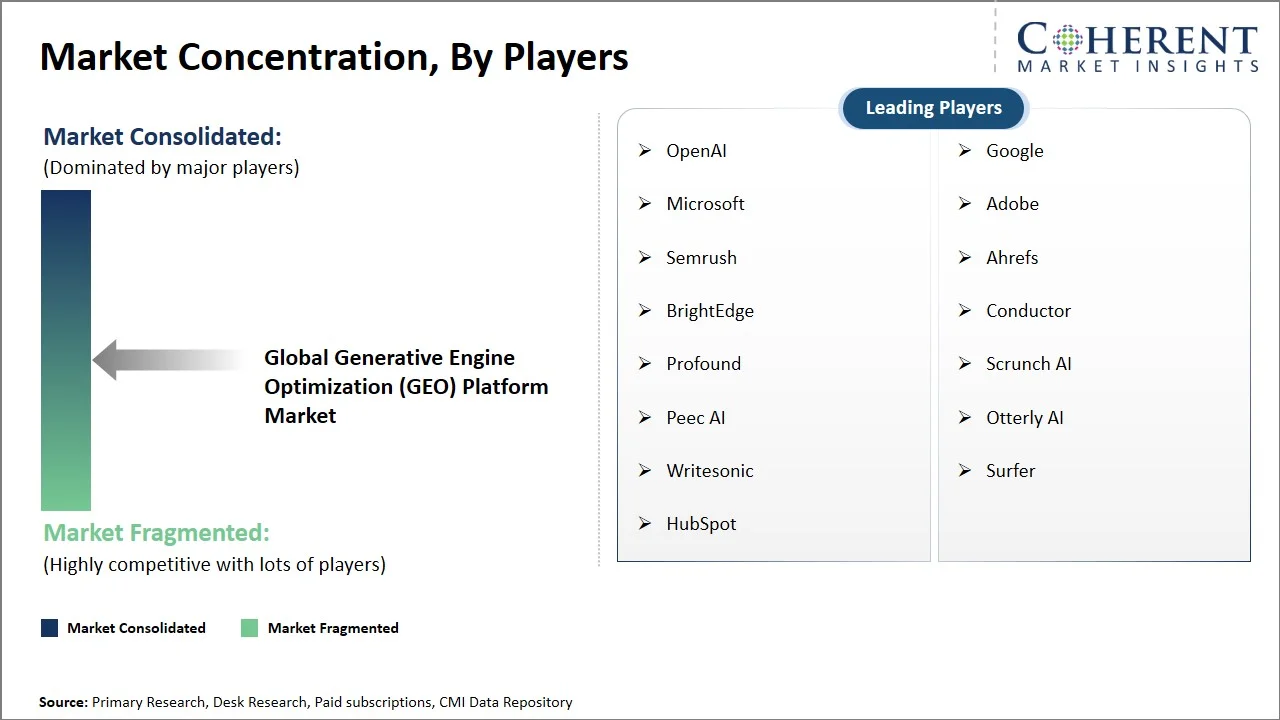
Key Developments
- On April 14, 2026, Bluefish announced USD 43 million in Series B financing co-led by Threshold Ventures and NEA with participation from multiple enterprise investors. The investment expanded its agentic marketing platform for Fortune 500 brands and increased total funding to USD 68 million.
- On March 4, 2025, Semrush, a leading online visibility management SaaS platform, launched the AI Toolkit. The AI Toolkit is a solution designed to help businesses understand their visibility in AI-driven search platforms like ChatGPT, Gemini, and Perplexity.
Competitive Landscape
Profound, Scrunch, Semrush, Peec AI and Adobe are leading the competitive field with diverse methods. DeepSight is an enterprise AI visibility, multi-engine monitoring and technical governance platform. Scrunch monitors, audits, optimizes and delivers AI content across multi-large-language-models. Semrush introduces AI visibility into their existing SEO environment. Adobe LLM Optimizer is built with enterprise content and marketing workflows in mind. Peec AI specializes in structured AI search analytics and competitive visibility tracking. Competition is increasingly shifting toward actionable optimization, enterprise integrations, and monitoring across multiple generative engines.
Market Report Scope
Generative Engine Optimization (GEO) Platform Market Report Coverage
| Report Coverage | Details | ||
|---|---|---|---|
| Base Year: | 2025 | Market Size in 2026: | USD 2.70 Bn |
| Historical Data for: | 2020 To 2024 | Forecast Period: | 2026 To 2033 |
| Forecast Period 2026 to 2033 CAGR: | 13.6% | 2033 Value Projection: | USD 26.85 Bn |
| Geographies covered: |
| ||
| Segments covered: |
| ||
| Companies covered: | OpenAI, Google, Microsoft, Adobe, Semrush, Ahrefs, BrightEdge, Conductor, Profound, Scrunch AI, Peec AI, Otterly AI, Writesonic, Surfer, HubSpot | ||
| Growth Drivers: |
| ||
| Restraints & Challenges: |
| ||
Analyst Opinion (Expert Opinion)
- The industry is expected to shift from visibility measurement toward continuous optimization across autonomous AI search experiences. Google is already adding dedicated generative AI visibility reporting within Search Console. OpenAI is also developing richer product discovery through its Agentic Commerce Protocol. This creates a future where GEO platforms optimize both informational content and machine-readable product data.
- The strongest opportunity should emerge within enterprise GEO platforms serving e-commerce, financial services, healthcare, and technology brands. Product discovery deserves particular attention because ChatGPT is increasingly supporting richer shopping experiences. India, China and Japan also present great prospects, as multilingual optimization needs various content techniques. The benefit will accrue to platforms that enable localized prompts, regional engines and language-specific citation tracking.
- Market players should focus on proprietary visibility datasets, automated suggestions and integrations with existing marketing technology. Platforms should integrate GEO findings directly to content management systems and enterprise analytics. They should also tighten verification of citations, as incorrect AI-generated brand information might entail reputational harm. Building engine-specific optimization capabilities will be more defensible than offering basic AI visibility dashboards.
Speak to the analyst
Want personalized insights?
Take the findings above to one of our principal consultants, or have the report rebuilt around the segments, geographies and competitors you actually track.
Market Segmentation
- Offering Type Insights (Revenue, USD Billion, 2021 - 2033)
- GEO Software Platforms
- GEO Analytics Tools
- GEO Services
- Deployment Type Insights (Revenue, USD Billion, 2021 - 2033)
- Cloud
- On Premises
- Platform Function Insights (Revenue, USD Billion, 2021 - 2033)
- AI Visibility Monitoring
- Content Optimization
- Citation Tracking
- Competitor Analysis
- Brand Monitoring
- Technology Type Insights (Revenue, USD Billion, 2021 - 2033)
- Artificial Intelligence
- Machine Learning
- Natural Language Processing
- Large Language Models
- Application Insights (Revenue, USD Billion, 2021 - 2033)
- Digital Marketing
- Content Strategy
- Search Visibility
- Brand Optimization
- End User Insights (Revenue, USD Billion, 2021 - 2033)
- Retail
- BFSI
- Healthcare
- Information Technology
- Media and Entertainment
- E-Commerce
- Regional Insights (Revenue, USD Billion, 2021 - 2033)
- North America
- U.S.
- Canada
- Latin America
- Brazil
- Argentina
- Mexico
- Rest of Latin America
- Europe
- Germany
- U.K.
- Spain
- France
- Italy
- Russia
- Rest of Europe
- Asia Pacific
- China
- India
- Japan
- Australia
- South Korea
- ASEAN
- Rest of Asia Pacific
- Middle East
- GCC Countries
- Israel
- Rest of Middle East
- Africa
- South Africa
- North Africa
- Central Africa
- North America
- Key Players Insights
- OpenAI
- Microsoft
- Adobe
- Semrush
- Ahrefs
- BrightEdge
- Conductor
- Profound
- Scrunch AI
- Peec AI
- Otterly AI
- Writesonic
- Surfer
- HubSpot
Sources
Primary Research Interviews
- Digital Marketing Directors
- E-Commerce Marketing Executives
- GEO Service Providers
Journals
- International Journal of Artificial Intelligence and Agent Systems
- SSRN - Optimizing Visibility in Generative Engines
Associations
- Interactive Advertising Bureau
- World Wide Web Consortium
Public Domain Sources
- U.S. National Institute of Standards and Technology
- European Commission
Proprietary Elements
- CMI Data Analytics Tool
- Proprietary CMI Existing Repository of Information for the Last 10 Years
Get access to 250+ pages report
Every segment, forecast, competitor profile and data table behind the analysis above — available for instant download.
- ESOMAR Member
- ISO 9001:2015 Certified
- D-U-N-S Registered
- GDPR & CCPA Compliant
Missing comfort of reading report in your local language? Find your preferred language:
Transform your Strategy with Exclusive Trending Reports
Frequently Asked Questions
The global generative engine optimization (GEO) platform market is expected to stand at USD 2.70 Bn in 2026 and is expected to reach USD 26.85 Bn by 2033.
The CAGR of the global generative engine optimization (GEO) platform market is projected to be 13.6% from 2026 to 2033.
A GEO platform monitors, analyzes, and improves brand representation across generative AI engines.
GEO targets generated responses, while search engine optimization primarily targets rankings within conventional search results.
GEO platforms identify inaccurate, missing, or unfavorable brand representations across artificial intelligence generated responses.
Automated GEO optimization uses artificial intelligence to identify visibility gaps and recommend content improvements.
Competitor analysis identifies competing brands receiving stronger artificial intelligence visibility and citation coverage.