

Global Generative Engine Optimization (GEO) Services Market Size and Forecast – 2026 To 2033
The global generative engine optimization (GEO) services market is expected to grow from USD 1.25 Bn in 2026 to USD 13 Bn by 2033, registering a compound annual growth rate (CAGR) of 14% from 2026 to 2033. The global generative engine optimization (GEO) services market is driven by growing enterprise adoption of generative AI. On April 27, 2026, Accenture announced it is rolling out Microsoft Copilot across its workforce to around 743,000 people.
Key Takeaways of the Global Generative Engine Optimization (GEO) Services Market
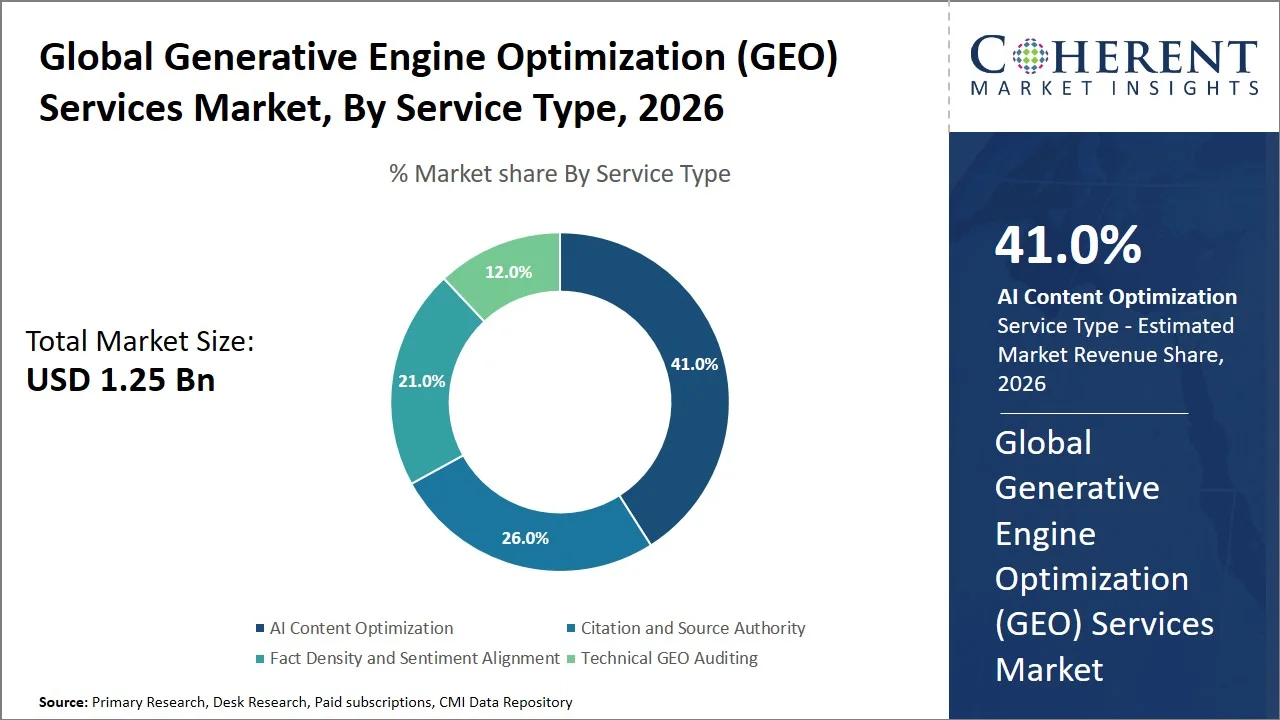
- The AI Content Optimization segment is expected to account for 41.0 % of the global generative engine optimization (GEO) services market share in 2026. Rising demand for AI visibility measurement and citation monitoring is driving the growth of the segment. On September 18, 2025, BrightEdge introduced detailed monitoring of AI Overview citation patterns through its Generative Parser.
- The Large Enterprises segment is estimated to capture 61.0 % of the market share in 2026. Increasing adoption of marketing automation is majorly driving the growth of the segment. On April 20, 2026, Adobe introduced the CX Enterprise, using AI agents to automate marketing tasks, customer interactions, customizations and campaign execution.
- The Content and Discoverability Optimization segment is estimated to capture 37.0 % of the market share in 2026. Increasing integration of GEO with existing search engine optimization programs is driving the growth of the segment. On September 2, 2025, EWR Digital launched Generative AI search engine optimization services.
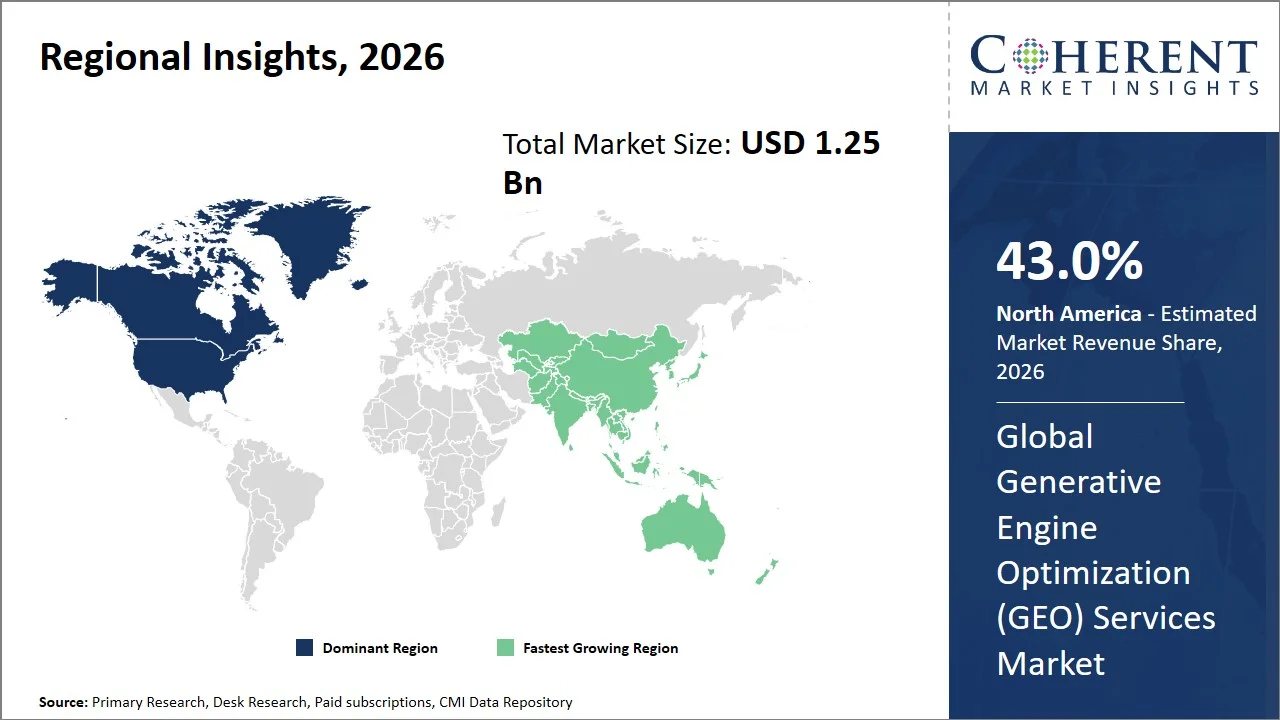
- North America is expected to dominate the generative engine optimization (GEO) services market in 2026 with a market share of 43.0 %. Increasing integration of GEO with content management systems in North America is driving the growth of the regional market. In May 2026, Progress Software published a dedicated framework connecting Search Engine Optimization, answer engine optimization, and GEO.
- Asia Pacific is expected to account for 24.0 % share in 2026. Growth of AI visibility analytics services in Asia Pacific is driving the growth of the regional market. On July 22, 2026, Pepper launched a GEO solution for chief marketing officers. The tool tracks brand visibility in AI-driven search settings and assists businesses in enhancing their presence.
Segmental Insights
Why Does AI Content Optimization Dominate the Global Generative Engine Optimization (GEO) Services Market?
The AI content optimization segment is expected to account for 41.0% of the global generative engine optimization (GEO) services market share in 2026. The rise of generative artificial intelligence in search experiences is a boon for AI content optimization, as businesses are increasingly tasked with creating content that is structured to be accurately understood by huge language models. Optimized content improves contextual relevance, factual clarity and likelihood of inclusion in AI-generated responses. It also helps organizations match content to conversational inquiries and influencing user search behavior. Thus, the growing use of generative AI means there is a constant demand for specialized content optimization services. On July 4, 2025, Contentful shared insights on how to adjust content strategies to GEO. The methodology focuses on structured material, clear entities, contextual relevance, and consistent information across digital properties.
- Current Industry Events of 2026
- Market Size Estimation
- Regional Breakdown
- Competitive Landscape
- Customer Intelligence
- Segmental Analysis
- Pricing Analysis
- Key Market Drivers, Challenges & Future Trends
- Customized Insights Section
Why is Large Enterprises the Most Crucial Enterprise Size?
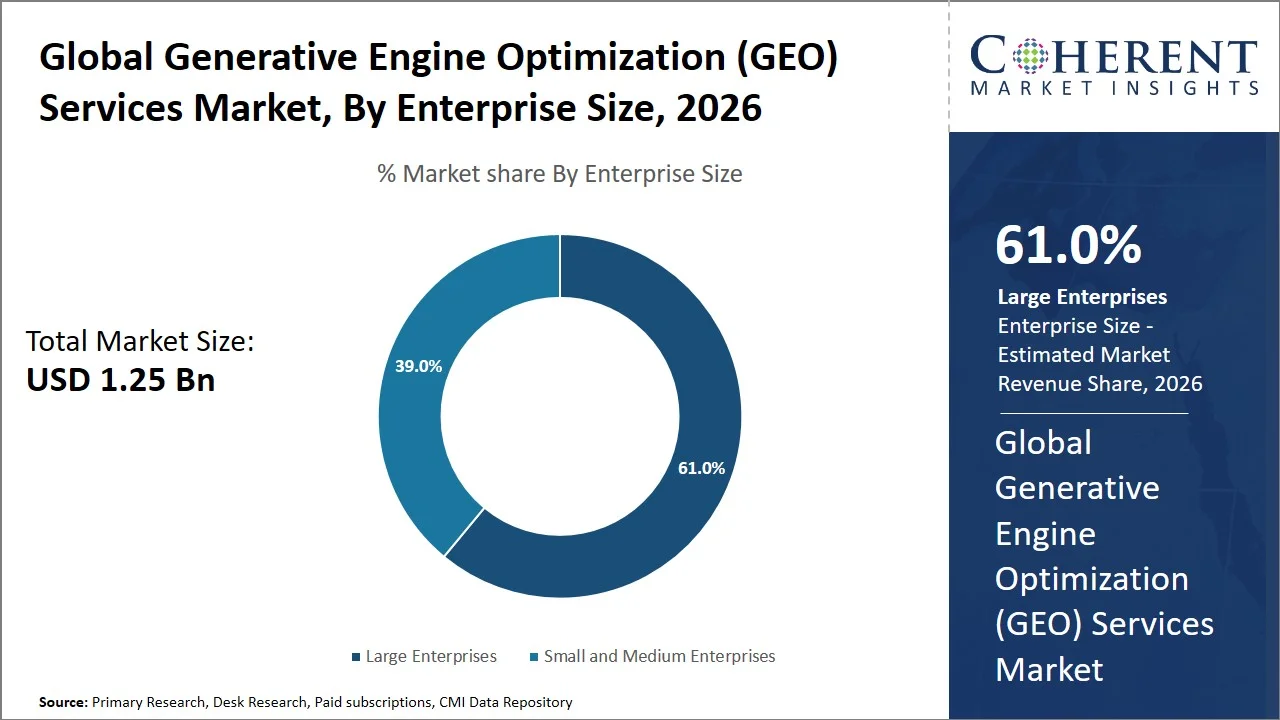
The large enterprises segment is expected to account for 61.0% of the global generative engine optimization (GEO) services market share in 2026. Large organizations usually have large digital content portfolios across several brands, products and geographic marketplaces. Their complex content ecosystems demand organized optimization for accurate interpretation by generative artificial intelligence systems. Large companies also have specialized marketing and IT teams to support the ongoing GEO implementation. With their established digital presence, they have a lot of content assets to optimize and manage. These criteria stimulate the increased use of specialized GEO services by large organizations. On August 18, 2026, Fractal secured a multi-year agreement exceeding USD 17 million with a major U.S. healthcare organization. The engagement focuses on modernizing data and AI infrastructure and creating a scalable enterprise AI environment.
Content and Discoverability Optimization Dominates the Global Generative Engine Optimization (GEO) Services Market
The content and discoverability optimization segment is expected to account for 37.0% of the global generative engine optimization (GEO) services market share in 2026. The rapid shift toward generative search increases the importance of making digital content easily interpretable by artificial intelligence systems. Businesses need organized contextually relevant content to accurately retrieve information in generated responses. When visitors receive responses instead of standard search results, it can improve brand visibility and make information more discoverable. Digital assets are the biggest opportunity for a company’s marketing to optimize content, semantic relevance, and the clarity of entities. This desire fuels continued use of specialized optimization services that are intended to improve visibility in generative search contexts. On April 10, 2026, Lumar announced a four-pillar GEO framework, including technical accessibility, content, entities and brand authority. In particular, the paradigm emphasizes the understandability and accessibility of webpages for generative search engines.
Current Events and their Impact
Current Events | Description and its Impact |
European Union Artificial Intelligence Act, 2024 |
|
Interim Measures for Generative Artificial Intelligence Services, China |
|
Generative Engine Optimization (GEO) Services Market Dynamics
Market Drivers
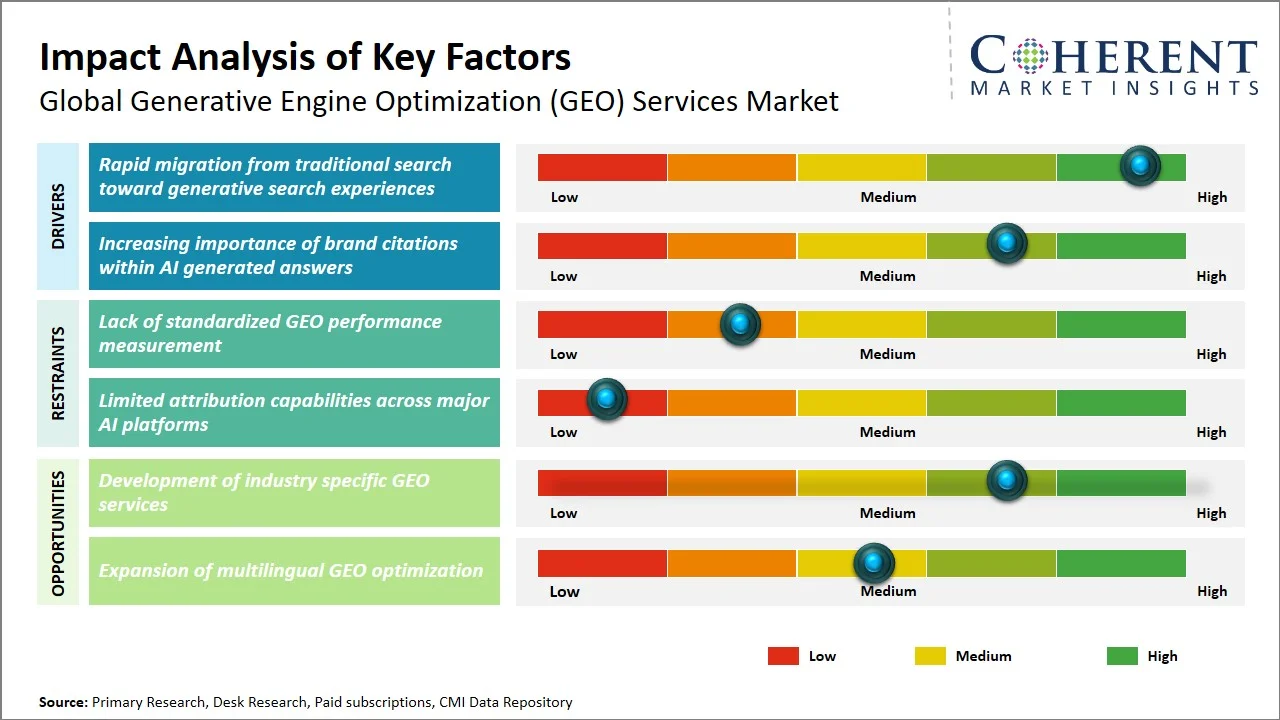
- Rapid migration from traditional search toward generative search experiences: With the increasing usage of generative AI, the way users seek for information online is changing. More and more, users get a simplified answer instead of scrolling through dozens of typical search results. “Businesses need content that’s optimized for conversational queries and for AI interpretation.” This trend also boosts demand for services that increase visibility inside generative search experiences. GEO providers can assist enterprises in tailoring their digital content to this changing discovery environment. On May 13, 2026, Amazon announced the launch of Alexa for Shopping, world’s most personalized AI assistant for shopping. Alexa for Shopping combines deep product understanding with personalization to be the best AI assistant for shopping on Amazon.
- Increasing importance of brand citations within AI generated answers: Brand mentions are becoming more and more important as generative artificial intelligence systems are influencing purchasing and research decisions. People often use the references that are listed to assess the trustworthiness of the information provided in generated answers. Businesses therefore want to be more visible on respected websites, periodicals and industry sources. GEO services boost digital authority, content relevancy and factual consistency for better brand references. This provides a higher need for citation-centric tactics in the domain of generative search optimization. On May 25, 2026, Pulp Strategy Communications introduced NeuroRank to track brand representation across ChatGPT, Gemini, Claude and Perplexity. It’s about citation visibility. It’s about regulating how brand narratives are constructed by artificial intelligence (AI) algorithms.
Emerging Trends
- AI Search Visibility Measurement: GEO providers are building proprietary dashboards that track brand mentions, citations, rankings, sentiment, and answer inclusion on generative artificial intelligence platforms, empowering businesses to track visibility more consistently and identify content gaps in quickly-evolving search environments.
- Generative AI Content Structuring: Businesses are structuring more content around entities, factual relationships, conversational queries and semantic context. This not only helps generative AI systems to understand information more accurately, but it also increases opportunities for relevant brand inclusion within generated responses.
- Integration With Traditional Search Engine Optimization: GEO tactics are being integrated with search engine optimization, digital public relations, structured data, and content marketing to build holistic visibility programs that span traditional search results and new generative search interfaces.
- Enterprise Knowledge Optimization: Large enterprises are increasingly optimizing proprietary information, product documentation and knowledge bases for generative artificial intelligence retrieval to improve answer accuracy while supporting consistent brand representation across customer service, research, purchasing and internal information discovery applications.
Regional Insights
Why is North America a Strong Market for Generative Engine Optimization (GEO) Services?
North America is expected to account for a market share of 43.0% in 2026. North America has an edge in concentrated development of artificial intelligence platforms and mature enterprise search marketing capabilities. The U.S. is home to top GEO tech suppliers, like OpenAI, Google, Microsoft, and Anthropic. AI visibility got more attention from corporation in 2025 with rapid growth of online sessions referred from AI. BrightEdge revealed that 68% of firms polled were changing methods for AI search. Large multilingual digital portfolios are also operated by North American firms in retail, financial services, healthcare and technology. Canada is helping through established digital marketing organizations and high usage of artificial intelligence. In conversational interfaces, commercial discovery prospects were amplified by product suggestions from OpenAI in 2025. These developments encourage businesses to optimize content, citations, product information, and brand authority for generative search.
Why Does Asia Pacific Generative Engine Optimization (GEO) Services Market Exhibit High Growth?
Asia Pacific is expected to register the fastest growth with a CAGR of 17.6% over the forecast period. It is projected to account for 24.0% of the global generative engine optimization (GEO) services market in 2026. Asia Pacific benefits from rapid artificial intelligence adoption across China, India, Japan, South Korea, and Australia. China has established a dedicated optimization environment for Baidu AI, DeepSeek and Zhipu. The huge smartphone population in India offers tremendous prospects for multilingual generative search optimization. Aggressive promotional activities by OpenAI, Google and Perplexity sped up Indian user acquisition. ChatGPT is claimed to have shown a 607% year-over-year rise in daily active users in India. India accounted for more than a third of Perplexity’s global users, it said. Japan has advanced capabilities in digital marketing and enterprise technology adoption. This dichotomy in ecosystems creates a need for GEO tactics that are specific to home platforms, languages, search behaviors, and content needs.
Global Generative Engine Optimization (GEO) Services Market Outlook for Key Countries
Why is U.S. Emerging as a Major Hub in the Generative Engine Optimization (GEO) Services Market?
The U.S. benefits from being the primary development center for leading generative artificial intelligence search platforms. OpenAI, Google, Microsoft, Anthropic, and Perplexity maintain major operations within the country. By 2025, around 46% of U.S. internet adults had used generative artificial intelligence tools. ChatGPT accounted for usage among nearly three-quarters of surveyed generative artificial intelligence users. Google Gemini reached approximately four in ten users within the same survey. The levels of adoption are such that brands are exposed to several AI discovery channels at the same time. U.S. companies are likewise grappling with fast-changing Google AI Overviews and ChatGPT search behavior. Consequently, agencies increasingly package GEO monitoring, citation tracking, content optimization, and brand visibility analytics for enterprise marketing teams.
Is China the Next Growth Engine for the Generative Engine Optimization (GEO) Services Market?
The GEO in China is developed within a homegrown AI environment that is different from the Western search platforms. Different environments generated by Baidu AI, DeepSeek and Zhipu need local optimization strategies. China’s generative artificial intelligence users reach 602 million by December 2025. This was 42.8% of the country’s population. The domestic market has created huge demand for Chinese language content optimization and entity recognition. Regulatory obligations also increase the focus on content governance and information veracity. Chinese firms increasingly demand visibility across conversational search, purchasing recommendations, and AI-generated replies. The country’s huge digital commerce ecosystem further enhances potential to optimize product descriptions, brand information, customer reviews and authoritative third-party references.
U.K. Generative Engine Optimization (GEO) Services Market Analysis and Trends
The U.K. benefits from strong digital marketing maturity and rapidly increasing consumer exposure to generative artificial intelligence. Government research found that 59% of adults used generative artificial intelligence during the latest three-month measurement period. Usage exceeded 75% among adults younger than 45. U.K. also has a well-established search engine optimization and digital public relations business. This creates a solid skill pool to transfer traditional search tactics to GEO practice. Ofcom has conducted specific research into user experiences of generative artificial intelligence search. British companies are looking increasingly for specialized optimization for English language searches, financial information, retail discovery and regulated industries.
Japan Generative Engine Optimization (GEO) Services Market Analysis and Trends
The possibility for Japan is supported by the advanced enterprise technology deployment and increasing use of generative artificial intelligence. Japanese enterprises need GEO methods that support Japanese semantics, formal writing rules, and locally authorized sources. In addition, domestic companies have complicated product ecosystems that need proper depiction of artificial intelligence. Leading automotive, electronics, financial services and consumer technology industries have large content optimization needs. Japan’s developed digital marketing industry has built up capabilities in search engine optimization to go toward generative search. Localization is especially necessary because a literal translation often fails to capture the contextual meaning in Japanese. Hence, GEO suppliers can set themselves apart with Japanese-language entity optimization, fact checking, product knowledge structure, and localized citation methodologies.
India Generative Engine Optimization (GEO) Services Market Analysis and Trends
India offers a unique GEO potential with its massive smartphone population and multilingual digital ecosystem. There are over 730 million smartphone owners in India, so the potential exposure for AI search apps is huge. OpenAI, Google and Perplexity aggressively pushed Indian access via commercial partnerships and free services. Google has teamed up with Reliance Jio to deploy its Gemini AI access to hundreds of millions of consumers. India accounted for more than a third of Perplexity’s global user base. These advancements are creating demand for GEO supporting English, Hindi and other Indian languages. As businesses seek to optimize for local commerce, education, financial services, healthcare and multilingual product discovery.
Global Generative Engine Optimization (GEO) Services Market - Monthly Users Across AI Search Engines (2025)
AI Search Engine | Company | Monthly Users |
ChatGPT | OpenAI | 700 million |
Gemini | 650 million | |
Perplexity | Perplexity AI | 30 million |
Google AI Overviews | 2.0 billion |
Global Generative Engine Optimization (GEO) Services Market - GEO Service Adoption by Industry (2025)
Industry | GEO Service Adoption |
Software and Technology | 78% |
Financial Services | 72% |
E-commerce and Retail | 65% |
Healthcare and Pharmaceuticals | 58% |
Media and Publishing | 54% |
Professional Services | 51% |
Travel and Hospitality | 48% |
Education | 45% |
Telecommunications | 43% |
Automotive | 41% |
How is Development of Industry Specific GEO Services Creating New Growth Opportunities in the Generative Engine Optimization (GEO) Services Market?
Industry-specific GEO services are opening up new prospects by adapting optimization to sector-specific questions, standards of evidence and compliance needs. Specialized GEO in healthcare emphasizes correct medical knowledge and reliable clinical sources, minimizing the danger of false AI responses. PwC says banking is moving to GEO and AI for product discovery and that financial services need content that understands compliance for products, rules and customer inquiries. E-commerce companies are improving product data for AI shopping assistants. Shopify says AI chatbot referral sessions are up more than 8X YoY. Legal services also require jurisdiction-specific answers and tightly monitored claims. These specific needs enable GEO providers to offer more valuable services on top of compliance, citation authority, product discovery, and industry-specific knowledge architectures.
On November 20, 2025, Opal Infotech announced the launch of sector specific GEO strategies for industrial equipment, medical devices and food processing. The company customizes artificial intelligence search information for particular product categories to target decision makers.
Market Players, Key Development, and Competitive Landscape
Key Developments
- On April 28, 2026, Adobe announced the completion of its acquisition of Semrush Holdings, Inc., a leading brand visibility platform. This acquisition enhances Adobe’s ability to offer businesses more capabilities to drive discoverability and conversion.
- On November 18, 2025, Peec AI, the marketing platform built for the age of AI search, announced a USD 21 million Series A, led by European VC firm Singular. Peec AI plans to use the funding for product development and team expansion.
Competitive Landscape
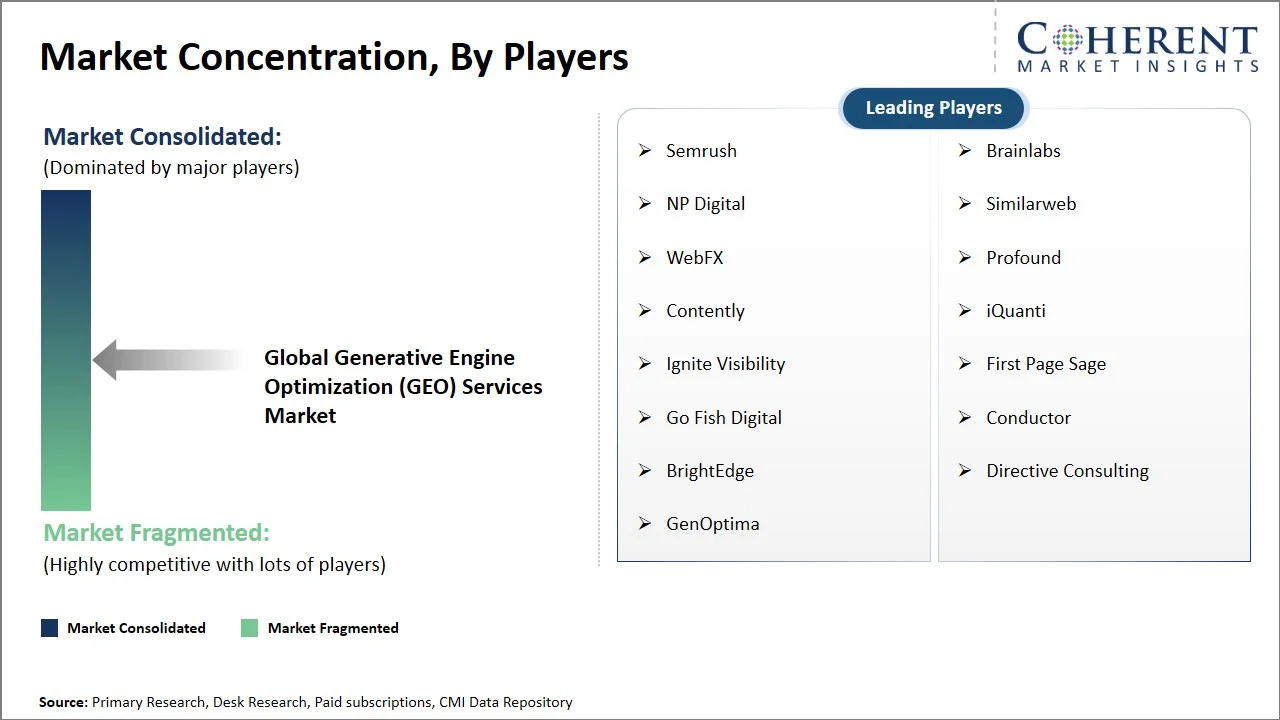
The competitive landscape is a combination of traditional search platforms, GEO-native startups and specialist agencies. Semrush is adding AI visibility tracking to their mature search intelligence ecosystem. Its methodology blends standard search data with AI citations, evaluation of mentions and visibility. BrightEdge is committed to enterprise AI search through its AI Catalyst platform, and tracks citations across ChatGPT, Google AI Overviews and Perplexity. Profound offers enterprise-grade GEO monitoring and competitive intelligence on generative platforms. Ahrefs has added Brand Radar to its features, tracking brand mentions in AI-generated responses. GEO-native services like Peec AI, Otterly.ai and Scrunch AI are concentrating on visibility monitoring and platform coverage. Competition increasingly centers on cross-engine tracking, citation attribution, actionable recommendations, and integration with existing marketing technology.
Market Report Scope
Generative Engine Optimization (GEO) Services Market Report Coverage
| Report Coverage | Details | ||
|---|---|---|---|
| Base Year: | 2025 | Market Size in 2026: | USD 1.25 Bn |
| Historical Data for: | 2020 To 2024 | Forecast Period: | 2026 To 2033 |
| Forecast Period 2026 to 2033 CAGR: | 14% | 2033 Value Projection: | USD 13 Bn |
| Geographies covered: |
| ||
| Segments covered: |
| ||
| Companies covered: | Semrush, Brainlabs, NP Digital, Similarweb, WebFX, Profound, Contently, iQuanti, Ignite Visibility, First Page Sage, Go Fish Digital, Conductor, BrightEdge, Directive Consulting, GenOptima | ||
| Growth Drivers: |
| ||
| Restraints & Challenges: |
| ||
Analyst Opinion (Expert Opinion)
- The future of GEO services will increasingly center on continuous AI visibility management rather than standalone content optimization. Generative platforms are becoming multi-engine discovery environments, requiring simultaneous optimization across ChatGPT, Google AI Overviews, Perplexity, Claude, and Gemini. The strongest opportunity should emerge in enterprise services combining citation monitoring, content restructuring, entity optimization, and competitive intelligence. Providers should also build workflows connecting AI visibility with product discovery and customer journeys.
- The largest opportunities should emerge within e-commerce, financial services, healthcare, software, and travel. Given the rising impact of generative interfaces on product search and purchase decisions, e-commerce is of special interest. GEO suppliers need to create product-feed optimization, review intelligence, structured product information and AI recommendation monitoring. Regionally, the U.S. should continue to be the most attractive market with India presenting good growth potential. China needs unique tactics since home-grown AI platforms have varied optimization and content-governance needs.
- A player who wants to have an edge should be looking into proprietary first-party visibility data and repeated cross-platform monitoring. They need to link citation adjustments to specific content updates, not promote general optimization solutions. Enterprise suppliers need to link GEO workflows with digital PR, content management, analytics and CRM solutions. They should also construct knowledge models tailored to the industry for regulated industries that require more rigorous factual controls. Differentiation will increasingly depend on proving which content changes improve visibility, citations, and commercial outcomes.
Speak to the analyst
Want personalized insights?
Take the findings above to one of our principal consultants, or have the report rebuilt around the segments, geographies and competitors you actually track.
Market Segmentation
- Service Type Insights (Revenue, USD Billion, 2021 - 2033)
- AI Content Optimization
- Citation and Source Authority
- Fact Density and Sentiment Alignment
- Technical GEO Auditing
- Enterprise Size Insights (Revenue, USD Billion, 2021 - 2033)
- Large Enterprises
- Small and Medium Enterprises
- Application Insights (Revenue, USD Billion, 2021 - 2033)
- Content and Discoverability Optimization
- Brand and Reputation Visibility
- Commerce and Conversion Enablement
- Data and Model Interaction Optimization
- End User Insights (Revenue, USD Billion, 2021 - 2033)
- E-commerce and Retail
- Financial Services and Fintech
- Healthcare and Pharmaceuticals
- Technology and Software
- Others
- Regional Insights (Revenue, USD Billion, 2021 - 2033)
- North America
- U.S.
- Canada
- Latin America
- Brazil
- Argentina
- Mexico
- Rest of Latin America
- Europe
- Germany
- U.K.
- Spain
- France
- Italy
- Russia
- Rest of Europe
- Asia Pacific
- China
- India
- Japan
- Australia
- South Korea
- ASEAN
- Rest of Asia Pacific
- Middle East
- GCC Countries
- Israel
- Rest of Middle East
- Africa
- South Africa
- North Africa
- Central Africa
- North America
- Key Players Insights
- Semrush
- Brainlabs
- NP Digital
- Similarweb
- WebFX
- Profound
- Contently
- iQuanti
- Ignite Visibility
- First Page Sage
- Go Fish Digital
- Conductor
- BrightEdge
- Directive Consulting
- GenOptima
Sources
Primary Research Interviews
- Digital Marketing Directors
- E-Commerce Marketing Executives
- GEO Service Providers
Journals
- International Journal of Artificial Intelligence and Agent Systems
- SSRN - Optimizing Visibility in Generative Engines
Associations
- Interactive Advertising Bureau
- World Wide Web Consortium
Public Domain Sources
- U.S. National Institute of Standards and Technology
- European Commission
Proprietary Elements
- CMI Data Analytics Tool
- Proprietary CMI Existing Repository of Information for the Last 10 Years
Get access to 250+ pages report
Every segment, forecast, competitor profile and data table behind the analysis above — available for instant download.
- ESOMAR Member
- ISO 9001:2015 Certified
- D-U-N-S Registered
- GDPR & CCPA Compliant
Missing comfort of reading report in your local language? Find your preferred language:
Transform your Strategy with Exclusive Trending Reports
Frequently Asked Questions
The global generative engine optimization (GEO) services market is expected to stand at USD 1.25 Bn in 2026 and is expected to reach USD 13 Bn by 2033.
The CAGR of the global generative engine optimization (GEO) services market is projected to be 14% from 2026 to 2033.
Generative engine optimization services improve brand visibility within AI-generated search responses and recommendations.
Generative search expands optimization requirements beyond rankings toward citations, mentions, entities, and answer inclusion.
Citations strengthen source recognition and can increase brand representation within generated answers.
Entity optimization helps artificial intelligence systems establish relationships between brands, products, people, and topics.
Multilingual GEO helps brands maintain accurate representation across different languages and regional search behaviors.