

Global Graph Database Market Size and Forecast – 2026 To 2033
The global graph database market is expected to grow from USD 4.50 Bn in 2026 to USD 20 Bn by 2033, registering a compound annual growth rate (CAGR) of 18% from 2026 to 2033. The global graph database market is driven by the expansion of recommendation engines across e-commerce and media. On June 24, 2026, Stitch Fix announced that it is expanding Stitch Fix Vision, its AI style visualization platform. Users can generate personalized images of themselves in recommended outfits, giving them more control over how they discover and visualize new looks.
Key Takeaways of the Global Graph Database Market
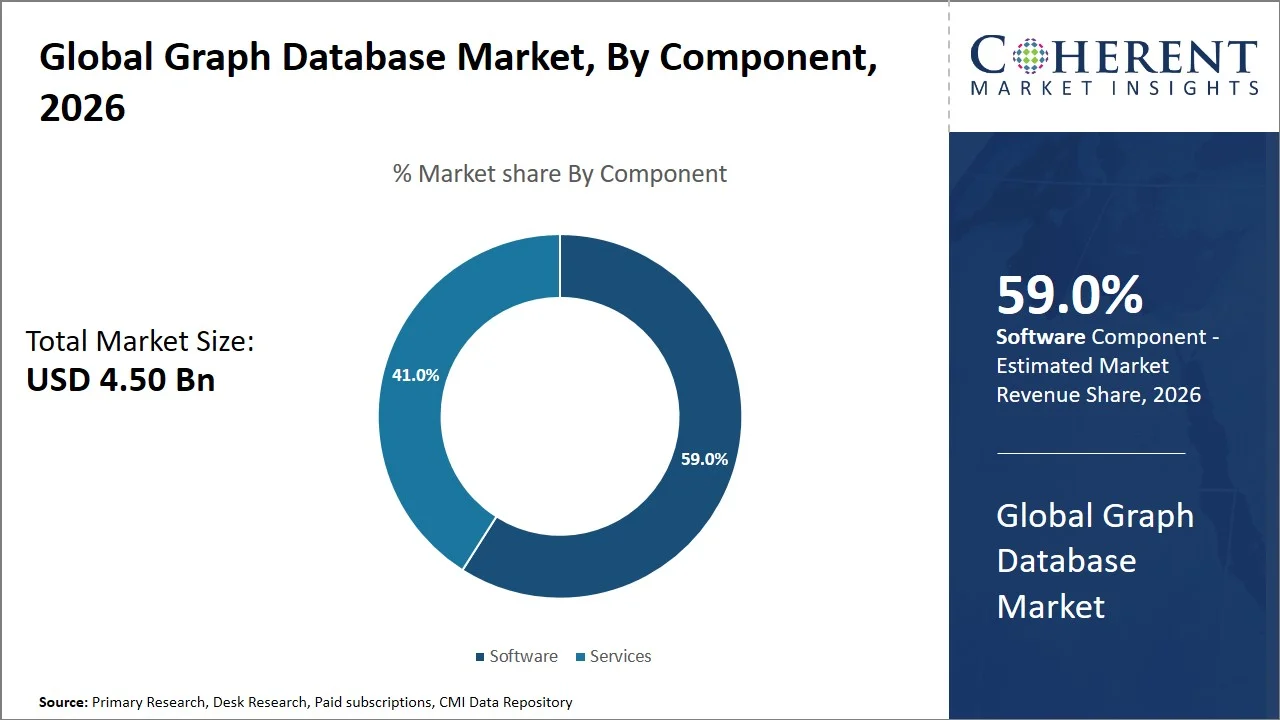
- The software segment is expected to account for 59.0% of the global graph database market share in 2026. Increasing enterprise investment in connected data analytics is driving the growth of the software segment. On July 1, 2026, Amazon Web Services (AWS) announced a USD 1 billion investment to establish a new Forward Deployed Engineering organization, which was designed to embed AI engineers directly within customer environments to accelerate the design, development, and deployment of agentic AI systems from months to days.
- The property graph segment is estimated to capture 45.0% of the market share in 2026. Growth in master data management and digital twin initiatives is majorly driving the growth of the segment. On May 7, 2025, SAS announced a strategic partnership with Epic Games to expand industrial digital twin solutions by integrating Unreal Engine technology with SAS analytics, with the first deployment implemented at a Georgia-Pacific manufacturing facility to improve operational decision making and asset performance.
- The path analysis segment is estimated to capture 39.0% of the market share in 2026. Rising use of graph databases for network and supply chain optimization is driving the growth of the segment. In October 2025, at the NODES 2025 conference, Neo4j showcased new supply chain knowledge graph capabilities and product enhancements focused on real time route optimization, supplier dependency analysis, and AI driven network intelligence for enterprise logistics applications.
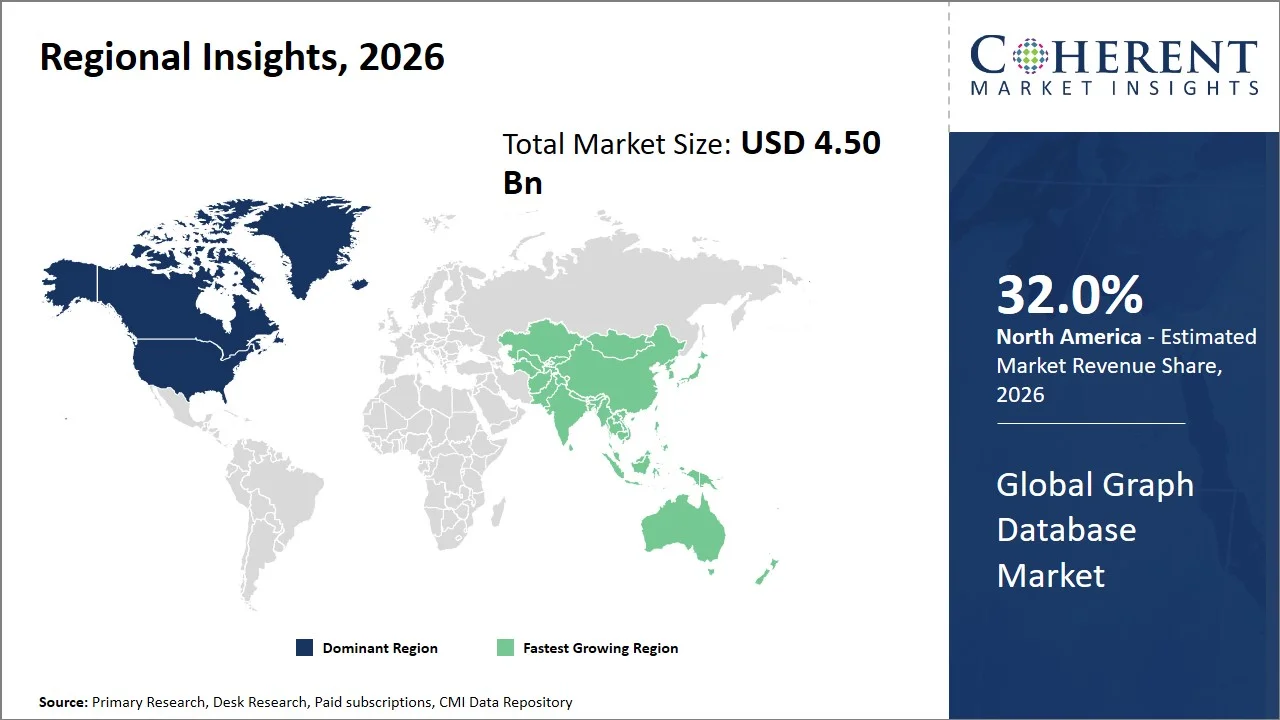
- North America is expected to dominate the graph database market in 2026 with a market share of 45.0%.
- Asia Pacific is expected to account for 27.0% share in 2026 and is projected to record the fastest growth over the forecast period.
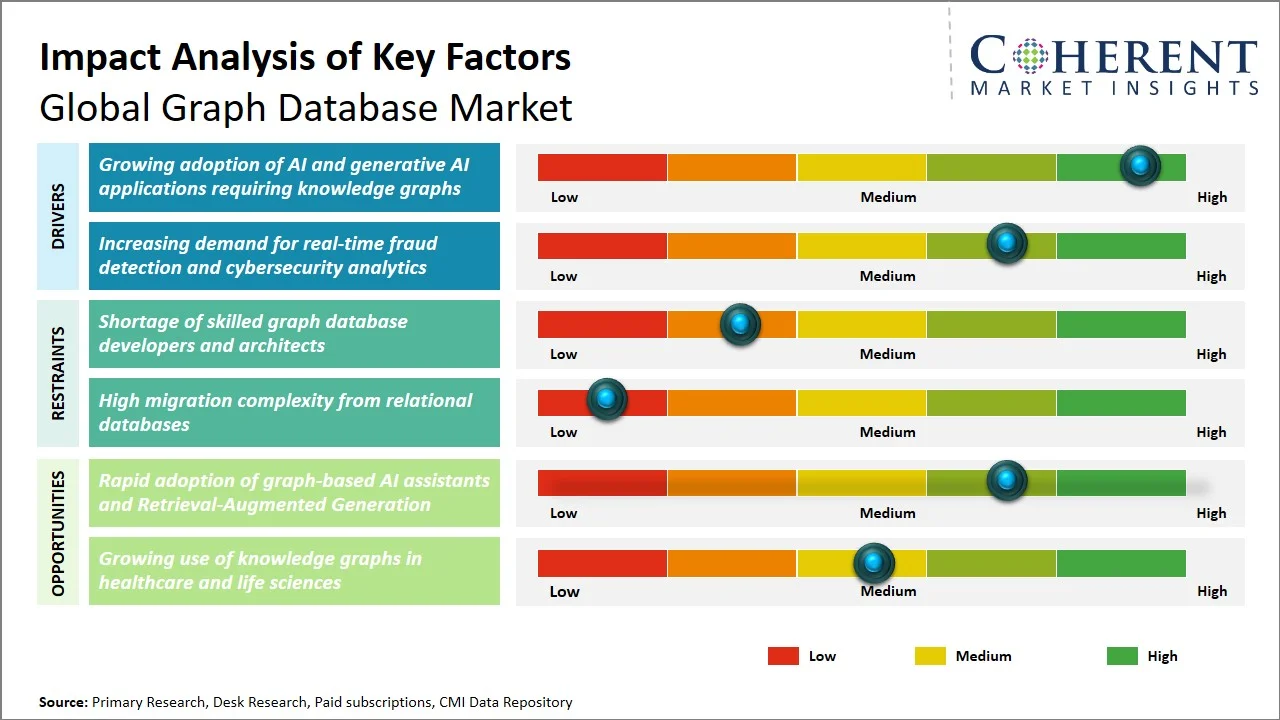
- Rapid adoption of graph-based AI assistants and retrieval-augmented generation (RAG): Organizations are increasingly integrating graph databases with large language models to improve contextual reasoning, reduce hallucinations, and deliver more accurate responses. Knowledge graphs are being used to structure enterprise data, enabling artificial intelligence assistants to understand complex relationships across documents, customers, products, and business processes.
- Growing shift toward cloud-native and managed graph database platforms: Enterprises are moving from self-managed deployments to fully managed cloud graph database services to improve scalability, reduce operational complexity, and accelerate application development. Multi-cloud compatibility, automated scaling, and serverless architectures are becoming key purchasing criteria for organizations modernizing their data infrastructure.
Segmental Insights
Why Does Software Dominate the Global Graph Database Market?
The software segment is expected to account for 59.0% of the global graph database market share in 2026. Demand for graph database software has been boosted by the increasing use of graph analytics in artificial intelligence, fraud detection, recommendation engines and knowledge graph applications. Organizations need flexible software platforms that can model and analyze massively connected data quickly, and that can support real time queries and scalable performance. The adoption of software has been further boosted by the heavy reliance on continuous development of cloud native architectures, graph query languages and integration with big data and machine learning frameworks, and has become the primary component of graph database deployments in different industries such as banking, healthcare, retail, telecommunications and cybersecurity. In 2025, Linkurious enhanced support for major graph database software platforms such as Neo4j, Amazon Neptune, Azure Cosmos DB, Memgraph, and Google Cloud Spanner to enable companies to improve their fraud investigation, financial intelligence and relationship analytics capabilities with sophisticated graph visualization and exploration.
- Current Industry Events of 2026
- Market Size Estimation
- Regional Breakdown
- Competitive Landscape
- Customer Intelligence
- Segmental Analysis
- Pricing Analysis
- Key Market Drivers, Challenges & Future Trends
- Customized Insights Section
Why is Property Graph the Most Preferred Database Model?
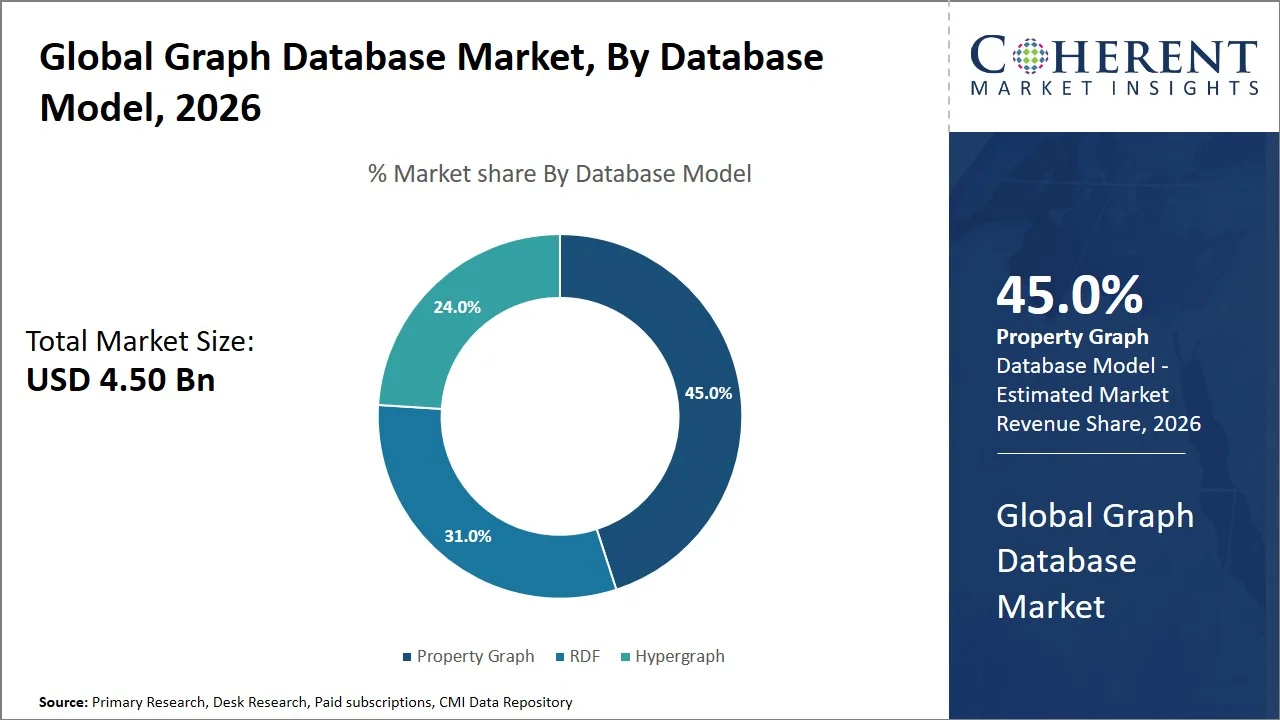
The property graph segment is expected to account for 45.0% of the global graph database market share in 2026. The property graph model is widely preferred because it provides a highly intuitive and flexible way to represent complex relationships by allowing both nodes and connections to store attributes. This enables organizations to efficiently model real world networks such as customer interactions, financial transactions, supply chains, and social connections without requiring rigid schemas. Its compatibility with advanced graph query languages and graph analytics also simplifies application development, accelerates query performance, and supports evolving data structures, making it well suited for enterprise applications involving artificial intelligence, fraud detection, recommendation engines, and knowledge graphs.
Path Analysis Dominates the Global Graph Database Market
The path analysis segment is expected to account for 39.0% of the global graph database market share in 2026. The growing adoption of graph databases for logistics optimization, cybersecurity investigations, financial fraud detection, telecommunications network management, and artificial intelligence reasoning has significantly increased the importance of advanced path analysis capabilities. Enterprises like IBM rely on path analysis to identify the shortest, safest, or most relevant connections across millions of interconnected entities, enabling faster root cause analysis, optimized transportation routes, dependency mapping, and relationship discovery. Its ability to process complex multi hop queries with low latency provides organizations with actionable insights for real time operational decisions, making it an essential analytical function in modern graph database deployments.
Currents Events and their Impact
Current Events | Description and its Impact |
European Chips Artificial Intelligence Act |
|
European Union Data Act |
|
Graph Database Market Dynamics
Market Drivers
Growing adoption of AI and generative AI applications requiring knowledge graphs
The widespread adoption of artificial intelligence and generative artificial intelligence applications is a key driver of demand for graph databases as knowledge graphs provide the contextual relationships required to improve model accuracy, reasoning, and explainability. Graph databases connect people, products, documents and events more effectively than traditional databases, allowing AI systems to obtain relevant information, decrease hallucinations and provide more context-aware responses. Enterprises in healthcare, banking, retail, manufacturing and telecommunications are increasingly combining graph databases with large language models, retrieval augmented generation architectures and intelligent recommendation systems in order to enhance decision making, semantic search and personalized user experiences. This increasing emphasis on relationship-based data management is solidifying graph databases as an essential technology for next-generation AI implementations. For example, across industries, organizations are updating their data and AI infrastructures on the Databricks Data Intelligence Platform to support advanced analytics and intelligent decision making. However, many business-critical decisions depend on finding complex relationships in large scale datasets. The integration of GraphRAG with Neo4j and Databricks is thus increasingly valuable as it brings together knowledge graphs with retrieval mechanisms to give artificial intelligence applications access to connected, trusted and context rich enterprise information. (Source: Neo4j)
Increasing demand for real-time fraud detection and cybersecurity analytics
The increasing complexity of cyber assaults and financial fraud is leading firms to use graph databases for real-time fraud detection and cybersecurity analytics. Graph databases enable security teams to quickly identify hidden relationships between people, devices, accounts, transactions and network events, allowing them to expose fraud rings, detect aberrant behavior and track attack vectors more efficiently than standard relational databases. Financial institutions, government agencies, telecommunications providers and e commerce companies are using graph-based analytics to enhance identity verification, anti-money laundering compliance, insider threat detection and network security while decreasing false positives and accelerating incident response.
Emerging Trends
Expansion of graph analytics for cybersecurity and fraud detection
Financial institutions, telecommunications providers, and government agencies are increasingly using graph databases to uncover hidden connections between users, devices, transactions, and networks. Advanced graph algorithms enable real-time detection of fraud rings, insider threats, money laundering activities, and sophisticated cyberattacks that are difficult to identify using traditional relational databases.
Increasing integration with digital twins and connected enterprise ecosystems
Graph databases are becoming a foundational technology for digital twins by modeling relationships among physical assets, IoT devices, supply chains, and operational workflows. This enables organizations to perform dependency analysis, predictive maintenance, impact assessment, and real-time operational optimization across complex industrial and smart infrastructure environments.
Regional Insights
Why is North America a Strong Market for Graph Database?
North America is expected to account for a market share of 32.0% in 2026. North America continues to be the primary innovation hub for graph database use, driven by the concentration of hyperscale cloud providers, artificial intelligence developers, and cybersecurity organizations. Big IT companies like Microsoft, Amazon Web Services, Google and IBM are integrating graph technologies into cloud platforms and AI ecosystems to power knowledge graphs, semantic search and recommendation engines. Financial companies are turning to graph databases for anti-money laundering investigations and fraud identification, while healthcare organizations are using them to link patient records, clinical research and genomic data. Government agencies are also extending graph analytics to help with cyber threat intelligence and critical infrastructure protection.
Why Does the Asia Pacific Graph Database Market Exhibit High Growth?
Asia Pacific is projected to account for 27.0% of the global graph database market and is expected to register the fastest growth. Asia Pacific is experiencing rapid growth, led by digital transformation, growing cloud infrastructure, and government-backed artificial intelligence projects in the region. Graph databases are being used by enterprises in financial services, telecommunications, manufacturing and e-commerce to manage highly connected data sets created via digital platforms. Alibaba Cloud, Tencent, Huawei and others enhance graph database capabilities for AI, smart cities and enterprise analytics. Increasing investments in digital banking, industrial automation, and intelligent transportation systems further drive regional demand.
Global Graph Database Market Outlook for Key Countries
Why is the U.S. Emerging as a Major Hub in the Graph Database Market?
The U.S. is the largest national market due to widespread adoption of cloud computing in defense, financial services and artificial intelligence. Organizations are employing graph databases to support retrieval augmented generation platforms, knowledge graphs and identity management and cyber security analytics. Technology leaders such as Neo4j, Oracle, Amazon Web offerings and Microsoft continue to expand managed graph database offerings and business AI integrations. Graph analytics are increasingly being leveraged by federal agencies and defense organizations for anything from intelligence analysis to supply chain insight to cyber resilience efforts.
Is China the Next Growth Engine for the Graph Database Market?
China’s graph database ecosystem is being built with domestic AI development, cloud computing expansion and digital economy ambitions. Leading technology businesses including as Alibaba Group, Tencent and Baidu are implementing graph databases to boost search engines, financial technology platforms, recommendation systems and smart city applications. Banking institutions are leveraging graph analytics to enhance fraud detection and credit risk analysis, while manufacturers are applying graph technologies to optimize industrial supply chains and predictive maintenance across interconnected production networks.
Germany Graph Database Market Analysis and Trends
Germany is a leading market in Europe, driven by modern manufacturing, industrial digitization and innovation in the automotive sector. Industrial companies are combining graph databases with digital twin platforms to map relationships between plants, suppliers, production assets and logistical networks. Automotive manufacturers such as BMW Group and Mercedes-Benz Group are progressively deploying graph technologies for linked vehicle data management, predictive maintenance and engineering knowledge management. Financial institutions and research companies increasingly use graph analytics to improve regulatory compliance and scientific data discovery.
Japan Graph Database Market Analysis and Trends
Japan is increasing its adoption of graph databases through investments in areas such as robotics, innovative manufacturing, telecommunications and life sciences. Enterprises are employing graph technologies to enhance industrial automation, streamline supply chains and provide predictive equipment maintenance, as well as facilitate artificial intelligence applications. Companies such as Fujitsu and NEC Corporation are among those implementing graph analytics into enterprise data platforms, cybersecurity solutions and smart infrastructure initiatives. Pharmaceutical firms also use knowledge graphs to speed up partnerships in drug discovery and scientific research.
U.K. Graph Database Market Analysis and Trends
The U.K. has built a robust graph database ecosystem powered by financial technology, artificial intelligence research, and cybersecurity innovation. Financial institutions and digital banks are using graph databases to discover fraud networks, improve anti money laundering compliance and client risk scoring. Research intensive universities and technology companies are now leveraging graph analytics for semantic search, healthcare research, and large language model development. Across the public sector, organizations are using graph technologies for identity resolution, intelligence analysis and digital government services.
Global Graph Database Market - Fraud Detection and Anti-Money Laundering Deployment Analysis (2025)
Metric | BFSI | FinTech & Digital Payments | Government & Law Enforcement | Cryptocurrency & Digital Assets |
Share of graph database deployments (%) | 43 | 18 | 12 | 11 |
Organizations using graph databases for fraud analytics (%) | 74 | 82 | 61 | 88 |
Organizations using graph databases for AML monitoring (%) | 81 | 76 | 69 | 92 |
Average fraud detection accuracy improvement (%) | 36 | 41 | 34 | 44 |
Reduction in false positives (%) | 48 | 53 | 45 | 56 |
How is the Rapid Adoption of Graph-Based AI Assistants and Retrieval-Augmented Generation Creating New Growth Opportunities in the Graph Database Market?
The fast adoption of graph based AI assistants and retrieval augmented generation is providing huge growth opportunities for the graph database market as it enables artificial intelligence systems to fetch highly connected and context rich information rather than depending on static training data. Graph databases are at the core of enterprise knowledge graphs that connect consumers, goods, records, regulations and business processes, empowering massive language models to offer more accurate and explainable answers while decreasing hallucinations. Microsoft has been incorporating graph-based information into its AI-powered enterprise search. Neo4j has enhanced its graph database platform to accommodate retrieval-augmented generation applications for better contextual reasoning. Banking organizations utilize graph enabled AI assistants to navigate intricate compliance policies and customer relationships. Healthcare providers link clinical records, medical literature and treatment guidelines for intelligent decision support. Manufacturers create knowledge graphs connecting engineering documents, suppliers and equipment data to improve maintenance recommendations. Enterprises are deploying domain specialized AI assistants that demand trustworthy and interconnected data, making graph databases a crucial infrastructure layer for scalable retrieval enhanced generation and corporate artificial intelligence solutions. On March 26, 2025, Databricks announced a strategic, five-year partnership to offer Anthropic models and services natively through the Databricks Data Intelligence Platform. (Source: Databricks)
Market Players, Key Development, and Competitive Intelligence
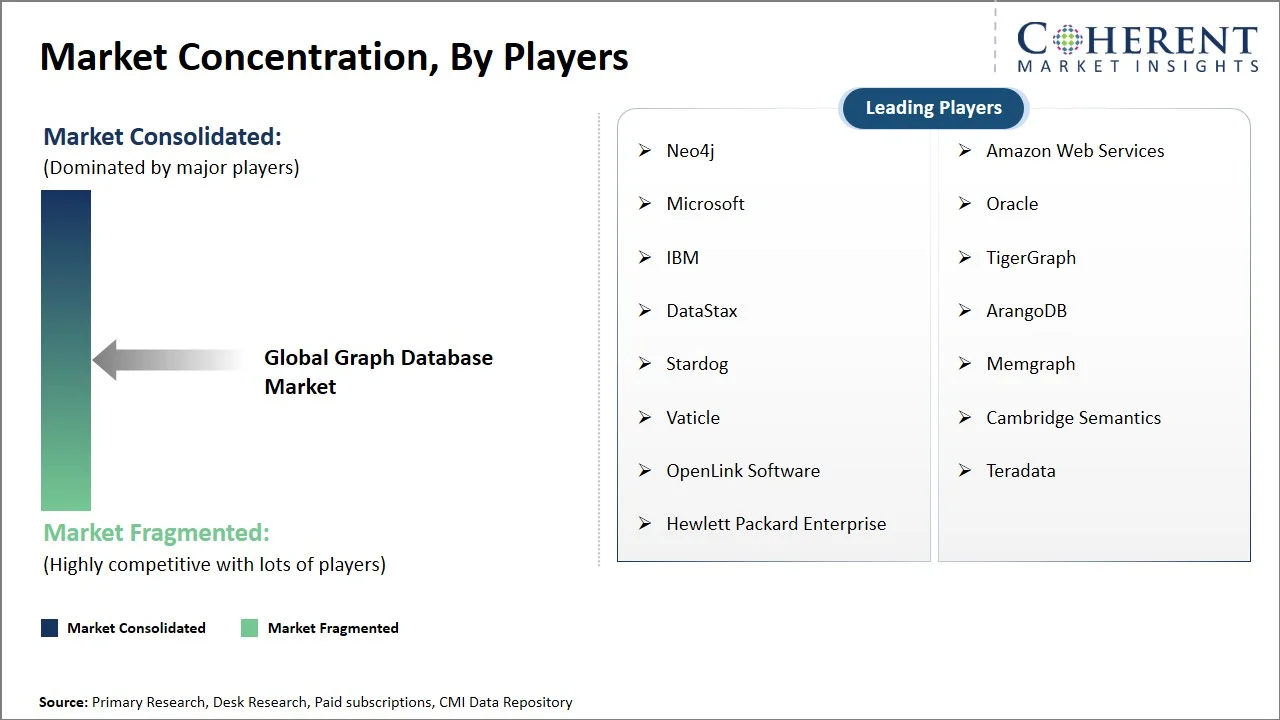
Key Developments
- On March 4, 2025, TigerGraph announced its next generation graph and vector hybrid search delivering the industry's most advanced solution for detecting data anomalies through sophisticated pattern analysis, identifying critical deviations from expected norms, and providing actionable recommendations.
- On January 21, 2025, Amazon Web Services announced the support of the open-source GraphRAG Toolkit, a new capability that enhances Generative AI applications by providing more comprehensive, relevant and explainable responses using RAG techniques combined with graph data. The toolkit provides an open-source framework for automating the construction of a graph from unstructured data, and composing question-answering strategies that query this graph when answering user questions.
Competitive Landscape
The competitive landscape includes continued innovation in cloud native graph database platforms, enterprise knowledge graph capabilities, and the integration of Artificial Intelligence. Established suppliers such as Neo4j, Oracle, Amazon Web Services, Microsoft and IBM are growing managed graph database services and increasing interoperability with large language models, vector search and retrieval enhanced generation frameworks. Cloud providers are also ratcheting up the competition by incorporating graph capabilities within wider data platforms, making it easier for enterprise clients to install.
Market Report Scope
Graph Database Market Report Coverage
| Report Coverage | Details | ||
|---|---|---|---|
| Base Year: | 2025 | Market Size in 2026: | USD 4.50 Bn |
| Historical Data for: | 2020 To 2024 | Forecast Period: | 2026 To 2033 |
| Forecast Period 2026 to 2033 CAGR: | 18 % | 2033 Value Projection: | USD 20 Bn |
| Geographies covered: |
| ||
| Segments covered: |
| ||
| Companies covered: | Neo4j, Amazon Web Services, Microsoft, Oracle, IBM, TigerGraph, DataStax, ArangoDB, Stardog, Memgraph, Vaticle, Cambridge Semantics, OpenLink Software, Teradata, and Hewlett Packard Enterprise | ||
| Growth Drivers: |
| ||
| Restraints & Challenges: |
| ||
Analyst Opinion (Expert Opinion)
- The graph database market is being transformed by a move away from standalone graph databases to intelligent data platforms that support artificial intelligence and real time analytics. Rather, competitive advantage will be defined by the capacity to combine graph processing, vector search, semantic reasoning and enterprise data governance in a unified architecture, rather than by graph storage capabilities alone. More emphasis is being placed on cloud managed services, automated graph modeling, and seamless integration with enterprise data ecosystems, while vendors with strong developer tools, high performance query engines and native support for retrieval augmented generation workflows are being positioned more favorably for long-term enterprise adoption.
- The next stage of market development will be driven by the enterprise-wide deployment of knowledge graphs that connect structured and unstructured information across business processes. Relationship based data models will probably be more widely adopted in digital twins, supply chain intelligence, cybersecurity operations, pharmaceutical research, and autonomous business decision systems where an operational advantage can be measured. Product development is expected to focus on multimodal data integration, graph enhanced AI reasoning, automated ontology management and distributed cloud architectures. The increasing regulatory expectations on explainable artificial intelligence and data lineage are expected to drive the adoption of graph databases into mission critical enterprise platforms.
Speak to the analyst
Want personalized insights?
Take the findings above to one of our principal consultants, or have the report rebuilt around the segments, geographies and competitors you actually track.
Market Segmentation
- Component Insights (Revenue, USD Billion, 2021 - 2033)
- Software
- Services
- Database Model Insights (Revenue, USD Billion, 2021 - 2033)
- Property Graph
- RDF
- Hypergraph
- Analysis Type Insights (Revenue, USD Billion, 2021 - 2033)
- Path Analysis
- Connectivity Analysis
- Community Analysis
- Centrality Analysis
- Application Insights (Revenue, USD Billion, 2021 - 2033)
- Fraud Detection and Risk Management
- Recommendation Engines
- Customer Analytics
- Identity and Access Management
- Master Data Management
- Knowledge Graphs
- Network and IT Operations
- Content Management
- End User Insights (Revenue, USD Billion, 2021 - 2033)
- BFSI
- Retail and E-commerce
- IT and Telecommunications
- Healthcare and Life Sciences
- Government and Public Sector
- Manufacturing and Automotive
- Media and Entertainment
- Energy and Utilities
- Transportation and Logistics
- Regional Insights (Revenue, USD Billion, 2021 - 2033)
- North America
- U.S.
- Canada
- Latin America
- Brazil
- Argentina
- Mexico
- Rest of Latin America
- Europe
- Germany
- U.K.
- Spain
- France
- Italy
- Russia
- Rest of Europe
- Asia Pacific
- China
- India
- Japan
- Australia
- South Korea
- ASEAN
- Rest of Asia Pacific
- Middle East
- GCC Countries
- Israel
- Rest of Middle East
- Africa
- South Africa
- North Africa
- Central Africa
- North America
Sources
Primary Research Interviews
- Graph Database Solution Providers & Vendors
- Enterprise IT & Data Architecture Professionals
- Cloud Infrastructure & Database Administrators
- AI/ML & Big Data Analytics Specialists
Magazines
- Database Trends and Applications (DBTA)
- InformationWeek
- MIT Technology Review
- IEEE Spectrum
Journals
- Journal of Big Data (Springer)
- ACM Transactions on Database Systems
- IEEE Transactions on Knowledge and Data Engineering
Associations
- Association for Computing Machinery (ACM)
- IEEE Computer Society
- NoSQL Now! Industry Association
- Cloud Native Computing Foundation (CNCF)
Public Domain Sources
- U.S. Bureau of Labor Statistics (BLS) – Technology Sector Data
- European Union Open Data Portal
- World Bank – Digital Economy Reports
- National Institute of Standards and Technology (NIST)
Proprietary Elements
- CMI Data Analytics Tool
- Proprietary CMI Existing Repository of Information for the Last 10 Years
Get access to 250+ pages report
Every segment, forecast, competitor profile and data table behind the analysis above — available for instant download.
- ESOMAR Member
- ISO 9001:2015 Certified
- D-U-N-S Registered
- GDPR & CCPA Compliant
Missing comfort of reading report in your local language? Find your preferred language:
Transform your Strategy with Exclusive Trending Reports
Frequently Asked Questions
The global graph database market is expected to stand at USD 4.50 Bn in 2026 and is expected to reach USD 20 Bn by 2033.
The CAGR of the global graph database market is projected to be 18% from 2026 to 2033.
Growing adoption of AI and generative AI applications requiring knowledge graphs and increasing demand for real-time fraud detection and cybersecurity analytics are the major factors driving the growth of the global graph database market.
Shortage of skilled graph database developers and architects and high migration complexity from relational databases are the major factors hampering the growth of the global graph database market.
In terms of component, the software segment is estimated to dominate the market revenue share in 2026.
They provide knowledge graphs that improve contextual understanding, reasoning, and explainability for AI models.
They analyze user behavior and relationship patterns to deliver highly personalized recommendations.