

Global Green Tire Market Size and Forecast – 2026 To 2033
The global green tire market is expected to grow from USD 180 Mn in 2026 to USD 581 Mn by 2033, registering a compound annual growth rate (CAGR) of 12.5% from 2026 to 2033. The market is driven by growing consumer preference for sustainable mobility. On August 25, 2025, CEAT launched the SecuraDrive CIRCL, targeting consumers seeking sustainable passenger-car mobility. The tire offers variants containing 50% and 90% bio-based materials.
Key Takeaways of the Global Green Tire Market
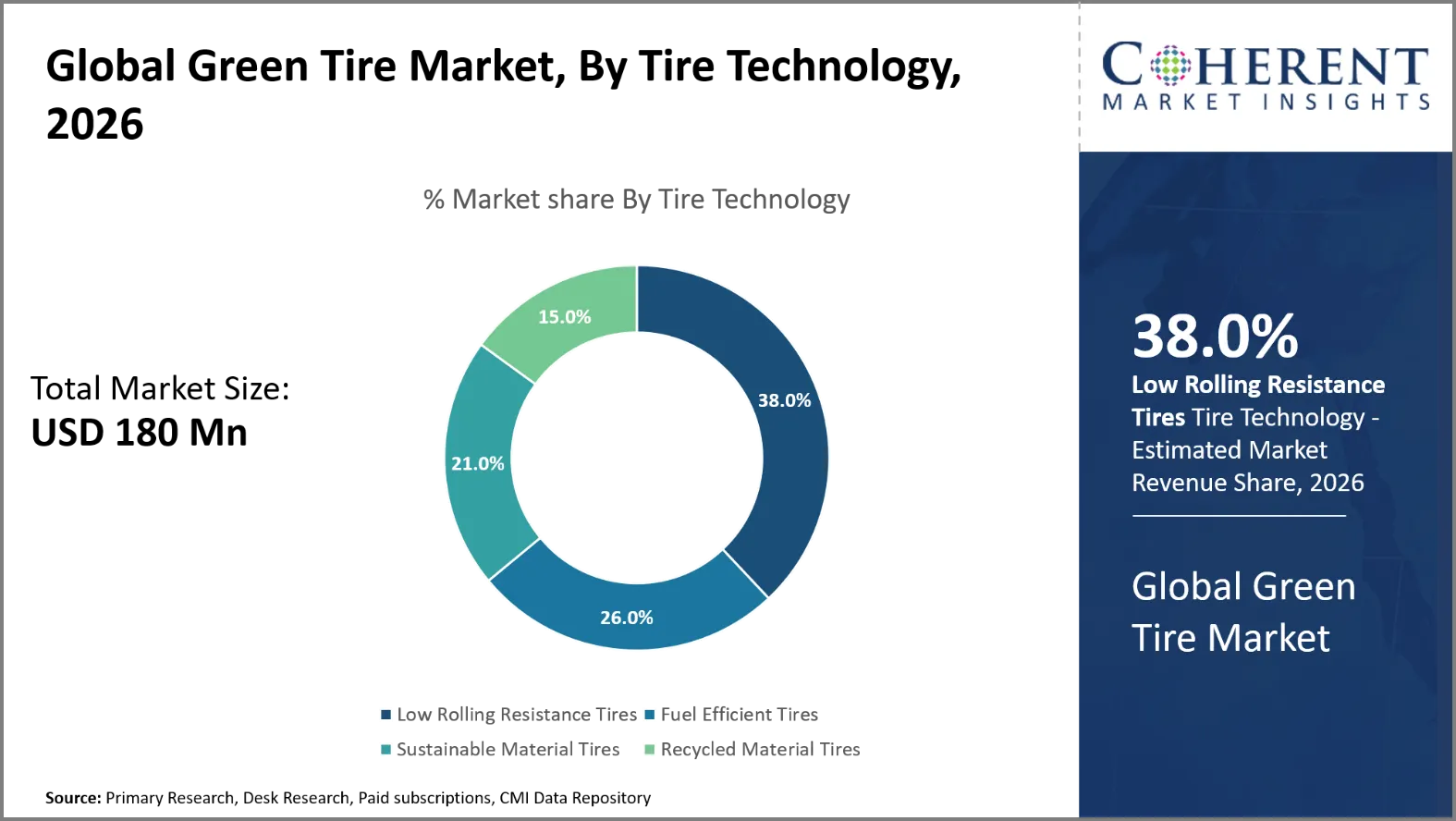
- The Low Rolling Resistance Tires segment is expected to account for 38.0% of the global green tire market share in 2026. Increasing adoption of low rolling resistance tires is driving the growth of the segment. On February 5, 2025, Continental released the EcoContact 7 and EcoContact 7 S, aimed at driving efficiency through lower rolling resistance.
- The Passenger Vehicles segment is estimated to capture 52.0% of the market share in 2026. Rising tire lifecycle sustainability requirements is majorly driving the growth of the segment. In January 2025, Continental expanded its ContiLifeCycle strategy with Conti Eco Gen 5 and Conti Urban HA 5 tires. Both products combine durability, optimized rolling resistance, casing reuse, and retreading within a cradle-to-grave approach.
- The Natural Rubber segment is estimated to capture 34.0% of the market share in 2026. Growing use of recycled tire materials is majorly driving the growth of the segment. On January 30, 2025, Bridgestone announced a precision pyrolysis pilot plant for end-of-life tires. The planned Japanese facility will recover tire-derived oil and recovered carbon black for circular material applications.
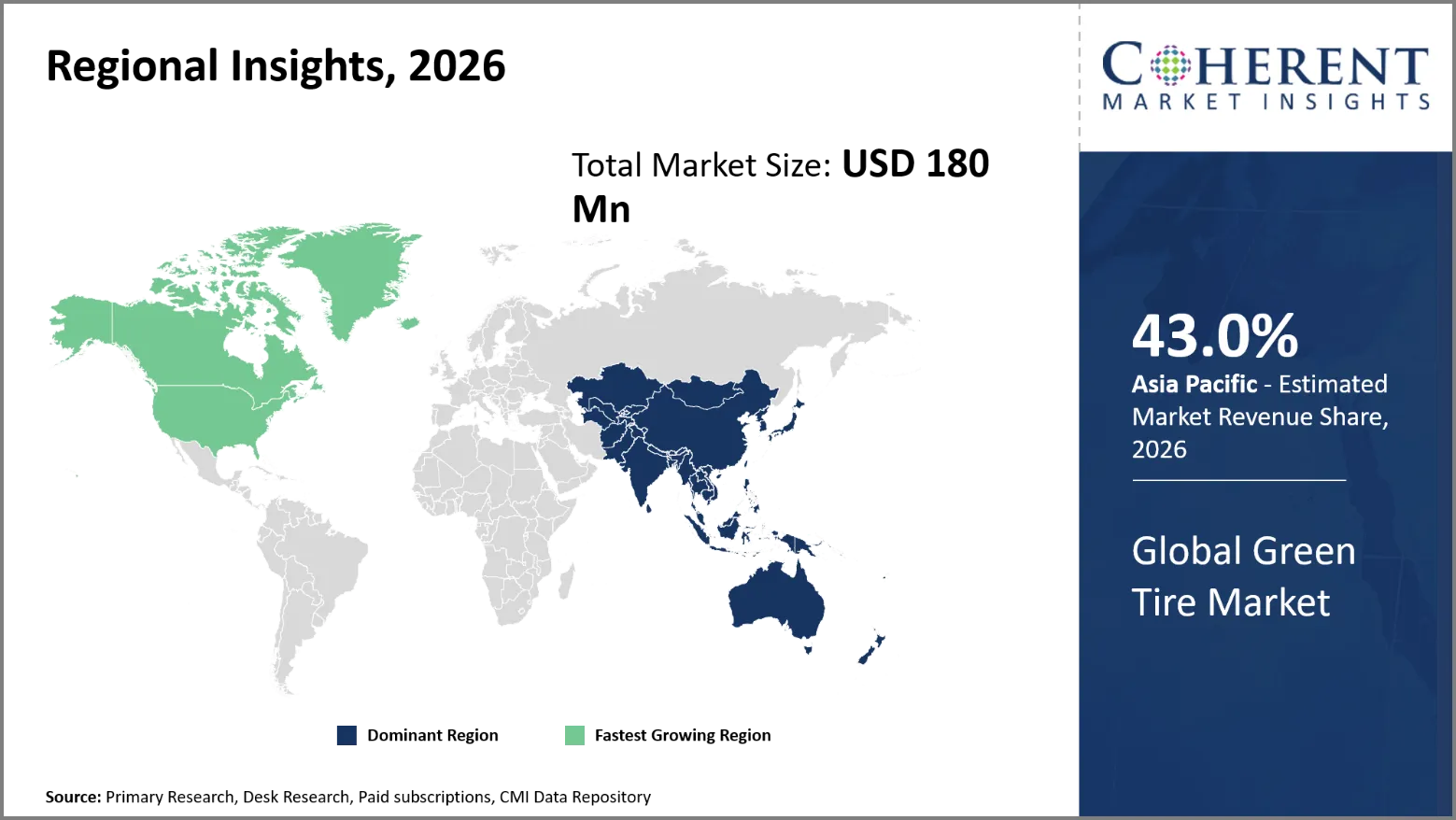
- Asia Pacific is expected to dominate the green tire market in 2026 with a market share of 43.0%. Expansion of sustainable tire technology in Asia Pacific is driving the growth of the regional market. On January 27, 2025, Bridgestone launched a Japanese joint project with Tokai Carbon, Kyushu University, and Okayama University. The project aims to upgrade recovered carbon black into eco Carbon Black with reinforcement performance comparable with virgin carbon black.
- North America is expected to account for 24.0% share in 2026 and is projected to record the fastest growth over the forecast period. Increasing automotive production in North America is driving the growth of the regional market. On June 10, 2025, General Motors announced approximately USD 4 billion of investment across Michigan, Kansas, and Tennessee manufacturing plants in the U.S.
Segmental Insights
Why Does Low Rolling Resistance Tires Dominate the Global Green Tire Market?
The low rolling resistance tires segment is expected to account for 38.0% of the global green tire market share in 2026. Low rolling resistance tires lessen the energy lost as the tire deforms as the vehicle moves. This improves fuel economy and reduces operational expenses for car owners. They also enable electric vehicles travel further between charging cycles. European tire labels will give clear information on the rolling resistance performance to help consumers make informed purchases. On August 14, 2026, Michelin Primacy5 was debuted in sedans and sport utility vehicles with increased energy economy and extended service life. Michelin reported 5% improved energy efficiency compared with Primacy4+. The tire also achieved an 18% lifespan improvement while maintaining wet-road performance.
- Current Industry Events of 2026
- Market Size Estimation
- Regional Breakdown
- Competitive Landscape
- Customer Intelligence
- Segmental Analysis
- Pricing Analysis
- Key Market Drivers, Challenges & Future Trends
- Customized Insights Section
Why is Passenger Vehicles the Most Crucial Vehicle Type?
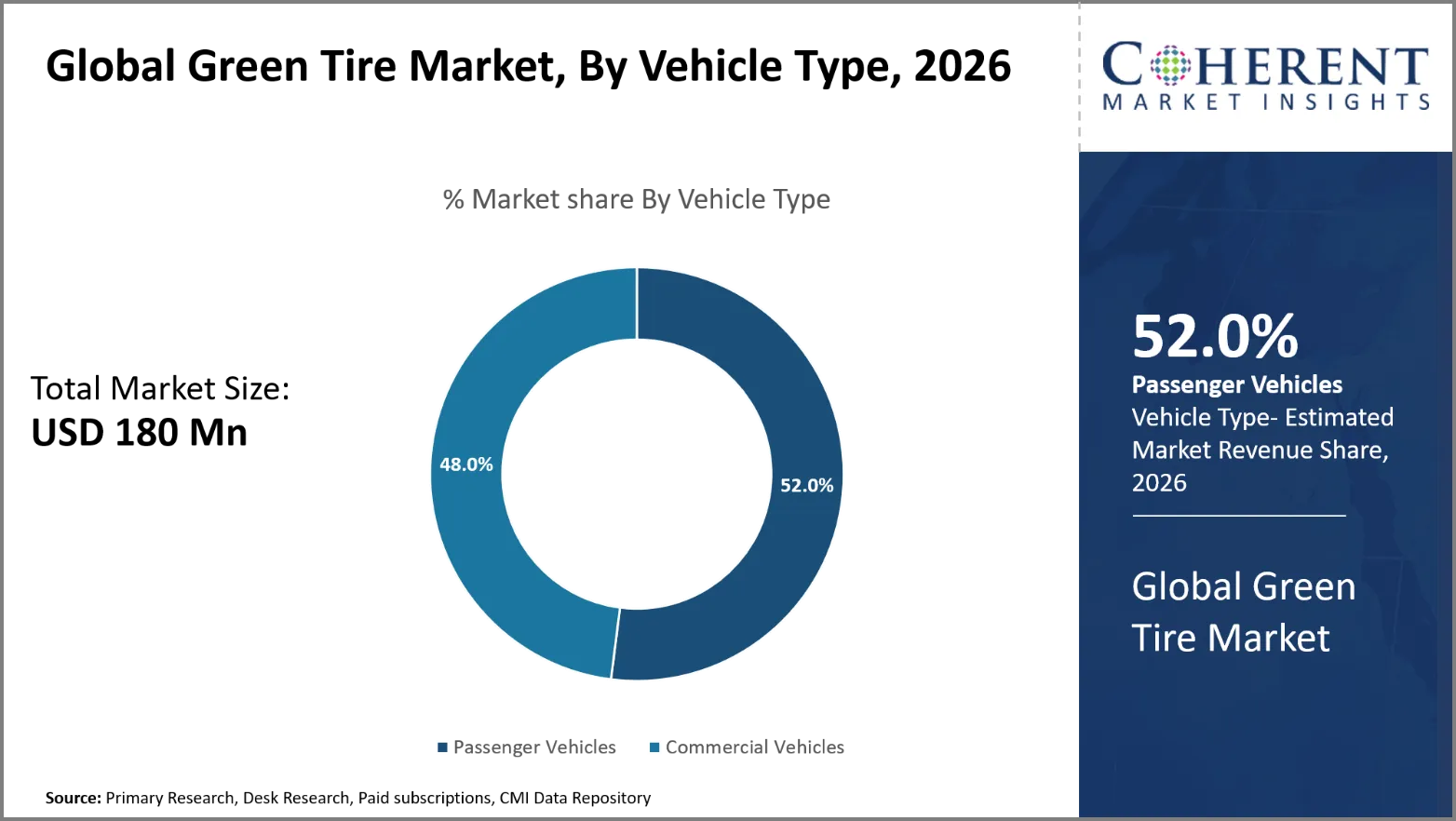
The passenger vehicles segment is expected to account for 52.0% of the global green tire market share in 2026. Passenger vehicles have high tire replacement frequency and make up a big worldwide vehicle population. Durable tire options that are fuel-efficient are also in demand from daily commuters. Low rolling resistance designs help reduce energy losses and improve fuel efficiency for passenger cars. The National Highway Traffic Safety Administration links lower rolling resistance to better fuel economy. This efficiency advantage is also a contributor to electric vehicle range, supporting adoption across passenger car platforms. For example, Pirelli continued to extend ELECT technology across passenger electric vehicles. ELECT tires are specifically designed for electric and plug-in vehicles with low rolling resistance, high load capacity and low noise. These features meet the demands of increasing weight and torque of new electric passenger vehicles.
Natural Rubber Dominates the Global Green Tire Market
The natural rubber segment is expected to account for 34.0% of the global green tire market share in 2026. Natural rubber offers outstanding elasticity, mechanical characteristics, resistance to wear and fatigue for tire applications Its strain-induced crystallization enhances durability under cyclic mechanical stress and harsh operating conditions Natural rubber also enables a good balance between grip, rolling resistance, and service life Its renewable plant-based origin contributes to sustainability goals if responsible cultivation and sourcing practices are followed These combined performance and sustainability features maintain its relevance in modern green tire formulations.
On April 9, 2026, Bridgestone Corporation announced that it has started joint research with Universitas Indonesia, Public University Corporation Yokohama City University, and Public University Corporation Maebashi Institute of Technology on the genetic study of para rubber plants. The project will leverage trees and genetic material from Bridgestone’s natural rubber plantation in Indonesia.
Current Events and Their Impact
Current Events | Description and its Impact |
European Union Euro 7 Regulation |
|
India Waste Tire Extended Producer Responsibility Rules |
|
Green Tire Market Dynamics
Market Drivers
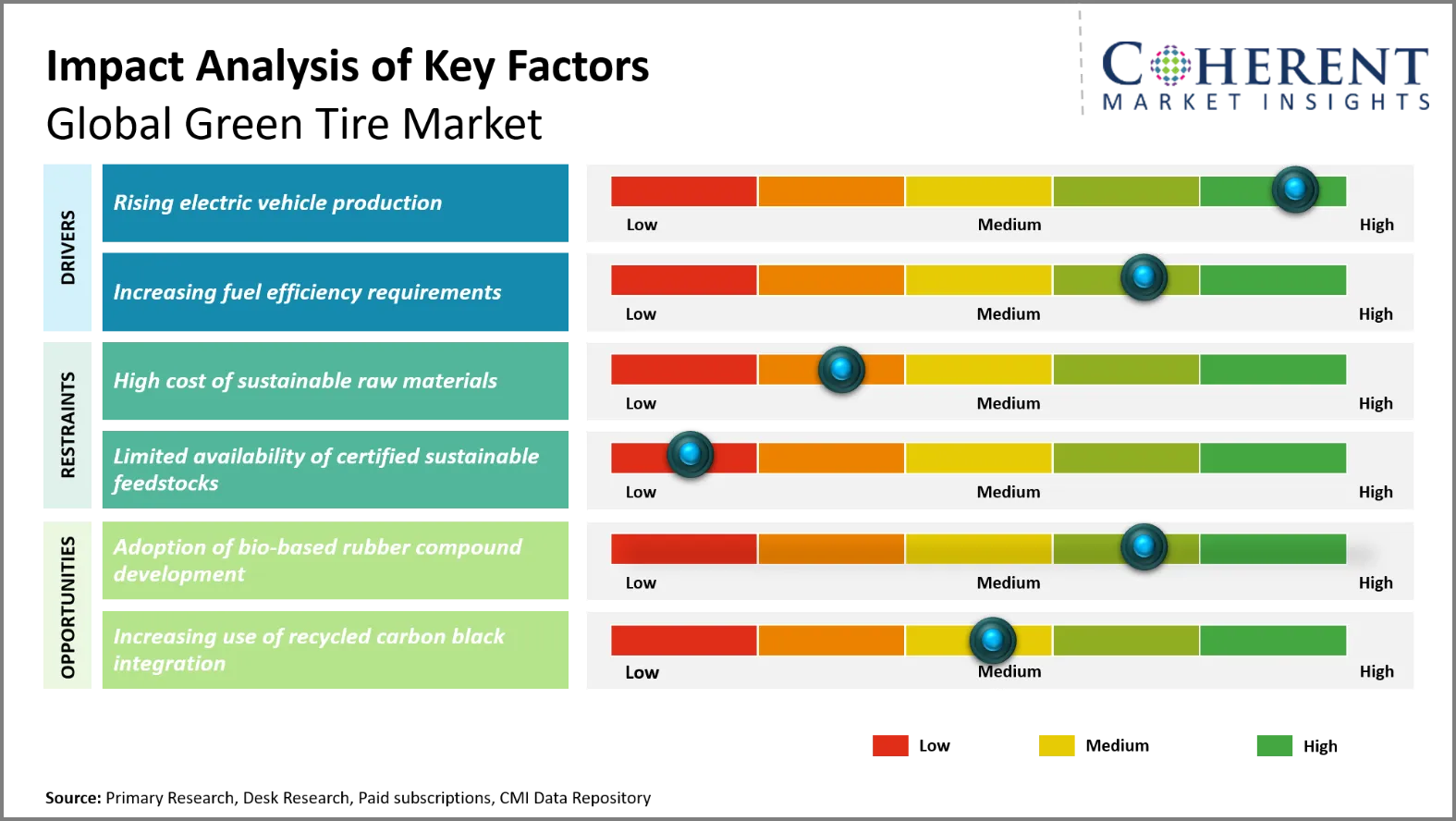
- Rising electric vehicle production: Growing electric car production is causing demand for tires engineered for energy efficiency and greater driving range. The International Energy Agency said the world made around 22 million electric cars in 2025. Electric vehicles have lower rolling resistance, which means less energy lost might increase driving range. Low rolling resistance tires can enhance the range of electric vehicles, according to the National Highway Traffic Safety Administration. And this correlation between tire efficiency and EV performance bodes well for the further use of green tire technologies. On June 30, 2026, BMW Group’s investment of USD 1.7 billion in South Carolina manufacturing facilities in the U.S. was completed. The investment will allow manufacture of all-electric vehicles at the Spartanburg factory.
- Increasing fuel efficiency requirements: The increasing fuel efficiency requirements are pushing the manufacturers to adapt tires that minimize the vehicle energy losses. The National Highway Traffic Safety Administration regards rolling resistance as an essential element in vehicle fuel economy. Its technical analysis assesses a variety of reduced rolling resistance systems for light duty cars. A 10% decrease in rolling resistance can result in a fuel economy improvement of around 1% to 2% for vehicles. These efficiency gains make it attractive to introduce low rolling resistance tires more broadly into new vehicle programs. On April 21, 2025, Hyundai Motor Group introduced its next-generation hybrid powertrain system, setting a new bar for power and economy. With this innovative system, the Group aims to launch a series of new products at the leading edge of the industry in the hybrid car segment.
Emerging Trends
- Greater Use of Renewable and Recycled Materials: Tire makers are increasing the use of renewable and sustainable materials in their commercial products. Continental aims for more than 40% renewable and recyclable materials by 2030. Materials include recycled PET, Rice Husk silica and recycled steel.
- Expansion of Circular Tire Manufacturing: Manufacturers are creating closed-loop technologies to recover valuable materials from end-of-life tires. Bridgestone is working on the chemical recycling and precise pyrolysis technologies. These approaches can reduce dependence on virgin raw materials and enhance resource efficiency.
- Development of Sustainable Electric Vehicle Tires: Tires for electric vehicles are increasingly being designed to combine reduced rolling resistance with durability and sustainable materials. Bridgestone has created tires that incorporate recycled and renewable materials for electric vehicle applications. Longer tire life can also mitigate the environmental impacts.
- Integration of Bio-Based Tire Materials: Tire producers are increasingly using bio-based alternatives for rubber, silica, resins and reinforcing elements. Continental is utilizing synthetic rubber made from discarded cooking oil and silica from rice husk ash These materials lessen the dependence on fossil-based inputs.
Regional Insights
Why is Asia Pacific a Strong Market for Green Tire?
Asia Pacific is expected to account for a market share of 43.0% in 2026. Rapid electric vehicle manufacture and localized sustainable tire production are being driven by Asia Pacific. Bridgestone also added International Sustainability and Carbon Certification PLUS facilities in Taiwan and Vietnam in 2025. The certificates enable the use of recycled and renewable tire materials in regional supply chains. Bridgestone also developed ENLITEN tires supporting NIO electric vehicles with lower material consumption and improved driving efficiency. China, Japan, India, and Southeast Asian countries are therefore strengthening sustainable tire technology development through vehicle partnerships and manufacturing investments.
Why Does North America Green Tire Market Exhibit High Growth?
North America is expected to register the fastest growth with a CAGR of 12.9% over the forecast period. The region is projected to account for 24.0% of the global green tire market in 2026. Green tires are gaining a foothold in North America, with electric vehicle makers prioritizing driving range and energy efficiency. Bridgestone launched Turanza EV with 50% sustainable and recyclable materials for electric vehicles in North America. The tire is made with recycled synthetic rubber, recycled carbon black and natural rubber. Bridgestone Americas also revealed the M870 demonstration tire for waste collection fleets in 2025. The tire supports allocation of 70% recycled and renewable materials through International Sustainability and Carbon Certification PLUS processes.
Global Green Tire Market Outlook for Key Countries
Why is China Emerging as a Major Hub in the Green Tire Market?
China is fueling green tire demand because of its huge electric vehicle production ecosystem and growing sustainable transportation demands. Bridgestone has equipped the NIO ET7 electric car with its ENLITEN technology. The technology enhances efficiency in driving and lowers the consumption of raw materials. Bridgestone also launched ENLITEN technology in China through the Nissan X-Trail program. Partnerships between the automotive and tire industries provide tire manufacturers with an incentive to focus on optimizing rolling resistance, material efficiency and electric vehicle reliability. China's large electric vehicle production ecosystem further accelerates original equipment development for sustainable tire technologies.
Is U.S. the Next Growth Engine for the Green Tire Market?
Fuel economy rules and growing electric car usage are shaping the U.S. industry. The National Highway Traffic Safety Administration assesses low rolling resistance technology because tire resistance influences vehicle efficiency. Bridgestone already markets the Turanza EV in North America with 50% renewable and recycled materials. Bridgestone Americas is also developing sustainable commercial tires for waste collection fleets. These advancements are pushing sustainable tire applications beyond passenger cars to specialized commercial fleets. Increasing demand for fleet efficiency is offering new prospects for improved low resistance tire designs.
Germany Green Tire Market Analysis and Trends
Germany is profiting from high manufacturing of premium cars and strict European sustainability regulations. Continental developed the UltraContact NXT as its most sustainable passenger car tire. The tire achieved first place in a 2025 electric vehicle summer tire test using a Nissan Leaf. The tested tire achieved an A rating for rolling resistance and wet braking under European tire labeling criteria. Germany therefore provides a strong development environment for combining sustainability, safety, and electric vehicle performance. Local automotive engineering capabilities further support advanced green tire development.
Japan Green Tire Market Analysis and Trends
Japan is advancing green tires through circular material technologies and precision tire recycling. Bridgestone decided to construct a precision pyrolysis pilot plant at its Seki Plant in Gifu Prefecture. The facility is scheduled to begin operations during 2027. It will recover pyrolysis oil and recovered carbon black from end-of-life tires. Bridgestone also introduced partially recycled-material tires in Japan, including REGNO GR-XIII. These initiatives demonstrate Japan's emphasis on circular material recovery and closed-loop tire manufacturing. The approach creates new applications for materials recovered from discarded tires.
India Green Tire Market Analysis and Trends
India is developing green tire technologies through electric vehicle growth and domestic sustainable material innovation. Apollo Tires has produced passenger car tires that comprise 75% sustainable materials, including bio-based and recycled inputs. These tires were manufactured by the business at their plant in Andhra Pradesh. Apollo Tires also produced the first-ever Apollo Amperion electric passenger vehicle tire using sustainable material technologies. Bridgestone India is also expanding electric vehicle tire technologies and sustainable mobility services across local operations. The increasing vehicle manufacturing capacities in India facilitate larger commercialization of sustainable tire technologies.
Global Green Tire Market - Commercial Fleet Green Tire Adoption by Country (2025)
Country | Estimated Commercial Fleet Green Tire Adoption |
France | 68% |
Germany | 61% |
U.K. | 64% |
U.S. | 58% |
Netherlands | 72% |
Sweden | 74% |
Norway | 78% |
Italy | 55% |
Spain | 52% |
China | 45% |
Japan | 57% |
South Korea | 51% |
India | 34% |
Australia | 48% |
Canada | 50% |
How is Adoption of Bio-Based Rubber Compound Development Creating New Growth Opportunities in the Green Tire Market?
Bio-based rubber compounds are opening up new growth opportunities by replacing petroleum-based feedstocks without compromising crucial tire performance. Continental already uses synthetic rubber from spent cooking oil and pyrolysis oil in tire compounds, based on International Sustainability and Carbon Certification PLUS mass-balance systems. These compounds can increase the sustainability profile of tread compositions, while maintaining the requisite braking and rolling-resistance properties. Michelin is also working on bio-based butadiene for synthetic elastomers, which creates prospects to decrease reliance on petroleum for production of high-performance rubber. In 2026, Michelin stepped up research with the National Center for Scientific Research and French institutions to develop recyclable, high-performance polymers which require less energy to produce. These innovations are giving rise to new supplier ecosystems for bio-based feedstocks, innovative elastomers, certified materials, and scalable green chemistry for tire makers.
On December 19, 2025, Hankook Tire & Technology announced that its Daejeon Plant has been awarded the International Sustainability & Carbon Certification (ISCC) PLUS, a global certification system for sustainable raw materials. ISCC PLUS is a voluntary international certification system that verifies the sustainability of bio-based and recycled materials, as well as supply chain transparency.
Market Players, Key Development, and Competitive Intelligence
Key Developments
- On June 24, 2024, ENSO signed a Letter of Interest with the Export-Import Bank of the United States to establish a groundbreaking carbon-neutral tire factory in America. U.S.-based technology partners Rockwell, global sustainable development firm Arup and US-based investors 8090 Industries and Galway Sustainable Capital, are supporting ENSO.
- On May 23, 2024, Michelin partnered with French cleantech startup Bobine to develop chemical recycling technology for plastics. Bobine joined Michelin's Center for Sustainable Materials at Parc Cataroux in France. The collaboration targets industrial scaling of complex plastic recycling processes.
- On January 12, 2024, Toyo Tire Corporation announced that it has introduced a concept tire that uses sustainable materials for 90% of its raw materials. The highest-ever ratio of sustainable raw materials used in Toyo Tire’s tires was 50%, and the ratio for this new concept tire far surpasses this previous record.
Competitive Landscape
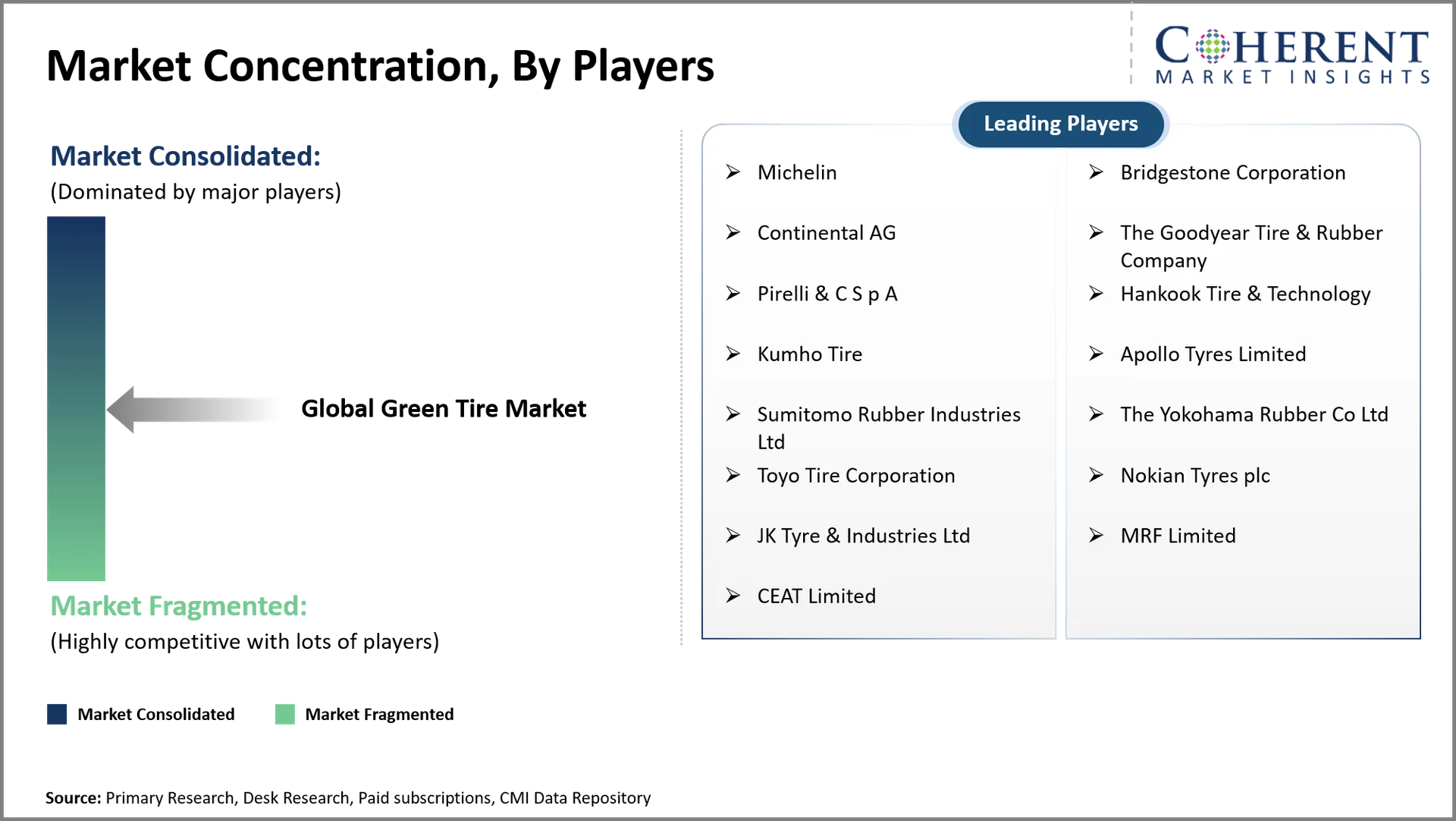
The green tire market is led by Michelin, Bridgestone, Continental, Goodyear, Pirelli, and Apollo Tires. Michelin is focusing on longer-lasting products and lower energy consumption through technologies such as Primacy5. Its Primacy5 delivers 18% longer lifespan and 5% improved energy efficiency compared with Primacy4. Bridgestone is focused on circular materials, ENLITEN lightweighting, renewable feedstocks and tire recycling. In 2025, it had 40% recycled and renewable material content. Continental is focusing on bio-based synthetic rubber, rice husk silica, recovered steel and recycled polyester. Its UltraContact NXT contains up to 65% renewable, recycled, and mass-balance certified materials. Apollo Tires is targeting sustainable materials across passenger and agricultural tires. Its prototype passenger tires contain up to 75% sustainable materials. Competitive differentiation is therefore shifting toward verified material substitution, durability, energy efficiency, and scalable circular manufacturing.
Global Green Tire Market Report Coverage | |||
Report Coverage | Details | ||
Base Year | 2025 | Market Size in 2026: | USD 180 Mn |
Historical Data For: | 2020 To 2024 | Forecast Period: | 2026 To 2033 |
Forecast Period 2026 To 2033 CAGR: | 12.50% | 2033 Value Projection: | USD 581 Mn |
Geographies covered: |
| ||
Segments covered: |
| ||
Companies covered: | Michelin, Bridgestone Corporation, Continental AG, The Goodyear Tire & Rubber Company, Pirelli & C S p A, Hankook Tire & Technology, Kumho Tire, Apollo Tires Limited, Sumitomo Rubber Industries Ltd, The Yokohama Rubber Co Ltd, Toyo Tire Corporation, Nokian Tires plc, JK Tire & Industries Ltd, MRF Limited, CEAT Limited | ||
Growth Drivers: |
| ||
Restraints & Challenges: |
| ||
Analyst Opinion (Expert Opinion)
- The future of green tires will increasingly center on tires combining bio-based compounds with low rolling resistance and extended service life. Bio-based synthetic rubber, renewable oils, rice-husk silica, and recycled carbon black will become important formulation priorities. Passenger electric vehicles should offer the strongest opportunity because tire efficiency directly affects driving range and energy consumption. Manufacturers are already focused on specific tire specs for premium electric car programs, so advanced sustainable compounds can also be brought to market more quickly. Hence, players should focus on certified feedstock supply, compound optimization and direct collaborations with EV makers.
- Asia, especially China, Japan and India, should offer major potential for localized green tire development. China offers good prospects for EV specialized tires and local integrated sustainable material supply chains. Japan offers prospects for circular tire technologies involving chemical recycling and incorporation of recovered materials. India could be an especially good region to develop bio-based compounds, as Apollo Tires currently has sustainable-material prototypes in production domestically. Premium sustainable tires are expected to be a key segment for European markets, as environmental standards increasingly consider factors such as tire materials and abrasion.
- Tire makers need to think beyond just substituting one petroleum input to obtain an edge. Companies need to build full material platforms that integrate renewable feedstocks, recycled materials, lightweight construction and durability enhancements. Bridgestone’s ENLITEN method is a great example of combining recycled and renewable inputs with material reduction. Continental’s UltraContact NXT shows another option, bringing together renewable resources and recyclable inputs with mass-balance certified chemicals. Suppliers should also secure traceable feedstock partnerships and certification capabilities before sustainable materials become mainstream procurement requirements.
Speak to the analyst
Want personalized insights?
Take the findings above to one of our principal consultants, or have the report rebuilt around the segments, geographies and competitors you actually track.
Market Segmentation
- Tire Technology Insights (Revenue, USD Million, 2021 - 2033)
- Low Rolling Resistance Tires
- Fuel Efficient Tires
- Sustainable Material Tires
- Recycled Material Tires
- Vehicle Type Insights (Revenue, USD Million, 2021 - 2033)
- Passenger Vehicles
- Commercial Vehicles
- Material Insights (Revenue, USD Million, 2021 - 2033)
- Natural Rubber
- Synthetic Rubber
- Silica-Based Compounds
- Bio-Based Polymers
- Recycled Materials
- Sales Channel Insights (Revenue, USD Million, 2021 - 2033)
- OEM
- Aftermarket
- Regional Insights (Revenue, USD Million, 2021 - 2033)
- North America
- U.S.
- Canada
- Latin America
- Brazil
- Argentina
- Mexico
- Rest of Latin America
- Europe
- Germany
- U.K.
- Spain
- France
- Italy
- Russia
- Rest of Europe
- Asia Pacific
- China
- India
- Japan
- Australia
- South Korea
- ASEAN
- Rest of Asia Pacific
- Middle East
- GCC Countries
- Israel
- Rest of Middle East
- Africa
- South Africa
- North Africa
- Central Africa
- North America
Sources
Primary Research Interviews
- Tire Manufacturers & OEM Representatives
- Raw Material Suppliers (Silica, Natural Rubber Suppliers)
- Automotive Industry Experts & Consultants
- Regulatory & Environmental Policy Experts
Magazines
- Tire Technology International Magazine
- Rubber & Plastics News
- Automotive World Magazine
- European Rubber Journal
Journals
- Journal of Cleaner Production
- International Journal of Sustainable Transportation
- Journal of Applied Polymer Science
Associations
- European Tire & Rubber Manufacturers' Association (ETRMA)
- Rubber Manufacturers Association (RMA)
- International Organization of Motor Vehicle Manufacturers (OICA)
- World Business Council for Sustainable Development (WBCSD)
Public Domain Sources
- U.S. Environmental Protection Agency (EPA) – Green Vehicle & Tire Efficiency Reports
- European Commission – Green Deal & Sustainable Mobility Policy Documents
- International Energy Agency (IEA) – Electric Vehicles & Sustainable Transport Reports
- United Nations Environment Programme (UNEP) – Sustainable Consumption Reports
Proprietary Elements
- CMI Data Analytics Tool
- Proprietary CMI Existing Repository of Information for Last 10 Years
Get access to 250+ pages report
Every segment, forecast, competitor profile and data table behind the analysis above — available for instant download.
- ESOMAR Member
- ISO 9001:2015 Certified
- D-U-N-S Registered
- GDPR & CCPA Compliant
Missing comfort of reading report in your local language? Find your preferred language:
Frequently Asked Questions
The global green tire market is expected to stand at USD 180 Mn in 2026 and is expected to reach USD 581 Mn by 2033.
The CAGR of the global green tire market is projected to be 12.5% from 2026 to 2033.
Rising electric vehicle production and Increasing fuel efficiency requirements are the major factors driving the growth of the global green tire market.
High cost of sustainable raw materials and Limited availability of certified sustainable feedstocks are the major factors hampering the growth of the global green tire market.
In terms of tire technology, low rolling resistance tires segment is estimated to dominate the market revenue share in 2026.
Green tires use technologies and materials that reduce environmental impacts while maintaining required tire performance.
Bio-based rubber reduces dependence on petroleum-derived feedstocks while supporting advanced tire compound formulations.