

Global Greenhouse Management Market Size and Forecast – 2026 To 2033
The Global Greenhouse Management Market is estimated to be valued at USD 2.54 Bn in 2026 and is expected to reach USD 6.51 Bn by 2033, expanding at a CAGR of 14.40% during 2026–2033. Market expansion is supported by investments in automated climate control, precision irrigation, and intelligent crop monitoring systems that help commercial growers improve productivity while managing water and energy consumption.
In June 2026, GreenTech Amsterdam awarded its Innovation Award to Belgium-based Sensie for Sensie Omni, a wireless plant-monitoring technology that combines real-time root-zone, climate, and plant-response data to support cultivation decisions. This development highlights the industry's shift toward plant-centered greenhouse management and data-informed resource optimization.
Key Takeaways of the Global Greenhouse Management Market
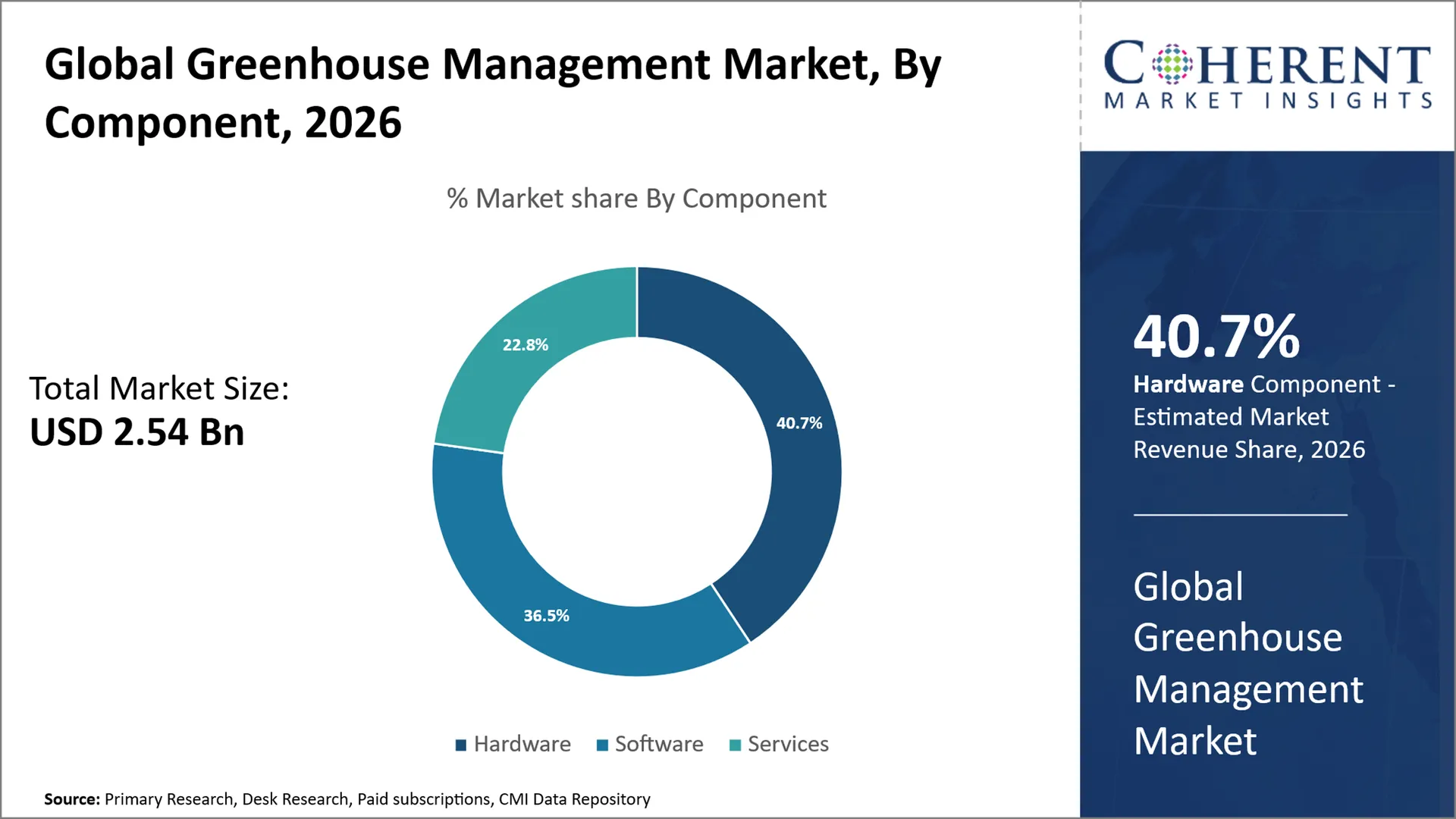
- Hardware is forecast to grow at an estimated CAGR of 13.7% during 2026–2033 and represent 40.7% of the global greenhouse management market in 2026. Sensors, controllers, and connected monitoring devices remain essential investments for measuring growing conditions and validating crop responses. In June 2025, Ridder integrated Gardin's optical photosynthesis sensor data into its Hortimax Pro greenhouse control platform, linking plant measurements to operating decisions.
- Climate and Environmental Control is estimated to expand at a CAGR of 15.1% from 2026 to 2033, with a 31.4% global greenhouse management market share expected in 2026. Growers prioritize stable humidity and heat distribution because fluctuations can disrupt flowering, disease management, and crop consistency. In January 2025, Svensson documented Marjoland's installation of energy screens and vertical fans to stabilize greenhouse conditions during its LED transition.
- Automated Greenhouse Control Systems are projected to achieve an estimated 14.8% CAGR across 2026–2033, alongside a leading 57.5% share in the global greenhouse management market. Integrated execution platforms reduce repetitive operator adjustments while coordinating climate and cultivation settings across commercial facilities. In September 2026, Hoogendoorn and De Bakker Westland opened a control room combining IIVO execution, production analytics, and intelligent algorithms in an operating greenhouse business.
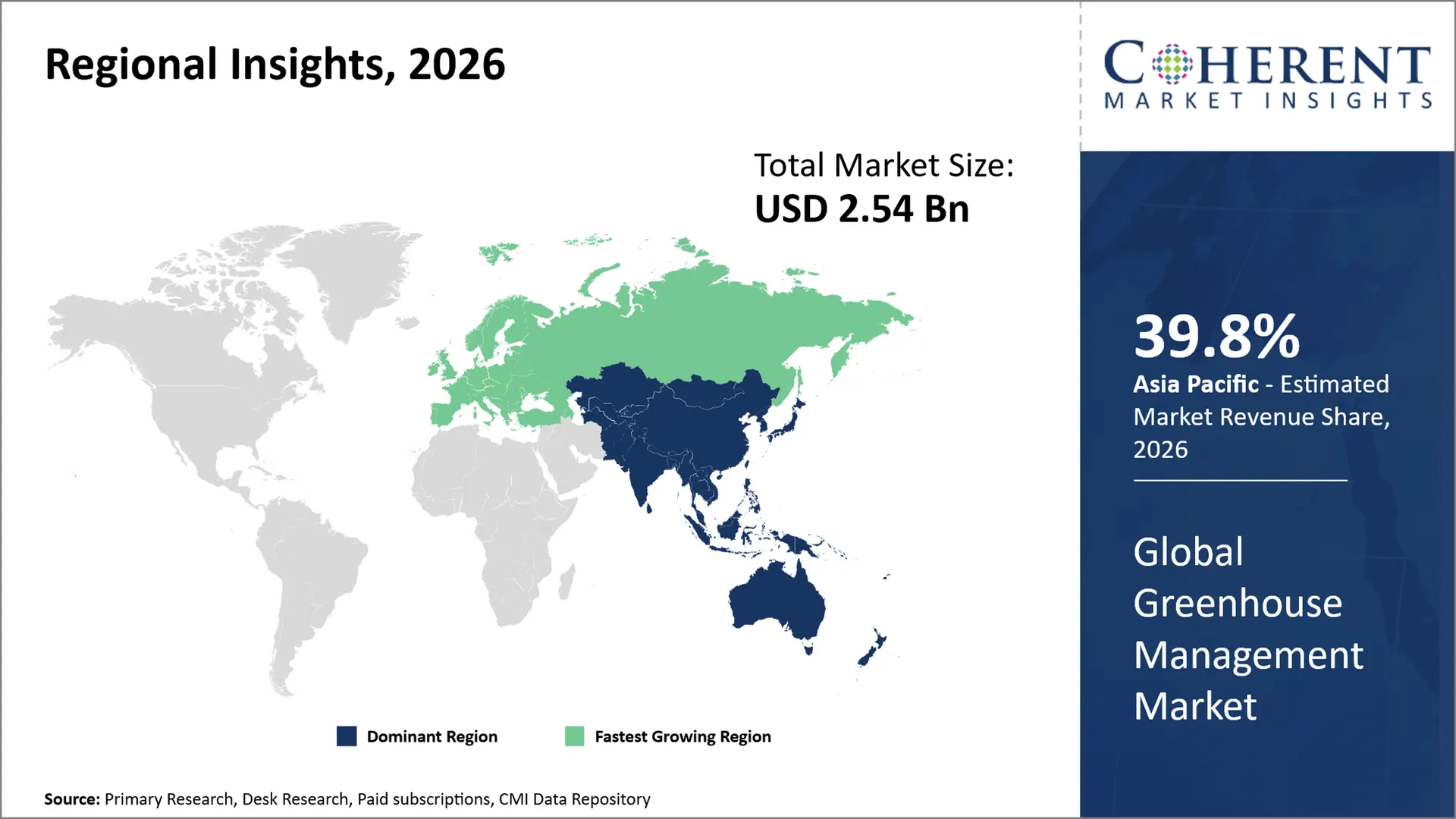
- Asia Pacific is estimated to register a 14.3% CAGR over 2026–2033 and hold 39.8% of the global greenhouse management market in 2026. Growers across Japan, China, and India are expanding protected cultivation through localized technology adoption and productivity-focused investments. In June 2025, Japan's Ministry of Agriculture, Forestry and Fisheries invited applications for its Smart Greenhouse Deployment Promotion initiative under a data-driven agriculture support program.
- Europe is anticipated to expand at an estimated 17.2% CAGR during 2026–2033, following a 31.6% share of global greenhouse management market in 2026, making it the fastest-growing region in this forecast. Retrofitting established glasshouse facilities offers suppliers opportunities to modernize energy-intensive infrastructure. In September 2026, the Netherlands Enterprise Agency opened an energy-efficiency subsidy window supporting greenhouse investments in qualifying equipment and systems.
Segmental Insights
Why Does Hardware Dominate the Global Greenhouse Management Market?
Hardware is expected to account for 40.7% of the global greenhouse management market in 2026, making it the largest component category. Its leadership reflects the need to capture reliable measurements at multiple crop locations before operators can evaluate differences between benches, aisles, or greenhouse compartments. Commercial nurseries and research greenhouses particularly value portable, weather-resistant instruments that can be installed without replacing existing control infrastructure. Hardware suppliers benefit from instrument replacement cycles, calibration requirements, and demand for specialized light measurements, while distributors can serve customers seeking incremental upgrades. In August 2025, LI-COR introduced HOBO MX2308 and MX2309 multiparameter data loggers. The MX2308 combines temperature, relative humidity, and photosynthetically active radiation measurements for commercial greenhouses and other cultivation settings. Such instruments help buyers expand observation coverage without undertaking a complete greenhouse automation project.
- Current Industry Events of 2026
- Market Size Estimation
- Regional Breakdown
- Competitive Landscape
- Customer Intelligence
- Segmental Analysis
- Pricing Analysis
- Key Market Drivers, Challenges & Future Trends
- Customized Insights Section
Why Is Climate and Environmental Control the Largest Primary Management Function in the Global Greenhouse Management Market?
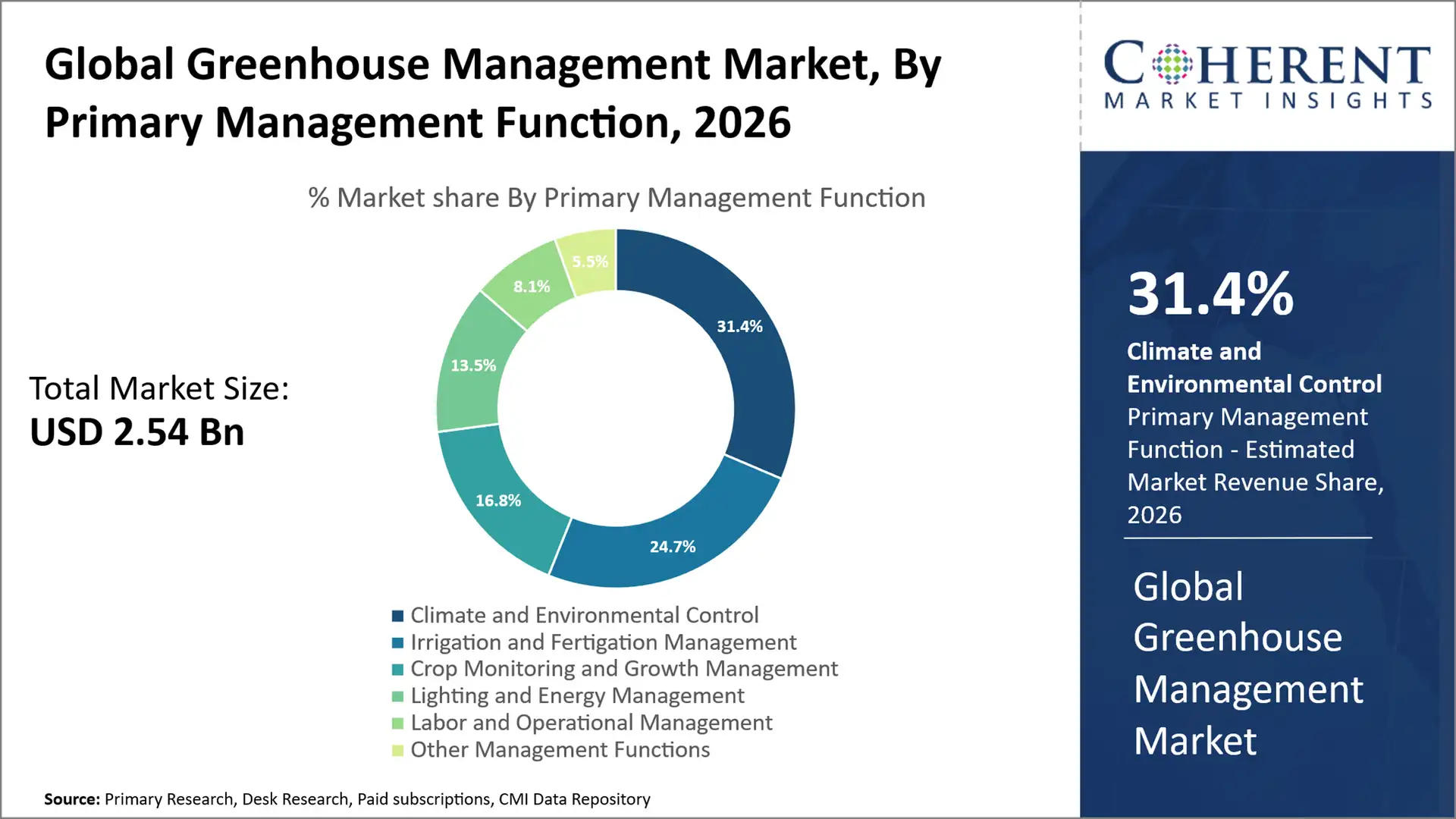
Climate and Environmental Control is expected to secure 31.4% of the global greenhouse management market in 2026, leading the primary management function category. Its commercial importance extends beyond setting a target temperature: densely planted tomato and pepper greenhouses can accumulate moisture within the canopy even when conditions elsewhere appear acceptable. Operators need equipment that removes excess water vapor without repeatedly releasing heated, carbon-enriched air through ventilation. This creates procurement opportunities for specialized dehumidification manufacturers and greenhouse retrofit contractors, particularly in facilities adjusting to LED lighting. In June 2026, DryGair unveiled its DG-12 50Hz dehumidifier at the DryGair Experience event in the Netherlands. Developed for high-wire vegetable crops, the unit combines moisture extraction with managed air circulation. Its design illustrates the growing value of targeted humidity treatment over generalized ventilation.
Why Do Automated Greenhouse Control Systems Dominate the Global Greenhouse Management Market by Automation Level?
Automated Greenhouse Control Systems are expected to represent 57.5% of the global greenhouse management market in 2026, the largest share within the automation level category. Many commercial operators prefer programmable automation because it can preserve established operating procedures while letting facilities add crop zones or replace equipment in stages. The purchasing decision therefore turns on configurable inputs and outputs, communication compatibility, and service access rather than autonomous decision-making alone. System integrators benefit when control architectures accommodate mixed equipment fleets and limit redesign costs during expansion. In October 2025, Argus Controls Systems unveiled Argus Axia, a greenhouse control platform using modular edge controllers and configurable input-output cards. Its architecture illustrates how scalable automation can protect installed infrastructure while supporting new operating requirements across cultivation spaces.
Current Events and their Impact
Current Event | Description and Its Impact |
India's Updated Horticulture Development Guidelines – December 2024 |
|
U.S. FDA Updates Agricultural Water Safety Requirements – May 2024 |
|
Netherlands Introduces Individual Greenhouse Carbon Levy – January 2025 |
|
Global Greenhouse Management Market Dynamics
Key Market Drivers
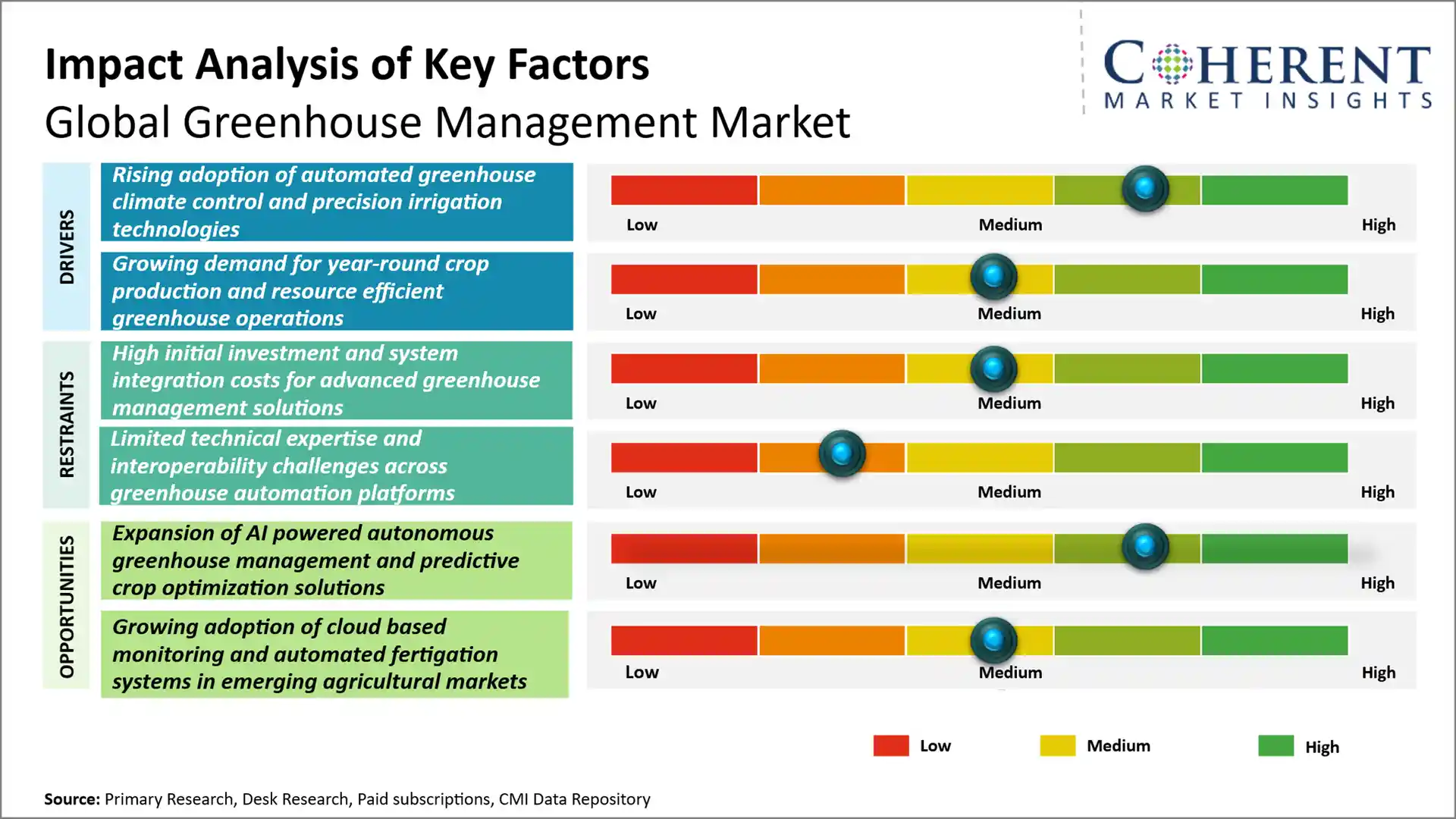
- Rising adoption of automated greenhouse climate control and precision irrigation technologies: Commercial growers increasingly coordinate greenhouse climate regulation and irrigation scheduling to improve crop consistency and reduce operational waste. Automated controllers, environmental sensors, and precision dosing equipment help operators regulate moisture and nutrient delivery while limiting manual intervention. This creates opportunities for automation manufacturers, equipment suppliers, and system integrators. In February 2025, Orbia Netafim introduced its Hybrid Dripline system, designed to simplify irrigation connections for greenhouse substrates. The development demonstrates how improved irrigation infrastructure can reduce installation complexity and strengthen the commercial value of greenhouse modernization.
- Growing demand for year-round crop production and resource efficient greenhouse operations: Year-round greenhouse cultivation requires efficient energy utilization, reliable growing conditions, and predictable operating expenses across changing seasons. Commercial growers increasingly prioritize coordinated investments in heating, lighting, and energy-saving infrastructure to maintain production continuity and improve profitability. This supports demand for greenhouse equipment manufacturers, technology integrators, and engineering contractors. In December 2025, Government of Canada and Alberta announced a USD-independent USD 7.04 million Growing Greenhouses program supporting commercial greenhouse expansion, energy-efficient technologies, advanced lighting, and automation. The initiative illustrates how public investment can strengthen local production capacity and encourage modern greenhouse infrastructure adoption.
Emerging Market Trends
- Increasing Use of Digital Crop Models for Predictive Production Planning: Crop-model platforms are moving beyond yield estimation toward production commitments that reflect actual plant development. Digital twins can combine cultivar histories, observed crop growth, and expected weather to compare alternative cultivation plans before growers change settings. That raises procurement expectations for greenhouse software: transparent assumptions, frequent model recalibration, and links to harvest and packing schedules become more valuable than dashboards alone. Agronomic software specialists and grower cooperatives could gain operational leverage, while spreadsheet-based planning services face pressure to demonstrate comparable reliability across variable harvest periods.
- Growing Importance of Data Interoperability and Secure Greenhouse Connectivity: Greenhouse owners are placing greater value on controlling the operational information generated by sensors, dosing systems, and climate computers. Procurement teams are therefore examining exportable datasets, standardized application interfaces, and contract terms governing access to cultivation records. This shift can extend the useful life of technology investments when multiple equipment brands operate within one facility. Independent integration specialists could gain negotiating power, while suppliers dependent on proprietary interfaces may need to prove compatibility and cybersecurity safeguards. Secure, transferable data architectures are likely to become more important in purchasing decisions.
Regional Insights
Why Does Asia Pacific Dominate the Global Greenhouse Management Market?
Asia Pacific is expected to lead the global greenhouse management market with a 39.8% share in 2026. Its position reflects the coexistence of industrial-scale protected vegetable production and smaller facilities seeking affordable controls across different climatic conditions. Growers in East Asia prioritize consistent cultivation protocols and skilled operation, while operators in warmer production zones require equipment suited to intensive cooling and irrigation. This creates opportunities for manufacturers offering adaptable control systems and localized technical support. In June 2025, South Korea's Ministry of Agriculture, Food and Rural Affairs designated the Korea Agricultural Technology Promotion Agency as a smart-farming support centre for controlled horticulture, covering workforce training, technology adoption, equipment services, and agricultural data management. The initiative demonstrates how institutional support can strengthen greenhouse modernization across commercial farming operations.
Why Is Europe Emerging as the Fastest-Growing Region in the Global Greenhouse Management Market?
Europe is projected to be the fastest-growing region in the global greenhouse management market, accounting for 31.6% in 2026. Growth opportunities increasingly lie in upgrading established greenhouse facilities to address production traceability, environmental compliance, and resource management requirements. Specialist crop advisers, software developers, and horticultural associations can commercialize technologies that translate research into practical cultivation methods. Cross-border knowledge sharing is particularly valuable because greenhouse operating requirements differ between Mediterranean vegetable clusters and northern glasshouse facilities. In October 2025, the European Union-funded BIOGREENET project commenced activities to connect organic greenhouse producers, researchers, and advisers through digital platforms and coordinated knowledge-sharing initiatives. Its focus on applied cultivation practices illustrates how collaborative innovation can improve technology accessibility and support further greenhouse management investment across European agricultural markets.
Global Greenhouse Management Market Outlook for Key Countries
Why Is the U.S. a Key Market for the Global Greenhouse Management Market?
The U.S. is an important global greenhouse management market because growers face distinct production economics across northern heating-dependent facilities and warm-climate vegetable operations. American buyers often assess technology through crop-specific returns rather than treating automation as a universal package. Research institutions help reduce this uncertainty by testing irrigation regimes, nutrient recipes, and varieties against local greenhouse conditions. Their findings can shape specifications for suppliers of dosing equipment, substrate monitoring, and production software. In September 2025, the U.S. Department of Agriculture's Agricultural Research Service began a cooperative project focused on high-quality tomato production in Florida's controlled-environment facilities. The work covers recirculating seedling irrigation, nutrient concentrations, suitable cultivars, and the feasibility of an extended greenhouse crop season. Such evidence can help commercial growers prioritize validated process improvements over unnecessary capital expenditure.
Why Does China Support Growth in the Global Greenhouse Management Market?
China's greenhouse management market benefits from the ability to build digitally coordinated production facilities alongside expanding horticultural supply chains. Provincial agricultural parks can combine nursery operations, vegetable cultivation, digital farm management, and downstream distribution within the same investment program. This structure encourages procurement of compatible monitoring, fertigation, and operating platforms rather than disconnected equipment purchases. It also creates opportunities for domestic engineering contractors to replicate integrated designs across agricultural districts. In March 2025, Hubei's agricultural authorities reported that Macheng's digital agriculture industrial park had entered operation with an intelligent greenhouse, automated environmental controls, water-fertilizer management, and a cloud-based operating platform. The development demonstrates how local agricultural industrialization can generate demand for system integration, installation services, and ongoing technical support across the greenhouse production chain.
Why Is the Netherlands Important in the Global Greenhouse Management Market?
The Netherlands holds a strategic position in global greenhouse management market because horticultural technology firms work within a concentrated ecosystem of glasshouse growers, crop specialists, and research facilities. Commercial customers can test management decisions against measured crop outcomes, creating a demanding environment for software validation and supplier differentiation. Dutch expertise is particularly valuable for export-oriented greenhouse projects that need transferable cultivation protocols and operator training. In January 2025, Wageningen University & Research announced the results of its fourth Autonomous Greenhouse Challenge, in which competing algorithms managed dwarf-tomato cultivation and were evaluated on profitability. Team IDEAS achieved the highest profit. By assessing crop strategy as a commercial result rather than a technical demonstration alone, the challenge offers a useful model for evaluating greenhouse decision-support systems before wider deployment.
Why Is India an Important Growth Market for the Global Greenhouse Management Market?
India represents a developing global greenhouse management market because production requirements differ sharply between hot plains, humid growing zones, and higher-altitude horticultural areas. Commercial growers of capsicum, cucumber, and tomato need equipment configurations that match crop value, power availability, local service capacity, and the cost of ongoing maintenance. Limited access to trained greenhouse technicians can make technical support as important as equipment specifications. In March 2026, the Indian Council of Agricultural Research's Indian Agricultural Research Institute concluded a three-month training program covering greenhouse farming, hydroponics, aeroponics, nutrient management, and climate management. Practical demonstrations and field visits formed part of the course. Such initiatives help build the skills required to operate protected cultivation systems and strengthen opportunities for vendors offering installation and structured operator training.
Why Is Germany a Strategic Country in the Global Greenhouse Management Market?
Germany's importance in the greenhouse management market centers on precision instrumentation, engineering capability, and crop measurement research rather than greenhouse acreage alone. Suppliers serving research institutes, commercial nurseries, and specialist growers can differentiate through reliable imaging, robust sensor interfaces, and consistent equipment performance. Plant-phenotyping technologies are relevant because they connect observable growth characteristics with cultivation decisions and variety testing. In October 2025, Fraunhofer IIS announced that it would showcase agricultural sensing and phenotyping technologies at AGRITECHNICA in Hannover the following month, including optical three-dimensional plant analysis and solutions applicable to greenhouse environments. The announcement highlighted approaches to measuring plant structure, biomass, and vitality. These capabilities may support premium monitoring applications, although wider commercial adoption depends on practical integration costs and agronomic validation.
Greenhouse Automation and Technology Adoption Landscape
Technology | Greenhouse Application | Adoption Profile | Commercial Implications |
Integrated Climate Control Computers | Coordinate ventilation, heating, humidity, and CO₂ settings through connected control equipment. | Established in advanced commercial greenhouses; continuing modernization | Creates replacement demand and opportunities for integrated system upgrades. |
Sensor-Based Fertigation Control | Uses electrical conductivity, pH, and root-zone measurements to regulate nutrient dosing and irrigation. | Expanding across precision cultivation operations | Supports dosing accuracy, equipment reliability, and more predictable nutrient consumption. |
Adaptive LED Lighting Controllers | Adjust light intensity and daily light integral according to crop requirements and available daylight. | Scaling in supplemented-light greenhouses | Improves lighting flexibility and strengthens the business case for energy-focused retrofits. |
Machine-Vision Crop Monitoring | Analyzes crop images for growth irregularities, maturity indicators, and potential health concerns. | Selective commercial deployment | Creates software and imaging opportunities while requiring crop-specific model validation. |
AI-Based Crop Simulation and Forecasting | Models crop development and harvest timing using environmental and cultivation information. | Emerging to scaling among data-intensive growers | Supports planning reliability and increases demand for agronomic software expertise. |
Greenhouse Energy Management Systems | Coordinate thermal storage, electricity consumption, and heating equipment around operational requirements. | Selective adoption in energy-intensive facilities | Supports energy-cost management and creates opportunities for specialist energy-system integrators. |
How Are Crop-Specific Propagation Controls Creating New Growth Opportunities in the Global Greenhouse Management Market?
Greenhouse nurseries and propagation facilities offer an underdeveloped market for crop-stage-specific environmental management. Unlike mature vegetable production, young plants often move between germination, rooting, hardening, and dispatch zones with sharply different moisture and light requirements.
Suppliers could package compact zoning controllers, misting sensors, substrate monitoring, and traceability software into modular systems that integrate with existing benches and irrigation lines. Seedling producers, ornamental propagators, and contract nurseries would gain better batch visibility and fewer avoidable handover errors, while suppliers could sell recurring calibration, training, and remote agronomy services.
Capturing this opportunity requires crop-specific trials, reliable local installers, straightforward interfaces, and clear ownership of propagation records. Equipment makers with established horticultural support networks have an advantage in commissioning complex installations, but specialist developers can compete by designing affordable modules for facilities unable to justify full-scale automation. Commercial success will depend on proving repeatability across varieties without burdening nursery staff with data entry.
Market Players, Key Development, and Competitive Intelligence
Key Developments
- In April 2026, Source.ag commercially launched its AI-powered Harvest Forecast for greenhouse pepper cultivations, extending beyond its existing tomato forecasting applications. The release helps growers and marketing cooperatives coordinate harvest expectations with retail commitments, labor schedules, and packing operations, improving the practical value of crop-management software.
- In July 2025, Valoya, a Greenlux Lighting Solutions brand, reported that its RX and NS1 horticultural luminaires had been installed in the new ETH Zurich research greenhouse. The deployment demonstrates demand from institutional buyers for repeatable lighting conditions and offers suppliers a reference environment for testing crop-response technologies.
- In January 2025, Priva signed a multiyear strategic cooperation agreement with Blue Radix to deepen integration between greenhouse process computers and autonomous crop control. The arrangement strengthens interoperability between established control infrastructure and algorithmic decision tools, creating a clearer upgrade pathway for existing horticultural customers.
Competitive Landscape
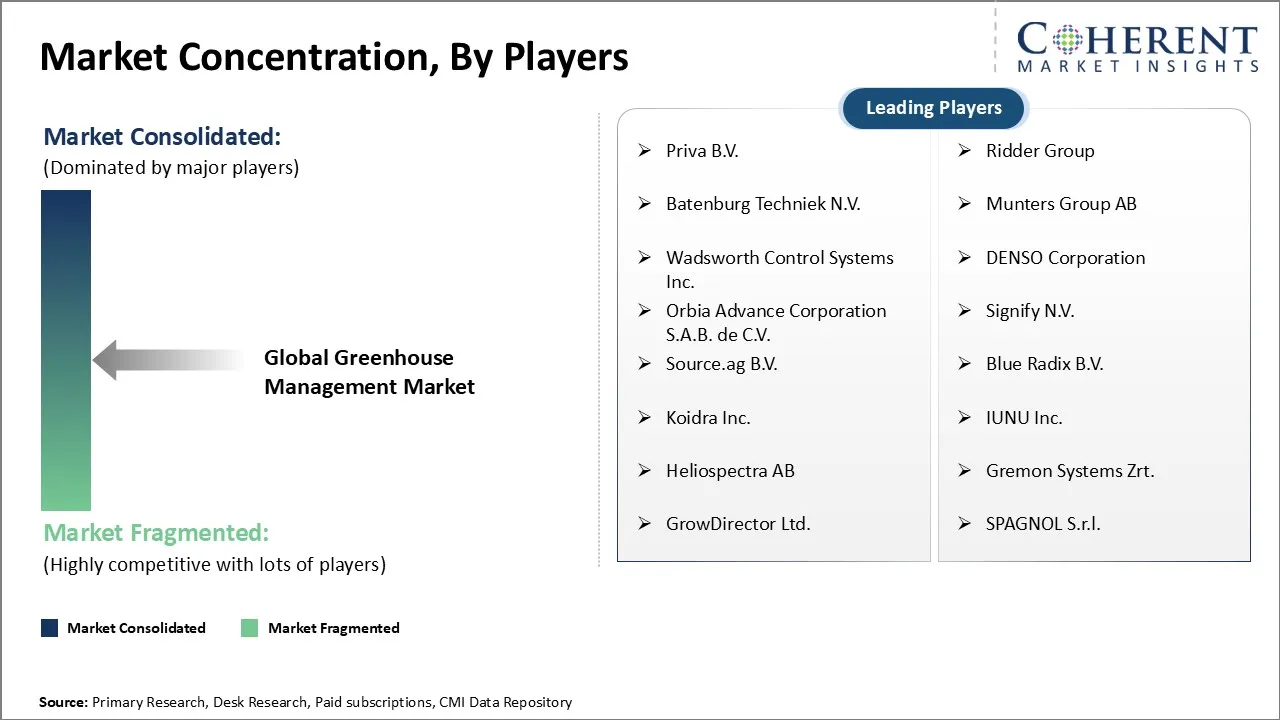
The global greenhouse management market is fragmented, comprising integrated automation providers, irrigation and lighting manufacturers, software specialists, and local engineering firms. Vendors compete on control accuracy, equipment compatibility, installation quality, operating costs, and ongoing support. Regional integrators retain an advantage where greenhouse designs, crops, and service requirements vary, while larger suppliers benefit from established distribution networks, tested components, and long-term grower relationships.
Key focus areas include
- Product Reliability: Consistent equipment performance under humid and demanding greenhouse conditions.
- Technology Differentiation: Proprietary control algorithms, sensor calibration, and operational precision.
- Total Cost of Ownership: Competitive installation expenses, maintenance requirements, and equipment longevity.
- Supply Reliability: Dependable component availability, spare parts, and replacement equipment.
- Quality and Compliance: Electrical safety, equipment certification, and relevant water-management requirements.
- Distribution Capabilities: Access to established horticultural clusters through qualified regional partners.
- After-Sales Services: Responsive troubleshooting, preventive maintenance, and practical operator training.
Market Report Scope
Global Greenhouse Management Market Report Coverage | |||
Report Coverage | Details | ||
Base Year | 2025 | Market Size in 2026: | USD 2.54 Bn |
Historical Data For: | 2020 To 2024 | Forecast Period: | 2026 To 2033 |
Forecast Period 2026 To 2033 CAGR: | 14.40% | 2033 Value Projection: | USD 6.51 Bn |
Geographies covered: |
| ||
Segments covered: |
| ||
Companies covered: | Priva B.V., Ridder Group, Batenburg Techniek N.V., Munters Group AB, Wadsworth Control Systems Inc., DENSO Corporation, Orbia Advance Corporation S.A.B. de C.V., Signify N.V., Source.ag B.V., Blue Radix B.V., Koidra Inc., IUNU Inc., Heliospectra AB, Gremon Systems Zrt., GrowDirector Ltd., SPAGNOL S.r.l. | ||
Growth Drivers: |
| ||
Restraints & Challenges: |
| ||
Analyst Opinion (Expert Opinion)
- During the forecast period, global greenhouse management market leadership may depend less on individual controller specifications and more on whether suppliers accept measurable responsibility for system reliability. Growers could increasingly require commissioning benchmarks, service-response commitments, and documented performance under local cultivation conditions. Vendors that combine independent validation with dependable maintenance networks should be better positioned to defend margins than those competing primarily through low equipment prices.
- Greenhouses could become more commercially valuable as flexible participants in electricity markets rather than passive energy consumers. Where tariffs and grid rules permit, coordinated heating, thermal storage, and lighting loads may support demand-response services without compromising critical crop thresholds. This could challenge installers accustomed to selling fixed-capacity equipment and favor technology providers able to combine energy-market expertise, agronomic risk limits, and verifiable operational controls.
- Suppliers should prioritize corrosion-resistant sensors, resilient remote diagnostics, and technicians capable of supporting growers through entire cultivation cycles. They should also qualify component suppliers to reduce exposure to replacement-part shortages and offer modular configurations for customers with limited capital. Cybersecurity, worker training, and documented water-handling procedures deserve early attention. Overinvestment in costly proprietary platforms without clear service economics could erode margins and restrict channel partnerships.
Speak to the analyst
Want personalized insights?
Take the findings above to one of our principal consultants, or have the report rebuilt around the segments, geographies and competitors you actually track.
Market Segmentation
- Component Insights (Revenue, USD Bn, 2021 - 2033)
- Hardware
- Software
- Services
- Primary Management Function Insights (Revenue, USD Bn, 2021 - 2033)
- Climate and Environmental Control
- Irrigation and Fertigation Management
- Crop Monitoring and Growth Management
- Lighting and Energy Management
- Labor and Operational Management
- Other Management Functions
- Automation Level Insights (Revenue, USD Bn, 2021 - 2033)
- Manual and Sensor Assisted Monitoring
- Automated Greenhouse Control Systems
- AI Enabled and Autonomous Management Systems
- Cultivation Type Insights (Revenue, USD Bn, 2021 - 2033)
- Hydroponic
- Non Hydroponic
- Crop Type Insights (Revenue, USD Bn, 2021 - 2033)
- Vegetables
- Fruits
- Flowers and Ornamentals
- Nursery and Propagation Crops
- Other Crops
- End User Insights (Revenue, USD Bn, 2021 - 2033)
- Commercial Greenhouse Growers
- Research and Educational Institutions
- Smallholder and Community Greenhouse Operators
- Government and Other Institutional Operators
- Distribution Channel Insights (Revenue, USD Bn, 2021 - 2033)
- Direct Manufacturer Sales
- System Integrators and Installation Partners
- Distributors and Authorized Dealers
- Regional Insights (Revenue, USD Bn, 2021 - 2033)
- North America
- U.S.
- Canada
- Latin America
- Brazil
- Argentina
- Mexico
- Rest of Latin America
- Europe
- Germany
- U.K.
- Spain
- France
- Italy
- Russia
- Rest of Europe
- Asia Pacific
- China
- India
- Japan
- Australia
- South Korea
- ASEAN
- Rest of Asia Pacific
- Middle East
- GCC Countries
- Israel
- Rest of Middle East
- Africa
- South Africa
- North Africa
- Central Africa
- North America
Sources
Primary Research Interviews
- Greenhouse automation manufacturers, climate control system providers, and technology developers
- Irrigation, fertigation, horticultural lighting, and greenhouse software suppliers
- Commercial greenhouse growers, system integrators, agricultural consultants, and industry experts
Stakeholders
- Greenhouse equipment manufacturers and technology suppliers
- Sensor, controller, automation software, and irrigation equipment manufacturers
- Commercial greenhouse operators, horticultural producers, and research institutions
- Greenhouse constructors, distributors, installation partners, and agricultural service providers
End-use Sectors
- Commercial vegetable and fruit greenhouse cultivation
- Hydroponic and conventional greenhouse farming
- Floriculture, ornamental horticulture, and nursery production
- Agricultural research, education, and institutional cultivation
Regulatory and Industry Bodies
- U.S. Department of Agriculture (USDA)
- European Commission
- Food and Agriculture Organization (FAO)
- U.S. Environmental Protection Agency (EPA)
- International Organization for Standardization (ISO)
- American Society of Agricultural and Biological Engineers (ASABE)
- Ministry of Agriculture & Farmers Welfare, India
Databases
- Company annual reports and investor presentations
- FAOSTAT agricultural production and resource-use databases
- USDA Census of Horticultural Specialties and Eurostat
- UN Comtrade greenhouse equipment and agricultural technology trade datasets
- Greenhouse automation patents, equipment pricing, and technology databases
Magazines and Journals
- Greenhouse Grower
- Greenhouse Management
- Scientia Horticulturae
- Biosystems Engineering
- Computers and Electronics in Agriculture
- Agricultural Water Management
Associations
- International Society for Horticultural Science (ISHS)
- AmericanHort
- Controlled Environment Agriculture Alliance (CEA Alliance)
- Glastuinbouw Nederland
- International Association of Horticultural Producers (AIPH)
Public Domain Sources
- Greenhouse cultivation area, crop production, and protected agriculture statistics
- Greenhouse automation, irrigation, and climate management technology developments
- Energy consumption, water efficiency, and horticultural productivity data
- Government greenhouse modernization programs and agricultural investment initiatives
- Product launches, technology partnerships, and greenhouse infrastructure expansions
Key Standards and Regulations
- EN 13031-1:2019 – Design and construction of commercial greenhouses
- EU Regulation 2020/741 – Minimum requirements for agricultural water reuse
- U.S. FDA 21 CFR Part 112 – Produce Safety Rule under FSMA
- GLOBALG.A.P. Integrated Farm Assurance – Agricultural production and food safety standards
- IEC 62443 – Industrial automation and control system cybersecurity standards
- India's Mission for Integrated Development of Horticulture (MIDH) Guidelines – Protected cultivation assistance
Proprietary Elements
- CMI Data Analytics Tool
- Proprietary CMI research repository containing 10+ years of industry intelligence, including greenhouse automation, climate control systems, irrigation technologies, horticultural equipment pricing, cultivation trends, technology adoption, sustainability, regulatory developments, and competitive intelligence.
Get access to 250+ pages report
Every segment, forecast, competitor profile and data table behind the analysis above — available for instant download.
- ESOMAR Member
- ISO 9001:2015 Certified
- D-U-N-S Registered
- GDPR & CCPA Compliant
Frequently Asked Questions
The CAGR of global greenhouse management market is projected to be 14.40% from 2026 to 2033.
The global greenhouse management market is estimated to be valued at USD 2.54 billion in 2026 and is expected to reach USD 6.51 billion by 2033.
The report covers greenhouse management technologies, customer requirements, regional markets, competitive positioning, and distribution channels.
Commercial greenhouse growers, research institutions, smallholder greenhouse operators, and government agricultural institutions are the primary customers.
System compatibility, installation costs, operational efficiency, scalability, equipment reliability, and after-sales technical support influence purchasing decisions.
Yes, the report covers key countries, leading technology providers, competitive strategies, regional market dynamics, and supplier positioning.
The major factors driving the growth of the global greenhouse management market are the increasing adoption of automated climate control and precision irrigation technologies, along with the growing need for year-round crop production and resource-efficient greenhouse operations.