

Global Hafnium Market Size and Forecast – 2026 To 2033
The Global Hafnium Market is estimated to be valued at USD 420.9 Mn in 2026 and is expected to reach USD 654.1 Mn by 2033, growing at a compound annual growth rate (CAGR) of 6.50% from 2026 to 2033. Growth is supported by hafnium’s strategic role across semiconductor electronics, nuclear reactor components, aerospace superalloys, and other high-temperature applications were material performance and reliability limit substitution. In electronics, hafnium oxide is gaining importance as a high-k dielectric material and as a foundation for emerging ferroelectric memory technologies requiring improved scalability, energy efficiency, and device performance.
In January 2025, IBM Research published findings on ferroelectric hafnium zirconium oxide (HfZrO₂), analyzing its capacitance behavior and polarization mechanisms for memory-related applications. The research highlights continued industry focus on hafnium-based materials for next-generation semiconductor devices and reinforces demand for high-purity hafnium compounds in advanced electronics manufacturing.
Key Takeaways of the Global Hafnium Market
- Hafnium Metal is estimated to expand at a 6.7% and is expected to hold 45.8% of the global hafnium market in 2026. Its leadership reflects use in high-temperature superalloys, nuclear systems, plasma electrodes, and electronics where purity and thermal stability command premium pricing. In March 2024, Shenzhen Zhonghafnium highlighted metal hafnium, sponge hafnium, and hafnium alloys within its commercial portfolio for aerospace, atomic-energy, and integrated-circuit applications.
- Powder is estimated to grow at a 7.0% CAGR through 2033 and is expected to capture 36.7% of the global hafnium market in 2026. Powdered hafnium and hafnium compounds offer processing flexibility for sputtering targets, deposition feedstocks, coatings, ceramics, and research formulations, supporting broad cross-industry consumption. In August 2026, American Elements’ current safety documentation identified a 99.5% hafnium powder product for scientific research and development.
- Nuclear Reactor Control Rods is estimated to rise at a 6.6% CAGR through 2033 and is expected to account for 32.8% of the global hafnium market in 2026. Hafnium’s neutron-absorption capability, corrosion resistance, and durability under reactor conditions support its strategic role in control components where long service life is essential. In November 2025, the USGS final critical-minerals list explicitly identified hafnium as a material used in nuclear control rods.
- North America is estimated to grow at a 6.2%CAGR through 2033 and is expected to represent 46.8% of the global hafnium market in 2026. The region combines nuclear development, aerospace manufacturing, semiconductor demand, and defense-linked materials procurement, sustaining a high-value consumption base. In June 2025, Centrus Energy received a U.S. Department of Energy contract extension to continue HALEU production, reinforcing the reactor supply chain that supports specialized material demand.
- Europe is estimated to expand at a 7.3% CAGR through 2033 and is expected to hold 29.6% of the global hafnium market in 2026, making it the fastest-growing region. Growth is supported by semiconductor R&D, aerospace and nuclear capabilities, and policy emphasis on securing critical-material supply. In April 2024, the European Union adopted the Critical Raw Materials Act, which formally included hafnium on its list of critical raw materials.
Segmental Insights
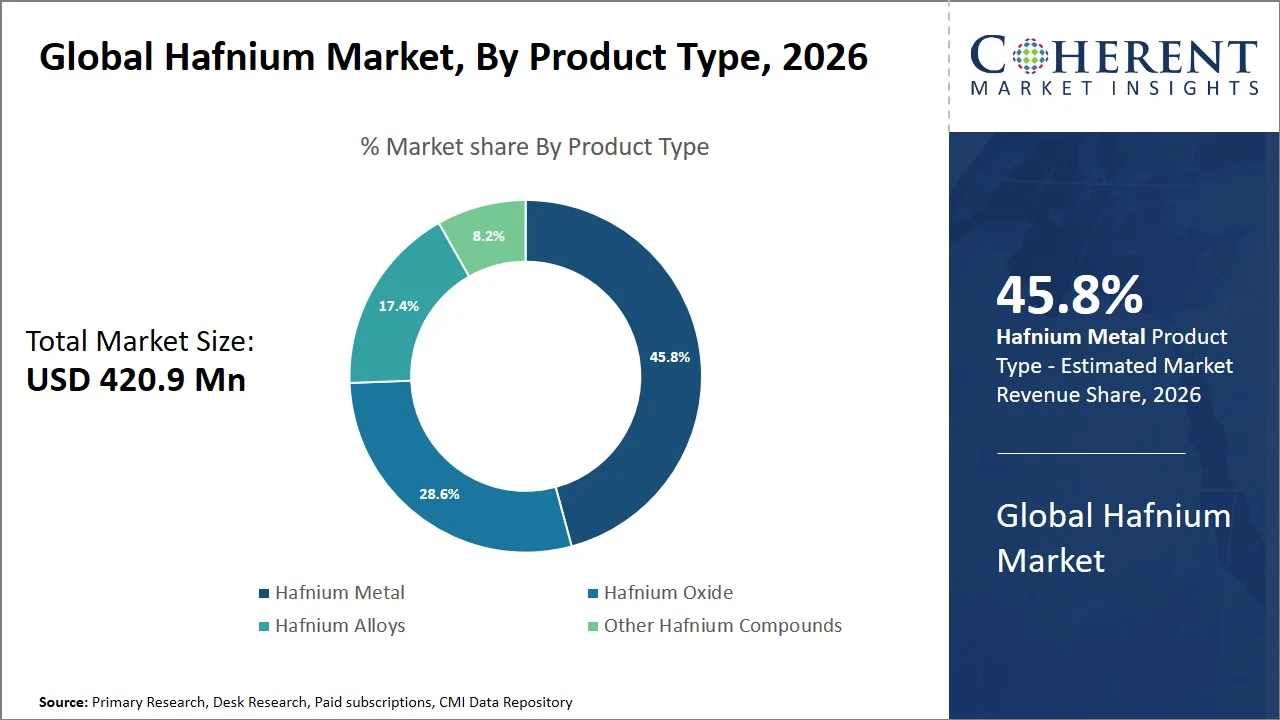
Why Does Hafnium Metal Dominate the Global Hafnium Market by Product Type?
Hafnium Metal is expected to account for 45.8% of the global hafnium market in 2026, making it the leading product type. Its commercial advantage comes from its position in the value chain: once hafnium is separated from zirconium, conversion into qualified metal creates the base material from which customers specify alloy additions, forged products, rolled products, and precision components. This concentrates value in the metallic stage rather than in intermediate compounds. Procurement is also relationship-intensive because buyers require repeatable chemistry, lot traceability, melt control, and dependable qualification, favoring suppliers with integrated refining and metallurgical capabilities. In February 2026, ATI disclosed that its specialty-alloy operations include hafnium, supply military-grade hafnium materials, and produce reactor-grade zirconium-hafnium alloys. The disclosure illustrates how qualified metal supply is embedded directly within high-value manufacturing programs, supporting stronger supplier positioning and pricing discipline.
- Current Industry Events of 2026
- Market Size Estimation
- Regional Breakdown
- Competitive Landscape
- Customer Intelligence
- Segmental Analysis
- Pricing Analysis
- Key Market Drivers, Challenges & Future Trends
- Customized Insights Section
Why Does Powder Represent the Largest Form Segment in the Global Hafnium Market?
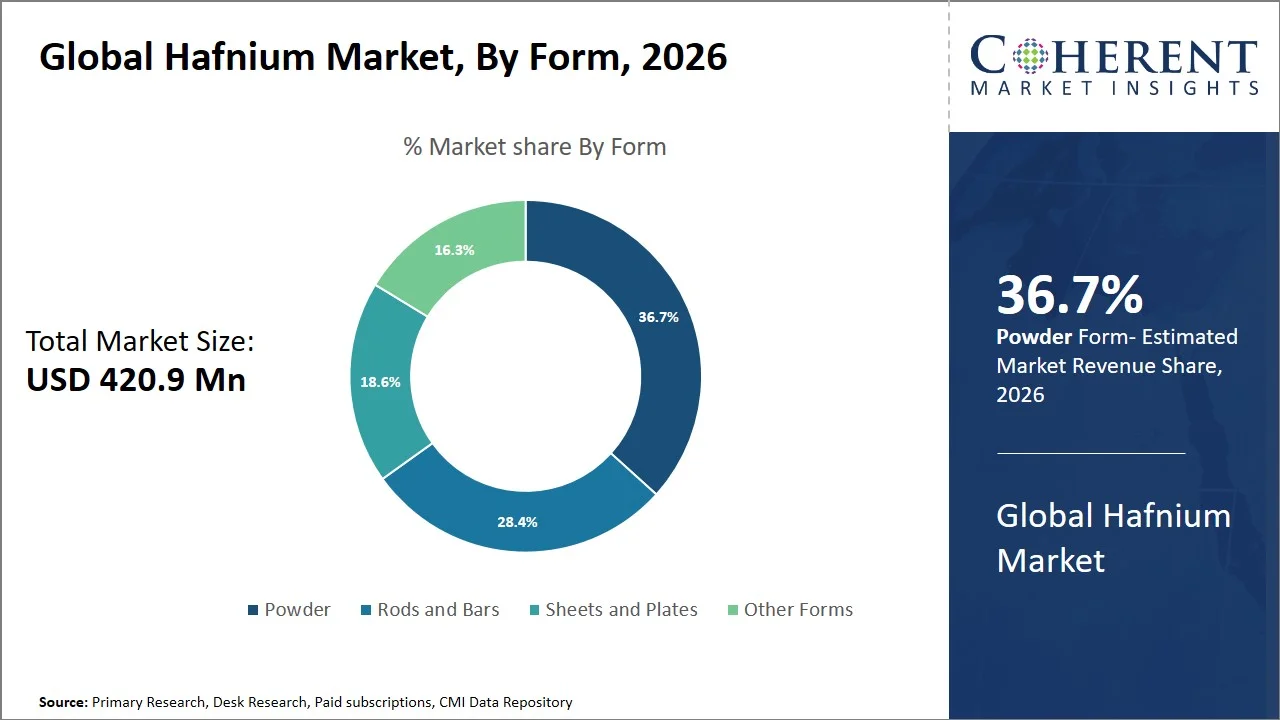
Powder is expected to hold 36.7% of the global hafnium market in 2026, ranking as the largest form segment. Its leadership is linked to manufacturing economics and particle-level control, particularly where expensive hafnium must be converted with minimal machining loss. Fine powders allow producers to manage composition, particle size, packing behavior, and reaction kinetics before consolidation, supporting near-net-shape fabrication and more efficient use of high-value material. This is especially relevant to hafnium carbide and hafnium diboride systems used for extreme-temperature components, where final performance depends strongly on powder characteristics before sintering or laser processing. In May 2025, North Carolina State University researchers reported a one-step selective laser reaction pyrolysis method that produced crystalline hafnium carbide powder and enabled direct fabrication on carbon-carbon substrates. The work demonstrates how powder-based processing can shorten manufacturing routes and expand design flexibility for advanced thermal applications.
Why Do Nuclear Reactor Control Rods Dominate the Application Segment of the Global Hafnium Market?
Nuclear Reactor Control Rods are expected to represent 32.8% of the global hafnium market in 2026, making them the largest application segment. Their leadership reflects a strong installed-base and qualification effect rather than simple material consumption. Control rods are integral safety and reactivity-management components, so operators cannot substitute absorber materials or geometries casually once reactor physics, shutdown margins, drive systems, and maintenance procedures are validated around a specific configuration. This creates high switching barriers and favors repeat procurement through established nuclear-component supply chains. Manufacturing also requires tight dimensional control, reactor-specific geometry, documented material pedigree, and compatibility with control-rod guide systems. In April 2024, the Australian Nuclear Science and Technology Organisation confirmed that its OPAL reactor operates with five hafnium control rods, including movable flat-plate rods and a cruciform regulator. The operating configuration directly demonstrates hafnium’s embedded role in routine reactor shutdown, restart, and power regulation.
Current Events and their Impact
Current Event | Description and Business Impact |
UK Department for Business and Trade – January 2026: Vision 2035 Critical Minerals Strategy |
|
India DGFT – September 2025: Updated SCOMET Export-Control List |
|
U.S. Department of Commerce – January 2026: CHIPS Program Support for Domestic Critical-Mineral Processing |
|
Key Takeaways of the Global Hafnium Market Dynamics
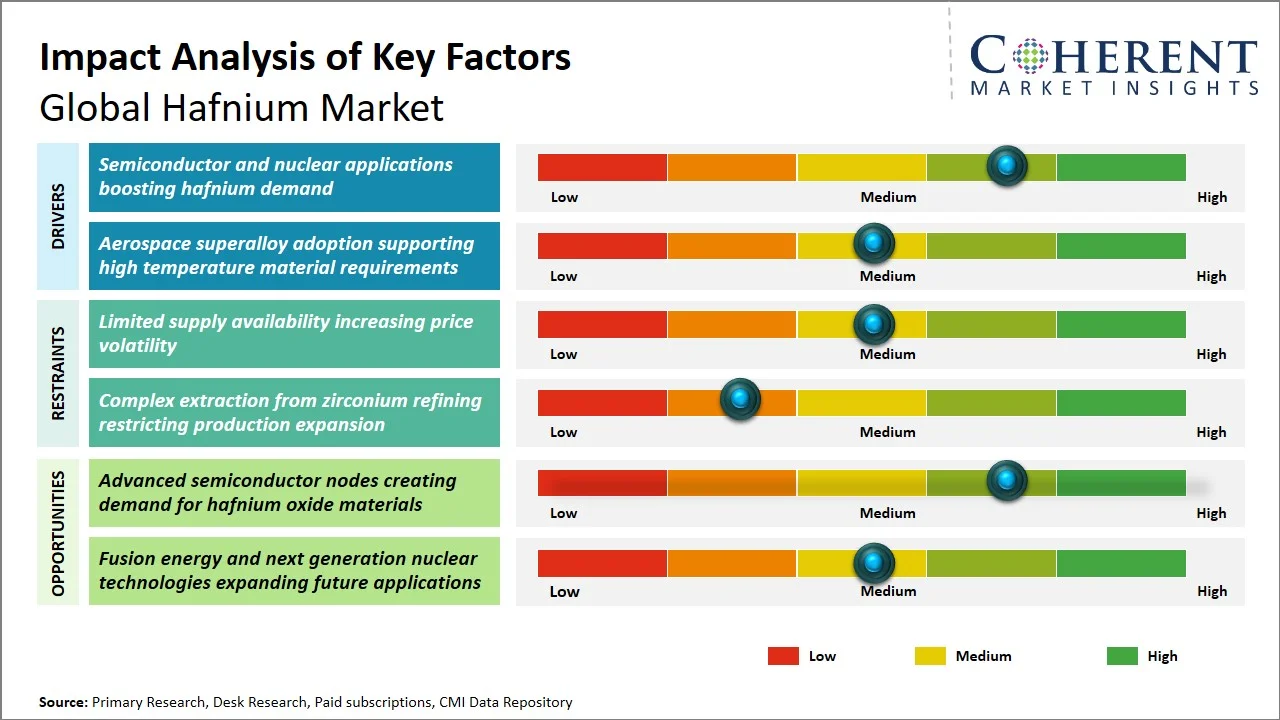
Key Market Drivers
Semiconductor and Nuclear Applications Boosting Hafnium Demand
Hafnium demand is increasingly anchored in applications where substitution is technically difficult. Semiconductor manufacturers require high-purity hafnium oxide and hafnium-zirconium oxide for high-k and ferroelectric structures, while nuclear operators value metallic hafnium for neutron-absorbing components. This raises qualification requirements, favors integrated purification capability, and supports firmer pricing for electronic- and nuclear-grade material. Buyers consequently prioritize consistency and long-term supply over spot availability. In December 2025, Intel Foundry demonstrated ferroelectric hafnium-zirconium-oxide capacitor materials for advanced chip power delivery, reinforcing the material’s role in future semiconductor architectures.
Aerospace Superalloy Adoption Supporting High-Temperature Material Requirements
Aerospace demand supports hafnium consumption through niobium-based superalloys and refractory systems that must retain strength under extreme thermal and mechanical loads. Hafnium additions improve grain-boundary stability and high-temperature performance, making material qualification more important than commodity pricing. This pushes suppliers toward controlled sponge purity, alloy-ready feedstock, traceability, and dependable batch consistency, while aerospace customers tend to lock in qualified sources. In January 2025, India’s C-MET initiated recruitment tied to a VSSC purchase order for production and supply of hafnium sponge for C-103 alloy processing, providing direct evidence of program-linked aerospace demand.
Emerging Market Trends
Shift Toward Application-Engineered Electronic-Grade Hafnium Materials
Electronic-grade demand is shifting from conventional hafnium oxide toward tightly engineered HfO₂ and hafnium-zirconium-oxide compositions tailored for high-k, ferroelectric, and three-dimensional device structures. This changes supplier economics because customers increasingly evaluate precursor purity, defect control, deposition compatibility, and interface behavior rather than bulk chemical specification alone. Producers able to support atomic-layer deposition, customized doping, and application-specific qualification can move closer to semiconductor customers, while suppliers focused only on standard oxide grades face greater commoditization and weaker access to premium programs.
Vertical Coordination of Zirconium-Hafnium Supply Chains
Hafnium procurement is moving toward vertically coordinated zirconium-hafnium separation, refining, and downstream conversion rather than isolated spot purchases. Because hafnium availability is tied to zircon processing, end users are placing greater value on visibility into feedstock origin, separation capacity, inventory buffers, and conversion routes. This encourages producers to secure upstream zircon sources and develop multiple product forms from the same separated stream. The competitive result is a market where supply assurance, auditable provenance, and flexible conversion capability increasingly influence contract awards alongside material purity.
Regional Insights
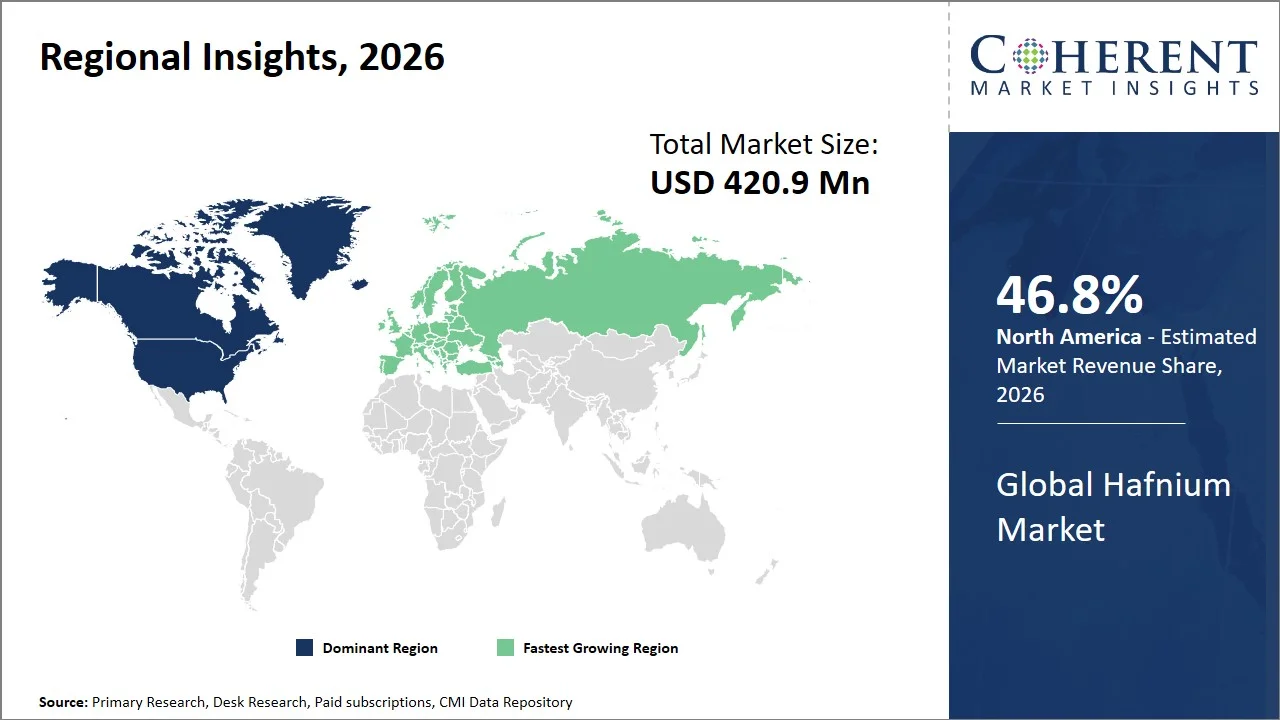
Why Does North America Dominate the Global Hafnium Market?
North America is expected to account for 46.8% of the global hafnium market in 2026, supported by an unusually dense concentration of hafnium-intensive end uses. The region combines leading-edge semiconductor fabrication, commercial nuclear infrastructure, aerospace and defense manufacturing, and high-temperature alloy demand, creating several premium demand channels rather than dependence on one application. Advanced chip production is particularly important because hafnium-based high-k dielectric materials are integral to scaled transistor architectures, while nuclear and aerospace programs support demand for metallic and alloy grades. Regional buyers also place high value on material purity, qualification, traceability, and supply reliability, favoring established specialty-material supply chains. In November 2024, the U.S. Department of Commerce awarded TSMC Arizona up to USD 6.6 billion to support three leading-edge fabs in Phoenix, including advanced A16 production, strengthening a downstream manufacturing base relevant to high-purity hafnium compounds.
Why Is Europe Emerging as the Fastest-Growing Region in the Global Hafnium Market?
Europe is expected to hold 29.6% of the global hafnium market in 2026 and emerge as the fastest-growing region as demand shifts toward advanced semiconductor materials, specialty aerospace alloys, nuclear technologies, and research-grade compounds. The region’s advantage is its ability to convert comparatively limited raw-material availability into high-value applications through strong materials science, microelectronics R&D, and precision manufacturing. Growth should therefore be value-led, with high-purity hafnium oxide and engineered hafnium compounds gaining importance alongside established metallic uses. Europe’s semiconductor research ecosystem is especially relevant because hafnium-based ferroelectrics are being evaluated for next-generation memory architectures. In June 2026, Belgium-based imec reported new ferroelectric memory advances targeting low-voltage capacitors and vertically stacked FeFETs for high-density AI-era memory, demonstrating continued European development of applications that can expand demand for hafnium-containing functional materials.
Global Hafnium Market Outlook for Key Countries
Why Is the U.S. a Key Market for the Global Hafnium Market?
The U.S. is a key country in the global hafnium market because it brings together nuclear deployment, defense procurement, aerospace engineering, semiconductor fabrication, and specialty-metals consumption at commercial scale. Its importance is strongest in applications where material substitution is difficult and qualification cycles are long. Hafnium’s neutron-absorption characteristics support reactor-control applications, while its temperature resistance and alloying role make it relevant to aerospace components; semiconductor manufacturing adds a separate high-purity oxide demand stream. This diversified end-use structure supports resilient purchasing even when one industry enters a slower investment cycle. Federal support for new reactor deployment is also expanding the long-term addressable base for specialized nuclear materials. In August 2025, the U.S. Department of Energy selected 11 advanced reactor projects for its Nuclear Reactor Pilot Program, aiming to move multiple designs toward deployment and at least three test reactors toward criticality by July 2026.
Why Is Germany a Strategic Country in the Global Hafnium Market?
Germany is strategically important in the global hafnium market because its demand is concentrated in technically demanding, high-value manufacturing rather than bulk consumption. The country’s semiconductor cluster around Dresden, advanced automotive electronics, industrial automation, precision optics, and materials research create opportunities for high-purity hafnium oxide and hafnium-based functional films. German buyers typically operate within tightly controlled qualification environments, so consistency in thin-film performance, deposition compatibility, and long-term material reliability can matter more than low-cost supply. This favors specialty producers capable of supplying electronic-grade material and supporting process integration. In June 2026, Fraunhofer IPMS announced that, together with GlobalFoundries, it had integrated ultra-fast ferroelectric FRAM based on hafnium oxide into the industrial 22FDX manufacturing platform. The development moves hafnium oxide from laboratory evaluation toward manufacturable memory technology and strengthens Germany’s commercial relevance for advanced hafnium compounds.
Why Does China Support Growth in the Global Hafnium Market?
China is an important growth market for the global hafnium market because it combines a large semiconductor manufacturing ecosystem with expanding nuclear infrastructure and an active domestic advanced-materials research base. Demand is not limited to conventional metal uses: hafnium oxide is increasingly relevant to ferroelectric memory, low-power electronics, optical coatings, and other high-performance thin-film applications. At the same time, continued nuclear construction creates a separate strategic pathway for hafnium-bearing reactor materials and reinforces the importance of secure domestic supply. China’s scale in electronics also provides a potential route from research validation to higher-volume device adoption when technologies mature. In May 2025, the Institute of Microelectronics of the Chinese Academy of Sciences reported that a radiation-resistant Mbit FeRAM chip using doped HfO₂-based ferroelectric material had completed space experiments, demonstrating a domestic, application-specific route for hafnium compounds in high-reliability aerospace electronics.
Why Is Japan a Key Market for the Global Hafnium Market?
Japan is a key market for the global hafnium market because its semiconductor-materials ecosystem emphasizes purity, process control, and advanced-node compatibility attributes that align closely with electronic-grade hafnium compounds. The country also has strong aerospace, precision optics, nuclear engineering, and specialty-chemical capabilities, but its clearest incremental demand opportunity comes from rebuilding domestic leading-edge logic manufacturing. As gate structures become more complex, material suppliers must meet tighter requirements for high-k dielectric deposition, contamination control, and wafer-scale uniformity, increasing the commercial value of qualified hafnium precursors and oxides. Japan’s equipment and materials companies can also participate upstream in these process flows. In April 2025, Rapidus began launching its 2 nm pilot production line in Chitose, Hokkaido, according to Japan’s Ministry of Economy, Trade and Industry. The project supports a domestic advanced-logic ecosystem where high-k gate-stack materials are strategically relevant.
Why Is South Korea an Important Growth Market for the Global Hafnium Market?
South Korea is important to the global hafnium market because its semiconductor industry is heavily weighted toward advanced memory, where hafnium-based dielectric and ferroelectric materials have a clear pathway into future device architectures. The country’s concentration of DRAM, NAND, foundry, materials, and equipment capabilities shortens the distance between university research, process development, and high-volume manufacturing. This creates a commercially attractive environment for electronic-grade hafnium oxide and hafnium-zirconium oxide, particularly if next-generation memories require lower operating voltage, higher density, or improved endurance. Supplier opportunities therefore depend on purity, deposition consistency, and compatibility with scaled CMOS processes rather than commodity volume alone. In June 2024, POSTECH reported a hafnia-based ferroelectric memory breakthrough that increased multilevel data-storage capability through aluminum doping and a redesigned device structure, illustrating South Korea’s active development of hafnium-containing materials for advanced memory applications.
Innovation, Production & Manufacturing Landscape
Category | Current Status / Adoption Level | Key Application or Impact | Business Implication |
Zirconium-Hafnium Separation & Purification | Commercially established but technically demanding | Separates neutron-absorbing hafnium from nuclear-grade zirconium streams and creates hafnium-rich intermediates | Separation efficiency directly influences recoverable hafnium availability, production economics, and supplier scalability |
Hafnium Sponge & Metal Conversion | Mature within specialized production networks | Produces feedstock for alloys, reactor components, electrodes, and high-temperature applications | Metal purity, oxygen control, and batch traceability create qualification barriers and support premium positioning |
High-Purity Hafnium Oxide & Chloride Processing | Increasingly specialized | Supports semiconductor dielectrics, deposition precursors, optical coatings, ceramics, and electronic materials | Suppliers need tighter impurity specifications and process consistency to access semiconductor-grade contracts |
Powder Metallurgy & Hafnium Carbide Processing | Developing toward higher-value applications | Enables refractory components, coatings, sintered products, and extreme-temperature material systems | Powder morphology and chemistry become differentiators, creating opportunities for application-specific product portfolios |
Nuclear Absorber Component Manufacturing | Highly qualified and application-specific | Uses hafnium in reactor control and neutron-management components requiring long operating life | Long qualification cycles protect approved suppliers but create high technical and regulatory barriers for new entrants |
Secondary Recovery & Process Residue Utilization | Emerging commercial focus | Recovers hafnium from separation residues, process streams, scrap, and off-spec material | Higher recovery rates can improve feedstock efficiency, reduce waste exposure, and provide additional supply without proportional primary-resource expansion |
How Can Recovery from Zirconium-Processing Residues Create a High-Value Growth Opportunity in the Global Hafnium Market?
A high-value opportunity is emerging in recovering additional hafnium from zirconium-hafnium separation residues, process liquors, off-spec material, and qualified manufacturing scrap. The opportunity is attractive because hafnium supply is structurally linked to zirconium processing, while conventional extraction leaves limited flexibility to respond quickly when downstream requirements change. Recovery-focused operators can improve feedstock utilization without depending entirely on new mineral output and can potentially create differentiated streams for metal, oxide, chloride, or carbide conversion. Likely customers include semiconductor-material suppliers, aerospace alloy producers, nuclear-component manufacturers, and specialty chemical processors seeking more secure sourcing. Success requires selective separation chemistry, impurity control, waste-treatment capability, analytical traceability, and customer qualification. Entry barriers remain high because recovery must preserve purity and consistency rather than simply maximize yield. Strategically, this model can reduce supply-chain exposure while giving established refiners a margin-enhancing route to monetize material previously treated as low-value residue.
Market Players, Key Development, and Competitive Intelligence
Key Developments
- In May 2026, Critical Metals Corp outlined plans for the Tanbreez project and a proposed European refining pathway expected to produce hafnium alongside other strategic materials. The project could broaden non-Chinese upstream availability and create an additional Western-aligned source for aerospace, semiconductor, nuclear, and defense customers concerned about supply concentration.
- In March 2024, Nanjing Youtian Metal Technology’s subsidiary Jiangsu Yichu Zirconium-Hafnium New Materials highlighted its new zirconium-hafnium separation factory and integrated refining infrastructure. The facility expands dedicated separation and conversion capability, strengthening the company’s ability to supply oxide and downstream metallic hafnium products rather than relying solely on externally processed intermediate material.
Competitive Landscape
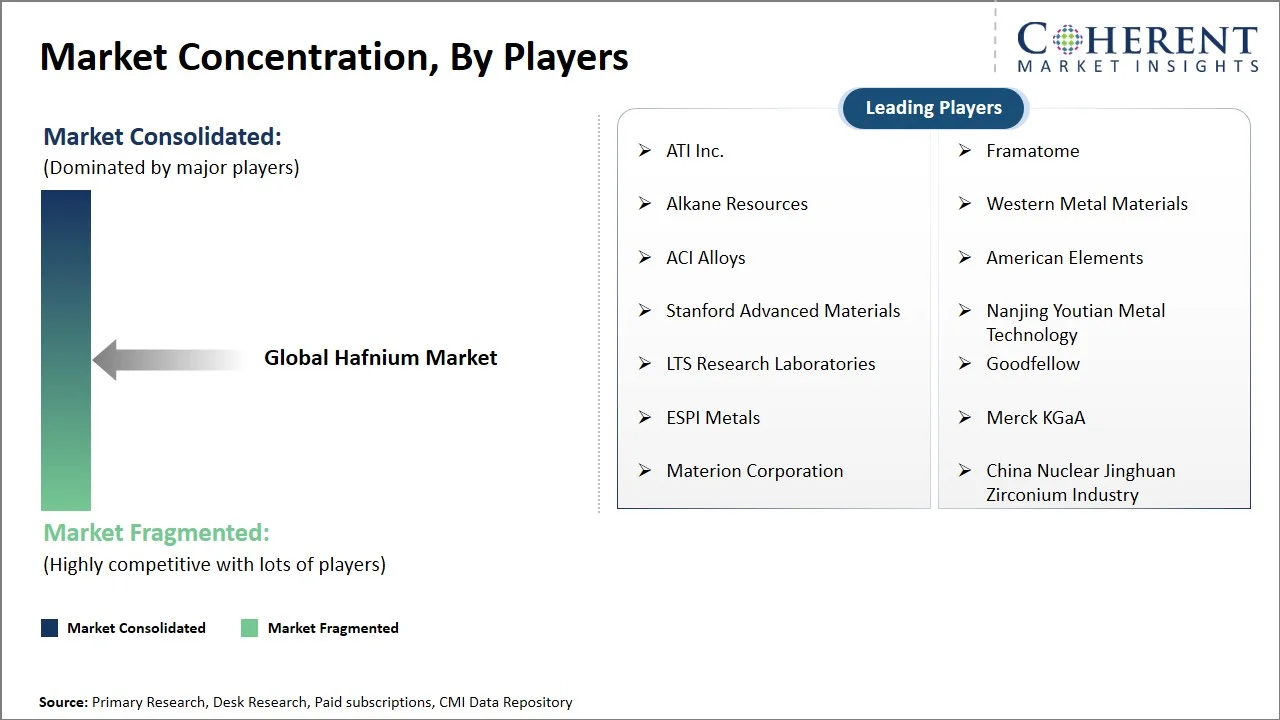
The global hafnium market has a concentrated upstream structure because commercially viable hafnium is recovered through technically demanding separation from zirconium streams, while downstream competition is more specialized across metal, oxide, chloride, carbide, and alloy products. Competitive advantage therefore depends less on scale alone and more on purification capability, qualification history, application-specific conversion, security of feedstock, and long-term customer relationships in semiconductor, nuclear, and aerospace programs.
Key focus areas include:
- Access to zirconium-hafnium feedstock – Long-term control over suitable zircon-derived streams reduces procurement exposure and supports production continuity.
- Separation and purification capability – Higher selectivity and impurity control determine whether output can move into high-value nuclear, aerospace, or electronic grades.
- Electronic-grade material consistency – Semiconductor customers require repeatable composition, precursor behavior, contamination control, and lot-level traceability.
- Nuclear and aerospace qualification history – Existing approvals create substantial switching barriers because customers cannot rapidly substitute unqualified material.
- Product-form breadth – Capability across sponge, metal, powder, oxide, chloride, carbide, and alloys enables suppliers to address multiple value pools.
- Supply reliability and inventory management – Strategic buyers increasingly value continuity and buffer capacity because hafnium availability cannot be expanded rapidly.
- Application engineering support – Technical collaboration on alloying, deposition, powder processing, and component fabrication differentiates suppliers beyond material specification.
- Regional supply-chain localization – Customers in strategic sectors increasingly prefer geographically diversified and compliance-ready sourcing to reduce geopolitical and logistics exposure.
Market Report Scope
Hafnium Market Report Coverage
| Report Coverage | Details | ||
|---|---|---|---|
| Base Year: | 2025 | Market Size in 2026: | USD 420.9 Mn |
| Historical Data for: | 2020 To 2024 | Forecast Period: | 2026 To 2033 |
| Forecast Period 2026 to 2033 CAGR: | 6.50% | 2033 Value Projection: | USD 654.1 Mn |
| Geographies covered: |
| ||
| Segments covered: |
| ||
| Companies covered: | ATI Inc., Framatome, Alkane Resources, Western Metal Materials, ACI Alloys, American Elements, Stanford Advanced Materials, Nanjing Youtian Metal Technology, LTS Research Laboratories, Goodfellow, ESPI Metals, Merck KGaA, Materion Corporation, China Nuclear Jinghuan Zirconium Industry | ||
| Growth Drivers: |
| ||
| Restraints & Challenges: |
| ||
Analyst Opinion (Expert Opinion)
- The global hafnium market is likely to become more segmented by qualification level rather than simply by product form. Commodity-style oxide or metal availability will matter less than the ability to deliver semiconductor-grade, nuclear-grade, aerospace-qualified, or application-engineered material with documented consistency. Leadership will therefore move toward suppliers that combine feedstock access with purification, conversion, analytical control, and customer-specific technical support. Vertical integration will be particularly valuable because it provides visibility from zircon-derived feedstock through finished hafnium products.
- The most important structural shift will be hafnium’s transition from a specialized by-product metal into a strategically managed functional material. Semiconductor scaling, advanced memory architectures, high-temperature aerospace systems, and nuclear applications increasingly require performance characteristics that cannot be addressed through simple material substitution. This favors suppliers that understand how purity, chemistry, particle form, precursor behavior, and alloy composition affect downstream performance. Producers selling undifferentiated material will face pressure as customers increasingly procure against application-specific qualification criteria rather than basic chemical specification.
- Market participants should prioritize secure zirconium-hafnium feedstock access, higher-yield separation processes, electronic-grade purification, secondary recovery, and multi-region customer qualification. The principal risk is not only geological availability but the concentration of separation expertise and the long time required to establish qualified production routes. Buyers should avoid dependence on a single conversion source, while suppliers should develop inventory buffers and flexible product pathways. Companies that invest simultaneously in supply security and application engineering will be better positioned than businesses relying primarily on short-term price movements.
Speak to the analyst
Want personalized insights?
Take the findings above to one of our principal consultants, or have the report rebuilt around the segments, geographies and competitors you actually track.
Market Segmentation
- Product Type Insights (Revenue, USD Mn, 2021 - 2033)
- Hafnium Metal
- Hafnium Oxide
- Hafnium Alloys
- Other Hafnium Compounds
- Form Insights (Revenue, USD Mn, 2021 - 2033)
- Powder
- Rods and Bars
- Sheets and Plates
- Other Forms
- Application Insights (Revenue, USD Mn, 2021 - 2033)
- Nuclear Reactor Control Rods
- Aerospace Superalloys
- Semiconductor and Electronics
- Plasma Cutting Electrodes
- Chemical and Research Applications
- Others
- End Use Industry Insights (Revenue, USD Mn, 2021 - 2033)
- Nuclear Energy
- Aerospace and Defense
- Semiconductor and Electronics
- Industrial Manufacturing
- Research and Others
- Distribution Channel Insights (Revenue, USD Mn, 2021 - 2033)
- Direct Sales
- Indirect Sales
- Regional Insights (Revenue, USD Mn, 2021 - 2033)
- North America
- U.S.
- Canada
- Latin America
- Brazil
- Argentina
- Mexico
- Rest of Latin America
- Europe
- Germany
- U.K.
- Spain
- France
- Italy
- Russia
- Rest of Europe
- Asia Pacific
- China
- India
- Japan
- Australia
- South Korea
- ASEAN
- Rest of Asia Pacific
- Middle East
- GCC Countries
- Israel
- Rest of Middle East
- Africa
- South Africa
- North Africa
- Central Africa
- North America
Sources
Primary Research Interviews
- Volleyball footwear manufacturers, sportswear brands, distributors, retailers, professional athletes, coaches, team managers, and sports academies
- Product designers, material specialists, procurement professionals, sporting goods executives, and industry experts
Stakeholders
- Volleyball shoe manufacturers, athletic footwear companies, sports equipment brands, and private-label footwear producers
- Raw material suppliers, footwear component manufacturers, sports retailers, e-commerce platforms, distributors, and team procurement organizations
- Professional clubs, schools, universities, training academies, and recreational sports organizations
End-use Sectors
- Professional and competitive volleyball
- Collegiate, school, and youth volleyball programs
- Recreational and amateur sports activities
- Indoor sports, athletic training, and fitness applications
Regulatory and Industry Bodies
- Federation International de Volleyball (FIVB)
- National volleyball federations and sports governing organizations
- Olympic sports organizations
- Regional sports authorities and athletic associations
Databases
- Company annual reports, investor presentations, and corporate filings
- Trade statistics and footwear industry databases
- Retail and e-commerce product databases
- Sports participation and athlete development databases
- Industry publications and product portfolio analysis
Magazines and Journals
- Sports Engineering journals
- Footwear technology and materials science publications
- Sporting goods industry publications
- Athletic performance and sports biomechanics research journals
Associations
- Federation International de Volleyball (FIVB)
- Asian Volleyball Confederation (AVC)
- European Volleyball Confederation (CEV)
- National volleyball associations
- Sporting goods and athletic footwear associations
Public Domain Sources
- Volleyball participation and competition developments
- Professional league and tournament updates
- Athletic footwear innovation and material advancements
- Sports retail and e-commerce channel developments
- Consumer trends in performance footwear and indoor sports equipment
Key Standards and Regulations
- Footwear quality and safety standards
- Material testing and durability requirements
- Product labeling and consumer safety regulations
- Sustainable footwear manufacturing guidelines
- International trade and import regulations for sporting goods
Proprietary Elements
- CMI Data Analytics Tool
- Proprietary CMI Existing Repository of information for the last 10 years
Get access to 250+ pages report
Every segment, forecast, competitor profile and data table behind the analysis above — available for instant download.
- ESOMAR Member
- ISO 9001:2015 Certified
- D-U-N-S Registered
- GDPR & CCPA Compliant
Missing comfort of reading report in your local language? Find your preferred language:
Frequently Asked Questions
The CAGR of global hafnium market is projected to be 6.50% from 2026 to 2033.
The global hafnium market is estimated to be valued at USD 420.9 Mn in 2026 and is expected to reach USD 654.1 Mn by 2033.
Hafnium is primarily used in nuclear reactor control components, semiconductor materials, aerospace superalloys, plasma cutting electrodes, and specialized research applications due to its high-temperature resistance and neutron absorption properties.
Companies should evaluate supply security, availability of high-purity material, supplier qualification capabilities, regulatory requirements, and long-term demand from semiconductor, nuclear, and aerospace industries before investing in the hafnium market.
Hafnium is considered a strategic material because it combines unique thermal stability, corrosion resistance, and neutron absorption characteristics, making it difficult to replace in critical applications such as nuclear systems, advanced electronics, and high-performance alloys.
Hafnium buyers face challenges related to limited supplier availability, complex zirconium-based extraction processes, strict quality requirements, and the need for consistent high-purity material supply for specialized applications.
Semiconductor and nuclear applications boosting hafnium demand and Aerospace superalloy adoption supporting high temperature material requirements are the major factor driving the growth of global hafnium market.