

Global Healthcare Interoperability Platform Market Size and Forecast – 2026 To 2033
The global healthcare interoperability platform market is expected to grow from USD 3.62 Bn in 2026 to USD 8.35 Bn by 2033, registering a compound annual growth rate (CAGR) of 12.7% from 2026 to 2033. The market for global healthcare interoperability platform is poised for significant expansion, fueled by the widespread adoption of electronic health records (EHRs) and the growing need for seamless data exchange across healthcare systems.
According to the U.S. Office of the National Coordinator for Health Information Technology (ONC), more than 99% of non-federal acute care hospitals had adopted certified EHRs by 2024, creating a strong foundation for interoperability platform deployment.
Key Takeaways of the Global Healthcare Interoperability Platform Market
- Software platforms are projected to hold 67.3% of the global healthcare interoperability platform market share in 2026, making it dominant component segment, across North America driven by the benefits from established electronic health record infrastructure and regulatory requirements that encourage certified health IT systems to exchange standardized patient information. For instance, the U.S. Office of the National Coordinator for Health Information Technology (ONC), through its HTI-1 Final Rule, established USCDI Version 3 as the baseline standard in its Health IT Certification Program from January 1, 2026. This supports software platforms that standardize and exchange clinical data across healthcare systems.
- Healthcare data integration platforms are projected to hold 24.6% of the global healthcare interoperability platform market share in 2026, making it dominant platform type segment, across Asia Pacific driven by digital health initiatives and the integration of public- and private-sector systems are creating opportunities for data integration platforms across the region. For instance, In India, the National Health Authority’s Ayushman Bharat Digital Mission (ABDM) reported 27 integrations with healthcare and health-tech service providers in February 2022, including hospital and laboratory information systems. ABDM’s interoperable APIs and open standards are intended to help separate applications exchange information, illustrating the need for platforms that connect diverse healthcare systems.
- Structural interoperability is projected to hold 29.4% of the global healthcare interoperability platform market share in 2026, making it dominant interoperability level segment, with Europe advancing common technical requirements to make health information exchanged across different healthcare systems readable and consistently structured. For instance, the European Health Data Space (EHDS) Regulation, published in March 2025, establishes a harmonized framework for electronic health record systems and cross-border electronic health data exchange. From 2029, the first priority data categories, including patient summaries and e-prescriptions, are scheduled to become exchangeable across EU member states. This creates a regulatory basis for solutions that align data structures and formats between systems.
- North America market maintains dominance with an expected share of 39.2% in 2026, bolstered by established digital health infrastructure and initiatives to improve healthcare data exchange. For instance, Australia’s National Healthcare Interoperability Plan 2023–2028 outlines 44 actions across five priority areas, including healthcare identifiers, standards, information sharing, and innovation, illustrating how coordinated national strategies are advancing interoperability in other markets.
- Asia Pacific is expected to exhibit the fastest growth in the global healthcare interoperability platform market, registering an estimated CAGR of 16.0% during 2026–2033, driven by national digital health infrastructure initiatives and efforts to standardize health information exchange. For instance, Japan’s Ministry of Health, Labour and Welfare has published standards and implementation guides for exchanging medical information between healthcare institutions, supporting more consistent digital information sharing.
Segmental Insights
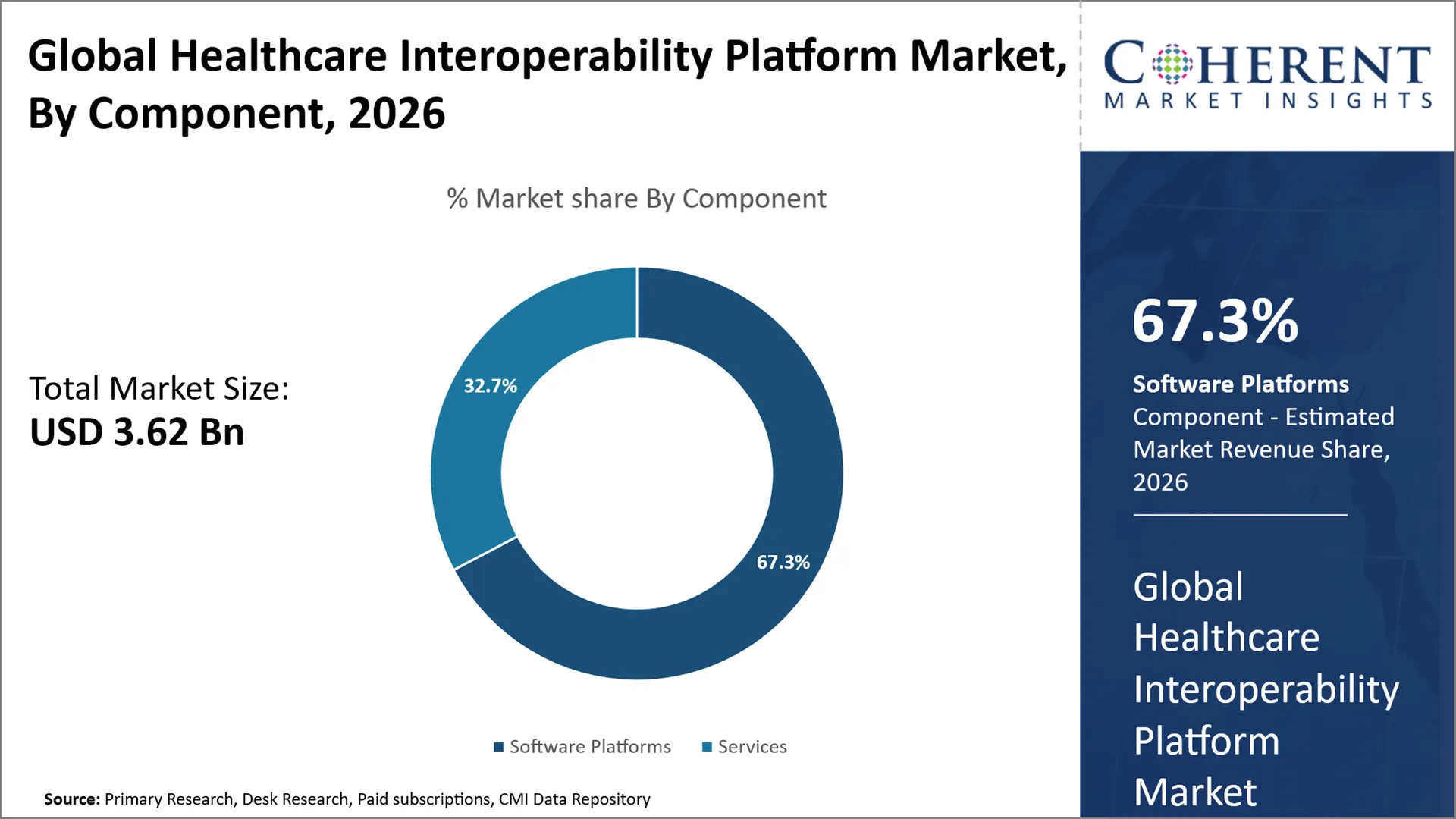
Why Do Software Platforms Dominate the Global Healthcare Interoperability Platform Market?
Software platforms are projected to hold the market share of 67.3% in 2026, due to enabling end users to exchange secure data, standardize and integrate the data across multiple EHRs, laboratories, imaging, and other healthcare applications. Additionally, the ability of these platforms to scale-up and connect legacy platforms with new age applications would increase access to data and care. For instance, Inter Systems Health Connect enables HL7 FHIR, HL7 v2, DICOM, and healthcare APIs for secure data sharing across various clinical applications and clinical systems. Its integration features are representative of software platforms that enable hospitals to connect systems and make information available.
- Current Industry Events of 2026
- Market Size Estimation
- Regional Breakdown
- Competitive Landscape
- Customer Intelligence
- Segmental Analysis
- Pricing Analysis
- Key Market Drivers, Challenges & Future Trends
- Customized Insights Section
Why Does Healthcare Data Integration Platforms Represent the Largest Platform Type Segment in the Healthcare Interoperability Platform Market?
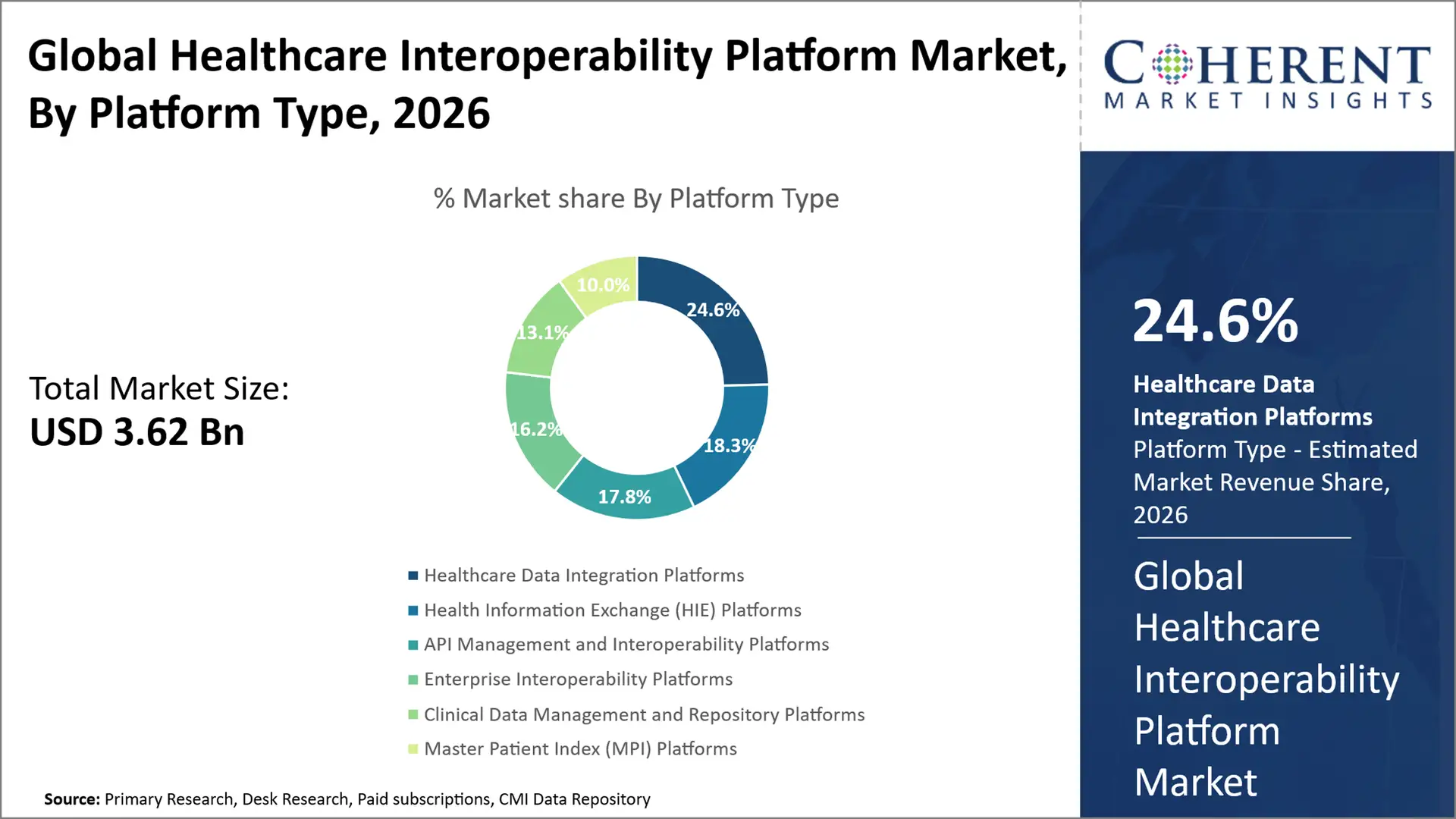
Healthcare data integration platforms are projected to hold a market share of 24.6% in 2026, owing to the capacity of the healthcare data integration platforms to aggregate data from laboratory, pharmacy, clinical and other EHR systems in a single accessible format. Furthermore, the support for HL7 and FHIR standards indicates that healthcare data is less fragmented, that clinical workflows are improving, and that care is more coordinated. For instance, Oracle Integration for Healthcare supports HL7 and FHIR standards to integrate disparate clinical, operational, and administrative systems, enabling secure healthcare data exchange and more consistent information access.
Structural Interoperability Segment Dominates the Global Healthcare Interoperability Platform Market
The structural interoperability segment is projected to hold a market share of 29.4% in 2026, as it is primarily important for managing the accuracy of transferred healthcare data in defined formats and message structures, to enable exchange of information between systems. In addition, HL7 v2 standard helps in the structured transfer of information related to admission, laboratory results and clinical information, which can help in accurate data interpretation and efficient workflows. For instance, IHE’s Laboratory Technical Framework defines standardized profiles for exchanging laboratory results and related information between healthcare systems, supporting consistent data structures and reliable interoperability.
Current Events and their Impact
Current Events | Description and its Impact |
U.S. CMS Advances Interoperability Framework Requirements (July 2026) |
|
India Launches Unified Health Interface (UHI) for Interoperable Digital Health Services (June 2026) |
|
U.S. ONC Releases 2026 Interoperability Standards Advisory (March 2026) |
|
Healthcare Interoperability Platform Market Dynamics
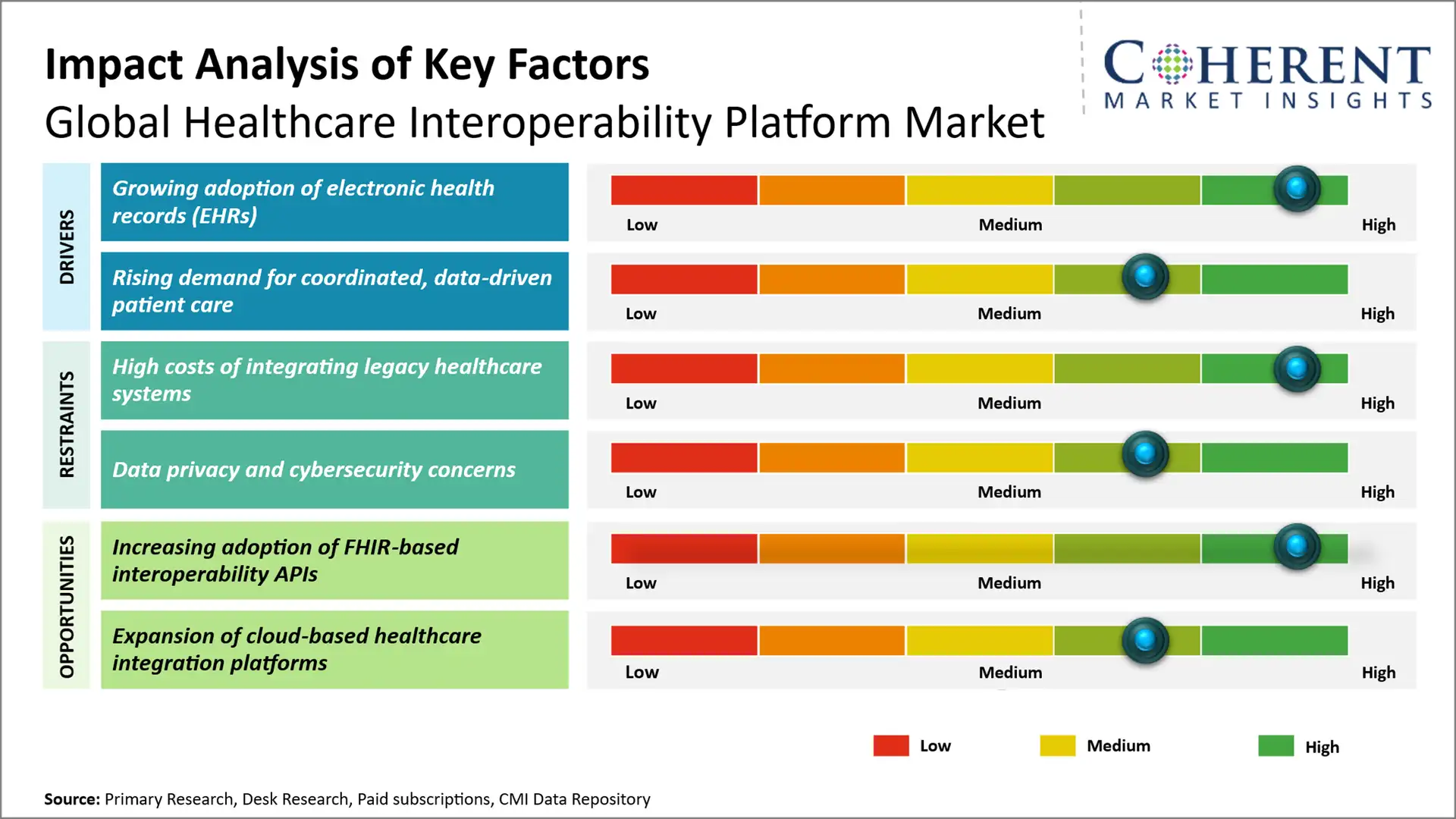
Market Drivers
- Growing adoption of electronic health records (EHRs): The increasing digitization of patient records is driving demand for interoperability platforms that enable healthcare providers to exchange clinical information across disconnected systems. For instance, Singapore’s National Electronic Health Record (NEHR) initiative aims to provide authorized healthcare professionals with a consolidated view of patients’ health records across participating care settings, supporting continuity of care and coordinated treatment. This initiative highlights the need for platforms that integrate information from multiple healthcare providers.
- Rising demand for coordinated, data-driven patient care: The growing emphasis on integrated care is increasing demand for interoperability platforms that combine clinical, diagnostic, and treatment data to support timely decisions across healthcare settings. For instance, Finland’s Kanta Services, managed by the Finnish Social Insurance Institution (Kela), enable healthcare providers to access shared patient records and medication information, supporting continuity of care and coordinated treatment. This national infrastructure demonstrates the value of connected health data in data-driven care delivery.
- Increasing regulatory emphasis on healthcare data exchange: Governments are introducing policies and technical frameworks that encourage secure, standardized sharing of electronic health information, increasing demand for interoperability platforms across healthcare organizations. For instance, Brazil’s Ministry of Health established the National Health Data Network (Rede Nacional de Dados em Saúde, RNDS) to enable health information exchange across the country’s public and private healthcare networks, supporting integrated care and continuity of patient records.
Emerging Trends
- Adoption of FHIR-Based APIs: Healthcare organizations are increasingly adopting HL7 FHIR-based APIs to enable standardized, near-real-time data exchange between electronic health records, healthcare applications, laboratories, and payer systems. This trend supports connected care and simplifies integration across disparate healthcare IT environments.
- AI-Enabled Healthcare Data Integration: Artificial intelligence and machine learning are increasingly being incorporated into interoperability workflows to support data mapping, normalization, duplicate record detection, and clinical data extraction. These capabilities can reduce manual integration efforts and improve the usability of fragmented healthcare data.
- Expansion of Cloud-Based Interoperability Platforms: Healthcare providers and payers are increasingly exploring cloud-based platforms to connect distributed healthcare systems, scale data exchange, and reduce dependence on complex on-premises infrastructure. Growing adoption of hybrid architectures also enables organizations to integrate legacy systems while modernizing their digital health infrastructure.
Regional Insights
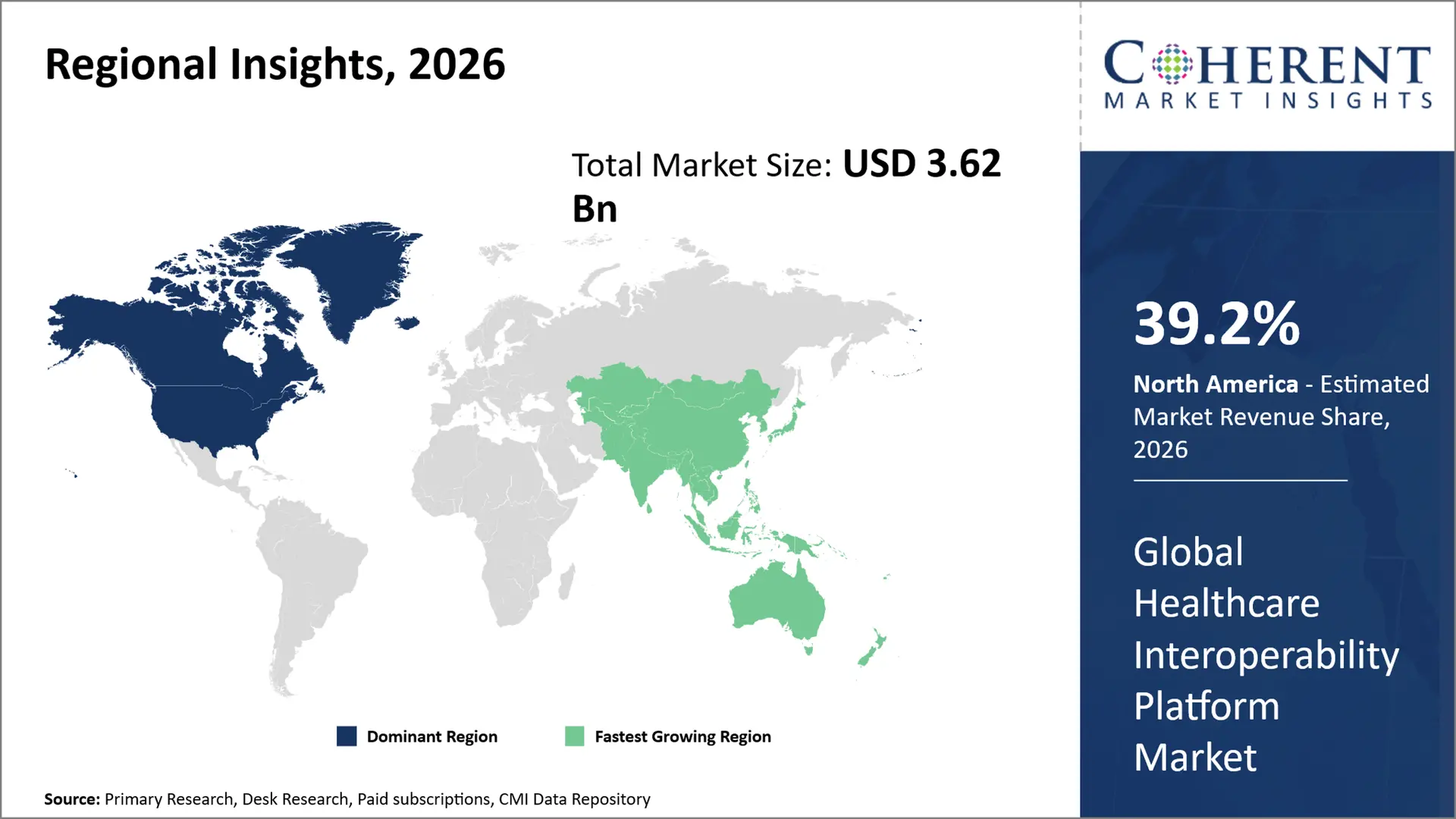
Why is North America a Strong Market for Healthcare Interoperability Platform?
North America leads the global healthcare interoperability platform market, accounting for an estimated 39.2% share in 2026, attributed to increasing adoption of healthcare services, technological advancements, development in healthcare infrastructure, and government initiatives and policies regarding the improvement of healthcare information exchange and patient care. Additionally, introduction of regulations and policies for facilitating the adoption of EHRs and prescribing data standards seem to enhance the demand for interoperability platform.
For instance, in June 2024, the U.S. Centers for Medicare & Medicaid Services (CMS) finalized CMS-4205-F2, requiring updated standardized electronic prescribing transactions for Medicare Part D, including the adoption of NCPDP SCRIPT version 2023011 from January 1, 2028. This supports standardized prescription data exchange between prescribers and pharmacies. Furthermore, rising adoption of digitalization of healthcare industry and requirement for continuous data interoperability among all the providers, hospitals, and payers is expected to strengthen the regional market growth.
Why Does Asia Pacific Healthcare Interoperability Platform Market Exhibit High Growth?
Asia Pacific is expected to exhibit the fastest growth in the global healthcare interoperability Platform market, registering an estimated CAGR of 16.0% during 2026–2033. The region is projected to account for 23.4% of the global market in 2026, attributed to the increasing digitization of healthcare, an expanding infrastructure, and an increasing government focus on smart healthcare. Investments and regulatory reforms for modernizing health IT infrastructure and to foster the standardization of data are expected to support the increased adoption of platforms.
For instance, in October 2024, China's National Health Commission published 12 hospital information platform interoperability recommended standards for the healthcare industry. The standards cover patient, provider, clinical document and medical order information exchanges. The standards, took effect on 1 April 2025 that help to standardize data exchanges within the industry. Moreover, increasing requirement for better management of patient data, better healthcare access, and information exchange is fueling the regional market.
Global Healthcare Interoperability Platform Market Outlook for Key Countries
Why is the U.S. Leading Innovation and Adoption in the Healthcare Interoperability Platform Market?
The U.S. will lead innovation, adoption, and use of health information technology through federal certification requirements and rules to encourage the exchange of electronic health information. In January 2024, the Centers for Medicare & Medicaid Services (CMS) announced its Interoperability and Prior Authorization Rule, requiring relevant payers to adopt FHIR APIs for patient access, provider access, payer-to-payer exchange and prior authorization. This will create a future market opportunity for a platform that creates a link between providers, insurers and digital health players.
Is Japan a Favorable Market for Healthcare Interoperability Platform Market?
Japan is expected to be a lucrative area for the healthcare interoperability platform market driven by government’s drive to digitalize healthcare and enable frictionless exchange of medical data across Japan. The focus on connected healthcare and standardized electronic medical records seem to be creating potential for tools that bring together hospitals, clinics and pharmacies. However, legacy-system integration, data standardization, and privacy requirements remain key challenges.
Is China Emerging as a Key Growth Hub for the Healthcare Interoperability Platform Market?
China is one of the most promising markets for growth of healthcare interoperability platforms, as the government is promoting initiatives to connect healthcare information systems and enable secure exchange of medical data. In July 2026, China’s national health plan highlighted a smart healthcare platform for sharing and access to imaging and diagnosis test results and existing medical records across provinces. These efforts bring opportunities for data integration, standardization and sharing platforms.
Why Does Germany Top the European Healthcare Interoperability Platform Market?
Germany's role in the European healthcare interoperability platform market is strengthened by rising investments by the government and increasing adoption of electronic medical records. The country is focused on the promotion of modernization in healthcare IT and the ease of sharing of secure patient data among healthcare service providers are expected to bolster the need for healthcare interoperability platform market. However, complex data-protection protocols and source diversity continue to influence implementation.
Is Healthcare Interoperability Platform Market Developing in UK?
The UK Healthcare Interoperability Platform market is driven by healthcare digitalization and need for connected patient records which in turn is likely to support the market. Complexity, legacy systems and data privacy issues may continue to pose a major challenge to the market.
How is the increasing adoption of FHIR-based interoperability APIs creating new growth opportunities in the healthcare interoperability platform market?
The growing use of FHIR-based interoperability Application Programming Interfaces (APIs) reflects a potential availability for solutions that enable apps that connect electronic health records (EHRs), laboratories, and pharmacies with the rest of the digital health ecosystem via shared data. These solutions can reduce integration complexity, improve access to data, and enable care to be provided in a more connected, patient-centric way. For instance, in June 2026, the Ministry of Health and Family Welfare of India announced the development of the National Health Claims Exchange (NHCX), and an Insurance Plan FHIR utility, intended to standardize the electronic exchange of health claims and insurance plan data. It offers platform providers the chance to come up with FHIR-based integration solutions to connect hospitals, insurers, and the broader health system. (Source: Press Information Bureau)
Market Players, Key Development, and Competitive Landscape
Key Developments
- In June 2026, Redox Inc. launched AI capabilities designed to scale healthcare integration teams and establish a reliable data foundation for AI applications. The announcement highlights how AI-ready data infrastructure and streamlined integration workflows can strengthen healthcare interoperability platforms.
- In January 2026, Onyx announced its acquisition of InteropX to strengthen electronic prior authorization, payer-to-payer data exchange, and API-based healthcare interoperability. The acquisition combines FHIR-based data exchange, AI-assisted clinical document processing, and interoperability services to help health plans streamline workflows and meet regulatory requirements.
- In December 2025, Trivitron Healthcare and ResoHealth launched Trivitron Digital.AI, a cloud-based platform integrating laboratory information systems, medical imaging, personal health records, and AI-powered automation. Designed around standards such as HL7, FHIR, and DICOM, the platform aims to improve clinical data exchange and accelerate hospital digitization, particularly in India’s Tier-2 and Tier-3 regions.
- In August 2025, HealthEx partnered with athenahealth, CLEAR, MedAllies, and CommonWell Health Alliance to launch a platform enabling patients to securely access, retrieve, and share health records through the U.S. TEFCA framework. Supporting FHIR-based and clinical document exchange, the platform uses identity verification and consent management to facilitate secure, patient-directed data interoperability.
Competitive Landscape
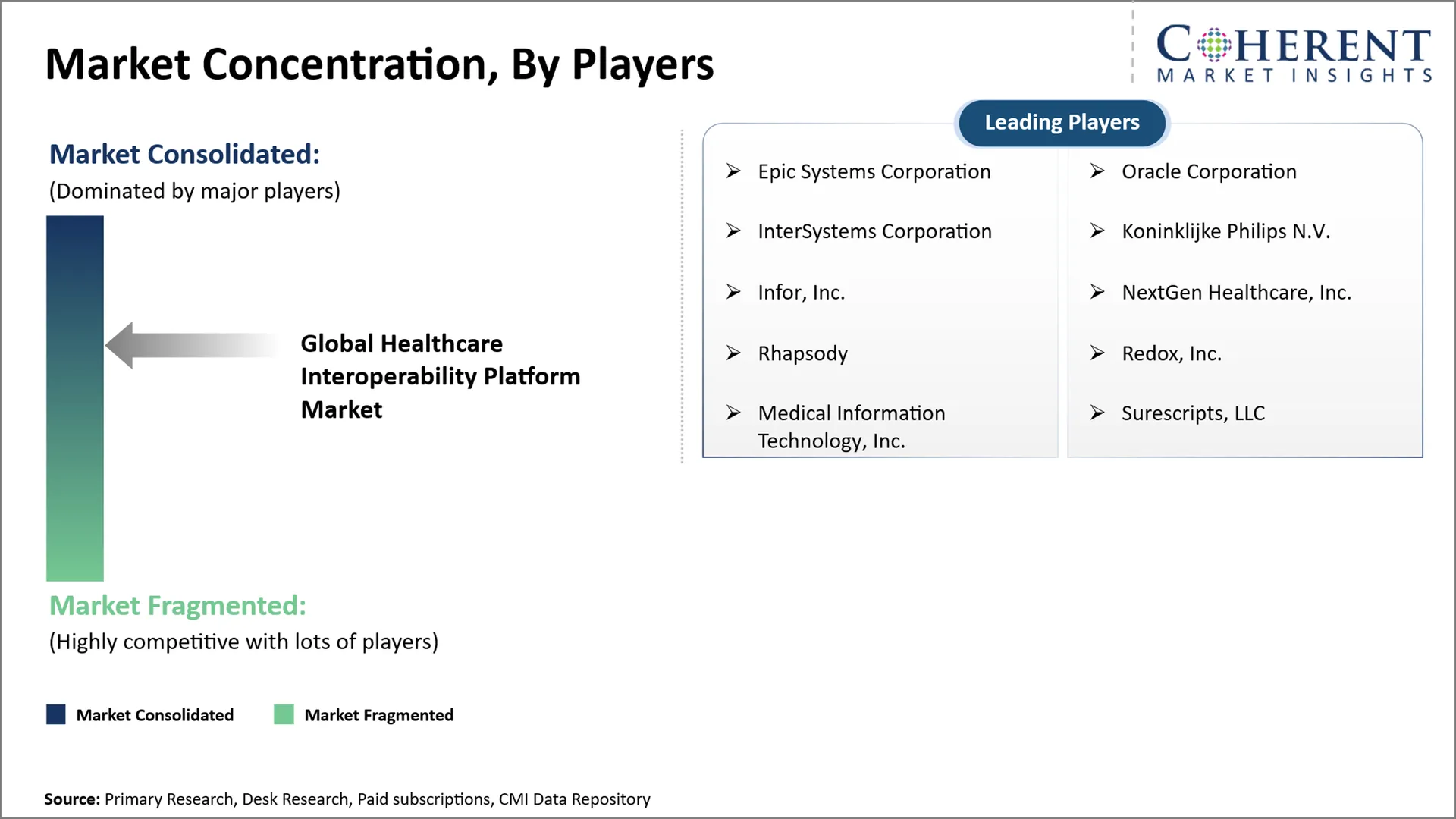
The global healthcare interoperability platform market is moderately competitive, with competition centered on healthcare data integration, standards-based information exchange, API management, and connectivity across clinical and administrative systems. Market participants are increasingly focusing on enabling seamless data exchange between electronic health records (EHRs), laboratories, pharmacies, healthcare payers, and other care providers. Key focus areas include:
- Development of FHIR-based APIs and standards-driven healthcare data exchange solutions
- Expansion of cloud-based interoperability platforms and hybrid integration capabilities
- Integration of EHRs, laboratory information systems, diagnostic imaging, pharmacy, and payer data
- Enhancement of semantic interoperability through standardized clinical terminologies, data mapping, and patient identity matching
- Strengthening of data security, patient consent management, privacy protection, and regulatory compliance
- Adoption of AI-enabled tools for data normalization, duplicate record detection, and automated integration workflows
- Support for real-time information exchange to improve care coordination, clinical decision-making, and population health management
- Expansion of cross-border and national health information exchange networks to connect fragmented healthcare ecosystems
Market Report Scope
Healthcare Interoperability Platform Market Report Coverage | |||
Report Coverage | Details | ||
Base Year | 2025 | Market Size in 2026: | USD 3.62 Bn |
Historical Data For: | 2020 To 2024 | Forecast Period: | 2026 To 2033 |
Forecast Period 2026 To 2033 CAGR: | 12.7% | 2033 Value Projection: | USD 8.35 Bn |
Geographies covered: |
| ||
Segments covered: |
| ||
Companies covered: | Epic Systems Corporation, Oracle Corporation, InterSystems Corporation, Koninklijke Philips N.V., Infor, Inc., NextGen Healthcare, Inc., Rhapsody, Redox, Inc., Medical Information Technology, Inc., Surescripts, LLC | ||
Growth Drivers: |
| ||
Restraints & Challenges: |
| ||
Analyst Opinion (Expert Opinion)
- In the coming years, global healthcare interoperability platform market will be shaped by the transition from basic data connectivity toward intelligent, secure, and real-time healthcare information exchange. As healthcare providers increasingly rely on digital records, connected diagnostics, and data-driven care delivery, interoperability platforms will become essential infrastructure for integrating fragmented healthcare systems. Future solutions are expected to combine FHIR-based APIs, cloud integration, semantic data mapping, patient identity management, and AI-enabled data processing to improve information accessibility and usability across care settings.
- The maximum opportunities are foreseen within FHIR-based healthcare data integration platforms for hospitals and health systems, particularly in India and the U.S. In the U.S., opportunities will center on connecting provider networks, EHR systems, laboratories, and healthcare payers, with emphasis on API-based exchange and administrative workflow integration. In India, the expansion of digital health infrastructure creates opportunities for cloud-based interoperability platforms that connect hospitals, diagnostic laboratories, clinics, and digital health applications. Vendors that address fragmented IT environments and offer scalable solutions for healthcare organizations of different sizes are likely to benefit.
- In order to gain a competitive advantage market players should prioritize standards-based interoperability, flexible deployment models, and seamless integration with legacy healthcare systems. Developing reusable FHIR connectors, robust patient matching, terminology mapping, and consent-based data-sharing capabilities can reduce implementation complexity and improve platform adoption. Players should also strengthen cybersecurity, privacy controls, and implementation support while offering modular, cost-effective solutions that demonstrate measurable improvements in data accessibility, workflow efficiency, and care coordination.
Speak to the analyst
Want personalized insights?
Take the findings above to one of our principal consultants, or have the report rebuilt around the segments, geographies and competitors you actually track.
Market Segmentation
- Component Insights (Revenue, USD Bn, 2021 - 2033)
- Software Platforms
- Services
- Platform Type Insights (Revenue, USD Bn, 2021 - 2033)
- Healthcare Data Integration Platforms
- Health Information Exchange (HIE) Platforms
- API Management and Interoperability Platforms
- Enterprise Interoperability Platforms
- Clinical Data Management and Repository Platforms
- Master Patient Index (MPI) Platforms
- Interoperability Level Insights (Revenue, USD Bn, 2021 - 2033)
- Structural Interoperability
- Foundational Interoperability
- Semantic Interoperability
- Organizational Interoperability
- Technology Insights (Revenue, USD Bn, 2021 - 2033)
- HL7 v2
- HL7 FHIR
- DICOM
- CDA / C-CDA
- IHE Profiles
- API-Based and Other Standards
- Deployment Mode Insights (Revenue, USD Bn, 2021 - 2033)
- Cloud-Based
- On-Premises
- Hybrid
- Application Insights (Revenue, USD Bn, 2021 - 2033)
- Clinical Data Exchange
- Electronic Health Record (EHR) Integration
- Care Coordination and Patient Management
- Diagnostic and Laboratory Data Integration
- Medication and Prescription Data Exchange
- Population Health Management
- Administrative and Claims Data Exchange
- Others
- End User Insights (Revenue, USD Bn, 2021 - 2033)
- Hospitals and Health Systems
- Physician Practices and Specialty Clinics
- Diagnostic Laboratories and Imaging Centers
- Healthcare Payers and Insurance Providers
- Pharmacies
- Health Information Exchanges and Networks
- Others
- Regional Insights (Revenue, USD Bn, 2021 - 2033)
- North America
- U.S.
- Canada
- Latin America
- Brazil
- Argentina
- Mexico
- Rest of Latin America
- Europe
- Germany
- U.K.
- Spain
- France
- Italy
- Russia
- Rest of Europe
- Asia Pacific
- China
- India
- Japan
- Australia
- South Korea
- ASEAN
- Rest of Asia Pacific
- Middle East
- GCC Countries
- Israel
- Rest of Middle East
- Africa
- South Africa
- North Africa
- Central Africa
- North America
- Key Players Insights
- Epic Systems Corporation
- Oracle Corporation
- InterSystems Corporation
- Koninklijke Philips N.V.
- Infor, Inc.
- NextGen Healthcare, Inc.
- Rhapsody
- Redox, Inc.
- Medical Information Technology, Inc.
- Surescripts, LLC
Sources
Primary Research Interviews
- Healthcare IT leaders and clinical informatics specialists involved in EHR integration, clinical data exchange, health information exchange networks, and interoperability strategy.
- Healthcare interoperability architects and integration engineers developing FHIR-based APIs, HL7 interfaces, data mapping solutions, master patient indexes, and enterprise integration platforms.
- Hospital CIOs, CMIOs, health information management professionals, and IT administrators responsible for connecting clinical, laboratory, imaging, pharmacy, and administrative systems.
- Digital health and health information exchange specialists working on cloud-based healthcare integration, patient-mediated data access, cross-organizational exchange, and connected care.
- Data scientists, health data engineers, and healthcare analytics specialists working on data normalization, terminology mapping, patient identity matching, data quality, and interoperability analytics.
Stakeholders
- Healthcare interoperability platform developers and healthcare IT vendors
- Hospitals, health systems, physician practices, and specialty clinics
- Health information exchanges (HIEs), health information networks, and national digital health infrastructure organizations
- Diagnostic laboratories, imaging centers, pharmacies, and electronic prescribing networks
- Healthcare payers, health insurance providers, and claims-processing organizations
- Cloud service providers and healthcare data integration specialists
- Academic institutions and research organizations specializing in health informatics and digital health
- Government health departments, public health agencies, and healthcare technology regulators
- End-use Sectors
- Hospitals and Health Systems
- Physician Practices and Specialty Clinics
- Diagnostic Laboratories and Imaging Centers
- Healthcare Payers and Health Insurance Providers
- Pharmacies and E-Prescribing Networks
- Health Information Exchanges and Networks
- Government and Public Health Organizations
- Long-Term Care and Post-Acute Care Providers
- Academic and Research Institutions
- Regulatory & Health Bodies
- U.S. Assistant Secretary for Technology Policy/Office of the National Coordinator for Health Information Technology (ASTP/ONC) — Health IT certification, interoperability standards, information blocking, USCDI, and nationwide health information exchange.
- U.S. Centers for Medicare & Medicaid Services (CMS) — Interoperability regulations, payer and provider data exchange, FHIR APIs, patient access, and electronic prior authorization.
- U.S. Office of the National Coordinator's Health IT Certification Program resources — Certification criteria and technical requirements relevant to interoperable health IT products.
- European Commission — European Health Data Space (EHDS) — European framework for electronic health data access, exchange, interoperability, and secondary use.
- Australia's Australian Digital Health Agency (ADHA) — National digital health infrastructure, interoperability standards, and connected healthcare initiatives.
- India's National Health Authority (NHA) — Ayushman Bharat Digital Mission, digital health registries, interoperable health information exchange, and national digital health architecture.
Databases
- ONC Health IT Data and Research — Public data on EHR adoption, health information exchange organizations, interoperability standards, and health IT implementation.
- CMS Interoperability Standards and Implementation Guides — Technical standards and implementation guidance for FHIR APIs and healthcare data exchange.
- HealthIT.gov Certified Health IT Product List (CHPL) — Public listings of health IT products certified under the U.S. Health IT Certification Program.
- ClinicalTrials.gov — Public registry of clinical studies, useful for identifying studies involving digital health systems, clinical data integration, and health informatics.
- WHO Global Health Observatory (GHO) — International health-system and digital health indicators that can help contextualize national healthcare digitization.
- OECD Health Statistics — Comparative health-system data and indicators supporting analysis of healthcare digitalization and health information infrastructure.
Associations
- HL7 International — Development and maintenance of healthcare data exchange standards, including HL7 v2, CDA, and FHIR.
- Integrating the Healthcare Enterprise (IHE) — Interoperability profiles and implementation frameworks for connecting healthcare applications and workflows.
- Healthcare Information and Management Systems Society (HIMSS) — Healthcare IT, digital health transformation, interoperability, and health informatics resources.
- Health Information Management Systems Society (HIMSS) India — Healthcare interoperability and digital health resources relevant to the Indian healthcare market.
- Digital Imaging and Communications in Medicine (DICOM) — Standards supporting medical imaging data exchange and interoperability among imaging equipment and healthcare systems.
- SNOMED International — Clinical terminology standards supporting consistent interpretation of clinical information across healthcare systems.
- Regenstrief Institute / LOINC — Standardized identifiers for laboratory tests, clinical observations, and related health information.
Public Domain Sources
- World Health Organization (WHO) — Global digital health strategy, health-system information, digital health policy, and health data governance.
- U.S. Centers for Disease Control and Prevention (CDC) — Public health data exchange, electronic case reporting, public health surveillance, and health information system integration.
- U.S. National Library of Medicine (NLM) — Biomedical information resources, clinical terminology tools, and health data standards resources.
- U.S. National Institutes of Health (NIH) — Biomedical informatics and digital health research relevant to clinical data management and health information systems.
- European Commission — Digital Health and Care — EU digital health policy, cross-border health data exchange, and European interoperability initiatives.
- India's Ministry of Health and Family Welfare (MoHFW) — National health policy, digital health initiatives, and public health system information.
Proprietary Elements
- CMI Data Analytics Tool, Proprietary CMI Existing Repository of information for last 10 years.
Get access to 250+ pages report
Every segment, forecast, competitor profile and data table behind the analysis above — available for instant download.
- ESOMAR Member
- ISO 9001:2015 Certified
- D-U-N-S Registered
- GDPR & CCPA Compliant
Frequently Asked Questions
The global healthcare interoperability platform market is estimated to be valued at USD 3.62 Bn in 2026 and is expected to reach USD 8.35 Bn by 2033.
Software platforms dominate due to their essential role in integrating healthcare IT systems and enabling secure, standardized patient data exchange across care settings.
A healthcare interoperability platform enables seamless, secure, and standardized exchange of health information among disparate healthcare systems, providers, and applications.
The CAGR of global healthcare interoperability platform market is projected to be 12.7% from 2026 to 2033.
Growing adoption of electronic health records (EHRs), and rising demand for coordinated, data-driven patient care are the major factors driving the growth of the global healthcare interoperability platform market.
High costs of integrating legacy healthcare systems, and data privacy and cybersecurity concerns are the major factors hampering the growth of the global healthcare interoperability platform market.
In terms of platform type, healthcare data integration platforms are estimated to dominate the market revenue share in 2026.