

Global Healthcare Revenue Integrity Market Size and Forecast – 2026 To 2033
The global healthcare revenue integrity market is expected to grow from USD 210.6 Bn in 2026 to USD 451.8 Bn by 2033, registering a compound annual growth rate (CAGR) of 11.5% from 2026 to 2033. The market for global healthcare revenue integrity is poised for significant expansion, fueled by the increasing focus on revenue leakage prevention and reimbursement accuracy.
The U.S. Centers for Medicare & Medicaid Services (CMS) reported that Medicare Fee-for-Service had an estimated improper payment rate of 7.66%, equivalent to USD 31.70 billion, in FY 2024. Of this amount, USD 21.56 billion (68% of improper payments) was associated with missing or insufficient documentation, highlighting the importance of accurate clinical documentation, coding validation, and payment compliance in the healthcare revenue integrity market.
Key Takeaways of the Global Healthcare Revenue Integrity Market
- Claims management is projected to hold 19.4% of the global healthcare revenue integrity market share in 2026, making it dominant type segment, across North America due to region’s established health insurance systems, complex reimbursement requirements, and extensive Medicare and Medicaid billing processes increase the need for accurate claims submission, validation, and denial prevention. For instance, the U.S. Centers for Medicare & Medicaid Services (CMS) reported USD 28.83 billion in Medicare Fee-for-Service improper payments in FY2025. Documentation deficiencies and billing errors create a need for stronger claims review and payment-integrity processes.
- Services are projected to hold 67.4% of the global healthcare revenue integrity market share in 2026, making it dominant component segment, across Europe driven by the surging demand supported by healthcare providers’ need for specialist expertise in medical coding, billing audits, documentation improvement, compliance, and denial management. For instance, the European Union’s European Health Data Space Regulation establishes common rules and standards for electronic health data exchange and interoperability. As healthcare organizations strengthen digital-data governance and administrative workflows, specialist implementation and compliance services may become increasingly important.
- Cloud-based is projected to hold 63.5% of the global healthcare revenue integrity market share in 2026, making it dominant deployment model segment, with Asia-Pacific expected to offer substantial growth opportunities. Increasing healthcare digitization, expanding electronic health record adoption, and demand for scalable analytics tools support cloud deployment. For instance, India’s National Health Authority is implementing the Ayushman Bharat Digital Mission (ABDM) to develop interoperable digital health infrastructure. This digital transformation can support demand for connected healthcare administration and analytics platforms, although ABDM does not specifically mandate cloud-based revenue integrity solutions
- North America market maintains dominance with an expected share of 52.6% in 2026, bolstered by the region’s large managed-care sector, complex risk-adjusted reimbursement models, and rigorous payer audits. For instance, the U.S. Department of Health and Human Services Office of Inspector General (HHS-OIG) estimated that unsupported diagnoses identified through certain Medicare Advantage health risk assessments and related chart reviews generated USD 7.5 billion in risk-adjusted payments for 2023. The report recommended stronger validation of diagnoses used for payment calculations, highlighting the need for accurate clinical documentation, coding audits, and payment-integrity controls.
- Asia Pacific is expected to exhibit the fastest growth in the global healthcare revenue integrity market, registering an estimated CAGR of 15.6% during 2026–2033, driven by expanding digital health infrastructure, increasing insurance coverage, and the growing need to manage complex healthcare payments efficiently. For example, Australia’s Department of Health, Disability and Ageing is advancing the My Health Record system, with legislation introduced to require specified pathology and diagnostic imaging information to be uploaded by default. Greater availability and exchange of structured health information can help providers strengthen documentation workflows and data accuracy, supporting the gradual adoption of digital revenue integrity solutions.
Segmental Insights
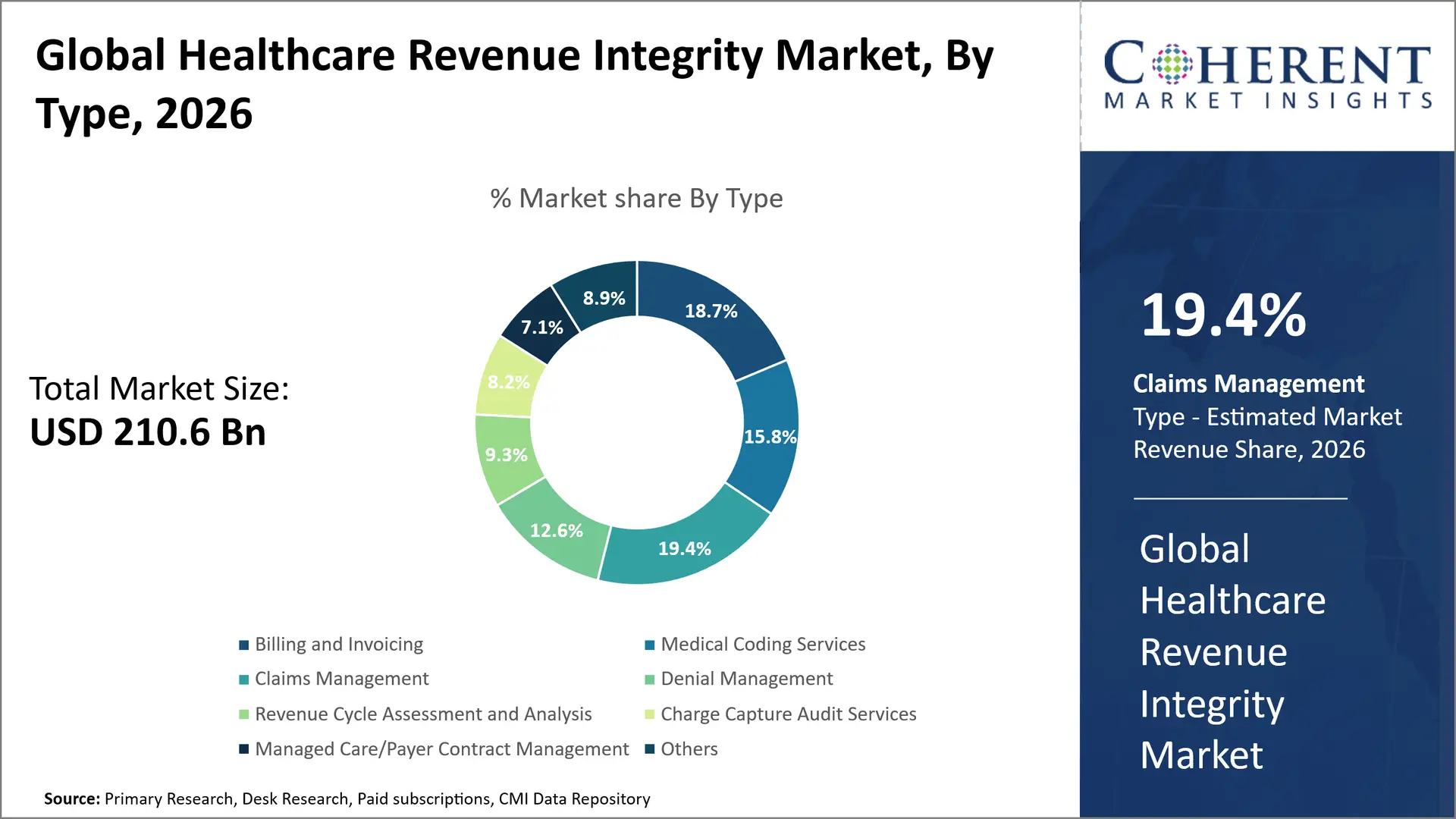
Why Do Claims Management Dominate the Global Healthcare Revenue Integrity Market?
Claims management is projected to hold the market share of 19.4% in 2026, as providers seek to reduce billing errors, eliminate denials, and secure appropriate reimbursement in a variety of payer environments. For instance, the U.S. Centers for Medicare & Medicaid Services’ Real-Time Claims Processing program aims to accelerate electronic transactions to spot potential chances to lower claim rejections, resubmissions and lag. It highlights the importance of automated claims validation and streamlined reimbursement operations.
- Current Industry Events of 2026
- Market Size Estimation
- Regional Breakdown
- Competitive Landscape
- Customer Intelligence
- Segmental Analysis
- Pricing Analysis
- Key Market Drivers, Challenges & Future Trends
- Customized Insights Section
Why Does Services Represent the Largest Component Segment in the Healthcare Revenue Integrity Market?
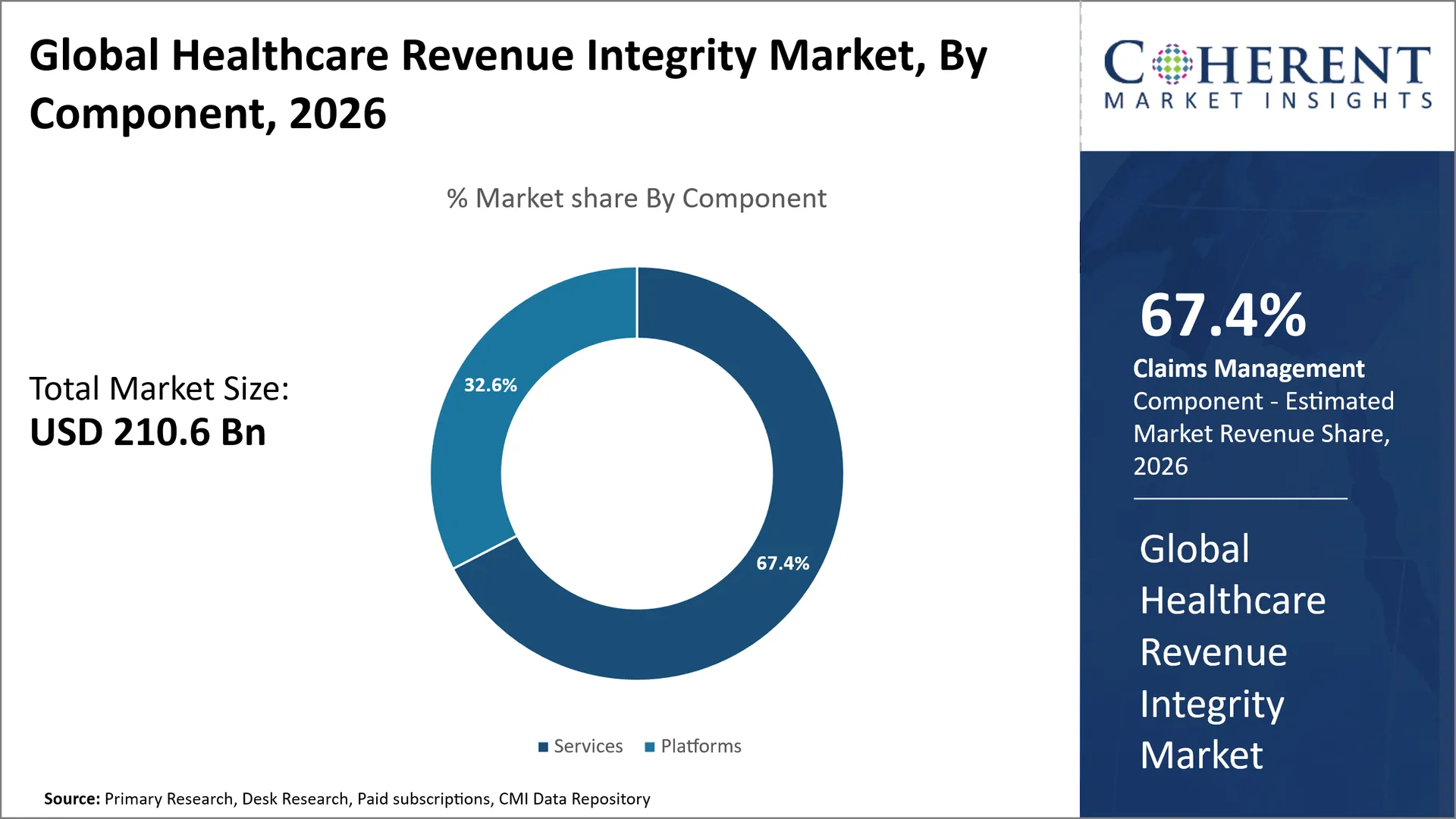
Services are projected to hold a market share of 67.4% in 2026, as healthcare providers require high levels of expertise to optimize processes such as coding, billing audits, denial management, and payer requirement analysis. The providers have to incorporate consulting and managed services to detect revenue leakage, improve reimbursement, and utilize the technology to streamline processes in the absence of an internal team. For instance, the 2025 State of the Revenue Integrity Industry report by National Association of Healthcare Revenue Integrity (NAHRI) identifies charge capture, charge audits, and chargemaster management as key revenue integrity responsibilities, highlighting the need for specialized operational support.
Cloud-Based Segment Dominates the Global Healthcare Revenue Integrity Market
The cloud-based segment is projected to hold a market share of 63.5% in 2026, as it is scalable, has low cost of entry, and can support distributed billing and coding teams. Providers also get centralized access, automatic software upgrades, and integrations with electronic health records and claims management to improve workflow transparency and to help identify revenue discrepancies more efficiently. For instance, the U.S. Department of Health and Human Services provides guidelines for the use of cloud storage and processing for electronic protected health information under the Health Insurance Portability and Accountability Act (HIPAA). The guidelines include specific requirements regarding the types of safeguards as well as business associate agreements to help make cloud use easier for health care financials.
Current Events and their Impact
Current Events | Description and its Impact |
India’s National Health Authority Showcases AI-Based Claims Auto-Adjudication Solutions (May 2026) |
|
U.S. Centers for Medicare & Medicaid Services (CMS) Proposes New Medicaid Payment Integrity Measures (May 2026) |
|
U.S. Centers for Medicare & Medicaid Services (CMS) Updates Medicare National Correct Coding Initiative (NCCI) Payment Edits (March 2026) |
|
Healthcare Revenue Integrity Market Dynamics
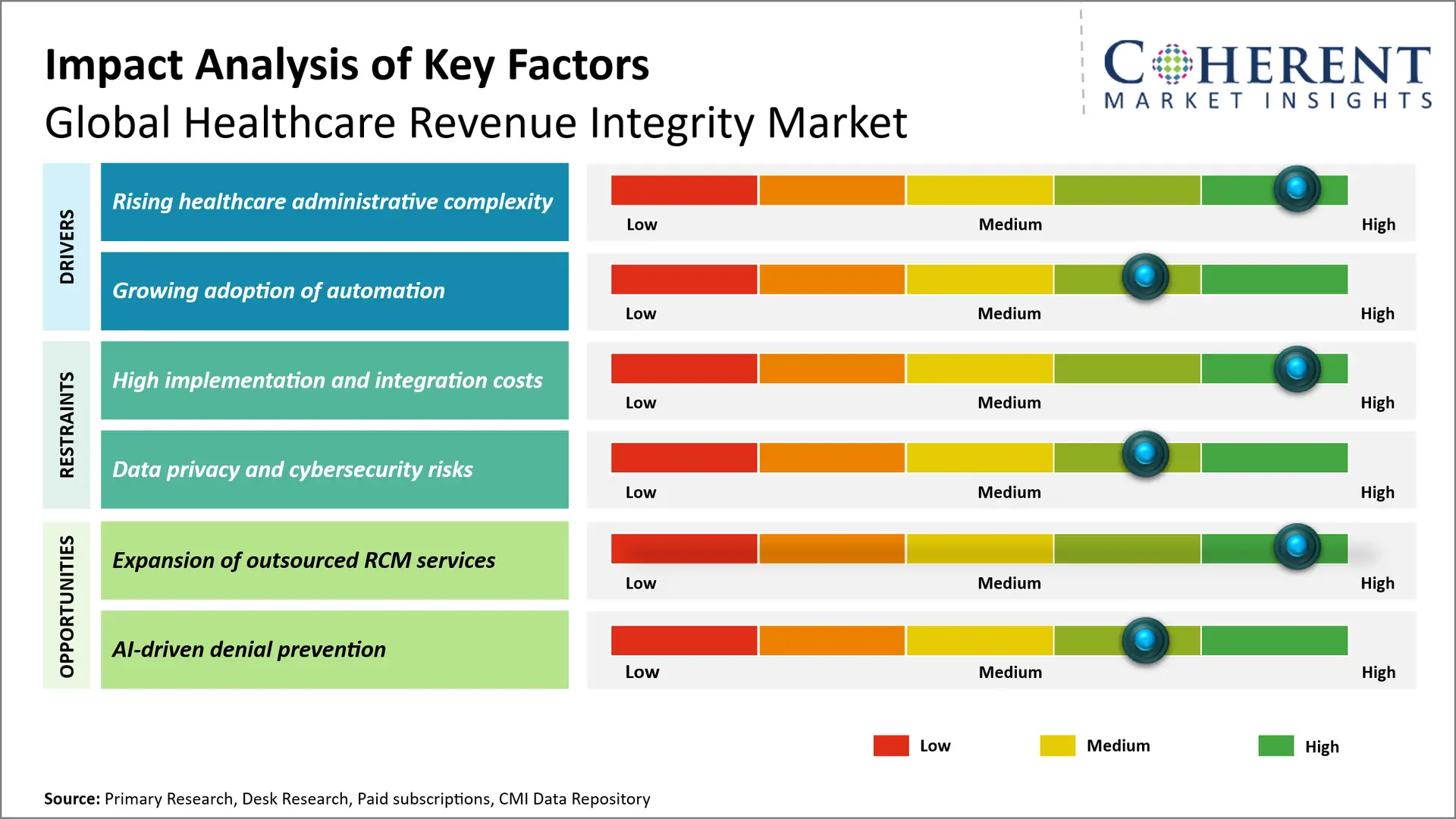
Market Drivers
- Rising healthcare administrative complexity: Increasingly complex reimbursement models, payer-specific billing rules, and risk-adjustment requirements are driving healthcare providers to strengthen revenue integrity processes. For instance, the U.S. Department of Health and Human Services Office of Inspector General (HHS-OIG) reported in 2026 that unsupported acute stroke diagnosis codes submitted by Medicare Advantage organizations could have resulted in USD 462 million in potential net overpayments for 2021, highlighting the need for rigorous coding validation and medical-record audits. This complexity supports demand for solutions that improve documentation accuracy and payment compliance.
- Growing adoption of automation: Healthcare providers are increasingly implementing automated claims processing, electronic payment reconciliation, and billing validation tools to reduce manual workloads, accelerate reimbursements, and improve administrative accuracy. For instance, the U.S. Centers for Medicare & Medicaid Services (CMS) supports standardized electronic claims transactions and electronic remittance advice, enabling providers to streamline payment posting and reconcile reimbursements more efficiently. These capabilities are encouraging the adoption of automated revenue integrity solutions across healthcare organizations.
- Growing Adoption of Automation: Healthcare providers are increasingly adopting automated workflows to streamline prior authorization, reduce manual documentation, and accelerate reimbursement decisions. For instance, the U.S. Centers for Medicare & Medicaid Services (CMS), under its 2024 Interoperability and Prior Authorization Final Rule, established requirements for impacted payers to implement electronic APIs for prior authorization and health data exchange, with key API requirements generally beginning in 2027. These initiatives support demand for automated revenue integrity solutions that improve administrative efficiency and reduce processing delays
Emerging Trends
- AI-driven revenue integrity automation: Healthcare providers are increasingly adopting artificial intelligence (AI) and machine learning to identify coding discrepancies, detect missed charges, predict claim denials, and automate billing reviews. These capabilities help improve reimbursement accuracy and reduce manual administrative workloads.
- Predictive denial management and real-time auditing: Revenue integrity platforms are evolving toward proactive identification of documentation gaps, payer-rule mismatches, and claim errors before submission. Predictive analytics enables providers to prioritize high-risk claims and address potential revenue leakage earlier in the reimbursement cycle.
- Integrated revenue integrity platforms and outsourcing: Healthcare organizations are increasingly combining revenue integrity software with outsourced coding, billing audits, and denial-management services to address staffing shortages and reimbursement complexity. Integrated approaches can improve coordination across clinical documentation, coding, claims, and payment review while reducing reliance on fragmented systems.
Regional Insights
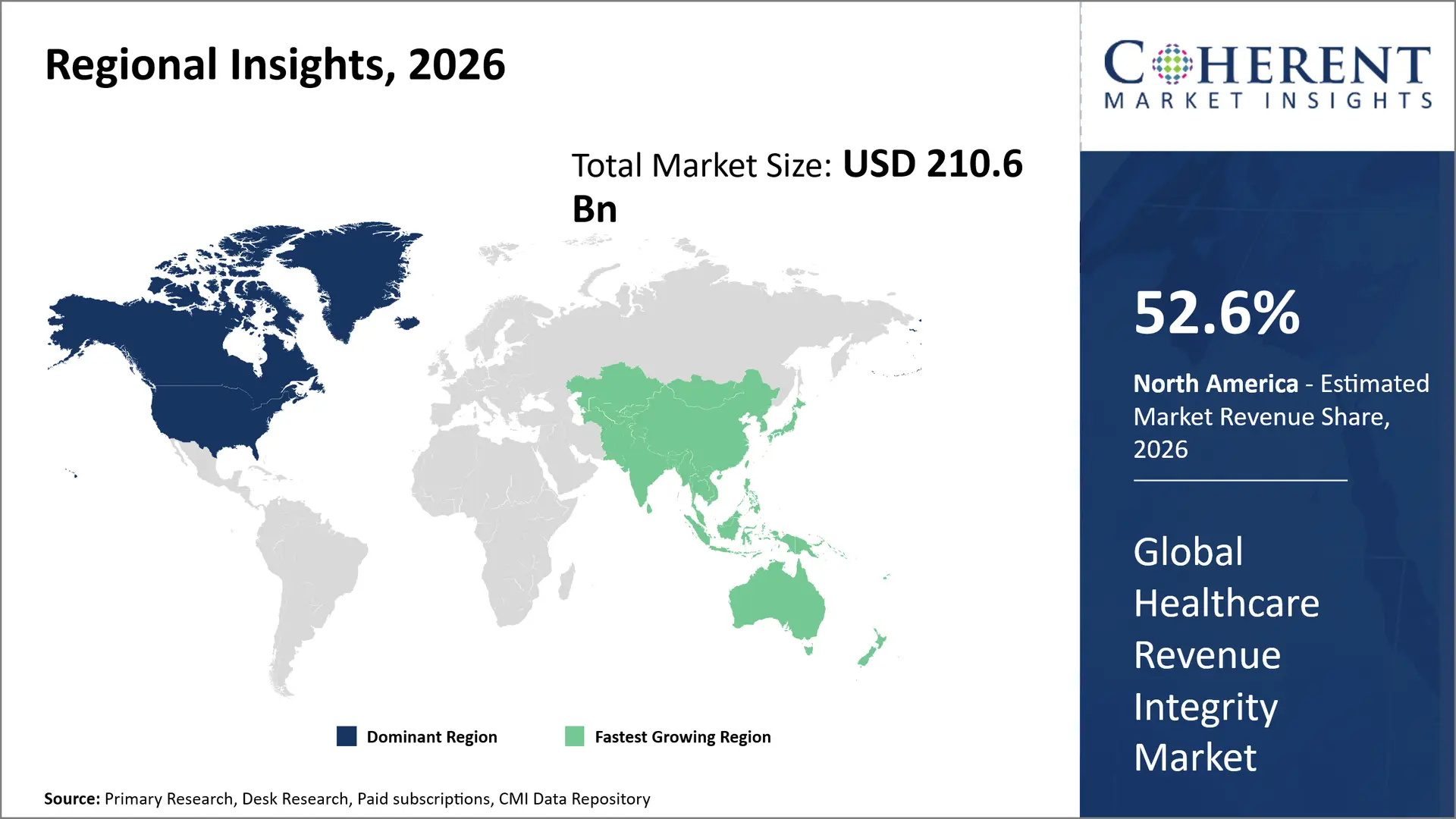
Why is North America a Strong Market for Healthcare Revenue Integrity?
North America leads the global healthcare revenue integrity market, accounting for an estimated 52.6% share in 2026, due to the region's advanced healthcare infrastructure, sophisticated payer networks, high adoption of healthcare IT and automation tools. Government initiatives and payment integrity programs further indicate that initiatives to control fraud, waste, and abuse are expected to intensify and prompt healthcare providers to make investments in revenue cycle management solutions and platforms.
For instance, in February 2026, U.S. management introduced a great campaign to combat health care fraud to improve affordability as well as make available oversight involving payments. This highlights the need to have for extensive claims testing, invoicing compliance, as well as earnings accuracy, within health care organizations. (Source: Centers for Medicare & Medicaid Services (CMS)) Moreover, artificial intelligence (AI) based coding validation, claims review, and denial management are being used as markers of the efforts to minimize revenue leakage.
Why Does Asia Pacific Healthcare Revenue Integrity Market Exhibit High Growth?
Asia Pacific is expected to exhibit the fastest growth in the global healthcare revenue integrity market, registering an estimated CAGR of 15.6% during 2026–2033. The region is projected to account for 19.3% of the global market in 2026, owing to the rising healthcare spends, a surge in hospital infrastructure investments, and increased adoption of the digital systems and technologies. Additionally, the surging government initiatives and policies that accentuate healthcare reforms and universal health coverage are expected to catapult the demand for better billing and revenue integrity and revenue assurance services.
For instance, in May 2025, the China National Healthcare Security Administration issued its first set of intelligent medical insurance fund supervision rules. It adopts big data screening technology to realize more accurate and efficient identification of irregular use of funds, thus fulfilling the requirements for automated claims screening, billing verification and healthcare payment accountability. Furthermore, the increasing private healthcare investments and automated revenue cycle solutions are predicted to act as key growth drivers for revenue cycle management in India, China, and Australia.
Global Healthcare Revenue Integrity Market Outlook for Key Countries
Why is the U.S. Leading Innovation and Adoption in the Healthcare Revenue Integrity Market?
The complex hybrid structure of commercial insurance, Medicare, and Medicaid payment criteria will likely result in the high revenue integrity market for the US. The healthcare providers are motivated to build specialized teams for revenue integrity and to use integrated platforms that improve charge capture, review of documentation and medical coding, and to identify claim denials and underpayments. This can be further incentivized by efforts to match clinical documentation with payer-specific billing rules and reimbursement policies.
Is China a Favorable Market for Healthcare Revenue Integrity Market?
China is probably a strong growth market for healthcare revenue integrity technology driven by increased hospital digitalization, use of electronic health records and standardized billing and insurance reimbursement. The growth in digital hospital systems and focus on the appropriate use of medical insurance funds opens the market for automatic claim review, coding validation and billing compliance tools. However, adoption depends on alignment with China’s national and provincial healthcare insurance scheme, hospital information technology infrastructure and local data rules.
Is Japan Emerging as a Key Growth Hub for the Healthcare Revenue Integrity Market?
Japan seems to be a promising market for revenue integrity solutions for healthcare, primarily because of the adoption of electronic medical records, simplification of medical fee claims and payments process by the national health insurance programme. The uniformity of the country's reimbursement schedule is expected to support demand for accurate medical coding, billing and audit compliance. Digital workflow automation, and AI-enabled claims testing, could also be used to minimize billing errors and administrative burden.
Why Does Germany Top the European Healthcare Revenue Integrity Market?
Germany leads the European for healthcare revenue integrity market due to its large hospital base, complicated statutory and private health insurance reimbursement systems and codes. The DRG reimbursement system might take a stronger focus on more accurate coding, documentation, and billing validation. Additionally, the digitization of hospitals in order to control operating expenses, the industry will probably put an emphasis on commercial, automated coding audits, claims validation, and revenue improvement.
Is Healthcare Revenue Integrity Market Developing in UK?
The growth of UK healthcare revenue integrity market is driven by the emphasis on accurate capture of patient activity and commissioning payments with the smooth operation of healthcare delivery by NHS providers. NHS Payment Scheme and standard healthcare coding norms may be expected to accelerate the adoption of transparent activity capture, data validation and reimbursement handling process. Furthermore, the use of electronic patient records and automated data quality validation can potentially reduce recording errors and improve financial reporting within NHS trusts and private healthcare providers.
How is the expansion of outsourced RCM services creating new growth opportunities in the healthcare revenue integrity market?
The growth of outsourced revenue cycle management (RCM) services is expected to be a lucrative opportunity in the global healthcare revenue integrity market, as providers aim to reduce administration costs, improve coding accuracy, avoid rejections and get reimbursement faster. Additional factors contributing to growth in the market include outsourcing organizations bringing in deep billing knowledge, along with automated verification of claims and automated checks for fraudulent activity factors that make them more attractive to hospitals and clinics with fewer internal resources. For instance, in September 2026, the National Health Authority (NHA) in India reaffirmed the importance of the National Health Claims Exchange (NHCX) and technology-enabled claims processing in bringing efficiencies to health insurance workflows and interoperability, thus increasing the demand for targeted claims-management capabilities. (Source: Press Information Bureau)
Market Players, Key Development, and Competitive Landscape
Key Developments
- On October 14, 2026, Zocdoc, Inc. announced its acquisition of Sohar Health, a healthcare technology company specializing in automated insurance eligibility and benefits verification. The acquisition strengthens Zocdoc’s healthcare access infrastructure by integrating coverage discovery, network-status checks, and cost estimation to reduce administrative friction and improve patient access to care.
- In August 2026, Waystar announced new AltitudeAI-powered agentic capabilities designed to automate key revenue-cycle workflows, including claim resubmission, financial analytics, clinical documentation, and patient financial engagement. The solutions aim to reduce manual administrative work, accelerate reimbursement, and improve operational efficiency for healthcare providers. Early adopters reported up to a 75% reduction in time spent on data analysis.
- In January 2026, Kodiak Solutions announced the acquisition of BESLER, a provider of hospital revenue recovery and reimbursement solutions. The acquisition expands Kodiak’s revenue-cycle analytics, automation, and managed services, including tools to identify Medicare underpayments and improve reimbursement accuracy. The deal strengthens technology-enabled revenue integrity services for hospitals and health systems.
- In May 2025, New Mountain Capital announced the formation of Smarter Technologies by combining Access Healthcare, SmarterDx, and Thoughtful.ai. The platform integrates AI-powered automation, clinical intelligence, and revenue-cycle management to improve healthcare administrative efficiency and financial performance. The combined entity serves more than 200 clients and manages over $200 billion in revenue annually.
Competitive Landscape
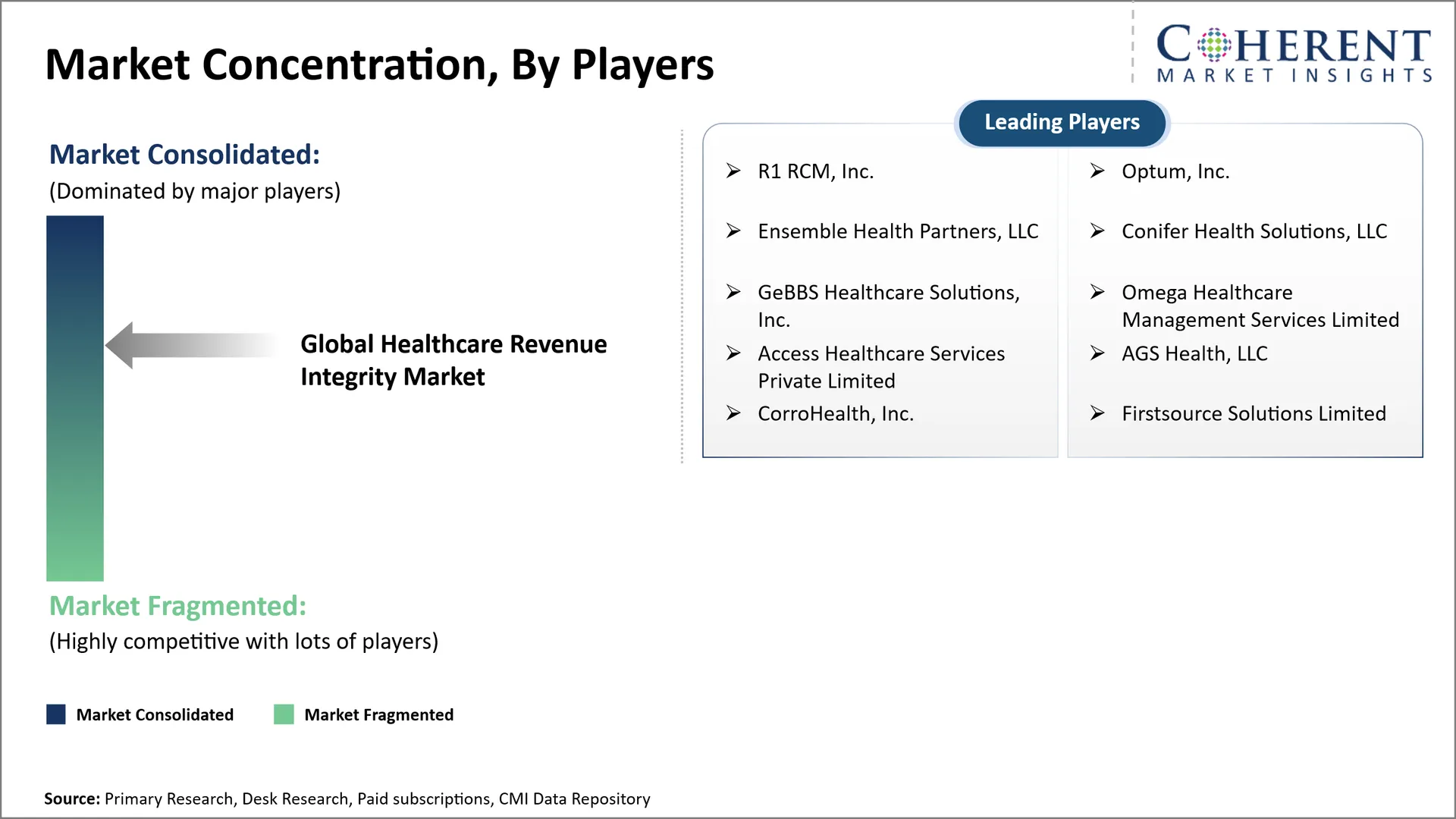
The global healthcare revenue integrity market is moderately competitive, with competition centered on claims accuracy, medical coding, charge capture, denial prevention, reimbursement compliance, and revenue cycle optimization. Market participants focus on combining healthcare financial workflows with automation, analytics, and specialized services to reduce revenue leakage, improve reimbursement accuracy, and strengthen regulatory compliance. Key focus areas include:
- AI-powered medical coding, clinical documentation validation, and charge capture accuracy
- Automated claims management, denial prevention, and appeals optimization
- Revenue leakage detection, underpayment identification, and payment variance analysis
- Regulatory compliance, billing audits, and payer-specific reimbursement rule management
- Integration of electronic health records (EHRs), billing systems, and claims data
- Predictive analytics for denial risk assessment and reimbursement performance monitoring
- Outsourced revenue integrity services, coding support, and end-to-end revenue cycle management
- Cloud-based platforms, workflow automation, interoperability, and secure financial data management
Market Report Scope
Healthcare Revenue Integrity Market Report Coverage | |||
Report Coverage | Details | ||
Base Year | 2025 | Market Size in 2026: | USD 210.6 Bn |
Historical Data For: | 2020 To 2024 | Forecast Period: | 2026 To 2033 |
Forecast Period 2026 To 2033 CAGR: | 11.5% | 2033 Value Projection: | USD 451.8 Bn |
Geographies covered: |
| ||
Segments covered: |
| ||
Companies covered: | R1 RCM, Inc., Optum, Inc., Ensemble Health Partners, LLC, Conifer Health Solutions, LLC, GeBBS Healthcare Solutions, Inc., Omega Healthcare Management Services Limited, Access Healthcare Services Private Limited, AGS Health, LLC, CorroHealth, Inc., Firstsource Solutions Limited | ||
Growth Drivers: |
| ||
Restraints & Challenges: |
| ||
Analyst Opinion (Expert Opinion)
- In the coming years, global healthcare revenue integrity market will be shaped by the shift from reactive billing audits toward proactive, technology-enabled revenue protection. AI-driven coding validation, automated charge capture, predictive denial prevention, and real-time reimbursement monitoring are expected to become increasingly important as healthcare providers seek to reduce revenue leakage and manage complex payer requirements. Services will remain essential for organizations requiring specialized coding, compliance, and audit expertise, while integrated cloud-based platforms will support more scalable and continuous revenue integrity management.
- The maximum opportunities are foreseen within AI-enabled claims management and denial prevention for hospitals and health systems in the U.S., where complex payer rules and reimbursement workflows create a need for accurate claims processing and revenue protection. A second opportunity lies in cloud-based revenue integrity platforms for hospitals and multispecialty healthcare providers in India, supported by ongoing healthcare digitization and expanding insurance-linked care delivery. Providers serving multiple payers, high claim volumes, and complex clinical specialties are likely to offer particularly attractive opportunities for specialized solutions and services.
- In order to gain a competitive advantage market players should prioritize solutions that deliver measurable improvements in clean-claim rates, denial prevention, charge capture, and recovery of underpayments rather than offering automation without demonstrable financial outcomes. Integrating AI with existing electronic health records, billing systems, and payer workflows can improve usability and reduce implementation barriers. Players should also combine technology with expert coding and compliance services, maintain transparent audit trails and human oversight for AI-generated recommendations, and develop scalable offerings for smaller hospitals and emerging healthcare markets.
Speak to the analyst
Want personalized insights?
Take the findings above to one of our principal consultants, or have the report rebuilt around the segments, geographies and competitors you actually track.
Market Segmentation
- Type Insights (Revenue, USD Bn, 2021 - 2033)
- Billing and Invoicing
- Medical Coding Services
- Claims Management
- Denial Management
- Revenue Cycle Assessment and Analysis
- Charge Capture Audit Services
- Managed Care/Payer Contract Management
- Others
- Component Insights (Revenue, USD Bn, 2021 - 2033)
- Services
- Platforms
- Deployment Model Insights (Revenue, USD Bn, 2021 - 2033)
- On-Premises
- Cloud-Based
- Hybrid
- End User Insights (Revenue, USD Bn, 2021 - 2033)
- Hospitals and Clinics
- Individual Practitioners
- Ambulatory Surgical Centers
- Others
- Regional Insights (Revenue, USD Bn, 2021 - 2033)
- North America
- U.S.
- Canada
- Latin America
- Brazil
- Argentina
- Mexico
- Rest of Latin America
- Europe
- Germany
- U.K.
- Spain
- France
- Italy
- Russia
- Rest of Europe
- Asia Pacific
- China
- India
- Japan
- Australia
- South Korea
- ASEAN
- Rest of Asia Pacific
- Middle East
- GCC Countries
- Israel
- Rest of Middle East
- Africa
- South Africa
- North Africa
- Central Africa
- North America
- Key Players Insights
- R1 RCM, Inc.
- Optum, Inc.
- Ensemble Health Partners, LLC
- Conifer Health Solutions, LLC
- GeBBS Healthcare Solutions, Inc.
- Omega Healthcare Management Services Limited
- Access Healthcare Services Private Limited
- AGS Health, LLC
- CorroHealth, Inc.
- Firstsource Solutions Limited
Sources
Primary Research Interviews
- Healthcare Revenue Integrity Directors and Managers overseeing charge capture, billing audits, revenue leakage prevention, compliance monitoring, and reimbursement optimization.
- Chief Financial Officers (CFOs) and Revenue Cycle Executives responsible for hospital financial performance, payer reimbursement, denial rates, accounts receivable, and revenue cycle strategy.
- Medical Coding and Clinical Documentation Integrity (CDI) Specialists responsible for coding accuracy, documentation validation, charge reconciliation, and compliance with reimbursement requirements.
- Claims Management and Denial Prevention Professionals managing claims submission, payment reconciliation, denial analysis, appeals, and underpayment recovery.
- Healthcare IT Leaders and Revenue Cycle Technology Specialists evaluating revenue integrity platforms, EHR integration, claims automation, cloud deployment, and AI-enabled auditing.
- Healthcare Payer and Insurance Representatives overseeing claims adjudication, reimbursement policies, provider contracts, payment accuracy, and fraud, waste, and abuse prevention.
- Healthcare Consulting and Outsourced RCM Service Providers delivering coding services, billing audits, revenue integrity assessments, and end-to-end revenue cycle management.
Stakeholders
- Healthcare Revenue Cycle Software Providers developing claims management, coding validation, charge capture, denial prevention, payment reconciliation, and revenue analytics platforms.
- Hospitals and Integrated Health Systems implementing revenue integrity programs to improve reimbursement accuracy, identify missed charges, and reduce financial losses.
- Healthcare Payers and Insurance Companies managing claims adjudication, payment integrity, reimbursement policies, and provider compliance.
- Medical Billing and Coding Service Providers delivering outsourced coding, claims processing, documentation review, and reimbursement support.
- Healthcare Revenue Cycle Management (RCM) Outsourcing Companies providing denial management, accounts receivable follow-up, underpayment recovery, and revenue integrity services.
- Ambulatory Surgery Centers and Specialty Clinics managing procedure-level charge capture, coding accuracy, and payer reimbursement.
- Healthcare Compliance and Audit Professionals conducting billing audits, documentation reviews, coding assessments, and payment compliance evaluations.
- End-use Sectors
- Hospitals and Health Systems
- Physician Groups and Multispecialty Practices
- Ambulatory Surgery Centers (ASCs)
- Specialty Clinics
- Diagnostic and Imaging Centers
- Other Healthcare Providers
- Regulatory & Health Bodies
- Centers for Medicare & Medicaid Services (CMS), U.S. — Medicare and Medicaid reimbursement policies, claims processing, coding requirements, payment integrity, and improper payment measurement.
- U.S. Department of Health and Human Services Office of Inspector General (HHS-OIG), U.S. — Healthcare billing audits, payment compliance, fraud and abuse oversight, and recommendations for improving claims controls.
- U.S. Department of Health and Human Services (HHS), U.S. — HIPAA administrative simplification, healthcare transaction standards, privacy requirements, and electronic claims-related regulations.
- Centers for Disease Control and Prevention (CDC), U.S. — ICD-10-CM coding resources and healthcare classification information relevant to diagnosis coding and reimbursement.
Databases
- CMS Medicare Coverage Database — National and local coverage determinations, coverage policies, and requirements relevant to medical necessity and reimbursement.
- CMS National Correct Coding Initiative (NCCI) — Procedure-to-procedure edits, Medically Unlikely Edits, and coding resources used to identify billing inconsistencies.
- CMS Data and Public Use Files — Medicare and Medicaid utilization, provider, payment, quality, and claims-related datasets for analyzing reimbursement activity.
- CMS Improper Payments Measurement Programs — Government-reported payment accuracy and improper payment estimate relevant to claims compliance and payment integrity.
- HHS-OIG Work Plan and Audit Reports — Government audits, investigations, and oversight findings concerning healthcare billing, reimbursement, and payment controls.
- Medicare Provider Utilization and Payment Data — Publicly available provider-level information useful for examining service utilization and Medicare payment patterns.
Associations
- Healthcare Financial Management Association (HFMA) — Revenue cycle performance, claim integrity, denial management, charge capture, and healthcare financial management benchmarks.
- American Health Information Management Association (AHIMA) — Medical coding, clinical documentation integrity, health information management, coding compliance, and auditing practices.
- American Academy of Professional Coders (AAPC) — Medical coding standards, billing compliance, reimbursement education, and coding audit resources.
- Healthcare Information and Management Systems Society (HIMSS) — Healthcare IT adoption, digital transformation, interoperability, and technology implementation in healthcare organizations.
- Medical Group Management Association (MGMA) — Medical practice operations, physician billing, reimbursement management, and practice-level financial performance.
- American Hospital Association (AHA) — Hospital finance, reimbursement policy, regulatory developments, and operational challenges affecting healthcare providers.
Public Domain Sources
- CMS — Official Medicare and Medicaid reimbursement policies, claims-processing manuals, coding requirements, payment integrity reports, and public datasets.
- HHS-OIG — Public audit findings, healthcare billing compliance reports, payment integrity recommendations, and fraud and abuse oversight publications.
- HHS Administrative Simplification — Official HIPAA transaction standards, electronic claims requirements, and electronic remittance advice and payment transaction guidance.
- CDC National Center for Health Statistics (NCHS) — ICD-10-CM classification resources used in diagnosis coding and healthcare reimbursement workflows.
- National Health Authority, India — Public information on AB PM-JAY, health insurance administration, claims-related initiatives, and digital health infrastructure.
- U.S. Government Accountability Office (GAO) — Public reports on Medicare and Medicaid oversight, payment accuracy, improper payments, and healthcare program accountability.
- Federal Register, U.S. — Proposed and final rules affecting Medicare and Medicaid payment policies, billing requirements, and healthcare administrative compliance.
- European Commission — Public information on healthcare digitalization, data governance, and regulations affecting healthcare administrative systems.
Proprietary Elements
- CMI Data Analytics Tool, Proprietary CMI Existing Repository of information for last 10 years.
Get access to 250+ pages report
Every segment, forecast, competitor profile and data table behind the analysis above — available for instant download.
- ESOMAR Member
- ISO 9001:2015 Certified
- D-U-N-S Registered
- GDPR & CCPA Compliant
Frequently Asked Questions
The global healthcare revenue integrity market is estimated to be valued at USD 210.6 Bn in 2026 and is expected to reach USD 451.8 Bn by 2033.
Services dominate due to the need for specialized expertise in medical coding, claims auditing, denial management, compliance, and revenue leakage prevention.
Healthcare revenue integrity encompasses processes and technologies that ensure accurate billing, compliant claims, and appropriate reimbursement for healthcare services.
The CAGR of global healthcare revenue integrity market is projected to be 11.5% from 2026 to 2033.
Rising healthcare administrative complexity, and growing adoption of automation are the major factors driving the growth of the global healthcare revenue integrity market.
High implementation and integration costs, and data privacy and cybersecurity risks are the major factors hampering the growth of the global healthcare revenue integrity market.
In terms of deployment model, cloud-based is estimated to dominate the market revenue share in 2026.