
Global Heat-Activated Hair Actives Market Size and Forecast – 2026 To 2033
The global heat-activated hair actives market is expected to grow from USD 4.20 Bn in 2026 to USD 5.60 Bn by 2033, registering a compound annual growth rate (CAGR) of 8.3% from 2026 to 2033. The global heat-activated hair actives market is driven by increasing demand for multifunctional haircare formulations. On November 24, 2025, Procter & Gamble’s Aussie brand introduced its Ultra Wonder Collection. The collection includes Daily Mist, Treatment, and Gel Crème products.
Key Takeaways of the Global Heat-Activated Hair Actives Market
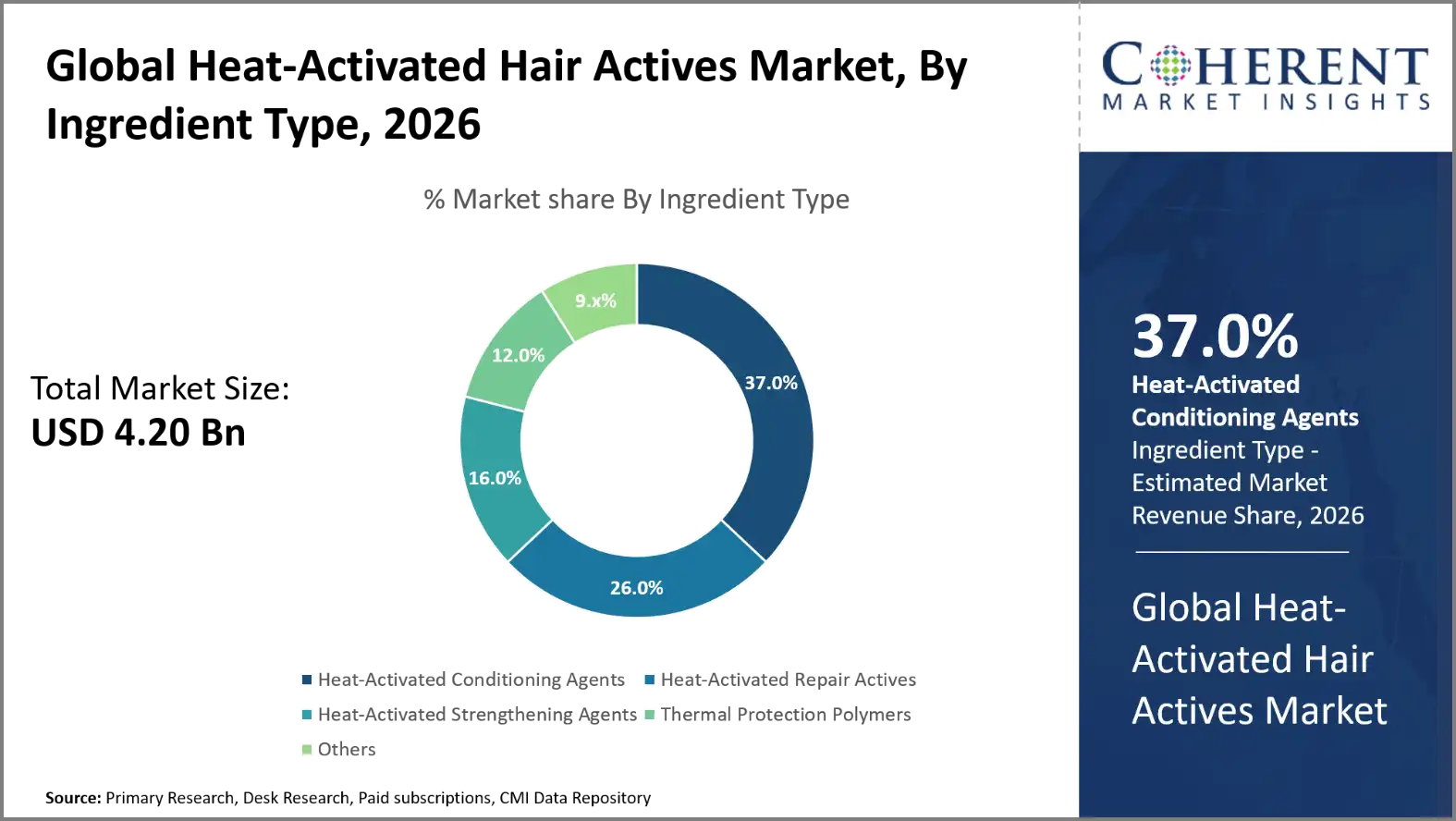
- The Heat-Activated Conditioning Agents segment is expected to account for 37.0% of the global heat-activated hair actives market share in 2026. Growing popularity of professional hair styling treatments is driving the growth of the segment. On September 4, 2025, Wella Professionals launched its Ultimate Smooth range in India. The collection targets dry, dull, and frizzy hair through specialized smoothing treatments.
- The Silicone-Based Ingredients segment is estimated to capture 32.0% of the market share in 2026. Increasing demand for heat-responsive conditioning technologies is majorly driving the growth of the segment. On July 9, 2026, Unilever detailed its KeraKinetic technology through its TRESemmé Professional announcement. The technology uses heat styling to strengthen and repair hair fibers.
- The Serums segment is estimated to capture 28.0% of the market share in 2026. Expansion of premium haircare product categories is majorly driving the growth of the segment. On March 26, 2026, Henkel announced an agreement to acquire OLAPLEX. The proposed transaction valued the company at approximately USD 1.4 billion.
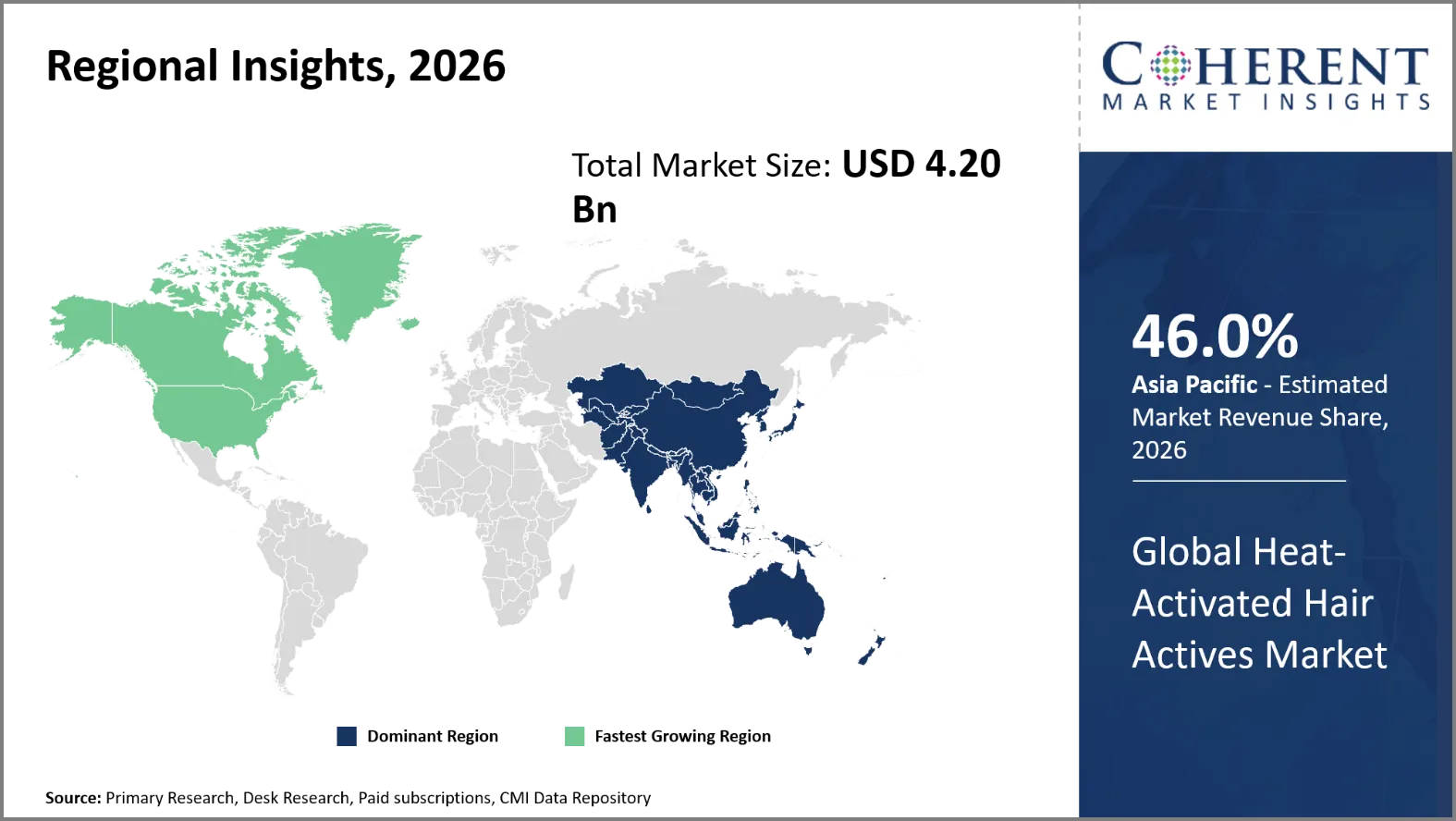
- Asia Pacific is expected to dominate the heat-activated hair actives market in 2026 with a market share of 46.0%. Growing adoption of advanced polymer-based hair actives in Asia Pacific is driving the growth of the regional market. On November 4, 2025, Dow introduced four personal care ingredients at in-cosmetics Asia in Bangkok. DEXCARE CD-2 Polymer is a bio-based, low-viscosity, dual-cationic dextran polymer.
- North America is expected to account for 29.0% share in 2026 and is projected to record the fastest growth over the forecast period. Rising consumer awareness of thermal hair damage in North America is driving the growth of the regional market. On July 23, 2025, K18 launched HeatBounce, with its patented ResiliCore technology for superior thermal protection. The solution penetrates the hair cortex to target damage from high temperature styling.
Segmental Insights
Why Does Heat-Activated Conditioning Agents Dominate the Global Heat-Activated Hair Actives Market?
The heat-activated conditioning agents segment is expected to account for 37.0% of the global heat-activated hair actives market share in 2026. Heat-activated conditioning agents dominate because consumers increasingly seek hair protection alongside styling benefits. These compounds increase softness, smoothness, gloss and manageability during thermal styling. They generate protective layers that minimize surface damage and loss of moisture. There are also fancy formulas that are activated when users blow-dry or heat-style their hair. For example, Croda’s Crodasone Cystine employs heat activated polymerization to preserve and restore hair cuticles. The dominance of this segment is further strengthened by the growing demand for multifunctional hair treatments.
On February 4, 2025, Goddess Maintenance added shampoo and conditioners to their BioTech Blowout line. The technique reinforces the hair structure using dual-peptide technology and builds a lightweight protective surface layer. This conditioner promotes smoothness, detangling and resilience without excessive buildup.
- Current Industry Events of 2026
- Market Size Estimation
- Regional Breakdown
- Competitive Landscape
- Customer Intelligence
- Segmental Analysis
- Pricing Analysis
- Key Market Drivers, Challenges & Future Trends
- Customized Insights Section
Why is Silicone-Based Ingredients the Most Crucial Chemical Composition?
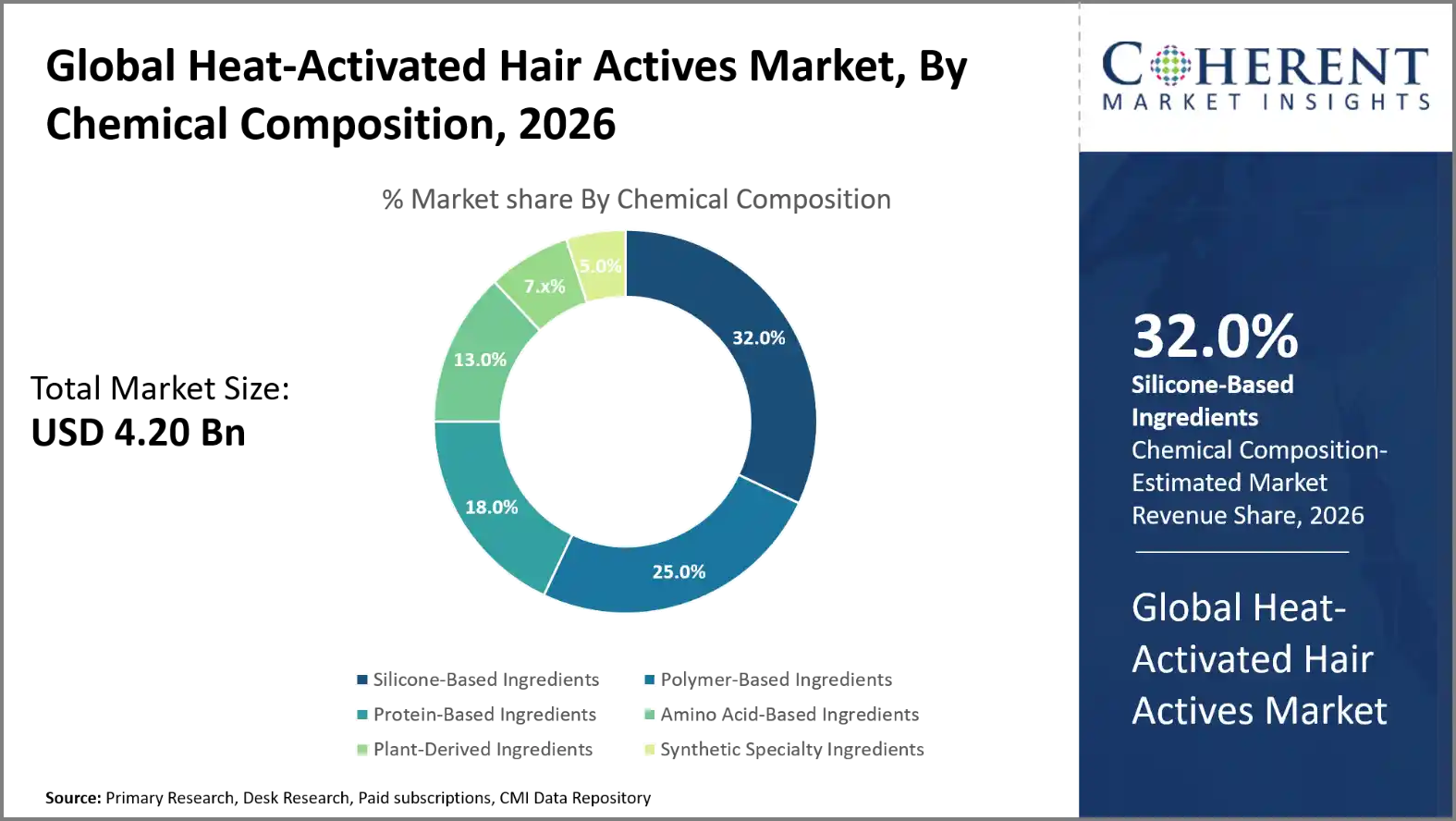
The silicone-based ingredients segment is expected to account for 32.0% of the global heat-activated hair actives market share in 2026. Silicone-based ingredients are still important since they condition well, protect from heat and smooth the surface. Dimethicone and amodimethicone lay light coatings around hair fibers. They minimize friction, improve combability and increase shine. Functional silicones also help to hold moisture and protect damaged cuticles during thermal style. Their compatibility with serums, leave-in conditioners and styling treatments boosts formulation flexibility. Dow’s specialist silicone technologies can be used for conditioning, heat protection and color protection. These performance benefits justify the continued use of silicones in premium haircare formulations.
On October 28, 2026, Givaudan Active Beauty launched SensoTrue DM5. SensoTrue DM5 is a bio-based alternative to dimethicone for professional hair care formulations. Its polymeric emollients provide a light film that smooths the cuticle, decreases friction and controls frizz.
Serums Dominates the Global Heat-Activated Hair Actives Market
The serums segment is expected to account for 28.0% of the global heat-activated hair actives market share in 2026. Serums are the most sought-after option as they are light, easy, and offer various benefits for haircare. The formulas protect against heat, prevent frizz, add shine and improve manageability. Their leave-in application keeps active substances on hair throughout thermal styling. Silicone based serums also spread quickly through hair length without the need of rinsing More and more brands are releasing specific serums to combat breakage, dryness, and heat damage. For example, TRESemmé has a heat protectant oil serum that can handle styling temperatures of up to 230 degrees Celsius. Such benefits lead to a higher uptake of serum among regular users of hair dryers and straighteners.
On July 2, 2025, Wella Professionals introduced its Ultimate Smooth haircare range, featuring a leave-on Miracle Oil Serum. The formulation combines squalane with patented technology to nourish dry hair and improve smoothness. The range claims up to 96 hours of frizz control and 85% smoother hair.
Current Events and their Impact
Current Events | Description and its Impact |
European Union - Commission Regulation (EU) 2026/909 |
|
European Union - Commission Regulation (EU) 2026/78, Omnibus Act VIII |
|
Heat-Activated Hair Actives Market Dynamics
Market Drivers
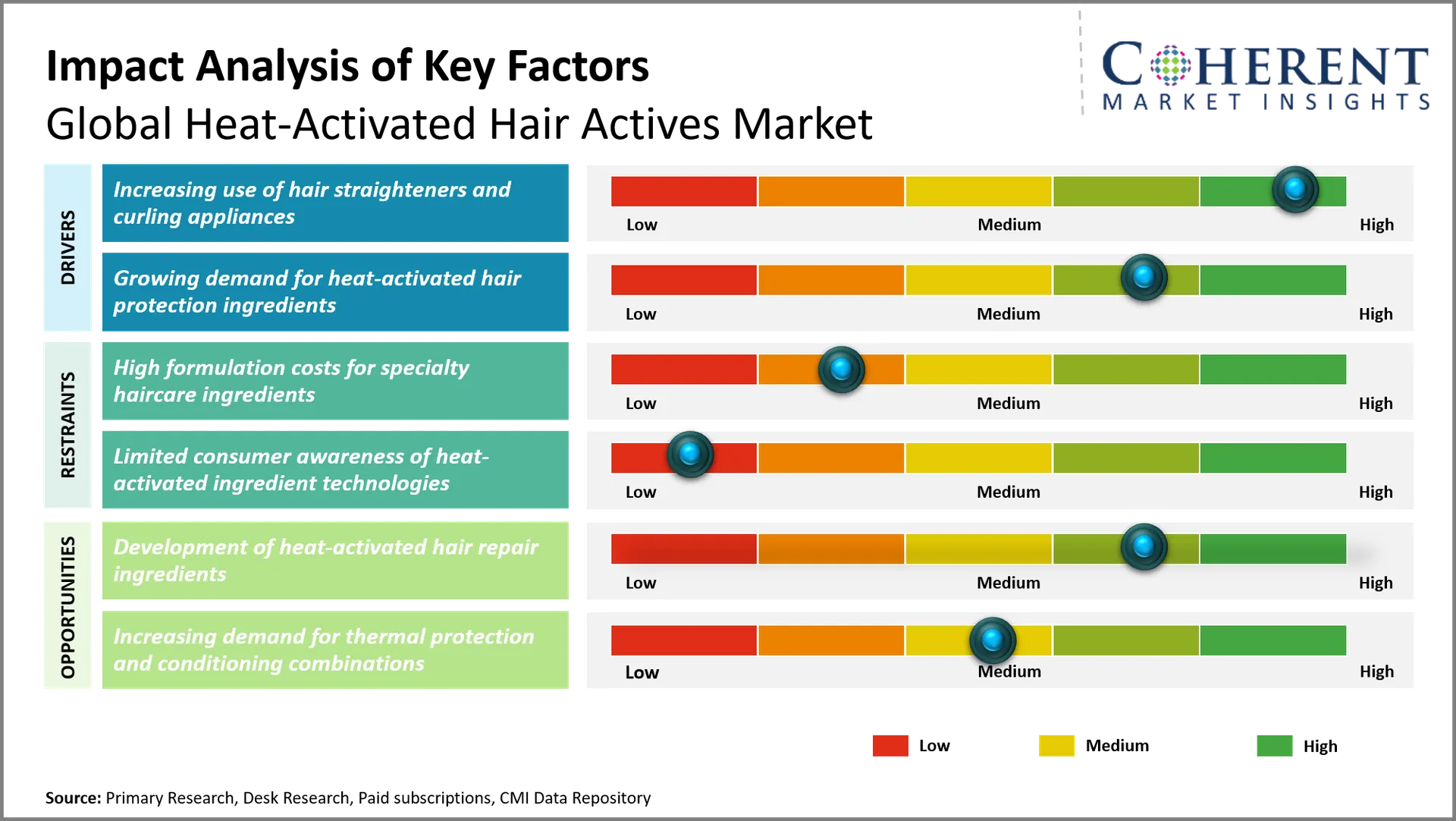
- Increasing use of hair straighteners and curling appliances: Increasing consumption of hair straighteners and curling appliances is boosting demand for heat-activated hair actives. Consumers are increasingly turning to thermal styling equipment for sleek, straight, curled and professionally styled hairstyles. Excessive heat used on a regular basis can also damage the hair strands causing dryness, breakage and cuticle damage. This prompts consumers to add heat-protective serums, conditioning sprays and leave-in treatments to their style regimes. Growing availability of inexpensive styling equipment further drives product uptake among consumer segments. This is why producers are creating specialist formulations to give thermal protection, smoothness, gloss and frizz control.
- On February 24, 2025, Philips India debuted its 2-in-1 Airstyler (BHA531/10) for easy hairstyling at home. The appliance is a hybrid between a paddle straightening brush and a round brush of 38mm. It has ceramic plates impregnated with argan oil, ionic conditioning and uniform heat distribution.
- Growing demand for heat-activated hair protection ingredients: Growing demand for heat-activated hair protection compounds is driving innovation across the haircare sector. Consumers are increasingly looking for formulations that protect hair while blow-drying, straightening and curling. Heat-responsive polymers, silicone derivatives and conditioning chemicals promote the protection of the hair surface. They can also reduce friction, promote moisture retention and increase hair manageability in thermal styling. Cosmetic makers are mixing multipurpose actives into serums, sprays, conditioners and styling creams. Growing knowledge of heat-related damage to hair is promoting preventive hair care techniques. This trend presents opportunity for specialty ingredient providers that are innovating with enhanced thermal protection solutions.
- On September 23, 2026, Provital introduced Kromboost, an upcycled protein-based bioactive derived from barley malt rootlets. Its formulation combines hydrolyzed malt extract and serine to reinforce keratin, maintain moisture, and protect colored hair.
Emerging Trends
- Development of Multifunctional Heat-Activated Haircare Formulations: Manufacturers are developing multi-functional heat-activated products that offer thermal protection, frizz control, conditioning, shine, and moisture retention in one haircare product.
- Impact: These formulations streamline consumer haircare regimens, driving demand for sophisticated conditioning agents, functional silicones and heat-responsive polymers in premium haircare categories.
- Relevance to the market: Brands like L'Oréal Paris and Tresemmé have developed multipurpose heat-protective styling products thus ingredient suppliers are developing appropriate conditioning technologies.
- Increasing Adoption of Advanced Silicone-Based Thermal Protection Technologies: Cosmetic manufacturers are increasingly looking for functional silicone blends and specialized polymers that improve heat resistance, reduce friction, and protect hair cuticles during repeated thermal styling.
- Impact: This trend drives demand for enhanced silicone derivatives, film forming agents and specialized chemicals that deliver superior conditioning performance and formulation stability.
- Relevance to the market: Companies like Dow and Wacker Chemie provide specific silicone technology for haircare applications, allowing innovation in heat-protective serums and leave-in treatments.
Regional Insights
Why is Asia Pacific a Strong Market for Heat-Activated Hair Actives?
Asia Pacific is expected to account for a market share of 46.0% in 2026. The growing beauty production, specific haircare routines and increased acceptance of thermal styling products benefit Asia Pacific. In South Korea, the professional beauty business offers high-end hair treatments that combine conditioning, smoothing and styling protection. Japanese brands tend to focus on lighter weights and moisture control for frequent styling. Shiseido’s professional hair care range is regionally attuned, with specific conditioning technology. Chinese domestic beauty brands are rapidly developing tailored treatments for frizz, dryness and damaged hair. The rising trend of salon sector in India is fueling the use of professional hair care. These developments strengthen demand for silicone derivatives, conditioning polymers, and multifunctional thermal protection ingredients across regional cosmetic manufacturing operations.
Why Does North America Heat-Activated Hair Actives Market Exhibit High Growth?
North America is expected to register the fastest growth with a CAGR of 8.1% over the forecast period. It is projected to account for 29.0% of the global heat-activated hair actives market in 2026. The region has the advantage of skilled salon services, a high level of consumption of premium hair care products and established specialty chemical suppliers. Thermal protection solutions are increasingly becoming a part of consumers’ routines that involve straighteners, curling irons and blow dryers. Brands like Living Proof offer style products to tackle frizz, smoothness and heat related hair issues. Procter & Gamble’s haircare range includes thermal styling protection products from leading consumer brands. Specialty vendors, like Dow, give silicone technologies to aid in the conditioning and styling formulas. Professional beauty retailers are also offering heat-protective remedies alongside styling equipment. These improvements are driving innovation in ingredients for enhanced conditioning, lightweight application and compatibility with thermal styling.
Global Heat-Activated Hair Actives Market Outlook for Key Countries
Why is China Emerging as a Major Hub in the Heat-Activated Hair Actives Market?
China is benefiting from its home-grown cosmetics industry, digital beauty commerce and desire for niche haircare formulas. Local manufacturers are rapidly developing products for damaged hair, humidity related frizz and style performance. E-commerce platforms like Tmall offer a massive distribution opportunity for specialist haircare goods. And Chinese consumers are being increasingly exposed to ingredient-led beauty education through internet channels and professional hairstylists. Conditioning polymers and silicone derivatives can be used by domestic manufacturers into formulas made domestically. International suppliers also work with Chinese cosmetics manufacturers seeking specialty ingredient technologies. These trends are good news for heat-protecting serums, styling creams and multipurpose conditioning treatments.
Is U.S. the Next Growth Engine for the Heat-Activated Hair Actives Market?
The U.S. provides professional hairstyling services, specialist beauty retail and broad consumer product development. Consumers frequently utilize thermal styling appliances such as straighteners, curling irons and blow dryers. There are heat-protective styling solutions for appliance-assisted regimes, including as Tresemmé. L’Oréal Paris also has thermal protection products for consumers who want smoother style outcomes. Specialist beauty businesses stock specific treatments for problems including as dryness, frizz and styling damage. Silicone-based conditioning technologies are developed for these applications by ingredient suppliers. These well-established product categories foster formulation innovation and drive the market for effective heat-protectant haircare ingredients.
Germany Heat-Activated Hair Actives Market Analysis and Trends
Germany benefits from established cosmetic manufacturing, specialty chemical expertise, and professional haircare product development. Schwarzkopf is one of Henkel's haircare brands, offering professional styling and conditioning products. German clients are also given particular salon treatments for damaged hair and styling performance. Wacker Chemie produces silicone technology for cosmetic applications, e.g. hair conditioning formulas. BASF creates cosmetic chemicals that contribute to conditioning, formulation stability and sensory performance. These local chemical capabilities enable ingredient innovation and technological collaboration. The professional beauty market in Germany offers potential for specialist thermal protectant formulas that provide conditioning, smoothness and styling compatibility.
Japan Heat-Activated Hair Actives Market Analysis and Trends
Japan has advanced expertise in cosmetic formulation, high-end haircare preferences and long history of professional beauty. Shiseido Professional creates hair care products focused on conditioning, smoothness and styling capabilities. The Japanese makers tend to focus on light textures and easy-to-tame hair finishes. Kao’s haircare range has solutions for damaged hair and style needs. Japanese beauty customers are also seeing specific treatments for humidity management and hair surface smoothness. These formulation priorities provide a foundation for developing conditioning polymers, useful silicones and lightweight film-forming constituents. Japan’s proven cosmetic research capabilities underpin specialist thermal protection technology for professional and consumer haircare applications.
India Heat-Activated Hair Actives Market Analysis and Trends
India is benefiting from the increased consumer interest in specialized hair care regimens, the growth of salon services, and the expansion of internet beauty retail. Styling products from brands like Streax and L’Oréal Paris target smoothness, manageability and protection of hair. Indian customers are turning to beauty producers and professional hairstylists to get advice on haircare. Nykaa provides an opportunity to sell specialist style treatments & premium hair care products. Humidity, along with frequent washing and style procedures, drive the need for conditioning formulas that combat frizz and dryness. Local cosmetic manufacturers would be able to manufacture cost effective thermal protection goods catering to the taste of local consumers. These improvements offer prospects for silicone-based serums, conditioning sprays and multipurpose styling treatments.
Global Heat-Activated Hair Actives Market - Heat Protection Serum Launches by Product Category
Company | Product | Launch / Announcement Date | Product Category | Heat Protection |
Amway | Satinique Hair Oil Serum | May 1, 2025 | Hair oil serum | Strengthens heat-exposed hair |
TYPEBEA | S1 Ultimate Styling Serum | February 18, 2025 | Styling serum | Up to 230°C |
L'Oréal Professionnel | Glass Shine Serum | May 2025 | Heat-activated shine serum | Up to 450°F |
TRESemmé Professional | Thermo Sculpt Memory Priming Serum | May 2026 | Heat-activated priming serum | Heat-activated protection |
K18 | HeatBounce | July 23, 2025 | Conditioning heat-protection treatment | Up to 450°F |
How is Development of Heat-Activated Hair Repair Ingredients Creating New Growth Opportunities in the Heat-Activated Hair Actives Market?
Growth prospects are being created by the development of heat-activated hair restoration chemicals, which utilize specific technology to address thermal damage and weaker hair fibers. Crodasone Cystine from Croda is a heat-activated polymerization technology that is designed to protect and restore hair cuticles. These developments prompt ingredient makers to create functional polymers that promote conditioning and thermal styling performance. Dow’s advanced silicone technology also help with damaged hair formulation and better surface protection. These advances present potential for specialized ingredient suppliers with differentiated technology for luxury serums, leave-in conditioners and professional styling treatments. Growing demand for hair repair backed by science is also driving producers to look for unique active substances with proven conditioning effects.
On July 1, 2026, SEIWA KASEI CO., LTD. developed Protesil JLH, a hybrid polymer that combines the hair care benefits of plant protein, the smooth feel of silicone, and the hydrophobicity of alkyl groups. It helps in damage healing, color retention, and less surface accumulation. The creation of this polymer fulfills the requirement for superior conditioning polymers that protect hair fibers while providing lightweight performance.
Market Players, Key Development, and Competitive Intelligence
Key Developments
- On September 22, 2026, Clariant launched Genadvance Revive, a revolutionary functional hair care ingredient that combines repair and heat styling. Genadvance Revive is heat-activated and helps restore hair damaged by bleaching, coloring and environmental stress when users blow-dry or straighten it, changing a routine associated with hair damage into an opportunity for healing.
- On October 1, 2025, dsm-firmenich launched the patent-pending Bond Aid, a next-generation ingredient solution powered by OXY 229 CB, a biotech-derived innovation meant to visibly restore hair integrity and vitality. Bond Aid delivers the latest scientific breakthrough to consumers looking for high-performance solutions to daily heat styling, colorant, UV ray damage and environmental stress on the hair.
Competitive Landscape
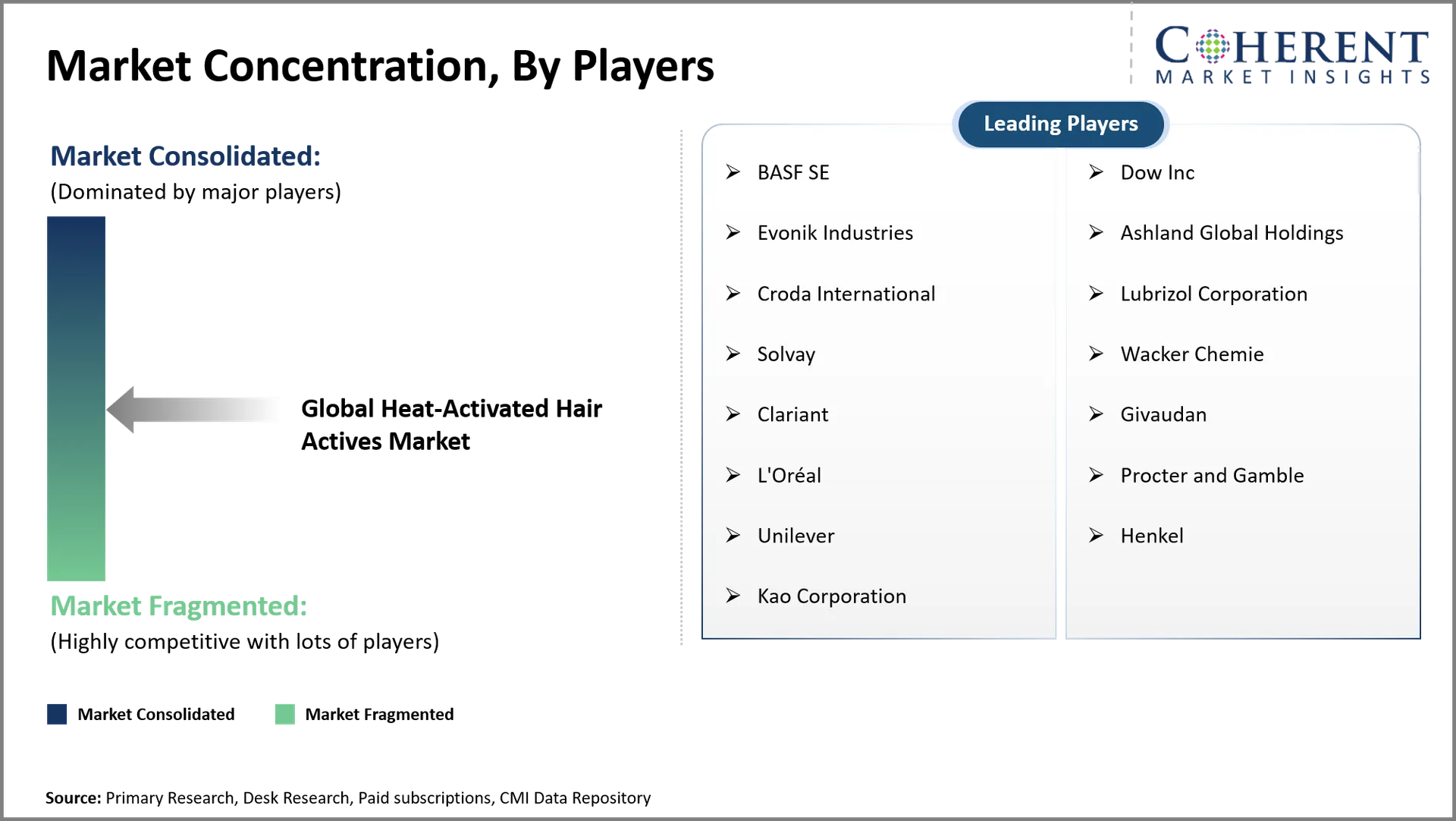
The global heat-activated hair actives market comprises specialized chemical suppliers and cosmetic ingredient manufacturers competing on formulation innovation. In the silicone technologies space, Dow is focused on DOWSIL 5-7113 Silicone Quat MicroEmulsion for conditioning and thermal protection applications. Wacker Chemie provides silicone-based chemicals for hair care applications where a smooth, conditioning and better sensory performance is required. Croda International is focused on specialist conditioning compounds for heat-activated hair protection such as Crodasone Cystine. BASF works on cosmetic chemicals for conditioning, formulation stability and haircare performance. Their strategies emphasize differentiated ingredient technologies, formulation compatibility, and collaboration with cosmetic manufacturers developing premium serums and leave-in treatments.
Top Manufacturers and Notable Products in the Heat-Activated Hair Actives Market
Manufacturer | Notable Product | Key features |
L'Oréal Groupe | L'Oréal Professionnel Keratin Alpha Sleek Mirror Sleek Serum | Keratin Sealer+, amino acid chains, silicone conditioning, anti-humidity performance |
K18 | K18 HeatBounce | ResiliCore technology, lightweight conditioning, hair fibre strengthening, reduced breakage |
Henkel | Schwarzkopf Professional OSiS+ Flatliner Heat Protection Spray | Smoothness, frizz control, thermal styling support, lightweight finish |
Wella Company | Wella Professionals EIMI Thermal Image | Heat protection, smoothing, shine enhancement, lightweight application |
Procter & Gamble | TRESemmé Heat Defence Spray | Thermal protection, frizz management, smoothness, styling support |
Market Report Scope
Global Heat-Activated Hair Actives Market Report Coverage | |||
Report Coverage | Details | ||
Base Year | 2025 | Market Size in 2026: | USD 4.20 Bn |
Historical Data For: | 2020 To 2024 | Forecast Period: | 2026 To 2033 |
Forecast Period 2026 To 2033 CAGR: | 8.30% | 2033 Value Projection: | USD 5.60 Bn |
Geographies covered: |
| ||
Segments covered: |
| ||
Companies covered: | BASF SE, Dow Inc, Evonik Industries, Ashland Global Holdings, Croda International, Lubrizol Corporation, Solvay, Wacker Chemie, Clariant, Givaudan, L'Oréal, Procter and Gamble, Unilever, Henkel, Kao Corporation | ||
Growth Drivers: |
| ||
Restraints & Challenges: |
| ||
Analyst Opinion (Expert Opinion)
- The future of the heat-activated hair actives market will increasingly depend on ingredients combining thermal protection with measurable conditioning benefits. Advanced silicone derivatives, heat-responsive polymers, and hair-repair ingredients will create opportunities for differentiated formulations. By creating chemicals that can withstand several style treatments, manufacturers may tap into the market of consumers seeking protection from dryness, breakage and frizz. Lightweight conditioning technology will continue to be vital for products for fine hair. Formulation innovation should concentrate on blow-dry, straightening and curling performance and not only on traditional conditioning promises.
- The biggest prospects will be in heat protectant serums, leave-in conditioners and multi-function styling treatments. Silicone-based conditioning chemicals provide interesting formulation opportunities, as they promote smoothness, gloss and reduced friction. The U.S. has prospects in professional hair styling and premium thermal protectant products. China has prospects for domestic cosmetic manufacture and specialized beauty formulations. India has the potential for economical heat-protective serums associated with frequent styling and frizz due to humidity. Japan has a space for lightweight conditioning technology for sophisticated haircare preferences.
- Market players should produce chemicals that demonstrate defined thermal protection and conditioning effectiveness under controlled styling settings. Suppliers should focus on formulation compatibility, application specific testing and confirmed safety of ingredients. Partnerships with cosmetic brands can enhance tailored silicone mixes and heat-reactive polymer research. Also, companies should enhance the technical support available to product creators analyzing constituent concentrations and formulation stability. Differentiation will be based on measured performance, verifiable ingredient documentation, and compatibility with commercial hair care manufacture. Suppliers who can offer practical formulation solutions can improve their ties with professional and consumer haircare businesses.
Speak to the analyst
Want personalized insights?
Take the findings above to one of our principal consultants, or have the report rebuilt around the segments, geographies and competitors you actually track.
Market Segmentation
- Ingredient Type Insights (Revenue, USD Billion, 2021 - 2033)
- Heat-Activated Conditioning Agents
- Heat-Activated Repair Actives
- Heat-Activated Strengthening Agents
- Thermal Protection Polymers
- Others
- Chemical Composition Insights (Revenue, USD Billion, 2021 - 2033)
- Silicone-Based Ingredients
- Polymer-Based Ingredients
- Protein-Based Ingredients
- Amino Acid-Based Ingredients
- Plant-Derived Ingredients
- Synthetic Specialty Ingredients
- Product Form Insights (Revenue, USD Billion, 2021 - 2033)
- Serums
- Sprays
- Creams
- Lotions
- Leave-In Conditioners
- Hair Oils
- Hair Masks
- Application Insights (Revenue, USD Billion, 2021 - 2033)
- Thermal Hair Protection
- Hair Repair and Strengthening
- Hair Smoothing
- Hair Conditioning
- Frizz Control
- Hair Styling
- Color Protection
- Distribution Channel Insights (Revenue, USD Billion, 2021 - 2033)
- Online Retail
- Supermarkets and Hypermarkets
- Specialty Beauty Stores
- Pharmacies and Drugstores
- Professional Salon Distribution
- Regional Insights (Revenue, USD Billion, 2021 - 2033)
- North America
- U.S.
- Canada
- Latin America
- Brazil
- Argentina
- Mexico
- Rest of Latin America
- Europe
- Germany
- U.K.
- Spain
- France
- Italy
- Russia
- Rest of Europe
- Asia Pacific
- China
- India
- Japan
- Australia
- South Korea
- ASEAN
- Rest of Asia Pacific
- Middle East
- GCC Countries
- Israel
- Rest of Middle East
- Africa
- South Africa
- North Africa
- Central Africa
- North America
- Key Players Insights
- BASF SE
- Dow Inc
- Evonik Industries
- Ashland Global Holdings
- Croda International
- Lubrizol Corporation
- Solvay
- Wacker Chemie
- Clariant
- Givaudan
- L'Oréal
- Procter and Gamble
- Unilever
- Henkel
- Kao Corporation
Sources
Primary Research Interviews
- Hair Care Product Manufacturers & Formulators
- Raw Material & Active Ingredient Suppliers
- Professional Salon & Trichology Experts
- Cosmetic Chemists & R&D Specialists
Magazines
- Cosmetics & Toiletries Magazine
- Global Cosmetic Industry (GCI) Magazine
- Beauty Matter Magazine
- Personal Care Magazine
Journals
- International Journal of Cosmetic Science
- Journal of the Society of Cosmetic Chemists
- Journal of Dermatology & Trichology
Associations
- Personal Care Products Council (PCPC)
- Cosmetic, Toiletry and Fragrance Association (CTFA)
- European Cosmetics Association (Cosmetics Europe)
- Society of Cosmetic Chemists (SCC)
Public Domain Sources
- U.S. Food & Drug Administration (FDA) - Cosmetic Regulations & Ingredient Safety
- European Chemicals Agency (ECHA) - Cosmetic Ingredient Compliance Data
- World Health Organization (WHO) - Consumer Product Safety Reports
- United Nations Comtrade - Import/Export Trade Data for Hair Care Actives
Proprietary Elements
- CMI Data Analytics Tool
- Proprietary CMI Existing Repository of Information for Last 10 Years
Get access to 250+ pages report
Every segment, forecast, competitor profile and data table behind the analysis above — available for instant download.
- ESOMAR Member
- ISO 9001:2015 Certified
- D-U-N-S Registered
- GDPR & CCPA Compliant
Frequently Asked Questions
The global heat-activated hair actives market is expected to stand at USD 4.20 Bn in 2026 and is expected to reach USD 5.60 Bn by 2033.
The CAGR of the global heat-activated hair actives market is projected to be 8.3% from 2026 to 2033.
Increasing use of hair straighteners and curling appliances and Growing demand for heat-activated hair protection ingredients are the major factors driving the growth of the global heat-activated hair actives market.
High formulation costs for specialty haircare ingredients and Limited consumer awareness of heat-activated ingredient technologies are the major factors hampering the growth of the global heat-activated hair actives market.
Heat-activated hair actives are functional ingredients that provide conditioning, protection, or repair benefits during thermal styling.
They form protective films or provide conditioning benefits that help minimize friction and thermal styling damage.
Heat-responsive polymers support film formation, conditioning, and improved hair surface protection during thermal styling.