

High-Performance Engineering Plastics Market Size and Share Analysis- 2026 To 2033
The High-Performance Engineering Plastics Market size is anticipated to grow at a CAGR of 7.3%, with USD 26.61 Bn in 2026, and is expected to reach USD 43.53 Bn in 2033. The primary drivers are largely defined by the increasing demand for lightweight and high-strength materials in automotive and aerospace applications, growing adoption of heat-resistant and chemically stable polymers in electrical and electronic components, rising use of advanced engineering plastics in medical devices, and expanding applications in electric vehicles and industrial manufacturing. According to BASF, engineering plastics such as polyamides (PA), polybutylene terephthalate (PBT) and polyphthalamides (PPA) are frequently used in automotive, electrical and electronics and medical technology applications because of their mechanical strength, thermal resistance and dimensional stability, creating opportunities for advanced material innovations and high-performance component manufacturing.
Key Takeaways of the Global High-Performance Engineering Plastics Market
- The PPS segment is expected to account for 34.0% of the global share of the high-performance engineering plastics market in 2026. Demand for heat resistant, chemically stable and dimensionally stable materials for automotive, electrical and industrial applications is driving the segment growth. In September 2026, Victrex reported that global PEEK volumes are forecast to grow at about 5% per year over the next five years, indicating ongoing opportunities throughout the broader high-performance polymer space.
- Automotive segment is expected to hold 32.0% of the market share in 2026. The segment is driven by the growing demand for lightweight components, electrification, thermal management and high-performance electrical insulation. Global sales of electric cars reached more than 20 million units in 2025, or about 25% of all new cars sold, the International Energy Agency said in its Global EV Outlook for May 2026. This expansion is giving more opportunities for specialized engineering plastics in electrical vehicle systems.
- Transportation segment is estimated to hold 35.0% of the global market share in 2026. The lightweight polymer components in cars and airplanes, the focus on fuel efficiency, and the increasing replacement of traditional metals are driving the growth of the segment. Airbus announced on January 12, 2026 that it delivered 793 commercial aircraft in 2025, up 4% year-on-year, and that its order backlog at the end of the year was 8,754 aircraft. The increasing aerospace manufacturing pipeline provides long term demand opportunities for high-performance polymer parts.
- Asia Pacific is expected to have the largest market share of 39.0% in the high-performance engineering plastics market in 2026. Regional demand is growing due to growing automotive manufacturing and semiconductor fabrication and high investments in advanced polymer processing. According to IEA’s 2026 Global EV Outlook, China made up almost 75% of the world’s electric car production in 2025, further highlighting the region’s significant manufacturing capabilities and avenues for advanced engineering plastics.
- North America is projected to account for 28.0% share of the global high-performance engineering plastics market in 2026. The regional growth is supported by the demand for advanced polymers in aerospace, semiconductor manufacturing, medical devices and industrial equipment. In March 2026 GE Aerospace announced plans to invest another USD 1 Bn in U.S. manufacturing in 2026 to boost engine production, improve component durability and bolster domestic suppliers, creating downstream opportunities for high-performance materials.
Segmental Insights
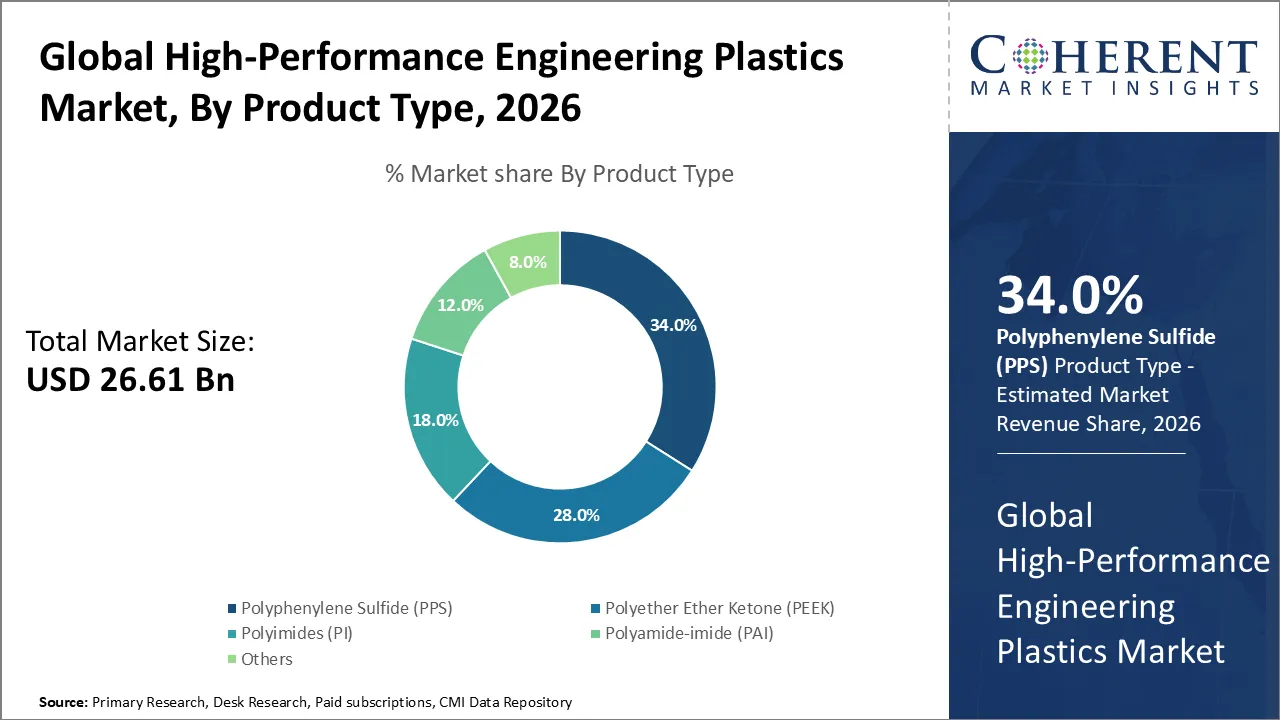
Why Does Polyphenylene Sulfide (PPS) Dominate the Global High-Performance Engineering Plastics Market?
The polyphenylene sulfide (PPS) segment is anticipated to capture 34.0% of the global high-performance engineering plastics market share in 2026. PPS is increasingly selected for its excellent thermal stability, chemical resistance, flame retardancy and dimensional stability in demanding operating conditions. These properties make it suitable for automotive electric components, industrial machinery, semiconductor equipment and electronic connectors. The growing popularity of electric vehicles and the miniaturization of electronic components have created demand for polymers that retain their mechanical strength at high temperatures.
On November 3, 2025, Toray Advanced Materials Korea announced that it had finished expanding the second PPS production line at its Gunsan plant in South Korea, increasing annual production capacity by 5,000 tons. The expansion enhances the company’s PPS manufacturing capabilities and meets the increasing demand for heat-resistant engineering plastics used in automotive, electrical and industrial applications.
- Current Industry Events of 2026
- Market Size Estimation
- Regional Breakdown
- Competitive Landscape
- Customer Intelligence
- Segmental Analysis
- Pricing Analysis
- Key Market Drivers, Challenges & Future Trends
- Customized Insights Section
Why Is Automotive the Leading Application in the High-Performance Engineering Plastics Market?
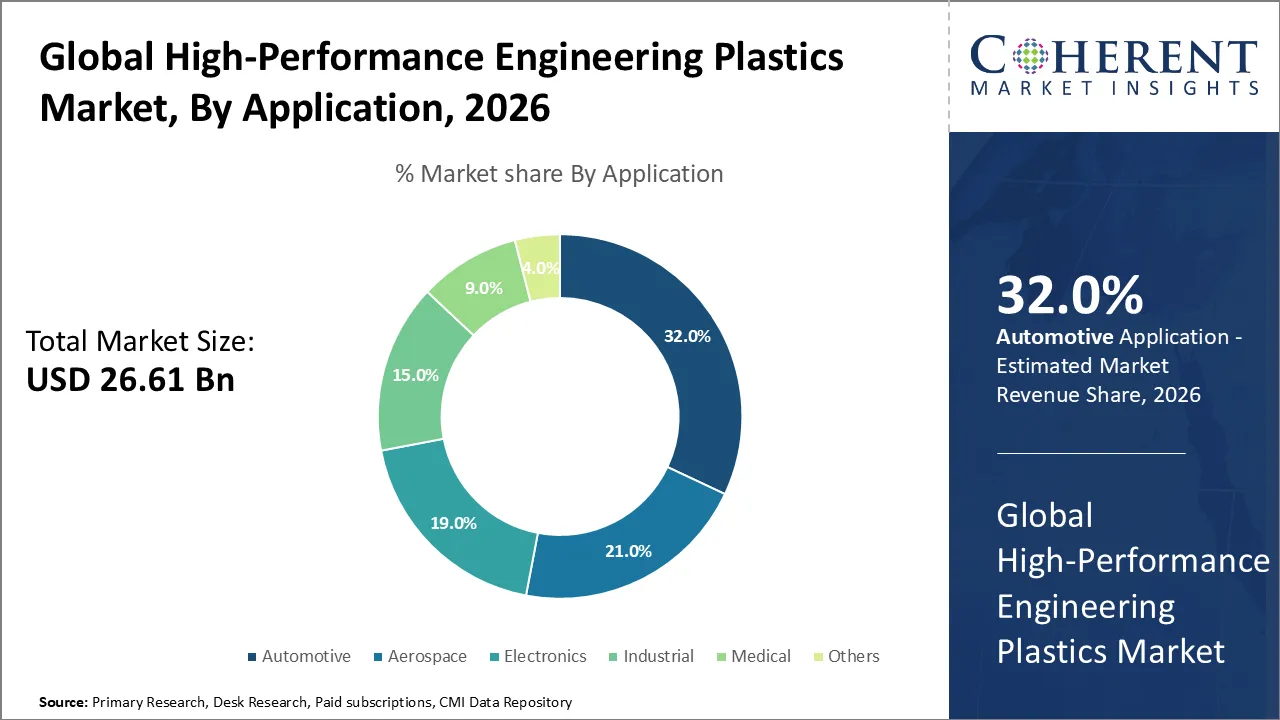
The automotive segment is projected to account for 32.0% of the global high-performance engineering plastics market by 2026. Engineering plastics are used more because cars are becoming more electrified, the parts have to be lighter weight and they have to perform better thermally and electrically. Car makers are using materials such as PPS, PEEK and polyimides in battery systems, electrical connectors, sensors, powertrain components and thermal management assemblies. They have high strength-to-weight ratios, are resistant to chemicals and high temperatures and are more durable than many conventional polymers. Increasing demand for high voltage electrical systems and compact vehicle components is driving the development of specialized engineering plastics, which further contribute to vehicle efficiency, safety and long-term reliability.
On June 11, 2026, Envalior announced its Xytron M5080ET PPS compound for electric vehicle busbars that provides more than 70% improved thermal shock resistance compared to standard PPS compounds. It is designed for applications above 150 °C, providing better durability and electrical insulation in high voltage electric vehicle systems.
Transportation Dominates the Global High-Performance Engineering Plastics Market
The transportation segment is anticipated to hold 35.0% of the global high-performance engineering plastics market share in 2026. Segment growth is aided by the increase in demand for lightweight, durable and high temperature resistant components in automotive, aerospace and rail transportation. To reduce structural weight, improve energy efficiency, and increase resistance to corrosion and operational stress, transportation manufacturers are increasingly turning to specialized polymers to replace conventional metal parts. High-performance plastics such as PEEK, PPS and polyimides are used in electrical insulation, aircraft interior components, under-the-hood automotive systems, bearings and precision mechanical assemblies.
According to the company’s October 2026 commercial aircraft delivery report, Airbus delivered 621 commercial aircraft to 91 customers during January–October 2026, including 74 aircraft in October alone. The ongoing commercial aircraft manufacturing activity provides demand opportunities for lightweight, flame resistant and thermally stable engineering plastics in aerospace components.
Current Events and Their Impact on the High-Performance Engineering Plastics Market
Current Event | Description and its Impact |
European Union Introduces Mandatory Recycled Plastic Requirements for New Vehicles (August 2026) |
|
European Chemicals Agency Advances Proposed PFAS Restrictions (March 2026) |
|
High-Performance Engineering Plastics Market Dynamics
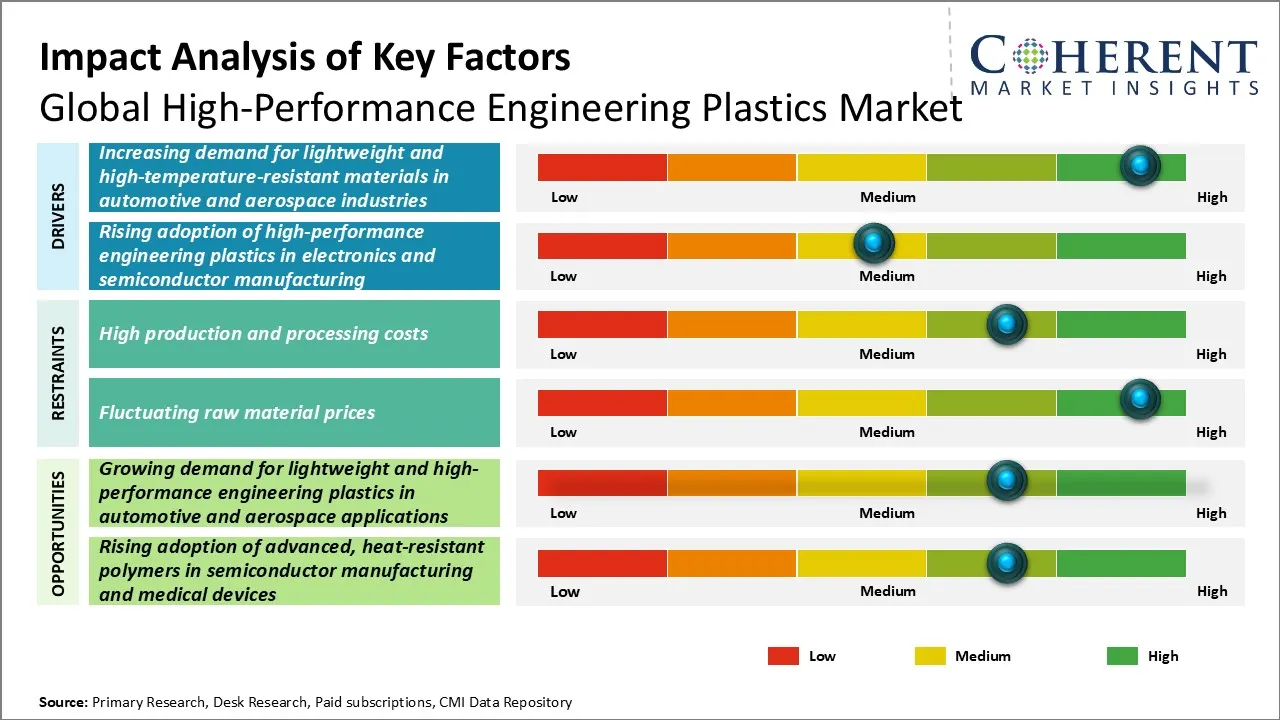
Market Drivers
- Increasing demand for advanced materials in semiconductor and electronics manufacturing: The global high-performance engineering plastics market is driven by the rapid growth of semiconductor fabrication facilities and increasing demand for high-performance electronic components. Semiconductor manufacturers require thermal stability, chemical resistance, dimensional accuracy and low contamination characteristics. Wafer-handling equipment, electrical insulation, precision connectors, and semiconductor processing components are increasingly utilizing high-performance polymers such as polyether ether ketone (PEEK), polyphenylene sulfide (PPS), and polyimides.
- According to SEMI projects that worldwide spending on 300mm semiconductor fabrication equipment will increase 18% to USD 133 billion in 2026 and another 14% to USD 151 billion in 2027. Growth is primarily driven by the increasing demand for artificial intelligence chips, advanced semiconductor manufacturing technologies and regional supply chain investments that create more opportunities for high performance engineering plastics used in semiconductor manufacturing equipment.
- Increasing use of lightweight and high temperature resistant materials in aerospace manufacturing: High-performance engineering plastics are in high demand due to the increased focus on aircraft weight reduction, fuel efficiency and component durability. Aerospace manufacturers are using more PEEK, PPS, polyimides and other high-performance polymers in aircraft interiors, electrical systems, structural brackets, bearings and components near engines. They have high ratios of strength to weight, high thermal resistance, and better resistance to chemicals and fatigue, enabling manufacturers to replace selected metal components without compromising performance requirements. The growing aircraft production, fleet modernization and adoption of advanced manufacturing technologies further support the demand for specialized engineering plastics.
- The Global Market Forecast 2026-2045 from Airbus anticipates a requirement for 42,060 new commercial aircraft within the next 20 years, of which around 33,920 will be single-aisle aircraft and 8,140 widebody aircraft. An estimated 19,820 aircraft will replace older fleets, showing the continued need for next-generation lightweight materials and high-performance polymer components in aerospace manufacturing.
High-Performance Engineering Plastics Market Trends
- Increasing use of high-temperature-resistant and lightweight engineering plastics is prompting manufacturers to replace conventional metal components with PEEK, PPS and polyimides in precision equipment, industrial machinery and demanding structural applications.
- Increasingly, high-performance polymers are being used in additive manufacturing to enable the production of customized, lightweight and complex industrial components. INTAMSYS and JLC3DP have announced the production-ready PEEK and PEKK 3D printing services on August 5, 2026, bringing advanced polymer manufacturing to more users.
- The growing demand for high-performance polyimide films in the flexible electronics and semiconductor packaging industries is driving the development of materials with better insulation, thermal stability and dimensional precision. PI Advanced Materials said July 28, 2026 its advanced industrial business revenue increased 35.3% year-on-year on demand for industrial-process and semiconductor films.
Regional Insights
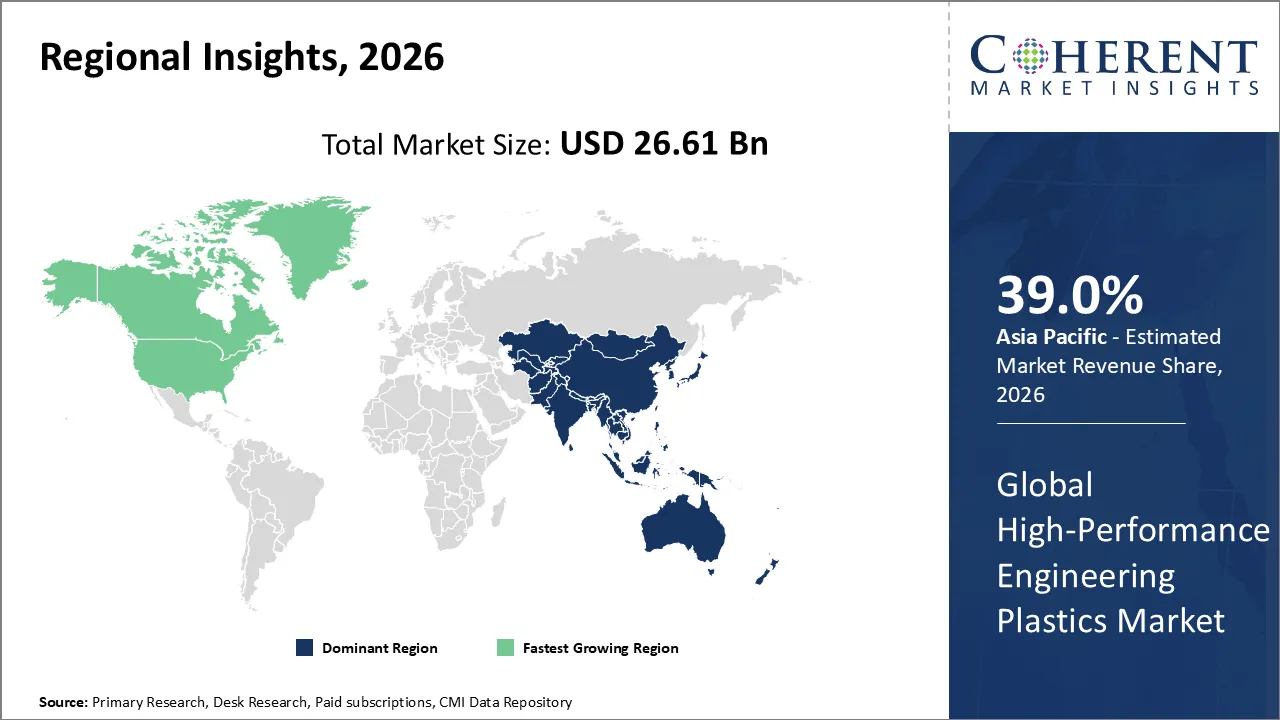
Why Does Asia Pacific Dominate the High-Performance Engineering Plastics Market?
Asia Pacific region is expected to hold the largest share of the global high-performance engineering plastics market, with a market share of 39.0% in 2026. The region has a significant automotive manufacturing base, growing electronics manufacturing and investments in semiconductor fabrication and advanced industrial technologies. The key demand growth drivers for specialty polymers such as polyether ether ketone (PEEK), polyphenylene sulfide (PPS), and polyimides in the region are China, Japan, South Korea, and India. Their thermal stability, chemical resistance and mechanical strength make these materials increasingly useful in electrical connectors, semiconductor manufacturing equipment, automotive components and precision industrial machinery. Government initiatives to boost local electronics production, industrial automation and development of advanced materials are giving the regional market a boost.
In September 2026, Syensqo announced an investment in a new high-performance aromatic polymer compounding line at the company’s Panoli facility in India. The expansion is expected to double the current compounding capacity of the facility by the first quarter of 2028, supporting the production of advanced polymers, including polyphenylene sulfide (PPS), polyether ether ketone (PEEK), polyphthalamide (PPA) and polyarylamide (PARA).
Why Is North America a Major Market for High-Performance Engineering Plastics?
North America is projected to hold a 28.0% share of the global high-performance engineering plastics market by 2026. It has a strong aerospace and defense manufacturing base, well-established medical device industries and growing use of specialty polymers in semiconductor equipment and industrial applications. Regional demand is driven by strong aerospace manufacturing, advanced material development and high precision component supply in the United States. Canada's contribution is through its aerospace manufacturing, industrial machinery and transportation equipment industries. PEEK, PPS, polyimides and polyamide-imide materials are being used by more manufacturers to improve durability, reduce weight and enhance performance in extreme temperatures and operating conditions.
The Aerospace Industries Association released its 2026 Facts & Figures report June 25, noting the U.S. aerospace and defense industry had total sales of USD 988.6 billion in 2025. The industry also invested USD 45 billion in capital expenditures, a 13% increase compared with 2024. The investments underline ongoing growth and modernization of aerospace and defense manufacturing, offering opportunities for lightweight, thermally stable and high-strength engineering plastics for aircraft systems, precision components and defense equipment.
Global High-Performance Engineering Plastics Market Outlook for Key Countries
Why Is the U.S. a Major Market for High-Performance Engineering Plastics?
The U.S. high-performance engineering plastics market is driven by advanced aerospace manufacturing, automotive electrification, semiconductor production and lightweight industrial components. In precision electrical connectors, aircraft components, industrial equipment and high temperature automotive systems, manufacturers are increasingly using polyether ether ketone (PEEK), polyphenylene sulfide (PPS) and polyimides.
On May 14, 2025, Syensqo announced an investment to expand its Ryton PPS compounding capabilities at its Augusta, Georgia manufacturing facility. KetaSpire PEEK and Amodel PPA compounding and resin production were already supported at the site. The expansion improves local supply capabilities for specialty polymers used in automotive electrification, energy and industrial applications.
Is China Emerging as a Major Manufacturing Hub for High-Performance Engineering Plastics?
The China’s high-performance engineering plastics market is witnessing growth due to growing domestic production of specialty polymers, increasing demand for semiconductor manufacturing and adoption of advanced materials in automotive and industrial equipment. Chinese makers are investing in PEEK, PPS and polyimide, hoping to reduce their dependence on foreign materials and boost their domestic manufacturing capabilities. Growing use of these polymers in electronic connectors, precision machinery, medical devices and aerospace components is opening opportunities for local suppliers.
On October 15, 2026, Jiangsu Junhua Special Polymer Materials signed an agreement to build a PEEK production base in Wujin National High-Tech Zone, China. The project will require an investment of approximately RMB 1 billion and will have a planned annual production capacity of 4,050 metric tons of PEEK and polyimide pellets, profiles and finished products when fully commissioned.
Germany High-Performance Engineering Plastics Market Analysis and Trends
Germany’s high-performance engineering plastics market is driven by its advanced automotive manufacturing, industrial machinery, medical technology and specialty chemical industries. The country is a major hub for the development of engineering polymers that offer thermal stability, chemical resistance and superior mechanical performance. German manufacturers are increasingly using PEEK, PPS and polyamide-imide materials in precision bearings, medical components, automotive systems and industrial processing equipment. The increase in the focus of material efficiency, manufacturing of lightweight components and high value industrial applications has resulted in the creation of specialized grades of polymers. The presence of established chemical manufacturers and advanced research infrastructure further drives innovation in high-temperature engineering plastics.
On October 20, 2026, Evonik introduced two new grades of VESTAKEEP PEEK, DC4760 and DC4780, for long-term dental prosthetics. Increased rigidity, biocompatibility and compatibility with CAD/CAM manufacturing workflows are offered by the materials. The development underlines Germany’s ongoing innovation in high-performance polymers for specialized medical applications.
Why Is the U.K. an Important Market for High-Performance Engineering Plastics?
The U.K. high-performance engineering plastics market is bolstered by a well-established aerospace industry, advanced polymer research capabilities and a strong presence in specialty medical and industrial materials. The country has experience in developing and producing PEEK based materials for demanding applications where high strength, thermal resistance and chemical stability are required. Aerospace manufacturers use these polymers in lightweight structural components, electrical systems and precision assemblies, while medical device manufacturers use them in orthopedic and surgical applications, with implant-grade PEEK available for such uses. Increasing demand for custom polymer parts, advanced manufacturing processes and high-performance material alternatives is further supporting innovation across the country.
On May 11, 2026, U.K.-based Victrex reported its high-performance polymer sales volume for the six months ended March 31, 2026, was 2,137 metric tons, up 6% year-on-year from 2,018 metric tons in the same period in 2025. Company’s revenue rose 1% to GBP 147.1 million, underpinned by sustained demand for specialized polymer solutions across its industrial and medical markets worldwide.
Japan High-Performance Engineering Plastics Market Analysis and Trends
Japan’s high-performance engineering plastics market is driven by advanced electronics manufacturing, automotive engineering, semiconductor equipment manufacturing and precision industrial technologies. Japanese materials makers are developing more heat-resistant, electrically insulating, and chemical-resistant versions of PPS, PEEK, and polyimides for increasingly demanding industrial applications. Increasing interest in sustainable manufacturing and resource efficiency is also driving the development of advanced polymer recycling technologies.
On September 30, 2026, Toray Industries announced the development of what it calls the industry’s first solvent-based recycling technology for recovering polyphenylene sulfide (PPS) from waste. The process selectively dissolves and isolates PPS without destroying its polymer structure, enabling material recovery without depolymerization.
Market Players, Key Development, and Competitive Intelligence
How Is the Growing Adoption of Lightweight Thermoplastic Composites Creating New Growth Opportunities in the High-Performance Engineering Plastics Market?
The global high-performance engineering plastics market is expected to witness significant growth opportunities owing to the increasing demand for lightweight thermoplastic composites in aerospace and advanced industrial manufacturing. In particular, manufacturers are looking at high-performance polymers such as polyether ether ketone (PEEK), polyether ketone ketone (PEKK) and polyaryletherketone (PAEK) to replace conventional metal components and thermoset composites. These materials offer high mechanical strength, thermal stability, chemical resistance and better processing flexibility. Aerospace manufacturers are investigating advanced polymer-based structures to reduce aircraft weight, improve fuel efficiency and simplify component assembly.
For instance, in January 2026, Victrex announced its partnership with Daher to produce aerospace components using VICTREX LMPAEK unidirectional composite tape. The company said the collaboration aims to demonstrate how advanced thermoplastic materials can enable more efficient aerospace manufacturing, with a target of 25% faster production times than thermoset composites.
Key Developments
- In May 2026, BASF announced a patented hot-gas welding process designed to significantly shorten welding times for thermoplastic components, particularly Ultramid Advanced polyphthalamide (PPA). The technology supports applications in electric mobility and fuel-cell systems.
- In October 2026, Celanese announced global price increases for its liquid crystal polymer (LCP) products, including Vectra, Zenite, and related specialty grades. The company cited strong demand, increasing feedstock costs, raw-material supply disruptions, and logistics constraints.
Top Manufacturers and Notable Products/Solutions in the High-Performance Engineering Plastics Market
Company/Manufacturer | Notable Product/Brand | Key Features |
Victrex plc | VICTREX PEEK 450G | High thermal stability, excellent chemical resistance, mechanical strength, wear resistance, electrical insulation, injection molding and extrusion compatibility |
Toray Industries, Inc. | TORELINA PPS Resin | High heat resistance, dimensional stability, flame retardancy, chemical resistance, low moisture absorption, precision molding capabilities. |
DuPont de Nemours, Inc. | Vespel SP-1 Polyimide | Exceptional thermal resistance, high-temperature electrical insulation, mechanical strength, dimensional stability, durability, suitability for demanding industrial applications. |
Ensinger GmbH | TECAPAI CM XP403 PAI | High strength and stiffness, excellent wear resistance, thermal stability, chemical resistance, good dielectric properties, precision-machined industrial components. |
Evonik Industries AG | VESTAKEEP PEEK | High-temperature resistance, chemical stability, mechanical strength, reinforced compound options, dimensional stability, injection molding and extrusion capabilities. |
Market Report Scope
High-Performance Engineering Plastics Market Report Coverage
Report Coverage | Details | ||
Base Year: | 2025 | Market Size in 2026: | USD 26.61 Bn |
Historical Data for: | 2020 to 2024 | Forecast Period: | 2026 to 2033 |
CAGR: | 7.3% | 2033 Value Projection: | USD 43.53 Bn |
Geographies covered: |
| ||
Segments covered: |
| ||
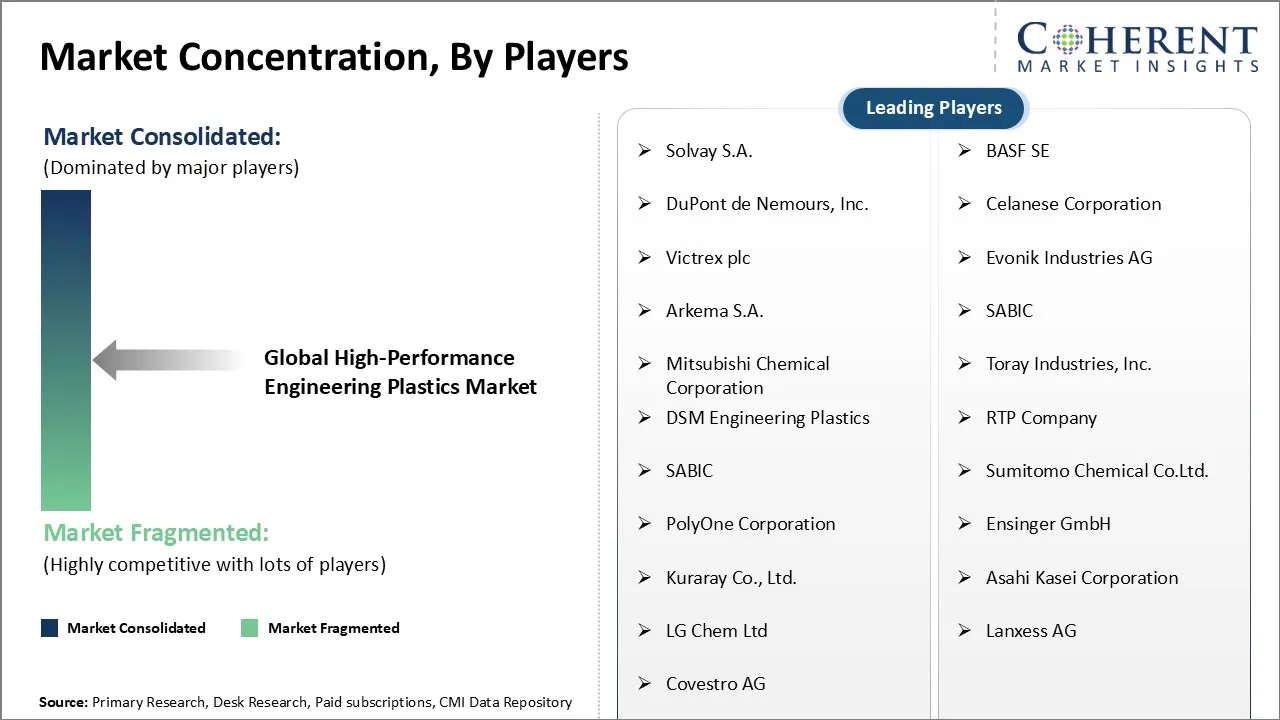
Companies covered: | Solvay S.A., BASF SE, DuPont de Nemours, Inc., Celanese Corporation, Victrex plc, Evonik Industries AG, Arkema S.A., SABIC, Mitsubishi Chemical Corporation, Toray Industries, Inc., DSM Engineering Plastics, RTP Company, Sumitomo Chemical Co., Ltd., PolyOne Corporation, Ensinger GmbH, Kuraray Co., Ltd., Asahi Kasei Corporation, LG Chem Ltd., Lanxess AG, Covestro AG. | ||
Growth Drivers: |
| ||
Restraints & Challenges: |
| ||
Analyst Opinion (Expert Opinion)
- The global high-performance engineering plastics market is the future of lightweight, thermally stable and chemically resistant polymers in automotive, aerospace and industrial manufacturing. Materials such as polyether ether ketone (PEEK), polyphenylene sulfide (PPS) and polyimides are expected to be in demand as manufacturers seek to improve the durability, reduce the weight and increase the operational efficiency of components. Growth in vehicle manufacturing and development of advanced automotive technologies will provide additional opportunities for specialized polymer formulations. Worldwide motor vehicle production in April 2026 was 96.4 million units in 2025, up 3.9% from 2024, says International Organization of Motor Vehicle Manufacturers (OICA).
- The biggest opportunities for growth are expected to be in semiconductor manufacturing, advanced electronics, medical technology and high-precision industrial applications. Asia Pacific is anticipated to continue as a significant manufacturing and consumption hub with the presence of established electronics manufacturing networks and growing investments in specialty polymer processing. In North America and Europe, there will continue to be opportunities for high-value polymer grades in aerospace, semiconductor equipment and precision engineering. Global semiconductor assembly and packaging equipment sales are predicted to grow by 9.6% to USD 6.7 billion in 2026, driven by advanced packaging technologies and more complex semiconductor devices, according to SEMI’s August 2026 industry forecast.
- Instead of competing on price alone, market players should focus on differentiating their products by enhancing thermal resistance, mechanical strength, processing efficiency, sustainability and application-specific performance. To meet the growing demands of industry, manufacturers must invest in recyclable polymer formulations, sophisticated compounding technologies and customer-specific material development. Alliances with car makers, semiconductor equipment vendors and aerospace component makers can help with longer term product qualification and commercial adoption. “Circular plastics accounted for 15.8% of total plastics production in Europe in 2024, or 8.7 million metric tons, while annual growth in circular plastics production slowed to 1.2% in 2024,” Plastics Europe said in its May 2026 report.
Speak to the analyst
Want personalized insights?
Take the findings above to one of our principal consultants, or have the report rebuilt around the segments, geographies and competitors you actually track.
Market Segmentation
- By Product Type (Revenue, USD Bn, 2021-2033)
- Polyether Ether Ketone (PEEK)
- Polyphenylene Sulfide (PPS)
- Polyimides (PI)
- Polyamide-imide (PAI)
- Others
- By Application (Revenue, USD Bn, 2021-2033)
- Automotive
- Aerospace
- Electronics
- Industrial
- Medical
- Others
- By End User (Revenue, USD Bn, 2021-2033)
- Transportation
- Electrical & Electronics
- Industrial Machinery
- Medical Devices
- Others
- By Region (Revenue, USD Bn, 2021-2033)
- North America
- U.S.
- Canada
- Latin America
- Brazil
- Mexico
- Argentina
- Rest of Latin America
- Europe
- Germany
- U.K.
- France
- Italy
- Spain
- Russia
- Rest of Europe
- Asia Pacific
- China
- India
- Japan
- Australia
- South Korea
- ASEAN
- Rest of Asia Pacific
- Middle East
- GCC
- Israel
- Rest of Middle East
- Africa
- South Africa
- Central Africa
- North Africa
- North America
- Key Players
- Solvay S.A.
- BASF SE
- DuPont de Nemours, Inc.
- Celanese Corporation
- Victrex plc
- Evonik Industries AG
- Arkema S.A
- SABIC
- Mitsubishi Chemical Corporation
- Toray Industries, Inc.
- DSM Engineering Plastics,
- RTP Company
- Sumitomo Chemical Co., Ltd.
- PolyOne Corporation
- Ensinger GmbH
- Kuraray Co., Ltd.
- Asahi Kasei Corporation
- LG Chem Ltd.
- Lanxess AG
- Covestro AG
Sources
Primary Research Interviews
- High-performance engineering plastics manufacturers and suppliers
- Polymer scientists and advanced materials engineers
- R&D heads from specialty polymer and chemical manufacturing companies
- PEEK, PPS, polyimide, and polyamide-imide product development specialists
- Automotive and aerospace component manufacturers
- Semiconductor and electronics industry procurement managers
- Industrial machinery and medical device manufacturers
- Key opinion leaders (KOLs) in polymer engineering and high-performance materials
Databases
- World Bank
- Organisation for Economic Co-operation and Development (OECD)
- United Nations Comtrade Database (UN Comtrade)
- U.S. International Trade Commission (USITC)
- Eurostat – European Statistical Office
- U.S. Census Bureau
- National Science Foundation (NSF)
- National Institute of Standards and Technology (NIST)
Magazines
- Plastics Technology
- Plastics Engineering
- European Plastics News
- Compounding World
- Plastics Today
- CompositesWorld
- Chemical & Engineering News
Journals
- Polymer
- Polymer Engineering & Science
- Journal of Applied Polymer Science
- High Performance Polymers
- Polymer Testing
- Materials & Design
- Composites Science and Technology
- Journal of Materials Science
Newspapers
- The New York Times
- The Guardian
- The Wall Street Journal
- Financial Times
- The Economic Times
- Nikkei Asia
Associations
- Society of Plastics Engineers (SPE)
- Plastics Industry Association (PLASTICS)
- Plastics Europe
- American Chemistry Council (ACC)
- European Chemical Industry Council (Cefic)
- International Organization of Motor Vehicle Manufacturers (OICA)
- ASTM International
- Society of Automotive Engineers (SAE International)
- Society for the Advancement of Material and Process Engineering (SAMPE)
Public Domain Sources
- Company Annual Reports and Investor Presentations
- Official Product Catalogs and Technical Data Sheets from BASF, Victrex, Toray, Evonik, and DuPont
- Government Research and Industrial Manufacturing Publications
- University Research Publications and Polymer Technology Studies
- Patent Databases such as WIPO, USPTO, and Google Patents
- Publicly Available Specialty Polymer Production and Capacity Expansion Reports
- Regulatory and Standards Publications Related to Engineering Plastics, Chemical Safety, and Polymer Recycling
- Semiconductor Industry Association (SIA) and SEMI Industry Publications
- International Energy Agency (IEA) Automotive and Energy Technology Reports
Proprietary Elements
- CMI Data Analytics Tool
- Proprietary CMI Existing Repository of Information for the Last 10 Years
Get access to 250+ pages report
Every segment, forecast, competitor profile and data table behind the analysis above — available for instant download.
- ESOMAR Member
- ISO 9001:2015 Certified
- D-U-N-S Registered
- GDPR & CCPA Compliant
Frequently Asked Questions
The global High-Performance Engineering Plastics Market is expected to reach USD 43.53 Bn in 2033, increasing from USD 26.61 Bn in 2026.
Major players operating in the global High-Performance Engineering Plastics Market include Solvay S.A., BASF SE, DuPont de Nemours, Inc., Celanese Corporation, Victrex plc, Evonik Industries AG, Arkema S.A., SABIC, Mitsubishi Chemical Corporation, Toray Industries, Inc., DSM Engineering Plastics, RTP Company, Sumitomo Chemical Co., Ltd., PolyOne Corporation, Ensinger GmbH, Kuraray Co., Ltd., Asahi Kasei Corporation, LG Chem Ltd., Lanxess AG, and Covestro AG.
High production and processing costs, fluctuating raw material prices, and complex manufacturing requirements are the key factors hampering market growth.
Increasing demand for lightweight and high-temperature-resistant materials in automotive and aerospace industries, rising adoption of advanced engineering plastics in electronics and semiconductor manufacturing, and growing demand for durable industrial components are driving market growth.
The High-Performance Engineering Plastics Market is anticipated to grow at a CAGR of 7.3% between 2026 and 2033.
Asia Pacific is expected to dominate the global High-Performance Engineering Plastics Market, accounting for the largest market share of 39.0% in 2026, supported by expanding automotive, electronics, and industrial manufacturing activities.
High-performance engineering plastics are advanced polymer materials designed to offer superior mechanical strength, thermal stability, chemical resistance, and dimensional stability under demanding operating conditions. These include polyether ether ketone (PEEK), polyphenylene sulfide (PPS), polyimides (PI), and polyamide-imide (PAI).