

Global High Pressure Pumps Market Size and Forecast – 2026 To 2033
The global high pressure pumps market is expected to grow from USD 3.25 Bn in 2026 to USD 4.15 Bn by 2033, registering a compound annual growth rate (CAGR) of 3% from 2026 to 2033. The market for high pressure pumps is driven by increasing reverse osmosis installations. On January 17, 2025, ACWA Power won the Caspian seawater reverse osmosis project in Azerbaijan. The planned plant will produce approximately 300,000 cubic meters daily.
Key Takeaways of the Global High Pressure Pumps Market
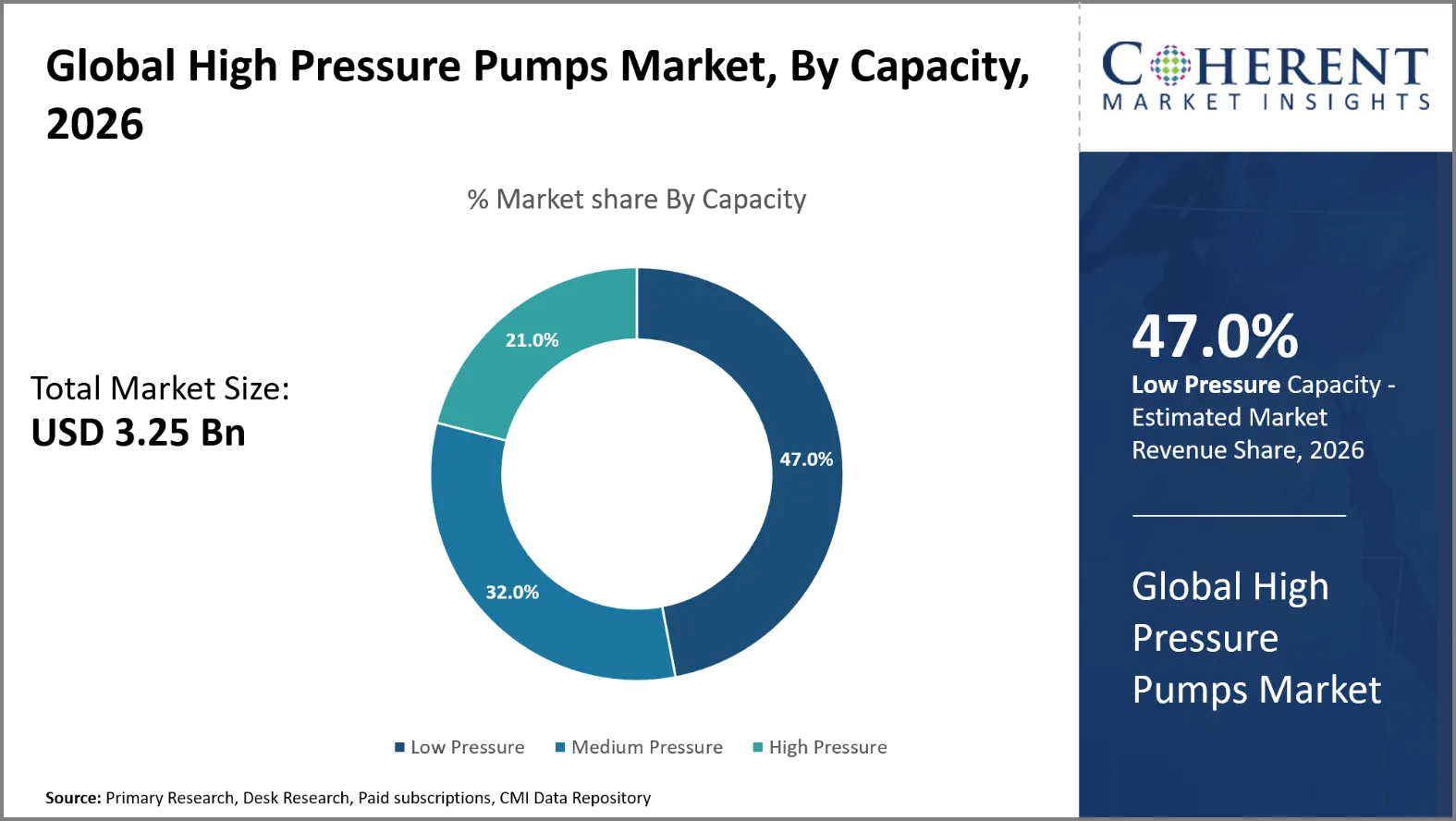
- The Low Pressure segment is expected to account for 47.0% of the global high pressure pumps market share in 2026. Increasing industrial automation is driving the growth of the segment. In July 2025, KSB installed an automated pump control system for Ahlstrom-Munksjö. The system combines multiple pumps with automated monitoring and control functions.
- The Dynamic Pumps segment is estimated to capture 39.0% of the market share in 2026. Replacement of aging pumping equipment is majorly driving the growth of the segment. On July 23, 2025, KSB won a pump replacement project for the geothermal facilities of Geo Dipa Energi. The project required extensive technical expertise and on-site support.
- The Oil and Gas segment is estimated to capture 27.0% of the market share in 2026. Expansion of oil and gas processing is majorly driving the growth of the segment. On April 9, 2025, Aramco and Sinopec advanced a major petrochemical expansion at the Yasref refinery. The project includes a 1.8-million-ton-per-year steam cracker.
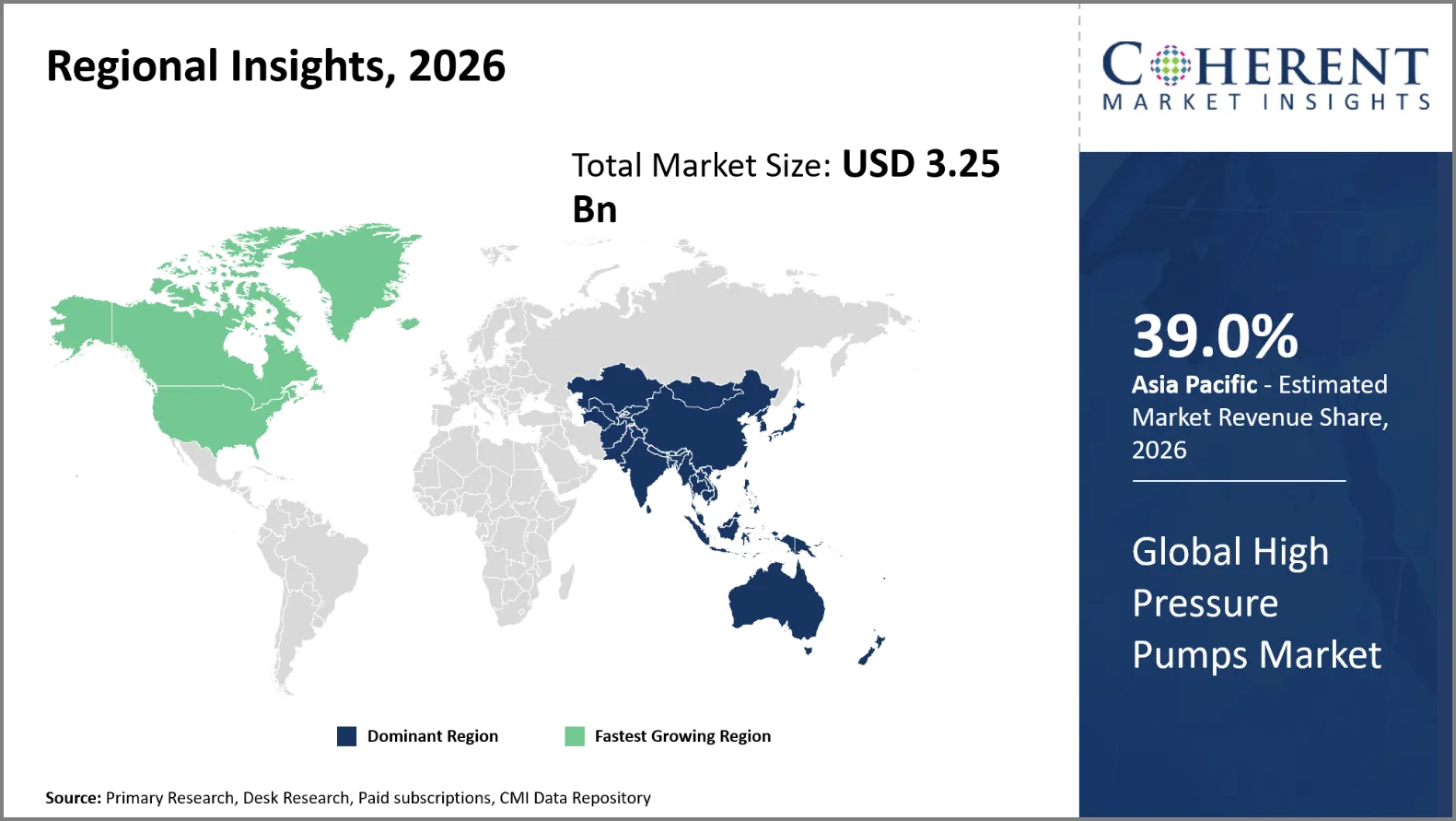
- Asia Pacific is expected to dominate the high pressure pumps market in 2026 with a market share of 39.0%. Rising demand for energy efficient pumping systems in Asia Pacific is driving the growth of the regional market. In April 2026, Wilo India showcased intelligent and energy-efficient pumping technologies at Plumbex India 2026. The company highlighted its IE5 Multi Pump Booster System and Internet of Things-enabled pump connectivity.
- North America is expected to account for 24.0% share in 2026 and is projected to record the fastest growth over the forecast period. Growth of chemical processing facilities in North America is driving the growth of the regional market. On March 28, 2025, DSM SemiChem received a USD 7.87 million Texas Semiconductor Innovation Fund grant to expand its Plainview facility.
Segmental Insights
Why Does Low Pressure Dominate the Global High Pressure Pumps Market?
The low pressure segment is expected to account for 47.0% of the global high pressure pumps market share in 2026. For applications needing consistent fluid transmission and continuous operation, lower pressure systems are chosen. Their simpler designs usually lower installation, maintenance and operating expenses for industrial users. Moderate levels of pressure are often needed in water treatment, industry, agricultural and general processing facilities. They want to be efficient and want reliable circulation of fluids and these applications produce a lot of demand. Additional investments in industrial water management further facilitate adoption in a variety of end-use facilities. On September 30, 2025, EBARA CORPORATION announced the launch of the new model DKE anti-clog submersible wastewater pump for global markets outside Japan. The Pump features an anti-clog design that prevents foreign matter from blocking the impeller and helps realize high operating efficiency. Following initial release in the United States in 2023, the sales are now being expanded to Europe, China, Southeast Asia, the Middle East and other regions.
- Current Industry Events of 2026
- Market Size Estimation
- Regional Breakdown
- Competitive Landscape
- Customer Intelligence
- Segmental Analysis
- Pricing Analysis
- Key Market Drivers, Challenges & Future Trends
- Customized Insights Section
Why is Dynamic Pumps the Most Preferred Pump Type?
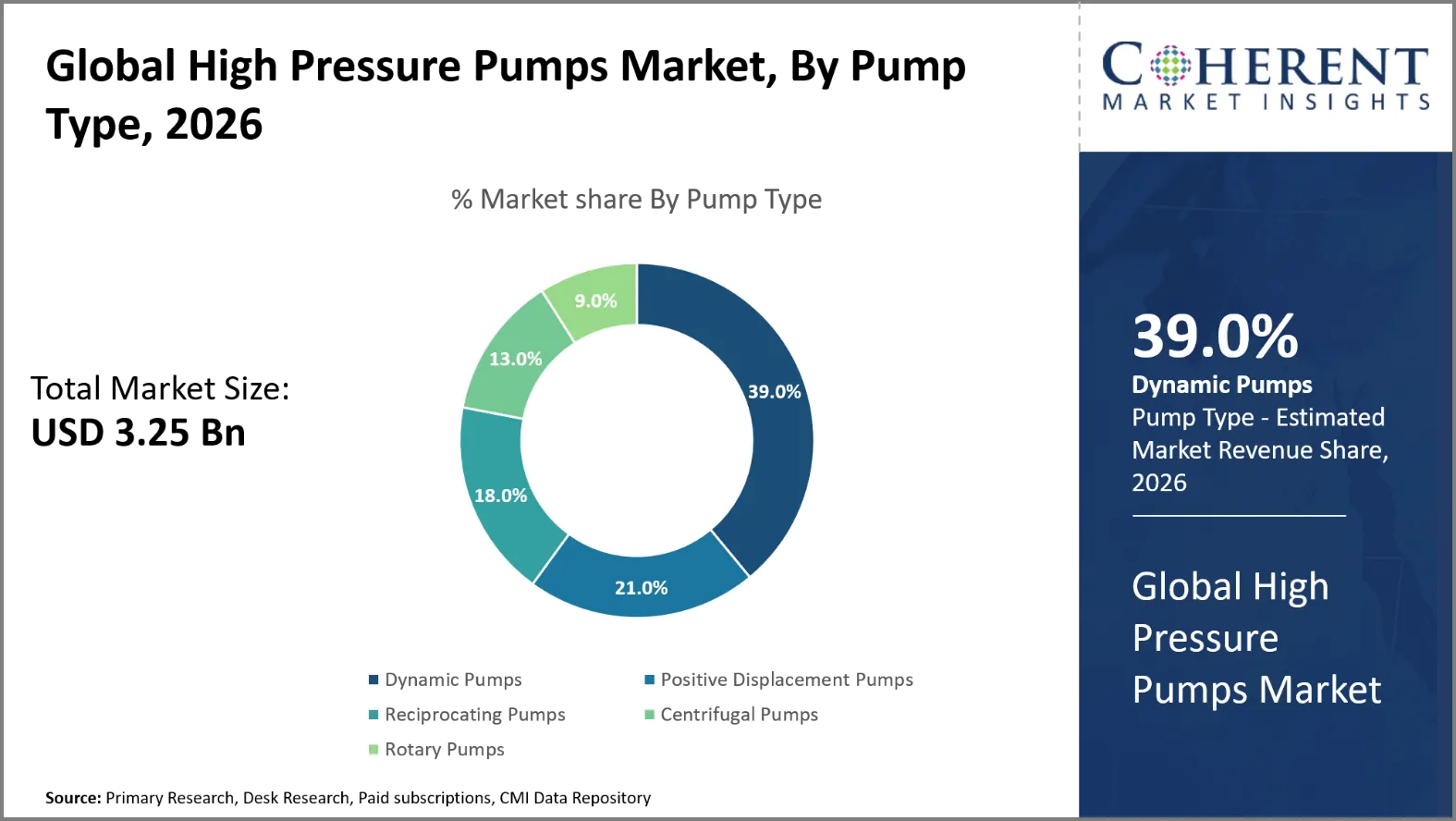
The dynamic pumps segment is expected to account for 39.0% of the global high pressure pumps market share in 2026. Dynamic pumps provide continuous fluid flow with relatively simple operating mechanisms. Their capacity to transfer enormous quantities of fluid makes them useful in many industrial applications. These pumps work well in water treatment, cooling, irrigation and process industries. They come in scalable configurations that let consumers pick equipment to match their flow and pressure needs. The need for continuous fluid handling is increasing and this is accelerating adoption in different industrial facilities. In March 2025, Sulzer introduced its Energy Optimization Service for centrifugal pumps in energy-intensive businesses. The service combines digital analysis, machine learning, monitoring, and pump engineering. Sulzer reported that a Spanish customer improved five pumps from 72% to 83% efficiency.
Oil and Gas Dominates the Global High Pressure Pumps Market
The oil and gas segment is expected to account for 27.0% of the global high pressure pumps market share in 2026. Oil and gas operations require high pressure pumps for fluid transfer, injection, circulation, and processing applications. More offshore exploration demands reliable pumping equipment for harsh working situations. High pressure systems are used in refining plants for process operations and fluid management. Continued investment in production infrastructure is leading to demand for durable pumping technology. The growing usage of enhanced oil recovery techniques also supports equipment requirements across upstream operations. On January 14, 2025, Flowserve Corporation announced that it has been granted a contract to supply Dry Gas Seals and Dry Gas Seal Systems for a landmark effort for Abu Dhabi National Oil Company. The initiative will be accomplished through Flowserve’s collaboration with Celeros Flow Technology, a major force in the flow control technology space providing solutions that deliver outstanding performance while minimizing environmental impacts.
Current Events and their Impact
Current Events | Description and its Impact |
European Union Industrial Emissions Directive, Directive (EU) 2024/1785 |
|
U.K. Building Regulations 2026, Approved Document L |
|
High Pressure Pumps Market Dynamics
Market Drivers
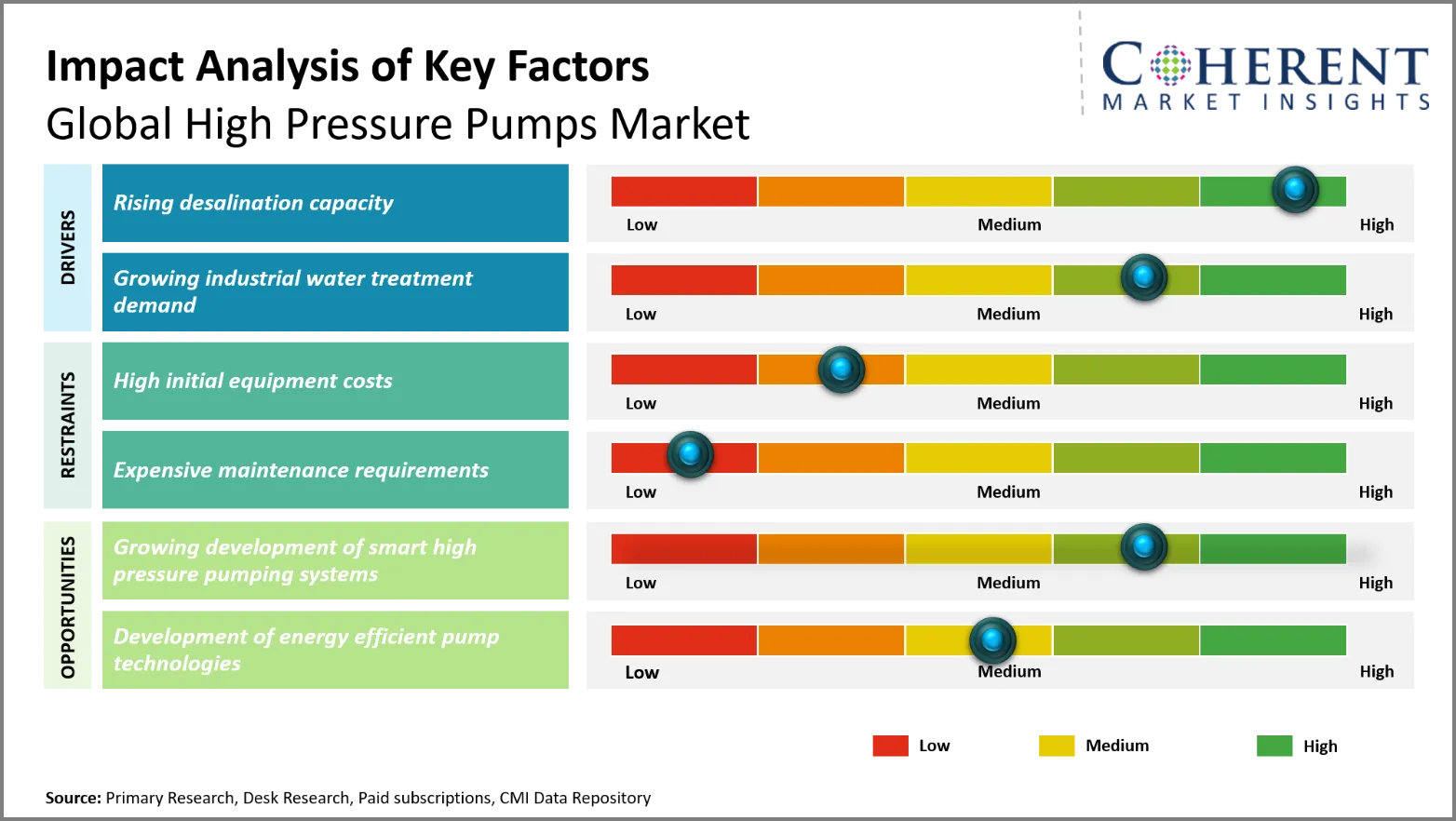
- Rising desalination capacity: The increase in desalination capacity is boosting the demand for high pressure pumps in the seawater reverse osmosis facilities. The pumps provide the pressure to push seawater through membrane systems. Governments are ramping up desalination projects to support water security in water-stressed regions. New plants require pumping machines that are reliable, can operate continuously and survive in harsh environments. The expansion reflects continued demand for corrosion resistant, energy-efficient high pressure pumping systems. On July 14, 2025, ACWA Power commercially commissioned the Shuaibah 3 Independent Water Project. The seawater reverse osmosis plant produces 600,000 cubic meters of desalinated water daily. The project transformed an existing thermal desalination process into a cutting-edge SWRO technology. The enormous membrane capacity requires a large seawater supply and high pressure pumping infrastructure.
- Growing industrial water treatment demand: The rising demand for industrial water treatment is leading to extra requirements for high pressure pumping equipment. More and more manufacturing plants need treated water for production, cooling, cleaning and process operations. Stricter wastewater management rules are prompting enterprises to upgrade treatment infrastructure. High pressure pumps support filtration, reverse osmosis, water reuse and wastewater processing systems. Expanding industrial water management investments therefore create opportunities for advanced and reliable pump technologies. On September 15, 2025, Veolia announced the signing of an agreement between the consortium of Veolia, Marafiq and Lamar, and SATORP for the implementation of a major project to recycle water from complex industrial effluents in Jubail Industrial City, the largest petrochemical hub in the Middle East.
Emerging Trends
- Smart Pumping Systems: High pressure pumps are increasingly fitted with sensors, digital controls and remote monitoring capabilities. These offer real-time performance tracking, predictive maintenance and defect identification. Industrial operators can avoid unplanned downtime while increasing energy management in demanding pumping operations.
- Energy Efficient Pump Technologies: Manufacturers are producing high pressure pumps with better hydraulic designs, efficient motors and variable speed controls. These systems save energy as the operational conditions change. Industrial users are looking more and more for equipment that reduces their operating expense and gives consistent pressure and flow performance.
- Advanced Desalination Applications: High pressure pumps are becoming increasingly relevant in sophisticated seawater reverse osmosis plants. Manufacturers are developing pressure capabilities, corrosion resistance and energy recovery integration. These innovations can lead to larger desalination projects, and also improve the operating efficiency and reduce the energy consumption of water treatment plants.
- Digital Predictive Maintenance: Digital monitoring is being incorporated into high pressure pumping equipment more and more to detect performance irregularities. Sensors can measure pressure, vibration, temperature and flow parameters in real time. Predictive maintenance helps operators anticipate probable faults at an earlier stage and improve the maintenance schedule of essential industrial systems.
Regional Insights
Why is Asia Pacific a Strong Market for High Pressure Pumps?
Asia Pacific is expected to account for a market share of 39.0% in 2026. Asia Pacific benefits from large-scale desalination and industrial water infrastructure projects across coastal economies. China’s pump manufacturers supply reverse osmosis systems with pressures reaching 75 bar. Japan is developing high-efficiency hydrogen boosting pumps for future hydrogen logistics. South Korea and Singapore continue investing in advanced water recycling facilities. China’s seawater desalination industry is also advancing high-pressure pump efficiency and corrosion-resistant materials. These developments increase demand for specialized pumping equipment across water treatment and industrial applications.
Why Does North America High Pressure Pumps Market Exhibit High Growth?
North America is expected to register the fastest growth with a CAGR of 4.1% over the forecast period. The region is projected to account for 24.0% of the global high pressure pumps market in 2026. North American demand is strongly connected with upstream oil and gas production and pressure-intensive field operations. U.S. oil producers increasingly use pressure pumping equipment across unconventional production activities. Major operators include ExxonMobil, Occidental Petroleum, EOG Resources, and Permian Resources. These companies accounted for substantial customer activity for U.S. pressure-pumping providers during 2025. Industrial water treatment and specialized cleaning applications provide additional demand for high-pressure pumping equipment.
Global High Pressure Pumps Market Outlook for Key Countries
Why is China Emerging as a Major Hub in the High Pressure Pumps Market?
China has strong demand from seawater desalination, petrochemicals, steel production, and industrial water treatment. Nanfang Pump Industry offers the VMHP series specifically for reverse osmosis desalination. The series provides flows from 5 to 540 cubic meters per hour. Its pressure head reaches 725 meters. Stainless steel and super-austenitic stainless-steel construction support seawater applications. These specifications demonstrate China’s growing emphasis on corrosion resistance and efficient high-pressure desalination equipment.
Is U.S. the Next Growth Engine for the High Pressure Pumps Market?
In the U.S., demand is fueled by pressure intensive oilfield services and sophisticated industrial processing requirements. U.S. pressure-pumping suppliers work with major producers including ExxonMobil, Occidental Petroleum, EOG Resources and Permian Resources. One provider reported these four customers represented 61.9% of revenue during 2025. High-pressure equipment also supports industrial cleaning, reverse osmosis, hydrostatic testing, and specialized water applications. CAT Pumps offers systems reaching 690 bar for industrial and commercial applications.
Germany High Pressure Pumps Market Analysis and Trends
Germany benefits from advanced steelmaking, mining, chemical processing, and industrial cleaning applications requiring controlled high-pressure water systems. KAMAT develops high-pressure plunger pumps for steel descaling and rolling-mill component cleaning. Its systems also support hydrostatic testing of pipelines, tanks, and industrial vessels. Mining motors and forging presses are also applications for water hydraulics. These specific applications lead to a demand for robust pumps able to cope with severe pressures and industrial working conditions.
Japan High Pressure Pumps Market Analysis and Trends
Hydrogen storage and transportation high-pressure pumping technologies are developed by Japan in its decarbonization goal. In 2023, Torishima Pump Manufacturing started to create large-flow and high-efficiency liquid hydrogen booster pumps. Industrial water treatment also continues to be significant in Japanese manufacturing plants. KSB produces high-pressure pumps, variable-speed systems, and monitoring equipment for applications in Japan’s industrial water sector. These developments connect pump demand with hydrogen infrastructure and precision-oriented manufacturing requirements.
India High Pressure Pumps Market Analysis and Trends
India is expanding high-pressure pump applications across reverse osmosis, desalination, industrial manufacturing, and boiler-feed systems. CNP Pumps India offers CDH systems reaching 48 bar for water treatment and reverse osmosis. The equipment also serves high-pressure cleaning, manufacturing, and windmill cooling applications. In 2025, India’s Defense Research and Development Organization developed a high-pressure polymeric membrane for seawater desalination. Such domestic technology development strengthens demand for specialized pressure equipment and supporting water-treatment infrastructure.
Global High Pressure Pumps Market - Variable Speed Drive Adoption by Region (2025):
Region | Variable Speed Drive Adoption |
Asia Pacific | 48% |
North America | 55% |
Europe | 62% |
Latin America | 38% |
Middle East & Africa | 35% |
Global | 49% |
Global High Pressure Pumps Market - High Pressure Pump Installation by Industry (2025):
Industry | High Pressure Pump Installation Share |
Oil and Gas | 27% |
Water Treatment and Desalination | 24% |
Chemical Processing | 16% |
Power Generation | 10% |
Mining and Metals | 8% |
Food and Beverage | 5% |
Pharmaceutical | 4% |
Others | 6% |
How is Growing Development of Smart High Pressure Pumping Systems Creating New Growth Opportunities in the High Pressure Pumps Market?
Smart high pressure pumping systems are creating opportunities by combining pressure sensors, variable speed drives, vibration monitoring, and remote diagnostics. iSOLUTIONS from Grundfos links pumps with sensors and digital controls to optimize operation and detect abnormal performance. Danfoss also integrates high pressure pumps with electronic controls for reverse osmosis applications, which allows to regulate pressure and optimize energy. In industrial plants, these capabilities allow operators to prevent failures from seal wear, cavitation, pressure instability and motor difficulties before they disrupt production. Predictive maintenance also allows for condition-based servicing, instead of fixed maintenance intervals. This presents potential for manufacturers supplying connected pump packages, digital monitoring platforms and intelligent control systems. For example, Danfoss expanded digitally controlled high-pressure pumping solutions for demanding water applications. The high-pressure pump portfolio combines electronic controls with pressure control and system optimization. Operators can tailor pump performance to changing operating conditions using these features.
Market Players, Key Development, and Competitive Landscape
Key Developments
- On September 23, 2025, Grundfos launched the SE and SL Range 48 and 52 pumps alongside the Grundfos Connect Sewer Insights platform. The products target improved wastewater performance and digital monitoring capabilities.
- On March 25, 2025, Sulzer launched the Sulzer Energy Optimization Service, an energy efficiency and carbon reduction service that will create a new best practice standard for the operation of centrifugal pumps. Launched to address growing demand for industrial energy efficiency, the solution brings together digital analysis, machine learning and ongoing monitoring with Sulzer’s decades of engineering expertise.
Competitive Landscape
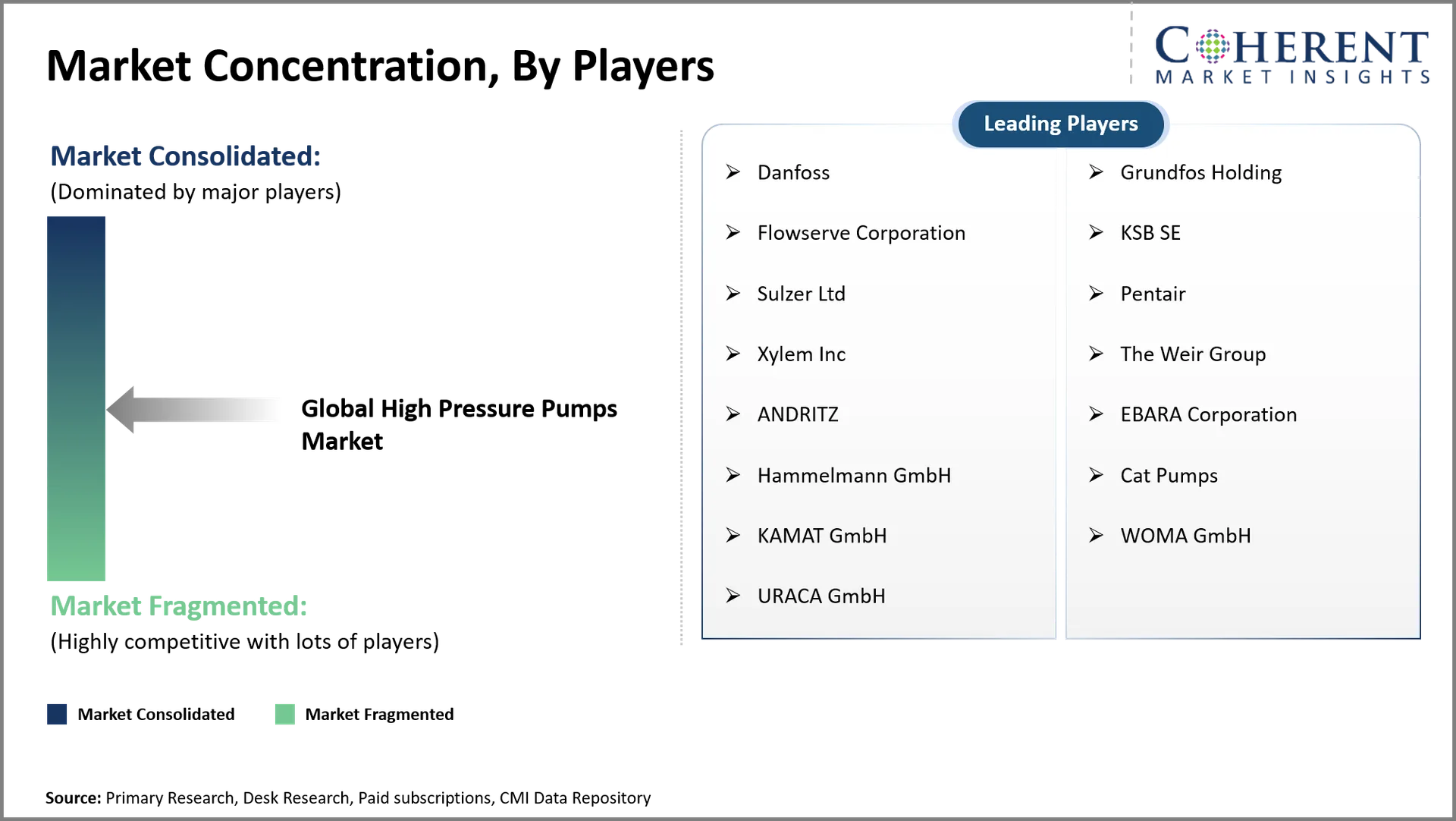
The competitive landscape includes Danfoss, Flowserve, KAMAT, Grundfos, Sulzer, KSB, and Xylem, with distinct application strategies. Danfoss focuses strongly on reverse osmosis, water reuse, energy recovery, and oil-free pumping. Its APP pumps reach efficiency levels up to 92% for membrane applications. Flowserve concentrates on engineered pumps for oil and gas, chemical processing, power generation, and water resources. KAMAT differentiates through engineered high-pressure plunger systems for steel descaling, mining, chemicals, and oil and gas. Its Indian steel installation includes 16 K55000 pumps and 8,800 kilowatts of installed power.
High Pressure Pumps Market Report Coverage | |||
Report Coverage | Details | ||
Base Year | 2025 | Market Size in 2026: | USD 3.25 Bn |
Historical Data For: | 2020 To 2024 | Forecast Period: | 2026 To 2033 |
Forecast Period 2026 To 2033 CAGR: | 3% | 2033 Value Projection: | USD 4.15 Bn |
Geographies covered: |
| ||
Segments covered: |
| ||
Companies covered: | Danfoss, Grundfos Holding, Flowserve Corporation, KSB SE, Sulzer Ltd, Pentair, Xylem Inc, The Weir Group, ANDRITZ, EBARA Corporation, Hammelmann GmbH, Cat Pumps, KAMAT GmbH, WOMA GmbH, URACA GmbH | ||
Growth Drivers: |
| ||
Restraints & Challenges: |
| ||
Analyst Opinion (Expert Opinion)
- The industry's future will increasingly center on energy-efficient pumping and digitally controlled high-pressure systems. Reverse osmosis will remain particularly important as desalination and industrial water reuse expand. Zero liquid discharge applications can create additional opportunities for pumps supporting membrane-based treatment. Danfoss already offers pumps reaching 120 bar for these applications.
- The strongest opportunities should emerge in positive displacement pumps for demanding pressure applications. Desalination, industrial wastewater treatment, steel descaling, and specialized water hydraulics offer attractive application opportunities. Asia Pacific should receive particular attention because industrial water treatment and manufacturing expansion create diverse equipment requirements. India also offers specialized opportunities in steel descaling, where KAMAT has already supplied automated high-pressure systems.
- Players should differentiate through efficiency, corrosion resistance, automation, and application-specific engineering rather than competing only on pump pricing. Manufacturers should develop modular systems supporting variable flow, remote monitoring, and predictive maintenance. Danfoss demonstrates the value of oil-free designs, while KAMAT emphasizes automated pressure control and application-specific configurations. Companies should also strengthen local engineering and service capabilities near desalination, steel, chemical, and industrial water clusters.
Speak to the analyst
Want personalized insights?
Take the findings above to one of our principal consultants, or have the report rebuilt around the segments, geographies and competitors you actually track.
Market Segmentation
- Capacity Insights (Revenue, USD Billion, 2021 - 2033)
- Low Pressure
- Medium Pressure
- High Pressure
- Pump Type Insights (Revenue, USD Billion, 2021 - 2033)
- Dynamic Pumps
- Positive Displacement Pumps
- Reciprocating Pumps
- Centrifugal Pumps
- Rotary Pumps
- Application Insights (Revenue, USD Billion, 2021 - 2033)
- Oil and Gas
- Water and Wastewater Treatment
- Desalination
- Chemical Processing
- Power Generation
- Mining
- Industrial Cleaning
- Regional Insights (Revenue, USD Billion, 2021 - 2033)
- North America
- U.S.
- Canada
- Latin America
- Brazil
- Argentina
- Mexico
- Rest of Latin America
- Europe
- Germany
- U.K.
- Spain
- France
- Italy
- Russia
- Rest of Europe
- Asia Pacific
- China
- India
- Japan
- Australia
- South Korea
- ASEAN
- Rest of Asia Pacific
- Middle East
- GCC Countries
- Israel
- Rest of Middle East
- Africa
- South Africa
- North Africa
- Central Africa
- North America
- Key Players Insights
- Danfoss
- Grundfos Holding
- Flowserve Corporation
- KSB SE
- Sulzer Ltd
- Pentair
- Xylem Inc
- The Weir Group
- ANDRITZ
- EBARA Corporation
- Hammelmann GmbH
- Cat Pumps
- KAMAT GmbH
- WOMA GmbH
- URACA GmbH
Sources
Primary Research Interviews
- High Pressure Pump Manufacturers & OEMs
- Industrial End-Users (Oil & Gas, Water Treatment, Chemical Processing)
- Pump Distributors & Suppliers
- Engineering & Procurement Contractors (EPCs)
Magazines
- Pumps & Systems Magazine
- World Pumps Magazine
- Fluid Handling Magazine
- Industrial Equipment News (IEN)
Journals
- Journal of Fluids Engineering (ASME)
- International Journal of Fluid Machinery and Systems
- Journal of Hydraulic Engineering
Associations
- Hydraulic Institute (HI)
- European Association of Pump Manufacturers (Europump)
- World Pumps Association
- American Society of Mechanical Engineers (ASME)
Public Domain Sources
- U.S. Environmental Protection Agency (EPA) – Water & Industrial Equipment Data
- U.S. Department of Energy (DOE) – Industrial Pump Systems Reports
- International Energy Agency (IEA) – Energy Efficiency & Industrial Systems Data
- World Bank – Infrastructure & Water Management Reports
Proprietary Elements
- CMI Data Analytics Tool
- Proprietary CMI Existing Repository of Information for Last 10 Years
Get access to 250+ pages report
Every segment, forecast, competitor profile and data table behind the analysis above — available for instant download.
- ESOMAR Member
- ISO 9001:2015 Certified
- D-U-N-S Registered
- GDPR & CCPA Compliant
Missing comfort of reading report in your local language? Find your preferred language:
Frequently Asked Questions
The global high pressure pumps market is expected to stand at USD 3.25 Bn in 2026 and is expected to reach USD 4.15 Bn by 2033.
The CAGR of the global high pressure pumps market is projected to be 3% from 2026 to 2033.
Rising desalination capacity and growing industrial water treatment demand are the major factors driving the growth of the global high pressure pumps market.
High initial equipment costs and expensive maintenance requirements are the major factors hampering the growth of the global high pressure pumps market.
In terms of capacity, low pressure segment is estimated to dominate the market revenue share in 2026.
High pressure pumps transfer liquids at elevated pressures for desalination, oil and gas, cleaning, and industrial processing.
Variable speed drives adjust motor speed according to operating requirements, reducing unnecessary energy consumption.