

Global Hydrogen Pipeline Market Size and Forecast – 2026 To 2033
The Global Hydrogen Pipeline Market is estimated to be valued at USD 3.25 Bn in 2026 and is expected to reach USD 8.59 Bn by 2033, growing at a compound annual growth rate (CAGR) of 14.90% from 2026 to 2033. Market expansion is supported by investment in dedicated hydrogen transmission systems, industrial decarbonization projects, hydrogen production hubs, storage integration, and the gradual establishment of regulatory frameworks for hydrogen transport.
Pipeline infrastructure is becoming increasingly important for connecting large-scale hydrogen production with refineries, chemical plants, steel facilities, power projects, and other industrial users requiring continuous supply. In June 2025, the UK Secretary of State issued a Section 35 direction for the proposed Humber Hydrogen Pipeline Project, formally bringing the hydrogen transmission project within the Planning Act 2008 framework. The decision illustrates how governments are establishing planning pathways for large-scale hydrogen transport infrastructure as hydrogen networks move toward commercial deployment.
Key Takeaways of the Global Hydrogen Pipeline Market
- Dedicated Hydrogen Pipelines, with an estimated CAGR of 15.6% during 2026–2033, are projected to command 58.6% of the global hydrogen pipeline market in 2026. Their lead reflects the need for high-purity, large-volume hydrogen transport between production hubs and industrial users without blending constraints or gas-separation requirements. In May 2026, Gasunie inaugurated a 32-km hydrogen network section linking Maasvlakte with Pernis in Rotterdam.
- Carbon Steel Pipelines should advance at an estimated 14.3% CAGR during 2026–2033, while retaining 62.8% of the global hydrogen pipeline market in 2026. Carbon steel remains preferred for long-distance transmission because it combines fabrication capacity, weldability, strength, and project-scale economics, provided hydrogen-embrittlement requirements are addressed. In March 2026, Salzgitter secured orders to supply Mannesmann steel line pipes for Germany’s FGL 702 hydrogen pipeline.
- High Pressure Pipelines are forecast to achieve an estimated 15.7% CAGR during 2026–2033, with a 48.6% share of the global hydrogen pipeline market in 2026. High-pressure transmission improves throughput over long distances and supports centralized hydrogen production, storage, and industrial offtake, making compression performance and material integrity critical purchasing criteria. In September 2025, SGN completed live hydrogen operations on a repurposed 30-km high-pressure transmission pipeline between Grangemouth and Granton.
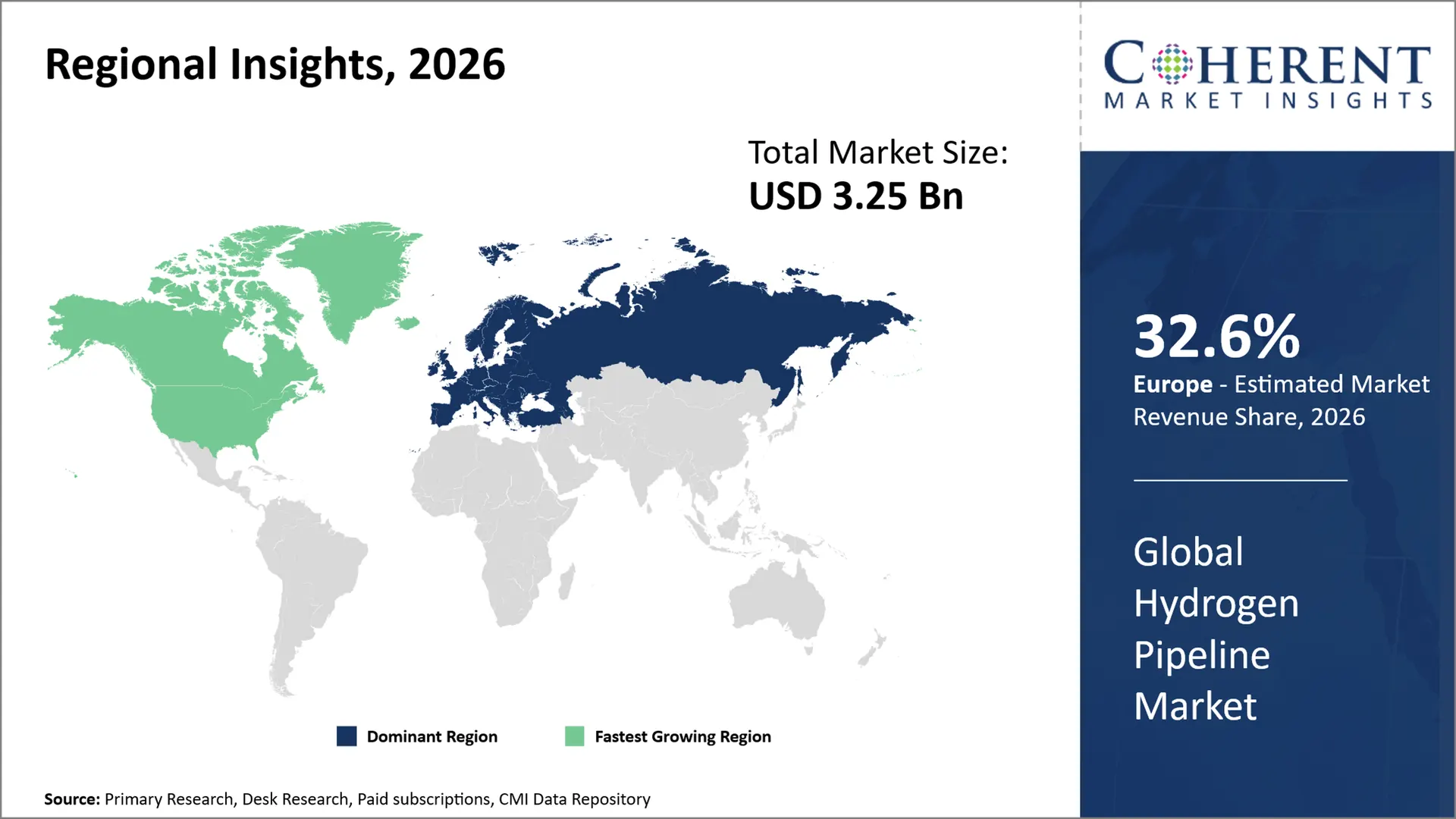
- Europe, projected to expand at an estimated 14.4% CAGR during 2026–2033, is expected to contribute 32.6% of the global hydrogen pipeline market in 2026. Its leadership rests on coordinated cross-border planning, regulated transmission investment, industrial decarbonization requirements, and policy mechanisms that reduce early infrastructure risk. In October 2024, Germany’s Bundesnetzagentur approved a 9,040-km hydrogen core network with expected investment of USD 21.44 Bn and phased commissioning through 2032.
- North America is projected to outpace other regions with an estimated 16.4% CAGR during 2026–2033, alongside a 31.8% share of the global hydrogen pipeline market in 2026. Expansion is supported by industrial clusters, existing hydrogen infrastructure, new production hubs, and planned connective pipelines. In January 2025, the U.S. Department of Energy awarded initial funding to the Mid-Atlantic Hydrogen Hub, whose plan includes new pipelines linking producers and end users.
Segmental Insights
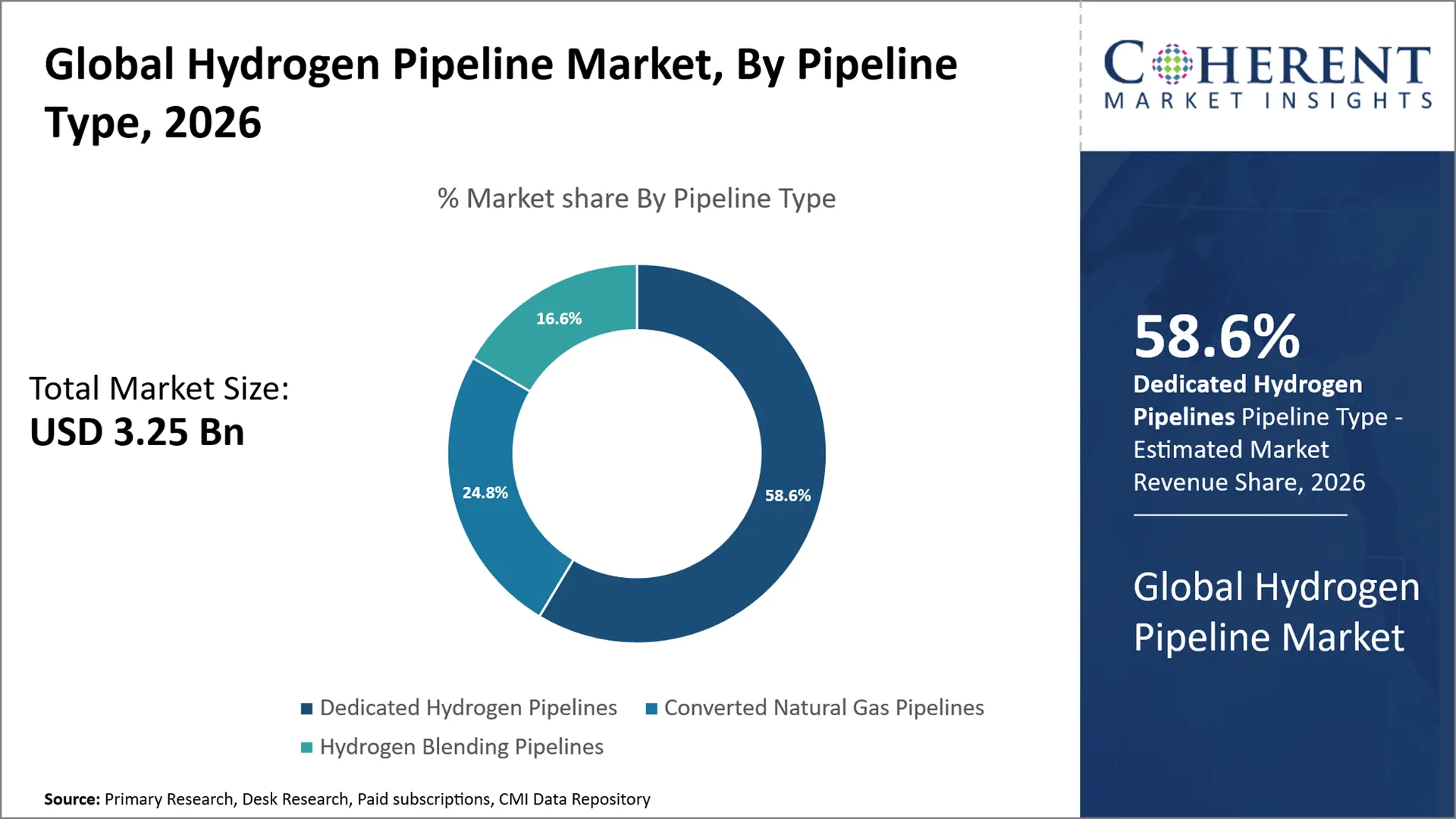
Why Do Dedicated Hydrogen Pipelines Dominate the Global Hydrogen Pipeline Market?
Dedicated hydrogen pipelines are expected to lead the pipeline-type category with expected share 58.6% in 2026 because new hydrogen hubs increasingly require infrastructure designed around hydrogen-specific pressure cycles, metering, isolation, storage interfaces, and future network expansion from the outset. These lowers retrofit uncertainty for developers and gives transmission operators greater control over asset specifications, maintenance planning, and connection standards. Demand is strongest around integrated production-storage-power and industrial clusters where multiple users need dependable network access. For EPC contractors and equipment suppliers, dedicated projects also create broader opportunities across valves, compression, controls, monitoring, and connection infrastructure rather than pipe supply alone. In May 2025, SSE Thermal and Equinor received planning permission for the Aldbrough Hydrogen Pathfinder, alongside proposals for a dedicated hydrogen pipeline connecting storage with regional producers and users.
- Current Industry Events of 2026
- Market Size Estimation
- Regional Breakdown
- Competitive Landscape
- Customer Intelligence
- Segmental Analysis
- Pricing Analysis
- Key Market Drivers, Challenges & Future Trends
- Customized Insights Section
Why Do Carbon Steel Pipelines Represent the Largest Material Type in the Global Hydrogen Pipeline Market?
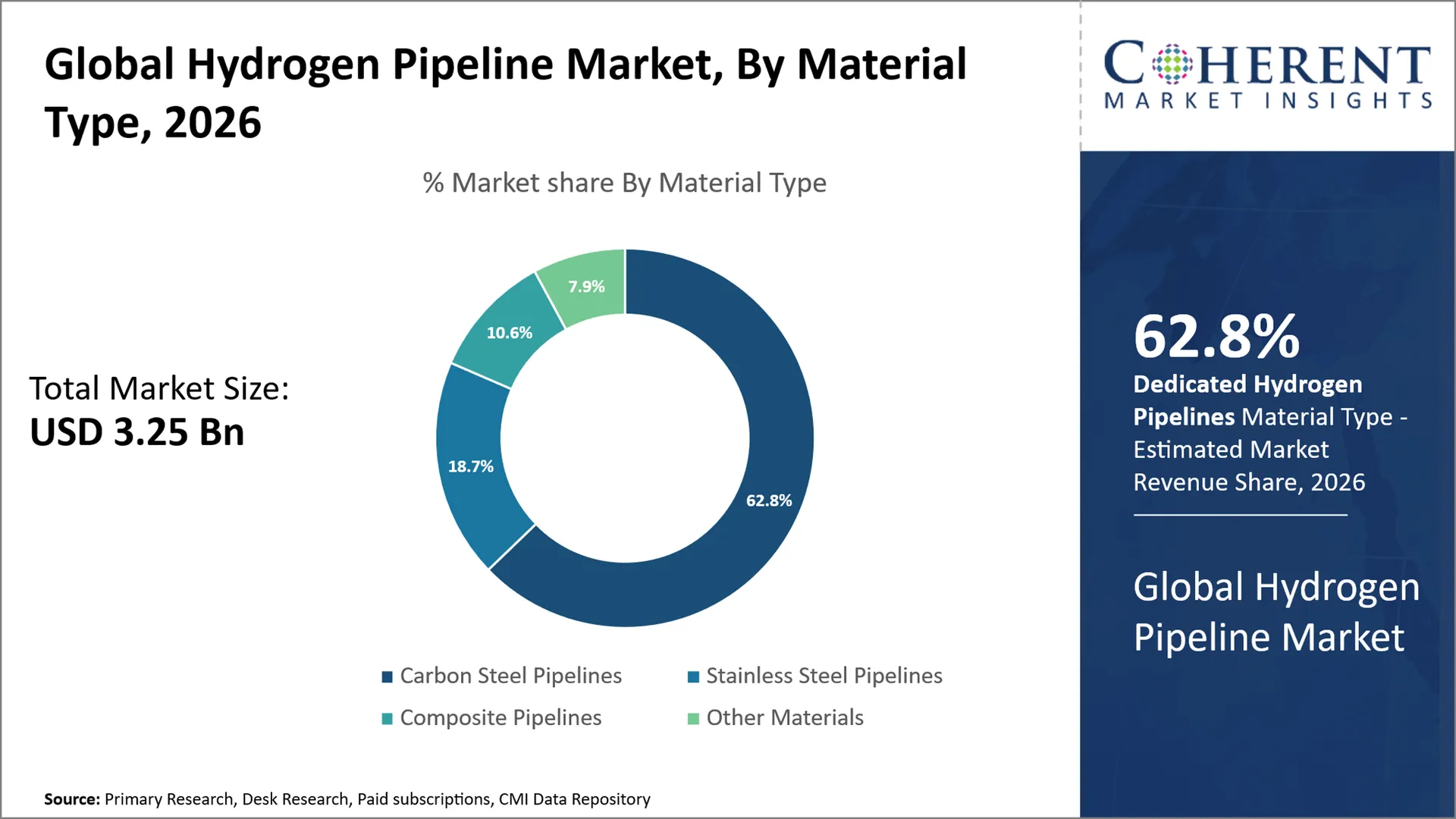
Carbon steel is expected to remain the largest material category with expected 62.8% share because hydrogen transmission developers can build on a mature ecosystem of line-pipe manufacturing, welding procedures, field construction, inspection, repair, and lifecycle integrity management. Its commercial advantage is therefore not limited to raw-material cost; it also reduces project execution complexity by allowing contractors and operators to adapt established pipeline practices to hydrogen-specific qualification requirements. The material is particularly relevant for buried transmission networks and large-diameter routes where standardized fabrication and maintainability matter. Suppliers that can demonstrate fracture resistance, weld performance, and operating-envelope compatibility should gain preference in procurement. In December 2024, Finland’s Gasgrid reported that modern carbon steel pipes are suitable for hydrogen use when pressure, flow conditions, material properties, and lifecycle operating limits are properly addressed.
Why Do High Pressure Pipelines Dominate the Pressure Type of the Global Hydrogen Pipeline Market?
High pressure pipelines are expected to lead the pressure category with 48.6% share because transmission-scale projects concentrate substantially more value in pressure-rated line pipe, compressor systems, block valves, metering, isolation, monitoring, and safety engineering than lower-pressure distribution links. Their role is especially important where backbone networks must connect production zones with refineries, steel plants, chemical complexes, storage sites, and downstream pressure-reduction stations. Higher technical qualification requirements also raise spending on fracture assessment, ignition-risk studies, operating procedures, and integrity assurance, increasing the segment’s market value per route kilometer. This creates attractive opportunities for specialist testing firms, compressor OEMs, and high-specification component suppliers. In May 2025, National Gas began a project specifically examining ignition risks for 100% hydrogen and hydrogen blends in high-pressure transmission systems.
Current Events and their Impact
Current Event | Description and Its Impact |
EU Hydrogen and Decarbonized Gas Market Package – May 2024 |
|
ACER Inter-Temporal Cost Allocation Recommendation – July 2025 |
|
UK Hydrogen Network Code Industry Engagement – March 2026 |
|
Global Hydrogen Pipeline Market Dynamics
Key Market Drivers
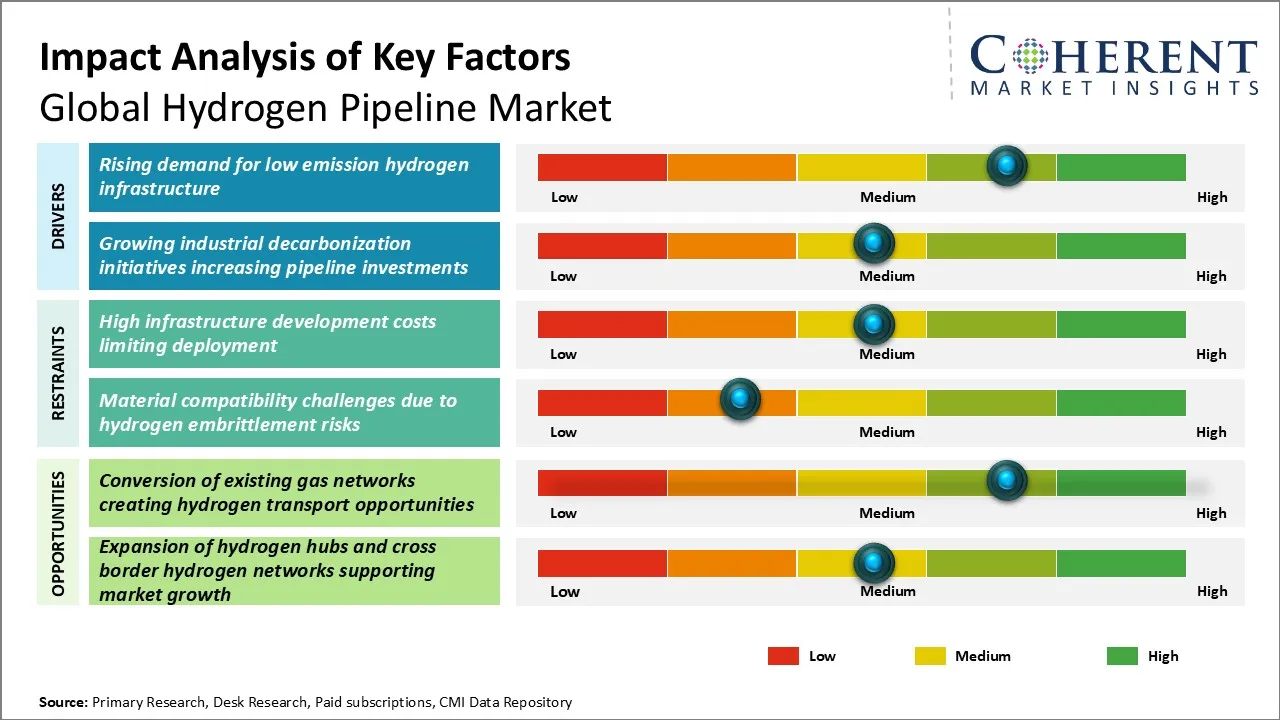
- Rising demand for low emission hydrogen infrastructure: Low-emission hydrogen infrastructure is moving from planning into physical network build-out because producers need dependable transport routes before large industrial offtake can scale. This creates direct demand for hydrogen-qualified pipe, valves, compressors, metering systems, EPC services, and integrity solutions while reducing the logistics penalty of truck-based distribution. Transmission operators, pipeline manufacturers, and engineering contractors benefit most. In March 2025, Fluxys began constructing the first phase of Belgium’s open-access hydrogen pipeline network across the Antwerp–Ghent industrial corridor, with initial capacity targeted for 2026.
- Growing industrial decarbonization initiatives increasing pipeline investments: Industrial decarbonization programs are converting hydrogen pipelines from optional utility assets into enabling infrastructure for steel, chemicals, and refinery transition projects. These sectors require continuous, high-volume hydrogen supply that favors fixed pipeline connections over intermittent delivered gas, improving bankability for dedicated networks around industrial clusters. Pipeline operators, steel pipe suppliers, compressor vendors, and industrial EPC firms gain from this infrastructure pull. In December 2025, OGE received planning approvals for hydrogen pipelines linking Ruhr industrial sites, including connections intended to support lower-carbon steel and chemical production.
Emerging Market Trends
- Selective Pipeline Repurposing Is Replacing Blanket Conversion Strategies: Repurposing strategies are becoming more selective rather than assuming that existing gas pipelines can be converted wholesale. Developers are increasingly combining reused transmission corridors with purpose-built sections, replacement valves, revised compression, material verification, and hydrogen-specific integrity management. This shifts value toward inspection specialists, metallurgy providers, engineering consultants, and operators with detailed asset records. Over the forecast period, project economics will increasingly depend on proving which existing assets are technically and commercially reusable, rather than simply maximizing the percentage of legacy infrastructure retained.
- Open-Access Hydrogen Networks Are Evolving Into Multi-Participant Market Platforms: Hydrogen transport is evolving from closed point-to-point supply lines toward multi-user networks with standardized access, balancing, nomination, metering, and capacity-allocation rules. That transition changes pipeline projects into market platforms connecting producers, storage operators, industrial consumers, and eventually import corridors. Transmission operators with system-management capabilities should gain strategic relevance, while captive pipeline models may face pressure where open-access frameworks become mandatory. During the forecast period, commercial differentiation will increasingly depend on network flexibility, interoperability, and the ability to accommodate changing supply and offtake portfolios.
Regional Insights
Why Does Europe Dominate the Global Hydrogen Pipeline Market?
Europe is expected to account for 32.6% of the global hydrogen pipeline market in 2026 because the region is building hydrogen transport as shared energy infrastructure rather than isolated industrial pipelines. Cross-border network planning, public funding, natural-gas asset conversion, and coordinated access rules are reducing project-development uncertainty. Demand is concentrated around steel, chemicals, refining, ports, storage sites, and planned import corridors, creating multiple anchor users for backbone networks. The region also benefits from experienced transmission-system operators and established pipeline engineering capacity. In February 2024, the European Commission approved IPCEI Hy2Infra, supporting approximately 2,700 km of new and repurposed hydrogen transmission and distribution pipelines across seven member states, alongside electrolysers and storage infrastructure. This directly broadens the investable project pipeline for hydrogen transport equipment, EPC services, and network operations.
Why Is North America Emerging as the Fastest-Growing Region in the Global Hydrogen Pipeline Market?
North America is expected to represent 31.8% of the global hydrogen pipeline market in 2026 and emerge as the fastest-growing region as hydrogen infrastructure expands beyond established refinery corridors into clean-hydrogen production, industrial decarbonization, heavy transport, and storage-linked applications. The region combines mature gas-pipeline engineering capability with large industrial hydrogen users, enabling both dedicated lines and technically qualified conversions. Canada adds growth through new low-carbon hydrogen projects, while U.S. industrial clusters provide concentrated offtake. In September 2025, the Canada Energy Regulator reported approximately 4 million tonnes of annual hydrogen production and another 5 million tonnes per year of clean-hydrogen projects announced or under development, while transport and storage infrastructure was expanding. This enlarges the addressable pipeline infrastructure opportunity across North America.
Global Hydrogen Pipeline Market Outlook for Key Countries
Why Is the U.S. a Key Market for the Global Hydrogen Pipeline Market?
The U.S. is a key country in the global hydrogen pipeline market because it combines established hydrogen-consuming industries with emerging demand for dedicated clean-hydrogen corridors. Gulf Coast refining and chemicals provide a commercial base for continuous pipeline supply, while California and other states are evaluating networks connecting renewable hydrogen production, storage, ports, power generation, and hard-to-electrify industrial users. This creates opportunities for pipe suppliers as well as compression, metering, valves, leak detection, routing, and environmental engineering. Project economics are increasingly linked to securing multiple anchor users along shared corridors. In December 2024, SoCalGas filed with the California Public Utilities Commission to advance Angeles Link to Phase 2, a proposed open-access hydrogen pipeline system connecting third-party production and storage locations with customers across Central and Southern California.
Why Does China Support Growth in the Global Hydrogen Pipeline Market?
China supports growth in the global hydrogen pipeline market because its hydrogen consumption base, renewable-energy buildout, and geographic separation between supply and industrial demand create a strong case for long-distance transport. Refining and chemical industries consume large hydrogen volumes, while renewable hydrogen projects are concentrated increasingly in resource-rich northern and western provinces. Moving this output toward industrial clusters raises the strategic value of high-pressure pipelines, blending-capable systems, storage connections, and standardized operations. Domestic steel and equipment supply chains also support localized project execution. In June 2025, China’s National Energy Administration reported that hydrogen production and consumption had exceeded 36.5 million tonnes in 2024 and that the country’s first long-distance high-pressure pipeline capable of hydrogen blending had been completed, indicating movement from localized supply toward larger interconnected transport infrastructure.
Why Is India Important in the Global Hydrogen Pipeline Market?
India is becoming important to the global hydrogen pipeline market as green-hydrogen policy moves beyond production incentives toward transport, blending, safety standards, and industrial delivery infrastructure. Refining, fertilizer, steel, and city-gas applications create concentrated hydrogen demand, while renewable-resource-rich locations do not always coincide with major consumption centers. This mismatch strengthens the commercial rationale for dedicated transmission routes and selective use of existing gas infrastructure. India’s extensive gas-pipeline and city-gas base also provides engineering experience and potential assets for technical qualification. In January 2025, the Petroleum and Natural Gas Regulatory Board stated that it was developing a roadmap covering hydrogen blending in existing gas infrastructure and dedicated 100% hydrogen pipelines, together with safety standards, technical specifications, implementation actions, and funding identification. This establishes a clearer foundation for future pipeline investment.
Why Is Germany a Strategic Country in the Global Hydrogen Pipeline Market?
Germany is a strategic country in the global hydrogen pipeline market because its industrial geography requires hydrogen transport between northern production and import points and inland steel, chemical, refinery, storage, and power users. The commercial opportunity centers on converting suitable transmission assets while adding purpose-built links where existing routes cannot meet hydrogen flow or connection requirements. This strategy can shorten development schedules but simultaneously increases demand for material verification, integrity assessment, compressor adaptation, metering, and network-balancing services. In March 2025, Nowega began commissioning a 55-km hydrogen pipeline between Lingen and Bad Bentheim, with 95% of the section comprising existing pipelines converted for hydrogen transport. The project demonstrates Germany’s transition from infrastructure planning into physical hydrogen-network operation while providing practical operating experience for subsequent conversions, producer connections, storage integration, and industrial supply routes.
Why Is Brazil an Important Growth Market for the Global Hydrogen Pipeline Market?
Brazil is an important growth market for hydrogen pipelines because its emerging hydrogen economy is being organized around integrated industrial hubs rather than dispersed stand-alone production. Large renewable resources can support low-emission hydrogen supply, while refining, fertilizers, steel, chemicals, and export-oriented port complexes provide potential anchor demand. Pipeline opportunities are therefore likely to begin with connections between generation, storage, industrial consumption, and logistics infrastructure within individual hubs before longer-distance networks become commercially justified. Existing gas-sector engineering capability offers an additional foundation for pipeline development. In August 2025, Brazil’s Ministry of Mines and Energy announced the final outcome of its low-emission hydrogen hub selection process; the government’s hub framework explicitly includes infrastructure required for hydrogen production, storage, and transport. This supports localized pipeline investment as selected projects move toward implementation.
Technology Deployment and Infrastructure Landscape in the Global Hydrogen Pipeline Market
Technology / Infrastructure Area | Adoption Stage | Primary Role in Hydrogen Pipelines | Commercial Significance |
Hydrogen-Compatible Line Pipe Metallurgy | Commercial and expanding | Uses steels, weld procedures, coatings, and material specifications engineered to manage hydrogen embrittlement and fatigue | Creates higher-value opportunities for qualified pipe mills, welding specialists, material-testing companies, and certification providers |
Pipeline Repurposing Qualification and Integrity Assessment | Rapidly scaling | Evaluates existing natural-gas pipelines through material verification, fracture assessment, pressure testing, inspection, and remaining-life analysis | Enables selective reuse of legacy assets while creating recurring demand for engineering, inspection, remediation, and integrity-management services |
Hydrogen Compression and Seal Systems | Commercial with continuing optimization | Maintains transmission pressure and throughput while addressing hydrogen leakage, seal compatibility, heat management, and compression efficiency | Compressor efficiency and reliability can materially influence lifecycle operating costs, giving specialist OEMs a strong position in long-distance networks |
Hydrogen Leak Detection and Distributed Monitoring | Emerging-to-commercial | Combines fixed hydrogen sensors, fiber-optic monitoring, pressure analytics, and automated isolation systems to identify abnormal releases | Strengthens safety performance and can reduce response times, making monitoring capability increasingly important for permitting and operator acceptance |
Gas Quality Metering and Hydrogen Analysis Systems | Commercializing with network development | Measures hydrogen purity, composition, flow, moisture, contaminants, and custody-transfer parameters at network entry and exit points | Becomes essential as networks add multiple producers, storage facilities, imports, and industrial offtakers with different quality requirements |
Digital Twins, SCADA and Flow Optimization Platforms | Scaling | Models network hydraulics, compressor operation, pressure conditions, nominations, storage interaction, and multi-directional flows | Supports capacity optimization, predictive maintenance, balancing, and lower operating costs as hydrogen systems evolve from simple lines into interconnected networks |
How Are Storage-Linked, Bidirectional Hydrogen Networks Creating New Growth Opportunities in the Global Hydrogen Pipeline Market?
A high-potential opportunity lies in pipeline systems designed around underground hydrogen storage, flexible compression, and bidirectional flow rather than simple producer-to-consumer transport. As renewable hydrogen output becomes more variable, industrial users and power generators will require infrastructure that can absorb production surpluses, withdraw stored hydrogen during shortages, and rebalance flows across multiple connection points. Suppliers can capture this opportunity through compressor upgrades, pressure-control packages, metering skids, storage interconnections, digital flow optimization, and integrity services engineered for frequent operating cycles. The strongest demand should emerge around industrial clusters, port zones, hydrogen-to-power projects, and regions with suitable salt-cavern geology. Participation will require expertise in pipeline hydraulics, hydrogen-compatible materials, storage interfaces, controls, and permitting. Established transmission operators may hold an advantage in network integration, while specialist equipment and software companies can build defensible positions in balancing, monitoring, and high-cycle asset management.
Market Players, Key Development, and Competitive Intelligence
Key Developments
- In July 2026, GASCADE launched ground investigations for the planned AquaDuctus hydrogen import pipeline in the German North Sea. This matters for the global hydrogen pipeline market because route investigations advance offshore hydrogen transport toward engineering definition, permitting readiness, and future construction planning.
- In July 2025, Enagás, NaTran, and Teréga established a joint company to develop the BarMar hydrogen pipeline between Barcelona and Marseille. This matters for the global hydrogen pipeline market because dedicated project governance can coordinate engineering, permitting, financing, and cross-border execution for a major renewable-hydrogen corridor.
- In February 2025, Air Liquide announced the ELYgator electrolyzer project in Rotterdam, designed to leverage its existing hydrogen pipeline network for industrial and mobility customers. This matters for the global hydrogen pipeline market because new low-carbon production can increase utilization and strengthen the commercial value of established pipeline assets.
Competitive Landscape
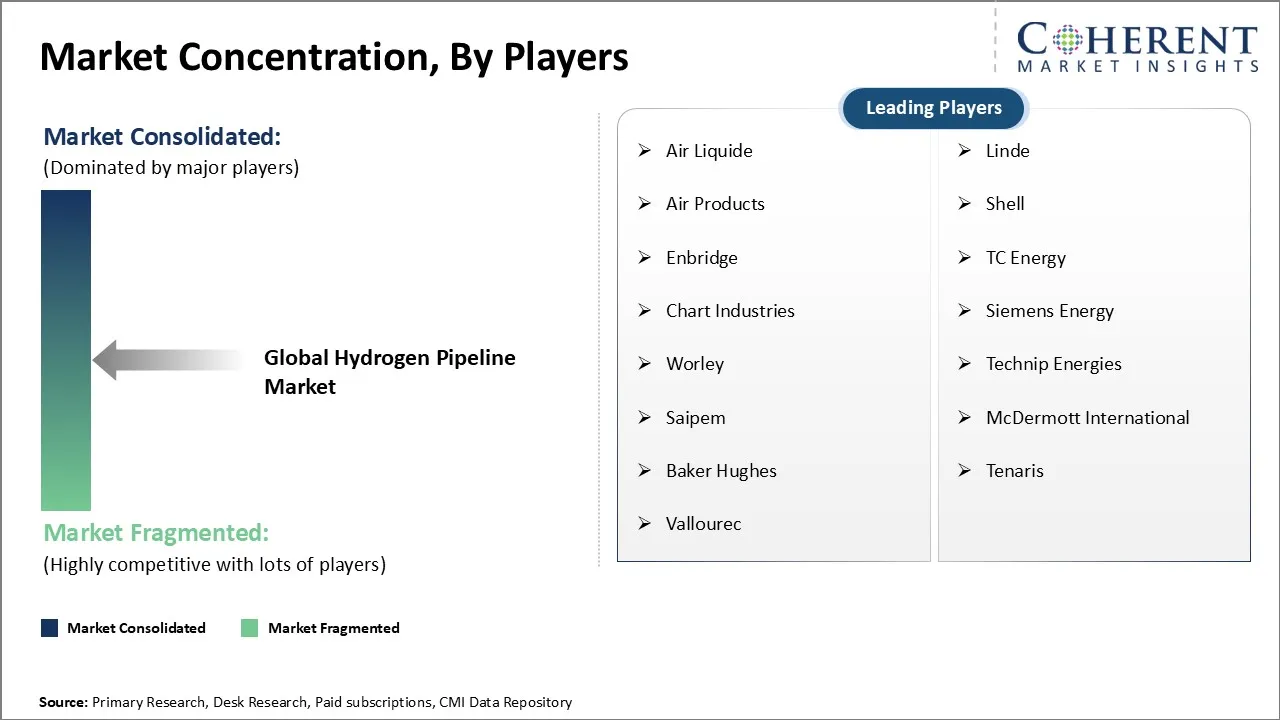
The global hydrogen pipeline market is moderately consolidated at the large-project development level but remains fragmented across engineering, materials, compression, integrity, and control technologies. Competition centers on hydrogen compatibility, project-bankability support, lifecycle reliability, delivered cost, regulatory compliance, and execution capacity. Regional transmission operators shape network access, while specialist suppliers can win high-value positions where metallurgy, inspection, compression, or digital monitoring requirements exceed conventional gas-pipeline specifications.
Key focus areas include
- Hydrogen-qualified engineering capability: Contractors able to integrate pipeline hydraulics, materials, compression, metering, storage, and safety requirements are better positioned for complex backbone projects.
- Lifecycle integrity performance: Buyers increasingly evaluate fracture resistance, weld quality, leakage management, inspection strategy, and maintenance requirements rather than relying only on initial equipment cost.
- Total cost of ownership: Competitive bids must balance new-build expenditure, repurposing costs, compressor energy consumption, remediation requirements, inspection frequency, and expected asset life.
- Execution and supply reliability: Large transmission programs favor suppliers capable of securing qualified steel, valves, compressors, coatings, control systems, and field-service capacity over long project schedules.
- Regulatory and standards readiness: Expertise in hydrogen-specific codes, permitting, pressure requirements, environmental assessment, and network-access rules can materially improve project bankability.
- Customization by operating condition: Pressure, purity, diameter, storage integration, offshore routing, bidirectional flow, and industrial connection requirements create opportunities for differentiated engineering solutions.
- Long-term technical service: Inspection, monitoring, compressor maintenance, integrity analytics, digital optimization, and network-management support can create recurring revenue beyond initial pipeline construction.
Market Report Scope
Global Hydrogen Pipeline Market Report Coverage | |||
Report Coverage | Details | ||
Base Year | 2025 | Market Size in 2026: | USD 3.25 Bn |
Historical Data For: | 2020 To 2024 | Forecast Period: | 2026 To 2033 |
Forecast Period 2026 To 2033 CAGR: | 14.90% | 2033 Value Projection: | USD 8.59 Bn |
Geographies covered: |
| ||
Segments covered: |
| ||
Companies covered: | Air Liquide, Linde, Air Products, Shell, Enbridge, TC Energy, Chart Industries, Siemens Energy, Worley, Technip Energies, Saipem, McDermott International, Baker Hughes, Tenaris, Vallourec | ||
Growth Drivers: |
| ||
Restraints & Challenges: |
| ||
Analyst Opinion (Expert Opinion)
- The global hydrogen pipeline market leadership is likely to migrate from companies that simply supply pipeline assets toward participants capable of assembling bankable hydrogen transport ecosystems. Project origination, anchor-customer contracting, permitting, financing support, engineering integration, and lifecycle operation may become as commercially important as the physical pipeline itself. Suppliers that can reduce interface risk across these activities should gain greater negotiating power with network developers and infrastructure investors.
- The most consequential disruption could come from slower-than-expected synchronization between hydrogen production, transport capacity, and end-user conversion. Instead of building networks against theoretical future volumes, developers may increasingly stage infrastructure around contracted demand and expandable corridors. This would pressure business models dependent on immediate high utilization while rewarding modular engineering, scalable compression, convertible assets, flexible contracting, and disciplined capacity planning.
- Global hydrogen pipeline market participants should invest in hydrogen-compatibility testing, integrity analytics, efficient compression, metering accuracy, project-development expertise, and customer-specific connection solutions. Anchor industrial users and storage-linked projects deserve particular attention because they improve utilization visibility. Companies should protect margins through lifecycle-service offerings and localization of critical equipment, while avoiding excessive capital commitment to speculative routes lacking credible offtake, regulatory clarity, permitting progress, or coordinated upstream hydrogen supply.
Speak to the analyst
Want personalized insights?
Take the findings above to one of our principal consultants, or have the report rebuilt around the segments, geographies and competitors you actually track.
Market Segmentation
- Pipeline Type Insights (Revenue, USD Bn, 2021 - 2033)
- Dedicated Hydrogen Pipelines
- Converted Natural Gas Pipelines
- Hydrogen Blending Pipelines
- Material Type Insights (Revenue, USD Bn, 2021 - 2033)
- Carbon Steel Pipelines
- Stainless Steel Pipelines
- Composite Pipelines
- Other Materials
- Pressure Type Insights (Revenue, USD Bn, 2021 - 2033)
- High Pressure Pipelines
- Medium Pressure Pipelines
- Low Pressure Pipelines
- Application Insights (Revenue, USD Bn, 2021 - 2033)
- Industrial Hydrogen Supply
- Refining and Petrochemicals
- Power Generation
- Hydrogen Mobility Infrastructure
- Other Applications
- End User Insights (Revenue, USD Bn, 2021 - 2033)
- Chemical and Refining Industry
- Energy Companies
- Steel and Metal Industry
- Transportation Sector
- Others
- Distribution Channel Insights (Revenue, USD Bn, 2021 - 2033)
- Direct Project Contracts
- Engineering Procurement and Construction Contractors
- Other Channels
- Regional Insights (Revenue, USD Bn, 2021 - 2033)
- North America
- U.S.
- Canada
- Latin America
- Brazil
- Argentina
- Mexico
- Rest of Latin America
- Europe
- Germany
- U.K.
- Spain
- France
- Italy
- Russia
- Rest of Europe
- Asia Pacific
- China
- India
- Japan
- Australia
- South Korea
- ASEAN
- Rest of Asia Pacific
- Middle East
- GCC Countries
- Israel
- Rest of Middle East
- Africa
- South Africa
- North Africa
- Central Africa
- North America
Sources
Primary Research Interviews
- Hydrogen pipeline operators, transmission system operators, hydrogen producers, electrolyzer manufacturers, EPC contractors, pipeline suppliers, and industrial hydrogen users
- Engineering consultants, storage operators, project developers, investors, and hydrogen infrastructure specialists
Stakeholders
- Hydrogen pipeline developers, pipeline manufacturers, material suppliers, compressor and valve suppliers
- Refining, steel, chemical, ammonia, power generation, and hydrogen mobility companies
- Government agencies, energy regulators, and hydrogen mission organizations
End-use Sectors
- Industrial hydrogen supply
- Refining and petrochemicals
- Steel and metal industries
- Power generation and energy storage
- Hydrogen mobility infrastructure
- Chemical and ammonia production
Regulatory and Industry Bodies
- International Energy Agency IEA
- International Renewable Energy Agency IRENA
- Hydrogen Council
- European Commission hydrogen initiatives
- U.S. Department of Energy DOE
- National energy ministries and hydrogen authorities across key markets
Databases
- Company annual reports, investor presentations, and regulatory filings
- Hydrogen project databases and infrastructure trackers
- Pipeline network databases and energy infrastructure records
- Trade datasets for pipeline materials, equipment, and hydrogen technologies
Magazines and Journals
- International Journal of Hydrogen Energy
- Energy Policy
- Renewable and Sustainable Energy Reviews
- Journal of Cleaner Production
- Pipeline & Gas Journal
Associations
- Hydrogen Council
- International Gas Union IGU
- European Hydrogen Backbone initiative
- Gas Infrastructure Europe GIE
- American Gas Association AGA
- International Organization for Standardization ISO
Public Domain Sources
- Hydrogen pipeline project announcements and infrastructure plans
- National hydrogen strategies and decarbonization roadmaps
- Pipeline conversion studies, hydrogen blending initiatives, and infrastructure investments
- Energy transition policies and clean hydrogen development programs
Key Standards and Regulations
- Hydrogen pipeline design, construction, and safety standards
- Material compatibility and hydrogen embrittlement guidelines
- Pressure management, leakage detection, and integrity monitoring requirements
- ISO, ASME, EN, and regional pipeline regulations
Proprietary Elements
- CMI Data Analytics Tool
- Proprietary CMI repository containing 10+ years of hydrogen, energy transition, industrial infrastructure, and clean technology market intelligence
Get access to 250+ pages report
Every segment, forecast, competitor profile and data table behind the analysis above — available for instant download.
- ESOMAR Member
- ISO 9001:2015 Certified
- D-U-N-S Registered
- GDPR & CCPA Compliant
Frequently Asked Questions
The CAGR of global hydrogen pipeline market is projected to be 14.90% from 2026 to 2033.
The global hydrogen pipeline market is estimated to be valued at USD 3.25 Bn in 2026 and is expected to reach USD 8.59 Bn by 2033.
Rising demand for low-emission hydrogen infrastructure and increasing investments in pipeline networks to support industrial decarbonization are the key factors driving the growth of the global hydrogen pipeline market.
High infrastructure development costs limiting deployment and Material compatibility challenges due to hydrogen embrittlement risks are the major factors hampering the growth of global hydrogen pipeline market.
In terms of pipeline type, dedicated hydrogen pipelines are estimated to dominate the market revenue share in 2026.
Air Liquide, Linde, Air Products, Shell, Enbridge, TC Energy, Chart Industries, Siemens Energy, Worley, Technip Energies, Saipem, McDermott International, Baker Hughes, Tenaris, Vallourec are the major players.
Europe is expected to lead the global hydrogen pipeline market in 2026.