

Global Indoor Bike Trainers Market Size and Forecast – 2026 To 2033
The global indoor bike trainers market is expected to grow from USD 147 Mn in 2026 to USD 240 Mn by 2033, registering a compound annual growth rate (CAGR) of 5.8% from 2026 to 2033. The global indoor bike trainers market is driven by growing popularity of virtual cycling platforms. On January 21, 2025, IRONMAN and ROUVY announced a multi-year partnership, which will see ROUVY become the Official Digital Sports Platform of the global IRONMAN and IRONMAN 70.3 Triathlon Series.
Key Takeaways of the Global Indoor Bike Trainers Market
- The Bluetooth segment is expected to account for 37.0 % of the global indoor bike trainers market share in 2026. Rising participation in virtual cycling races and esports is driving the growth of the segment. On November 15, 2025, MyWhoosh hosted the 2025 UCI Cycling Esports World Championships at the Space42 Arena in Abu Dhabi after an online semi-final stage involving riders competing for qualification.
- The Direct Drive Resistance segment is estimated to capture 41.0 % of the market share in 2026. Greater demand for realistic road simulation and controlled resistance is majorly driving the growth of the segment. For instance, ROUVY continued developing its real-world video-based cycling environment, where changes in the filmed route are translated into trainer resistance so that climbs and rolling terrain produce corresponding physical changes during indoor rides.
- The Smart Bike Trainers segment is estimated to capture 54.0 % of the market share in 2026. Increasing preference for smart trainers with real time power and performance monitoring is driving the growth of the segment. In June 2025, Garmin released the Tacx NEO 3M, featuring 1% power, speed and cadence accuracy, ERG mode for automatically altering resistance to exercise goals, and Garmin Connect integration.
- North America is expected to dominate the indoor bike trainers market in 2026 with a market share of 41.0 %. Increasing integration of artificial intelligence for personalized training recommendations in North America is driving the growth of the regional market. In January 2026, TrainerRoad introduced its next-generation AI training system, moving beyond fixed training plans toward predictive workout selection based on an athlete’s training history, current fitness, fatigue, recovery, schedule, and goals.
- Asia Pacific is expected to account for 22.0 % share in 2026. Growth of online retail and direct to consumer distribution across Asia Pacific is driving the growth of the regional market. On November 20, 2025, iGPSPORT entered the 2025 WorldTour through its partnership with Groupama-FDJ United, supplying the team with BiNavi and BSCC300T cycling computers, SR Mini radar lights, and HR50 heart-rate monitors.
Segmental Insights
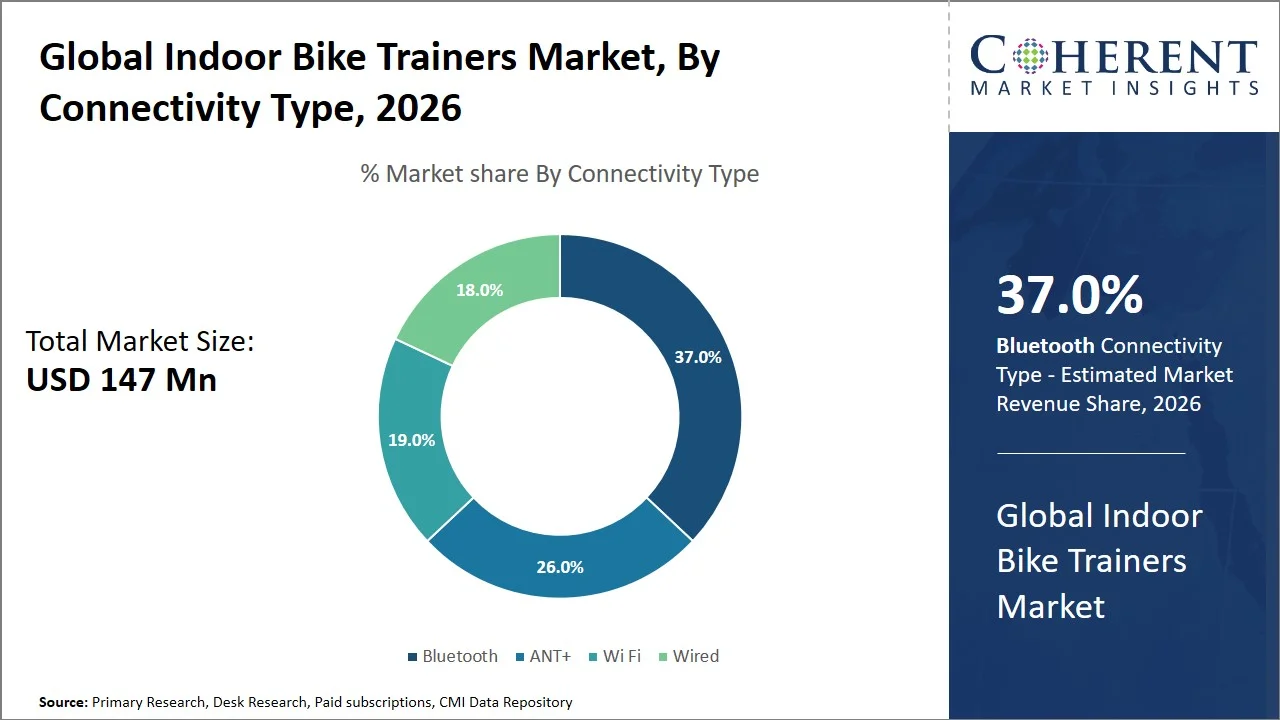
Why Does Bluetooth Dominate the Global Indoor Bike Trainers Market?
The Bluetooth segment is expected to account for 37.0% of the global indoor bike trainers market share in 2026. The reason for the preference for Bluetooth is that it enables a straightforward and widely compatible wireless link between indoor bike trainers and the smartphones, tablets, laptops and fitness software that cyclists already use for training. Bluetooth Low Energy is supported by most modern smart trainers and allows for two-way exchange of performance data including power, speed and cadence, plus lets compatible applications manage resistance for planned workouts and simulated rides. Garmin points out that most training apps support Bluetooth and Wahoo’s Bluetooth works with iOS, Android, Mac and Windows devices, so you don’t need more adapters and it makes it easier to set up for home users. On February 12, 2026, Wahoo Fitness launched the KICKR CORE 2. The Wahoo KICKR CORE 2 represents a significant evolution of the indoor cycling industry’s most popular mid-range smart trainer.
- Current Industry Events of 2026
- Market Size Estimation
- Regional Breakdown
- Competitive Landscape
- Customer Intelligence
- Segmental Analysis
- Pricing Analysis
- Key Market Drivers, Challenges & Future Trends
- Customized Insights Section
Why is Direct Drive Resistance the Most Preferred Resistance Type?
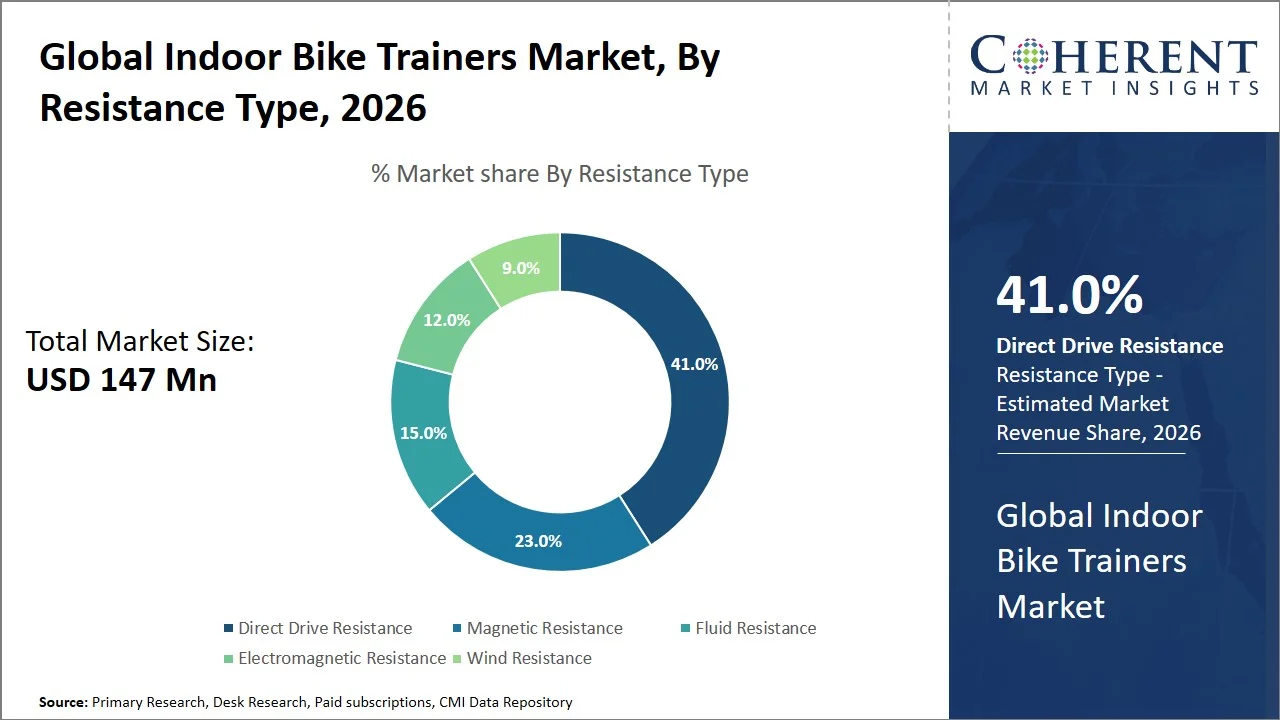
The direct drive resistance segment is expected to account for 41.0% of the global indoor bike trainers market share in 2026. Direct drive resistance is preferable as it transmits the power from the rider directly from the bicycle drive train to the resistance mechanism of the trainer, eliminating the tire to roller interface that can cause slippage, tire wear, and inconsistent power measurements. This direct link means more consistent power measurement, greater resistance generation and a more realistic feel to the pedaling. This is particularly important for planned workouts, sprint intervals and virtual cycling when correct adjustments in resistance are needed. Garmin further says that direct drive removes power loss through the tire and delivers accurate speed, cadence and power readings, and Cycling Weekly writes that drivetrain-based measuring is often more accurate than wheel-on systems. Moreover, Van Rysel continued to expand the D100 as an inexpensive direct-drive smart trainer, supporting Zwift Cog and Click with a maximum resistance of 600 W and 6% gradient simulation.
Smart Bike Trainers Dominates the Global Indoor Bike Trainers Market
The smart bike trainers segment is expected to account for 54.0% of the global indoor bike trainers market share in 2026. Increasingly, smart bike trainers are being chosen for their ability to accurately measure performance, automatically adjust resistance and connect to digital training platforms. They enable users to replicate structured workouts, climbs, intervals and virtual cycling environments with minimal manual input. Connected trainers can send power and other performance data to training apps and receive commands that automatically change resistance, providing a more dynamic and data-driven indoor cycling experience than traditional trainers. In August, 2026, Wahoo debuted a three-tiered subscription plan, expanding its ecosystem from gear to training insights and digital coaching, with the Pro tier including SYSTM and expanded training capability.
Current Events and their Impact
Current Events | Description and its Impact |
European Union - Ecodesign for Sustainable Products Regulation, Regulation EU 2024/1781. |
|
United States - FCC Cyber Trust Mark Program |
|
Indoor Bike Trainers Market Dynamics
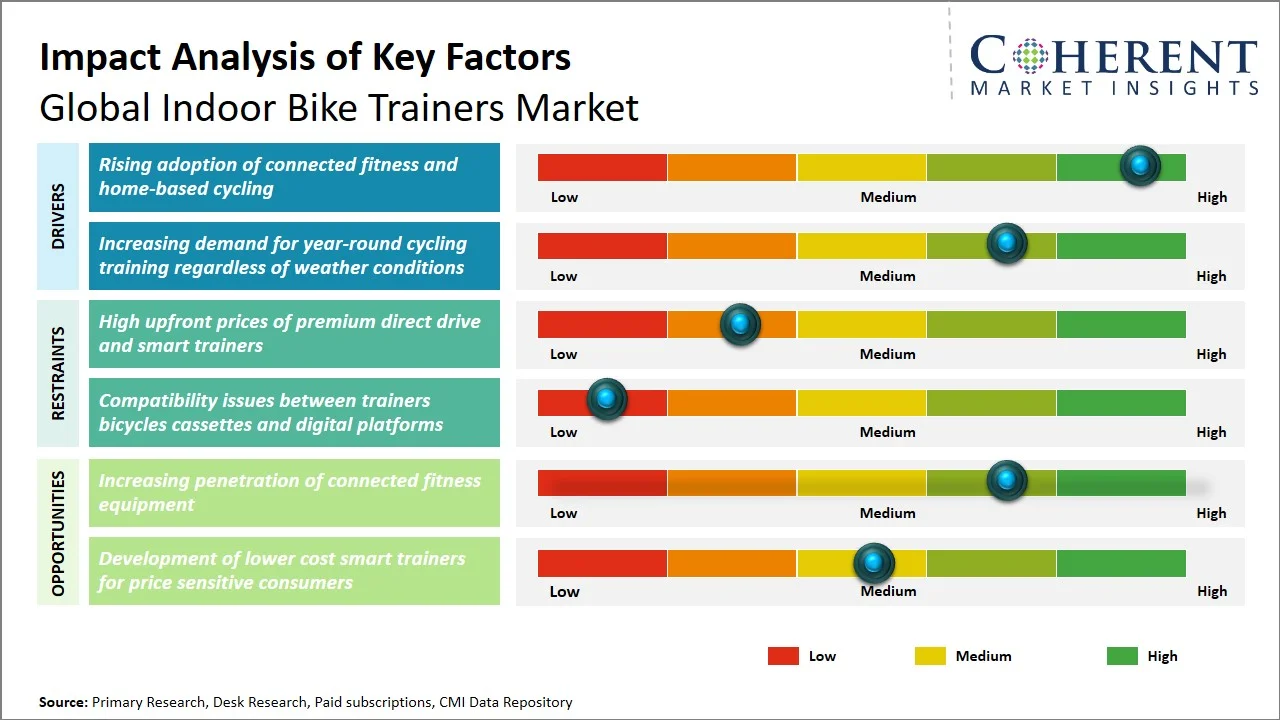
Market Drivers
- Rising adoption of connected fitness and home-based cycling: The integration of smart trainers with connected fitness platforms is making home cycling more interactive, measurable and personalized, encouraging cyclists to move from conventional indoor exercise to technology enabled training ecosystems. Modern trainers may communicate power, cadence and other performance data to virtual cycling and workout apps, and connected platforms offer planned workouts, gamified environments, virtual races and social interaction that can all boost interest and training adherence. A 2024 peer reviewed study showed that the most reported equipment set up among surveyed indoor cyclists was connected equipment, such as smart turbo trainers hooked up to mixed reality cycling software, pointing to the growing part of linked technology in indoor cycling. On June 18, 2025, Garmin announced new compatibility upgrades and features for Tacx NEO 2T and 3M smart trainers. These enhancements provide cyclists with even more possibilities to enjoy a full ride experience with their premium indoor trainer.
- Increasing demand for year-round cycling training regardless of weather conditions: Indoor bike trainers offer cyclists a protected training environment when rain, extreme heat or cold, darkness, or other outdoor conditions make road cycling inconvenient or unsafe, enabling training schedules to be maintained year-round. This is especially pertinent in areas with extreme seasonal weather, and study suggests that weather was an explanation mentioned by 88 4% of indoor cyclists assessed for indoor riding, with indoor training hours much more in winter than in summer. Garmin also sells smart trainers as a method to keep riding through changing seasons, and contemporary cycling advice still touts indoor training as a useful strategy to stay fit in the face of variable weather. In December 2025, ROUVY launched a special winter training camp. The program includes a 12-week Base Builder, featuring 39 exercises and real-world routes across European training hotspots, giving cyclists a planned way to stay fit throughout winter before heading back outside.
Emerging Trends
- Virtual Shifting and More Realistic Ride Simulation: Indoor cycling is progressing toward more realistic riding experiences featuring virtual shifting, simulated gradients, downhill effects, dynamic inertia and terrain-based resistance control.
- Integration with Multiple Connected Fitness Platforms: Interoperability across trainers, smartphones, cycling computers, smartwatches and third-party training applications is becoming increasingly crucial as customers want to have the choice of choosing their preferred digital training ecosystem.
- Increasing Emphasis on Immersive Group Riding and Social Features: Indoor cycling platforms are adding group rides, virtual races, challenges, social engagement, and shared training facilities to make indoor workouts more interesting and competitive.
- Development of Quieter, More Stable and More User-Friendly Trainers: Product development is increasingly focused on minimizing vibration and noise while improving stability, portability, setup convenience and natural movement during high intensity sessions.
Regional Insights
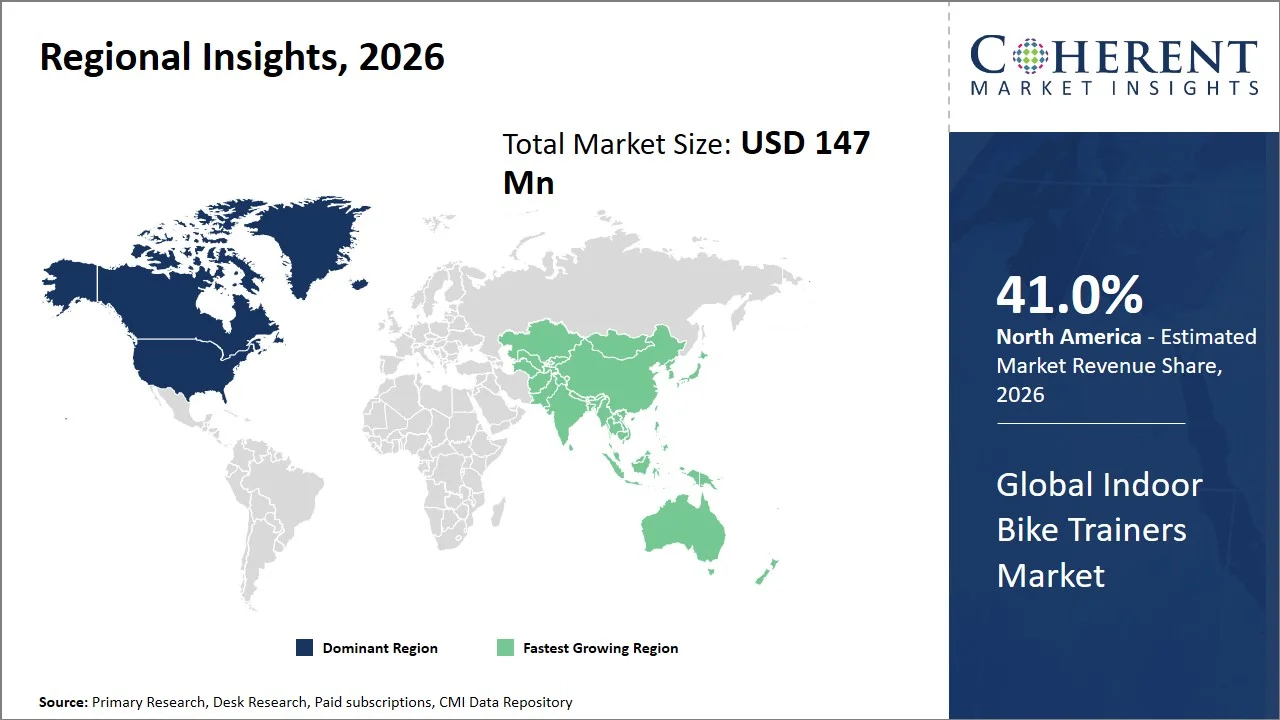
Why is North America a Strong Market for Indoor Bike Trainers?
North America is expected to account for a market share of 41.0% in 2026. The deep integration of indoor cycling with digital fitness ecosystems is supporting North America, especially the U.S. and Canada, where smart trainers are being used in conjunction with platforms like Zwift, TrainerRoad and Rouvy for structured training and virtual racing. Zwift works with smart trainers on PC and Mac, Android, iOS and Apple TV, and has an equipment ecosystem that includes products like the KICKR CORE Zwift One, which makes it easier for cyclists to convert an existing outdoor bike into an indoor system. The area also enjoys the presence of premium equipment brands such as Wahoo Fitness and Saris, a large base of specialized cycling retailers, and a significant consumer awareness of power-based training. North America represented about 45.4% of the global smart indoor bike market in 2025, indicating particularly strong consumer acceptance of connected indoor fitness equipment, although this broader category includes smart bikes in addition to trainers.
Why Does Asia Pacific Indoor Bike Trainers Market Exhibit High Growth?
Asia Pacific is expected to register the fastest growth with a CAGR of 7% over the forecast period. Asia Pacific is projected to account for 22.0% of the global indoor bike trainers market in 2026. Asia Pacific is being propelled by a combination of smartphone penetration, e-commerce infrastructure, compact urban housing, and the rapid development of connected fitness ecosystems rather than by traditional cycling culture alone. Connected gym equipment in the region is projected to record a 23.4% CAGR from 2025 to 2033, with cardiovascular equipment already representing the largest product category in 2024, while India is identified as the fastest-growing country within the regional connected-equipment segment. China, India, Japan, South Korea, and Southeast Asian markets are increasingly suitable for smart trainers because Bluetooth, ANT+, Wi-Fi, virtual training applications, and online purchasing allow relatively compact equipment to deliver an experience previously associated with dedicated fitness facilities.
Global Indoor Bike Trainers Market Outlook for Key Countries
Why is U.S. Emerging as a Major Hub in the Indoor Bike Trainers Market?
The U.S. benefits from a mature performance-cycling ecosystem in which indoor trainers are used not only for general fitness but also for FTP testing, structured interval training, winter preparation, endurance development, and virtual racing. The country is especially vulnerable to Wahoo KICKR and Garmin Tacx ecosystems. Zwift provides access to thousands of workouts, virtual routes and a worldwide rider community on different platforms. The growing popularity of linked training is also underpinned by the enormous installed base of cycling computers, heart-rate monitors, power meters and smartwatches, which enables trainers to become part of a bigger performance-data ecosystem rather than functioning as independent workout equipment.
Is China the Next Growth Engine for the Indoor Bike Trainers Market?
China’s blend of local technology manufacturing, highly developed e-commerce platforms, huge urban populations and fast-growing connected-fitness consumption is a unique development driver. The smart trainers are capitalizing on the country’s strong electronics supply chain and the availability of Bluetooth, Wi-Fi, ANT+ and direct-drive products. Chinese manufacturers and technology companies also provide a broad range of connected fitness hardware at different price levels, making smart training technology increasingly accessible beyond professional cyclists and premium consumers.
Germany Indoor Bike Trainers Market Analysis and Trends
Germany is being driven by the combination of a strong road-cycling culture, long periods of unfavorable outdoor riding conditions, and increasing penetration of smart gyms and connected fitness equipment. Germany’s indoor bike trainer import increased substantially in 2024, reflecting increased demand from consumers and channels for indoor training gear. The overall fitness sector in Germany increased to 4,202 single fitness facilities and 3,002 chain facilities in 2025. The growth in the chain segment was driven by smart-gym locations. The country’s penchant for durable, quiet and technically sophisticated equipment is particularly significant for direct-drive trainers, which can provide consistent power measurement and less drivetrain noise than typical wheel-on systems in residential contexts.
U.K. Indoor Bike Trainers Market Analysis and Trends
The U.K. has a substantial overlap between road cycling, indoor winter training, and virtual riding platforms. Unpredictable weather creates a practical necessity for riders to sustain scheduled training without relying on outdoor circumstances. Zwift’s UK ecosystem allows smart trainers to be used with existing bicycles, and to access virtual routes, structured workouts, group activities and competitive events. Compatibility with PC, Mac, Android, iOS and Apple TV expands the addressable user base beyond those with dedicated cycling computers. The country’s established road-racing and club-cycling groups also comprise a substantial pool of performance-oriented consumers who utilize indoor trainers for winter base training, interval sessions and preparation for outdoor events, rather than viewing trainers as general fitness equipment.
Japan Indoor Bike Trainers Market Analysis and Trends
Japan presents a distinct opportunity because indoor trainers address both limited residential space and the country's preference for compact, technology-integrated fitness solutions, while low-impact exercise is increasingly relevant to an ageing population. Japanese demand is being supported by smart fitness equipment, virtual classes, portable home-workout products, and the increasing use of technology within exercise routines, with industry research identifying smart trainers, direct-drive trainers, Bluetooth, Wi-Fi, and ANT+ as key product categories and connectivity technologies. This is also reflected in the fact that the Japanese market is highly dependent on imports of bike trainers from China, Taiwan, the U.S., South Korea, and Italy; showing how the Japanese market blends high-end consumer demand with a product ecosystem supplied abroad.
Global Indoor Bike Trainers Market - Professional Cyclist Adoption of Virtual Training
Professional Cycling Team / Organization | Virtual Training Platform / Technology | Professional Cyclist Adoption |
Team Visma | Lease a Bike | High |
Lidl-Trek | ROUVY | High |
UCI Cycling Esports | MyWhoosh | High |
Professional peloton | Smart trainers | Moderate to High |
WorldTour teams | Smart trainers with connected virtual platforms | High |
Professional cycling teams | ROUVY | Moderate to High |
WorldTour riders | ROUVY virtual group rides | High |
Professional cyclists | ROUVY virtual route reconnaissance | Moderate |
How is Increasing Penetration of Connected Fitness Equipment Creating New Growth Opportunities in the Indoor Bike Trainers Market?
As connected fitness equipment becomes more common, indoor bike trainers are shifting from standalone mechanical devices to components of larger digital fitness ecosystems, opening up new possibilities. Trainers can now connect to smartphones, wearables, cycling computers, training applications, and subscription platforms to generate ongoing performance data and personalized workouts. This is more relevant as connected fitness equipment becomes increasingly infused with AI-driven coaching, wearable sync, live classes and progress tracking, offering opportunities for trainer manufacturers to monetize software, accessories, data services and recurring subscriptions on top of hardware. Zwift, for instance, expanded its Zwift Ready ecosystem in 2025 to include 12 compatible trainers from brands like Wahoo and Tacx, and introduced AI-powered personalized workout recommendations and progress tracking, showing how more equipment connectivity can boost compatibility, user engagement, and recurring digital-service opportunities for indoor trainer manufacturers.
On October 1, 2025, Peloton Interactive, Inc. introduced Peloton IQ, an AI and computer vision technology that delivers tailored advice and the Peloton Cross Training Series, which includes brand new basic and premium equipment built for cross-training.
Market Players, Key Development, and Competitive Landscape
Key Developments
- On June 24, 2025, Garmin announced the launch of Tacx Alpine, a gradient simulator that raises and lowers the front of a bike during an indoor ride to replicate climbs and provide more natural movement. Featuring an exclusive design that accommodates the motion of Tacx NEO 2T and 3M smart trainers, Tacx Alpine builds upon that powerful, immersive ride experience by mimicking grades from up to 25% and down to 10%.
- On June 24, 2025, Elite introduced the Rivo with Zwift Cog and Click as an entry-oriented Zwift Ready smart trainer, combining a 10 kg design with an integrated carrying handle, 2.5% increase in power accuracy, simulated gradients up to 18%, Wi-Fi, dual Bluetooth, and silent operation.
Competitive Landscape
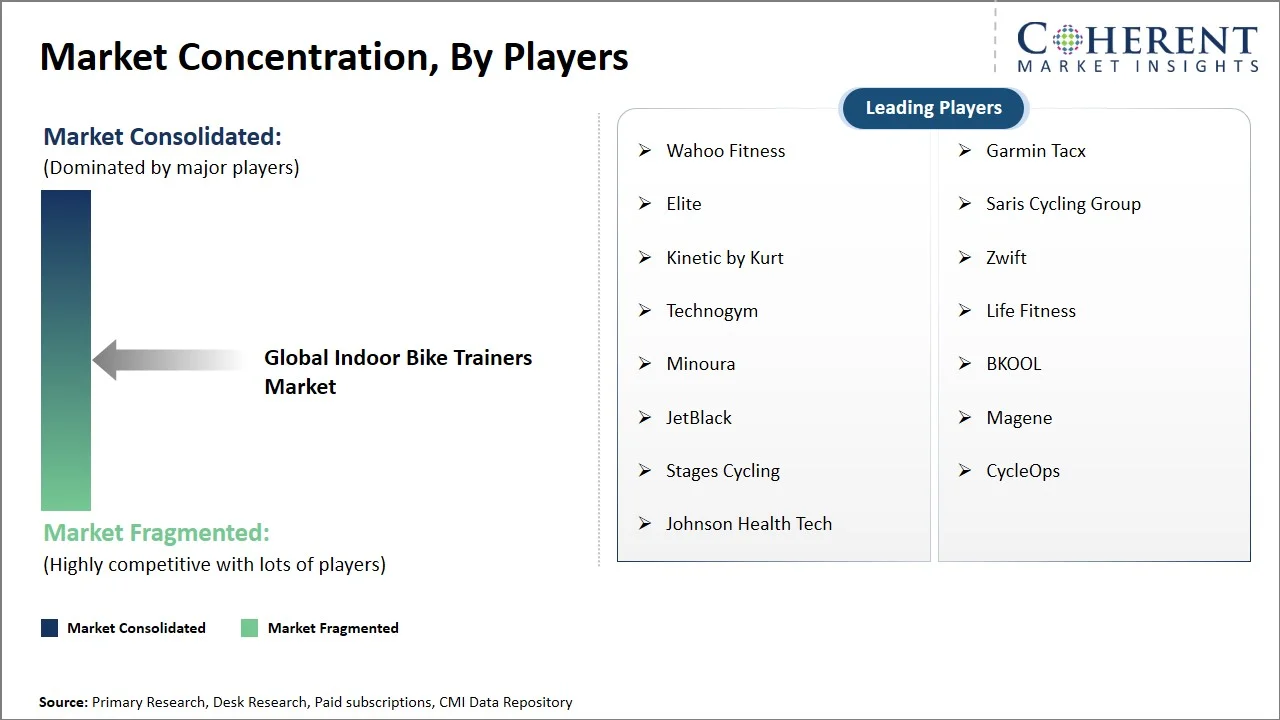
The competitive landscape is being shaped by companies that are moving beyond resistance hardware toward integrated trainer, connectivity, software, and virtual-cycling ecosystems, with Wahoo Fitness maintaining a particularly strong position through its KICKR family and expanding software strategy. Its KICKR CORE 2 combines Wi-Fi, Bluetooth, ANT+, automatic firmware updates, Zwift Cog and Click compatibility, 1,800 W maximum power and 16% gradient simulation, allowing Wahoo to compete across both performance and mainstream smart-trainer users, while its 2026 introduction of a three-tier subscription model extends the company further into recurring training services through SYSTM, training insights and route functionality. Garmin is taking its Tacx line to the next level with high-end ride realism and performance precision with the NEO 3M offering multidirectional movement, simulated surfaces, gradients up to 25%, descent simulation, power accuracy within 1% and compatibility with Zwift, TrainerRoad and Garmin Connect. Elite is competing through interoperability and value-oriented smart trainers, while Zwift is strengthening its hardware ecosystem through Zwift Ready compatibility and virtual shifting, making platform compatibility increasingly important alongside the physical trainer itself.
Market Report Scope
Indoor Bike Trainers Market Report Coverage
| Report Coverage | Details | ||
|---|---|---|---|
| Base Year: | 2025 | Market Size in 2026: | USD 147 Mn |
| Historical Data for: | 2020 To 2024 | Forecast Period: | 2026 To 2033 |
| Forecast Period 2026 to 2033 CAGR: | 5.8% | 2033 Value Projection: | USD 240 Mn |
| Geographies covered: |
| ||
| Segments covered: |
| ||
| Companies covered: | Wahoo Fitness, Garmin Tacx, Elite, Saris Cycling Group, Kinetic by Kurt, Zwift, Technogym, Life Fitness, Minoura, BKOOL, JetBlack, Magene, Stages Cycling, CycleOps, Johnson Health Tech | ||
| Growth Drivers: |
| ||
| Restraints & Challenges: |
| ||
Analyst Opinion (Expert Opinion)
- The future of the industry is expected to shift further toward connected direct-drive trainers that combine accurate power measurement, automated resistance, virtual shifting, realistic movement and seamless multi-platform connectivity rather than simply increasing mechanical resistance capabilities. The development of products such as the Tacx NEO 3M and Wahoo KICKR CORE 2 indicates that ride realism, wireless connectivity, automated software updates and virtual training integration are becoming core competitive attributes rather than optional premium features.
- The largest opportunity is projected to be mid-range smart direct-drive trainers and linked training ecosystems, especially in China, India and other Asia Pacific economies where increasing digital fitness use can enable lower-cost connected equipment. Products that include Zwift compatibility, Bluetooth and Wi-Fi connectivity, virtual shifting and easy installation can appeal to a broader consumer base than high-end trainers requiring a lot of setup, while the ongoing development of compact home fitness solutions can make direct-drive trainers more practical for urban households.
- Manufacturers should work to close the gap between premium capability and broad cost while creating better software ecosystems around the hardware to get an edge. Interoperability should be key, with multiple training platforms, automatic firmware updates, virtual shifting, stable Wi-Fi connections and wearable integration. Differentiated hardware features like movement simulation, quiet operation and accurate power measurement can justify premium positioning. Wahoo’s KICKR gear, Zwift integration and increasing SYSTM subscription approach shows how manufacturers can pursue both equipment sales and recurrent digital engagement.
Speak to the analyst
Want personalized insights?
Take the findings above to one of our principal consultants, or have the report rebuilt around the segments, geographies and competitors you actually track.
Market Segmentation
- Connectivity Type Insights (Revenue, USD Million, 2021 - 2033)
- Bluetooth
- ANT+
- Wi Fi
- Wired
- Resistance Type Insights (Revenue, USD Million, 2021 - 2033)
- Direct Drive Resistance
- Magnetic Resistance
- Fluid Resistance
- Electromagnetic Resistance
- Wind Resistance
- Type Insights (Revenue, USD Million, 2021 - 2033)
- Smart Bike Trainers
- Classic Bike Trainers
- Direct Drive Trainers
- Wheel On Trainers
- Rollers
- Application Insights (Revenue, USD Million, 2021 - 2033)
- Personal Fitness
- Professional Training
- Rehabilitation
- Commercial Fitness
- End User Insights (Revenue, USD Million, 2021 - 2033)
- Recreational Cyclists
- Professional Cyclists
- Fitness Enthusiasts
- Indoor Cycling Users
- Rehabilitation Users
- Regional Insights (Revenue, USD Million, 2021 - 2033)
- North America
- U.S.
- Canada
- Latin America
- Brazil
- Argentina
- Mexico
- Rest of Latin America
- Europe
- Germany
- U.K.
- Spain
- France
- Italy
- Russia
- Rest of Europe
- Asia Pacific
- China
- India
- Japan
- Australia
- South Korea
- ASEAN
- Rest of Asia Pacific
- Middle East
- GCC Countries
- Israel
- Rest of Middle East
- Africa
- South Africa
- North Africa
- Central Africa
- North America
- Key Players Insights
- Wahoo Fitness
- Garmin Tacx
- Elite
- Saris Cycling Group
- Kinetic by Kurt
- Zwift
- Technogym
- Life Fitness
- Minoura
- BKOOL
- JetBlack
- Magene
- Stages Cycling
- CycleOps
- Johnson Health Tech
Sources
Primary Research Interviews
- Independent bicycle retailers
- Indoor cycling coaches
Journals
- Frontiers in Sports and Active Living
- Journal of Sports Sciences
- International Journal of Sports Physiology and Performance
Associations
- Union Cycliste Internationale
- European Cyclists' Federation
Public Domain Sources
- U.S. Bureau of Economic Analysis
- U.S. Bureau of Labor Statistics
- Eurostat
Proprietary Elements
- CMI Data Analytics Tool
- Proprietary CMI Existing Repository of Information for the Last 10 Years
Get access to 250+ pages report
Every segment, forecast, competitor profile and data table behind the analysis above — available for instant download.
- ESOMAR Member
- ISO 9001:2015 Certified
- D-U-N-S Registered
- GDPR & CCPA Compliant
Missing comfort of reading report in your local language? Find your preferred language:
Transform your Strategy with Exclusive Trending Reports
Frequently Asked Questions
The global indoor bike trainers market is expected to stand at USD 147 Mn in 2026 and is expected to reach USD 240 Mn by 2033.
The CAGR of the global indoor bike trainers market is projected to be 5.8% from 2026 to 2033.
Rising adoption of connected fitness and home-based cycling and Increasing demand for year-round cycling training regardless of weather conditions are the major factors driving the growth of the global indoor bike trainers market.
Virtual shifting allows compatible electronic trainers or controllers to change simulated gears digitally within supported cycling applications without relying solely on the bicycle's physical gearing.
In terms of connectivity type, Bluetooth segment is estimated to dominate the market revenue share in 2026.
An indoor bike trainer is a device that allows a conventional bicycle to be used indoors by applying controlled resistance to the drivetrain or rear wheel.
Wi-Fi provides stable connectivity for firmware updates, cloud synchronization, virtual cycling platforms, and high-bandwidth training data transmission.