

Global Industrial Control Transformer Market Size and Forecast – 2026 To 2033
The global industrial control transformer market is expected to grow from USD 1.25 Bn in 2026 to USD 1.80 Bn by 2033, registering a compound annual growth rate (CAGR) of 2.3% from 2026 to 2033. The global industrial control transformer market is driven by modernization of aging manufacturing and electrical infrastructure. On July 21, 2026, Siemens announced its investment of USD 345 million to significantly expand the production of key technologies for the global energy transition and AI data centers. This strategic investment will enable the company to respond to massively increasing demand and further develop its position as a partner to world-leading cloud and AI companies.
Key Takeaways of the Global Industrial Control Transformer Market
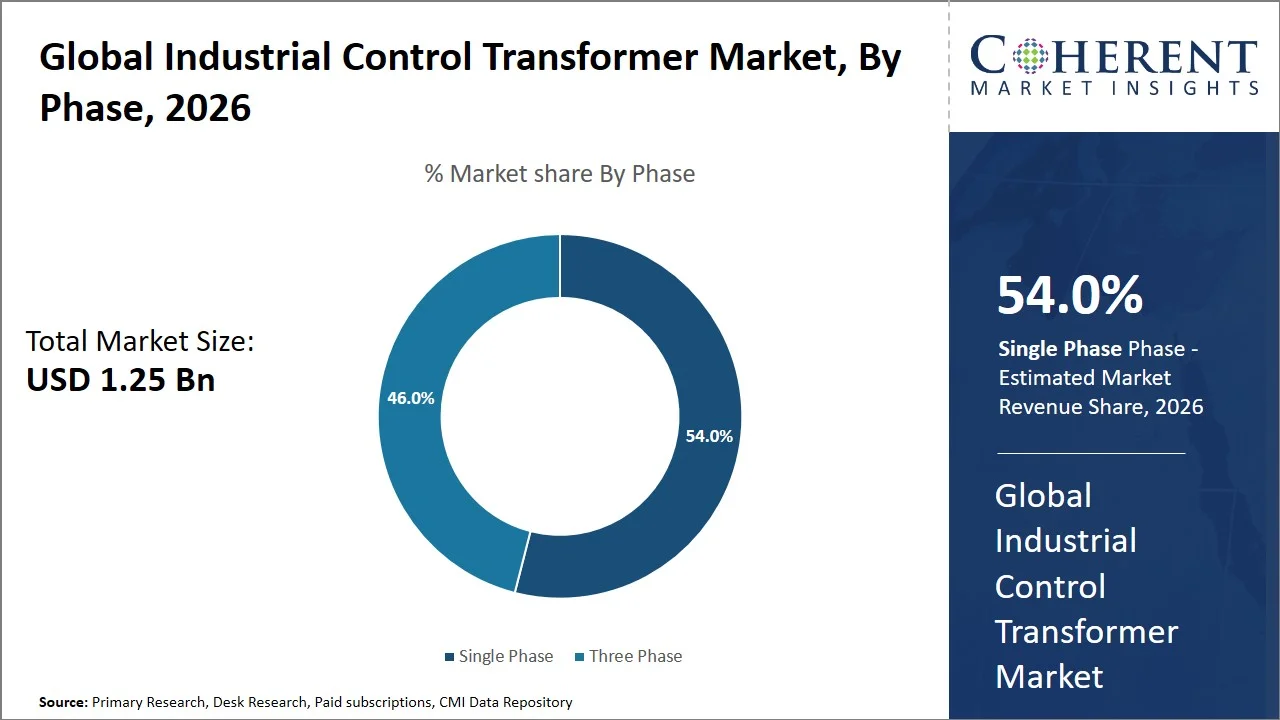
- The Single Phase segment is expected to account for 54.0 % of the global industrial control transformer market share in 2026. Growing demand for stable and isolated voltage supplies for sensitive control circuits is driving the growth of the segment. On April 2, 2025, Eaton issued a 2025 declaration of conformity for its STN single-phase control transformer family under EN IEC 61558-1:2019 and EN IEC 63000:2018, reinforcing its positioning of the product for industrial controls and automation applications.
- The 50 Hz segment is estimated to capture 62.0 % of the market share in 2026. Rising adoption of energy-efficient electrical equipment is majorly driving the growth of the segment. For example, ABB boosted its electrification capital spending to USD 636 million in 2025 from USD 472 million in 2024, with the expenditures going toward capacity development, equipment replacement and upgrades in important locations.
- The 25 to 500 VA segment is estimated to capture 41.0 % of the market share in 2026. Increasing investment in data centers and advanced manufacturing facilities is majorly driving the growth of the segment. On June 10, 2026, Applied Materials expanded its Singapore manufacturing and research and development operations through a new USD 500 million Tampines campus that more than doubles its advanced cleanroom capacity in the country.
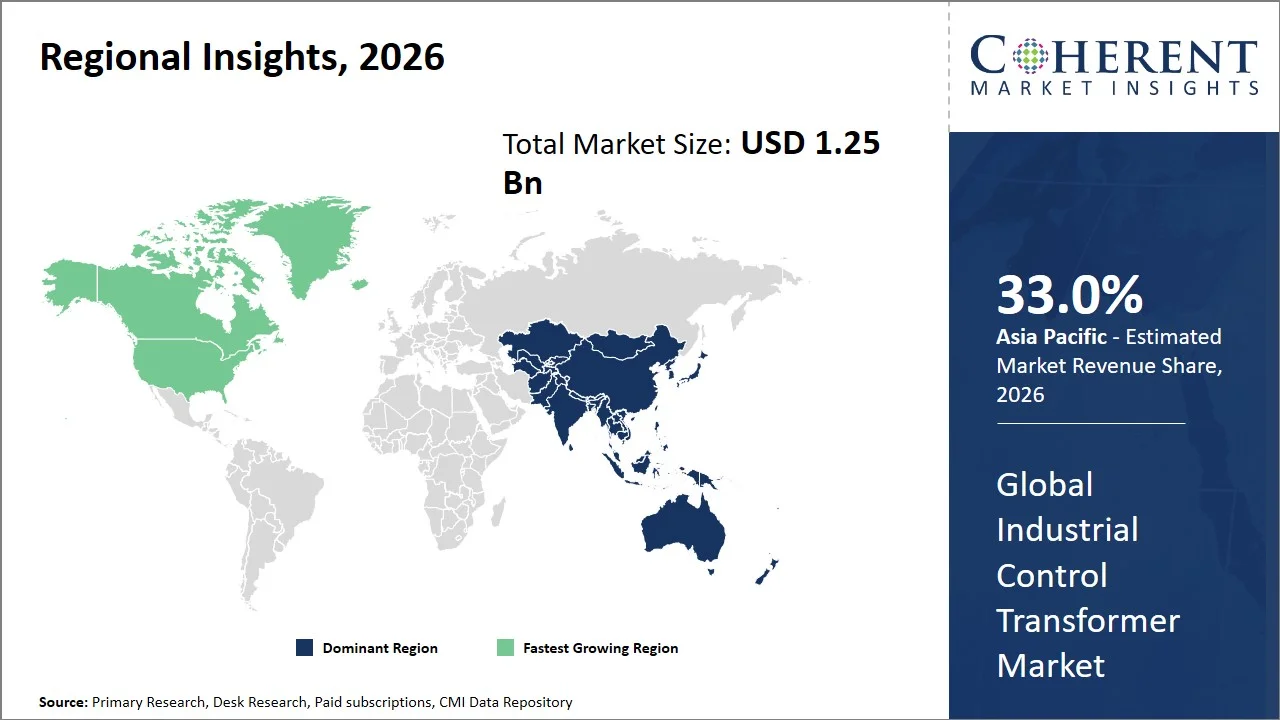
- Asia Pacific is expected to dominate the industrial control transformer market in 2026 with a market share of 33.0 %. Expansion of automated factories across Asia Pacific is driving the growth of the regional market. On May 16, 2025, Robust AI, a developer of autonomous mobile robots, announced a collaboration with Foxconn to ramp up production of its Carter collaborative warehouse robots, using Foxconn’s manufacturing expertise in Taiwan and its larger Asian manufacturing ecosystem to speed up adoption of automated logistics systems.
- North America is expected to account for 28.0 % share in 2026 and is projected to record the fastest growth over the forecast period. Replacement of legacy transformers with high-efficiency models in North America is driving the growth of the regional market. On April 25, 2025, Hitachi Energy invested USD 22.5 million to modernize its dry-type transformer operations in Virginia, including major upgrades at its existing Bland facility and the addition of a 75,000-square-foot manufacturing facility in Atkins.
Segmental Insights
Why Does Single Phase Dominate the Global Industrial Control Transformer Market?
The single phase segment is expected to account for 54.0% of the global industrial control transformer market share in 2026. Single phase transformers are the most common transformers used in the global industrial control transformer market as they provide a cost-efficient and compact solution for powering control circuits in machinery, automation equipment, control panels, HVAC systems and other industrial applications with relatively low power requirements. Their less complex architecture, easy installation, reduced maintenance needs and appropriateness for common single phase control circuits make them especially suitable for machine builders and producers of industrial equipment. Eaton’s Moeller line STN continues to supply specialized single phase control transformers for industrial control and auxiliary circuits with independent windings and compact structure. The 2026-listed STN product remains a single-phase option for applications where an independent control-circuit voltage from the primary supply is required.
- Current Industry Events of 2026
- Market Size Estimation
- Regional Breakdown
- Competitive Landscape
- Customer Intelligence
- Segmental Analysis
- Pricing Analysis
- Key Market Drivers, Challenges & Future Trends
- Customized Insights Section
Why is 50 Hz the Most Used Frequency?
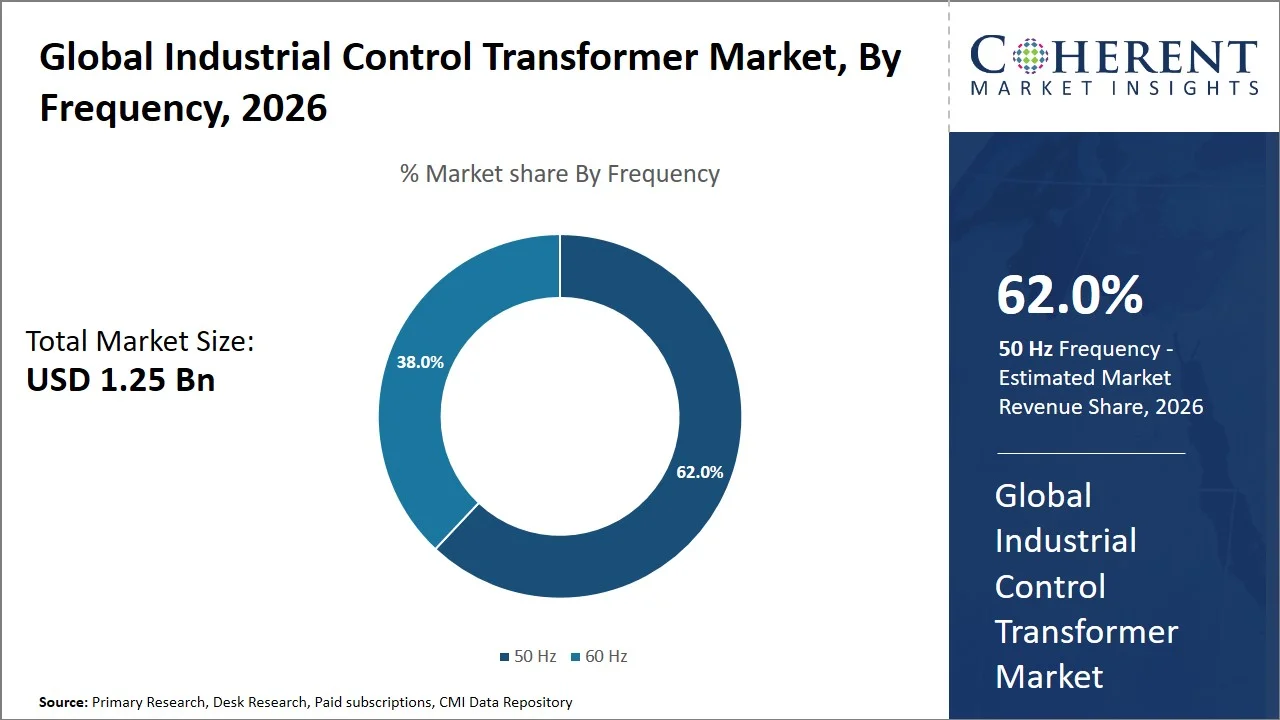
The 50 Hz segment is expected to account for 62.0% of the global industrial control transformer market share in 2026. The 50 Hz frequency is dominant because it is the standard industrial power network frequency in Europe, Asia Pacific, Africa and many other parts of the world. This means that control transformers can be operated directly in the existing electrical infrastructure without the need for frequency conversion equipment. This compatibility simplifies system design and installation, allowing industrial machinery, control panels, relays, contactors, and automation equipment to operate on a common power frequency, which reduces equipment complexity and ensures dependable operation in manufacturing facilities. Hammond Power Solutions (as of 2025) still makes industrial control transformers for 50 Hz operation, offering open-core-and-coil versions from 50 va to 3,000 va with copper-wound coils and various primary and secondary voltages. The dual-frequency design allows equipment manufacturers serving 50 Hz markets to standardize transformer platforms while maintaining compatibility with regional industrial power systems.
25 to 500 VA Dominates the Global Industrial Control Transformer Market
The 25 to 500 VA segment is expected to account for 41.0% of the global industrial control transformer market share in 2026. The 25 to 500 va range is very popular as it provides adequate power for most industrial control circuits such as contactors, relays, solenoids, timers, sensors and plc control systems without requiring huge transformer capacity. This line is particularly suitable for industrial equipment makers and automation integrators, thanks to its small size, reduced purchasing cost, efficient operation and adaptability for use in machine control panels, where control loads are often far smaller than main power loads. Eaton's Type MTE single-phase industrial control transformer portfolio includes a 500 va type with 220/440 v, 230/460 v, and 240/480 v primary options and 110/115/120 v secondary outputs. The 2026 product spec focuses on epoxy encapsulation, silicon-steel laminations for reduced core losses, copper windings, 50/60 hz operation, and molded terminals, and will continue to create small single-phase devices for industrial control applications.
Current Events and their Impact
Current Events | Description and its Impact |
U.S. Department of Energy Amended Energy Conservation Standards For Distribution Transformers |
|
European Union Ecodesign Regulation |
|
Industrial Control Transformer Market Dynamics
Market Drivers
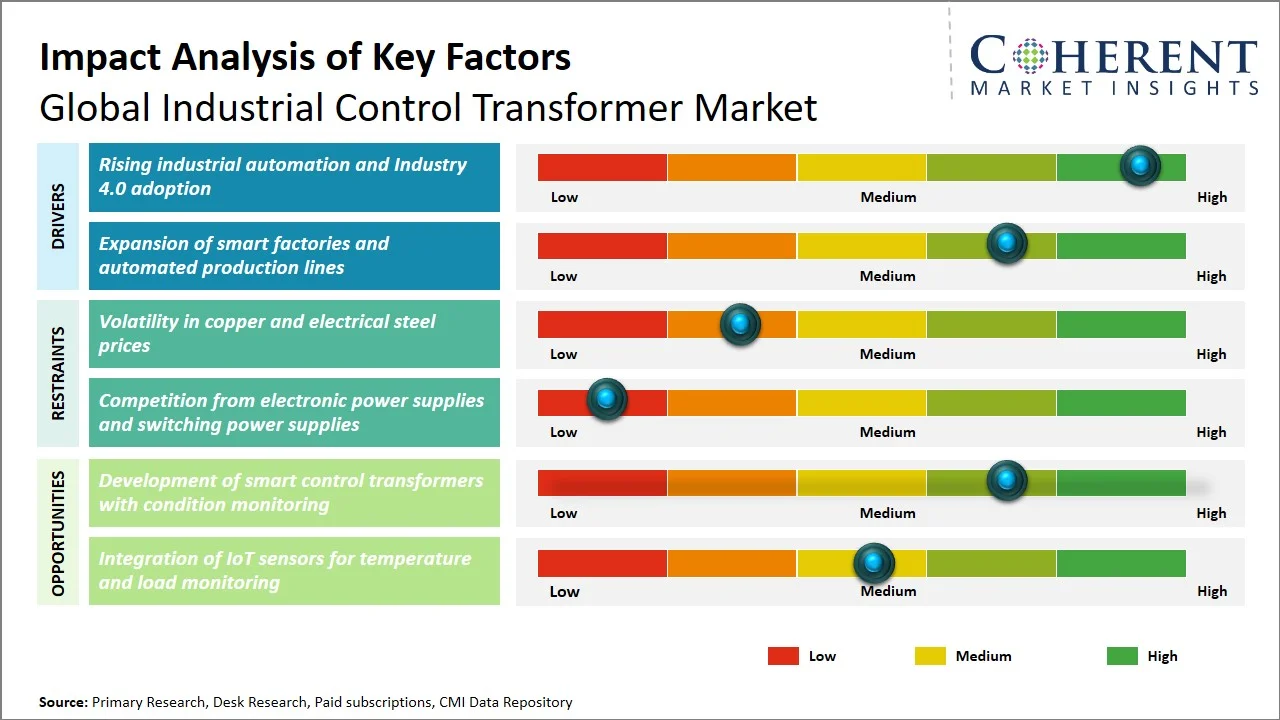
- Rising industrial automation and Industry 4.0 adoption: The rising adoption of industrial automation and Industry 4.0 technologies is fueling the demand for industrial control transformers, as automated machinery, robotic systems, programmable logic controllers, sensors, contactors and motor-control equipment requires stable and dependable control power. As manufacturers upgrade production facilities with connected automation systems, control transformers are increasingly being incorporated into control panels and machine systems for electrical isolation and proper voltage levels for critical control components. On November 20, 2025, Foxconn and Intrinsic launched a joint venture to build the intelligent factory of the future. AI-enabled robotics has huge potential for the manufacturing industry and the way things are manufactured on the factory floor. There needs to be more flexibility, more adaptability and more cost effectiveness in the future.
- Expansion of smart factories and automated production lines: The growth of smart factories and automated production lines is generating additional demand for industrial control transformers as manufacturers deploy interconnected machinery, robotic workstations, automated material-handling systems and digitally-monitored production equipment. Such devices require dependable low-voltage control power to be supplied to a few machines and control circuits. Therefore, small control transformers are a key part of providing dependable operation and reducing downtime in automated production facilities. On March 16, 2026, Hon Hai Technology Group (Foxconn) announced that it will join with SAP SE, a global leader in enterprise applications and business AI, to drive the adoption of next generation enterprise AI across the Asia-Pacific (APAC) region. The relationship is based on Foxconn’s continuing AI Factory mission to redefine the future of manufacturing processes and supply chain management, and explore new avenues for global deployment.
Emerging Trends
- Integration of smart monitoring capabilities: Industrial control transformers are increasingly being integrated with temperature, load and condition monitoring technologies, to provide real-time visibility into transformer performance and identify potential overheating, overloading or insulation issues before failures occur.
- Increasing adoption of energy-efficient transformer designs: Manufacturers are developing control transformers with enhanced magnetic materials, optimized winding structures, and reduced electrical losses to meet more stringent efficiency standards and reduce operating expenses of industrial plants.
- Growing demand from automated and electrified manufacturing: Increasing adoption of industrial robotics, automated assembly lines, electric vehicle manufacturing, semiconductor manufacturing, and sophisticated machinery is creating demand for small and reliable control-power solutions in today’s industrial plants.
- Development of compact and application-specific transformers: Manufacturers are offering more smaller, lighter and customized control transformers designed for specific control panels, machine tools, automation systems and industrial equipment, allowing for easier installation and more efficient use of limited panel space.
Regional Insights
Why is Asia Pacific a Strong Market for Industrial Control Transformer?
Asia Pacific is expected to account for a market share of 33.0% in 2026. The region is benefiting from the concentration of electronics, semiconductor, automotive, battery and precision manufacturing facilities, which require a large amount of control panel infrastructure and automated production equipment. By 2024, the region accounted for 74% of global industrial robot installations, with China, Japan, South Korea, Taiwan and Southeast Asia emerging as key automation hubs. In addition, semiconductor investment is also growing, with new fabrication projects in Japan, China, Taiwan, Korea and Southeast Asia. SEMI reported that 18 new semiconductor fabs were expected to begin construction globally in 2025, including projects in Japan, China, Taiwan, Korea, and Southeast Asia, creating additional demand for automated process equipment and associated control-power components.
Why Does North America Industrial Control Transformer Market Exhibit High Growth?
North America is expected to register the fastest growth with a CAGR of 4.1% over the forecast period. The region is projected to account for 28.0% of the global industrial control transformer market in 2026. North America is being supported by the reshoring of manufacturing and the rapid construction of semiconductor, automotive, battery, food-processing, and data-center facilities that require automated electrical control systems. The number of industrial robot installations across the Americas exceeded 50,000 units in 2024, with 68% of those deployments in the U.S. U.S. installations grew 11% in 2025 to 38,000 units. Automotive accounted for 13,500 installations, while adoption by the food industry increased 30%. Another key factor is the growth of domestic semiconductor manufacture, with the U.S. The U.S. Department of Commerce highlighted several CHIPS Act-supported projects with Corning, Edwards Vacuum, Infinera, GlobalFoundries and TSMC, highlighting the significance of automated manufacturing and precision electrical-control infrastructure.
Global Industrial Control Transformer Market Outlook for Key Countries
Why is China Emerging as a Major Hub in the Industrial Control Transformer Market?
China is witnessing high demand for reliable control power for automation machinery and production lines from large-scale factory automation, robotics, electric car manufacture, electronics production, and battery manufacturing. China installed about 295,000 industrial robots in 2024, or 54% of global installations, and its stock of operating industrial robots exceeded 2 million units, indicating the massive installed base of automated equipment in need of electrical control systems. Local manufacturers also accounted for 57% of industrial robot installations in China in 2024, a sign that the country’s automation ecosystem is rapidly being bolstered by domestically produced equipment and component supply chains.
Is U.S. the Next Growth Engine for the Industrial Control Transformer Market?
The U.S. market is being driven particularly by the modernization of automotive plants, expansion of food-processing automation, semiconductor fabrication, and the rebuilding of domestic manufacturing supply chains. Industrial robot installations hit 38,000 in 2025, with automotive factories taking 13,500 and adoption in the food industry jumping 30% to 307 robots per 10,000 industrial employes in robot density. Another distinctive demand driver comes from semiconductor manufacturing, as TSMC is opening its third Arizona fab in 2025, and CHIPS-backed projects are expanding the manufacture of semiconductor materials, packaging, photonics, and equipment across states such as Arizona, New York, Michigan, Massachusetts, Texas, and Oregon.
Germany Industrial Control Transformer Market Analysis and Trends
The extensive integration of Industrie 4.0 into automotive, mechanical, chemical, electronics and industrial equipment manufacturing supports Germany, which demands robust low-voltage control circuits and protection against voltage disturbances for automated machinery. Germany has the highest industrial robot density in Europe with 415 robots per 10,000 manufacturing employes. According to a 2026 Bitkom survey, 97% of German industrial companies were already using at least one Industrie 4.0 application and 81% considered the technology very important or indispensable for international competitiveness. The country’s machinery and equipment sector is also highly focused on connected production, industrial Internet of Things systems, digital twins and enhanced automation, supporting demand for control components within current production equipment.
Japan Industrial Control Transformer Market Analysis and Trends
Japan is characterized by an exceptionally mature automation ecosystem and the demand for industrial control transformers is tightly tied to robotics, automotive production, precision machinery, electronics and semiconductor manufacture. In 2024, Japan had roughly 450,500 industrial robots in operation and installed 44,500 new robots during the year. Japan's automobile industry alone deployed over 13,000 robots in 2024, an 11% rise from the previous year and the highest level since 2020. The government’s ongoing support for machine tools, industrial robots, servo systems, programmable logic controllers and other components is also helping to bolster domestic supply-chain resilience. The Ministry of Economy, Trade and Industry and NEDO have targeted the development of open software platforms for robotics in their 2025 initiatives to speed up deployment across industries with labor shortages.
India Industrial Control Transformer Market Analysis and Trends
India is being propelled by the rapid development of electronics manufacturing clusters, semiconductor facilities, automotive production and digitally controlled factories, with industrial automation increasingly being deployed to improve production consistency and compensate for skilled-labor constraints. In 2024 India installed a record 9,100 industrial robots (7% growth). Electronics manufacturing clusters have sprung up around Pune, Noida, Sriperumbudur, Bengaluru, Hyderabad and Gujarat, with companies like Foxconn, Samsung, Jabil, Bosch, Micron, Tata, PSMC, Renesas, CG Power and AT&S. The concentration of semiconductor and electronics projects in locations such as Dholera, Sanand, Bengaluru, Tamil Nadu, and Maharashtra is particularly important because semiconductor and electronic-component production requires highly controlled automated equipment, extensive process-control systems, and reliable low-voltage control power.
Global Industrial Control Transformer Market - Average Transformer Operating Life In Industrial Applications
Transformer Type / Industrial Application | Average Operating Life |
Low-voltage dry-type transformers | 20-30 years |
Molded / encapsulated transformers | Around 30 years |
Oil-immersed industrial transformers | 25-30 years |
Cast-coil transformers | Around 20 years |
Conventional dry-type transformers | 15-20 years |
Industrial control transformers under normal loading | 20-30 years |
How is Development of Smart Control Transformers with Condition Monitoring Creating New Growth Opportunities in the Industrial Control Transformer Market?
Development of smart control transformers with condition monitoring is creating new growth opportunities by enabling manufacturers to add sensors, connectivity, and analytics to transformer systems so that temperature, vibration, moisture, load, and partial-discharge conditions can be tracked continuously rather than assessed only during scheduled inspections. ABB’s TRAFCOM, for example, uses a non-invasive magnetic sensor and gateway to provide real-time monitoring of ambient and surface temperature, vibration, magnetic fields, and partial discharge, while Schneider Electric’s EcoStruxure Transformer Expert combines sensors with analytics to identify overheating, moisture, and discharge-related conditions and generate configurable alerts. These capabilities allow industrial operators to shift from time-based maintenance toward condition-based interventions, reduce unnecessary shutdowns, identify developing faults earlier, and make better replacement decisions, creating opportunities for transformer manufacturers to generate additional revenue through connected monitoring services, software analytics, retrofit sensor packages, and recurring maintenance contracts.
On June 2, 2026, Siemens Energy reached an agreement to acquire Camlin Group, a Northern Ireland-based specialist in grid monitoring, analytics and asset digitalization technologies. The acquisition will expand Siemens Energy’s digital grid portfolio at a time of accelerated global investment in electricity networks.
Market Players, Key Development, and Competitive Landscape
Key Developments
- On May 14, 2025, GE Vernova announced plans to invest approximately USD 16 million in India to expand its electrification manufacturing and engineering footprint, specifically, advanced grid technologies that enable stable, reliable, and secure delivery of electricity.
- On March 19, 2025, Hitachi Energy announced additional major investments of more than USD 250 million USD by 2027 to expand global production of critical components for transformers. This rapid follow-up to the recently announced USD 6 billion USD investment across the company portfolio reflects the escalating transformer shortage, which continues to increase.
Competitive Landscape
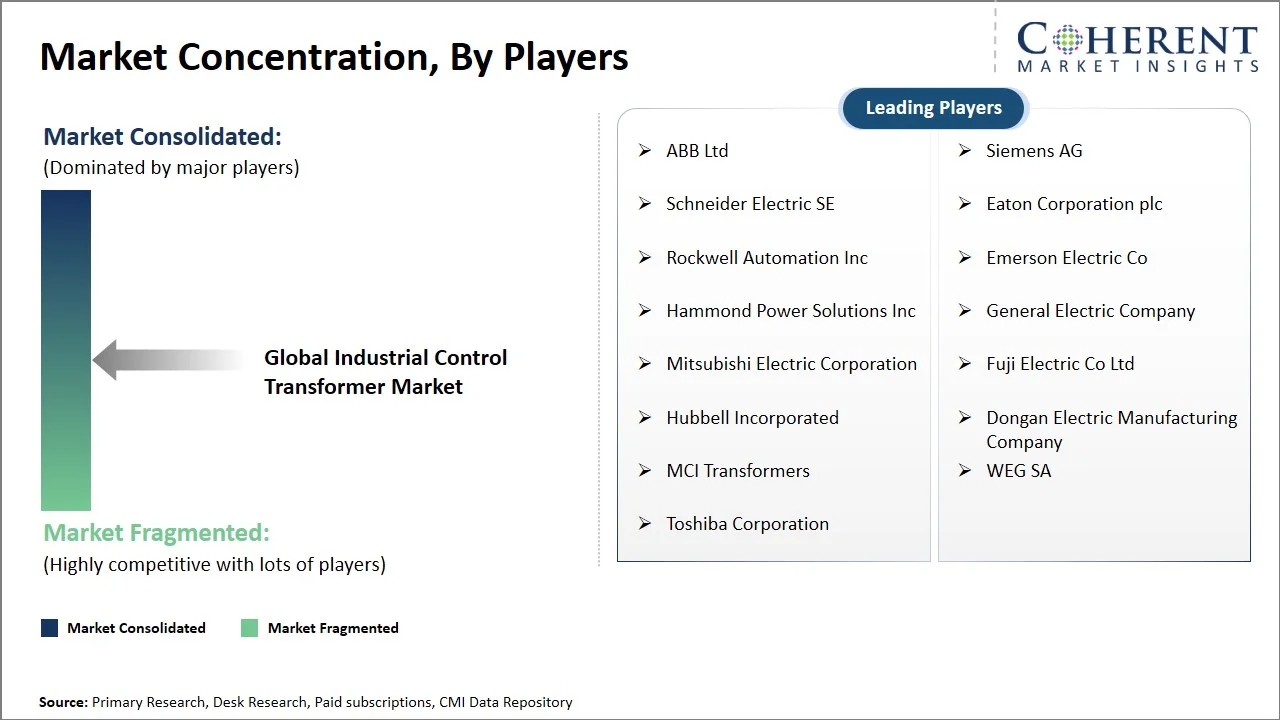
The competitive landscape is dominated by diversified electrical and automation companies, including ABB, Schneider Electric, Siemens, Eaton and GE Vernova, and competition is shifting from transformer hardware alone to product breadth, industrial integration, efficiency and regional manufacturing. ABB provides single-phase control and machine-tool transformers ranging from 25 va to 5 kva for use in control cabinets, conveyors, and industrial control panels. ABB is also enhancing its transformer manufacturing presence in the US with its 2025 investment in Tennessee and Mississippi. Schneider Electric also has unique Type T and Type TF control transformer offerings, with factory-installed fuse protection for panel builders and machinery OEMs. It also incorporates transformers into its broader Modicon industrial automation portfolio. Siemens is pursuing a broader automation and digitalization strategy in manufacturing and smart infrastructure, while Eaton is boosting its U.S. transformer manufacturing capacity to bolster domestic supplies. This combination of specialized control-transformer ranges, automation ecosystems, localized manufacturing, and application-specific solutions is making integration with industrial equipment and electrical-control platforms an increasingly important competitive factor.
Market Report Scope
Industrial Control Transformer Market Report Coverage
| Report Coverage | Details | ||
|---|---|---|---|
| Base Year: | 2025 | Market Size in 2026: | USD 1.25 Bn |
| Historical Data for: | 2020 To 2024 | Forecast Period: | 2026 To 2033 |
| Forecast Period 2026 to 2033 CAGR: | 2.3% | 2033 Value Projection: | USD 1.80 Bn |
| Geographies covered: |
| ||
| Segments covered: |
| ||
| Companies covered: | ABB Ltd, Siemens AG, Schneider Electric SE, Eaton Corporation plc, Rockwell Automation Inc, Emerson Electric Co, Hammond Power Solutions Inc, General Electric Company, Mitsubishi Electric Corporation, Fuji Electric Co Ltd, Hubbell Incorporated, Dongan Electric Manufacturing Company, MCI Transformers, WEG SA, Toshiba Corporation | ||
| Growth Drivers: |
| ||
| Restraints & Challenges: |
| ||
Analyst Opinion (Expert Opinion)
- The future of the industry is expected to be shaped by the continued expansion of automated machinery, semiconductor fabs, electric vehicle manufacturing, robotics, and digitally controlled production equipment, where dependable control power remains essential. The strongest opportunity is expected to remain in compact single-phase products used in machinery and control panels, but products incorporating temperature monitoring, condition diagnostics, and connectivity could capture additional value as factories move toward predictive maintenance. ABB’s integration of control transformers into its wider automation portfolio demonstrates how transformer vendors might benefit from this shift instead of just competing on traditional transformer specs.
- It is expected that the best geographic prospects will be concentrated in China, the U.S., India, Japan and Germany, but for different reasons. China has the largest automation equipment ecosystem, the US has semiconductor and advanced manufacturing investments, India is building new electronics and industrial production capacity, Japan is still one of the world’s most automated manufacturing bases, and Germany remains a major center for machinery and Industrie 4.0 applications.
- To obtain a competitive edge, transformer producers must combine high transformer dependability with speedier customization, more compact packaging, greater inrush-current capability, energy-efficient design and digital monitoring choices. Schneider Electric’s Type TF solution, which offers factory-installed fuse protection for typical panel-builder requirements, shows how incorporating auxiliary functions can simplify equipment design for OEMs and panel builders. In addition, companies should ramp up regional production and distribution, create standard products for high-volume applications while maintaining customization options, and collaborate with automation-system integrators to make sure control transformers are specified directly into new machinery and factory projects.
Speak to the analyst
Want personalized insights?
Take the findings above to one of our principal consultants, or have the report rebuilt around the segments, geographies and competitors you actually track.
Market Segmentation
- Phase Insights (Revenue, USD Billion, 2021 - 2033)
- Single Phase
- Three Phase
- Frequency Insights (Revenue, USD Billion, 2021 - 2033)
- 50 Hz
- 60 Hz
- Power Rating Insights (Revenue, USD Billion, 2021 - 2033)
- 25 to 500 VA
- 500 to 1,000 VA
- 1,000 to 1,500 VA
- Above 1,500 VA
- Application Insights (Revenue, USD Billion, 2021 - 2033)
- Industrial Automation
- Machine Tools
- HVAC and Refrigeration
- Motor Control
- Control Panels
- Other Industrial Applications
- End User Insights (Revenue, USD Billion, 2021 - 2033)
- Power Generation
- Oil & Gas
- Chemical
- Metal & Mining
- Manufacturing
- Automotive
- Others
- Regional Insights (Revenue, USD Billion, 2021 - 2033)
- North America
- U.S.
- Canada
- Latin America
- Brazil
- Argentina
- Mexico
- Rest of Latin America
- Europe
- Germany
- U.K.
- Spain
- France
- Italy
- Russia
- Rest of Europe
- Asia Pacific
- China
- India
- Japan
- Australia
- South Korea
- ASEAN
- Rest of Asia Pacific
- Middle East
- GCC Countries
- Israel
- Rest of Middle East
- Africa
- South Africa
- North Africa
- Central Africa
- North America
- Key Players Insights
- ABB Ltd
- Siemens AG
- Schneider Electric SE
- Eaton Corporation plc
- Rockwell Automation Inc
- Emerson Electric Co
- Hammond Power Solutions Inc
- General Electric Company
- Mitsubishi Electric Corporation
- Fuji Electric Co Ltd
- Hubbell Incorporated
- Dongan Electric Manufacturing Company
- MCI Transformers
- WEG SA
- Toshiba Corporation
Sources
Primary Research Interviews
- Transformer manufacturers and product managers
- Industrial automation equipment manufacturers
Magazines
- Electrical Construction & Maintenance
- Control Engineering
Journals
- IEEE Transactions on Energy Conversion
- IET Electric Power Applications
Associations
- National Electrical Manufacturers Association
- International Electrotechnical Commission
Proprietary Elements
- CMI Data Analytics Tool
- Proprietary CMI Existing Repository of Information for the Last 10 Years
Get access to 250+ pages report
Every segment, forecast, competitor profile and data table behind the analysis above — available for instant download.
- ESOMAR Member
- ISO 9001:2015 Certified
- D-U-N-S Registered
- GDPR & CCPA Compliant
Missing comfort of reading report in your local language? Find your preferred language:
Transform your Strategy with Exclusive Trending Reports
Frequently Asked Questions
The global industrial control transformer market is expected to stand at USD 1.25 Bn in 2026 and is expected to reach USD 1.80 Bn by 2033.
The CAGR of the global industrial control transformer market is projected to be 2.3% from 2026 to 2033.
Smart transformers can incorporate sensors and monitoring systems that provide information about temperature, loading, vibration, and developing equipment faults.
Condition monitoring enables manufacturers to offer connected sensors, analytics, remote diagnostics, retrofit packages, and maintenance services alongside conventional transformer products.
Rising industrial automation and Industry 4.0 adoption and expansion of smart factories and automated production lines are the major factors driving the growth of the global industrial control transformer market.
Volatility in copper and electrical steel prices and competition from electronic power supplies and switching power supplies are the major factors hampering the growth of the global industrial control transformer market.
In terms of phase, single phase segment is estimated to dominate the market revenue share in 2026.