

Global Industrial Wearables Market Size and Forecast – 2026 To 2033
The global industrial wearables market is expected to grow from USD 15.20 Bn in 2026 to USD 37.85 Bn by 2033, registering a compound annual growth rate (CAGR) of 7.5% from 2026 to 2033. Growth is driven by rising workplace safety requirements. On March 23, 2026, Honeywell introduced a new gas sensor that uses optical non-dispersive infrared (NDIR) technology to detect flammable gases, such as methane, propane and butane, in industrial settings.
Key Takeaways of the Global Industrial Wearables Market
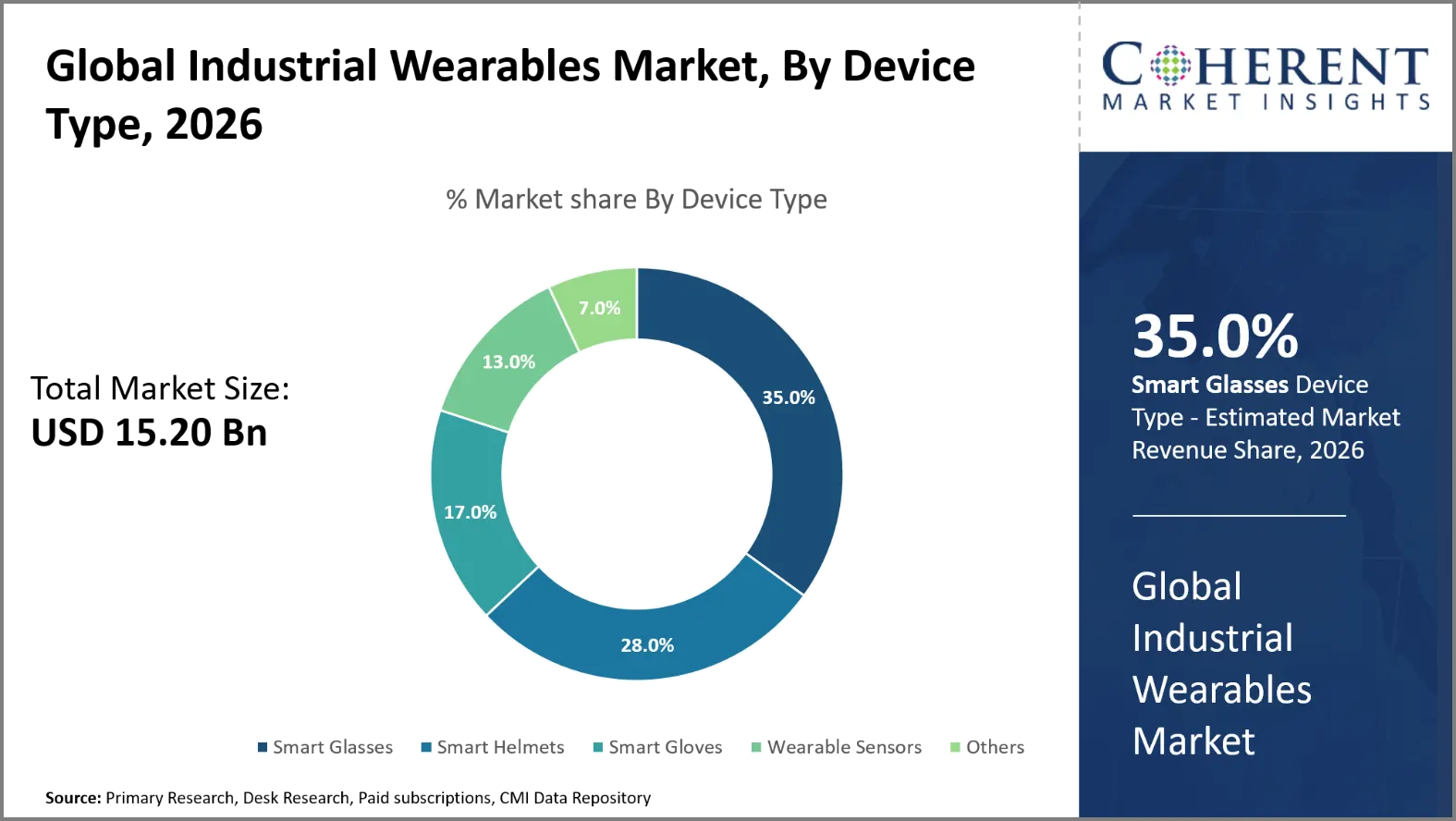
- The Smart Glasses segment is expected to account for 35.0% of the global industrial wearables market share in 2026. Increasing deployment of augmented reality smart glasses is driving the growth of the segment. On August 12, 2025, Vuzix introduced LX1 smart glasses specifically for warehouse operations. The ruggedized device provides hands-free operation and up to ten hours of runtime.
- The Wi-Fi segment is estimated to capture 39.0% of the market share in 2026. Growing adoption of real time worker monitoring is majorly driving the growth of the segment. In July 2026, KT and Samsung Electronics launched an enterprise 5G industrial safety service in South Korea. Wearable smartwatches monitor worker health and workplace conditions in real time.
- The Worker Safety segment is estimated to capture 31.0% of the market share in 2026. Expansion of smart manufacturing facilities is driving the growth of the segment. On May 20, 2025, TRUMPF officially opened a new Smart Factory in Farmington, Connecticut, U.S. The facility represents a USD 40 million investment and adds 55,800 square feet.
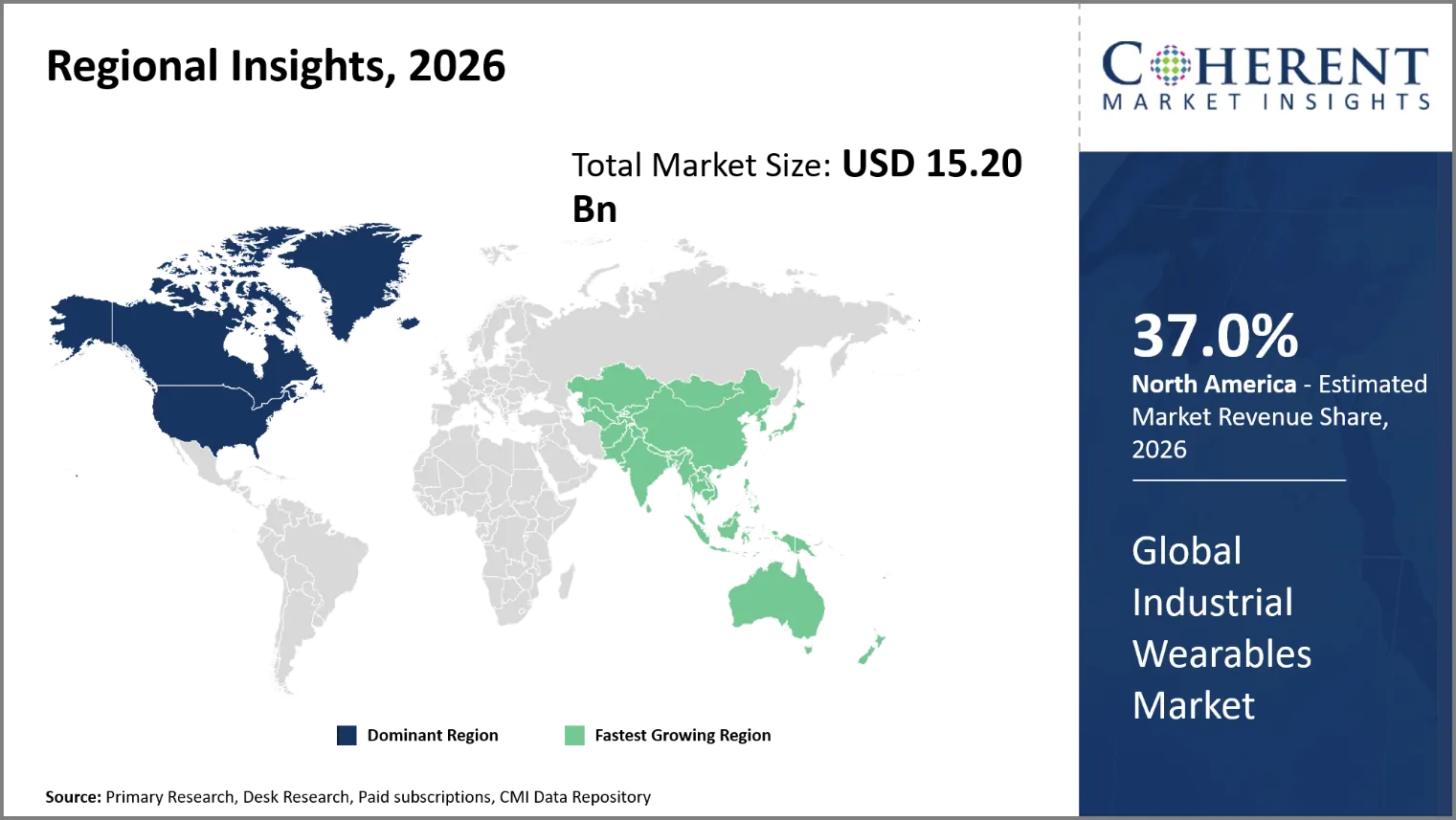
- North America is expected to dominate the industrial wearables market in 2026 with a market share of 37.0%. Rising demand for remote maintenance support in North America is driving the growth of the regional market. On February 18, 2026, Vuzix launched its enterprise Solutions Kits with native Microsoft Teams and Zoom support. The Remote Assist kit targets field service, manufacturing, logistics, and industrial maintenance applications.
- Asia Pacific is expected to account for 28.0% share in 2026. Increasing use of wearable scanners in warehouses in Asia Pacific is driving the growth of the regional market. In June 2026, Ninja Van Malaysia modernized fulfillment operations using Zebra warehouse technology. The deployment includes Zebra mobile computers connected with a cloud-native warehouse management system.
Segmental Insights
Why Does Smart Glasses Dominate the Global Industrial Wearables Market?
The smart glasses segment is expected to account for 35.0% of the global industrial wearables market share in 2026. Smart glasses support hands-free access to digital instructions, equipment data, and remote expert assistance. They increase worker productivity by providing useful information without the need for hand-held devices. Increasingly, manufacturers are turning to augmented reality to help with assembly, inspection, maintenance and training of employees. Connected smart glasses can feature cameras, sensors, software platforms and industrial communication systems. High popularity among industrial users is supported by their increasing adoption in manufacturing, logistics, aerospace and field services. On June 24, 2026, Grandtime Technology announced the commercial debut of their flagship 4G AI-Powered AR Smart Glasses, a purpose-built wearable solution developed to ease end-to-end industrial site inspections. It also helps to digitize on-site management workflows and to unlock data-driven operational efficiency for manufacturing, energy, mining and heavy industry facilities across the globe.
- Current Industry Events of 2026
- Market Size Estimation
- Regional Breakdown
- Competitive Landscape
- Customer Intelligence
- Segmental Analysis
- Pricing Analysis
- Key Market Drivers, Challenges & Future Trends
- Customized Insights Section
Why is Wi-Fi the Most Preferred Connectivity Type?
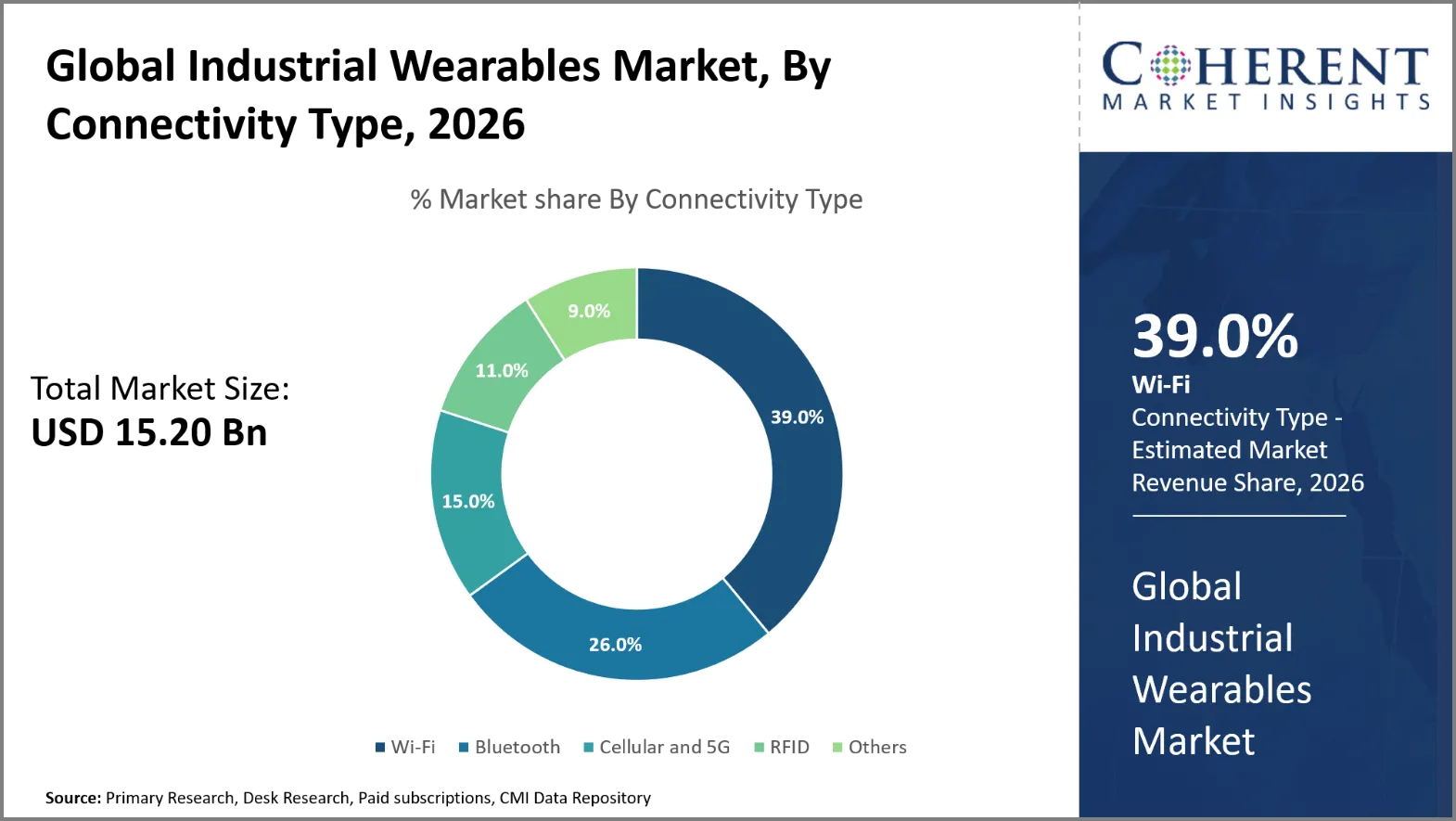
The Wi-Fi segment is expected to account for 39.0% of the global industrial wearables market share in 2026. Wi-Fi is a trusted source of high-speed connectivity in factories, warehouses and other controlled industrial areas. It provides quick transmission of operational data, video streams and augmented reality information. Wi-Fi networks can be integrated with current enterprise systems and connected equipment in industrial facilities. Modern Wi-Fi standards also allow more connected devices with better network efficiency. Those qualities make Wi-Fi viable for real-time communication between industrial wearables and workplace infrastructure. On November 5, 2025, Zyxel Networks announced its first industrial-grade wireless access point, the BE5000 4-Stream Wi-Fi 7 Dual-Radio NebulaFlex Pro Industrial Access Point (IAP500BE). Built for harsh indoor situations, the IAP500BE combines rugged durability, extended coverage and ultra-fast Wi-Fi 7 performance to expedite industrial digital transformation.
Worker Safety Dominates the Global Industrial Wearables Market
The worker safety segment is expected to account for 31.0% of the global industrial wearables market share in 2026. Industrial wearables allow firms monitor employees and identify dangerous situations while doing strenuous procedures. Wearable sensors can monitor position, motion, environmental exposure, and key operational metrics. Smart helmets and connected devices can inform workers as they approach restricted or dangerous regions. These skills enable a quicker reaction to mishaps and less exposure to hazards in the workplace. The industries are increasingly focusing on proactive safety management which is driving the use of connected wearable devices. On January 13, 2026, Blackline Safety Corp. announced G8, the next evolution of worksite safety and the most connected wearable the company has ever built. G8 combines advanced gas detection, lone worker protection, and radio-quality communication in one rugged device that connects workers to each other, to their safety teams, and to the broader digital worksite.
Current Events and their Impact
Current Events | Description and its Impact |
European Union Artificial Intelligence Act - Regulation (EU) 2024/1689 |
|
European Union Cyber Resilience Act - Regulation (EU) 2024/2847 |
|
Industrial Wearables Market Dynamics
Market Drivers
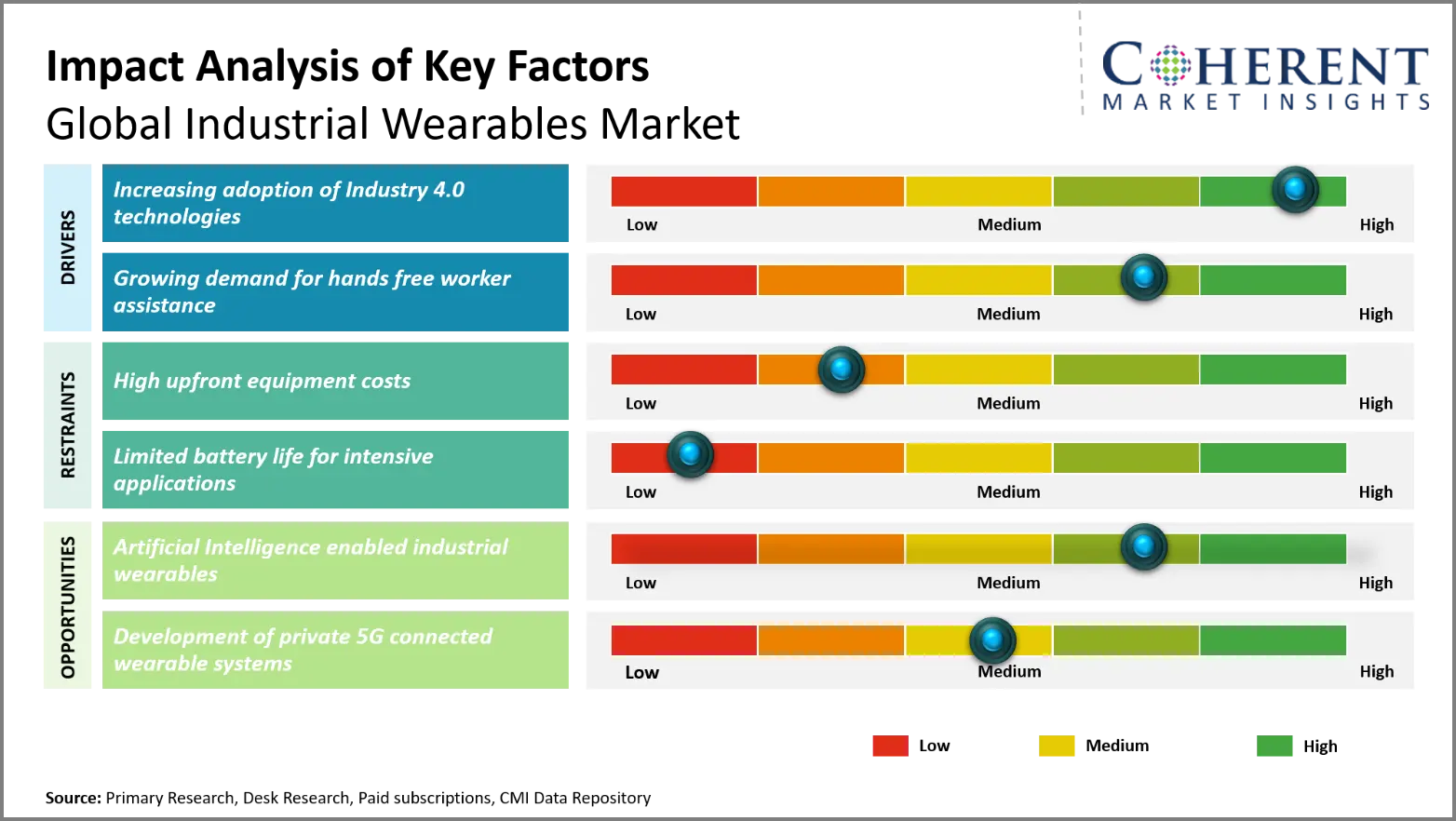
Increasing adoption of Industry 4.0 technologies
Manufacturers are adopting linked machinery, industrial Internet of Things platforms, automation, and real-time analytics. These technologies are supported by industrial wearables that provide workers with real-time operational information. Digital work instructions, equipment data and maintenance information can be displayed on smart glasses during manufacturing processes. Wearable sensors can gather data about workers and equipment for linked industrial platforms. This combination will boost the demand for wearables in digitally connected manufacturing environments.
On April 16, 2026, Schneider Electric, a global energy technology leader, announced that it will highlight significant milestones in its strategic partnership with Microsoft at Hannover Messe 2026. It will showcase how their combined technologies are helping manufacturers modernize operations, speed engineering and increase resiliency.
Growing demand for hands free worker assistance
Complex jobs require industrial workers to have instant access to instructions and operating data. Smart eyewear and wearable computers can give information to workers without interfering in their duties. They support maintenance processes, equipment inspections, inventory handling and remote expert assistance. Hands-free communication can help minimize disruptions during tasks that require continual physical concentration. As workplaces become more digital, there is more use of wearable help technologies.
On March 31, 2025, AutoAlign announced the launch of Visor, its cutting-edge AI assistant for industrial applications at Hannover Messe 2025. Visor is designed to increase operational efficiency, safety and productivity across sectors with hands-free, real-time help through workers’ safety glasses or mobile devices.
Emerging Trends
- Artificial Intelligence-Enabled Wearables: Industrial wearables are increasingly incorporating artificial intelligence (AI) for real-time help, anomaly detection, predictive maintenance and automated decision support. These features enable workers analyze operational data faster while enabling firms to enhance productivity, safety monitoring, equipment diagnostics and workplace efficiency.
- 5G-Connected Industrial Wearables: 5G infrastructure provides faster connectivity between industrial wearables, machines and cloud platforms. Lower latency enables real-time video assistance, remote collaboration, position monitoring and augmented reality applications across industrial facilities, warehouses, utilities and field service locations.
- Advanced Worker Safety Monitoring: Wearable smart sensors are increasingly used to monitor worker position, mobility, environmental exposure and proximity to dangerous equipment. In demanding industrial workplaces, connected safety systems can alert in real time when unsafe conditions arise, allowing for faster response and better preventative safety practices.
- Lightweight Augmented Reality Devices: Manufacturers are creating smaller and lighter augmented reality wearables that can be used for longer periods in industrial applications. Improved screens, batteries, cameras and ergonomic designs are extending uses in assembly, inspection, maintenance, training, logistics and remote technical assistance.
Regional Insights
Why is North America a Strong Market for Industrial Wearables?
North America is expected to account for a market share of 37.0% in 2026. Industrial augmented reality research and collaborative robotics deployment in U.S. industry encourage North American adoption. The National Institute of Standards and Technology (NIST) has researched wearable interfaces for human-robot interaction. Its research has industrial applications in task training, hands free interaction and situational awareness. The National Institute of Standards and Technology also showcased augmented reality for remote factory monitoring and inspection. These capabilities are especially applicable in automobile factories, aerospace facilities, warehouses and high-tech machinery operations. Canada also contributes through industrial automation, mining technology, and connected-worker applications. Regional demand therefore benefits from integrating wearables with robotics, digital manufacturing systems, and remote technical support.
Why Does Asia Pacific Industrial Wearables Market Exhibit High Growth?
Asia Pacific is expected to register the fastest growth with a CAGR of 8.3% over the forecast period and projected to account for 28.0% of the global industrial wearables market in 2026. Smart manufacturing, augmented reality production and advanced electronics ecosystems are helping Asia Pacific establish strong industrial wearable capabilities. China boosts its smart glasses production and Japan is developing specialist optical technology. Shanghai has launched a big project for augmented-reality glasses, encompassing an area of 200 mu. Japan’s Ministry of Economy, Trade and Industry has identified smart glasses for industrial, warehousing and logistics use. The region is also a hub for a vibrant electronics component manufacturing and robotics integration. These qualities make smart eyewear for industry, wearable sensors, connected helmets and augmented reality maintenance systems possible. Increasing collaboration between electronics suppliers and factories further strengthens regional deployment.
Global Industrial Wearables Market Outlook for Key Countries
Why is U.S. Emerging as a Major Hub in the Industrial Wearables Market?
The U.S. industrial wearables market benefits from strong integration between industrial wearables, collaborative robotics, and advanced manufacturing research. The National Institute of Standards and Technology specifically examined augmented-reality wearables for smaller U.S. manufacturers. Research has focused on hands-free interaction, worker training, and safety during human-robot collaboration. The National Institute of Standards and Technology also demonstrated remote manufacturing inspection using contextual machine information. Industrial wearable applications therefore extend beyond simple communication devices. These capabilities can be used in aerospace repair, automotive assembly, warehouse operations and equipment service. The country’s well-developed robotics ecosystem also offers more prospects for wearable interfaces that link workers to automated industrial equipment.
Is China the Next Growth Engine for the Industrial Wearables Market?
Industrial wearable technology in China is growing fast, together with its move to intelligent production. At JA Solar’s solar plant in Hefei, engineers have employed Rokid glasses with 5G to inspect equipment. The system reportedly generated inspection results in less than one second and improved production-line efficiency by more than 50%. Shanghai is also supporting an AR-glasses micro-optics production project covering more than 200 mu. Beijing Economic-Technological Development Area has gathered more than 100 companies across the extended-reality supply chain. These developments strengthen domestic capabilities in optics, displays, artificial intelligence, and wearable manufacturing.
Germany Industrial Wearables Market Analysis and Trends
Germany’s uptake of industrial wearables is strongly linked to Industry 4.0 manufacturing and digitally-assisted production. Fraunhofer research confirms: Smart glasses give workers machine information directly during manufacturing processes. The SmARPro platform integrates wearables, machines and smart services for contextual information delivery. Fraunhofer also produces industrial microdisplays for augmented-reality eyewear and wearable displays. These technologies are aimed at manufacturing needs like as high resolution, sunlight readability, gesture control and robustness. Germany’s large automotive, machinery and industrial-equipment base provide real-world conditions in which to deploy wearable production helpers. This provides a particular demand for augmented reality applications for maintenance, inspection, assembly and worker guiding.
Japan Industrial Wearables Market Analysis and Trends
Japan’s industrial wearable development is increasingly centered on advanced optical components and connected-worker technologies. The Ministry of Economy, Trade and Industry said smart glasses are now established equipment in manufacturing, warehouses and logistics. In January 2026, a Japanese project improved the measurement technology for liquid-crystal diffractive elements used in smart glasses. The project is focused on automotive, electronics, optical equipment and information-communications applications. Its non-contact measurement method helps to increase quality and to mass produce future generation smart eyewear. Japan's precision manufacturing capabilities therefore create opportunities for smaller, lighter, and higher-performance industrial wearable components.
South Korea Industrial Wearables Market Analysis and Trends
South Korea's industrial wearable opportunity is closely connected with its semiconductor, electronics, robotics, and display manufacturing capabilities. The country's production environment supports applications requiring compact displays, sensors, cameras, and high-speed connectivity. Industrial wearables can assist with semiconductor equipment inspection, electronics assembly, warehouse handling, and technical maintenance. Smart glasses are especially essential when workers need visual instructions without disrupting manual activities. Also, the country’s mature display ecosystem will help build small optical modules for wearable gadgets. The precision inspection and servicing equipment required in semiconductor manufacturing also produces demanding environments. These applications offer an alternative route for industrial wearables to be adopted through electronics-heavy production rather than just traditional communication at work.
Global Industrial Wearables Market - Connected Worker Deployments By Country (2025):
Country | Estimated Deployment Share |
U.S. | 24.0% |
China | 20.0% |
Germany | 10.0% |
Japan | 8.0% |
South Korea | 7.0% |
India | 6.0% |
Canada | 4.0% |
Australia | 3.5% |
U.K. | 3.5% |
France | 3.0% |
Italy | 2.5% |
Mexico | 2.0% |
Others | 6.5% |
How is Artificial Intelligence Enabled Industrial Wearables Creating New Growth Opportunities in the Industrial Wearables Market?
Wearables for industry that use artificial intelligence are turning observations that workers make into data that can be used to take action in production. Smart glasses can identify equipment parts and pull up maintenance instructions without workers needing to stop what they are doing. AI may also scan camera feeds to detect assembly faults, damaged components, and harmful operating conditions. At JA Solar’s Hefei photovoltaic facility, 5G connected Rokid glasses reportedly reduced inspection processing to under one second. The system also reportedly improved production-line efficiency by more than 50%. Such solutions provide automated inspection, contextual work instructions, predictive maintenance and remote technical assistance in complex industrial situations.
On May 29, 2025, Vuzix Corporation and Ramblr announced that they have formed a partnership to offer a new level of AI-driven intelligence and engagement to enterprise users through Vuzix smart glasses. With smart glasses becoming widespread, workers may do just that, applying AI for analyzing dynamic, context-based activities with 70% accuracy.
Market Players, Key Development, and Competitive Landscape
Key Developments
- On August 25, 2026, RealWear introduced Ari OS, a new voice-first operating system designed to bring artificial intelligence into the way people actually live and work. Built around natural conversation, visual context and connected intelligence, Ari OS creates a new way to interact with technology, one that doesn't require people to stop, look down at a screen, or switch between applications.
- On January 6, 2026, Siemens announced a collaboration to bring Industrial AI to Meta Ray-Ban AI Glasses. With hands-free, real-time audio guidance, safety insights, and feedback, shop floor workers will feel empowered to solve problems efficiently and confidently.
- On June 16, 2025, Vuzix Corporation announced the receipt of a USD 5 million second tranche investment from Quanta Computer. With this funding, Vuzix further enhanced its state-of-the-art waveguide manufacturing capabilities, positioning Vuzix to deliver the world's most affordable, lightweight, and performance-driven AI smart glasses for mass-market adoption.
Competitive Landscape
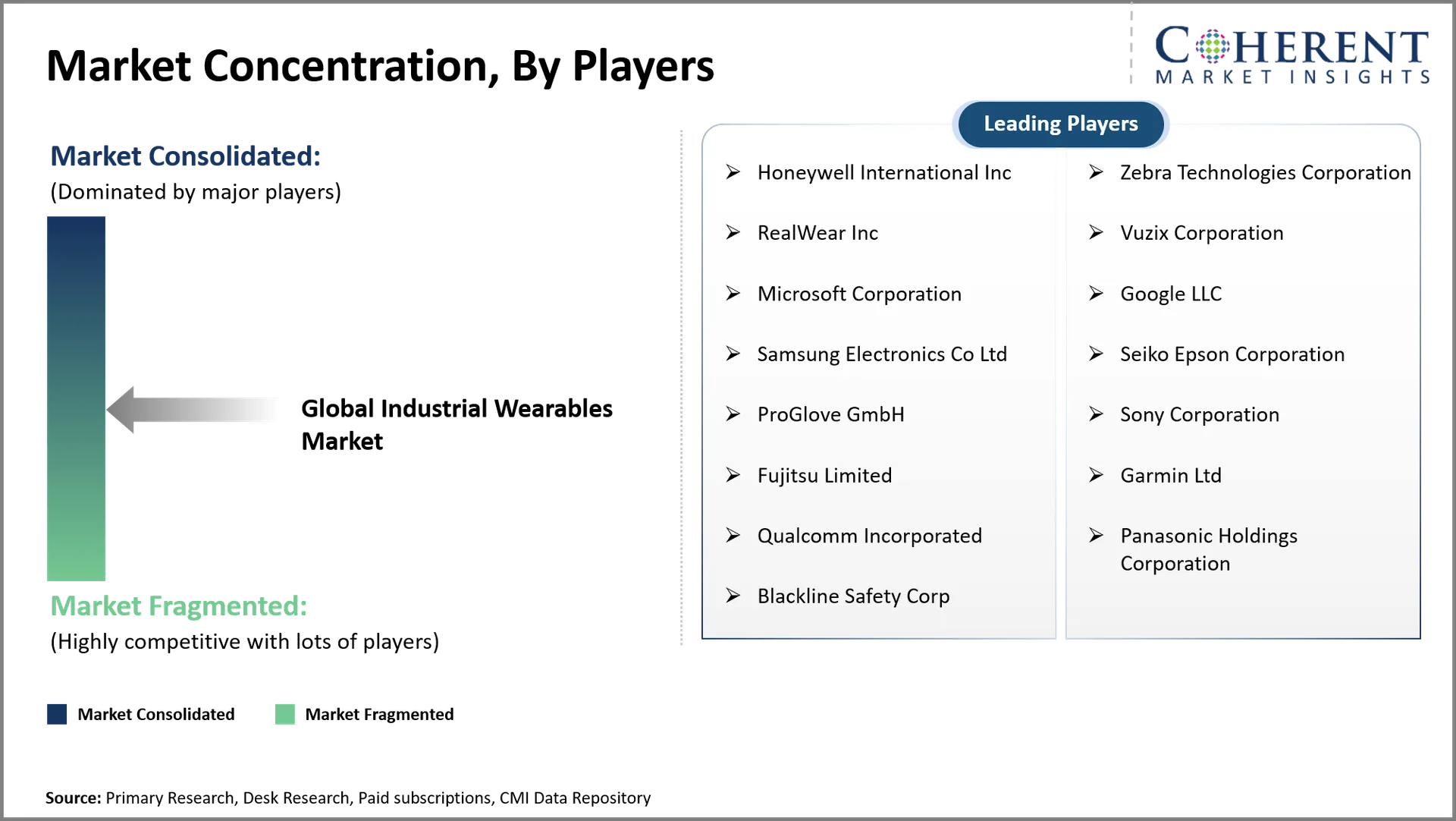
The competitive landscape features RealWear, Honeywell, Zebra Technologies, ProGlove, and Vuzix, with different industrial wearable strategies. RealWear specializes in robust assisted-reality gadgets, AI voice interaction, remote support and frontline processes. Its devices support automotive inspections, mining, oil and gas, warehousing, and manufacturing applications. RealWear also acquired Almer to accelerate industrial wearable adoption with TeamViewer support. Honeywell is focused on connected workforce solutions, guided work, industrial automation and real-time operational intelligence. Performance+ for Guided Work combines analytics with voice-driven workflows for warehouse and logistics operations. Zebra Technologies provides mobile computing, scanning, workforce productivity and warehouse workflows. ProGlove is focused on wearable scanners and hands-free picking and production processes. Vuzix concentrates on enterprise smart glasses, augmented reality, and industrial remote-assistance applications.
Market Report Scope
Industrial Wearables Market Report Coverage | |||
Report Coverage | Details | ||
Base Year | 2025 | Market Size in 2026: | USD 15.20 Bn |
Historical Data For: | 2020 To 2024 | Forecast Period: | 2026 To 2033 |
Forecast Period 2026 To 2033 CAGR: | 7.5% | 2033 Value Projection: | USD 37.85 Bn |
Geographies covered: |
| ||
Segments covered: |
| ||
Companies covered: | Honeywell International Inc, Zebra Technologies Corporation, RealWear Inc, Vuzix Corporation, Microsoft Corporation, Google LLC, Samsung Electronics Co Ltd, Seiko Epson Corporation, ProGlove GmbH, Sony Corporation, Fujitsu Limited, Garmin Ltd, Qualcomm Incorporated, Panasonic Holdings Corporation, Blackline Safety Corp | ||
Growth Drivers: |
| ||
Restraints & Challenges: |
| ||
Analyst Opinion (Expert Opinion)
- The industry is moving toward wearables that combine artificial intelligence, industrial software, and task-specific hardware. Smart glasses should increasingly function as operational interfaces rather than standalone viewing devices. Voice-first interaction can reduce physical device handling during maintenance, inspection, and production tasks. In 2026 RealWear launched Ari OS, a remarkable example of the advance to voice-enabled industrial computing.
- Best opportunities are likely to include smart glasses, worker safety, maintenance, inspection and remote help. Automotive manufacturing, semiconductor production, aerospace, energy and logistics have different deployment contexts. Their industrial and technological ecosystems in China, the U.S., Germany, Japan and South Korea provide particularly relevant potential. More development focus should be on products that need visual instructions at the point of use or remote expert support.
- Players looking for an edge need to pair tough hardware with purpose-built software and artificial intelligence capabilities. Partnerships with industrial software vendors can help extend interoperability with existing enterprise environments. RealWear’s integrations with Microsoft, TeamViewer and Zoom underscore the significance of wider software ecosystems. Also, companies should pay attention to the battery endurance, industrial certifications, cybersecurity, ergonomic design, and offline functioning. Focus on differentiating products by enhancing measurable workflows rather than simply adding wearable features for the sake of it, without a defined industrial use case.
Speak to the analyst
Want personalized insights?
Take the findings above to one of our principal consultants, or have the report rebuilt around the segments, geographies and competitors you actually track.
Market Segmentation
- Device Type Insights (Revenue, USD Billion, 2021 - 2033)
- Smart Glasses
- Smart Helmets
- Smart Gloves
- Wearable Sensors
- Others
- Connectivity Type Insights (Revenue, USD Billion, 2021 - 2033)
- Wi-Fi
- Bluetooth
- Cellular and 5G
- RFID
- Others
- Application Insights (Revenue, USD Billion, 2021 - 2033)
- Worker Safety
- Training and Assistance
- Maintenance and Repair
- Monitoring and Tracking
- Remote Collaboration
- Data Collection
- End User Insights (Revenue, USD Billion, 2021 - 2033)
- Manufacturing
- Logistics and Warehousing
- Oil and Gas
- Mining
- Construction
- Healthcare
- Utilities and Energy
- Automotive
- Aerospace and Defense
- Regional Insights (Revenue, USD Billion, 2021 - 2033)
- North America
- U.S.
- Canada
- Latin America
- Brazil
- Argentina
- Mexico
- Rest of Latin America
- Europe
- Germany
- U.K.
- Spain
- France
- Italy
- Russia
- Rest of Europe
- Asia Pacific
- China
- India
- Japan
- Australia
- South Korea
- ASEAN
- Rest of Asia Pacific
- Middle East
- GCC Countries
- Israel
- Rest of Middle East
- Africa
- South Africa
- North Africa
- Central Africa
- North America
Sources
Primary Research Interviews
- Industrial Wearables Manufacturers & Hardware Developers
- Enterprise IoT Solution Providers & System Integrators
- Occupational Health & Safety (OHS) Professionals
- Industrial Automation & Smart Factory Consultants
Magazines
- Occupational Health & Safety Magazine (OHS)
- Manufacturing Today
- Wearable Technology Magazine
Journals
- Journal of Industrial Ergonomics (Elsevier)
- IEEE Transactions on Industrial Informatics
- International Journal of Advanced Manufacturing Technology
Associations
- Industrial Internet Consortium (IIC)
- Wearable Technology Association (WTA)
- International Safety Equipment Association (ISEA)
- National Safety Council (NSC)
Public Domain Sources
- U.S. Bureau of Labor Statistics (BLS)
- European Agency for Safety and Health at Work (EU-OSHA)
- U.S. Occupational Safety and Health Administration (OSHA)
- World Economic Forum (WEF)
Proprietary Elements
- CMI Data Analytics Tool
- Proprietary CMI Existing Repository of Information for the last 10 years
Get access to 250+ pages report
Every segment, forecast, competitor profile and data table behind the analysis above — available for instant download.
- ESOMAR Member
- ISO 9001:2015 Certified
- D-U-N-S Registered
- GDPR & CCPA Compliant
Missing comfort of reading report in your local language? Find your preferred language:
Frequently Asked Questions
The global industrial wearables market is expected to stand at USD 15.20 Bn in 2026 and is expected to reach USD 37.85 Bn by 2033.
The CAGR of the global industrial wearables market is projected to be 7.5% from 2026 to 2033.
Increasing adoption of Industry 4.0 technologies and Growing demand for hands free worker assistance are the major factors driving the growth of the global industrial wearables market.
High upfront equipment costs and Limited battery life for intensive applications are the major factors hampering the growth of the global Industrial Wearables market.
In terms of device type, smart glasses segment is estimated to dominate the market revenue share in 2026.
Industrial wearables are connected devices designed to assist workers with industrial tasks, safety, communication, and data access.
Wearables provide production instructions, inspection information, workflow alerts, and equipment data directly to operators.