

Global Insect Screen Market Size and Forecast – 2026 To 2033
The Global Insect Screen Market is estimated to be valued at USD 6.92 Bn in 2026 and is expected to reach USD 10.82 Bn by 2033, growing at a compound annual growth rate (CAGR) of 6.6% from 2026 to 2033. This expansion is supported by rising adoption of insect protection solutions across residential and commercial buildings, increasing preference for natural ventilation, and continued development of housing and renovation activities globally.
Demand is further strengthened by improvements in product design, including retractable systems, pleated screens, high-visibility meshes, and customized solutions for modern window and door applications. Manufacturers are increasingly focusing on durability, aesthetic integration, ease of installation, and compatibility with evolving architectural requirements. In October 2025, KeJe Horren & Raamdecoratie expanded its production approach for original insect screen doors through its Serbia-based production activities, strengthening manufacturing flexibility and supporting continued growth of customized insect screening solutions across European markets.
Key Takeaways of the Global Insect Screen Market
- Retractable Insect Screens are estimated to register a 7.1% CAGR during 2026–2033 and are expected to account for 34.2% of the global insect screen market in 2026, supported by preference for concealed designs, improved aesthetics, and flexible ventilation solutions. In May 2025, Andersen expanded its LuminAire retractable screen portfolio for patio doors, reflecting premium residential adoption trends.
- Fiberglass is estimated to achieve a 6.8% CAGR during 2026–2033 and are projected to hold 42.8% of the material segment in 2026 due to lightweight construction, easy installation, durability, and broad residential applicability. In March 2025, Saint-Gobain ADFORS continued promoting fiberglass screening solutions for windows and doors with flexible and economical mesh options.
- Residential Applications are estimated to expand at a 6.9% CAGR during 2026–2033 and are expected to represent 62.8% of the global insect screen market in 2026, supported by household protection needs, ventilation preferences, and home improvement activity. In April 2024, the CDC recommended installing or repairing window and door screens as part of household mosquito control practices.
- North America is estimated to grow at a 6.7% CAGR during 2026–2033 and is expected to contribute 32.8% of the global insect screen market in 2026, supported by established residential construction standards, replacement demand, and awareness of indoor pest prevention. In August 2025, the U.S. EPA highlighted structural barriers including window and door screens as measures for reducing mosquito entry into homes.
- Europe is estimated to record a 7.0% CAGR during 2026–2033 and is expected to account for 28.7% of the global insect screen market in 2026, supported by renovation activity, energy-efficient building upgrades, and demand for improved indoor comfort solutions. In July 2026, the European Commission assessed national building renovation plans focused on improving existing residential and non-residential building performance.
Global Insect Screen Market Dynamics
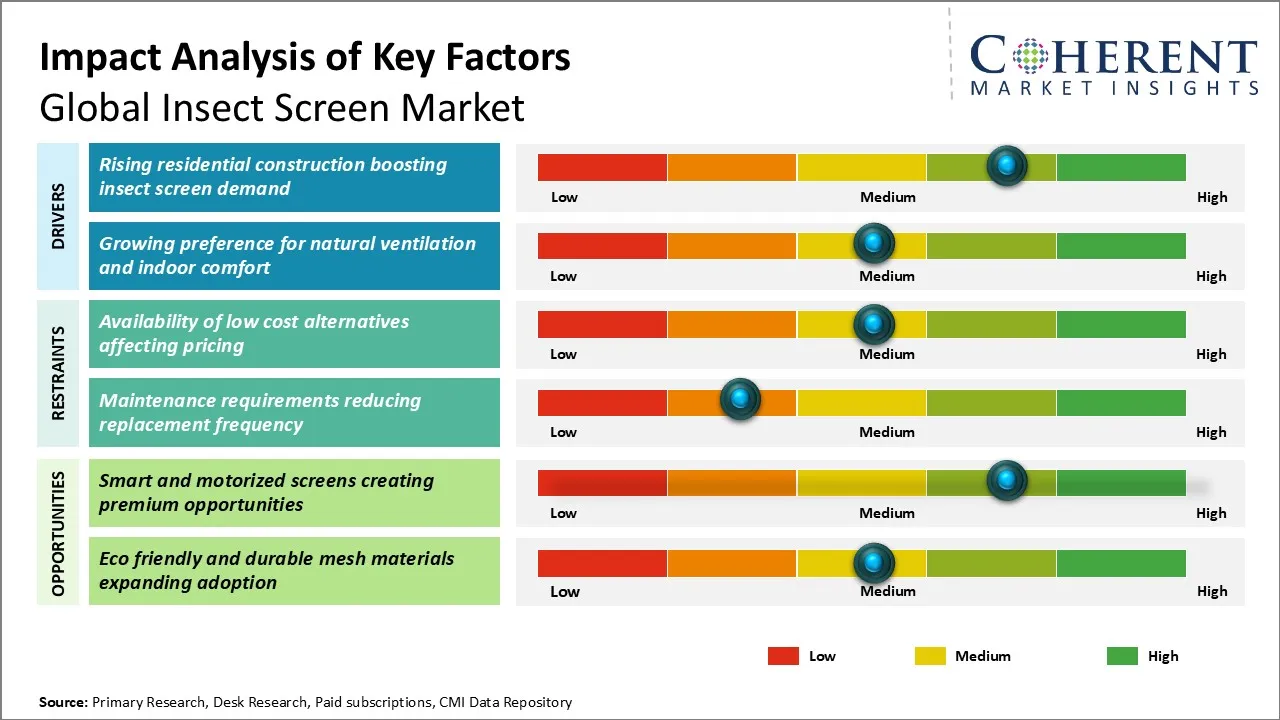
Key Market Drivers
- Rising Residential Construction Boosting Insect Screen Demand: Rising residential construction activity is strengthening demand for insect screens as builders and homeowners increasingly integrate ventilation and pest protection solutions into windows, doors, patios, and balconies. New housing developments create opportunities for manufacturers, fabricators, installers, and building material distributors by increasing demand for fixed, retractable, and customized screening systems. The driver is particularly significant in urban housing markets where indoor comfort and healthier living environments influence purchasing decisions. In April 2025, the U.S. Census Bureau reported continued residential construction activity through housing starts and building permit tracking, supporting downstream demand for construction-related components.
- Growing Preference for Natural Ventilation and Indoor Comfort: Growing preference for naturally ventilated living spaces is encouraging adoption of insect screens as consumers seek alternatives that maintain airflow while limiting insect entry. Unlike chemical pest-control methods, screening solutions provide a passive protection approach with minimal maintenance, benefiting residential users, hospitality operators, and commercial building owners. Manufacturers are responding through improved mesh visibility, durable materials, and aesthetically integrated designs that complement modern architecture. In March 2025, the U.S. Department of Energy continued emphasizing passive design approaches and ventilation strategies within building efficiency guidance, reinforcing interest in solutions supporting indoor environmental quality.
Emerging Market Trends
- Transition Toward Aesthetic and Integrated Screening Solutions: The insect screen market is shifting from basic functional barriers toward visually integrated solutions that align with modern architectural preferences. Homeowners and commercial developers increasingly expect screens to complement window systems rather than appear as separate accessories. This is encouraging manufacturers to develop concealed retractable mechanisms, slim-frame designs, improved mesh visibility, and customized color options. Over the forecast period, suppliers with stronger design capabilities and partnerships with window and door manufacturers are likely to gain advantage as screening becomes part of broader building comfort solutions.
- Increasing Adoption of Specialized Mesh Technologies: Specialized mesh development is changing product differentiation within the insect screen industry. Manufacturers are moving beyond conventional fiberglass and metal meshes toward solutions offering improved durability, visibility, airflow, and resistance against environmental conditions. Premium customers are increasingly evaluating screens based on performance characteristics such as pet resistance, pollen filtration capability, UV resistance, and long service life. This trend is expected to create opportunities for material suppliers and technology-focused manufacturers while increasing competition among traditional screen producers relying primarily on standard product offerings.
- Current Industry Events of 2026
- Market Size Estimation
- Regional Breakdown
- Competitive Landscape
- Customer Intelligence
- Segmental Analysis
- Pricing Analysis
- Key Market Drivers, Challenges & Future Trends
- Customized Insights Section
Segmental Insights
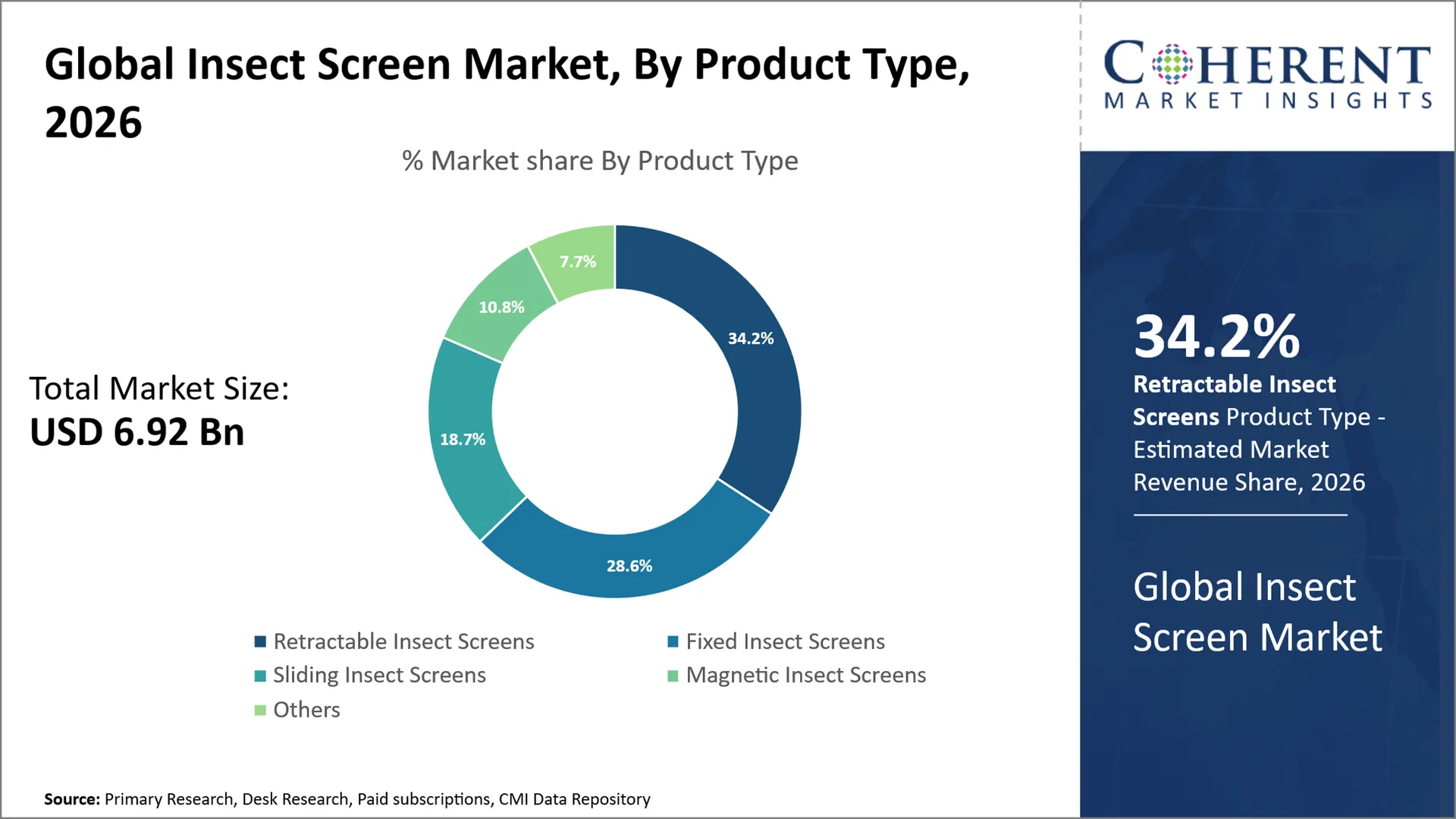
Why Do Retractable Insect Screens Dominate the Product Type Segment in the Global Insect Screen Market?
Retractable Insect Screens are expected to account for 34.2% of the global insect screen market in 2026, supported by their ability to combine insect protection with architectural aesthetics and flexible space utilization. Unlike permanent screening formats, retractable systems allow users to maintain open views, ventilation access, and design continuity when screens are not required. Demand is particularly strong among premium residential projects, renovated homes, patios, and large door openings were appearance and usability influence purchasing decisions. Manufacturers benefit from higher-value product positioning through customized dimensions, concealed mechanisms, and integration with window and door systems. In February 2025, Phantom Screens introduced updates to its retractable screen solutions portfolio focused on improving outdoor living applications and installation flexibility, reinforcing demand for premium screening systems.
Why Does Fiberglass Represent the Largest Material Category in the Global Insect Screen Market?
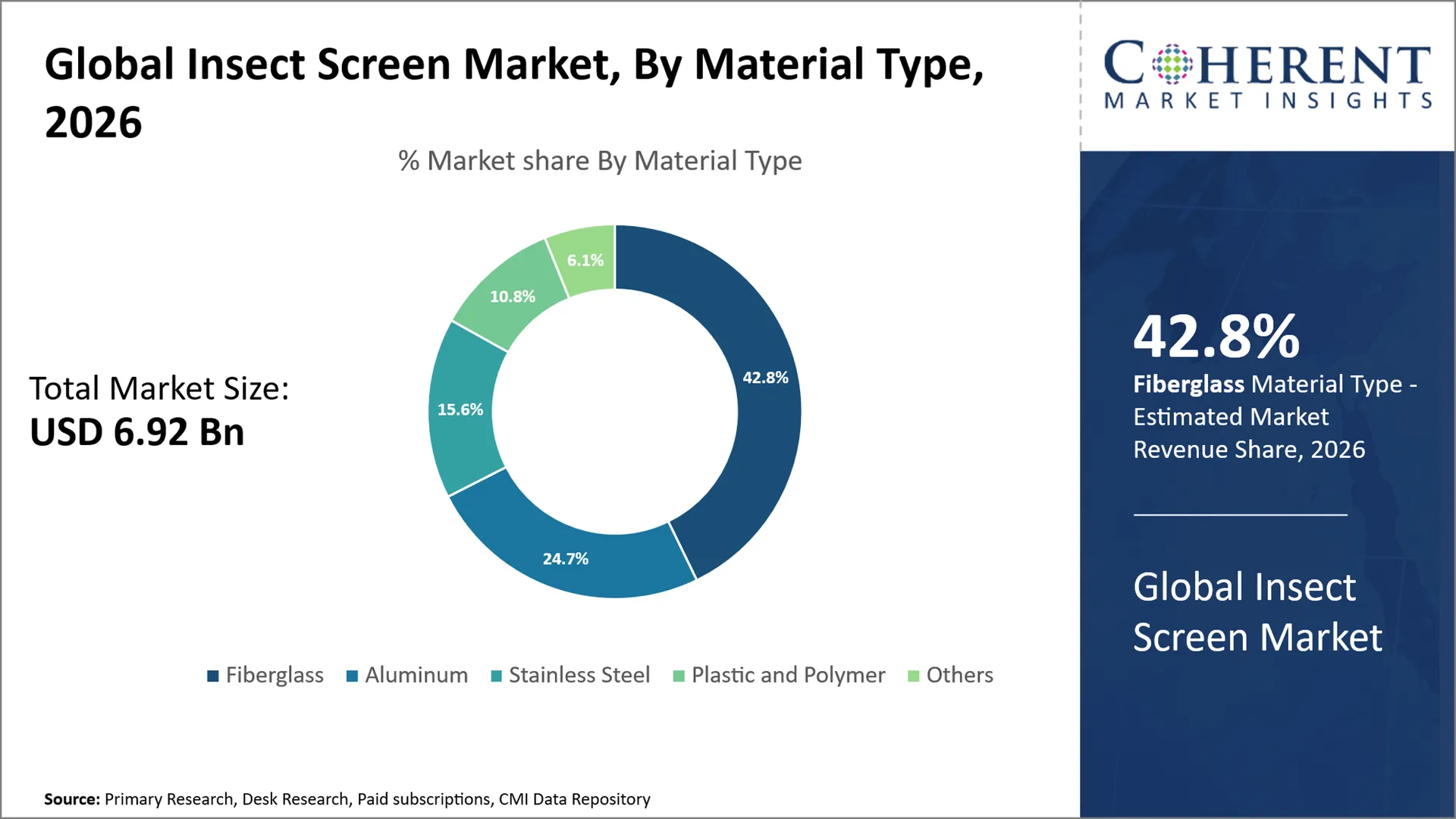
Fiberglass is expected to represent 42.8% of the global insect screen market in 2026 due to its balance of affordability, lightweight construction, corrosion resistance, and suitability across residential replacement applications. The material remains preferred among manufacturers because it enables efficient production, easy fabrication, and compatibility with commonly used window and door frames. From a demand perspective, homeowners and contractors select fiberglass mesh for practical applications where visibility, airflow, and maintenance requirements are important considerations. Suppliers benefit from established manufacturing processes and broad distribution availability through building material channels. In June 2025, Phifer Incorporated highlighted its fiberglass insect screening solutions designed for residential and commercial applications, emphasizing durability, airflow, and visibility characteristics.
Why Does Residential Application Dominate the Application Segment of the Global Insect Screen Market?
Residential applications are expected to account for 62.8% of the global insect screen market in 2026 as homeowners increasingly consider insect screens an essential component of comfortable indoor environments rather than an optional accessory. Adoption is supported by replacement demand, home renovation activities, and consumer preference for solutions that enable natural airflow while maintaining protection against insects. Residential buyers typically prioritize installation convenience, appearance, durability, and compatibility with existing windows and doors. This creates opportunities for manufacturers, retailers, installers, and home improvement channels to provide customized solutions across different housing formats. In August 2024, the U.S. Environmental Protection Agency continued promoting physical barriers such as window and door screens as part of mosquito prevention practices, supporting household adoption of protective screening solutions.
Current Events and their Impact
Current Event | Description and Its Impact |
March 2025 – U.S. Department of Energy Building Energy Efficiency Initiatives |
|
January 2025 – European Union Energy Performance of Buildings Directive Implementation Activities |
|
2024 – World Health Organization Vector Control Guidance Updates |
|
Regional Insights
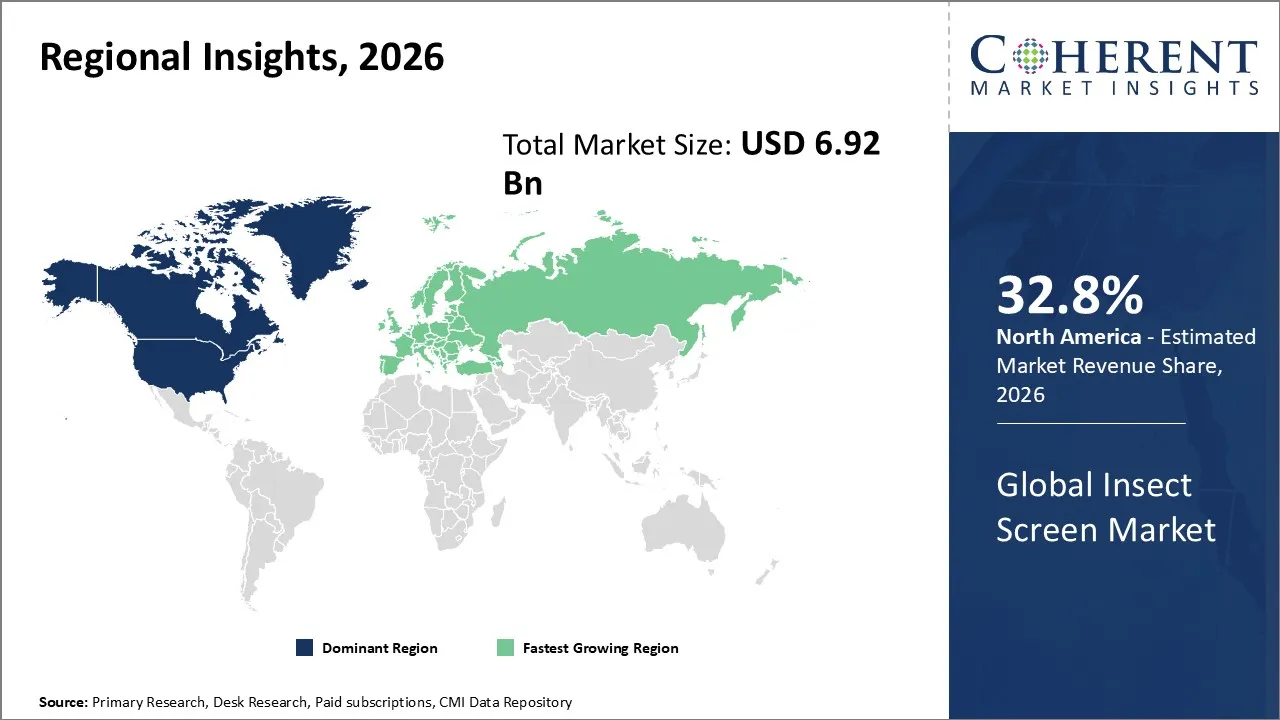
Why Does North America Dominate the Global Insect Screen Market?
North America is expected to account for 32.8% of the global insect screen market in 2026 due to strong residential renovation activity, widespread adoption of window and door protection systems, and established distribution networks across home improvement channels. The region benefits from a mature housing stock where replacement of aging screens, upgrades to energy-efficient windows, and outdoor living space improvements create consistent demand. Consumers increasingly prefer durable screening solutions that improve ventilation access while supporting indoor comfort. Manufacturers benefit from developed contractor networks, retail availability, and demand for customized solutions such as retractable and large-opening screens. Insect screens are also integrated into broader home improvement projects involving patios, decks, and replacement doors. In March 2025, the U.S. National Association of Home Builders highlighted continued homeowner investment in remodeling and repair activities, supporting demand for building-related products used in residential improvement projects.
Why Is Europe Emerging as the Fastest-Growing Region in the Global Insect Screen Market?
Europe is projected to represent 28.7% of the global insect screen market in 2026 and is emerging as the fastest-growing region due to increasing renovation activity, stricter building performance expectations, and rising preference for healthier indoor environments. European consumers increasingly evaluate window solutions based on ventilation, comfort, energy efficiency, and environmental compatibility, creating opportunities for advanced insect screening formats. Demand is supported by renovation of older residential buildings where upgraded windows and complementary accessories are installed together. Manufacturers focusing on slim designs, recyclable materials, and integration with European window systems are positioned to capture premium demand. In April 2025, the European Commission continued implementation activities related to the revised Energy Performance of Buildings Directive, encouraging building renovation and efficiency improvements across member states.
Global Insect Screen Market Outlook for Key Countries
Why Is the U.S. a Key Market for the Global Insect Screen Market?
The U.S. represents a major market for insect screens due to its large residential construction base, extensive detached housing inventory, and strong home improvement ecosystem. Demand is concentrated around window replacements, patio door upgrades, outdoor living areas, and seasonal insect protection requirements. Homeowners increasingly seek products that combine visibility, airflow, durability, and simple installation, supporting demand for fiberglass, retractable, and custom-fit screening systems. The country also has a well-developed ecosystem of manufacturers, distributors, retailers, and professional installers, enabling broad product accessibility. In May 2025, the U.S. Environmental Protection Agency continued promoting integrated mosquito prevention approaches that include physical barriers such as window and door screens, reinforcing household awareness of screening solutions.
Why Is India Important in the Global Insect Screen Market?
India is becoming an important market for insect screens due to urban residential expansion, increasing apartment development, and rising demand for improved indoor comfort solutions. Dense urban environments and climatic conditions with high insect exposure create demand for window and balcony screening products across residential buildings. Adoption is gradually expanding beyond premium housing toward broader residential applications as consumers become more aware of ventilation solutions that reduce reliance on chemical repellents. Local manufacturers and fabricators benefit from availability of aluminum profiles, mesh materials, and cost-effective production capabilities. Growing organized retail and online home improvement channels are also improving consumer access. In January 2025, India’s Ministry of Housing and Urban Affairs continued urban development initiatives through housing and city infrastructure programs, supporting expansion of residential construction ecosystems where insect screens can be integrated as building accessories.
Why Does China Support Growth in the Global Insect Screen Market?
China plays an important role in the global insect screen market due to its large-scale manufacturing ecosystem, extensive building material supply chain, and strong domestic demand from residential construction and renovation activities. The country has established production capabilities across fiberglass mesh, aluminum profiles, plastic components, and finished screening systems, enabling competitive pricing and efficient supply for both domestic and export markets. Rapid urbanization, apartment development, and consumer upgrades toward improved home comfort solutions continue supporting adoption. Chinese manufacturers also benefit from integrated supply networks that allow customization of screen sizes, materials, and designs for different regional requirements. In March 2025, China’s National Bureau of Statistics reported continued investment activity in real estate development and residential construction sectors, supporting demand for related building accessories including window and door components.
Why Is Germany a Strategic Country in the Global Insect Screen Market?
Germany represents a strategic market for insect screens due to its advanced construction standards, strong renovation sector, and preference for high-quality building components. German consumers and construction professionals typically prioritize durable, precision-engineered solutions that integrate with modern window and door systems. This creates opportunities for manufacturers offering premium retractable screens, customized frames, and products aligned with energy-efficient building upgrades. Germany’s established manufacturing base, engineering expertise, and export-oriented building component industry also strengthen its role as a regional technology and design hub. Demand is supported by residential modernization projects where insect screens are increasingly considered part of complete window solutions rather than standalone accessories. In February 2025, Germany’s Federal Ministry for Economic Affairs and Climate Action continued supporting building efficiency improvements through energy-related renovation programs, encouraging upgrades within the residential building ecosystem.
Why Is Australia an Important Growth Market for the Global Insect Screen Market?
Australia represents an important growth market for insect screens due to climatic conditions, outdoor-oriented lifestyles, and widespread demand for solutions that enable ventilation while limiting insect entry. Residential properties with large windows, balconies, patios, and outdoor living spaces create strong application opportunities for screening products. Consumers often prioritize durability, corrosion resistance, airflow, and compatibility with different architectural styles, supporting demand for fiberglass, aluminum, and customized screening formats. The market also benefits from established renovation activity and preference for home improvement solutions that enhance comfort without restricting natural airflow. Manufacturers and distributors can capture opportunities through partnerships with builders, window fabricators, and retail channels. In June 2025, Australia’s Department of Health continued public guidance on mosquito-borne disease prevention, reinforcing the importance of household protection measures.
Innovation Production & Manufacturing Landscape
Technology / Manufacturing Development | Current Adoption Level | Commercial Impact | Key Benefiting Participants |
Fiberglass Mesh Manufacturing | High Adoption | Provides lightweight and cost-effective screening solutions for mass residential applications | Mesh manufacturers residential suppliers |
Aluminum Frame Systems | High Adoption | Enables durable corrosion-resistant structures for premium doors and windows | Frame fabricators building material suppliers |
Retractable Screen Mechanisms | Growing Adoption | Supports premium architectural integration and space-saving designs | Premium screen manufacturers window companies |
Magnetic Screen Systems | Growing Adoption | Enables easy installation and replacement for rental and DIY users | Consumer-focused manufacturers retailers |
Pleated Folding Screen Systems | Moderate Adoption | Improves usability for large openings such as patios and sliding doors | Specialty manufacturers architects |
Motorized and Automated Screens | Early Commercial Adoption | Creates premium product differentiation through convenience and smart-home compatibility | Advanced solution providers smart-home suppliers |
How Are Smart Home Integration and Premium Customized Screening Solutions Creating New Growth Opportunities in the Global Insect Screen Market?
Smart home integration and customized screening solutions represent an emerging commercial opportunity as consumers increasingly seek products that combine insect protection with convenience, aesthetics, and automated operation. Motorized retractable screens, sensor-enabled systems, and solutions designed for large architectural openings can help manufacturers move beyond traditional replacement-driven demand toward premium value-added offerings. Residential renovation customers, luxury housing developers, hospitality operators, and commercial building owners represent key target groups for these advanced solutions. Companies can capture this opportunity by strengthening partnerships with window manufacturers, architects, home automation providers, and installation networks. Investment in modular designs, automation compatibility, durable materials, and localized customization capabilities will be important for market participation. While established screen manufacturers possess distribution advantages, specialized technology providers and smart-home solution companies can enter through differentiated product offerings and integration capabilities.
Market Players, Key Development, and Competitive Landscape
Key Developments
- In September 2025, Smartex Screen Co., Ltd expanded its insect screen manufacturing capabilities with integrated solutions covering screen mesh, windows, doors, and customized OEM/ODM systems for international markets. This development strengthens supply-side competitiveness by improving customization capability, production integration, and export readiness for residential and commercial insect screen applications across multiple regions.
- In March 2025, Meshworkz introduced its PVL 39 pleated insect screen system designed for modern residential applications with features such as compact folding design, magnetic locking, multiple finish options, and suitability for large openings. This development supports the shift toward space-efficient and aesthetically integrated insect screening solutions, enabling manufacturers to address premium housing, renovation, and architectural applications requiring both functionality and design compatibility.
- In April 2024, Andersen Corporation expanded its patio door offering with retractable screen solutions designed to provide airflow access while maintaining unobstructed views when screens are not in use. This development highlights increasing integration between window and door systems and insect protection solutions.
Competitive Landscape
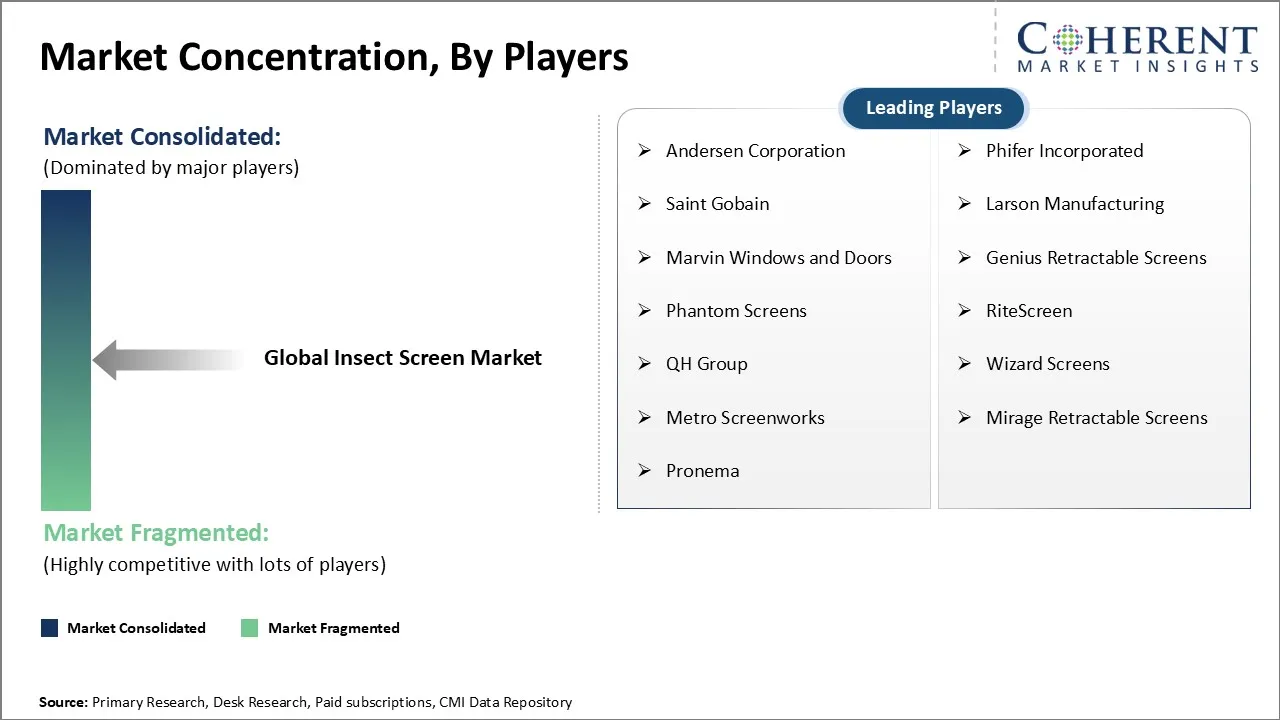
The global insect screen market is moderately fragmented, with competition distributed among specialized screen manufacturers, fiberglass mesh suppliers, window and door solution providers, and regional fabricators. Market positioning depends on product durability, customization capability, installation efficiency, pricing, distribution access, and relationships with construction professionals. Large companies benefit from established manufacturing networks and brand recognition, while regional players compete through customized solutions, faster delivery, and local installation expertise.
Key Focus Areas Include
- Product differentiation through retractable, pleated, magnetic, and customized screening formats
- Material performance including fiberglass durability, aluminum strength, and corrosion resistance
- Manufacturing consistency and supply reliability for residential and commercial projects
- Integration capability with window, door, and smart-home systems
- Distribution expansion through retailers, contractors, installers, and online channels
- Customization capability for architectural designs, large openings, and specialty applications
- Installation support and after-sales service to improve customer retention
- Sustainability-focused materials and longer product lifecycle positioning
Market Report Scope
Insect Screen Market Report Coverage | |||
Report Coverage | Details | ||
Base Year | 2025 | Market Size in 2026: | USD 6.92 Bn |
Historical Data For: | 2020 To 2024 | Forecast Period: | 2026 To 2033 |
Forecast Period 2026 To 2033 CAGR: | 6.6% | 2033 Value Projection: | USD 10.82 Bn |
Geographies covered: |
| ||
Segments covered: |
| ||
Companies covered: | Andersen Corporation, Phifer Incorporated, Saint Gobain, Larson Manufacturing, Marvin Windows and Doors, Genius Retractable Screens, Phantom Screens, RiteScreen, QH Group, Wizard Screens, Metro Screenworks, Mirage Retractable Screens, Pronema | ||
Growth Drivers: |
| ||
Restraints & Challenges: |
| ||
Analyst Opinion (Expert Opinion)
- The global insect screen market is likely to move gradually from a replacement-oriented product category toward a broader building comfort solution segment. Future competitiveness will depend less on basic mesh availability and more on manufacturers’ ability to combine aesthetics, installation convenience, durability, and compatibility with modern residential designs.
- The most influential transformation may come from the convergence of insect screens with smart-home and automated building systems. Companies that can integrate screening products with sensors, motorized controls, and connected home ecosystems may redefine customer expectations and create new premium categories beyond conventional manual screens.
- Market participants should prioritize product customization, installer networks, and partnerships with window and building solution providers. Companies should avoid competing only on low-cost standard products, as margin pressure may increase from commoditized mesh solutions. Building differentiated products with reliable supply chains and application-specific designs will become increasingly important.
Speak to the analyst
Want personalized insights?
Take the findings above to one of our principal consultants, or have the report rebuilt around the segments, geographies and competitors you actually track.
Market Segmentation
- Product Type Insights (Revenue, USD Bn, 2021 - 2033)
- Retractable Insect Screens
- Fixed Insect Screens
- Sliding Insect Screens
- Magnetic Insect Screens
- Others
- Material Type Insights (Revenue, USD Bn, 2021 - 2033)
- Fiberglass
- Aluminum
- Stainless Steel
- Plastic and Polymer
- Others
- Application Insights (Revenue, USD Bn, 2021 - 2033)
- Residential
- Commercial Buildings
- Industrial Facilities
- Hospitality and Others
- Installation Type Insights (Revenue, USD Bn, 2021 - 2033)
- Window Screens
- Door Screens
- Patio and Balcony Screens
- Other Openings
- Distribution Channel Insights (Revenue, USD Bn, 2021 - 2033)
- Direct Sales
- Home Improvement Stores
- Online Retail
- Specialty Stores
- Regional Insights (Revenue, USD Bn, 2021 - 2033)
- North America
- U.S.
- Canada
- Latin America
- Brazil
- Argentina
- Mexico
- Rest of Latin America
- Europe
- Germany
- U.K.
- Spain
- France
- Italy
- Russia
- Rest of Europe
- Asia Pacific
- China
- India
- Japan
- Australia
- South Korea
- ASEAN
- Rest of Asia Pacific
- Middle East
- GCC Countries
- Israel
- Rest of Middle East
- Africa
- South Africa
- North Africa
- Central Africa
- North America
- Key Players Insights
- Andersen Corporation
- Phifer Incorporated
- Saint Gobain
- Larson Manufacturing
- Marvin Windows and Doors
- Genius Retractable Screens
- Phantom Screens
- RiteScreen
- QH Group
- Wizard Screens
- Metro Screenworks
- Mirage Retractable Screens
- Pronema
Sources
Primary Research Interviews
- Insect screen manufacturers, window and door system providers, mesh suppliers, distributors, installers, retailers, and building material suppliers
- Architects, contractors, residential developers, facility managers, home improvement professionals, and industry experts
Stakeholders
- Insect screen manufacturers, fiberglass and aluminum mesh producers, retractable screen solution providers, and specialty screening companies
- Window and door manufacturers, construction material suppliers, distributors, home improvement retailers, and e-commerce platforms
- Residential consumers, commercial building owners, hospitality operators, and renovation service providers
End-use Sectors
- Residential housing, renovation, and home improvement applications
- Commercial buildings, offices, hospitality, and institutional facilities
- Outdoor living spaces, patios, balconies, and large opening applications
- Industrial and specialty ventilation protection applications
Regulatory and Industry Bodies
- Building standards organizations and construction regulatory authorities
- Housing and urban development agencies
- Energy efficiency and building performance organizations
- Trade associations related to windows, doors, and building materials
Databases
- Company annual reports, investor presentations, and corporate filings
- Construction activity, housing, and building permit databases
- Trade statistics, import-export datasets, and material supply databases
- Retail, e-commerce, and product pricing databases
- Competitive intelligence and product portfolio databases
Magazines and Journals
- Building materials and construction industry publications
- Window, door, and architectural solution publications
- Home improvement and renovation journals
- Sustainable building and indoor comfort publications
Associations
- Window and Door Manufacturers Association (WDMA)
- American Architectural Manufacturers Association (AAMA) / Fenestration and Glazing Industry Alliance (FGIA)
- European window, door, and building component associations
- Regional construction and building material associations
Public Domain Sources
- Residential construction and renovation trends
- Indoor comfort, ventilation, and building efficiency developments
- Product innovations in retractable, magnetic, and specialty insect screens
- Home improvement retail and distribution channel expansion
- Sustainability trends in screening materials and manufacturing
Key Standards and Regulations
- Building code requirements for windows, doors, and ventilation systems
- Material quality and performance standards for mesh and frame components
- Product safety and durability requirements
- Environmental compliance and sustainable material regulations
- International trade and import requirements for insect screen products
Proprietary Elements
- CMI Data Analytics Tool, proprietary CMI repository containing 10+ years of construction materials, building products, home improvement, and consumer goods market intelligence.
Get access to 250+ pages report
Every segment, forecast, competitor profile and data table behind the analysis above — available for instant download.
- ESOMAR Member
- ISO 9001:2015 Certified
- D-U-N-S Registered
- GDPR & CCPA Compliant
Missing comfort of reading report in your local language? Find your preferred language:
Frequently Asked Questions
The CAGR of global insect screen market is projected to be 6.6% from 2026 to 2033.
The global insect screen market is estimated to be valued at USD 6.92 billion in 2026 and is expected to reach USD 10.82 billion by 2033
The market includes retractable insect screens, fixed insect screens, sliding insect screens, magnetic insect screens, and other customized screening solutions used across residential, commercial, and industrial applications.
Fiberglass is the leading material type in the global insect screen market due to its lightweight structure, durability, cost efficiency, corrosion resistance, and suitability for residential window and door applications.
Residential applications represent the largest demand area, followed by commercial buildings, industrial facilities, hospitality spaces, and other specialized applications requiring ventilation and insect protection solutions.
Companies should evaluate product demand trends, material preferences, regional construction activity, distribution channels, customization requirements, competitive positioning, manufacturing capabilities, and emerging opportunities in premium retractable and automated screening solutions.
Rising residential construction activity, along with growing demand for natural ventilation and enhanced indoor comfort, are the primary factors supporting the growth of the global insect screen market.