

Global Insulated Packaging Market Size and Forecast – 2026 To 2033
The Global Insulated Packaging Market is estimated to be valued at USD 20.81 Bn in 2026 and is expected to reach USD 32.77 Bn by 2033, growing at a compound annual growth rate (CAGR) of 6.7% from 2026 to 2033. Market expansion is supported by the increasing movement of temperature-sensitive pharmaceuticals, biologics, fresh and frozen foods, meal deliveries, and specialty products through longer and more complex distribution networks.
Demand is also shifting toward packaging that offers extended thermal protection, improved payload efficiency, route flexibility, and lower material waste. In June 2025, Cryopak introduced its NexBlu Cube10 universal shipping system for pharmaceutical, biotechnology, and other cold-chain applications, offering EPS and graphite-expanded-polystyrene configurations with thermal protection designed for long-duration shipments. The development illustrates how suppliers are improving insulated packaging performance while addressing cost, logistics efficiency, and sustainability requirements.
Key Takeaways of the Global Insulated Packaging Market
- Insulated Boxes and Cartons should advance at an estimated CAGR of 6.5% during 2026–2033, while retaining an expected 42.8% share in 2026. Their dominance reflects broad compatibility with food, pharmaceuticals, parcel logistics, and last-mile distribution, while rigid formats simplify stacking and payload protection. In September 2025, va-Q-tec highlighted Swiss Post’s use of reusable highly insulated boxes for temperature-controlled medicine deliveries.
- Expanded Polystyrene is projected to post an estimated 6.1% CAGR over 2026–2033 and secure 32.6% of the market in 2026. EPS retains a strong commercial position because it combines thermal efficiency, low weight, shock protection, stackability, and established processing economics across seafood, food, and healthcare shipments. In October 2025, BASF reported Pescafácil’s adoption of CELOOPS boxes produced with Ccycled EPS for seafood transport.
- Chilled packaging is likely to register an estimated CAGR of 6.8% through 2033, after representing an expected 46.7 % of the market in 2026. It serves high-frequency flows of fresh foods, biologics, vaccines, diagnostics, and other products that require controlled but non-frozen conditions, creating consistent replenishment needs. In August 2025, DHL opened dual-certified cold-chain capability at Kuala Lumpur International Airport with dedicated 2–8°C pharmaceutical storage.
- North America should progress at an estimated 6.4% CAGR from 2026 to 2033, with its expected 2026 share reaching 33.4% of the global market. Mature pharmaceutical distribution, specialty drug logistics, direct-to-patient delivery, meal and grocery shipping, and extensive cold-chain infrastructure support premium insulated formats. In April 2025, UPS agreed to acquire Andlauer Healthcare Group to strengthen temperature-controlled healthcare logistics across North America.
- Europe is forecast to deliver an estimated 7.6% CAGR during 2026–2033 and account for an expected 28.7% of the global market in 2026, making it the fastest-growing region. Pharmaceutical cold-chain investment, dense cross-border distribution, sustainability requirements, and stronger adoption of reusable thermal systems support expansion. In June 2024, Cold Chain Technologies opened a manufacturing and distribution facility in Breda, the Netherlands, specifically to support European growth.
Segmental Insights
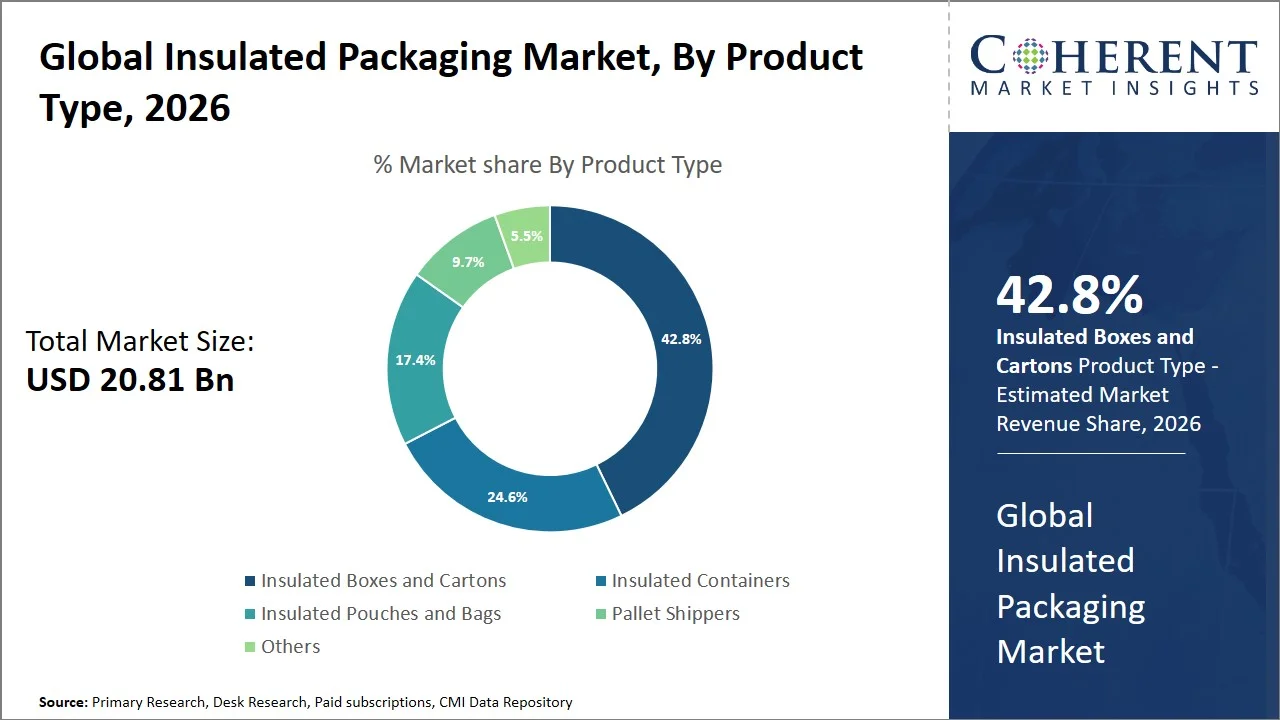
Why Do Insulated Boxes and Cartons Dominate the Global Insulated Packaging Market?
Insulated Boxes and Cartons are expected to account for 42.8% of the global insulated packaging market in 2026 because the format combines thermal control with familiar parcel-handling economics. Corrugated outers can be supplied flat, erected on existing packing lines, sized to multiple payloads, and paired with liners, refrigerants, or molded inserts according to required hold time. This flexibility is valuable for meal kits, specialty foods, diagnostics, pharmaceuticals, and e-commerce shipments where operators need scalable packouts without adopting dedicated reusable containers for every lane. For suppliers, boxes and cartons also create recurring demand for insulation components and refrigerants while supporting customization by shipment size and branding. In April 2024, Ranpak launched RecyCold climaliner Plus in North America, a paper-based cold-chain liner providing up to 72 hours of thermal protection and designed for food, beverage, and healthcare shipments.
- Current Industry Events of 2026
- Market Size Estimation
- Regional Breakdown
- Competitive Landscape
- Customer Intelligence
- Segmental Analysis
- Pricing Analysis
- Key Market Drivers, Challenges & Future Trends
- Customized Insights Section
Why Does Expanded Polystyrene Represent the Largest Insulation Material in the Global Insulated Packaging Market?
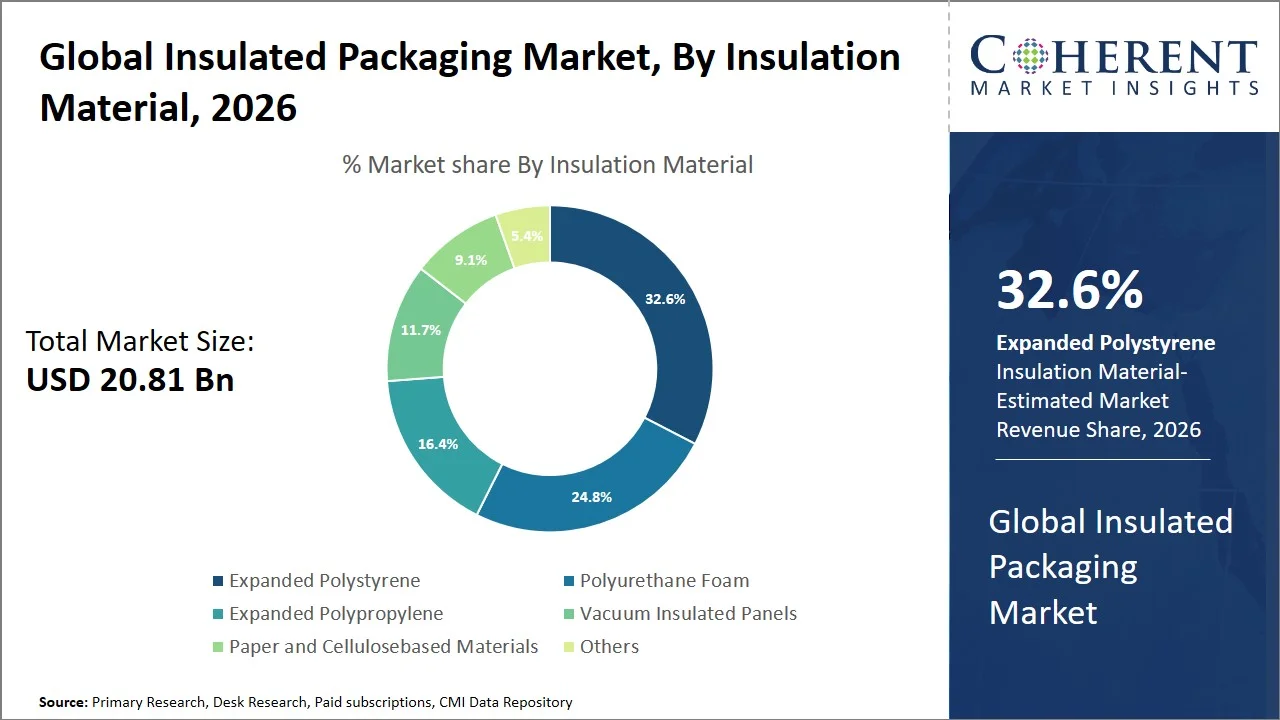
Expanded Polystyrene is expected to hold 32.6% of the global insulated packaging market in 2026 because its manufacturing economics remain well suited to high-volume thermal packaging. EPS can be molded into tight-fitting walls, lids, and cavities that reduce unwanted air movement around temperature-sensitive payloads, while its low material density limits added freight burden. Established molding processes also allow producers to manufacture fish boxes, pharmaceutical shippers, and food containers near major consumption or processing centers, supporting short replenishment cycles. Its commercial strength is therefore tied not only to insulation performance, but also to conversion scale and application-specific molding capability. In April 2024, BEWI introduced new EPS grades and fish boxes based on recycled feedstock, with the company reporting up to a 60% lower carbon footprint for the new offerings, showing how suppliers are adapting EPS to stricter sustainability-oriented procurement requirements.
Why Does Chilled Dominate the Temperature Requirement Segment of the Global Insulated Packaging Market?
Chilled packaging is expected to represent 46.7% of the global insulated packaging market in 2026 because the 2–8°C range serves a broad set of frequently shipped, high-value products that cannot tolerate freezing. Insulin, vaccines, biologics, diagnostic materials, dairy products, fresh proteins, and prepared foods require packaging systems that buffer external temperature variation while avoiding direct contact between sensitive payloads and excessively cold refrigerants. This creates demand for qualified packouts using phase-change materials, gel packs, thermal liners, and controlled spacing around the product. Packaging providers that can validate longer transit routes and accommodate customs or delivery delays gain an important service advantage. In November 2024, Peli BioThermal documented use of its CoolPall Flex solution to move insulin from Denmark to the Democratic Republic of Congo while maintaining the required 2–8°C range during a seven-day transit route.
Current Events and their Impact
Current Event | Description and Its Impact |
EU Packaging and Packaging Waste Regulation Begins General Application – August 2026 |
|
UK Confirms Packaging Extended Producer Responsibility Base Fees – June 2025 |
|
Oregon Launches Packaging Extended Producer Responsibility Program – July 2025 |
|
Global Insulated Packaging Market Dynamics
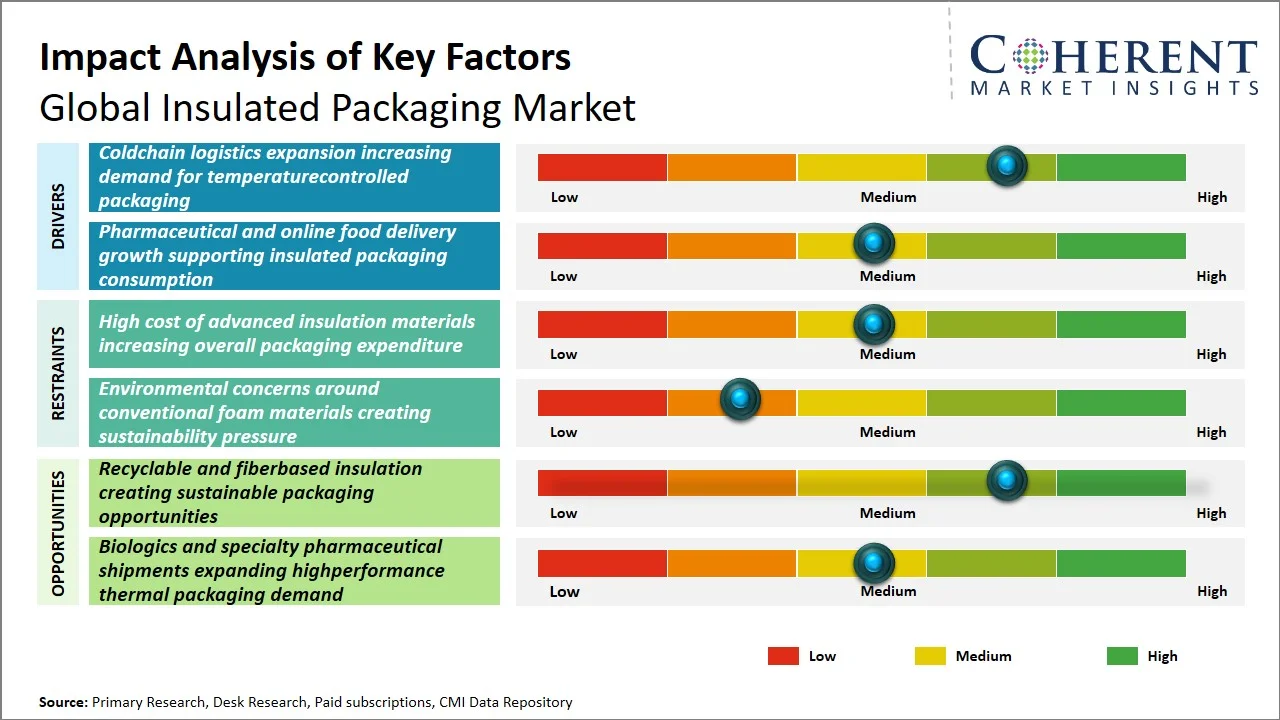
Key Market Drivers
- Cold chain logistics expansion increasing demand for temperature-controlled packaging: Cold chain logistics expansion is increasing the need for insulated boxes, pallet shippers, and reusable containers that protect products across longer, more complex distribution routes. As cold stores, reefer terminals, and multimodal hubs expand, packaging must bridge temperature gaps during loading, unloading, cross-docking, customs clearance, and last-mile transfer. These favors suppliers offering validated systems with longer hold times, stronger payload protection, and formats compatible with palletized and parcel networks. Food exporters, pharmaceutical distributors, logistics providers, and packaging manufacturers benefit as temperature assurance becomes embedded across more shipment stages. In February 2025, Maersk completed a 35,000-square-meter cold store in Rotterdam with more than 34,000 pallet positions for pharmaceuticals, fruits, meat, and fish. The facility illustrates how new cold-chain nodes create additional demand for packaging that maintains product condition before and after refrigerated storage.
- Pharmaceutical and online food delivery growth supporting insulated packaging consumption: Pharmaceutical and online food delivery growth is widening the range of shipments that require reliable thermal protection outside conventional refrigerated transport. Specialty medicines, biologics, meal kits, fresh groceries, and frozen products increasingly move through parcel and home-delivery networks where products may spend hours in staging areas, delivery vehicles, or at customer handoff points. This raises demand for compact insulated cartons, pouches, refrigerant-compatible liners, and prequalified packouts designed for predictable last-mile performance. Packaging suppliers, grocery retailers, pharmacies, fulfillment operators, and third-party logistics providers gain from solutions that reduce spoilage and temperature excursions without adding excessive handling complexity. In July 2024, Walmart announced five new high-tech perishable distribution centers and expansions at four existing sites while highlighting continued growth in its pickup and delivery business. The investment reinforces the need for temperature-protective packaging across increasingly distributed grocery fulfillment networks.
Emerging Market Trends
- Route-Specific Thermal Packouts Replacing Standardized Packaging Configurations: Thermal packaging is shifting toward route-specific packouts based on transit duration, climate exposure, payload sensitivity, and handling conditions. This increases the importance of thermal testing, qualification, and modular design. Suppliers that reduce overpacking while maintaining performance can improve freight efficiency, material use, and customer value across temperature-sensitive distribution routes.
- Reusable Thermal Packaging Moving Toward Managed Reverse-Logistics Models: Reusable insulated packaging is increasingly supported by rental pools, return programs, cleaning, inspection, and asset-management services. This model can improve lifecycle economics on repeat routes while reducing dependence on single-use formats. Adoption is expected to be strongest in healthcare, laboratory, foodservice, and B2B networks where predictable return flows support efficient reuse and refurbishment.
Regional Insights
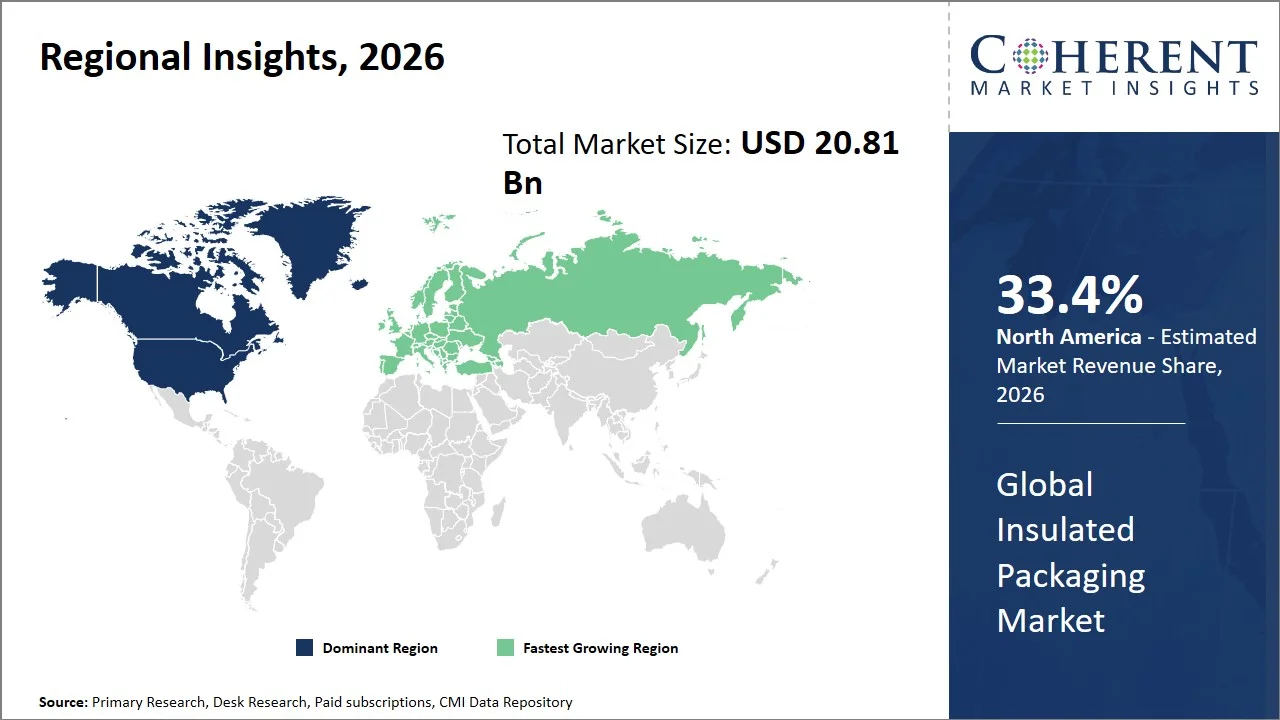
Why Does North America Dominate the Global Insulated Packaging Market?
North America is expected to account for 33.4% of the global insulated packaging market in 2026, supported by dense cold-chain infrastructure, high pharmaceutical distribution volumes, large-scale movement of chilled and frozen foods, and extensive parcel delivery across the U.S., Canada, and Mexico. Long transport distances and cross-border food flows increase the need for insulated boxes, pallet shippers, and reusable containers that protect payloads through multiple handling points. The region also benefits from strong adoption of validated thermal packaging for biologics, specialty medicines, meal delivery, seafood, and other temperature-sensitive goods. In August 2025, Americold opened a more than USD 100 million, 335,000-square-foot import-export hub in Kansas City, Missouri, linked to refrigerated rail service between the U.S. and Mexico. This infrastructure strengthens temperature-controlled distribution corridors where reliable insulated packaging is essential for maintaining product quality through storage and onward shipment.
Why Is Europe Emerging as the Fastest-Growing Region in the Global Insulated Packaging Market?
Europe is expected to hold 28.7% of the global insulated packaging market in 2026 and emerge as the fastest-growing region as packaging design shifts toward recyclable, reusable, and lower-waste thermal solutions. Pharmaceutical and biotechnology distribution, cross-border food trade, grocery delivery, and closely connected logistics networks create consistent requirements for chilled and controlled-room-temperature packaging. European sustainability requirements are also encouraging suppliers to redesign foam-intensive formats and increase fiber-based or circular alternatives without sacrificing thermal performance. In January 2025, DS Smith introduced TailorTemp at Pharmapack Europe 2025, a fibre-based temperature-controlled packaging solution using corrugated insulating inserts and an outer case, with cooling capability of up to 36 hours. The development demonstrates how European suppliers are combining cold-chain reliability with recyclability, supporting wider adoption of redesigned insulated boxes and parcel shippers across healthcare and other temperature-sensitive supply chains.
Global Insulated Packaging Market Outlook for Key Countries
Why Is the U.S. a Key Market for Insulated Packaging?
The U.S. is a key market for insulated packaging because it combines a large life-sciences supply chain with national food distribution, direct-to-consumer delivery, clinical-trial logistics, and high-value specialty medicine shipments. These flows require packaging capable of handling long domestic routes, airport transfers, last-mile handoffs, and seasonal temperature variation while maintaining chilled, frozen, or controlled-room-temperature conditions. Demand is also shifting toward reusable systems and shipment visibility as healthcare companies seek lower packaging waste and stronger product-integrity controls. In October 2025, Ohio-based CSafe launched Silverskin RE, a reusable thermal cover for life-science shipments designed for +2°C to +8°C and +15°C to +25°C temperature ranges and equipped with integrated tracking. This development reflects the U.S. market’s movement toward reusable, monitored thermal protection for palletized pharmaceuticals and other high-value temperature-sensitive cargo.
Why Does China Support Growth in the Global Insulated Packaging Market?
China supports growth in the insulated packaging market through its scale in pharmaceutical manufacturing, clinical research, fresh-food distribution, e-commerce fulfillment, and international trade. Temperature-sensitive products frequently move between inland production centers, coastal gateways, airports, and large urban consumption clusters, increasing the value of insulated shippers capable of maintaining stable conditions across multimodal journeys. Healthcare logistics is particularly important because biologics, vaccines, clinical-trial materials, and specialty medicines require qualified packaging and disciplined handling. In July 2025, FedEx announced that its Guangzhou Baiyun International Airport hub received IATA CEIV Pharma certification for handling and transporting time- and temperature-sensitive healthcare products. The certification strengthens compliant pharmaceutical logistics capacity at a major Chinese air gateway and supports broader use of validated insulated boxes, thermal containers, refrigerants, and monitoring solutions for domestic distribution and export-oriented healthcare shipments.
Why Is India Important in the Global Insulated Packaging Market?
India is becoming increasingly important to the insulated packaging market as pharmaceutical exports, vaccines, diagnostics, fresh-food distribution, quick commerce, and organized grocery delivery expand across a geographically large and climatically demanding market. Passive insulated solutions are commercially attractive because they can protect products during first-mile, intercity, and last-mile movement without depending continuously on powered refrigeration. Cost sensitivity also creates room for locally engineered phase-change materials, reusable bags, and compact multi-temperature systems suited to food and healthcare deliveries. In March 2025, PLUSS Advanced Technologies introduced PRONGO, a new line of temperature-controlled solutions for temperature-sensitive food transportation. The PRONGO platform incorporates phase-change-material-based thermal control for multiple temperature requirements, illustrating how domestic suppliers are adapting insulated packaging to India's need for flexible, reusable, and power-independent temperature management across fragmented distribution networks.
Why Is Germany a Strategic Country in the Global Insulated Packaging Market?
Germany is a strategic market for insulated packaging because its pharmaceutical, biotechnology, diagnostics, food, chemical, and industrial sectors place high value on product protection, process reliability, and packaging compliance. The country’s strong recycling framework and regulatory focus are influencing material selection, encouraging suppliers to improve the recyclability of insulated boxes, liners, and protective components while preserving thermal performance. This creates opportunities for paper and cellulose insulation, recyclable polymer formats, and reusable transport systems. In January 2025, Germany’s Central Agency Packaging Register highlighted that the new European packaging framework requires packaging to become recyclable from 2030 and introduces minimum recycled-content requirements for certain packaging formats. This regulatory direction raises the design threshold for insulated packaging supplied in Germany and should increase commercial interest in mono-material, fibre-based, recycled-content, and reusable thermal solutions.
Why Is Japan an Important Growth Market for the Global Insulated Packaging Market?
Japan is an important growth market for insulated packaging because its distribution system handles substantial volumes of seafood, chilled foods, frozen meals, pharmaceuticals, gifts, and convenience-oriented parcel deliveries across dense urban areas and island geographies. Buyers place strong emphasis on freshness, shipment reliability, compact packaging formats, and precise last-mile execution, supporting demand for insulated boxes, bags, and temperature-controlled parcel solutions. Advanced courier networks also make faster delivery models commercially viable for products where temperature-exposure time must be minimized. In November 2025, Yamato Transport announced same-day TA-Q-BIN delivery services beginning November 10, with Cool TA-Q-BIN included among eligible services and availability through sales offices nationwide, subject to specified exclusions. The expansion illustrates how Japan’s parcel network is incorporating faster temperature-controlled delivery options, strengthening the role of effective insulated packaging for fresh and temperature-sensitive products.
Technology Adoption Landscape in the Global Insulated Packaging Market
Technology | Adoption Level | Key Application Area | Business Impact |
Vacuum Insulation Panel Assemblies | Medium | High-value pharmaceutical and long-duration parcel shippers | Provides strong insulation in thinner walls, improving payload space and thermal duration, although premium cost limits mass-market deployment. |
Reusable Expanded Polypropylene Molded Systems | Medium | Closed-loop food, laboratory, and healthcare distribution | Improves durability, cleanability, and repeat-use economics where return routes are predictable. |
Aerogel-Based Flexible Insulation | Low | Space-constrained premium thermal shippers | Enables high thermal resistance with reduced liner thickness, but material cost and conversion complexity currently restrict wider adoption. |
Gel-Pack Refrigerant Systems | High | Chilled food, diagnostics, medicines, and parcel delivery | Offers simple, scalable temperature buffering with established handling procedures and broad compatibility with insulated cartons and containers. |
Reflective Radiant-Barrier Liners | Medium | Grocery pouches, meal delivery, and short-duration thermal shipments | Limits radiant heat transfer while adding little package weight, supporting lower freight cost and compact packout design. |
Environmental-Chamber Qualification and Computational Heat-Transfer Modeling | Medium | Packout engineering and route qualification | Helps optimize insulation thickness, refrigerant loading, payload placement, and seasonal configurations before commercial deployment. |
How Are Multi-Temperature Last-Mile Delivery Systems Creating New Growth Opportunities in the Global Insulated Packaging Market?
A high-potential opportunity lies in multi-temperature insulated packaging for decentralized last-mile networks that must carry chilled, frozen, and ambient products within the same delivery cycle. Grocery platforms, specialty pharmacies, diagnostic services, meal providers, and regional distributors increasingly need flexible thermal separation without dedicating an entire vehicle to one temperature range. Suppliers can capture this opportunity through modular inserts, removable insulated compartments, interchangeable refrigerant systems, and compact containers designed for repeated urban delivery routes. The strongest commercial proposition will combine easy packout, low tare weight, cleanability, and rapid reconfiguration so operators can improve vehicle utilization while protecting product quality. Participation requires application engineering, validation capability, durable materials, and partnerships with last-mile logistics operators that can test systems under real route conditions. This opportunity should favor specialists and vertically integrated suppliers able to combine packaging design with thermal qualification and operational support. New entrants can compete where they focus on underserved secondary cities, smaller shipment volumes, and configurable systems rather than capital-intensive large pallet solutions.
Market Players, Key Development, and Competitive Landscape
Key Developments
- In October 2025, Peli BioThermal officially launched Vēro One, a single-use, curbside-recyclable dry-ice shipper for pharmaceutical and biopharmaceutical temperature-sensitive shipments. The development is important for the global insulated packaging market because it addresses export and open-loop shipping lanes where retrieval of reusable containers is operationally difficult, while maintaining demand for high-performance parcel-level thermal protection.
- In May 2025, Intelsius introduced its Green and Connected strategic direction, combining reusable temperature-controlled packaging with rental services, connected monitoring, cloud-based shipment visibility, and recyclable insulation technologies. This is important for the global insulated packaging market because it demonstrates a shift from standalone thermal packaging toward integrated product-and-service ecosystems in which packaging performance, asset utilization, shipment oversight, and lifecycle management are addressed through one commercial platform.
- In April 2025, ThermoSafe launched the ChillTherm Bio pallet shipper using biodegradable expanded polystyrene for high-volume pharmaceutical and biologic distribution. The shipper is designed for extended chilled transport and global air-freight applications. This development is important because it introduces an alternative end-of-life pathway into a familiar insulation platform, allowing large cold-chain users to pursue sustainability objectives without immediately abandoning established EPS-based thermal performance characteristics.
Competitive Landscape
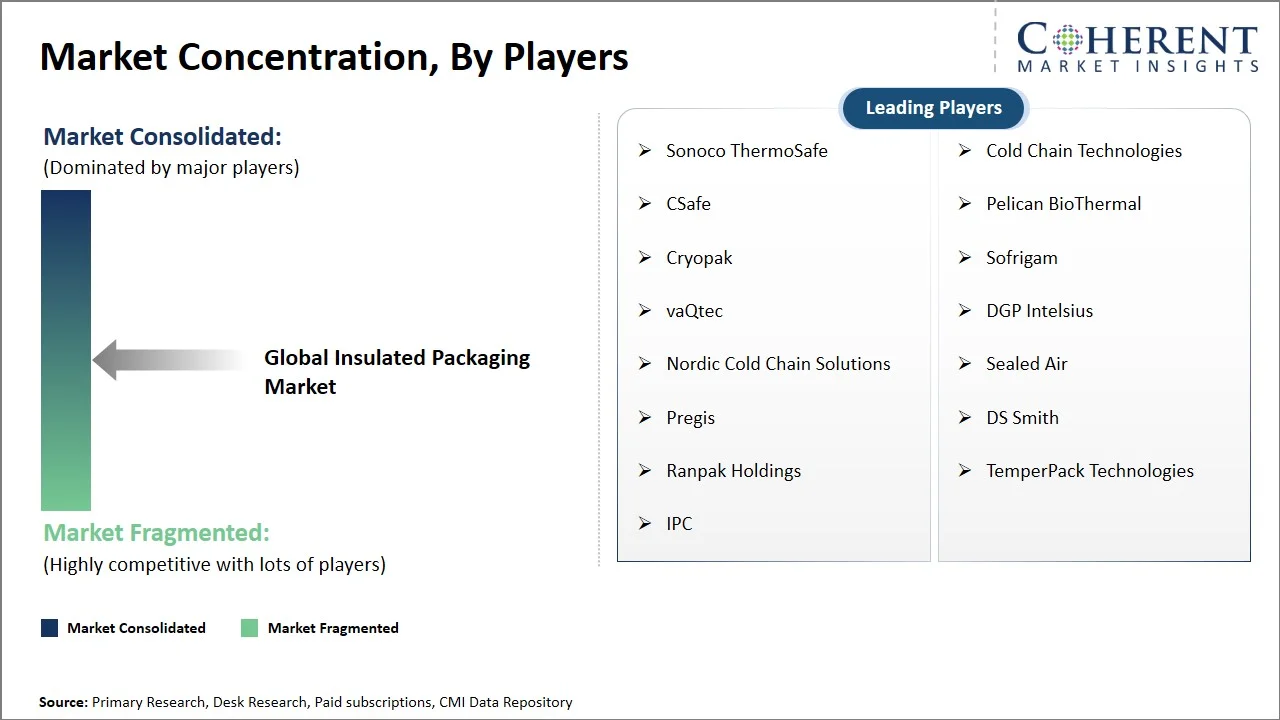
The global insulated packaging market is moderately fragmented, with competition spanning diversified packaging groups, temperature-controlled packaging specialists, foam and insulation converters, refrigerant suppliers, regional box manufacturers, and application-focused cold-chain solution providers. Competitive advantage depends increasingly on measurable thermal performance, qualification capability, material economics, supply continuity, and the ability to adapt packouts to specific shipping lanes. Regional suppliers retain an important position where short lead times, customized formats, and local customer support matter, while specialist companies compete more strongly in pharmaceutical and high-value temperature-sensitive shipments where validation and technical service influence procurement decisions.
Key focus areas include
- Thermal performance differentiation: Hold time, insulation efficiency, payload utilization, and resistance to ambient temperature variation remain central purchasing criteria.
- Qualification capability: Suppliers with environmental testing, application engineering, and packout validation can compete beyond basic material pricing.
- Total cost of ownership: Buyers increasingly compare freight, refrigerant requirements, storage space, assembly labor, damage risk, and disposal costs alongside purchase price.
- Manufacturing and supply reliability: Consistent availability of insulation materials, corrugated components, refrigerants, and molded parts is essential for large-volume programs.
- Customization capability: Market participants benefit from flexible dimensions, payload configurations, temperature ranges, and shipping-duration options.
- Regulatory and quality assurance: Healthcare customers particularly value documented performance, repeatability, traceable specifications, and disciplined change control.
- Regional production and service reach: Local conversion, conditioning, technical support, and shorter replenishment cycles can materially influence customer retention.
Market Report Scope
Insulated Packaging Market Report Coverage
| Report Coverage | Details | ||
|---|---|---|---|
| Base Year: | 2025 | Market Size in 2026: | USD 20.81 Bn |
| Historical Data for: | 2020 To 2024 | Forecast Period: | 2026 To 2033 |
| Forecast Period 2026 to 2033 CAGR: | 6.7% | 2033 Value Projection: | USD 32.77 Bn |
| Geographies covered: |
| ||
| Segments covered: |
| ||
| Companies covered: | Sonoco ThermoSafe, Cold Chain Technologies, CSafe, Pelican BioThermal, Cryopak, Sofrigam, vaQtec, DGP Intelsius, Nordic Cold Chain Solutions, Sealed Air, Pregis, DS Smith, Ranpak Holdings, TemperPack Technologies, IPC | ||
| Growth Drivers: |
| ||
| Restraints & Challenges: |
| ||
Analyst Opinion (Expert Opinion)
- The global insulated packaging market is likely to shift from basic insulation suppliers toward companies offering integrated thermal-packaging solutions. packaging engineering, qualification support, conditioning guidance, route optimization, and inventory planning will become stronger differentiators as buyers increasingly prioritize lower shipment risk and operational simplicity over unit packaging cost.
- Direct-to-patient and decentralized healthcare distribution could reshape insulated packaging design. Home delivery introduces unattended handoffs, variable exposure conditions, and limited unpacking expertise. Suppliers offering easier handling, clear condition verification, privacy protection, and reduced dependence on specialized receiving infrastructure will be better positioned to serve evolving pharmaceutical cold-chain requirements.
- Market participants should prioritize modular packaging platforms, alternative-material qualification, flexible manufacturing, and strong application engineering. Dual sourcing of insulation and refrigerant components can reduce supply risks, while shared-component designs can protect margins. Investment in expensive niche materials should remain selective unless customers demonstrate willingness to pay for clear freight, compliance, or thermal-performance benefits.
Speak to the analyst
Want personalized insights?
Take the findings above to one of our principal consultants, or have the report rebuilt around the segments, geographies and competitors you actually track.
Market Segmentation
- Product Type Insights (Revenue, USD Bn, 2021 - 2033)
- Insulated Boxes and Cartons
- Insulated Containers
- Insulated Pouches and Bags
- Pallet Shippers
- Others
- Insulation Material Insights (Revenue, USD Bn, 2021 - 2033)
- Expanded Polystyrene
- Polyurethane Foam
- Expanded Polypropylene
- Vacuum Insulated Panels
- Paper and Cellulose based Materials
- Others
- Temperature Requirement Insights (Revenue, USD Bn, 2021 - 2033)
- Chilled
- Frozen
- Controlled Room Temperature
- Others
- End User Insights (Revenue, USD Bn, 2021 - 2033)
- Food and Beverage
- Pharmaceuticals and Healthcare
- Chemicals
- Cosmetics and Personal Care
- Industrial Products
- Others
- Distribution Channel Insights (Revenue, USD Bn, 2021 - 2033)
- Direct Sales
- Indirect Sales
- Regional Insights (Revenue, USD Bn, 2021 - 2033)
- North America
- U.S.
- Canada
- Latin America
- Brazil
- Argentina
- Mexico
- Rest of Latin America
- Europe
- Germany
- U.K.
- Spain
- France
- Italy
- Russia
- Rest of Europe
- Asia Pacific
- China
- India
- Japan
- Australia
- South Korea
- ASEAN
- Rest of Asia Pacific
- Middle East
- GCC Countries
- Israel
- Rest of Middle East
- Africa
- South Africa
- North Africa
- Central Africa
- North America
- Key Players Insights
- Sonoco ThermoSafe
- Cold Chain Technologies
- CSafe
- Pelican BioThermal
- Cryopak
- Sofrigam
- vaQtec
- DGP Intelsius
- Nordic Cold Chain Solutions
- Sealed Air
- Pregis
- DS Smith
- Ranpak Holdings
- TemperPack Technologies
- IPC
Sources
Primary Research Interviews
- Insulated packaging manufacturers, thermal packaging specialists, cold-chain logistics providers, and material suppliers
- Food & beverage, pharmaceutical, healthcare, chemical, and industrial end users
- Distributors, packaging converters, logistics companies, procurement professionals, and industry experts
Stakeholders
- Insulated box, container, pouch, and pallet-shipper manufacturers
- EPS, EPP, polyurethane foam, vacuum insulation panel, and cellulose insulation suppliers
- Pharmaceutical, food processing, grocery delivery, biotechnology, and cold-chain companies
- Distributors, importers, exporters, packaging converters, and logistics providers
End-use Sectors
- Food and beverages
- Pharmaceuticals and healthcare
- Chemicals
- Cosmetics and personal care
- Industrial and temperature-sensitive products
Regulatory and Government Bodies
- U.S. FDA, EPA, USDA, and Department of Transportation
- European Commission, ECHA, EFSA, and national packaging authorities
- UK Department for Environment, Food & Rural Affairs and PackUK
- National food-safety, pharmaceutical, packaging-waste, and transport authorities across Asia Pacific
Databases
- UN Comtrade, ITC Trade Map, Eurostat, USITC, World Bank, and OECD
- FDA, EMA, WHO, and national pharmaceutical databases
- WIPO PATENTSCOPE, Espacenet, company filings, product catalogues, and trade records
Magazines and Journals
- Packaging Technology and Science
- International Journal of Refrigeration
- Journal of Food Engineering
- Pharmaceutical Technology
- Packaging Europe and Cold Chain News
Associations
- International Safe Transit Association
- International Air Transport Association
- Global Cold Chain Alliance
- Fibre Box Association
- Expanded Polystyrene Industry Alliance
- National packaging and cold-chain associations
Public Domain Sources
- Product catalogues, technical data sheets, thermal qualification reports, and packaging specifications
- Insulation performance, temperature range, hold-time, payload, and material-composition information
- Cold-chain infrastructure, pharmaceutical logistics, food distribution, and trade data
- Annual reports, patents, capacity expansions, product launches, and sustainability initiatives
Key Standards and Regulations
- EU Packaging and Packaging Waste Regulation
- Extended Producer Responsibility requirements for packaging
- ISTA temperature-controlled distribution testing standards
- GDP requirements for pharmaceutical distribution
- FDA and WHO guidance for temperature-sensitive healthcare products
- GHS, ISO quality, transport, recycling, labeling, and environmental requirements
Proprietary Elements
- CMI Data Analytics Tool, Proprietary CMI Existing Repository of information for the last 10 years
Get access to 250+ pages report
Every segment, forecast, competitor profile and data table behind the analysis above — available for instant download.
- ESOMAR Member
- ISO 9001:2015 Certified
- D-U-N-S Registered
- GDPR & CCPA Compliant
Missing comfort of reading report in your local language? Find your preferred language:
Transform your Strategy with Exclusive Trending Reports
Frequently Asked Questions
The CAGR of global insulated packaging market is projected to be 6.7% from 2026 to 2033.
The global insulated packaging market is estimated to be valued at USD 20.81 billion in 2026 and is expected to reach USD 32.77 billion by 2033.
Common insulation materials include expanded polystyrene, polyurethane foam, expanded polypropylene, vacuum insulated panels, and paper- or cellulose-based insulation materials.
Sustainability is encouraging manufacturers to develop recyclable, reusable, lightweight, and fiber-based insulated packaging solutions while reducing dependence on difficult-to-recycle conventional foam materials.
Insulated packaging helps maintain required temperature conditions for vaccines, biologics, diagnostics, and other sensitive medicines during transportation, reducing temperature excursions and supporting product quality throughout the supply chain.
Insulated packaging is widely used for temperature-sensitive food and beverages, pharmaceuticals, biologics, chemicals, cosmetics, and other products requiring thermal protection during storage and transportation.
Cold chain logistics expansion increasing demand for temperature controlled packaging and Pharmaceutical and online food delivery growth supporting insulated packaging consumption are the major factor driving the growth of global insulated packaging market.