

Anti-counterfeit Pharmaceutical Packaging Market Size and Trends: (2026-2033)
The Anti-counterfeit Pharmaceutical Packaging Market is estimated to be valued at USD 135.8 Bn in 2026 and is expected to reach USD 282.4 Bn by 2033, growing at a compound annual growth rate (CAGR) of 11% from 2026 to 2033.
Key Takeaways
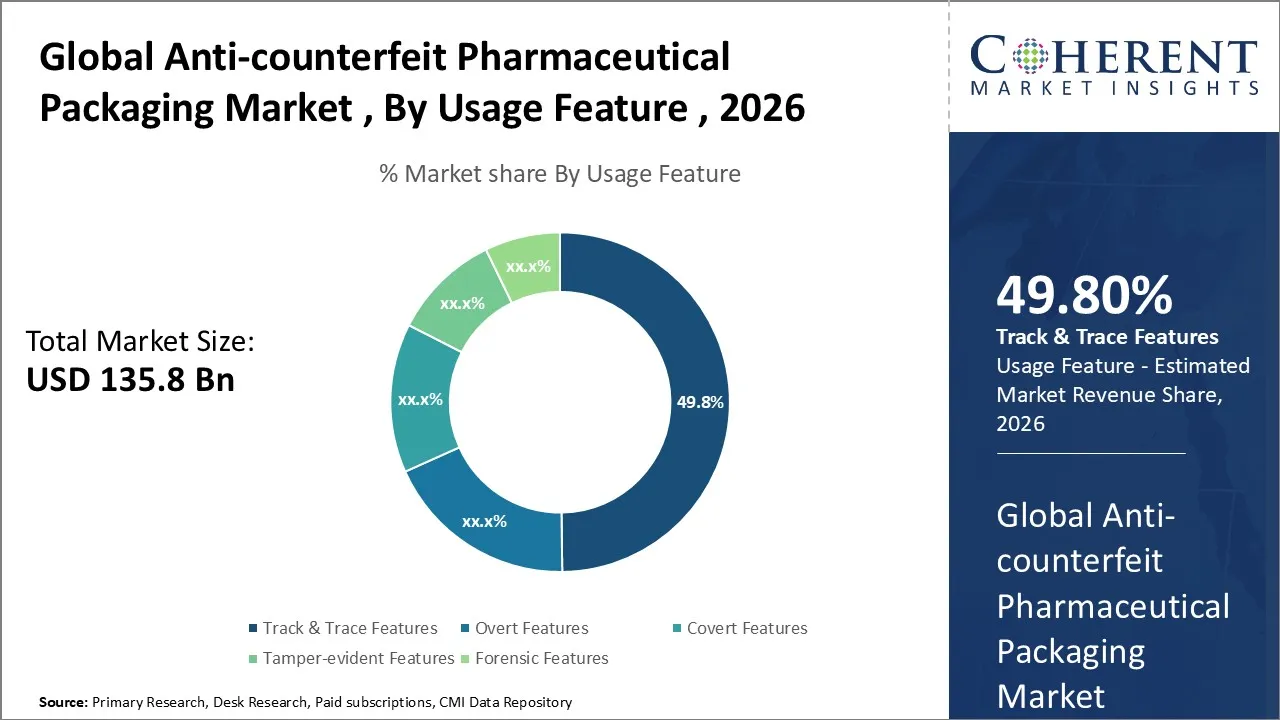
- Based on Usage Feature, the Track & Trace Features segment is expected to lead the market with 49.80 % share in 2026, due to stringent global mandates for drug serialization.
- Based on Technology, the RFID segment is expected to hold 32.10 % share of the market in 2026, driven by low-cost volume product tracking efficiency.
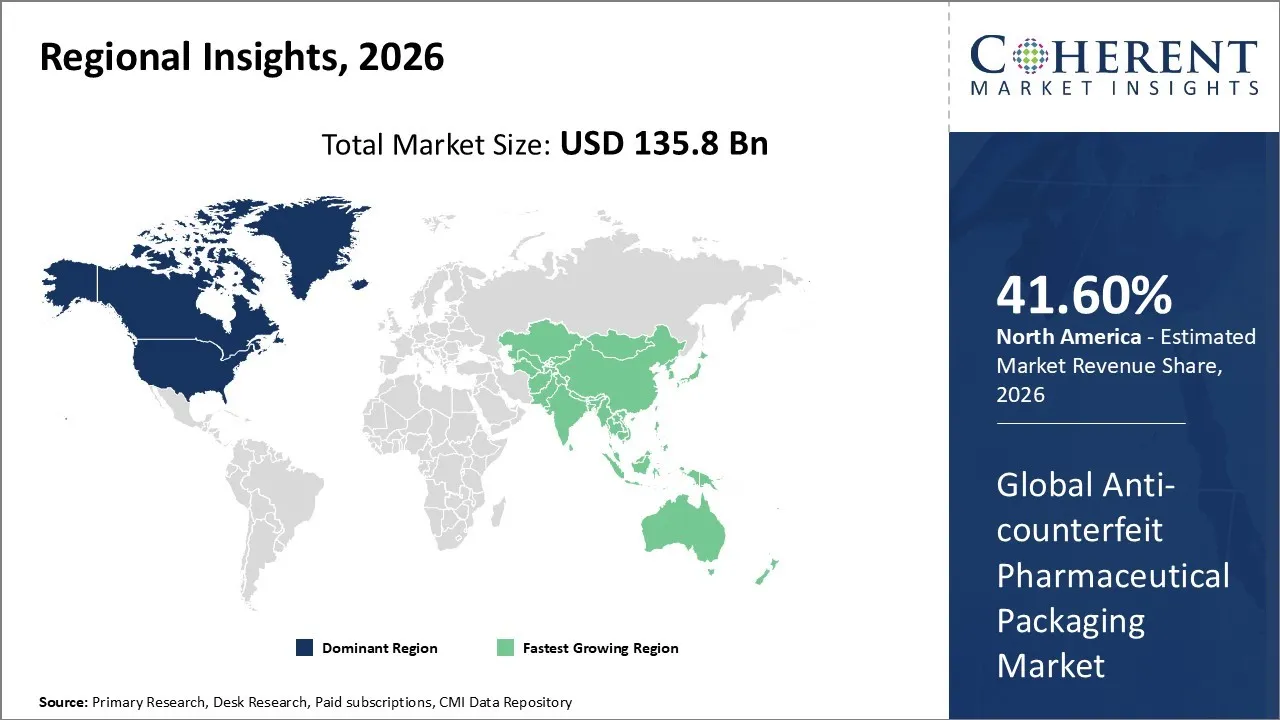
- Based on Region, North America is set to lead the market with 41.60 % share in 2026. While, Asia Pacific is anticipated to be the fastest growing region.
Market Overview
The anti-counterfeit pharmaceutical packaging market is advancing significantly with rising applications in supply chain security and patient safety. Moreover, expanding global pharmaceutical trade and tightening regulatory standards are expected to drive market growth over the forecast period. Anti-counterfeit packaging refers to the integration of secure measures to prevent the imitation or diversion of drugs. Anti-counterfeit analysis and implementation are commonly used techniques in biotechnological, clinical, and logistical industries. These packaging solutions are utilized for authentication as well as tracking and tracing of medicinal products, which aids in the accurate verification of drug integrity.
Current Events and Its Impacts on the Anti-counterfeit Pharmaceutical Packaging Market
Current Event | Description and the Impact |
Regulatory and Compliance Developments |
|
Geopolitical and Trade Dynamics |
|
Economic Factors and Market Growth Drivers |
|
Segmental Insights
- Current Industry Events of 2026
- Market Size Estimation
- Regional Breakdown
- Competitive Landscape
- Customer Intelligence
- Segmental Analysis
- Pricing Analysis
- Key Market Drivers, Challenges & Future Trends
- Customized Insights Section
Anti-counterfeit Pharmaceutical Packaging Market Insights, By Usage Feature - Stringent Global Mandates for Drug Serialization Drives Preference for Track & Trace Features
In terms of usage feature, the track & trace features segment contributes the highest share of 49.80% in 2026 of the market owing to the enforcement of stringent serialization mandates. The world's governments would require pharmaceutical firms to assign unique digital identities to every individual product unit. This technology enables manufacturers to monitor the entire journey of a medication from the production line to the patients' hands. These systems detect authorized diversions, preventing fraudulent products from entering legitimate supply chains through end-to-end traceability. This comprehensive oversight significantly enhances patient safety and ensures total regulatory compliance.
Serialization and traceability have been integrated into the safety regulations for pharmaceutical products across various countries in the European Union and the US.
Anti-counterfeit Pharmaceutical Packaging Market Insights By, Technology - RFID Leads with Low-cost Volume Product Tracking Efficiency
In terms of technology, the RFID segment contributes the highest share of 32.10% in 2026 of the market due to the increasing need for fast authentication of products. RFID technology allows multiple items to be scanned at once, without needing direct visibility. In addition, the need for direct visibility is eliminated. Pharmaceutical companies have access to vital information about temperature history through RFID devices. The declining cost of tags also encourages pharmaceutical firms to adopt this technology for large-scale brand protection.
For instance, in May 2022, Avery Dennison Corporation introduced two new products to its growing Dual-frequency (DF) RFID inlay portfolio, providing integrated NFC (HF) and RAIN RFID (UHF) capabilities for item-level identification in a compact and cost-efficient form. The new AD Medio Web DF EM4425 and AD Web DF EM4425 V12 inlays and tags are engineered for brand protection, supply chain oversight, and customer engagement. AD Medio Web DF has been designed for use in pharmaceutical and healthcare applications.
Regional Insights
North America Anti-counterfeit Pharmaceutical Packaging Market Analysis & Trends
North America has remained the dominant region with 41.60% in 2026 of the global anti-counterfeit pharmaceutical packaging market over the past decade owing to a sophisticated regulatory landscape. The Drug Supply Chain Security Act mandates rigorous serialization and unit-level traceability, thereby compelling manufacturers to incorporate cutting-edge technologies into their production lines. Businesses are adopting Radio Frequency Identification and Near Field Communication Tags to ensure real-time supply chain visibility as well as patient safety. The increasing consumer awareness about the medication authenticity is also propelling the demand for tamper-evident features and holographic seals. In addition, the rapid expansion of ecommerce platforms necessitates robust digital verification systems to protect brand integrity against sophisticated illicit networks.
In 2024, the Royal Canadian Mounted Police (RCMP) conducted a major operation in Canada, seizing over one million counterfeit tablets, as reported by the Pharmaceutical Security Institute (PSI). This highlights the need for anti-counterfeit packaging solutions.
Asia Pacific Anti-counterfeit Pharmaceutical Packaging Market Analysis & Trends
Asia Pacific experiences the most rapid growth in the anti-counterfeit pharmaceutical packaging sector due to expanding manufacturing hubs in China and India. The growing middle-class populations and increased healthcare spending are propelling the demand for genuine medications. This pushes governments to tighten regional pharmaceutical regulations. Local manufacturers are highly spending on mass encoding and physical solutions that combine physical security labels with smartphone-based digital authentication. The rise of sophisticated local counterfeit operations encourages the adoption of forensic markers and visible inks to safeguard high-value exports. Furthermore, the burgeoning online pharmacy market in Southeast Asia accelerates the integration of blockchain-based tracking to secure complex cross-border supply chains.
According to a survey conducted by the International Journal of Pharmaceutical Research and Applications, it is estimated that between 12% and 25% of all pharmaceuticals distributed in India are counterfeit. This underscores the importance of anti-counterfeit packaging solutions.
Anti-counterfeit Pharmaceutical Packaging Market Outlook Country-Wise
The US Anti-counterfeit Pharmaceutical Packaging Market Trends
The US retains its position in the industry through the strict enforcement of the Drug Supply Chain Security Act. This tough mechanism sets unit-level traceability, compelling pharmaceutical firms to invest in novel electronic tracing systems. Technologies such as Advanced Radio Frequency Identification coupled with Near Field Communication Tags facilitate real-time tracking of such medications through complex supply chains. The high consumer expectations for product safety are speeding up the adoption of multilayered security features such as tamper-evident seals and custom holograms. The US firms are placing greater emphasis on digital verification of platforms to protect brand integrity against the global influx of illicit online pharmacies.
For instance, in February 2021, Covectra, a leading provider of track and trace solutions, has unveiled the next generation of StellaGuard, an advanced smart label and mobile authentication solution. This innovation will allow brand managers and consumers to more efficiently and precisely identify, authenticate, and monitor authentic products, thereby strengthening efforts to combat counterfeiting.
China Anti-counterfeit Pharmaceutical Packaging Market Trends
The market in China is growing fast via the enforcement of stricter tracking and tracing policies by the government to secure its pharmaceutical supply chain. Manufacturers increasingly utilize mass encoding and digital serialization to verify product authenticity from the factory to the pharmacy. The rapidly growing pharmaceutical export sector is prompting companies to implement international security standards, which include the use of invisible inks and forensic markers. Furthermore, the massive rise in e-commerce mediation sales encourages the integration of smartphone-scannable codes and blockchain technology. These technologies empower Chinese consumers to validate their medicine instantly, fostering trust in the local healthcare infrastructure.
Market Report Scope
Anti-counterfeit Pharmaceutical Packaging Market Report Coverage
| Report Coverage | Details | ||
|---|---|---|---|
| Base Year: | 2025 | Market Size in 2026: | USD 135.8 Bn |
| Historical Data for: | 2020 To 2024 | Forecast Period: | 2025 To 2032 |
| Forecast Period 2026 to 2033 CAGR: | 11% | 2033 Value Projection: | USD 282.4 Bn |
| Geographies covered: |
| ||
| Segments covered: |
| ||
| Companies covered: | 3M Track and Trace Solutions, Avery Dennison Corporation, Alien Technology, Authentix, Inc., CFC International, Inc., Digimarc Corporation, Impinj, Inc., Sicpa Holding, ATL Security Label Systems, and Applied DNA Sciences | ||
| Growth Drivers: |
| ||
| Restraints & Challenges: |
| ||
Anti-counterfeit Pharmaceutical Packaging Market Drivers
Rising incidences of drug counterfeiting
The main factor contributing to the growth of the anti-counterfeit pharmaceutical packaging market is the growing incidence of drug counterfeiting. The criminal networks increasingly use the global supply chains to distribute the falsified medicines, which directly threaten patients' safety as well as public health. This rising illegitimate activity is forcing pharmaceutical companies to integrate sophisticated technologies like RFID tags, holographic seals, and mass serialization. This facilitates real-time tracking of medicinal products from factory to patient. By deploying such high-tech defenses, the industry actively combats the spread of dangerous, substandard drugs.
Counterfeiters are continuously developing more convincing replicas, which forces the pharmaceutical industry to invest in more complex security layers. Manufacturers currently utilize overt features like invisible markers to verify product legitimacy. These multilayered strategies prevent unauthorized parties from duplicating packaging and entering the legitimate supply chain. Regulatory agencies support this transition by implementing rigorous track and trace laws that mandate digital transparency of every unit produced. As businesses prioritized the safety of their customers, they fueled the rapid expansion of the specialized packaging sector. This approach ensures that patients receive only genuine treatments while effectively neutralizing the threat of fraudulent medical goods.
Pharmaceutical crime incidents increased by 10% globally in 2022, according to the Pharmaceutical Security Institute. This is the highest number of incidents in a single year.
Anti-counterfeit Pharmaceutical Packaging Market Trends
Growing implementation of electronic track and trace system
The market is anticipated to gain momentum during the forecast period due to the increased implementation of electronic track and trace systems throughout the supply chain. Pharmaceuticals are tracked from the manufacturer's supply to the end-user, verifying the authenticity of the drugs at every stage of the supply chain. There is a growing implementation of covert and overt features that provide authenticated packaging through advanced technologies, such as visual representations and sophisticated devices that are difficult to replicate without specific detection tools. This technology enhances the safety and security of products, including protections like tear tape and design tape. Consequently, the increasing adoption of such covert and overt technologies is expected to create new growth opportunities in the market.
Analyst Opinion (Expert Opinion)
- The anti-counterfeit pharmaceutical packaging market is witnessing sustained expansion, supported by strong regulatory enforcement, rising incidences of falsified medicines, and increasing digitalization of pharmaceutical supply chains. Industry data indicates that a significant proportion of medicines circulating in developing economies are either substandard or counterfeit, reinforcing the need for secure and verifiable packaging solutions across both branded and generic drug segments.
- Serialization and track-and-trace systems form the backbone of current adoption trends, accounting for a substantial share of implemented solutions due to mandatory compliance requirements in major pharmaceutical markets. Unique identification codes, combined with centralized databases, enable real-time product verification and recall efficiency, reducing diversion and parallel trade risks. Tamper-evident features such as seals, blister protection, and breakable closures continue to be widely adopted, particularly for oral solid dosage forms, which represent a large volume of global drug distribution.
- Technological innovation is reshaping the competitive landscape. RFID, holograms, invisible inks, and forensic markers are increasingly integrated with digital platforms that allow authentication at multiple supply-chain touchpoints. RFID adoption is accelerating due to improved read accuracy and declining implementation complexity. Regionally, mature markets demonstrate high compliance penetration, while emerging economies are recording faster adoption as regulatory frameworks tighten and pharmaceutical manufacturing capacity expands.
- Overall, data trends indicate that anti-counterfeit pharmaceutical packaging has evolved from a compliance-driven requirement to a strategic investment in brand protection, patient safety, and supply-chain transparency.
Speak to the analyst
Want personalized insights?
Take the findings above to one of our principal consultants, or have the report rebuilt around the segments, geographies and competitors you actually track.
Anti-counterfeit Pharmaceutical Packaging Industry News
- In November 2025, at CPHI & PMEC India 2025, Holostik showcased its comprehensive portfolio of phygital security and packaging innovations tailored for the pharmaceutical sector. The exhibition will highlight advanced high-security holographic packaging films, fourth-generation holograms, holographic blister and strip-pack solutions, and intelligent security labels designed to ensure product integrity and safeguard brand reputation.
- In October 2025, IFA Celtics, a prominent Mexican pharmaceutical manufacturer, teamed up with ForgeStop Technology Corp, a U.S.-based connected product technology firm, to introduce NFC-enabled smart packaging that enables immediate verification of medications via smartphone.
- In February 2025, Systech announced the introduction of UniSecure artAI™, a pioneering AI-driven authentication solution engineered to secure brands, maintain packaging integrity, and safeguard patients. As an entirely cloud-based Software as a Service (SaaS) platform, artAI utilizes existing packaging artwork and artificial intelligence applications to provide real-time insights and forensic analytics that address key challenges faced by life sciences companies and pharmaceutical brands.
- In September 2022, UbiQD, Inc. and SICPA SA, a top company in security inks and a major provider of secure authentication, identification, traceability, and supply chain solutions, announced they are working together to create anti-counterfeit security inks using UbiQD’s quantum dot technology.
- In August 2020, the Zabel Companies announced its purchase of Medical Packaging Incorporated. Located in Flemington, NJ, MPI provides unit-dose medicine and pharmaceutical packaging and labels systems, equipment, barcode printing software, and consumable materials for oral and liquid medicinal products.
Market Segmentation
- Usage Feature Insights (Revenue, USD Bn, 2026 - 2033)
- Covert Features
- Overt Features
- Forensic Features
- Tamper-evident Features
- Track & Trace Features
- Serialization
- Identification Systems
- Technology Insights (Revenue, USD Bn, 2026 - 2033)
- RFID
- Active RFID
- Passive RFID
- Semi-passive RFID
- Barcode & Serialization Technologies
- Linear & 2D Barcodes
- Digital Mass Encryption
- Security Inks & Coatings
- Security Printing & Graphics
- Holograms
- Digital Authentication Technologies
- Encryption-based Authentication
- Cloud-based Track & Trace Systems
- Others
- Electromagnetic Technologies
- Surveillance-based Technologies
- RFID
- Regional Insights (Revenue, USD Bn, 2026 - 2033)
- North America
- U.S.
- Canada
- Latin America
- Brazil
- Argentina
- Mexico
- Rest of Latin America
- Europe
- Germany
- U.K.
- France
- Italy
- Russia
- Rest of Europe
- Asia Pacific
- China
- India
- Japan
- Australia
- South Korea
- ASEAN
- Rest of Asia Pacific
- Middle East
- GCC
- Israel
- Rest of Middle East
- Africa
- North Africa
- Central Africa
- South Africa
- North America
- Key Players Insights
- 3M Track and Trace Solutions
- Avery Dennison Corporation
- Alien Technology
- Authentix, Inc.
- CFC International, Inc.
- Digimarc Corporation
- Impinj, Inc.
- Sicpa Holding
- ATL Security Label Systems
- Applied DNA Sciences
Sources
Primary Research Interviews
- Pharmaceutical Packaging Manufacturers
- Anti-counterfeit Technology Providers (Serialization, Track & Trace, RFID, Holograms)
- Pharmaceutical Drug Manufacturers & Brand Owners
- Contract Packaging Organizations (CPOs)
- Regulatory & Compliance Consultants (Serialization & Supply Chain Security)
- Supply Chain & Logistics Technology Providers
- Others
Databases
- Bloomberg Terminal
- Thomson Reuters Eikon
- IHS Markit
- Euromonitor International
- S&P Global Market Intelligence
- Factiva
- Others
Magazines
- Pharmaceutical Technology
- Packaging World
- Healthcare Packaging Magazine
- Pharma Manufacturing
- Packaging Europe
- Others
Journals
- International Journal of Pharmaceutics
- Journal of Pharmaceutical Sciences
- Pharmaceutical Research
- Journal of Supply Chain Management
- Journal of Packaging Technology & Research
- Others
Newspapers
- Financial Times
- The Wall Street Journal
- Reuters
- Bloomberg News
- The Economic Times
- Others
Associations
- International Pharmaceutical Excipients Council (IPEC)
- Pharmaceutical Security Institute (PSI)
- International Society for Pharmaceutical Engineering (ISPE)
- GS1 Healthcare
- Parenteral Drug Association (PDA)
- World Packaging Organisation (WPO)
- Others
Public Domain Sources
- U.S. Food and Drug Administration (FDA) – Drug Supply Chain Security Act (DSCSA)
- European Medicines Agency (EMA) – Falsified Medicines Directive (FMD)
- World Health Organization (WHO)
- European Commission – Directorate-General for Health and Food Safety
- World Bank Open Data
- Others
Proprietary Elements
- CMI Data Analytics Tool
- Proprietary CMI Existing Repository of Information for the Last 8 Years
*Definition: The anti-counterfeit pharmaceutical packaging sector focuses on using serialization and digital identification with the aim of handling tasks like track and trace, item-level authentication, and sealing packages with high security. These systems are widely used in large pharmaceutical manufacturing plants and distribution facilities where data integrity and patient safety are crucial for modern drug production. Specialized engineered equipment and automated assembly lines can help in minimizing the risk of falsified medicines as well as reducing the reliance on manual verification for complex logistics tasks [prior to products reaching consumers]. The demand for these solutions comes from pharmaceutical companies, contract manufacturers, and logistics providers that must comply with strict health and safety guidelines.
Get access to 250+ pages report
Every segment, forecast, competitor profile and data table behind the analysis above — available for instant download.
- ESOMAR Member
- ISO 9001:2015 Certified
- D-U-N-S Registered
- GDPR & CCPA Compliant
Missing comfort of reading report in your local language? Find your preferred language:
Transform your Strategy with Exclusive Trending Reports
Frequently Asked Questions
The Anti-counterfeit Pharmaceutical Packaging Market is estimated to be valued at USD 135.8 Bn in 2026, and is expected to reach USD 282.4 Bn by 2033.
The CAGR of the Anti-counterfeit Pharmaceutical Packaging Market is projected to be 11% from 2026 to 2033.
The escalating global counterfeit drug incidents and stringent government regulations are the major factors driving the growth of the Anti-counterfeit Pharmaceutical Packaging Market.
The high implementation costs and the ongoing operational expenses are the major factors hampering the growth of the Anti-counterfeit Pharmaceutical Packaging Market.
In terms of usage feature, the track & trace features is estimated to dominate the market revenue share in 2026.
3M Track and Trace Solutions, Avery Dennison Corporation, Alien Technology, Authentix, Inc., CFC International, Inc., Digimarc Corporation, Impinj, Inc., Sicpa Holding, ATL Security Label Systems, and Applied DNA Sciences are the major players.
Europe is expected to lead the Anti-counterfeit Pharmaceutical Packaging Market in 2026