

Global Isosorbide Cosmetic Packaging Resins Market Size and Forecast – 2026 To 2033
The Global Isosorbide Cosmetic Packaging Resins Market is estimated to be valued at USD 34.6 Mn in 2026 and is projected to reach USD 114.9 Mn by 2033, registering a CAGR of 18.70% during 2026–2033. This growth reflects changes in the cosmetics industry, as companies increasingly adopt eco-friendly, bio-based, and high-performance packaging solutions. Greater environmental awareness, circular economy initiatives, and regulatory requirements to reduce plastic waste are encouraging this transition. Material manufacturers are consequently developing packaging resins that combine premium aesthetics, durability, and environmentally friendly raw materials.
In September 2026, Indorama Ventures and REBHAN launched LUXYCLEAR EBM PET 5508 for high quality beauty and personal care packaging, which can contain up to 100% chemically recycled content or mass-balanced certified renewable feedstock. The industry is increasingly focused on meeting packaging performance standards while also minimizing its dependence on virgin, fossil based resources, making such next-generation materials as isosorbide-based copolyesters and polycarbonates increasingly attractive for business.
Key Takeaways of the Global Isosorbide Cosmetic Packaging Resins Market
- Isosorbide-Based Copolyesters (PEIT) are expected to account for 61.3% of the global isosorbide cosmetic packaging resins market in 2026 and are projected to grow at an estimated CAGR of 17.8% during 2026–2033. Their clarity, chemical resistance, and moldability make them suitable for premium rigid cosmetic packaging. In March 2024, Roquette secured ISCC PLUS certification for its plant-derived POLYSORB isosorbide, supporting traceable monomer sourcing for specialty polyester production.
- Bottles are projected to grow at an estimated CAGR of 18.4% during 2026–2033, accounting for 35.3% of global isosorbide cosmetic packaging resins market in 2026. Resins that balance transparency and chemical compatibility are preferred for repeat orders of lotion, serum and fragrance formats. In March 2025, CARBIOS and Biotherm announced an enzymatically recycled PET bottle for Waterlover sun mist, establishing a competitive circularity benchmark for isosorbide-based alternatives.
- Skin Care Packaging is expected to expand at an estimated 19.2% CAGR during 2026–2033, capturing 38.6% of the global isosorbide cosmetic packaging resins market in 2026. Premium serums and lotions require durable, refillable containers that are compatible with their formulations. In March 2025, FANCL launched the reusable toiro skincare packaging with Eastman Tritan copolyester, establishing a benchmark for the functional standards that isosorbide-based resins must meet.
- Asia Pacific is projected to grow at an estimated 18.0% CAGR during 2026–2033, accounting for 49.6% of global isosorbide cosmetic packaging resins market in 2026. The close connection with specialized resin production and beauty-packaging converters enable material qualification. Mitsubishi Chemical confirmed the use of its isosorbide-based DURABIO resin in ALBION's eye-color compact cases in Japan, showing commercial use in the region.
- Europe is expected to register an estimated CAGR of 21.0% during 2026–2033, while accounting for 28.7% of the global isosorbide cosmetic packaging resins market in 2026. Packaging redesign initiatives create opportunities for qualified bio-based materials, provided they meet applicable recyclability requirements. In August 2026, the European Union began applying its Packaging and Packaging Waste Regulation, increasing manufacturers' focus on material compatibility, recovery pathways, and packaging compliance.
Segmental Insights
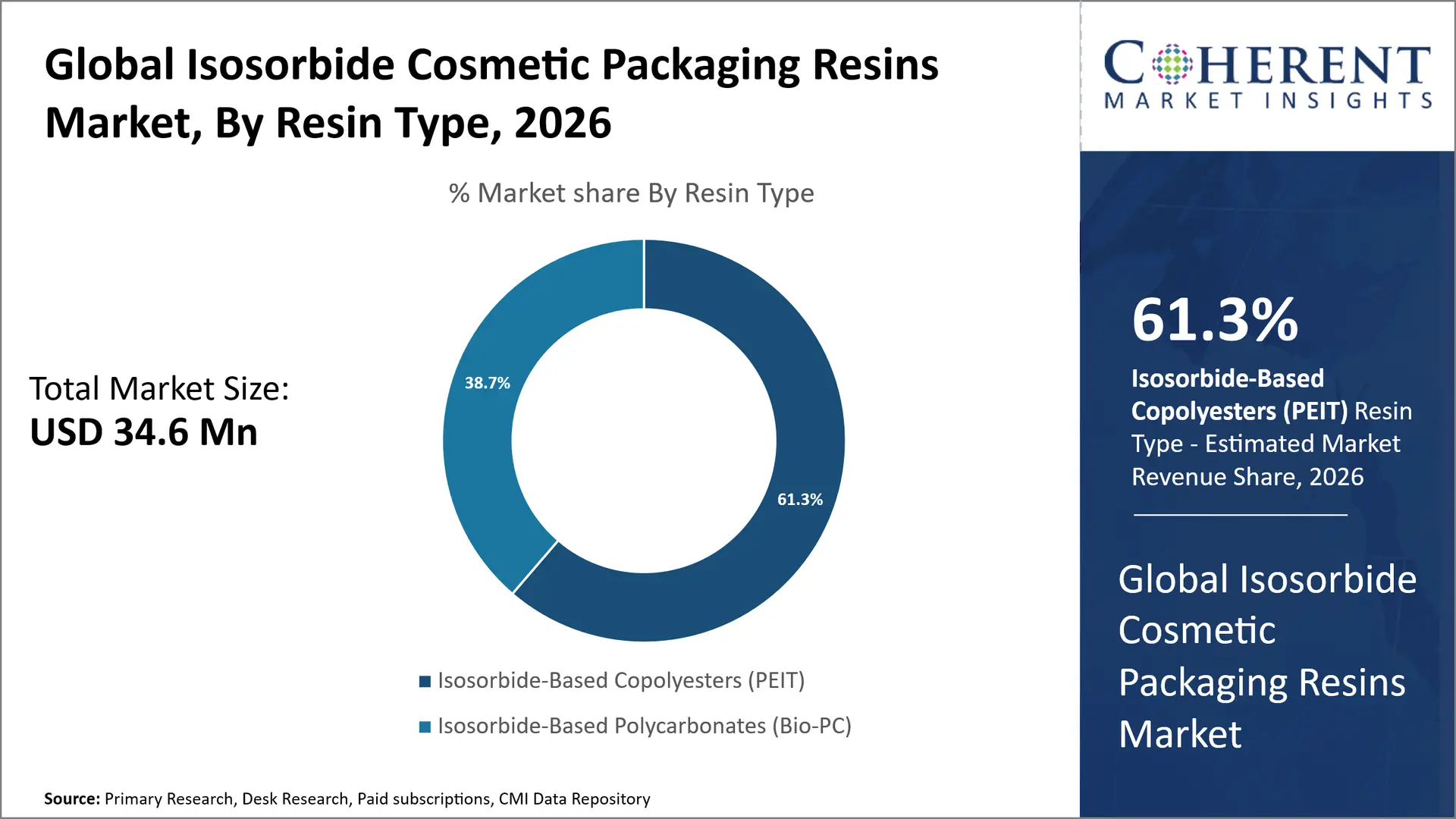
Why Do Isosorbide-Based Copolyesters (PEIT) Lead Resin Types in the Global Isosorbide Cosmetic Packaging Resins Market?
Isosorbide-Based Copolyesters (PEIT) are expected to account for 61.3% of the global isosorbide cosmetic packaging resins market in 2026, due to the incorporation of isosorbide into a PET-based polyester architecture, which retains the transparent, rigid profile, needed for premium containers. This provides converters with a path to improve thermal and mechanical properties without changing completely to another resin family. The suitability of the material to known polyester processing and packaging formats enables development of grades for bottles, jars and clear parts. The commercial benefit of resin producers is to be able to customize the amount of isosorbide and characteristics of the polymer in order to meet a specific packaging application, not just bio-based content. In March 2025, a peer-reviewed study published in Biomacromolecules reported PEIT copolyesters with tunable thermal, mechanical, and optical properties, including up to 90% light transmittance. The study demonstrates technical potential, not commercial deployment.
- Current Industry Events of 2026
- Market Size Estimation
- Regional Breakdown
- Competitive Landscape
- Customer Intelligence
- Segmental Analysis
- Pricing Analysis
- Key Market Drivers, Challenges & Future Trends
- Customized Insights Section
Why Do Bottles Represent the Largest Packaging Type in the Global Isosorbide Cosmetic Packaging Resins Market?
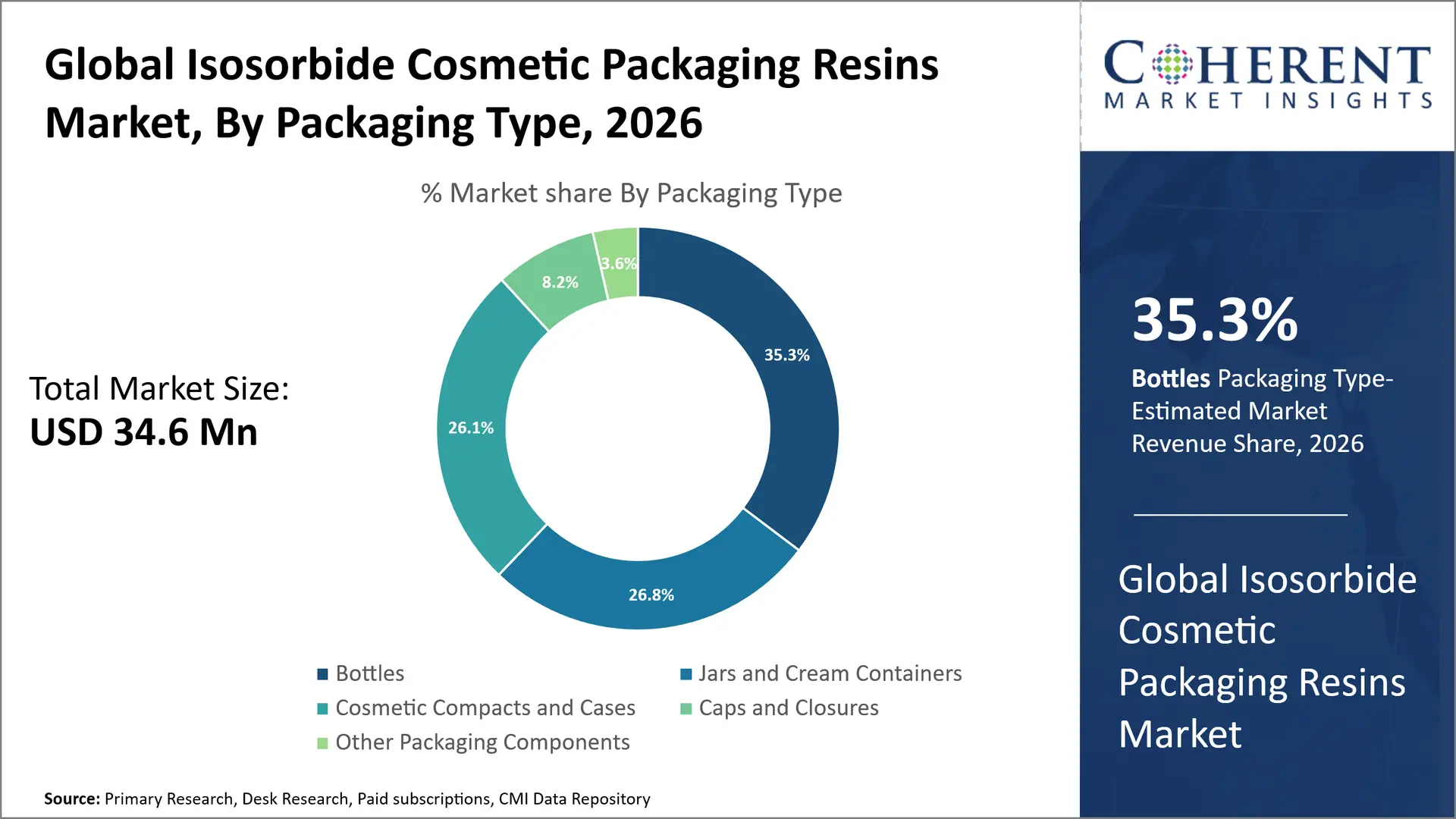
Bottles are projected to make up 35.3% of the global isosorbide cosmetic packaging resins market in 2026. This position reflects their versatility across liquid and semi-liquid beauty products, including cleansers, toners, lotions, serums, shampoos, and fragrances. Bottle neck finishes and body geometries can be customized to accommodate pumps, sprays, droppers, and flip-top closures without requiring a complete redesign of the packaging structure. This flexibility allows converters to manufacture multiple container sizes for different product lines and brands. Resin suppliers can also develop grades that meet specific transparency, impact resistance, and formulation compatibility requirements. In February 2026, Amcor introduced its Mocha bottle range for beauty and personal care in 100, 250 and 500 ml sizes featuring customizable finishes and pump or flip-top options. This is an example of the versatility of the bottle format and not isosorbide-resin adoption.
Why Does Skin Care Packaging Lead Applications in the Global Isosorbide Cosmetic Packaging Resins Market?
Skin Care Packaging is projected to hold 38.6% share in the global isosorbide cosmetic packaging resins market in 2026, reflecting the diverse protection and dispensing requirements of skincare products. These include lightweight serums, eye treatments, creams, and lotions. Packaging must help maintain formulation integrity while supporting controlled dispensing, hygienic use, refillability, and a premium tactile experience. These requirements create opportunities for isosorbide-based resins in outer housings, refillable containers, jars, and precision-molded components, where optical quality and dimensional stability influence product presentation and consumer experience. Skincare product portfolios can also create multiple component-level opportunities for resin suppliers within a single brand. In May 2026, Aptar described its reloadable airless packaging developed with Clarins for Total Eye Lift Eye Cream, highlighting the importance of formulation protection and refill engineering in this particular application. Isosorbide resin is not mentioned in the example.
Current Events and their Impact
Current Event | Description and Its Impact |
February 2025 – Oregon approves its Packaging Producer Responsibility Plan |
|
May 2026 – California approves permanent SB 54 packaging regulations |
|
Global Isosorbide Cosmetic Packaging Resins Market Dynamics
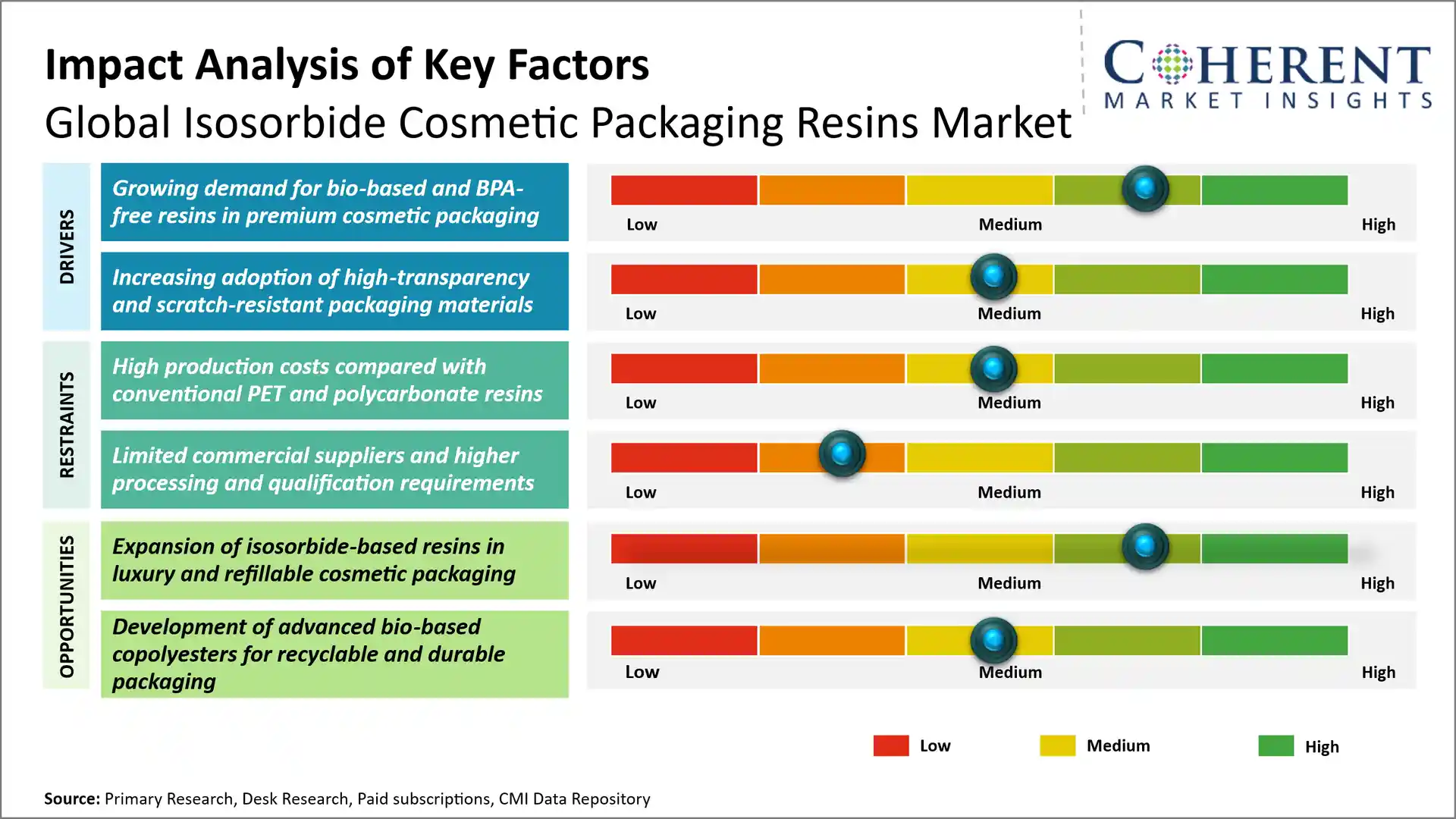
Key Market Drivers
- Growing Adoption of Bio-Based and BPA-Free Resins in Premium Cosmetic Packaging: The shift toward plant-derived engineering plastics is generating a commercial opportunity for isosorbide-based copolyesters (PEIT) and bio-based polycarbonates (Bio-PC). These materials provide cosmetic packaging manufacturers an opportunity to reduce dependence on conventional petroleum-based polymers while still delivering the material performance required for premium packaging. Resin makers, packaging converters and luxury beauty brands can benefit from differentiated material portfolios. In April 2026, SK Chemicals showcased ECOZEN-based cosmetic products at Chinaplas 2026, demonstrating the commercial positioning of biomass-based copolyesters in beauty packaging. This strengthens the case for incorporating renewable monomers into established cosmetic packaging applications.
- Increasing Preference for High-Transparency and Chemically Resistant Packaging Materials: High-end cosmetic packaging demands materials that maintain the product’s visual appeal, resist degradation caused by the formulation, and allow the product to be seen during storage and handling. Isosorbide-based PEIT and Bio-PC can replace conventional polymers in applications requiring chemical resistance, surface hardness, heat resistance and optical clarity. These properties make them of commercial interest for decorative elements for cosmetic, skincare packaging and perfumes containers. In December 2025, a study by NIH researchers stressed the importance of monomer purity in the development of high-performance resins. The study showed that the thermal and optical properties of the bio-based polycarbonate that was synthesized were bettered by purifying isosorbide.
Emerging Market Trends
- Shift Towards Refillable and Modular Cosmetic Packaging Architectures: The cosmetic packaging industry is gradually shifting toward durable outer shells with replaceable inner reservoirs, cartridges, and refillable components. This transition changes material requirements from single-use containment to repeated-use performance, including dimensional stability, closure retention, and resistance to cleaning agents.
- Impact: Resin suppliers offering grades suitable for repeated handling and formulation exposure can gain new qualification opportunities. Conventional single-use packaging designs may require structural modifications.
- Relevance of market: Isosorbide-based PEIT and Bio-PC could be evaluated for long-life outer casings, refill interfaces and reusable cosmetic components.
- Increasing Use of Multi-Material Molding and Decorative Surface Engineering: Premium cosmetic packaging is evolving towards layered optical effects, tactile finishes, translucent and opaque contrasts, and customized surface treatments. This increases the importance of co-injection, overmolding, and precision-controlled material flow.
- Impact: Resin formulators and packaging converters are required to enhance interfacial adhesion, shrinkage control and molding consistency to maintain the quality of the end product.
- Relevance of market: Isosorbide-based resins can allow for differentiated packaging designs. However, multi-material construction introduces additional recycling and material separation considerations.
Regional Insights
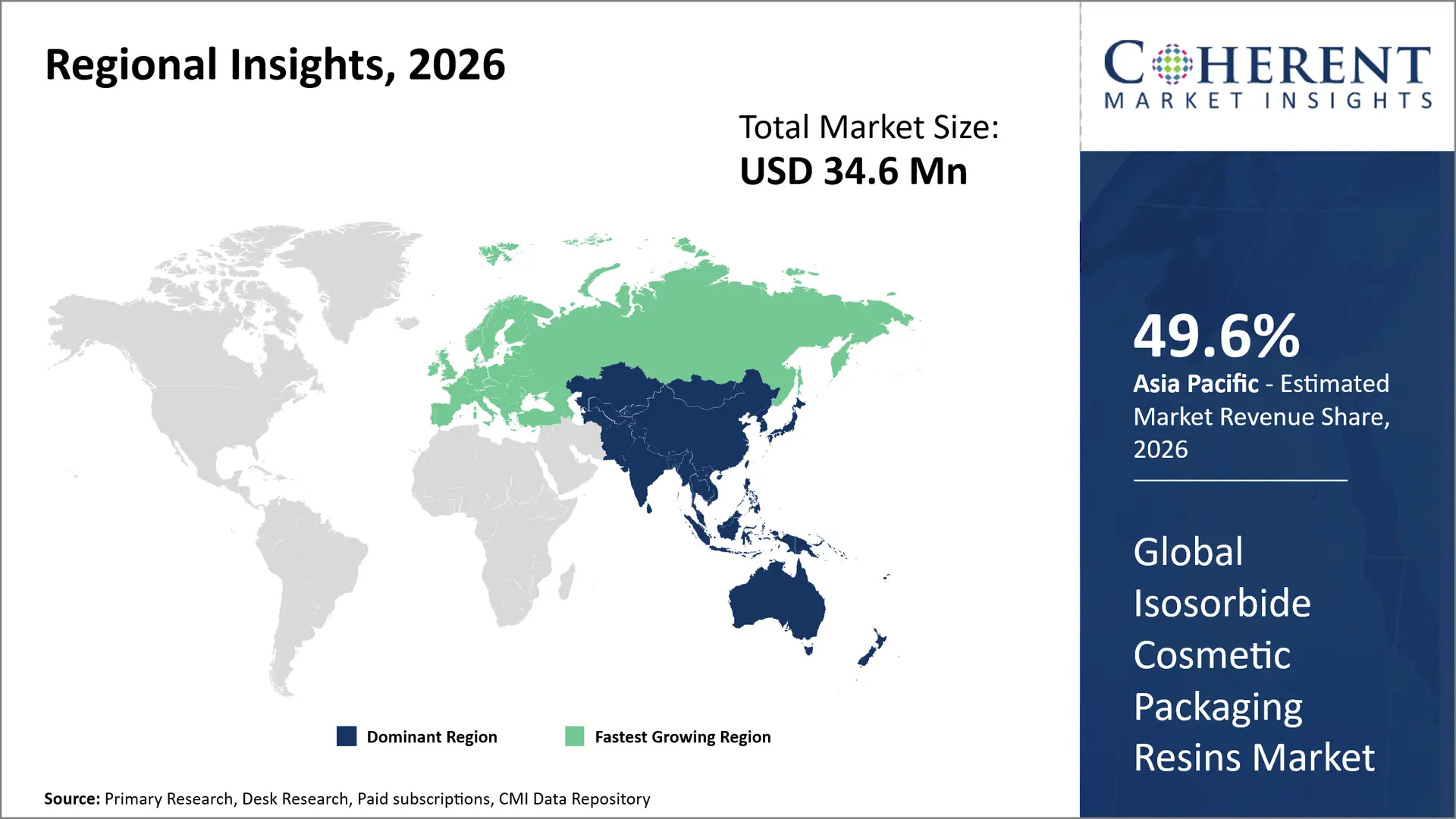
Why Does Asia Pacific Dominate the Global Isosorbide Cosmetic Packaging Resins Market?
Asia Pacific is expected to account for 49.6% of the global isosorbide cosmetic packaging resins market in 2026, supported by its concentration of cosmetics manufacturers, packaging converters, polymer producers, and beauty product supply chains. China, Japan, South Korea and India provide complementary capabilities in specialty material development, precision molding, packaging decoration and cosmetic formulation. The presence of domestic beauty brands alongside international manufacturers creates opportunities for resin suppliers to qualify materials across multiple packaging formats. In May 2025, the 29th China Beauty Expo opened in Shanghai, bringing together more than 3,200 cosmetics companies from over 40 countries and regions. The event included supply-chain participants specializing in packaging, machinery, and raw materials, demonstrating the region's extensive commercial ecosystem for cosmetic packaging innovation.
Why Is Europe Emerging as the Fastest-Growing Region in the Global Isosorbide Cosmetic Packaging Resins Market?
Europe is expected to be the fastest growing region and have a 28.7% share of the global cosmetic packaging resins market for isosorbide in 2026. The expansion is helped by the concentration of premium beauty brands, specialist packaging designers and converters that adapt materials to stricter circularity and recyclability requirements. This opens up opportunities to explore bio-based copolyesters and polycarbonates where performance can be demonstrated without detriment to compatibility with collection and recycling. Suppliers of resins that can document the origin of their feedstock, the composition of their materials and the end of life pathways of their products will be in a better position during customer qualification. In June 2025, the UK government published the first-year packaging EPR base fees for 2025–2026, establishing material-based waste-management charges for obligated producers. This increases the commercial importance of packaging design and end-of-life economics.
Global Isosorbide Cosmetic Packaging Resins Market Outlook for Key Countries
Why Does China Support Growth in the Global Isosorbide Cosmetic Packaging Resins Market?
China is a key global isosorbide cosmetic packaging resins market because it combines a large domestic cosmetics sector with extensive local manufacturing, contract formulation, and packaging-conversion capabilities. The resulting product diversity, from skincare formulations to colour cosmetics and fragrances, requires packaging across transparent, opaque, decorative, and dispensing formats. This creates a broad potential customer base for specialty resin suppliers, although adoption of isosorbide-based grades depends on cost, converter trials, and compatibility validation. In November 2025, China's National Medical Products Administration issued 24 reform measures to strengthen cosmetics quality oversight, encourage innovation, and improve supply-chain risk management. The policy direction reinforces the importance of reliable packaging inputs and documented material performance for brands and contract manufacturers.
Why Is the U.S. a Key Market for the Global Isosorbide Cosmetic Packaging Resins Market?
The United States is important in the global isosorbide cosmetic packaging resins market because it combines large beauty brand owners, premium personal-care demand, and a domestic network of packaging converters and contract manufacturers. Product differentiation in skincare, haircare, and colour cosmetics supports demand for engineered materials that meet appearance, durability, and formulation-contact requirements. For isosorbide resin suppliers, commercial entry will depend on brand qualification, compatibility testing, and converter access rather than resin availability alone. In October 2025, GPI Beauty reported that its new R4 Industrial USA facility had opened as a domestic flexible-tube manufacturing hub for beauty, skincare, and personal-care brands. This illustrates investment in local packaging conversion and shorter supply chains, although it is not evidence of isosorbide-resin use.
Why Is Japan Important in the Global Isosorbide Cosmetic Packaging Resins Market?
Japan’s importance stems from its strong base in cosmetic R&D, high standards of product presentation, and established expertise in precision packaging design and manufacture. Domestic brands need containers that dispense product in a controlled way, are easy to handle, protect the formula and look premium. These needs open the door for specialty copolyesters and polycarbonates where the performance of the material justifies the higher cost. Japanese manufacturers also provide process know-how that can help resin suppliers validate complex container geometries. Shiseido launched its LiquiForm bottle-molding-and-filling process for pump dispenser containers in May 2025, which uses about 56% less plastic than previous containers. The development is to highlight the capabilities in packaging engineering in Japan, rather than to confirm the adoption of isosorbide resin.
Why Is India Important in the Global Isosorbide Cosmetic Packaging Resins Market?
India's importance is supported by its expanding branded beauty and personal care industry and a manufacturing ecosystem developing specialized formulation and packaging capabilities. Consistent molding-grade resins are commercially valuable because contract manufacturers and packaging converters serve domestic beauty brands while developing export-oriented operations. The opportunities for PEIT and Bio-PC based on isosorbide are more likely to arise first in trials with premium rigid packs and components than in general substitution in low-cost formats. kdc/one and Clarion announced their joint venture in December 2025, and a Gujarat facility under development for cosmetic and personal-care packaging, including molding and decorative processes. The project is an example of local investment in integrated packaging capabilities.
Why Is South Korea Important in the Global Isosorbide Cosmetic Packaging Resins Market?
South Korea is strategically relevant because its beauty industry links fast-moving brand development with specialized OEM/ODM manufacturers, packaging designers, and domestic petrochemical suppliers. This structure can shorten material-evaluation cycles and create opportunities for customized resin grades used in compact cases, jars, caps, and transparent components. Suppliers must nevertheless demonstrate compatibility with the exact molding, decoration, and recycling specifications required by brand owners. In March 2025, LG Chem announced that it would present sustainable cosmetic containers made from bio-circular and circular-balanced materials, alongside recyclable packaging films, at Cosmoprof Worldwide Bologna. The announcement illustrates the country's specialty-material capabilities serving global beauty customers, but does not indicate isosorbide-based resin use.
Resin Innovation, Processing & Manufacturing Landscape in Global Isosorbide Cosmetic Packaging Resins Market
Technology | Application in Cosmetic Packaging | Adoption Status | Market Impact |
Isosorbide-Based PEIT Copolymerization | Incorporation of isosorbide into PET-based copolyesters for cosmetic bottles, jars, and rigid containers. | Commercial | Enhances thermal performance, optical clarity and mechanical properties for higher performance alternatives to conventional PET. |
Isosorbide-Based Bio-PC Polymerization | Production of BPA-free polycarbonate for transparent compact cases, decorative components, and premium packaging housings. | Commercial, niche applications | BPA free polycarbonate production for clear compact cases, decorative parts and luxury packaging housings. |
High-Purity Isosorbide Purification | It offers high quality packaging designs that feature high transparency, low birefringence, scratch resistance and surface hardness. | Emerging process development | Removal of impurities from the isosorbide feed stock prior to polymerization. |
Precision Injection Molding | Maintain consistent molecular weight, polymerization efficiency and optical quality in specialty resin grades. | Established commercial process | Production of cosmetic compacts, caps, closures, jars and decorative packaging components. |
Injection Stretch Blow Molding (ISBM) | Complex geometries, controlled surface finishes, dimensional accuracy and efficient component manufacture. | Application-specific commercial adoption | Production of light-weight and transparent cosmetic bottles, and hollow packaging elements. |
Multi-Material Co-Injection and Overmolding | It offers visual quality with controlled wall thickness, material distribution and bottle strength. | Selective and emerging adoption | Use of isosorbide-based resins in combination with other polymers for layered packaging, decorative shells and functional parts. |
How Are Precision-Molded Dispensing Components Creating New Growth Opportunities in the Global Isosorbide Cosmetic Packaging Resins Market?
An underdeveloped opportunity is precision-molded dispensing and closure components (airless-pump housings, collars, actuator shells, dropper assemblies, refill interfaces, and compact hinges). The dimensional stability, stress-crack resistance and consistent surface finishes of these parts are of commercial importance given the repeated mechanical loading and exposure to fragrances, alcohols, oils, surfactants and UV filters.
Pump manufacturers, packaging converters, and skincare and fragrance brands can collaborate with suppliers of isosorbide-based PEIT and Bio-PC to qualify application-specific resin grades. Commercial participation requires formulation compatibility testing, mold-flow optimization, tooling trials, and validation of component performance after repeated use.
Co-development at component level offers an opportunity for specialist resin producers to access a route to market, while established polymer manufacturers can use their polymerization capabilities and supply reliability to secure larger customer programs. But the price of premium resin is a hurdle. Suppliers should focus on applications where the advantages of improved durability, lighter parts or extended service life can justify the higher material price.
Market Players, Key Developments, and Competitive Landscape
Key Developments
- In October 2026, Avantium completed the spin-out of Parana Technology into Parana Materials, an independent company developing plant-based high-performance polyesters, including PEIT and PEIF. Its 2025 annual report records application testing with a major cosmetic brand. The transaction creates a dedicated commercialization route, not a confirmed commercial launch.
- In March 2024, Koza Novel Materials published its PCT application WO2024045640A1, outlining a PEIT synthesis route using isosorbide and BHET recovered from polyester waste. The disclosure identifies cosmetic packaging among potential uses; publication signals process development, not a confirmed commercial resin launch.
Competitive Landscape
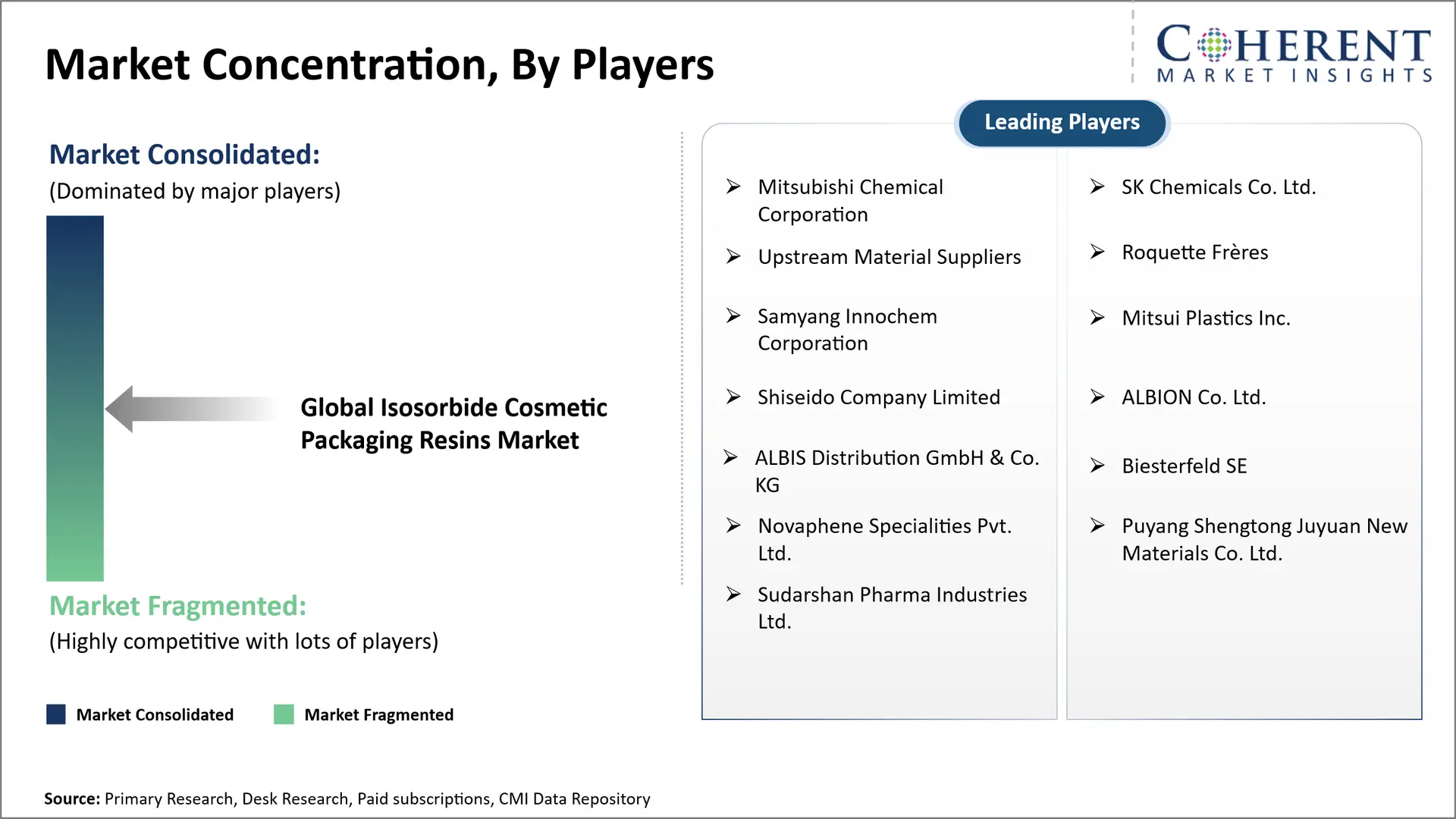
The global isosorbide cosmetic packaging resins market appears moderately concentrated at the resin-platform level, with a limited group of specialty polymer producers possessing established isosorbide-based PEIT and Bio-PC technologies. Downstream packaging converters and molders operate across a more dispersed supplier base. Competition depends on polymer consistency, optical performance, chemical resistance, processing efficiency, pricing, supply reliability, and customer qualification capabilities.
Key Focus Areas Include
- Isosorbide Feedstock Security: Reliable sourcing, monomer purity, and consistent raw-material specifications.
- Polymerization Efficiency: Enhanced incorporation of isosorbide, conversion rates, molecular weight, and tunable thermal properties.
- Material Performance: chemical compatibility, scratch resistance, transparency, haze control, impact strength.
- Manufacturing Efficiency: Higher manufacturing yields, production cycle times, blow molding and injection molding.
- Product Customization: Component specification, color consistency, surface finishes and grades of resin customized to the specific application.
- Customer Qualification: Technical support, Formulation testing, Mold trials, Collaboration with cosmetic packaging manufacturers.
- Circularity and Compliance: Material recovery validation, recyclability assessment, feedstock traceability, and packaging regulatory compliance.
Market Report Scope
Isosorbide Cosmetic Packaging Resins Market | |||
Report Coverage | Details | ||
Base Year | 2025 | Market Size in 2026: | USD 34.6 Mn |
Historical Data For: | 2020 to 2024 | Forecast Period: | 2026 to 2033 |
Forecast Period 2026 To 2033 CAGR: | 18.70% | 2033 Value Projection: | USD 114.9 Mn |
Geographies covered: |
| ||
Segments covered: |
| ||
Companies covered: | Mitsubishi Chemical Corporation, SK Chemicals Co. Ltd., Upstream Material Suppliers, Roquette Frères, Samyang Innochem Corporation, Mitsui Plastics Inc., Shiseido Company Limited, ALBION Co. Ltd., ALBIS Distribution GmbH & Co. KG, Biesterfeld SE, Novaphene Specialities Pvt. Ltd., Puyang Shengtong Juyuan New Materials Co. Ltd., Sudarshan Pharma Industries Ltd. | ||
Growth Drivers: |
| ||
Restraints & Challenges: |
| ||
Analyst Opinion (Expert Opinion)
- The global isosorbide cosmetic packaging resins market is likely to transition from competition based on individual resin properties toward the delivery of application-qualified packaging solutions. Competitive leadership will increasingly depend on combining resin-grade development, processing support, formulation-specific testing, and reliable supply. Claims about bio-based material content alone are unlikely to secure long-term customer relationships.
- Closed-loop recovery of polyester feedstocks could fundamentally change the economics of isosorbide-based resins. If polyester intermediates can be reliably purified and reincorporated with isosorbide, virgin-feedstock dependence could be reduced. This would be good for players with advanced polymer chemistry, purification and recycling capabilities, but a challenge for suppliers that rely solely on conventional virgin-resin production.
- Market participants should consider chemical compatibility, resin consistency, moldability and proven recovery pathways before committing to additional production capacity. Brands and converters should qualify materials on finished-pack performance not just renewable origin. Key risks include high resin costs, limited availability of feedstock and uncertain recycling economics. Investments should be made only in customer-backed applications and in proven converter partnerships, not in speculative capacity expansion.
Speak to the analyst
Want personalized insights?
Take the findings above to one of our principal consultants, or have the report rebuilt around the segments, geographies and competitors you actually track.
Market Segmentation
- Resin Type Insights (Revenue, USD Mn, 2021 - 2033)
- Isosorbide-Based Copolyesters (PEIT)
- Isosorbide-Based Polycarbonates (Bio-PC)
- Packaging Type Insights (Revenue, USD Mn, 2021 - 2033)
- Bottles
- Jars and Cream Containers
- Cosmetic Compacts and Cases
- Caps and Closures
- Other Packaging Components
- Application Insights (Revenue, USD Mn, 2021 - 2033)
- Skin Care Packaging
- Fragrance Packaging
- Color Cosmetics Packaging
- Hair Care Packaging
- Other Personal Care Packaging
- Processing Method Insights (Revenue, USD Mn, 2021 - 2033)
- Injection Molding
- Blow Molding
- Extrusion and Other Processes
- Sales Channel Insights (Revenue, USD Mn, 2021 - 2033)
- Direct Manufacturer Sales
- Specialty Resin Distributors
- Regional Insights (Revenue, USD Mn, 2021 - 2033)
- North America
- U.S.
- Canada
- Latin America
- Brazil
- Argentina
- Mexico
- Rest of Latin America
- Europe
- Germany
- U.K.
- Spain
- France
- Italy
- Russia
- Rest of Europe
- Asia Pacific
- China
- India
- Japan
- Australia
- South Korea
- ASEAN
- Rest of Asia Pacific
- Middle East
- GCC Countries
- Israel
- Rest of Middle East
- Africa
- South Africa
- North Africa
- Central Africa
- North America
- Key Players Insights
- Mitsubishi Chemical Corporation
- SK Chemicals Co. Ltd.
- Upstream Material Suppliers
- Roquette Frères
- Samyang Innochem Corporation
- Mitsui Plastics Inc.
- Shiseido Company Limited
- ALBION Co. Ltd.
- ALBIS Distribution GmbH & Co. KG
- Biesterfeld SE
- Novaphene Specialities Pvt. Ltd.
- Puyang Shengtong Juyuan New Materials Co. Ltd.
- Sudarshan Pharma Industries Ltd.
Sources
Primary Research Interviews
- Isosorbide, PEIT, and Bio-PC resin manufacturers
- Cosmetic packaging converters, molders, beauty brands, and specialty resin distributors
Stakeholders
- Bio-based monomer and specialty polymer producers
- Cosmetic packaging manufacturers, material suppliers, and sustainability certification providers
End-use Sectors
- Skin care, fragrance, color cosmetics, hair care, and personal care
- Cosmetic bottles, jars, compacts, cases, caps, and closures
Regulatory and Industry Bodies
- European Chemicals Agency (ECHA)
- European Commission (EC)
- U.S. Environmental Protection Agency (EPA)
- U.S. Food and Drug Administration (FDA)
Databases
- UN Comtrade and ITC Trade Map
- Eurostat PRODCOM and industrial production statistics
- ISCC PLUS certification database
- WIPO PATENTSCOPE and Google Patents
Magazines and Journals
- Polymer
- ACS Sustainable Chemistry & Engineering
- Journal of Applied Polymer Science
- Green Chemistry
Associations
- European Bioplastics (EUBP)
- PlasticsEurope
- Cosmetic, Toiletry and Perfumery Association (CTPA)
- Personal Care Products Council (PCPC)
Public Domain Sources
- PEIT and Bio-PC technical datasheets, annual reports, and sustainability disclosures
- Cosmetic packaging product specifications, resin capacity announcements, and recycling studies
- Bio-based polymer research, patent publications, and life cycle assessments
Key Standards and Regulations
- EU REACH Regulation (EC) No. 1907/2006
- EU Packaging and Packaging Waste Regulation (EU) 2025/40
- ISO 14040/14044 – Life Cycle Assessment
- ISO 14067 – Product Carbon Footprint
- ASTM D6866 – Bio-based Carbon Content
- ISCC PLUS – Sustainability and Mass-Balance Certification
Proprietary Elements
- CMI Data Analytics Tool and proprietary research repository, supported by primary interviews, isosorbide resin consumption modeling, cosmetic packaging demand assessments, pricing analysis, and competitive intelligence.
Get access to 250+ pages report
Every segment, forecast, competitor profile and data table behind the analysis above — available for instant download.
- ESOMAR Member
- ISO 9001:2015 Certified
- D-U-N-S Registered
- GDPR & CCPA Compliant
Frequently Asked Questions
The CAGR of the global isosorbide cosmetic packaging resins market is projected to be 18.70% from 2026 to 2033.
The global isosorbide cosmetic packaging resins market is estimated to be valued at USD 34.6 million in 2026 and is projected to reach USD 114.9 million by 2033.
The report covers the historical market context and provides market forecasts from 2026 to 2033, including revenue projections and growth analysis.
The report covers market forecasts, competitive landscape, technology trends, regulatory insights, pricing considerations, and emerging investment opportunities.
The major buyers are cosmetic packaging makers, plastic packaging converters, specialty packaging component producers, and beauty brands looking for sustainable packaging materials.
The report examines opportunities in specialty resin development, sustainable packaging innovation, manufacturing partnerships, supply chain expansion, and commercialization of bio-based packaging solutions.
The growing demand for bio-based and BPA-free resins in premium cosmetic packaging, along with the increasing use of transparent and scratch-resistant packaging materials, is driving the growth of the global isosorbide cosmetic packaging resins market.