

Global Kaempferol Market Size and Forecast – 2026 To 2033
The Global Kaempferol Market is estimated to be valued at USD 78.3 Mn in 2026 and is expected to reach USD 127.4 Mn by 2033, growing at a compound annual growth rate (CAGR) of 7.2% from 2026 to 2033. Market growth is supported by broader use of kaempferol in pharmaceutical research, dietary supplements, functional formulations, and cosmetic applications, particularly where its antioxidant, anti-inflammatory, and bioactive properties are being investigated.
Formulation research aimed at overcoming kaempferol’s limited solubility and skin permeability is also widening its potential use in advanced delivery systems. In February 2026, PubMed researchers published a study developing a milk-exosome-based topical emulsion containing kaempferol and quercetin that demonstrated improved antioxidant and anti-skin-aging performance in preclinical testing, highlighting the compound’s expanding relevance in advanced cosmetic formulations.
Key Takeaways of the Global Kaempferol Market
- 98% and Above kaempferol is projected to expand at an estimated CAGR of 7.8% and hold 58.7% of the global kaempferol market in 2026, reflecting its fit for reproducible assays, controlled formulations, and impurity-sensitive research. In November 2025, Shanghai Jiao Tong University researchers used ≥98% purity kaempferol to develop a ZIF-8 delivery system that improved solubility and bioavailability, reinforcing demand for high-specification material.
- Natural Plant-derived kaempferol is expected to grow at an estimated CAGR of 7.6% and account for 72.6% of the market in 2026, supported by established botanical extraction routes and preference for naturally originated bioactives. In July 2025, Scientific Reports published research isolating kaempferol from Impatiens balsamina flowers for antidiabetic and anti-glycation investigation, validating plant material as a practical feedstock for value-added kaempferol development.
- Pharmaceutical and Life Science Research is projected to advance at an estimated CAGR of 8.0% and represent 39.8% of the market in 2026, as kaempferol remains actively investigated across inflammation, oxidative stress, signaling pathways, and formulation science. In February 2025, Cytokine published a review detailing kaempferol’s effects on inflammatory mediators while emphasizing bioavailability, stability, dosage optimization, and further clinical investigation, sustaining demand for research-grade material.
- North America is anticipated to grow at an estimated CAGR of 6.9% and account for 32.6% of the global kaempferol market in 2026, supported by academic research depth, clinical investigation capacity, and specialty bioactive supply channels. In July 2026, Mito Discovery Alliance listed the University of Pittsburgh-sponsored KAPE study as recruiting in New York, Chapel Hill, and Pittsburgh to evaluate kaempferol pharmacokinetics and biological absorption in healthy adults.
- Asia Pacific is expected to record the fastest growth registering a CAGR of 8.6% and hold 30.4% of the market in 2026, supported by expanding flavonoid research and a broad institutional base evaluating plant-derived bioactives. In August 2024, China Academy of Chinese Medical Sciences researchers published a global bibliometric assessment identifying China and India among the major contributors to kaempferol research, reinforcing the region’s research-to-commercialization pipeline.
Segmental Insights
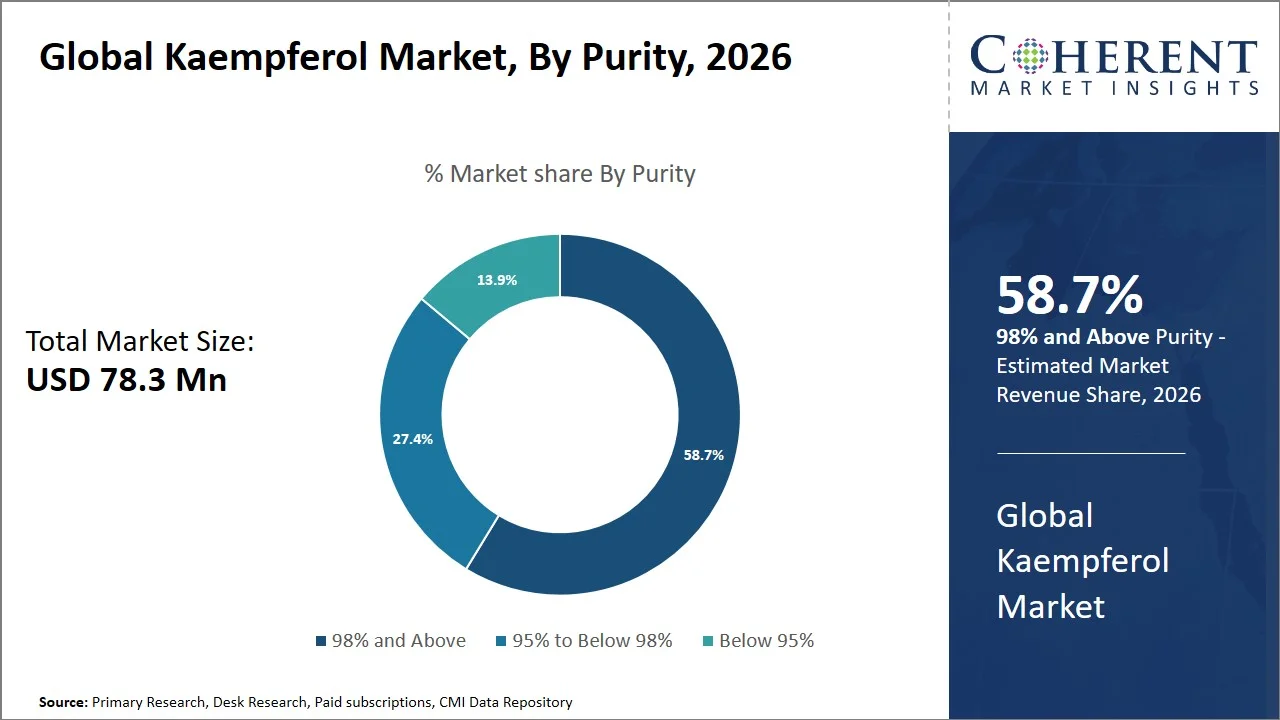
Why Does 98% and Above Dominate the Global Kaempferol Market?
The 98% and above purity segment is expected to hold 58.7% of the global kaempferol market in 2026 because high-assay material is preferred in pharmacological research, metabolic pathway studies, reference standard preparation, and formulation development, where even minor impurities can interfere with analytical accuracy and biological interpretation. Research laboratories, CROs, and specialty ingredient manufacturers prioritize reproducibility, certified purity levels, and batch-to-batch consistency, while suppliers benefit from higher margins due to additional purification and stringent quality-control processes. High-purity kaempferol is also more suitable for controlled dose-response experiments and advanced analytical method validation. In April 2024, scientists publishing in Food Chemistry: X utilized kaempferol with purity exceeding 98% (sourced from Chengdu Must Bio-Technology) to investigate its role in regulating lipid metabolism and inflammatory signaling pathways in experimental models. This reinforces the dependence of mechanistic research on highly purified flavonol compounds for reliable biochemical interpretation.
- Current Industry Events of 2026
- Market Size Estimation
- Regional Breakdown
- Competitive Landscape
- Customer Intelligence
- Segmental Analysis
- Pricing Analysis
- Key Market Drivers, Challenges & Future Trends
- Customized Insights Section
Why Does Natural Plant-Derived Kaempferol Represent the Largest Source Segment in the Global Kaempferol Market?
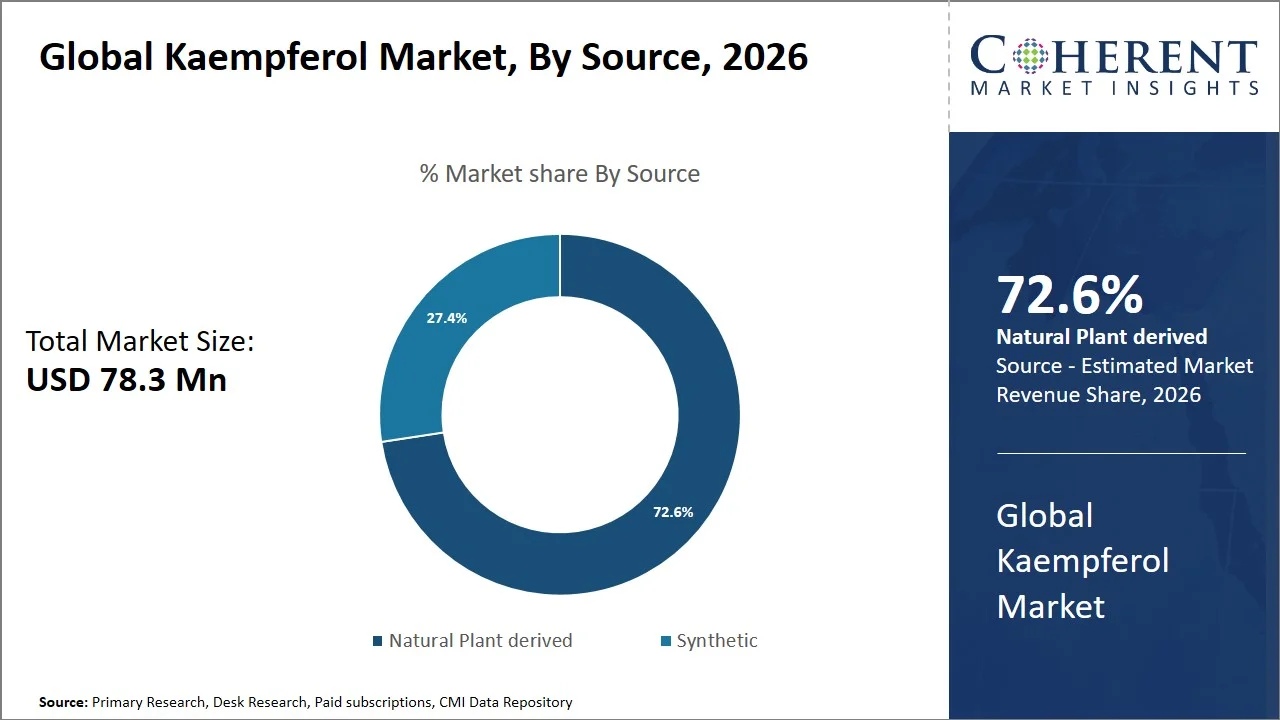
The natural plant-derived kaempferol segment is expected to account for 72.6% of the global kaempferol market in 2026 because botanical sourcing aligns with phytochemical research, nutraceutical development, and the growing preference for naturally derived bioactive ingredients. Kaempferol is widely distributed across leaves, flowers, fruits, and medicinal plants, providing multiple raw material sources for extraction and standardization. Through processes such as solvent extraction, fractionation, and chromatographic purification, manufacturers can produce both standardized extracts and isolated compounds suitable for research and formulation use. In June 2025, researchers in Plants (MDPI) reported the isolation of kaempferol from Ginkgo biloba leaves using ethanol-based extraction followed by column chromatography, and further evaluated its antioxidant and anti-inflammatory potential in cellular models. This demonstrates the continued reliance on plant-based extraction systems for obtaining characterized kaempferol for experimental applications.
Why Does Pharmaceutical and Life Science Research Dominate the Application Segment of the Global Kaempferol Market?
The pharmaceutical and life science research segment is expected to account for 39.8% of the global kaempferol market in 2026 because kaempferol is extensively used as a bioactive compound in studying disease mechanisms, signaling pathways, and therapeutic potential. Research demand is driven by its application in inflammation, oxidative stress, fibrosis, metabolic regulation, and drug-discovery studies, requiring consistent research-grade material across academic institutions, biotechnology companies, and contract research organizations. This segment also supports demand for derivatives, analytical standards, and structure–activity relationship studies, extending its value beyond bulk consumption. In January 2026, a study published in Biomedicine & Pharmacotherapy explored kaempferol-based molecular scaffolds as modulators of inflammatory signaling in preclinical disease models, highlighting their relevance in early-stage drug discovery and translational biomedical research.
Current Events and their Impact
Current Event | Description and Its Impact |
European Commission Authorization of Sage Tincture as a Feed Additive – July 2026 |
|
EFSA Safety Assessment of Camellia oleifera Seed Extract – October 2024 |
|
Global Kaempferol Market Dynamics
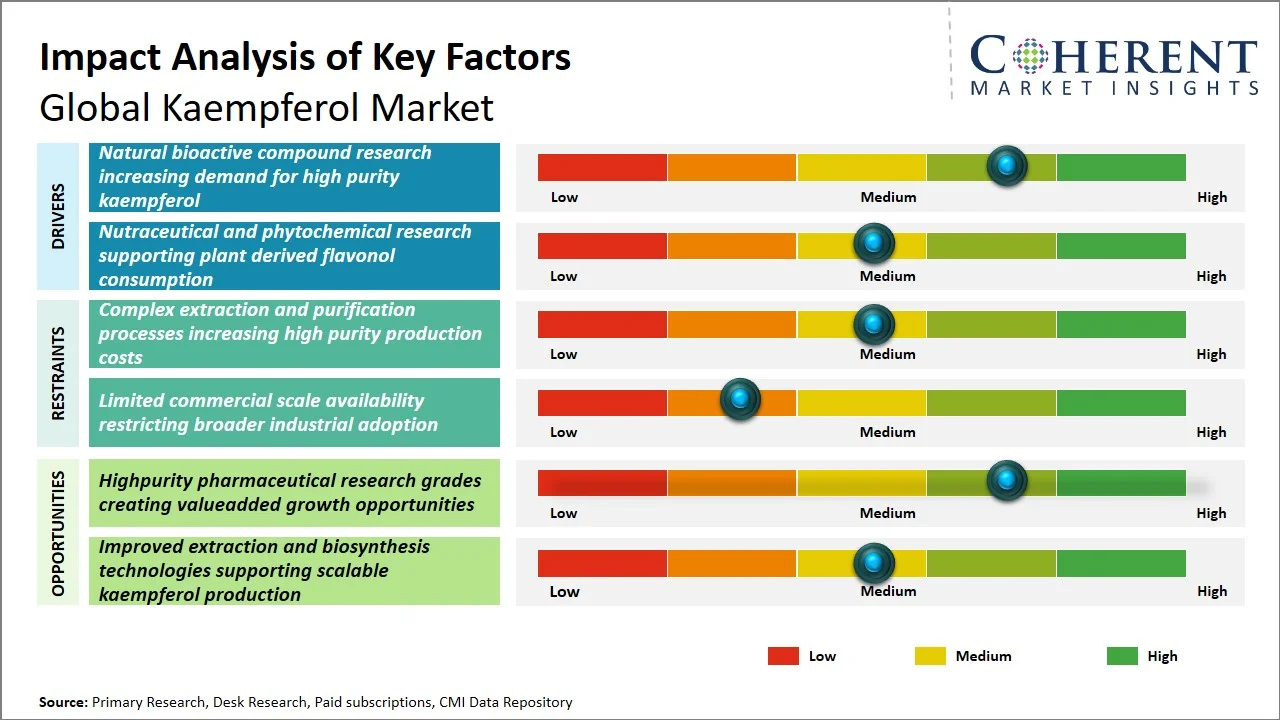
Key Market Drivers
- Natural bioactive compound research increasing demand for high purity kaempferol: Natural bioactive compound research is strengthening demand for high-purity kaempferol because pharmacology and preclinical studies require reproducible dosing, impurity control, and reliable analytical documentation. Higher-assay material supports more consistent evaluation of pathways, pharmacokinetics, toxicity, and formulation performance, benefiting research-chemical suppliers, analytical-standard providers, and specialist botanical processors. According to John Wiley & Sons, Inc researchers in Integrative Zoology used kaempferol with purity above 98% in an intestinal-health study in February 2026 involving Chinese forest musk deer, reinforcing the need for high-specification material in controlled biological research.
- Nutraceutical and phytochemical research supporting plant derived flavonol consumption: Nutraceutical and phytochemical research is expanding the commercial relevance of plant-derived kaempferol across functional foods, botanical formulations, and phytopharmaceutical studies. Suppliers can differentiate through botanical identity, extraction efficiency, solvent control, and standardized phytochemical profiles, while ingredient developers benefit from clearer links between plant source and biological activity. In May 2025, researchers in Phytomedicine Plus isolated kaempferol from Wattakaka volubilis leaves and evaluated its protective effects in an aluminium-induced liver-toxicity model, supporting continued interest in botanical kaempferol for bioactive research.
Emerging Market Trends
- Bioavailability Engineering Moving Kaempferol Beyond Conventional Powder Formats: Bioavailability engineering is shifting kaempferol development from basic powder supply toward more sophisticated delivery formats. Pharmaceutical, nutraceutical, and functional-food developers are exploring aglycone conversion, lipid carriers, polymeric systems, nanoencapsulation, and inclusion complexes to improve dispersion, stability, and biological availability. This raises the value of formulation-compatible grades, particle-size control, and technical support. Suppliers with delivery-system expertise may gain stronger pricing power, while vendors focused only on bulk powder could remain concentrated in lower-value research and transactional applications.
- Botanical Traceability Becoming a Procurement Requirement Rather Than a Marketing Attribute: Botanical kaempferol procurement is becoming more specification-intensive as buyers seek consistent plant origin, extraction history, contaminant control, residual-solvent compliance, and reproducible chromatographic profiles. This favors vertically integrated botanical processors that can connect cultivation, extraction, purification, and analytical release within one quality system. Traders’ dependent on variable spot sourcing may face longer qualification cycles and weaker customer retention. Over the forecast period, traceability and documentation are expected to become commercial differentiators that support premium positioning and stronger supplier relationships.
Regional Insights
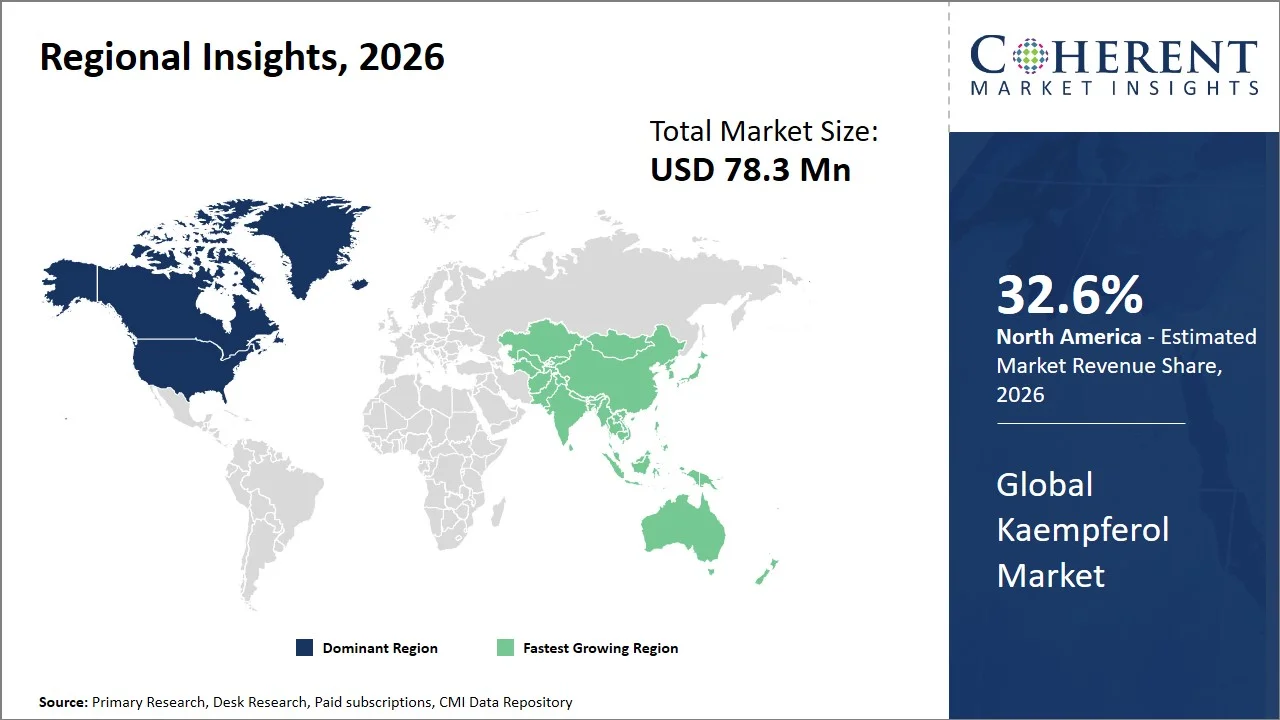
Why Does North America Dominate the Global Kaempferol Market?
North America is expected to account for 32.6% of the global kaempferol market in 2026, supported by a dense pharmaceutical and life-science research base, established nutraceutical manufacturing, and strong demand for analytically characterized botanical ingredients. The region also benefits from sophisticated testing infrastructure and buyers that place high value on purity documentation, toxicology evidence, and reproducible composition. These conditions favor suppliers capable of serving both research-grade and formulation-grade demand rather than competing only on bulk price. Regulatory scrutiny of complex plant extracts further increases the importance of constituent-level characterization. In January 2025, Health Canada and Environment and Climate Change Canada published a draft assessment of Ginkgo biloba extract that specifically identified kaempferol among its flavonoids and examined constituent-related safety evidence. This reinforces the commercial importance of quality control and regulatory-ready documentation for kaempferol-containing botanical products.
Why Is Asia Pacific Emerging as the Fastest-Growing Region in the Global Kaempferol Market?
Asia Pacific is expected to hold 30.4% of the global kaempferol market in 2026 and emerge as the fastest-growing region as botanical-resource availability converges with expanding pharmaceutical research, functional-food innovation, and synthetic-biology capability. China, India, and Japan provide distinct demand engines: China contributes scale in natural-product processing and biomanufacturing, India supports phytochemical research and traditional-medicine laboratories, while Japan is advancing functional applications. The region’s cost-competitive research and manufacturing base also supports experimentation with derivatives and delivery formats. In June 2025, according to ACS Publications affiliated with Tianjin University reported engineered Saccharomyces cerevisiae biotransformation of kaempferol into icaritin, using enzyme and cofactor engineering to improve production. The work illustrates how Asia Pacific laboratories are moving beyond conventional extraction toward metabolic-engineering routes that can expand the commercial value chain surrounding kaempferol.
Global Kaempferol Market Outlook for Key Countries
Why Is the U.S. a Key Market for the Global Kaempferol Market?
The U.S. is estimated to represent 27.3% of the global kaempferol market in 2026, making it the largest individual country market within the current scope. Its position reflects extensive biomedical laboratories, advanced preclinical infrastructure, a mature dietary-supplement industry, and steady procurement of high-purity flavonoids for mechanistic and translational studies. U.S. research capabilities are particularly relevant where kaempferol is evaluated under sophisticated models that require controlled dosing and analytically consistent material. This supports premium opportunities for research-grade suppliers and specialized distributors. In January 2026, Science reported that experiments at Brookhaven National Laboratory’s particle-accelerator facilities found kaempferol mitigated damage in mice and human tissues exposed to radiation doses comparable with lunar or Mars missions. The work illustrates the country’s ability to connect kaempferol with advanced space-biomedicine research beyond conventional nutraceutical applications.
Why Is Germany a Strategic Country in the Global Kaempferol Market?
Germany is estimated to represent 7.3% of the global kaempferol market in 2026, supported by advanced food science, phytochemical analytics, botanical ingredient research, and stringent quality expectations across nutraceutical and pharmaceutical supply chains. The country’s strength is less about low-cost bulk extraction and more about method development, controlled cultivation, analytical characterization, and premium applications where reproducibility matters. German research also links crop-production technology with flavonoid enrichment, creating upstream opportunities for controlled bioactive sourcing. In January 2025, involving Leibniz University Hannover, the Leibniz Institute of Vegetable and Ornamental Crops, Humboldt University Berlin, and the University of Göttingen reported that supplemental LED treatments altered kaempferol glycoside accumulation in pak choi. The work demonstrates Germany’s capacity to influence kaempferol-related value creation at the cultivation stage by combining horticultural technology with targeted phytochemical optimization.
Why Does China Support Growth in the Global Kaempferol Market?
China is estimated to account for 13.6% of the global kaempferol market in 2026, reflecting its combination of medicinal-plant resources, large-scale botanical extraction, research-chemical manufacturing, and rapidly advancing synthetic-biology capabilities. Domestic universities and ingredient producers can participate across the value chain, from plant-derived kaempferol and analytical standards to modified derivatives with higher application value. China’s fermentation and enzyme-engineering expertise also provides routes to reduce dependence on extraction yields for downstream flavonoid production. In April 2025, researchers from Jiangnan University published work on efficient biosynthesis of 8-prenylkaempferol from kaempferol using a flavonoid 8-dimethylallyltransferase derived from Epimedium koreanum. This demonstrates China’s ability to use kaempferol as a platform molecule for higher-value bioconversion, supporting pharmaceutical, functional-ingredient, and natural-product development programs.
Why Is India Important in the Global Kaempferol Market?
India is estimated to hold 5.4% of the global kaempferol market in 2026, supported by its large phytochemistry research network, traditional-medicine institutions, botanical raw-material base, and cost-competitive analytical laboratory ecosystem. Demand is particularly relevant for reference standards, herbal-drug characterization, HPTLC and HPLC method development, and studies linking medicinal plants with identifiable flavonoid markers. This creates opportunities for suppliers offering smaller research packs with verified purity rather than only bulk nutraceutical material. In November 2025, a government e-Marketplace tender for the Ministry of AYUSH’s Regional Research Institute of Unani Medicine in Chennai specified kaempferol at more than 97% purity among ten phytochemical reference standards required with an HPTLC system. The procurement directly demonstrates institutional demand for kaempferol as an analytical marker within India’s government-supported phytochemical research infrastructure.
Why Is Japan an Important Growth Market for the Global Kaempferol Market?
Japan is estimated to account for 4.8% of the global kaempferol market in 2026, supported by its established functional-food sector, precision-nutrition research, aging-related health innovation, and ability to translate botanical science into consumer-oriented formulations. Japanese developers are particularly relevant because they are investigating kaempferol absorption, mitochondrial function, exercise performance, and differentiated processing of naturally occurring glycosides. This creates demand for purified material, standardized botanical sources, and application-specific forms. In April 2026, Science Japan reported that researchers had identified kaempferol from horseradish leaves as a mitochondrial-activating compound and had conducted five human trials, including a randomized study in Nagano Prefecture. The program demonstrates Japan’s progression from compound screening to human validation, strengthening the country’s position in premium nutraceutical and functional-health applications.
Technology Adoption Landscape in the Global Kaempferol Market
Technology | Adoption Level | Key Application Area | Business Impact |
High-Performance Liquid Chromatography (HPLC) | High | Purity determination, batch release, reference-standard testing | Enables precise assay verification and consistent specification control, strengthening buyer confidence in pharmaceutical, research, and premium nutraceutical grades. |
LC-MS/MS and UPLC-MS Analytical Profiling | High | Trace-level quantification, metabolite analysis, pharmacokinetic research | Improves sensitivity and selectivity when measuring kaempferol and its metabolites in complex matrices, supporting advanced research and analytical-service demand. |
Macroporous Resin and Column Chromatography Purification | High | Botanical extract fractionation and high-purity kaempferol production | Supports scalable separation of flavonoids from plant extracts and enables manufacturers to move botanical feedstocks toward higher-value standardized grades. |
Ultrasound-Assisted Extraction | Medium | Recovery of kaempferol from leaves, fruits, herbs, and botanical residues | Can shorten extraction cycles and improve contact between solvent and plant material, offering processors opportunities to improve throughput and manage extraction costs. |
Enzyme-Assisted Glycoside Hydrolysis and Aglycone Conversion | Medium | Nutraceutical ingredient preparation and absorption-oriented formulation | Allows processors to convert naturally occurring kaempferol glycosides into targeted forms, creating differentiated ingredient formats and greater formulation flexibility. |
Nanoencapsulation and Advanced Carrier Systems | Low | Pharmaceutical, nutraceutical, and functional delivery systems | Offers a pathway to address formulation and delivery limitations, but commercialization requires stronger scale-up economics, stability validation, and application-specific regulatory support. |
How Is Agricultural Side-Stream Valorization Creating New Growth Opportunities in the Global Kaempferol Market?
Agricultural side-stream valorization can create a new supply route for kaempferol by recovering flavanols from plant materials that are currently underused after food, tea, herb, or vegetable processing. The opportunity is strategically attractive because it can diversify botanical feedstocks, improve raw-material economics, and give ingredient suppliers a circular-sourcing proposition without relying only on dedicated medicinal crops. Nutraceutical formulators, cosmetic active developers, functional-food companies, and analytical suppliers could benefit from standardized kaempferol fractions derived from validated side streams. Commercial capture requires more than extraction: producers need feedstock mapping, botanical identity controls, contaminant screening, scalable separation and purification, solvent-recovery systems, and evidence that seasonal variation does not compromise specification. Companies should also design traceability and regulatory documentation before approaching premium buyers. This opportunity is likely to favor vertically integrated botanical processors and specialized extraction companies that can secure side-stream contracts and convert variable biomass into reproducible ingredients. New entrants can participate, but only if they combine supply agreements with strong analytical and purification capabilities.
Market Players, Key Development, and Competitive Landscape
Recent Developments
- In July 2026, Shaanxi Green Bio-Engineering Co., Ltd introduced Kaempferol 98% Powder extracted from Sophora japonica fruit and standardized by HPLC. The launch strengthens high-purity botanical supply for nutraceutical, pharmaceutical research, food, and cosmetic applications while emphasizing traceability, analytical testing, and quality documentation.
- In April 2026, Pharmactive Biotech Products introduced Kyoh, a standardized Eruca sativa leaf extract containing kaempferol derivatives. The development expands kaempferol-related applications into beauty-from-within and nutricosmetic formulations, supporting value-added use of standardized botanical flavonols.
- In February 2026, Otsuka Pharmaceutical Co., Ltd released /zeroz, a functional food containing plant-derived kaempferol from horseradish leaves. Its processing converts kaempferol glycosides into the more absorbable aglycone form, demonstrating commercialization of kaempferol in differentiated consumer health and functional-food products.
Competitive Landscape
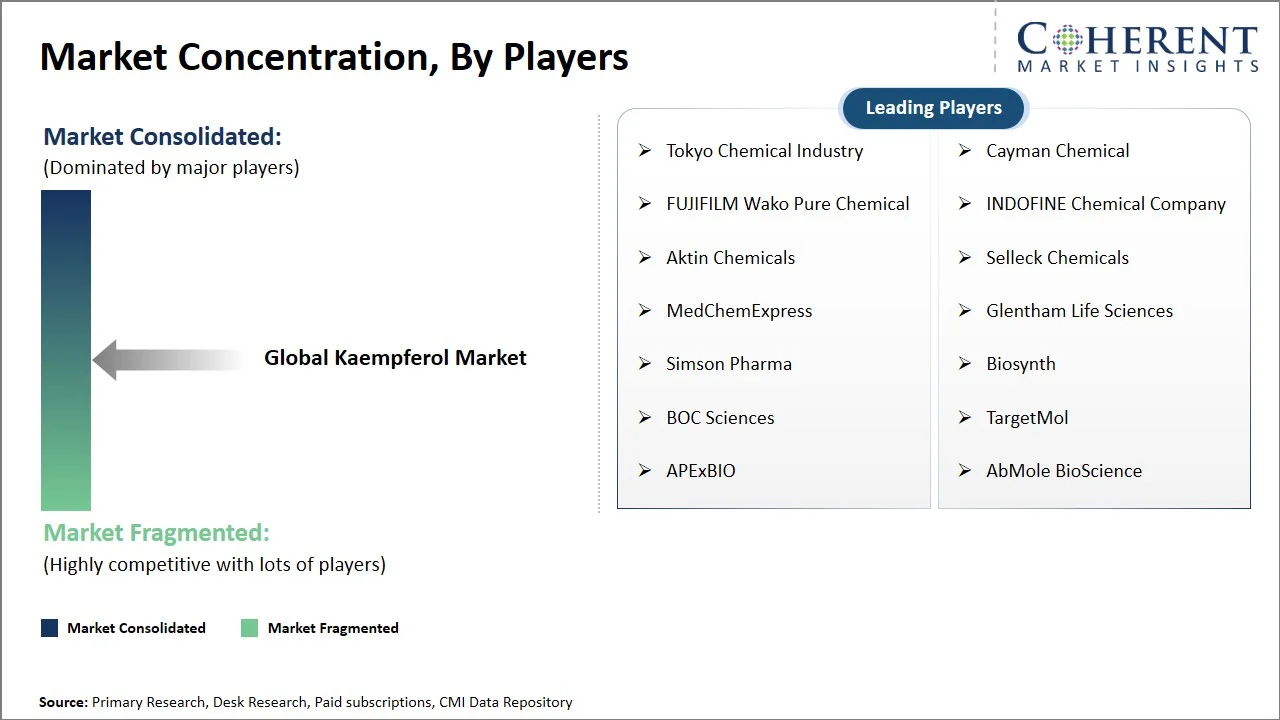
The global kaempferol market is fragmented, comprising botanical extract manufacturers, high-purity flavonoid specialists, research-chemical suppliers, analytical-standard providers, formulation-oriented ingredient companies, and regional distributors. Competition is increasingly determined by the supplier’s ability to deliver reproducible specifications rather than kaempferol availability alone. Regional manufacturers can compete effectively through access to botanical feedstocks and cost-efficient extraction, while specialist suppliers can protect margins through analytical rigor, custom specifications, small-volume research supply, and technical support. Reliable distribution and responsive customer relationships remain important because procurement needs differ substantially between research laboratories and commercial formulators.
Key focus areas include
- Product specification differentiation: Multiple purity levels, aglycone or derivative formats, particle-size options, and application-specific grades allow suppliers to address different customer economics.
- Analytical quality assurance: HPLC fingerprints, identity confirmation, residual-solvent testing, contaminant screening, and lot-specific certificates increasingly determine qualification success.
- Botanical source control: Stable access to validated plant material helps reduce seasonal variability and supports stronger traceability for naturally derived kaempferol.
- Manufacturing consistency: Extraction yield management, purification efficiency, process repeatability, and dependable scale-up influence both margins and long-term supply agreements.
- Technical and formulation support: Suppliers that assist with solubility, dispersion, stability, dosage-form compatibility, and analytical methods can move beyond transactional ingredient selling.
- Channel specialization: Research chemicals require rapid small-pack fulfillment, whereas nutraceutical and functional-product manufacturers prioritize bulk availability, documentation, and supply continuity.
- Regulatory readiness: Clear botanical identity, quality dossiers, safety documentation, and market-specific compliance support can shorten customer approval cycles and create a defensible supplier advantage.
Market Report Scope
Kaempferol Market Report Coverage
| Report Coverage | Details | ||
|---|---|---|---|
| Base Year: | 2025 | Market Size in 2026: | USD 78.3 Mn |
| Historical Data for: | 2020 To 2024 | Forecast Period: | 2026 To 2033 |
| Forecast Period 2026 to 2033 CAGR: | 7.2% | 2033 Value Projection: | USD 127.4 Mn |
| Geographies covered: |
| ||
| Segments covered: |
| ||
| Companies covered: | Tokyo Chemical Industry, Cayman Chemical, FUJIFILM Wako Pure Chemical, INDOFINE Chemical Company, Aktin Chemicals, Selleck Chemicals, MedChemExpress, Glentham Life Sciences, Simson Pharma, Biosynth, BOC Sciences, TargetMol, APExBIO, AbMole BioScience | ||
| Growth Drivers: |
| ||
| Restraints & Challenges: |
| ||
Analyst Opinion (Expert Opinion)
- Kaempferol suppliers are expected to shift from basic ingredient sales toward application-ready solutions combining analytical validation, formulation support, stability data, and regulatory documentation. Suppliers offering customized grades and technical expertise may gain stronger customer relationships and pricing power.
- Biosynthetic and fermentation-based production could reduce dependence on botanical extraction and agricultural variability. Improved production consistency, scalability, and scheduling may benefit biotechnology-enabled producers while increasing competitive pressure on traditional extractors.
- Market participants should prioritize analytical consistency, differentiated formulations, reliable feedstock sourcing, and regulatory-ready documentation. Diversified sourcing and partnerships with formulation specialists, laboratories, and botanical suppliers can reduce supply risks and protect margins.
Speak to the analyst
Want personalized insights?
Take the findings above to one of our principal consultants, or have the report rebuilt around the segments, geographies and competitors you actually track.
Market Segmentation
- Purity Insights (Revenue, USD Mn, 2021 - 2033)
- 98% and Above
- 95% to Below 98%
- Below 95%
- Source Insights (Revenue, USD Mn, 2021 - 2033)
- Natural Plant derived
- Synthetic
- Application Insights (Revenue, USD Mn, 2021 - 2033)
- Pharmaceutical and Life Science Research
- Nutraceuticals
- Food and Beverages
- Cosmetics and Personal Care
- Analytical Standards and Testing
- Others
- Distribution Channel Insights (Revenue, USD Mn, 2021 - 2033)
- Direct Sales
- Indirect Sales
- Regional Insights (Revenue, USD Mn, 2021 - 2033)
- North America
- U.S.
- Canada
- Latin America
- Brazil
- Argentina
- Mexico
- Rest of Latin America
- Europe
- Germany
- U.K.
- Spain
- France
- Italy
- Russia
- Rest of Europe
- Asia Pacific
- China
- India
- Japan
- Australia
- South Korea
- ASEAN
- Rest of Asia Pacific
- Middle East
- GCC Countries
- Israel
- Rest of Middle East
- Africa
- South Africa
- North Africa
- Central Africa
- North America
- Key Players Insights
- Tokyo Chemical Industry
- Cayman Chemical
- FUJIFILM Wako Pure Chemical
- INDOFINE Chemical Company
- Aktin Chemicals
- Selleck Chemicals
- MedChemExpress
- Glentham Life Sciences
- Simson Pharma
- Biosynth
- BOC Sciences
- TargetMol
- APExBIO
- AbMole BioScience
Sources
Primary Research Interviews
- Kaempferol manufacturers, high-purity flavonoid producers, botanical extract manufacturers, phytochemical suppliers, and analytical-standard producers
- Sophora japonica, horseradish, tea, medicinal herb, fruit, vegetable, and other kaempferol-rich botanical suppliers
- Extraction, purification, chromatography, crystallization, fermentation, and bioconversion companies
- Pharmaceutical, nutraceutical, functional food, beverage, cosmetic, and personal-care formulators
- Universities, biotechnology companies, CROs, analytical laboratories, and phytochemical research institutes
- Distributors, importers, exporters, specialty chemical suppliers, and botanical ingredient traders
- R&D, formulation, procurement, quality, regulatory, production, supply-chain, marketing, and sales executives
Stakeholders
- Kaempferol manufacturers, flavonoid extractors, botanical growers, and phytochemical processors
- Solvent, chromatography resin, filtration, extraction, drying, and laboratory-equipment suppliers
- HPLC, UPLC, LC-MS/MS, spectroscopy, chromatography, and purity-testing providers
- Pharmaceutical, nutraceutical, functional-food, and cosmetic companies
- Universities, biotechnology laboratories, CROs, toxicology laboratories, and clinical research organizations
- Analytical-standard suppliers, specialty distributors, contract manufacturers, and regulatory consultants
End-use Sectors
- Pharmaceutical discovery, preclinical research, pharmacology, molecular biology, and medicinal chemistry
- Nutraceuticals, dietary supplements, botanical formulations, and functional-health products
- Functional foods, beverages, and bioactive formulations
- Cosmetics, skin care, anti-aging, nutricosmetics, and personal care
- Analytical standards, reference materials, chromatography calibration, and laboratory testing
- Academic research, biotechnology, toxicology, metabolomics, bioavailability, and formulation studies
Regulatory and Government Bodies
- U.S. FDA, NIH, NCBI, and USDA
- Health Canada and CFIA
- European Commission, EFSA, EMA, and ECHA
- UK FSA, MHRA, and Office for Product Safety and Standards
- China NMPA, SAMR, and National Health Commission
- Japan MHLW, PMDA, and Consumer Affairs Agency
- India FSSAI, CDSCO, Ministry of AYUSH, and DSIR
- Brazil ANVISA and South Korea MFDS
- WHO, Codex Alimentarius Commission, and ICH
Databases
- PubChem, PubMed, PubMed Central, ClinicalTrials.gov, ChEBI, ChEMBL, UniProt, and Protein Data Bank
- EFSA scientific opinions, OpenFoodTox, EMA databases, and European Commission CosIng
- FDA dietary supplement, NDI, food, and drug databases
- USDA FoodData Central and flavonoid-composition datasets
- USP, European, Chinese, Japanese, and Indian Pharmacopoeia resources
- WIPO PATENTSCOPE, Espacenet, USPTO, and Google Patents
- UN Comtrade, ITC Trade Map, Eurostat, national customs databases, company catalogues, COAs, SDSs, and pricing records
Magazines and Journals
- Journal of Agricultural and Food Chemistry
- Food Chemistry
- Phytochemistry
- Phytomedicine
- Journal of Ethnopharmacology
- European Journal of Medicinal Chemistry
- International Journal of Molecular Sciences
- Nutrients
- Antioxidants
- Molecules
- Frontiers in Pharmacology and Frontiers in Nutrition
- International Journal of Pharmaceutics
- Journal of Functional Foods
- Food Research International
- Planta Medica
- Natural Product Research
- Journal of Chromatography A and B
Associations
- American Herbal Products Association
- Council for Responsible Nutrition
- Natural Products Association
- United Natural Products Alliance
- European Federation of Associations of Health Product Manufacturers
- Society for Medicinal Plant and Natural Product Research
- International Society for Nutraceuticals and Functional Foods
- Personal Care Products Council
- International Federation of Societies of Cosmetic Chemists
- European Federation for Cosmetic Ingredients
- Japan Health and Nutrition Food Association
- China Chamber of Commerce for Import & Export of Medicines & Health Products
- Association of Herbal and Nutraceutical Manufacturers of India
Public Domain Sources
- Product catalogues, technical data sheets, specifications, certificates of analysis, and safety data sheets
- Purity, assay, botanical source, solubility, storage, particle characteristics, and shelf-life data
- HPLC, UPLC, LC-MS/MS, UV-Vis, NMR, and other analytical methods
- Extraction, purification, crystallization, chromatography, and drying-process information
- Botanical-source data covering Sophora japonica, horseradish, tea, vegetables, fruits, herbs, and medicinal plants
- Pharmacokinetic, bioavailability, antioxidant, anti-inflammatory, formulation, and toxicology studies
- Research on kaempferol glycosides, derivatives, nanoencapsulation, carrier systems, and biosynthetic production
- Regulatory opinions, safety assessments, botanical monographs, company filings, product launches, patents, trade, shipment, and pricing data
Key Standards and Regulations
- ICH Q2(R2) – Validation of Analytical Procedures
- ICH Q14 – Analytical Procedure Development
- 21 CFR Part 111 – Dietary Supplement GMP
- U.S. DSHEA and FDA New Dietary Ingredient requirements
- EU Directive 2002/46/EC on Food Supplements
- Regulation (EC) No 1924/2006 on Nutrition and Health Claims
- Regulation (EU) 2015/2283 on Novel Foods
- Regulation (EC) No 1223/2009 on Cosmetic Products
- EU REACH Regulation (EC) No 1907/2006
- EMA guidelines for herbal medicinal products
- ISO/IEC 17025 for analytical laboratory competence
- Applicable USP, European, Chinese, Japanese, and Indian Pharmacopoeia requirements
- Country-specific nutraceutical, botanical drug, functional-food, cosmetic, and natural-health-product regulations
Proprietary Elements
- CMI Data Analytics Tool, Proprietary CMI Existing Repository of information for last 10 years.
Get access to 250+ pages report
Every segment, forecast, competitor profile and data table behind the analysis above — available for instant download.
- ESOMAR Member
- ISO 9001:2015 Certified
- D-U-N-S Registered
- GDPR & CCPA Compliant
Missing comfort of reading report in your local language? Find your preferred language:
Transform your Strategy with Exclusive Trending Reports
Frequently Asked Questions
The CAGR of global kaempferol market is projected to be 7.2% from 2026 to 2033.
The global kaempferol market is estimated to be valued at USD 78.3 million in 2026 and is expected to reach USD 127.4 million by 2033
Kaempferol is mainly used in pharmaceutical and life science research, nutraceuticals, food and beverages, cosmetics and personal care, and analytical testing.
Kaempferol naturally occurs in fruits, vegetables, herbs, tea, and medicinal plants, including Sophora japonica, broccoli, spinach, kale, and onions.
High-purity kaempferol provides better analytical consistency, controlled impurity levels, and reproducible experimental results, making it suitable for pharmaceutical research, biological studies, and analytical standards.
Natural bioactive compound research increasing demand for high purity kaempferol and Nutraceutical and phytochemical research supporting plant derived flavonol consumption are the major factors driving the growth of global kaempferol market.
Complex extraction and purification processes increasing high purity production costs and limited commercial scale availability restricting broader industrial adoption are the major factors hampering the growth of global kaempferol market.