

Medicinal Cannabis Market Size and Forecast – 2026 to 2033
The medicinal cannabis market is estimated to be valued at USD 29.51 Bn in 2026 and is expected to reach USD 127.83 Bn by 2033, growing at a compound annual growth rate (CAGR) of 23.3% from 2026 to 2033.
Key Takeaways
- By Product Type, Concentrates hold the largest market share of 27.9% in 2026 owing to the increasing legalization & regulatory change.
- By Compound, Tetrahydrocannabinol (THC) expected to hold the largest market share of 58.3% in 2026 owing to its therapeutic efficacy in specific conditions.
- By Application, Parkinson’s Disease acquired the prominent market share of 38.1% in 2026 owing to the unmet needs in symptom management.
- By Distribution Channel, Hospital Pharmacies dominates the overall market share in 2026 owing to the patient safety, dosing, & clinical oversight.
- By Region, North America dominates the overall market with an estimated share of 50.0% in 2026 owing to the progressive legal & regulatory environment.
Market Overview
Patients and healthcare providers are increasingly driving medicinal cannabis market growth as awareness rises and more regions legalize its use. Physicians are showing greater acceptance of cannabis-based treatments for chronic conditions like pain, epilepsy, and multiple sclerosis. Companies are advancing extraction technologies and developing innovative products that enhance safety and effectiveness. Regulatory bodies in North America and Europe actively support this shift, while ongoing clinical research continues to strengthen cannabis’s medical credibility and expand its role in modern healthcare.
Current Events and their Impact on the Medicinal Cannabis Market
Current Events | Description and its impact |
Regulatory and Legal Developments |
|
Technological and Scientific Advances |
|
Economic and Investment Trends |
|
End-user Feedback and Unmet Needs in the Medicinal Cannabis Market
- Patient Experience and Feedback: Patients value the therapeutic benefits of medicinal cannabis but often report challenges with inconsistent product quality, unclear dosing guidelines, and limited access to preferred formulations. Many seek more personalized treatment options and better education to confidently manage their conditions with cannabis-based therapies.
- Physician Perspectives and Challenges: Healthcare providers appreciate cannabis’s potential but face difficulties due to limited clinical data, unclear prescribing protocols, and concerns about drug interactions. They require more robust research and standardized guidelines to feel comfortable recommending medicinal cannabis safely and effectively.
- Accessibility and Affordability Issues: Patients frequently encounter barriers related to high costs, insurance coverage gaps, and limited availability in certain regions. Improving affordability and streamlining access through pharmacies and authorized dispensaries remains a significant unmet need in the market.
- Current Industry Events of 2026
- Market Size Estimation
- Regional Breakdown
- Competitive Landscape
- Customer Intelligence
- Segmental Analysis
- Pricing Analysis
- Key Market Drivers, Challenges & Future Trends
- Customized Insights Section
Segmental Insights
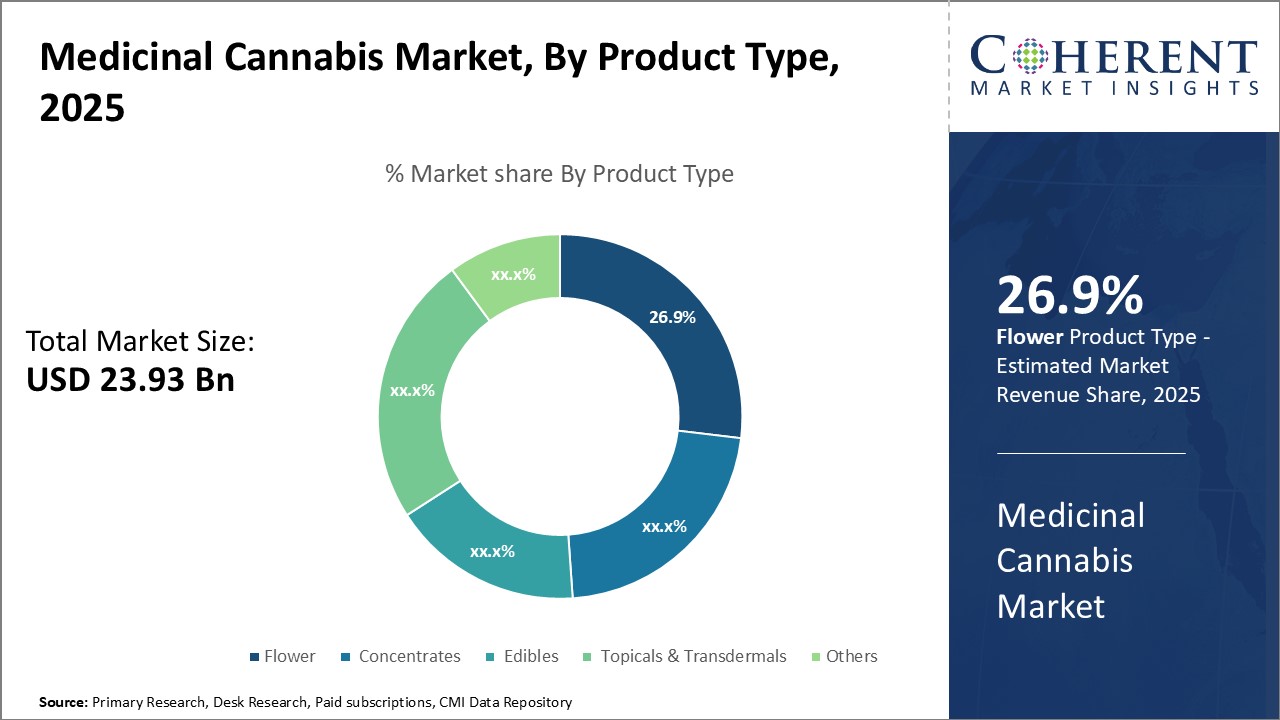
Medicinal Cannabis Market Insights, by Product Type: Concentrates contribute the highest share of the market owing to its alternative, more precise modes of administration.
Concentrates hold the largest market share of 27.9% in 2026. Patients are increasingly seeking fast-acting, high-potency medicinal cannabis treatments, which drives the demand for concentrates. These products provide a cleaner and more efficient option compared to traditional forms, particularly for treating chronic pain, neurological conditions, and severe symptoms. Manufacturers have improved extraction methods to boost purity and consistency, enhancing trust in product quality. Healthcare providers favor concentrates for their precise dosing and easy administration. As education expands, both clinics and patients actively adopt concentrates as a reliable therapeutic choice. For instance, in April 2025, Aurora Cannabis Inc., a leading Canadian medical cannabis company, announced it is now offering medical cannabis concentrates to patients in the United Kingdom. With this launch, the company takes a significant step in introducing its proprietary cultivar-specific inhalable cannabis extracts to the U.K. market.
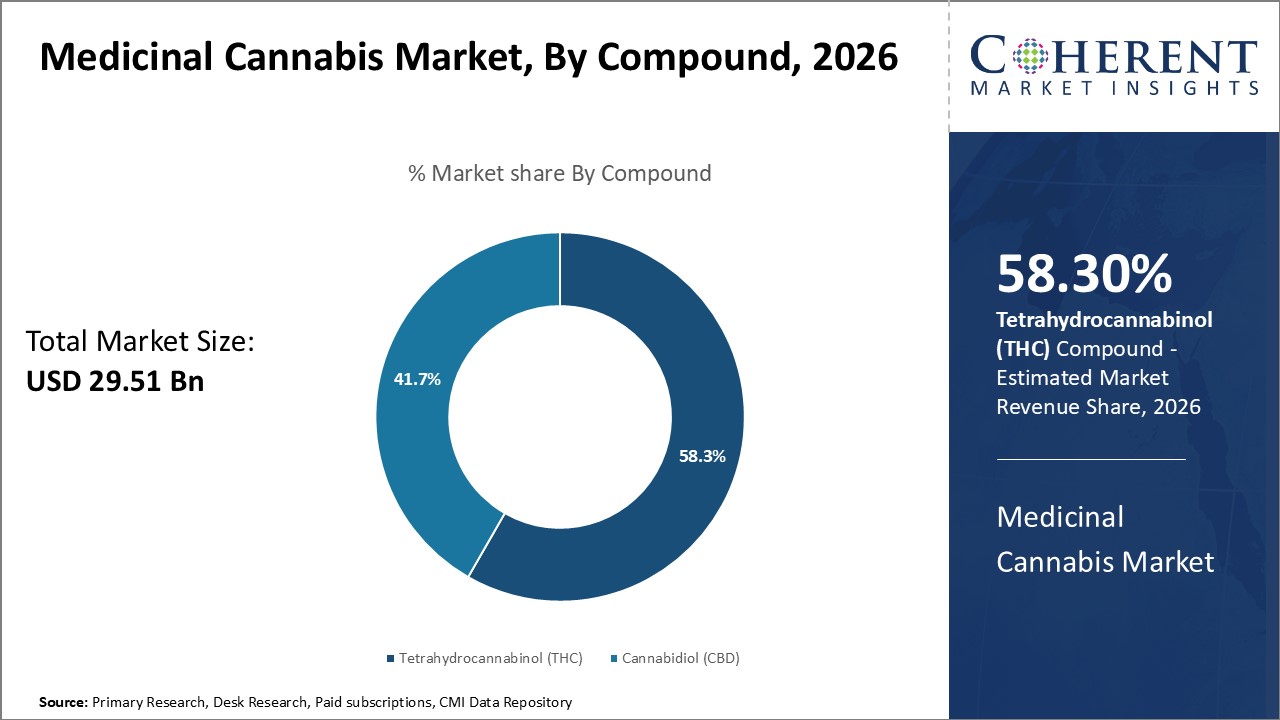
Medicinal Cannabis Market Insights, by Compound: Tetrahydrocannabinol (THC) contribute the highest share of the market owing to its advances in formulation & delivery.
Tetrahydrocannabinol (THC) expected to hold the largest market share of 58.3% in 2026. Demand for Tetrahydrocannabinol (THC) in the medicinal cannabis market grows as patients and healthcare providers recognize its effectiveness in treating chronic pain, nausea, muscle spasms, and appetite loss. Patients with severe or resistant symptoms often benefit more from THC-focused therapies. As clinical evidence advances, medical professionals actively explore its therapeutic potential. Companies develop improved delivery methods like oils and capsules to ensure safer, more precise use. Legal reforms and increased acceptance of psychoactive cannabinoids continue to boost THC’s prominence in medical treatments. For instance, in September 2025, Trulieve Cannabis Corp. has introduced five new 10 mg THC-infused beverage varieties under its Onward and Upward brands. The new flavors include Onward Berry Smash, Cosmopolitan, Lemon Drop Martini, and Paloma, along with Upward Half & Half iced tea and lemonade. Such innovations are accelerating the medical cannabis market demand.
Medicinal Cannabis Market Insights, by Application: Parkinson’s Disease contribute the highest share of the market owing to its scientific / biological plausibility.
Parkinson’s Disease acquired the prominent market share of 38.1% in 2026. Patients with Parkinson’s disease increasingly turn to medicinal cannabis to relieve motor symptoms like tremors and rigidity, along with non-motor issues such as anxiety and sleep problems. Cannabis serves as a promising alternative or complement to conventional treatments, helping reduce side effects and enhance quality of life. Researchers continue to advance cannabinoid studies, while regulators support wider use. Healthcare providers actively integrate cannabis-based therapies into their treatment plans to meet growing patient demand and explore new clinical possibilities. For instance, in August 2025, the Parkinson's Foundation has launched PD Trial Navigator, a pilot program to support the PD GENEration study by guiding participants through the genetic clinical trial landscape and helping them enroll in gene-targeted studies.
Medicinal Cannabis Market Insights, by Distribution Channel: Hospital Pharmacies contribute the highest share of the market owing to its formulary inclusion & standardization.
Hospital pharmacies ensure safe and precise dosing while maintaining strict quality control for patients with complex medical conditions in the medicinal cannabis market. Pharmacists compound and dispense cannabis products that comply with regulatory standards, supporting treatments within hospitals. As clinical research advances and physician acceptance grows, hospitals actively add cannabis therapies to their formularies. They also provide secure storage and continuous monitoring, which enhances patient safety and builds trust. This active involvement helps expand the adoption of medicinal cannabis in healthcare settings.
Regional Insights
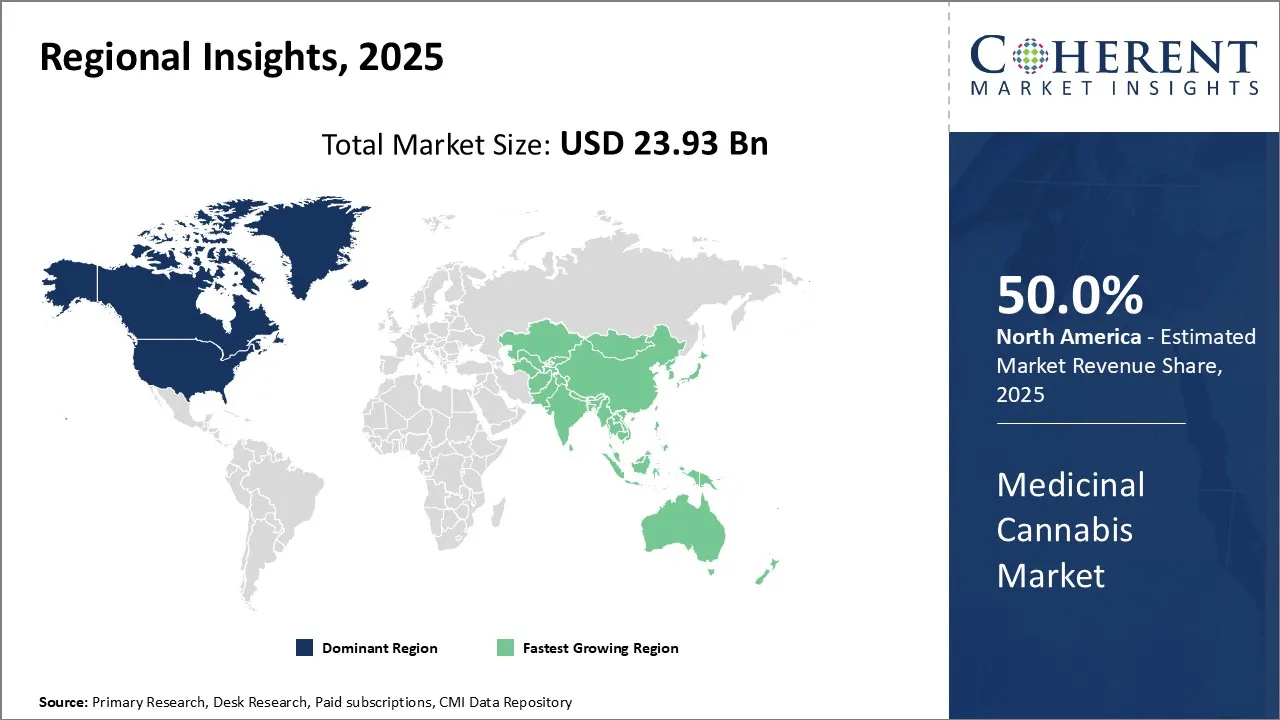
North America Medicinal Cannabis Market Trends
North America dominates the overall market with an estimated share of 50.0% in 2026. Legalization continues to expand across North America, fueling rapid growth in the medicinal cannabis market and broadening its medical applications. Companies develop innovative product formulations like oils, capsules, and edibles to improve patient convenience and choices. Healthcare professionals and patients increasingly accept medicinal cannabis, driving its wider use, backed by ongoing clinical research. Investors actively fund cultivation and processing technologies, enhancing product quality and consistency. Regulators also clarify frameworks, enabling safer access and smoother integration of cannabis into mainstream healthcare. For instance, in October 2024, Trulieve Cannabis Corp. partnered with Black Buddha Cannabis, a women-owned medical marijuana brand, to offer its products in Trulieve dispensaries across Arizona and Pennsylvania.
Asia Pacific Medicinal Cannabis Market Trends
More countries in the Asia Pacific region are exploring legalization and medical use, boosting momentum in the medicinal cannabis market. Governments and healthcare providers increasingly recognize cannabis’s therapeutic benefits, fueling clinical research and product development. Companies actively develop diverse formulations to address the region’s varied patient needs. Improvements in cultivation and manufacturing infrastructure enhance product quality. Meanwhile, awareness and education campaigns reduce stigma, encouraging patients and practitioners alike to embrace medicinal cannabis as a viable treatment option. For instance, in October 2024, Aurora Cannabis Inc., in partnership with MedReleaf Australia, has announced an expanded range of premium medical cannabis oil products for the Australian market.
United States Medicinal Cannabis Market Trends
As more states legalize medicinal cannabis, the market in the United States continues to grow, with healthcare providers increasingly prescribing cannabis-based therapies. Companies actively develop diverse delivery methods like tinctures, capsules, and topicals to meet patient preferences. Researchers receive increased funding to conduct clinical trials that drive new treatment innovations. Cultivators and processors enhance product quality through advanced techniques. Meanwhile, public education and advocacy campaigns work to reduce stigma, promoting broader acceptance among patients and medical professionals across the country. For instance, Pennsylvania launched its medical marijuana research program by approving three of the state’s medical schools to study the potential benefits and risks of using medicinal cannabis to treat various health conditions.
China Medicinal Cannabis Market Trends
The Chinese government is cautiously exploring the medical potential of cannabis, gradually developing the country’s medicinal cannabis market. Research institutions and pharmaceutical companies actively study cannabinoids and create targeted therapies. The focus on integrating traditional medicine fuels interest in cannabis-based products. Investors are increasing funding in cultivation and processing technologies to enhance quality and meet regulatory standards. Healthcare professionals and patients are becoming more aware, supporting gradual acceptance. Although strict regulations influence market growth, ongoing research and innovation point to a promising future for medicinal cannabis in China.
Medicinal Cannabis Market Trend
Expansion of Legal Frameworks
Governments worldwide are progressively revising laws to legalize or decriminalize medicinal cannabis, fostering market growth. These changes create clearer pathways for research, production, and distribution, encouraging more companies to enter the sector. Regulatory clarity also boosts patient confidence and access. As a result, markets become more structured with improved compliance, helping integrate medicinal cannabis into mainstream healthcare systems while reducing legal uncertainties for patients and providers alike.
Product Innovation and Diversification
The market is witnessing rapid innovation, with new cannabis-derived products like oils, tinctures, capsules, patches, and edibles gaining popularity. These innovations aim to enhance patient compliance, improve dosing accuracy, and minimize side effects. Manufacturers are exploring formulations targeting specific medical conditions, allowing personalized treatment approaches. This diversification attracts a broader patient base and supports better therapeutic outcomes by addressing individual preferences and needs, making medicinal cannabis more accessible and appealing.
Medicinal Cannabis Market Opportunity
Development of Specialized Formulations
There is growing demand for cannabis products tailored to specific medical conditions such as epilepsy, multiple sclerosis, and PTSD. Developing targeted formulations, including controlled-dose tinctures, transdermal patches, and inhalers, can improve patient outcomes and adherence. Innovations in cannabinoid ratios and delivery methods present opportunities to address unmet therapeutic needs. Companies that invest in R&D to create condition-specific, standardized products can capture niche segments and establish leadership in specialized medicinal cannabis therapies.
Market Report Scope
Medicinal Cannabis Market Report Coverage
| Report Coverage | Details | ||
|---|---|---|---|
| Base Year: | 2025 | Market Size in 2026: | USD 29.51 Bn |
| Historical Data for: | 2020 To 2024 | Forecast Period: | 2026 To 2033 |
| Forecast Period 2026 to 2033 CAGR: | 23.3% | 2033 Value Projection: | USD 127.83 Bn |
| Geographies covered: |
| ||
| Segments covered: |
| ||
| Companies covered: | BOL Pharma, Tilray, Medreleaf Corporation, Aurora Cannabis Inc., Canopy Growth Corporation, Insys Therapeutics Inc., Aphria Inc., MGC Pharmaceuticals Limited, GW Pharmaceuticals plc., Medical Marijuana Inc, Enveric Biosciences, Pascal Biosciences, Realize Therapeutics, Celadon Pharmaceuticals Plc., MAK Scientific LLC, MIRA Pharmaceuticals, and Cardiol Therapeutics | ||
| Growth Drivers: |
| ||
| Restraints & Challenges: |
| ||
Medicinal Cannabis Market News
- In October 2025, Awshad, a medical cannabis wellness startup, launched a 6500mg CBD oil to mark its fourth anniversary, becoming one of the first homegrown Indian brands in the sector to reach profitability.
- In October 2025, The E.R.I.C. Cancer Playbook, in partnership with Whole Health Oncology Institute, unveiled groundbreaking initiative to provide affordable access to Full Extract Cannabis Oil (FECO) for cancer patients worldwide, with availability limited to Colorado.
- In May 2025, Curaleaf International, a U.S. firm under Curaleaf Holdings, introduced its branded products in Australia, expanding into one of the fastest-growing medical cannabis markets and reinforcing its focus on local partnerships and patient care.
Analyst Opinion (Expert Opinion)
- From my perspective as an industry analyst, the medicinal cannabis market stands at a pivotal inflection point, driven less by hype and more by substantive shifts in clinical validation and regulatory acceptance. The surge in rigorous clinical trials—such as GW Pharmaceuticals' Epidiolex, which received FDA approval based on robust data for treating rare epilepsy—illustrates how high-quality evidence is reshaping perceptions. Data from the Journal of the American Medical Association highlights that nearly 75% of surveyed physicians now consider cannabis a viable treatment option for certain conditions, a striking turnaround from just a few years ago.
- However, the market's true potential hinges on overcoming persistent challenges in standardization and product consistency. Despite advances in extraction technology, a 2023 study by the American Chemical Society revealed that up to 60% of commercially available cannabis products contain variable cannabinoid concentrations, undermining patient trust and complicating clinical outcomes. Companies investing heavily in genomics and precision cultivation, such as Tilray and Canopy Growth, are therefore better positioned to dominate by delivering reproducible, pharmaceutical-grade products.
- Moreover, the evolving regulatory landscape offers both opportunity and risk. The FDA's recent public hearings and the DEA's shifting stance suggest an eventual easing of restrictions, which could unlock wider medical adoption and insurance reimbursement. Yet, fragmented regulations across states in the U.S. and countries worldwide continue to create operational complexities that favor well-capitalized players capable of navigating multi-jurisdictional compliance.
Speak to the analyst
Want personalized insights?
Take the findings above to one of our principal consultants, or have the report rebuilt around the segments, geographies and competitors you actually track.
Market Segmentation
- Product Type Insights (Revenue, USD Bn, 2021 - 2033)
- Flower
- Concentrates
- Edibles
- Topicals & Transdermals
- Others
- Compound Insights (Revenue, USD Bn, 2021 - 2033)
- Tetrahydrocannabinol (THC)
- Cannabidiol (CBD)
- Application Insights (Revenue, USD Bn, 2021 - 2033)
- Cancer
- Arthritis
- Chronic Pain
- Parkinson’s Disease
- Epilepsy
- Others
- Distribution Channel Insights (Revenue, USD Bn, 2021 - 2033)
- Hospital Pharmacies
- Retail Pharmacies
- Online Pharmacies
- Regional Insights (Revenue, USD Bn, 2021 - 2033)
- North America
- U.S.
- Canada
- Latin America
- Brazil
- Argentina
- Mexico
- Rest of Latin America
- Europe
- Germany
- U.K.
- Spain
- France
- Italy
- Russia
- Rest of Europe
- Asia Pacific
- China
- India
- Japan
- Australia
- South Korea
- ASEAN
- Rest of Asia Pacific
- Middle East
- GCC Countries
- Israel
- Rest of Middle East
- Africa
- South Africa
- North Africa
- Central Africa
- Key Players Insights
- BOL Pharma
- Tilray
- Medreleaf Corporation
- Aurora Cannabis Inc.
- Canopy Growth Corporation
- Insys Therapeutics Inc.
- Aphria Inc.
- MGC Pharmaceuticals Limited
- GW Pharmaceuticals plc.
- Medical Marijuana Inc
- Enveric Biosciences
- Pascal Biosciences
- Realize Therapeutics
- Celadon Pharmaceuticals Plc.
- MAK Scientific LLC
- MIRA Pharmaceuticals
- Cardiol Therapeutics
Sources
Primary Research interviews
- Interviews with healthcare professionals specializing in cannabinoid therapies
- Discussions with regulatory authorities and policymakers in medicinal cannabis
- Conversations with cultivation and processing experts
- Feedback from patients using medicinal cannabis products
- Insights from pharmacists involved in cannabis dispensing
Databases
- PubMed
- ClinicalTrials.gov
- World Health Organization (WHO) Global Health Observatory
- United Nations Office on Drugs and Crime (UNODC) cannabis reports
- FDA’s Drug Database
Magazines
- Cannabis Business Times
- Marijuana Business Magazine
- Cannabis Industry Journal
- HerbalGram
Journals
- Journal of Cannabis Research
- Journal of the American Medical Association (JAMA)
- Frontiers in Pharmacology
- The Lancet Neurology
- Drug and Alcohol Dependence
Newspapers
- The New York Times (Health Section)
- The Guardian (Science and Health)
- Reuters Health News
- Bloomberg Health News
Associations
- American Medical Marijuana Association (AMMA)
- International Association for Cannabinoid Medicines (IACM)
- National Cannabis Industry Association (NCIA)
- European Cannabinoid Association (ECA)
Public Domain sources
- World Bank Data
- U.S. National Institutes of Health (NIH) publications
- Centers for Disease Control and Prevention (CDC) reports
- Government health portals (e.g., Health Canada, NHS UK)
Proprietary Elements
- CMI Data Analytics Tool
- Proprietary CMI Existing Repository of information for last 8 years
Get access to 250+ pages report
Every segment, forecast, competitor profile and data table behind the analysis above — available for instant download.
- ESOMAR Member
- ISO 9001:2015 Certified
- D-U-N-S Registered
- GDPR & CCPA Compliant
Missing comfort of reading report in your local language? Find your preferred language:
Transform your Strategy with Exclusive Trending Reports
Frequently Asked Questions
The Medicinal Cannabis Market is estimated to be valued at USD 29.51 Bn in 2026, and is expected to reach USD 127.83 Bn by 2033.
The CAGR of the Medicinal Cannabis Market is projected to be 23.3% from 2026 to 2033.
Increasing acceptance of medicinal benefits and aging populations and chronic conditions are the major factors driving the growth of the medicinal cannabis market.
Stringent regulations and high cost of products are the major factors hampering the growth of the medicinal cannabis market.
In terms of product type, concentrates is estimated to dominate the market revenue share in 2026.
BOL Pharma, Tilray, Medreleaf Corporation, Aurora Cannabis Inc., Canopy Growth Corporation, Insys Therapeutics Inc., Aphria Inc., MGC Pharmaceuticals Limited, GW Pharmaceuticals plc., Medical Marijuana Inc, Enveric Biosciences, Pascal Biosciences, Realize Therapeutics, Celadon Pharmaceuticals Plc., MAK Scientific LLC, MIRA Pharmaceuticals, and Cardiol Therapeutics are the major players operating in the market.
North America is expected to lead the medicinal cannabis market.