

Global Language Learning Games Market Size and Forecast – 2026 To 2033
The global language learning games market is expected to grow from USD 8.45 Bn in 2026 to USD 22.85 Bn by 2033, registering a compound annual growth rate (CAGR) of 9% from 2026 to 2033. The global language learning games market is driven by the growing demand for multilingual workforce skills. On November 26, 2025, Duolingo expanded its Duolingo for Business offering, announcing that hundreds of organizations were providing Super Duolingo subscriptions to employees to strengthen multilingual communication, cross-cultural collaboration, and workforce development across global teams.
Key Takeaways of the Global Language Learning Games Market
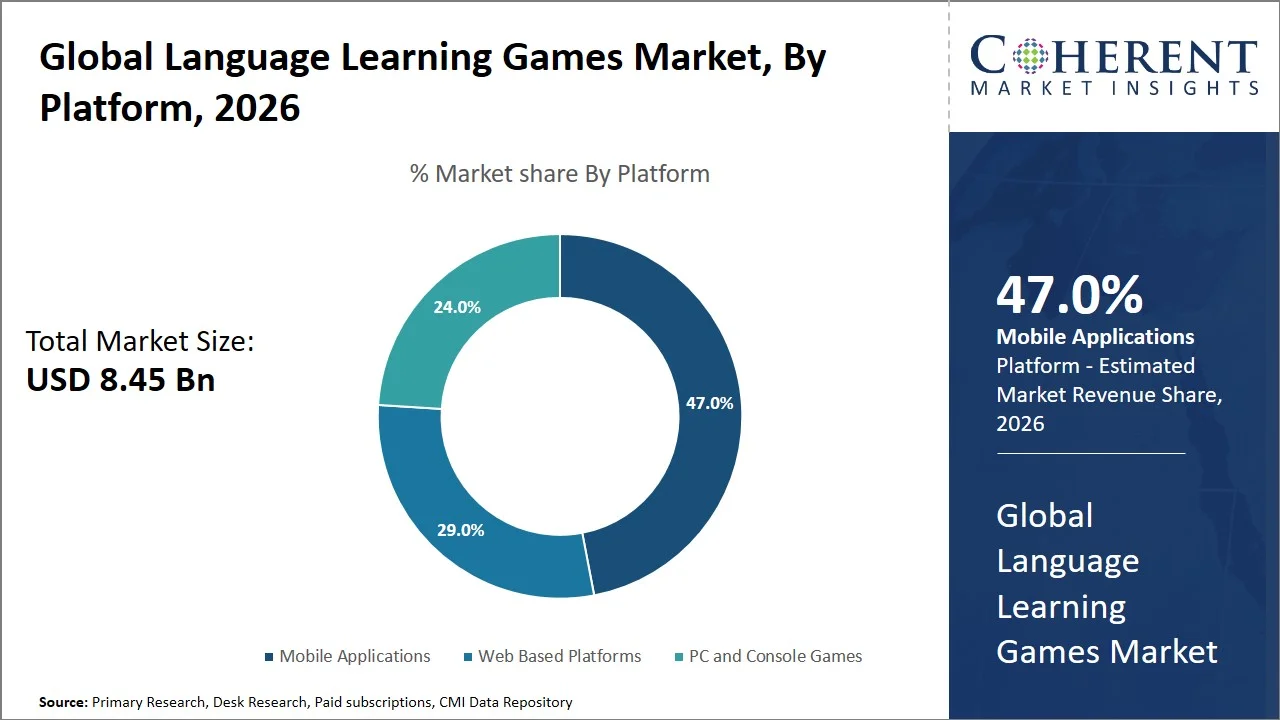
- The mobile applications segment is expected to account for 47.0 % of the global language learning games market share in 2026. Expansion of AI-powered personalized learning experiences is driving the growth of the segment. On July 15, 2025, Education First launched its AI-powered Efekta language learning program, delivering personalized English learning paths, adaptive assessments, and AI-driven tutoring for up to four million learners to improve individualized language acquisition.
- The children segment is estimated to capture 42.0 % of the market share in 2026. Rising popularity of self-paced online language learning is majorly driving the growth of the segment. On April 30, 2025, Duolingo announced the rollout of nearly 150 AI-generated language courses, dramatically expanding its self-paced learning catalog and enabling learners to access personalized language courses anytime through its mobile platform.
- The subscription segment is estimated to capture 39.0 % of the market share in 2026. Increasing government support for digital education initiatives is driving the growth of the segment. On September 18, 2025, Cambridge University Press & Assessment India signed a strategic MoU with the Government of Maharashtra to deliver NEP-aligned digital education, teacher training, international certifications and digital literacy programs.
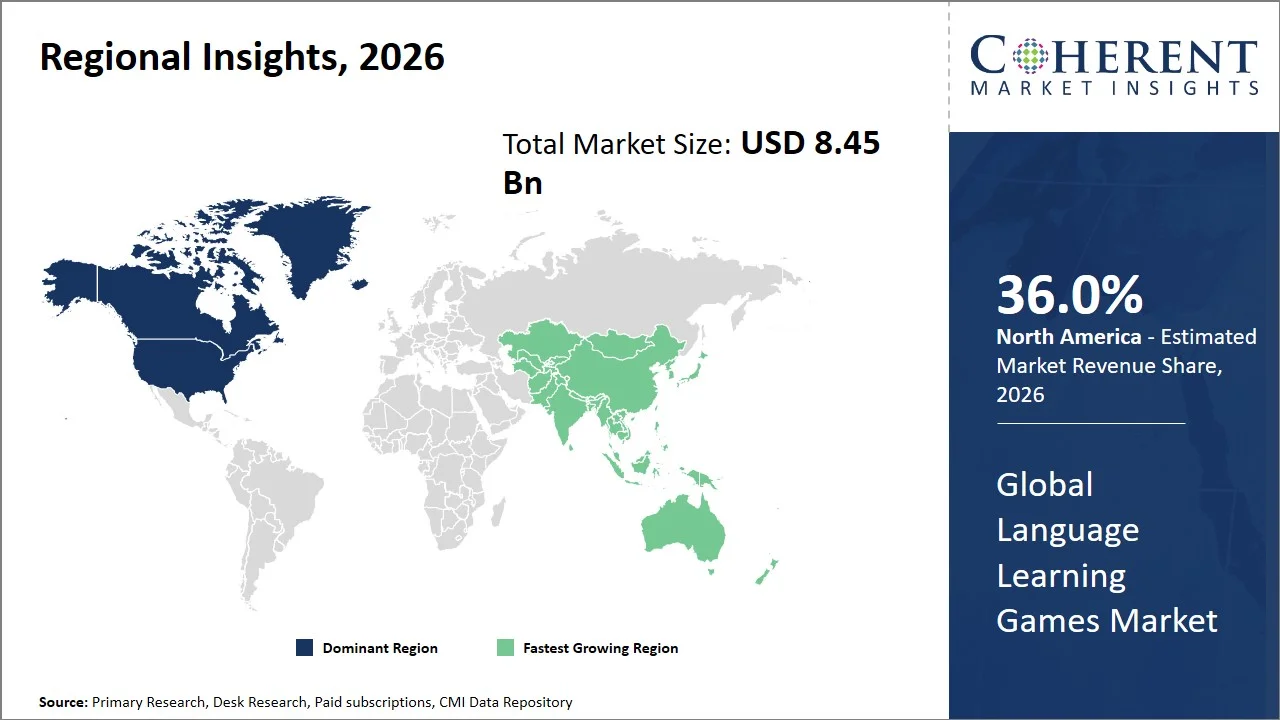
- North America is expected to dominate the language learning games market in 2026 with a market share of 36.0 %. Growing enterprise demand for employee language training in North America is driving the growth of the regional market. In January 2026, Berlitz expanded its Berlitz Flex and Berlitz On Demand corporate offerings across North America, enabling enterprises to combine self-paced digital language learning with live instructor coaching for globally distributed employees and multicultural teams.
- Asia Pacific is expected to account for 31.0 % of the market share in 2026 and is projected to record the fastest growth over the forecast period. In September 2025, Prep Edu launched its AI-powered Exam Platform and expanded its business to Thailand, Taiwan, Indonesia and South Korea, bringing AI Virtual Speaking Room and immersive interactive language learning technologies to learners in the Asia Pacific region, supporting more engaging language education experiences.
- Rapid Integration of Generative AI for Personalized Learning: Language game creators are leveraging generative AI to offer adaptive lessons, real-time conversation practice, personalized feedback, and dynamic content production. This leads to highly tailored learning experiences, which in turn increases user engagement and retention.
- Growing Adoption of Immersive AR and VR Language Learning Experiences: Companies are creating augmented reality and virtual reality environments that simulate real-life conversations, cultural interactions, and travel experiences for users to practice languages in immersive and contextual environments.
Segmental Insights
Why Do Mobile Applications Dominate the Global Language Learning Games Market?
The mobile applications segment is expected to account for 47.0% of the global language learning games market share in 2026. Mobile applications dominate the global language learning games sector and the reason is simply the growth of smartphones globally. Learners can access interactive lectures, gamified quizzes, pronunciation exercises and real-time progress tracking on mobile devices from practically anywhere at any time. Their capability to work with features like push notifications, offline learning, speech recognition and personalized learning paths enhances frequent engagement and higher rates of course completion. Moreover, the existence of app stores and subscription-based revenue models enable developers to swiftly update and release new content and to reach a large worldwide user base across multiple age groups. On July 18, 2024, Memrise launched new immersive AI speaking and conversation features in its Android and iOS apps, enabling learners to practice real-life conversations with AI as it broadens its mobile-first approach to language learning.
- Current Industry Events of 2026
- Market Size Estimation
- Regional Breakdown
- Competitive Landscape
- Customer Intelligence
- Segmental Analysis
- Pricing Analysis
- Key Market Drivers, Challenges & Future Trends
- Customized Insights Section
Why are Children the Most Widespread Age Group?
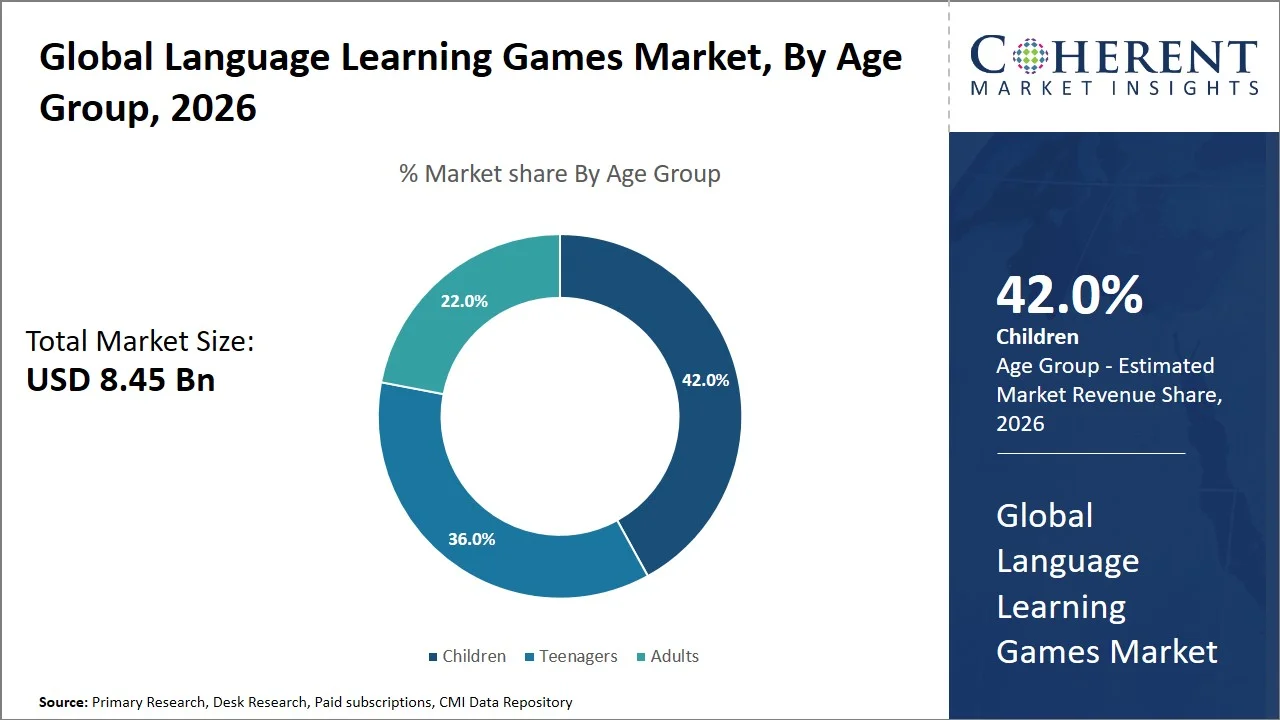
The children segment is expected to account for 42.0% of the global language learning games market share in 2026. Big stress on early language learning is the main reason behind the huge popularity of language learning games for youngsters. When cognitive flexibility and the capacity to acquire language are at their peak, parents and schools are introducing foreign language learning at younger and younger ages. Gamified learning systems combine interactive storytelling, animations, prizes and interesting challenges to hold children’s attention, while enhancing their vocabulary, pronunciation, and reading skills. Moreover, the increased usage of digital learning apps in school curricula and home-based education has further augmented the usage of language learning games among children all over the world. On September 19, 2024, Novakid acquired U.K.-based EFL app Lingumi. The agreement will attract hundreds of thousands of users to Novakid, promoting the objective to make quality English education available to young learners at an affordable price.
Subscription Dominates the Global Language Learning Games Market
The subscription segment is expected to account for 39.0% of the global language learning games market share in 2026. The worldwide language learning games market is witnessing a significant adoption of subscription-based business models due to the increasing need for ongoing access to high-quality instructional content. With subscription options, learners may follow planned learning paths, take advanced lessons, track their progress personally, learn offline, and get regular material updates, instead of having to purchase each one individually. This approach can also create continuous revenue streams for the platform providers, who can re-invest in developing new language courses and gamification features, and regularly update and personalize the learning experience to foster user engagement. On April 12, 2026, Memrise announced the expansion of its premium subscription service to include enhanced AI Language Partner features, which would provide clients with more immersive AI conversations, personalized speaking practice, and extra official language courses to foster long-term student engagement.
Current Events and their Impact
Current Events | Description and its Impact |
European Union Artificial Intelligence Act (AI Act) |
|
United States Kids Online Safety Act (KOSA) – Under Federal Legislative Consideration |
|
Global Language Learning Games Market Dynamics
Market Drivers
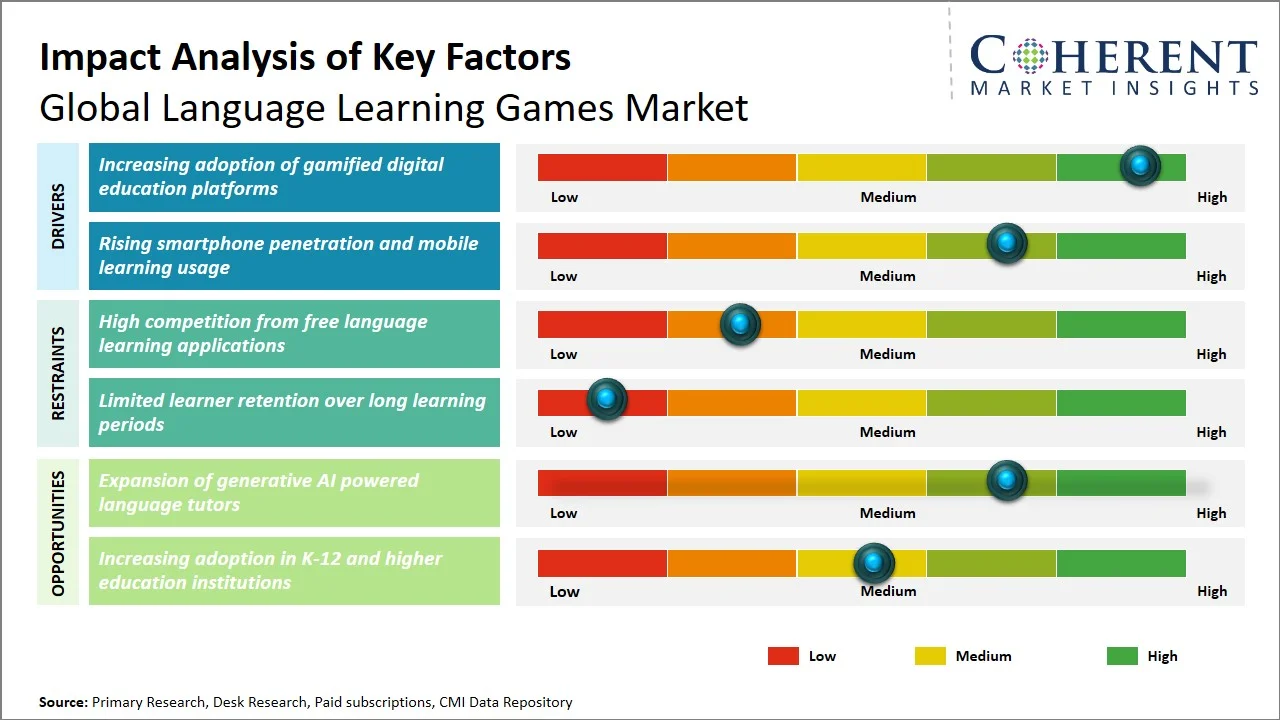
- Increasing adoption of gamified digital education platforms: The growth in adoption of gamified digital education platforms is offering substantial growth potential for the language learning games market to make language acquisition more dynamic, engaging, and outcome-oriented. Game-based learning approaches are employed by educational institutions, corporate training organizations, and individual learners to enhance student motivation and retention by using prizes, accomplishment badges, leaderboards, adaptive quizzes, and progress tracking. Artificial intelligence, speech recognition, and individualized learning paths also increase user engagement by motivating longer study sessions and higher completion rates, and by increasing the range of users across different age groups. On September 22, 2025, Kahoot unveiled more interactive quiz-generation and personalized learning capabilities increasing its AI-powered gamified learning platform for schools and corporations, strengthening game-based digital education adoption in classrooms and workplace training environments.
- Rising smartphone penetration and mobile learning usage: Increasing smartphone penetration and the use of mobile learning are driving the popularity of language learning games by providing learners the ability to access instructional information anytime and anywhere. The widespread availability of affordable smartphones, expanding high-speed mobile internet connectivity, and the rapid growth of digital application marketplaces have significantly enhanced the accessibility and adoption of language learning solutions worldwide. As a result, developers are coming up with mobile-first systems that offer offline learning, individualized courses, interactive gaming features, and real-time progress tracking to help the market continue growing. On November 5, 2025, Duolingo achieved 50 million daily active users, supported by high adoption of its smartphone app and ongoing investments in mobile engagement features, including AI-powered learning experiences and gamification.
Emerging Trends
- Expansion of Multiplayer and Social Gamification Features: Language learning platforms are incorporating more multiplayer challenges, collaborative missions, live competitions, leaderboards, and community-based learning to promote regular engagement and boost learner motivation.
- Increasing Enterprise and Educational Institution Adoption: Enterprises, universities, and K-12 schools are adopting gamified language learning platforms for employee upskilling, international workforce development, and classroom instruction, driving the development of institution-focused learning management and analytics capabilities.
Regional Insights
Why is North America a Strong Market for Language Learning Games?
North America is expected to account for a market share of 36.0% in 2026. North America leads the regional market for language learning games, fueled by widespread acceptance of digital education technologies, thriving subscription-based learning platforms, and considerable utilization of AI-driven educational apps. In the U.S. and Canada, gamified language learning systems have been quickly used in K-12 schools, universities, business training, and lifelong learning programs. Big players such as Duolingo, Rosetta Stone, Babbel and Mondly are still working on AI-based conversation practice, adaptive learning routes and speech recognition for English, Spanish, French and multilingual learning. Educational institutions are more and more using gamified mobile applications in blended learning environments, while employers are using language learning games to boost the communication skills of the workforce. The region has a high smartphone adoption, a developed digital payment infrastructure, and considerable investment in educational IT businesses.
Why Does the Asia Pacific Language Learning Games Market Exhibit High Growth?
Asia Pacific is projected to account for 31.0% of the global language learning games market in 2026 and expected to register the fastest growth. Asia Pacific is the fastest growing regional market, driven by increased internet access, expanded smartphone ownership and government measures to improve bilingual education and digital learning. China, Japan, India, South Korea and Singapore are quickly incorporating language learning software into schools and after-school education. While speaking English is still a key priority, there is growing demand for Japanese, Korean, Mandarin and regional languages for business, tourism and cultural interchange. Companies like Duolingo, LingoAce, Lingokids, as well as local EdTech providers are rolling out AI tutors, interactive vocabulary games and adaptive evaluation systems. Rising market adoption across the area is driven by increasing demand for competitive test preparation, rising online tutoring ecosystems and Government-backed digital education programs.
Global Language Learning Games Market Outlook for Key Countries
Why is the U.S. Emerging as a Major Hub in the Language Learning Games Market?
The U.S. is the largest market, owing to the developed EdTech ecosystem and the strong adoption of mobile-based educational applications. Duolingo, which is based in Pittsburgh, continues to be the world’s leader in gamified language learning, introducing new features like AI-powered conversation practice, video chatting with virtual tutors, and the option to build custom lessons. Meanwhile, Rosetta Stone continues to increase its partnerships with enterprise and educational institutions, while Babbel has expanded its presence with corporate language training programs among worldwide organizations. Gamified language systems are rapidly being adopted by K-12 school districts for their bilingual education and English language learner programs. Universities are also employing digital language games to improve classroom instruction while companies in health care, hospitality and customer service are adopting language-learning applications to improve multilingual skills in their workers.
Is China the Next Growth Engine for the Language Learning Games Market?
Driven by the growing demand for English language education, digital tutoring platforms and AI-enabled educational technology, China remains one of the major markets. Language education apps are now integrating gamified learning modules, voice evaluation technologies and intelligent tutoring systems. English language study still dominates, although Japanese and Korean language learning is growing among students and professionals. Cloud computing and AI-driven mobile-first educational platforms provide personalized vocabulary practice, pronunciation assessment and adaptive learning routes. The growing digital education infrastructure and the ubiquitous usage of smartphones continue to drive significant involvement in language learning games among school-age learners and young professionals.
Germany Language Learning Games Market Analysis and Trends
Germany is a major European market for multilingual workforce development and international education, and the demand is high. English is still the most popular foreign language among students, while apps for learning German are popular among international students, skilled workers and migrants. Based in Berlin, Babbel is further enhancing AI-supported learning experiences, business language training and individualized learning journeys. Educational institutions are increasingly incorporating gamified digital platforms into foreign language teaching, while corporate employers provide language learning subscriptions to facilitate cross-border collaboration within European operations. The need is especially high in manufacturing, engineering, health care and international business, where multilingual communication is a must.
Japan Language Learning Games Market Analysis and Trends
English language instruction is in high demand in Japan as government education reforms and growing foreign commercial activity take hold. Language learning games are popular among students who wish to prepare for entrance examinations to universities, professionals who wish to advance their careers and individuals who like to prepare for international travel. Japanese learners have embraced AI-powered pronunciation evaluation, speech recognition and interactive vocabulary games in a big way. Japanese learners are being targeted by domestic educational publishers and foreign language learning platforms that are developing mobile-first programs geared for them. Tourism, entertainment and developing regional commercial ties have also led to increased demand for studying Korean and Chinese.
India Language Learning Games Market Analysis and Trends
India is one of the fastest growing country markets with its enormous student base, developing digital education environment and wide spread adoption of smartphones. The leading application continues to be English language study, driven by competitive exams, higher studies, multinationals employment and professional skill development. Duolingo, Babbel and a few domestic EdTech players have scaled localized learning experiences with regional language interfaces and AI-powered practice modules. Gamified language learning apps have proliferated in cities and surrounding areas, thanks to government programs that support digital education, expand broadband networks, and make mobile data cheap and available. There is also a growing demand for foreign languages like German, Japanese, French and Korean as more Indian students are opting for international education and worldwide work prospects.
Global Language Learning Games Market - University Digital Language Platform Adoption (2025)
Region | Estimated University Adoption Rate | Primary Deployment Model |
North America | 74% | LMS Integration with Mobile Apps |
Europe | 68% | University LMS and Cloud Platforms |
Asia Pacific | 61% | Mobile First and Cloud Based Platforms |
Latin America | 49% | Mobile Applications |
Middle East & Africa | 42% | Cloud Learning Platforms |
How is the Expansion of Generative AI Powered Language Tutors Creating New Growth Opportunities in the Global Language Learning Games Market?
Generative AI-powered language tutors are opening up new growth possibilities and enabling language learning games to provide highly dynamic, real-time conversational experiences that simulate native speaker interactions. Duolingo Max utilizes GPT-based AI to deliver advanced features such as Roleplay, which enables simulated real-world conversational practice, and Explain My Answer, which provides personalized feedback to improve grammar accuracy and language proficiency. Babbel has introduced AI-driven conversation practice tailored to learning objectives and skill level. This enables language games to create infinite contextual conversations, to instantaneously correct pronunciation and sentence structure, and to modify lesson difficulty according to user performance rather than fixed learning modules. Developers are also creating multimodal AI that incorporates text, audio and image recognition, allowing learners to practice travel scenarios, business meetings, healthcare exchanges and customer service chats in immersive game environments. This is driving more user engagement, better subscription retention and providing new enterprise prospects for corporate language training, educational institutions and certification preparation with scalable AI-powered individualized instruction.
On January 14, 2025, Pearson announced the introduction of its AI-powered Digital Language Tutor on the Mondly by Pearson platform, enabling generative AI-based tailored language coaching for the workplace in various business communication scenarios following successful trials with corporate customers.
Market Players, Key Development, and Competitive Landscape
Key Developments
- On December 10, 2025, Duolingo expanded beyond languages by launching Chess, introducing interactive strategy lessons within its gamified platform to increase daily engagement and strengthen its position as a broader educational ecosystem rather than a standalone language learning application.
- On September 16, 2025, Babbel, the company that creates mutual understanding through language, announced the launch of its new feature, the Babbel Speak, designed to help first-time learners go from silence to speech. Introduced to the Babbel app via a new tab on the home screen, this AI-powered, voice-led trainer solves one of the most common barriers in language learning: not knowing how to begin speaking.
Competitive Landscape
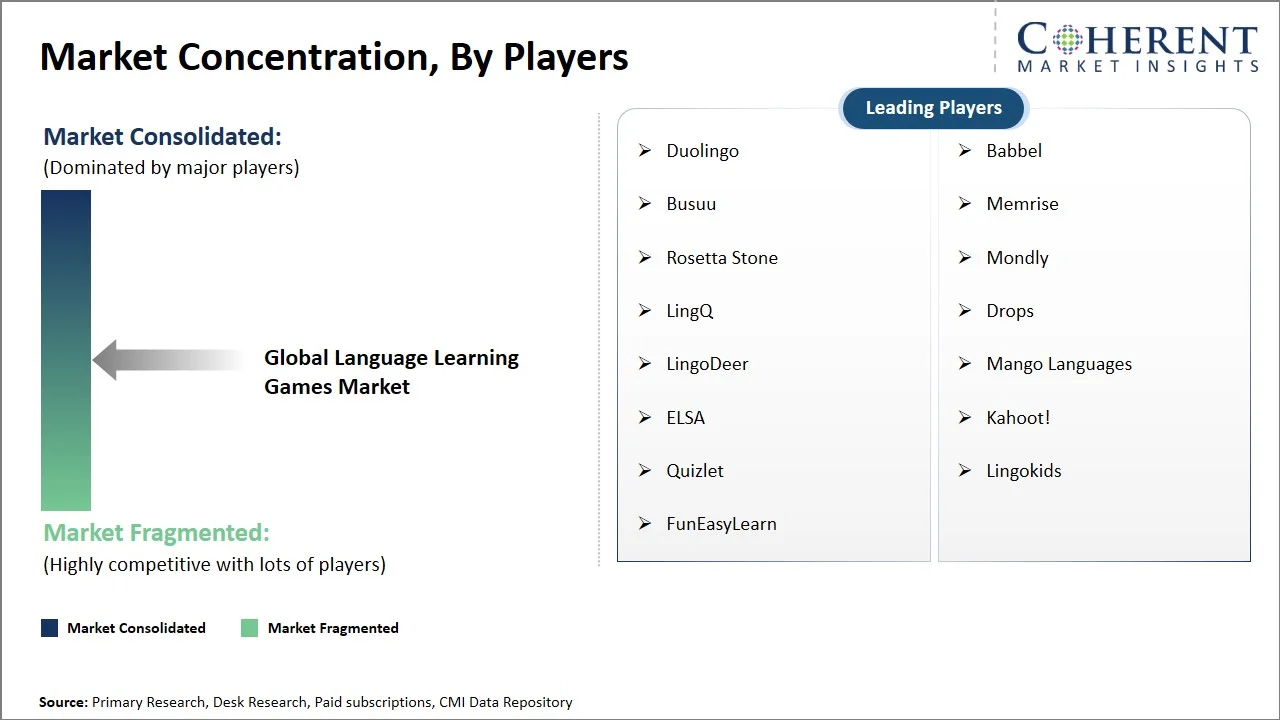
Duolingo is the global leader in language learning games market, further cementing its market position with quick generative AI integration, massive user interaction and constant content expansion. To further differentiate itself from other traditional gamified learning platforms, the firm has added AI-powered features like Roleplay and Explain My Answer with the launch of Duolingo Max. Babbel is now seeking to boost premium subscriptions through AI-supported conversation practice, corporate language training and relationships with companies in Europe and North America.
Rosetta Stone is growing institutional and enterprise licensing based on voice recognition technology and a bilingual curriculum, and Lingokids is consolidating its position in children’s education with curriculum-aligned gamified learning and school collaborations. LingoAce is spreading throughout Southeast Asia by integrating live tuition with AI-enhanced self-learning modules, while Mondly has boosted immersive learning with augmented reality and a chatbot to practice conversations. Top organizations are investing more in generative AI, adaptive learning engines, multi-lingual content expansion, enterprise learning solutions and child-focused educational environments to improve long-term client retention.
Market Report Scope
Language Learning Games Market Report Coverage
| Report Coverage | Details | ||
|---|---|---|---|
| Base Year: | 2025 | Market Size in 2026: | USD 8.45 Bn |
| Historical Data for: | 2020 To 2024 | Forecast Period: | 2026 To 2033 |
| Forecast Period 2026 to 2033 CAGR: | 9% | 2033 Value Projection: | USD 22.85 Bn |
| Geographies covered: |
| ||
| Segments covered: |
| ||
| Companies covered: | Duolingo, Babbel, Busuu, Memrise, Rosetta Stone, Mondly, LingQ, Drops, LingoDeer, Mango Languages, ELSA, Kahoot!, Quizlet, Lingokids, and FunEasyLearn | ||
| Growth Drivers: |
| ||
| Restraints & Challenges: |
| ||
Analyst Opinion (Expert Opinion)
- The future of the industry is expected to be shaped by generative AI becoming the core learning engine rather than an additional feature. Platforms capable of delivering real-time conversational practice, personalized lesson generation, voice-based assessment, and multilingual tutoring within gamified environments are likely to capture the highest user engagement and subscription retention. AI-powered language coaching is expected to become the standard across both consumer and enterprise learning applications.
- The strongest growth opportunity is expected to emerge in mobile application-based AI language learning games for children and young adults in India, China, and Southeast Asia. These markets have big student populations, increasing adoption of smartphones, growing digital education efforts, and increased demand for English and foreign language skills. Highest user acquisition and long-term subscription growth is likely to be driven by the integration of AI-powered personalized learning, localized content and regional language interfaces.
- To be competitive, market participants should concentrate on proprietary generative AI models that are trained for language instruction, rather than relying just on generic big language models. Companies should increase partnerships with schools, universities and multinational employers; embed internationally recognized language proficiency prep into gamified learning journeys; and create industry-specific language modules for healthcare, aviation, hospitality, finance and customer service. Multilingual voice AI, adaptive pronunciation assessment and region-specific material libraries will be a more powerful competition than price or volume of lessons.
Speak to the analyst
Want personalized insights?
Take the findings above to one of our principal consultants, or have the report rebuilt around the segments, geographies and competitors you actually track.
Market Segmentation
- Platform Insights (Revenue, USD Billion, 2021 - 2033)
- Mobile Applications
- Web Based Platforms
- PC and Console Games
- Age Group Insights (Revenue, USD Billion, 2021 - 2033)
- Children
- Teenagers
- Adults
- Revenue Model Insights (Revenue, USD Billion, 2021 - 2033)
- Subscription
- Freemium
- One Time Purchase
- In App Purchases
- Language Insights (Revenue, USD Billion, 2021 - 2033)
- English
- Spanish
- French
- German
- Mandarin
- Japanese
- Korean
- Others
- End User Insights (Revenue, USD Billion, 2021 - 2033)
- Individual Learners
- Schools and Educational Institutions
- Corporate Enterprises
- Language Training Centers
- Regional Insights (Revenue, USD Billion, 2021 - 2033)
- North America
- U.S.
- Canada
- Latin America
- Brazil
- Argentina
- Mexico
- Rest of Latin America
- Europe
- Germany
- U.K.
- Spain
- France
- Italy
- Russia
- Rest of Europe
- Asia Pacific
- China
- India
- Japan
- Australia
- South Korea
- ASEAN
- Rest of Asia Pacific
- Middle East
- GCC Countries
- Israel
- Rest of Middle East
- Africa
- South Africa
- North Africa
- Central Africa
- North America
- Key Players Insights
- Duolingo
- Babbel
- Busuu
- Memrise
- Rosetta Stone
- Mondly
- LingQ
- Drops
- LingoDeer
- Mango Languages
- ELSA
- Kahoot!
- Quizlet
- Lingokids
- FunEasyLearn
Sources
Primary Research Interviews
- Product Directors of gamified learning application developers
- Heads of Digital Learning and Innovation at EdTech companies
- Business Development Managers from language learning solution providers
Magazines
- EdTech Magazine
- eLearning Industry Magazine
- Education Technology Magazine
- Training Industry Magazine
Journals
- Language Teaching (Cambridge University Press)
- Computer Assisted Language Learning
- ReCALL
- Language Learning & Technology
Associations
- Association for Educational Communications and Technology
- Computer Assisted Language Instruction Consortium
- European Association for Computer Assisted Language Learning
- Association for the Advancement of Artificial Intelligence
Public Domain Sources
- UNESCO
- Organisation for Economic Co-operation and Development
- World Bank
- International Telecommunication Union
Proprietary Elements
- CMI Data Analytics Tool
- Proprietary CMI Existing Repository of Information for the Last 10 Years
Get access to 250+ pages report
Every segment, forecast, competitor profile and data table behind the analysis above — available for instant download.
- ESOMAR Member
- ISO 9001:2015 Certified
- D-U-N-S Registered
- GDPR & CCPA Compliant
Missing comfort of reading report in your local language? Find your preferred language:
Transform your Strategy with Exclusive Trending Reports
Frequently Asked Questions
The global language learning games market is expected to stand at USD 8.45 Bn in 2026 and is expected to reach USD 22.85 Bn by 2033.
The CAGR of the global language learning games market is projected to be 9% from 2026 to 2033.
Increasing adoption of gamified digital education platforms and rising smartphone penetration and mobile learning usage are the major factors driving the growth of the global language learning games market.
High competition from free language learning applications and limited learner retention over long learning periods are the major factors hampering the growth of the global language learning games market.
In terms of platform, the mobile applications segment is estimated to dominate the market revenue share in 2026.
Artificial intelligence enables personalized lessons, conversational tutoring, pronunciation assessment, and adaptive learning experiences.
Cryogenic propulsion provides high efficiency and greater payload capability for orbital and deep-space missions.