

Global Light Field Display Market Size and Forecast – 2026 To 2033
The global light field display market is expected to grow from USD 2.20 Bn in 2026 to USD 10.75 Bn by 2033, registering a compound annual growth rate (CAGR) of 13% from 2026 to 2033. The global light field display market is driven by rising investments in automotive holographic displays and digital cockpits. On July 28, 2026, LG Electronics was named a 2026 Automotive News PACE Pilot Award finalist for its UltraView Windshield Display, an innovative in-vehicle display solution designed to deliver driving information and infotainment content across a large area of the windshield.
Key Takeaways of the Global Light Field Display Market
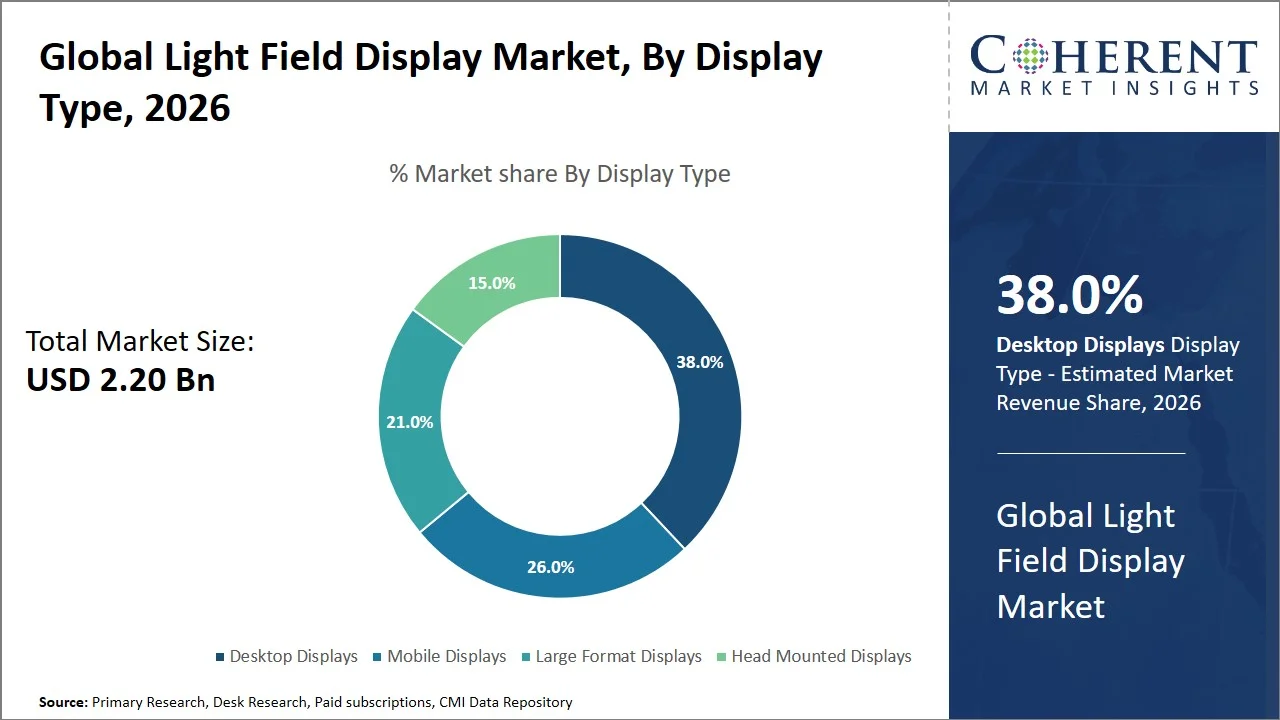
- The desktop displays segment is expected to account for 38.0 % of the global light field display market share in 2026. Expanding use of medical visualization and surgical planning systems is driving the growth of the segment. On March 27, 2026, Medtronic announced U.S. Food and Drug Administration (FDA) clearance of the Stealth AxiS surgical system for cranial and ear, nose, and throat (ENT) procedures.
- The image sensors segment is estimated to capture 41.0 % of the market share in 2026. Increasing demand for immersive gaming and entertainment experiences is majorly driving the growth of the segment. On March 24, 2025, Samsung Electronics announced that it will release its latest Odyssey game monitors and the ViewFinity S8. The 2025 Odyssey collection comprises the radical Odyssey 3D, the gorgeous Odyssey OLED G8 with its industry-leading 4K 240Hz display and the ultrawide Odyssey G9.
- The holographic display segment is estimated to capture 34.0 % of the market share in 2026. Continuous advancements in computational imaging and display technologies is driving the growth of the segment. On July 17, 2026, NVIDIA published a breakthrough real time radiance field visualization framework in August 2025, demonstrating interactive rendering on Looking Glass light field displays at more than 200 FPS across 45 simultaneous views.
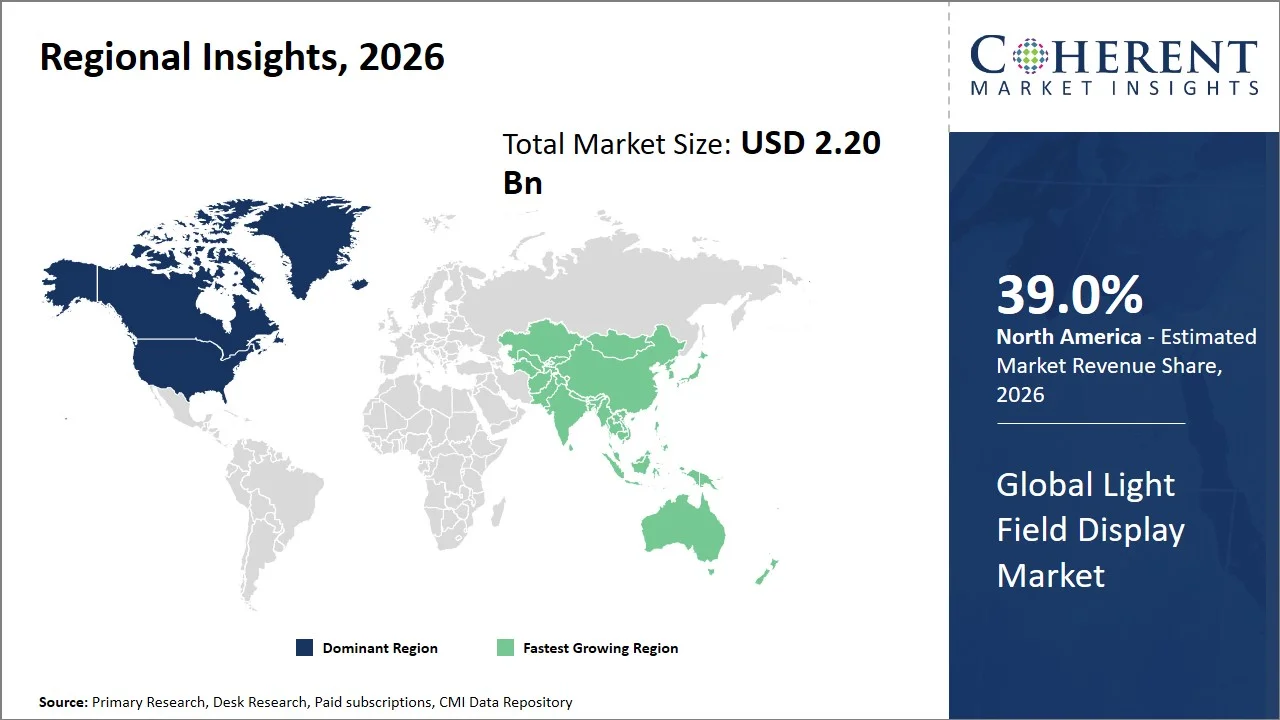
- North America is expected to dominate the light field display market in 2026 with a market share of 39.0 %. Rising adoption in defense simulation and aerospace training in North America is driving the growth of the regional market. On November 17, 2025, Red 6 expanded deployment of its Advanced Tactical Augmented Reality System (ATARS) across U.S. military aviation programs in 2025.
- Asia Pacific is expected to account for 33.0 % of the market share in 2026 and is projected to record the fastest growth over the forecast period. Increasing demand from industrial design and engineering visualization across Asia Pacific is driving the growth of the regional market. On January 7, 2025, Siemens Digital Industries Software, in collaboration with Sony Corporation, announced that it is delivering on its next-generation immersive engineering roadmap that brings together Siemens’ NX software for product engineering with Sony’s breakthrough head-mounted display (HMD) to enable the industrial metaverse.
Segmental Insights
Why Do Desktop Displays Dominate the Global Light Field Display Market?
The desktop displays segment is expected to account for 38.0% of the global light field display market share in 2026. Desktop monitors still remain the ideal deployment type, since they offer the processing power, display stability and bigger screen surface needed for high quality light field rendering in professional environments. For applications where precision and prolonged usage are essential, desktop based systems are the most practical choice. They power industries such as medical imaging, engineering design, scientific visualization and digital content creation with the ability to handle complex three dimensional data with minimal latency and consistent image quality. On September 16, 2025, Looking Glass launched its Hololuminescent Display product series with 16-inch, 27-inch and 86-inch desktop-class holographic screens that allow normal desktop content workflows without eye tracking.
- Current Industry Events of 2026
- Market Size Estimation
- Regional Breakdown
- Competitive Landscape
- Customer Intelligence
- Segmental Analysis
- Pricing Analysis
- Key Market Drivers, Challenges & Future Trends
- Customized Insights Section
Why are Image Sensors the Most Crucial Component?
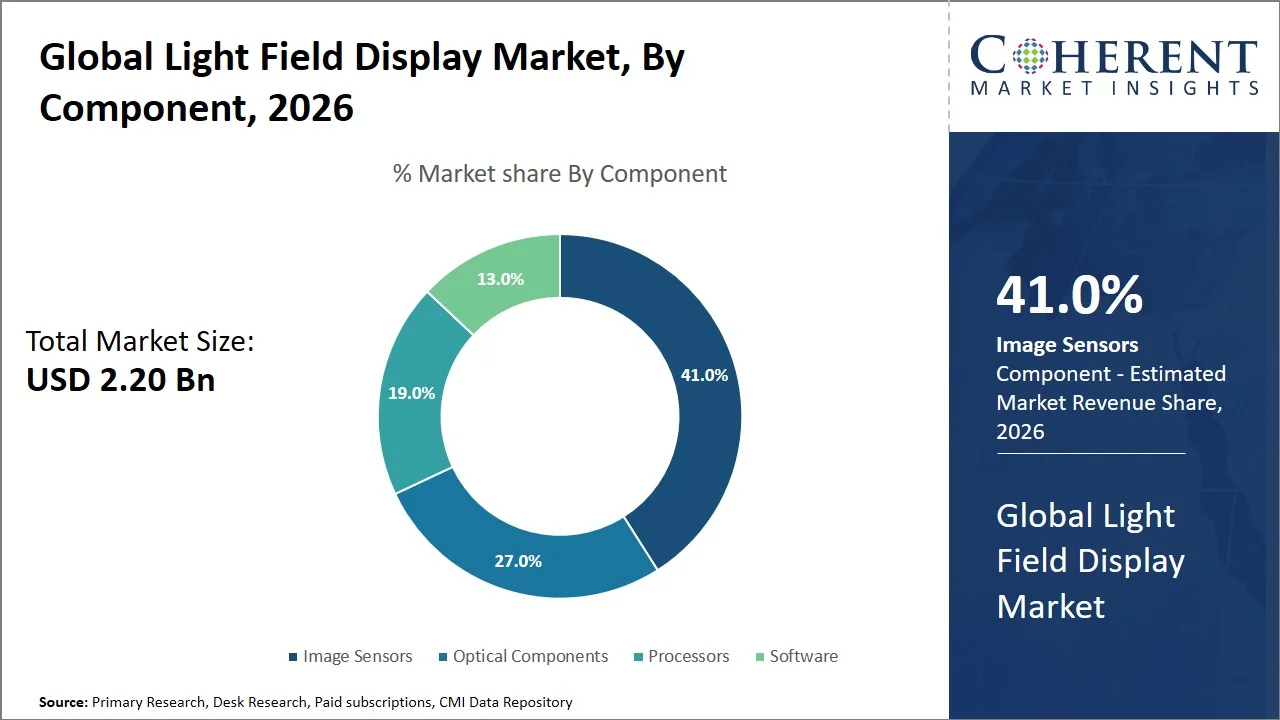
The image sensors segment is expected to account for 41.0% of the global light field display market share in 2026. The most important part is the image sensors, which gather high resolution visual data from many views for accurate depth mapping and picture reconstruction for realistic light field modeling. High-performance image sensors improve spatial resolution, color fidelity and light sensitivity, enabling the light field display systems to generate natural motion parallax and accurate three dimensional visuals. These features are essential for applications such as medical imaging, industrial visualization and immersive entertainment. On June 17, 2026, Sony Semiconductor Solutions Corporation announced the upcoming release of the LYTIA L910, an approximately 50-effective megapixel image sensor for mobile applications delivering 100 dB high dynamic range imaging with low power consumption. his is the first product in the LYTIA lineup with the LOFIC structure. It also features the new HDR technology and logic circuit technology to reduce random noise in dark areas of images.
Holographic Display Dominates the Global Light Field Display Market
The holographic display segment is expected to account for 34.0% of the global light field display market share in 2026. Holographic display technology is widely preferred because it delivers highly realistic three dimensional images with natural depth perception and full motion parallax without requiring special glasses. This capability is particularly powerful for advanced applications like medical diagnostics, engineering visualization, defense simulation and premium automotive displays, where precise spatial representation and immersive viewing profoundly improve user performance and decision making. On July 5, 2026, Samsung Electronics announced its Spatial Signage platform, an 85-inch commercial holographic-style display with patented 3D Plate optics, AI-based image processing and glasses-free three-dimensional projection. The platform targets premium retail, museums, entertainment venues and immersive commercial displays that need accurate spatial content.
Current Events and their Impact
Current Events | Description and its Impact |
European Union Artificial Intelligence Act (EU AI Act) |
|
U.S. FDA Final Guidance for AI Enabled Medical Devices 2025 |
|
Global Light Field Display Market Dynamics
Market Drivers
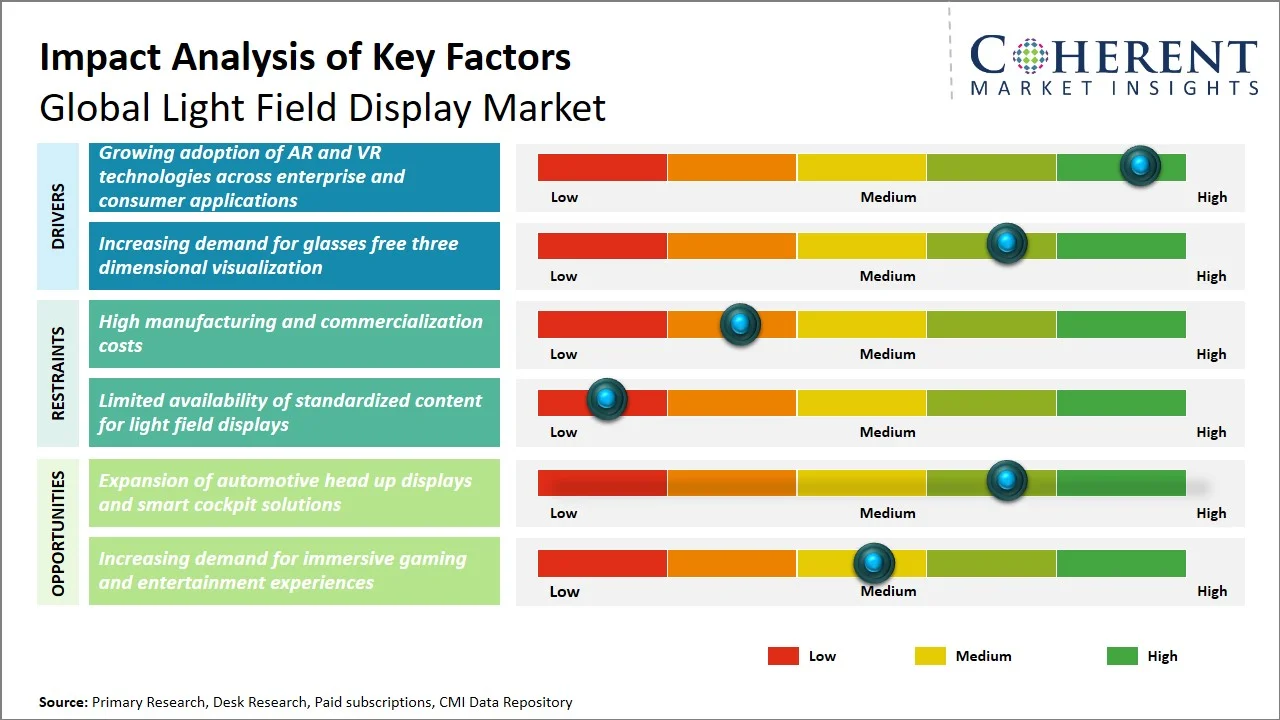
- Growing adoption of AR and VR technologies across enterprise and consumer applications: The growing adoption of augmented reality and virtual reality across different industries is driving the demand for light field display technology, as it provides a more natural depth perception and reduces the visual discomfort associated with traditional stereoscopic displays. Enterprises are using immersive visualization for product design, medical training, industrial maintenance and defense simulation, while consumer demand is growing through gaming, entertainment and interactive media. This is encouraging display manufacturers to develop high resolution light field solutions that create realistic three dimensional experiences without compromising image quality. On September 18, 2025, Meta’s launched its first AI glasses with a built-in visual display, the Meta Ray-Ban Display, providing navigation, messaging, real-time translation and visual AI support. The launch is an extension of Meta’s ongoing investment in consumer AR technology and its wearable computing ecosystem.
- Increasing demand for glasses free three dimensional visualization: The growing need for glasses free three dimensional visualization is driving the market for light field displays as customers desire immersive experiences without the hassle of wearing equipment. These displays are being rapidly deployed across sectors such as healthcare, automotive, retail, education and digital signage to improve user engagement, collaborative viewing and visual accuracy. Ongoing improvements in optical engineering and computational imaging are making glasses-free solutions more viable for commercial use. On November 20, 2025, Barco announced the launch of its glasses-free Eonis 3D display and Eonis Vision, which combines the monitor with Avatar Medical Vision software. By making augmented reality through glasses-free 3D visualization available for clinical work, Barco is transforming how clinicians and patients experience medical imaging, making consultations, surgical planning sessions, and educational moments more immersive, intuitive, and impactful than ever before.
Emerging Trends
- Integration of artificial intelligence for real time light field rendering: Artificial intelligence is being increasingly incorporated into light field display systems to enhance image reconstruction, depth estimation, and rendering efficiency. AI-driven methods minimize computing complexity and enhance image quality for smoother and real time visualization across healthcare, automotive and industrial applications.
- Expansion of automotive holographic cockpit displays: Car manufacturers are investing in advanced light field and holographic display technology to enhance digital instrument clusters, head up displays, and in automotive infotainment These technologies improve driver awareness by providing depth accurate visual information with minimal distraction, while supporting next generation intelligent cockpit designs.
- Development of micro LED based light field display platforms: Manufacturers are developing micro LED technology integrated with light field architectures to achieve high brightness, better energy efficiency and longer life of operation. This trend is leading to small-footprint display systems for high-end consumer electronics, commercial visualization and outdoor applications where excellent optical performance is needed.
- Increasing adoption in medical imaging and collaborative visualization: Light field displays are being used by healthcare professionals and academic institutes to visualize complicated anatomical structures without the need for specific eyewear. The system enables several users to simultaneously examine correct depth information improving surgical planning, medical education, diagnostic cooperation and three dimensional imaging.
Regional Insights
Why is North America a Strong Market for Light Field Displays?
North America is expected to account for a market share of 39.0% in 2026. North America is the innovation leader in the light field display market due to a robust ecosystem of display technology developers, semiconductor businesses, defense contractors, and research institutes. In the U.S., businesses like Leia Inc, Light Field Lab, Avegant and NVIDIA are leading the way in computational imaging, holographic visualization and AI accelerated rendering technologies. The region also enjoys widespread use by the defense industry, which employs immersive visualization for mission planning and simulation. Healthcare companies are also increasingly employing three-dimensional visualization for surgery planning and medical teaching. Hollywood studios and gaming companies are also evaluating light field displays for next generation content production, and leading universities including Stanford University and the Massachusetts Institute of Technology continue to publish research on computational optics and light field imaging.
Why Does the Asia Pacific Light Field Display Market Exhibit High Growth?
Asia Pacific is projected to account for 33.0% of the global light field display market in 2026 and is expected to register the fastest growth. Asia Pacific is the fastest advancing manufacturing hub for light field display technologies due to its concentration of display panel manufacturers, semiconductor fabrication facilities, and consumer electronics companies. South Korea, Japan, and China collectively account for a significant share of global OLED, micro LED, CMOS image sensor, and optical component production that supports light field display manufacturing. Samsung Electronics, LG Electronics, Sony, Panasonic, BOE Technology, AUO, and TCL CSOT are investing in advanced display research. Automotive makers are using holographic cockpit displays in luxury vehicles. Universities and government laboratories in China, Japan and South Korea are boosting research into integral imaging, holographic optics and computational display technology, driving commercialization across healthcare, education, industrial design and entertainment.
Global Light Field Display Market Outlook for Key Countries
Why is the U.S. Emerging as a Major Hub in the Light Field Display Market?
The U.S. continues to lead the development of light field displays with active participation from start-up firms, technology companies and government-funded research institutions. Leia Inc has commercialized diffractive light field display technology for mobile devices and automotive applications, while Light Field Lab is developing solid state holographic display platforms capable of producing realistic three dimensional imagery without wearable devices. NVIDIA contributes GPU based real time rendering technologies that enable computationally intensive light field visualization for industrial digital twins and simulation. Organizations such as DARPA, the U.S. Department of Defense and major medical institutions are supporting immersive visualization projects. Leading universities like Stanford, MIT and Carnegie Mellon are carrying out cutting-edge research in computational imaging, computer vision and light field reconstruction.
Is China the Next Growth Engine for the Light Field Display Market?
China has rapidly strengthened its position through government supported investments in advanced display manufacturing and semiconductor production. Companies including BOE Technology, TCL CSOT, Hisense, and Leyard continue expanding research in micro LED, holographic displays, and three dimensional visualization systems. Chinese universities such as Tsinghua University and Zhejiang University have produced significant research on computational photography and light field imaging, while smart manufacturing initiatives are encouraging industrial deployment of immersive visualization systems. Also, the large consumer electronics manufacturing ecosystem in the country enables fast commercialization of next generation display technologies, including local fabrication of optical components, CMOS image sensors and precision display modules.
Germany Light Field Display Market Analysis and Trends
Germany has the largest industrial market in Europe for light field displays, due to its advanced automotive, engineering and industrial automation industries. Companies such as Continental AG and Bosch and premium automotive manufacturers are examining holographic dashboard displays and enhanced driver visualization systems for next-generation vehicles. Other research institutes in Germany, such as the Fraunhofer Society, are still engaged in the development of optical imaging, holography and photonics technologies for industrial visualization and medical diagnostics. Strong adoption of digital engineering, factory automation, and Industry 4.0 initiatives has also increased demand for high precision three dimensional visualization used in product development, quality inspection, and engineering simulation.
Japan Light Field Display Market Analysis and Trends
Japan continues to play a major role through its leadership in precision optics, imaging sensors, and advanced display technologies. Major investors in light field display systems include companies such as Sony Group, Panasonic Holdings, Japan Display Inc and Toshiba which are all important to holographic visualization, tiny display technologies and high performance CMOS image sensors. Sony's experience in image sensors and display technology helps applications in healthcare, broadcast and industrial imaging. Japanese Universities and research centers continue to advance integral imaging, computational optics and holographic reconstruction. Strong collaboration between academia and industry has accelerated the development of next generation visualization platforms for medical imaging, robotics, and manufacturing.
South Korea Light Field Display Market Analysis and Trends
South Korea has become a global powerhouse for commercial display manufacturing due to the leadership of Samsung Electronics and LG Electronics in OLED, micro LED, and premium display technologies. The country’s tightly integrated semiconductor and display supply chain allows for speedy development of the optical engines, display panels and superior packaging needed to create light field displays. Government-sponsored research programs are fueling innovation in extended reality, holographic communication, and smart automotive displays, and leading electronics manufacturers are continuing to invest in glasses-free 3D visualization for consumer electronics, automotive infotainment, digital signage and commercial entertainment. Given South Korea’s supremacy in display fabrication and semiconductor production, the country has a good basis for wide scale commercialization of future light field display technologies.
Global Light Field Display Market - Manufacturing Footprint By Region (2025)
Region | Estimated Manufacturing Footprint Share (%) |
Asia Pacific | 58% |
North America | 20% |
Europe | 14% |
Latin America | 4% |
Middle East & Africa | 4% |
Global Light Field Display Market - Cost Structure Analysis Across the Value Chain (2025)
Value Chain Stage | Average Share of Total Cost (%) | Major Cost Elements | Cost Intensity |
Raw Materials & Optical Components | 16% | Optical glass, waveguides, microlens arrays, display substrates, specialty polymers | Medium |
Semiconductor & Image Sensors | 22% | CMOS image sensors, display driver ICs, processors, memory chips | Very High |
Display Panel Manufacturing | 24% | OLED panels, Micro LED panels, LCD panels, TFT backplanes | Very High |
Optical Assembly & Module Integration | 15% | Lens assemblies, holographic optical elements, optical alignment modules, calibration hardware | High |
Software & Computational Imaging | 10% | Rendering software, computational imaging software, AI algorithms, display firmware | Medium |
Testing & Quality Assurance | 6% | Optical inspection systems, image quality testing equipment, reliability testing equipment | Medium |
Packaging, Logistics & Distribution | 4% | Protective packaging materials, transportation, warehousing, distribution infrastructure | Low |
Sales, Marketing & After-sales Support | 3% | Sales operations, marketing activities, technical support, after-sales service | Low |
How is the Expansion of Automotive Head Up Displays and Smart Cockpit Solutions Creating New Growth Opportunities in the Global Light Field Display Market?
The expansion of automotive head up displays and smart cockpit platforms is creating new growth opportunities by increasing demand for light field displays that can project depth accurate navigation, hazard alerts, and vehicle information directly into the driver's natural field of view without causing eye refocusing between the road and the dashboard. Automakers including Mercedes-Benz, BMW, Hyundai Motor Group, General Motors, and Geely are integrating augmented reality head up displays with larger projection areas and higher information density, encouraging display suppliers to develop compact light field optical engines capable of producing realistic three dimensional virtual objects with natural motion parallax. Tier one suppliers such as Continental AG, Visteon, Denso and Panasonic Automotive Systems are also investing in next generation cockpit architectures that combine digital instrument clusters, passenger displays and holographic interfaces into a unified visualization platform, creating demand for light field technologies that improve depth perception, reduce driver distraction and support future software defined vehicles with advanced driver assistance and autonomous driving capabilities.
On January 8, 2025, Hyundai Mobis revealed its full-windshield holographic head-up display technology, a clear holographic projection system that presents navigation, ADAS alerts and vehicle information across the entire windshield. Once the prototype is validated in 2026, the business intends to start mass manufacturing in 2027.
Market Players, Key Development, and Competitive Landscape
Key Developments
- On March 31, 2026, LG Electronics unveiled the 2026 LG MAGNIT Micro LED display designed to deliver stunning visuals, simplified installation and enhanced reliability. With this new ultra-high-definition Micro LED solution, on sale now in the United States, LG aims to reinforce its global leadership in LED displays by delivering differentiated value tailored to B2B and high-end residential customers.
- On January 9, 2024, Samsung Electronics Co., Ltd. announced its latest QLED, MICRO LED, OLED and Lifestyle display lineups ahead of CES 2024. The announcement also served to kick off the AI screen era through the introduction of a next-generation AI processor poised to redefine the perception of smart display capabilities.
Competitive Landscape
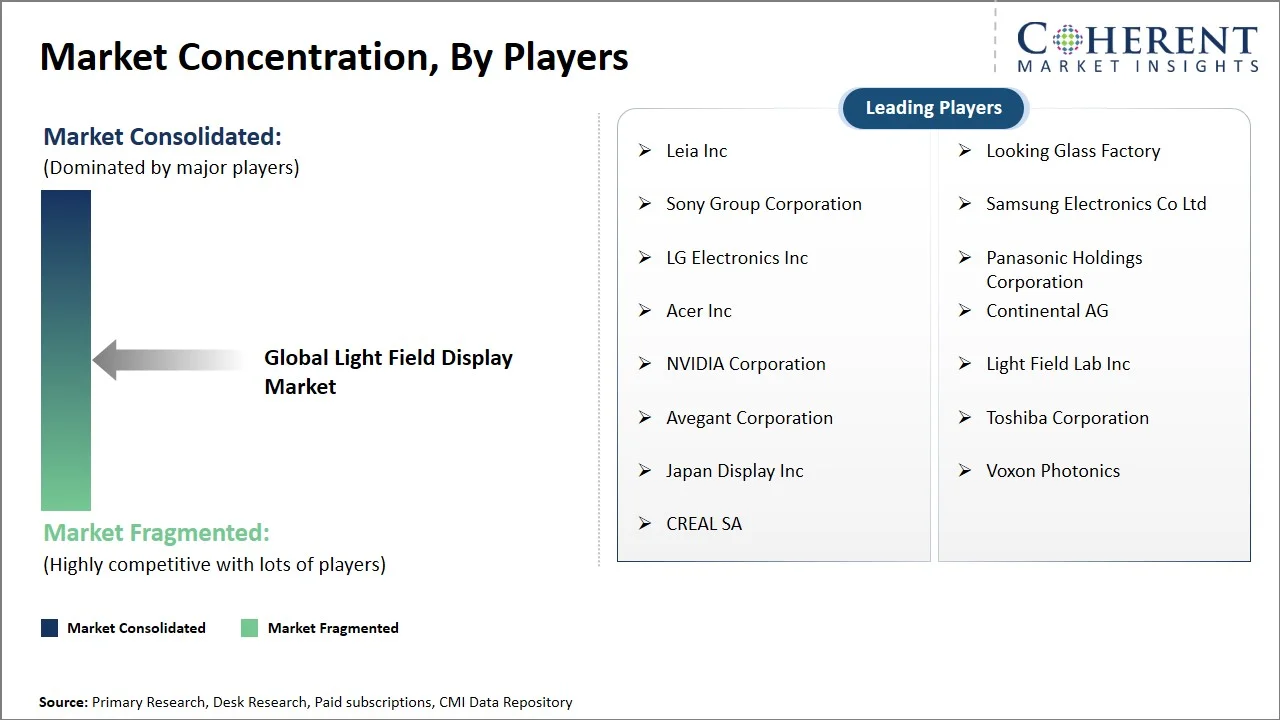
The global light field display market is led by a combination of specialized light field innovators and established display manufacturers focusing on commercialization, optical innovation, and strategic partnerships. Leia Inc has been focusing on diffractive light field technology for smartphones, tablets, automotive displays and digital signage through its proprietary Lightfield Platform, whereas Light Field Lab is developing SolidLight holographic display architecture targeting enterprise visualization, entertainment venues and location based experiences through collaborations with media and technology partners. Sony Group is capitalizing on its CMOS image sensor and professional visualization system strengths to enhance medical imaging and industrial applications. Samsung Electronics and LG Electronics are investing in micro LED, OLED and advanced display fabrication for future light field products.
Continental AG is focusing on automotive holographic displays and smart cockpit technologies, with the premium vehicle manufacturers as the target for three dimensional driver information systems. NVIDIA is broadening the ecosystem by offering GPU platforms for real time light field rendering for digital twins, simulation and immersive visualization. Most leading companies are prioritizing AI accelerated rendering, compact optical architectures, automotive integration, and strategic partnerships with automotive OEMs, healthcare solution providers, and content developers rather than competing solely on display hardware.
Market Report Scope
Light Field Display Market Report Coverage
| Report Coverage | Details | ||
|---|---|---|---|
| Base Year: | 2025 | Market Size in 2026: | USD 2.20 Bn |
| Historical Data for: | 2020 To 2024 | Forecast Period: | 2026 To 2033 |
| Forecast Period 2026 to 2033 CAGR: | 13% | 2033 Value Projection: | USD 10.75 Bn |
| Geographies covered: |
| ||
| Segments covered: |
| ||
| Companies covered: | Leia Inc, Looking Glass Factory, Sony Group Corporation, Samsung Electronics Co Ltd, LG Electronics Inc, Panasonic Holdings Corporation, Acer Inc, Continental AG, NVIDIA Corporation, Light Field Lab Inc, Avegant Corporation, Toshiba Corporation, Japan Display Inc, Voxon Photonics, and CREAL SA | ||
| Growth Drivers: |
| ||
| Restraints & Challenges: |
| ||
Analyst Opinion (Expert Opinion)
- The industry is expected to transition from prototype driven deployments toward commercial adoption in automotive cockpits, healthcare visualization, and industrial engineering over the next several years. Companies capable of reducing computational requirements while improving brightness, viewing angles, and optical efficiency are likely to establish stronger competitive positions as enterprise customers increasingly demand deployable rather than experimental solutions.
- The strongest growth opportunity is expected to emerge from holographic display technology for automotive smart cockpit and augmented reality head up display applications in the United States, China, South Korea, and Germany. These nations have strong automobile manufacturing, semiconductor capabilities and government support for intelligent mobility producing a conducive environment for broad scale adoption of light field visualization technology.
- The market players have to invest in proprietary optical engines, AI based light field rendering software and unique application platforms so that they may get a competitive edge rather than only competing on display hardware specifications. Strategic collaborations with automotive OEMs, medical imaging companies, GPU manufacturers, and optical component suppliers, together with vertical specific software ecosystems and intellectual property development, are expected to provide stronger long term differentiation than standalone display products.
Speak to the analyst
Want personalized insights?
Take the findings above to one of our principal consultants, or have the report rebuilt around the segments, geographies and competitors you actually track.
Market Segmentation
- Display Type Insights (Revenue, USD Billion, 2021 - 2033)
- Desktop Displays
- Mobile Displays
- Large Format Displays
- Head Mounted Displays
- Component Insights (Revenue, USD Billion, 2021 - 2033)
- Image Sensors
- Optical Components
- Processors
- Software
- Technology Type Insights (Revenue, USD Billion, 2021 - 2033)
- Holographic Display
- Volumetric Display
- Multi View Display
- Integral Imaging
- Microlens Array Based Display
- Application Insights (Revenue, USD Billion, 2021 - 2033)
- Consumer Electronics
- Automotive
- Healthcare
- Aerospace and Defense
- Media and Entertainment
- Education
- Industrial Design
- End User Insights (Revenue, USD Billion, 2021 - 2033)
- Commercial
- Industrial
- Healthcare Institutions
- Government and Defense
- Regional Insights (Revenue, USD Billion, 2021 - 2033)
- North America
- U.S.
- Canada
- Latin America
- Brazil
- Argentina
- Mexico
- Rest of Latin America
- Europe
- Germany
- U.K.
- Spain
- France
- Italy
- Russia
- Rest of Europe
- Asia Pacific
- China
- India
- Japan
- Australia
- South Korea
- ASEAN
- Rest of Asia Pacific
- Middle East
- GCC Countries
- Israel
- Rest of Middle East
- Africa
- South Africa
- North Africa
- Central Africa
- North America
- Key Players Insights
- Leia Inc
- Looking Glass Factory
- Sony Group Corporation
- Samsung Electronics Co Ltd
- LG Electronics Inc
- Panasonic Holdings Corporation
- Acer Inc
- Continental AG
- NVIDIA Corporation
- Light Field Lab Inc
- Avegant Corporation
- Toshiba Corporation
- Japan Display Inc
- Voxon Photonics
- CREAL SA
Sources
Primary Research Interviews
- Optical Engineering Managers
- Display Hardware Design Engineers
- Computational Imaging Scientists
- Imaging Sensor Technology Specialists
- Micro LED and OLED Display Experts
Magazines
- Laser Focus World
- Photonics Spectra
- Vision Systems Design
- Electronic Products
Journals
- Journal of the Society for Information Display (JSID)
- Journal of Information Display
- Journal of the Optical Society of America A
- Nature Photonics
Associations
- Society for Information Display (SID)
- Optica (formerly OSA)
- SPIE - The International Society for Optics and Photonics
- IEEE Photonics Society
Public Domain Sources
- U.S. Food and Drug Administration (FDA)
- U.S. Patent and Trademark Office (USPTO)
- European Patent Office (EPO)
- World Intellectual Property Organization (WIPO)
Proprietary Elements
- CMI Data Analytics Tool
- Proprietary CMI Existing Repository of Information for the Last 10 Years
Get access to 250+ pages report
Every segment, forecast, competitor profile and data table behind the analysis above — available for instant download.
- ESOMAR Member
- ISO 9001:2015 Certified
- D-U-N-S Registered
- GDPR & CCPA Compliant
Missing comfort of reading report in your local language? Find your preferred language:
Transform your Strategy with Exclusive Trending Reports
Frequently Asked Questions
The global light field display market is expected to stand at USD 2.20 Bn in 2026 and is expected to reach USD 10.75 Bn by 2033.
The CAGR of the global light field display market is projected to be 13% from 2026 to 2033.
Growing adoption of AR and VR technologies across enterprise and consumer applications and increasing demand for glasses free three dimensional visualization are the major factors driving the growth of the global light field display market.
High manufacturing and commercialization costs and limited availability of standardized content for light field displays are the major factors hampering the growth of the global light field display market.
In terms of display type, the desktop displays segment is estimated to dominate the market revenue share in 2026.
Artificial intelligence improves real time rendering, depth estimation, and image reconstruction efficiency.
Gaming companies are adopting immersive display technologies to deliver more realistic interactive experiences.