

Global Holographic Display Market Size and Forecast – 2026-2033
The Global Holographic Display Market is estimated to be valued at USD 16.83 Bn in 2026 and is expected to reach USD 66.16 Bn by 2033, exhibiting a compound annual growth rate (CAGR) of 21.6% from 2026 to 2033.
Key Takeaways of the Holographic Display Market
- The electro-holographic segment leads the market holding an estimated share of 43.3 % in 2026.
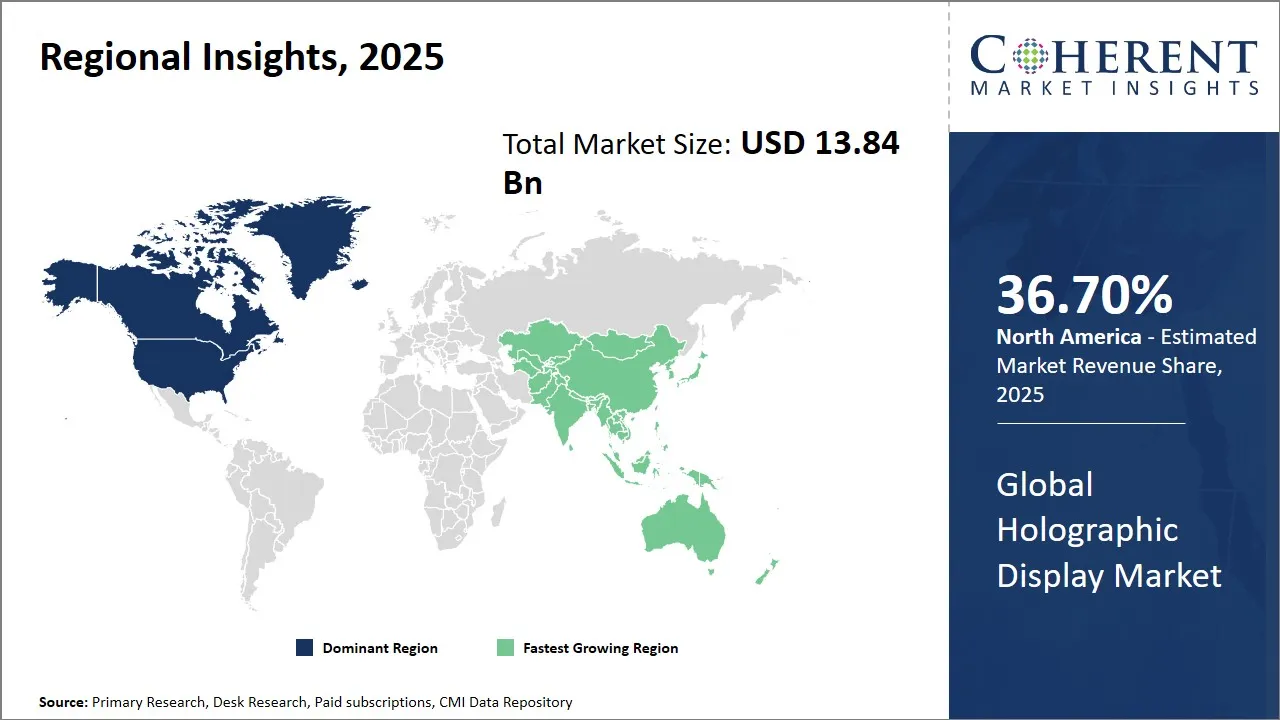
- North America is estimated to lead the market with a share of 36.7 % in 2026.
- Asia Pacific, holding a share of 27.6 % in 2026, is projected to be the fastest growing region.
Market Overview
Market trends indicate a strong shift towards integrating holographic displays with AI and IoT technologies, enhancing real-time data visualization and user engagement. Additionally, the surge in consumer electronics, virtual reality, and augmented reality applications is accelerating market growth. Companies are investing heavily in R&D to improve holographic resolution and reduce costs, making this technology more accessible. These factors combined are set to revolutionize display systems, transforming communication and visualization across multiple industries.
Current Events and Its Impact
Current Events | Description and its impact |
Geopolitical and Trade Developments |
|
Economic and Infrastructure Trends |
|
Segmental Insights
- Current Industry Events of 2026
- Market Size Estimation
- Regional Breakdown
- Competitive Landscape
- Customer Intelligence
- Segmental Analysis
- Pricing Analysis
- Key Market Drivers, Challenges & Future Trends
- Customized Insights Section
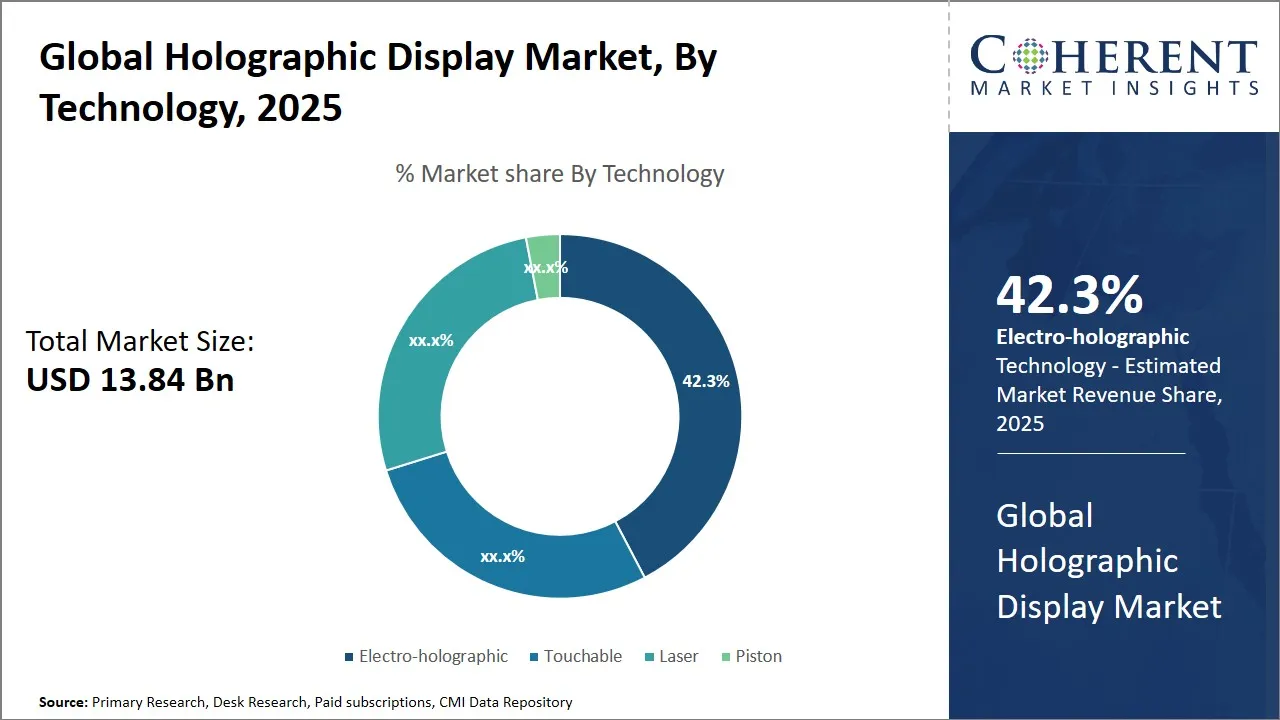
Global Holographic Display Market Insights, By Technology - Electro-holographic contributes the highest share of the market owing to its superior image quality and versatile application potential
Electro-holographic technology, holding an estimated share of 43.3% in 2026, stands out within the global holographic display market due to its remarkable ability to produce highly realistic, three-dimensional images that closely mimic natural visual experiences. This advanced display method leverages electrically controlled holograms, enabling dynamic and high-resolution visuals without the need for special eyewear, which significantly enhances user engagement and interaction..
One of the primary factors driving growth in the electro-holographic segment is its extensive applicability in consumer electronics, medical imaging, automotive displays, and advertising sectors. In consumer electronics, for instance, the demand for next-generation visual technologies that can increase immersion and user interface intuitiveness is rapidly growing. Electro-holography offers a tangible solution by providing interactive, touchless displays that meet these emerging expectations. Similarly, in medical diagnostics and training, this technology supports detailed visualization of complex anatomical structures, improving accuracy and educational outcomes.
Technological advancements have also accelerated the adoption of electro-holographic displays. Improvements in materials, such as photorefractive polymers and liquid crystal on silicon, have enhanced image fidelity and response times. Additionally, progress in computational power and algorithms has allowed for more efficient rendering of holographic content, thereby expanding practical usability and reducing production costs. These developments cultivate a favorable environment for both manufacturers and end-users seeking cutting-edge display solutions.
Furthermore, growing investments in research and development to overcome earlier limitations, such as system size and power consumption, have contributed to making electro-holographic displays more accessible and scalable. Integration with other emerging technologies like augmented reality (AR) and virtual reality (VR) further strengthens the segment’s market position, enabling hybrid applications that enhance user experiences across entertainment, education, and professional fields.
Impact of AI on the Holographic Display Market
Artificial Intelligence (AI) is significantly transforming the holographic display market by enhancing real-time rendering, image quality, personalization, and interactivity. AI algorithms enable holograms to adapt to user behavior, gestures, and voice inputs—making the experience more immersive and dynamic. One major breakthrough is the integration of AI in medical holography, where platforms like EchoPixel use AI-driven 3D imaging to convert medical scans into interactive holograms for diagnostics and surgical planning. These holograms assist surgeons in visualizing patient anatomy in real-time, reducing error rates and improving procedural outcomes.
A real-world example of AI’s growing influence is HYPERVSN’s 2025 launch of the “AI-powered holographic platform”, which allows brands to create hyper-realistic, 3D advertising content that reacts to audience presence and behavior.
Regional Insights
North America Holographic Display Market Analysis and Trends
North America, holding an estimated share of 36.7% in 2026, in the global holographic display market asserts its dominance due to a well-established technological ecosystem, strong presence of innovative companies, and favorable government initiatives supporting advanced display technologies. The U.S. and Canada have robust R&D infrastructure and significant investment in augmented and mixed reality, fueling demand for holographic displays in sectors such as defense, healthcare, automotive, and consumer electronics.
The presence of key industry players like Microsoft with its HoloLens technology, Zebra Imaging, and Leia Inc. drives continuous innovation. Furthermore, government policies promoting digital transformation and technology adoption enhance market readiness. The well-integrated supply chain and access to advanced manufacturing capabilities bolster North America’s position as the market leader.
Asia Pacific Holographic Display Market Analysis and Trends
The Asia Pacific region, holding an estimated share of 27.6% in 2026, exhibits the fastest growth in the holographic display market, propelled by rapidly expanding consumer electronics markets, government support for technological advancements, and growing adoption across diverse sectors such as retail, entertainment, and education. Countries like China, Japan, South Korea, and India are investing heavily in smart display technologies, augmented reality experiences, and digital signage solutions.
China’s aggressive push for innovation-led growth, facilitated by extensive state-driven grants and subsidies, supports both startups and established companies like TCL and BOE Technology Group. Additionally, the widespread proliferation of smartphones and electronics in emerging economies of Southeast Asia fuels demand for innovative holographic applications, making this region the fastest-growing contributor to the global market.
Holographic Display Market Outlook for Key Countries
U.S. Holographic Display Market Analysis and Trends
The U.S. maintains its lead in the holographic display space through a combination of advanced R&D centers and strong manufacturer presence. Pioneers such as Microsoft dominate with their mixed reality devices, pushing the envelope in immersive holography. Additionally, startups focusing on holographic projectors and medical imaging applications deepen the ecosystem. Government funding via agencies like DARPA ensures continuous innovation and integration of holographic displays in defense and healthcare sectors, securing the U.S.’s competitive edge.
China Holographic Display Market Analysis and Trends
China reflects rapid expansion driven by state-backed initiatives promoting smart manufacturing and digital innovation. Companies like TCL and BOE have ramped up investments in holographic research and production capabilities. The country is a hub for electronics manufacturing and digital advertising solutions, fostering a fertile environment for holographic display adoption in retail and consumer electronics. Furthermore, collaboration between academia and industry enhances China’s position as a key growth engine in the Asia Pacific region.
Japan Holographic Display Market Analysis and Trends
Japan continues to lead through its strong technological advancements and longstanding electronics industry. Firms such as Sony and Panasonic are at the forefront, integrating holographic displays into consumer electronics and automotive heads-up displays. The government’s support for Industry 4.0 and smart manufacturing bolsters research in holography and optical components. Japan’s mature supply chains and focus on high-quality manufacturing ensure it remains an important player with steady market expansion.
South Korea Holographic Display Market Analysis and Trends
South Korea thrives on its dynamic consumer electronics sector and high adoption of next-generation display technologies. Companies like Samsung and LG Electronics are pivotal, developing holographic displays targeted at smartphones, televisions, and virtual showrooms. Government initiatives aimed at fostering innovation within the ICT sector align perfectly with these corporate efforts, accelerating adoption across entertainment and advertising industries. The country’s sophisticated technological infrastructure makes it a crucial hub within the Asia Pacific landscape.
Germany Holographic Display Market Analysis and Trends
Germany plays a significant role within Europe with its strong industrial base and focus on integrating holographic displays into automotive, manufacturing, and healthcare sectors. Corporations such as Bosch and Siemens invest in holographic technologies for enhanced visualization and operation efficiencies. Germany’s government provides substantial support for Industry 4.0 initiatives and digital transformation of manufacturing, fostering innovation in holographic display solutions. The country’s strategic location and trade agreements facilitate active participation in the broader European market.
Market Players, Key Development, and Competitive Intelligence
Key Developments
- In May 2025, Technology leaders ZEISS and tesa joined forces to bring holography to industrial scale. The two companies have signed a strategic partnership agreement to drive the serial replication of large-format, holographically functionalized films – with a focus on transparent display applications in automotive windshields. By combining ZEISS’s microoptics expertise with tesa’s advanced adhesive technologies, the partnership aims to enable scalable, process-stable production of optical holographic components for integration into transparent surfaces such as glass.
- In May 2025, Avalon Holographics releases NOVAC, the first commercially available, true holographic table display. For the first time, groups can visualize detailed holograms together, turning their 3D content into mechanisms for high-powered decision making without glasses, headsets or tracking systems.
- In May 2025, HYPERVSN, the global pioneer in cutting-edge 3D holographic technology, announced a revolutionary leap in experiential advertising with the debut of the world’s first 3D Holographic Experience Truck, brought to life through a strategic collaboration with mobile advertising innovator FLO Advertising and out-of-home media leader Firefly.
- In January 2025, Hyundai Mobis, a leading global automotive supplier, has introduced the world's first full-windshield holographic display at CES 2025, redefining the future of in-vehicle display technology. Unlike conventional systems that rely on traditional screen-based components, this cutting-edge innovation operates without physical screens, offering a next-generation approach to information display in vehicles.
Top Strategies Followed by the Holographic Display Market Players
- Established companies dominate through substantial investments in research and development, continuously innovating to produce high-performance holographic displays that meet the demands of various industries such as consumer electronics, healthcare, and automotive sectors.
- Microsoft, a leading player in spatial computing, continues to invest significantly in R&D for its HoloLens platform.
- Mid-level players in the holographic display market adopt strategies that focus on cost-effectiveness without compromising significant quality. Recognizing the importance of affordability, these companies tailor their product offerings to appeal to price-sensitive consumers and small to medium-sized enterprises seeking realistic, yet budget-friendly holographic solutions.
- Looking Glass Factory, a mid-sized player in the 3D holographic space, launched the Looking Glass Go in 2025—a portable, affordable holographic display designed for content creators, developers, and educators.
- Small-scale players contribute to the competitive landscape by focusing on niche segments and specialized product features that larger companies might overlook. These agile firms often adopt cutting-edge and experimental technologies such as advanced light field displays, holographic projection integrated with augmented reality, or ultra-portable holographic devices to differentiate themselves.
- Holoxica, a small but specialized player, focuses on glass-free 3D medical displays used in neurology and radiology. The company specializes in converting MRI and CT scans into high-resolution 3D holographic models for hospitals and training institutions.
Market Report Scope
Holographic Display Market Report Coverage
| Report Coverage | Details | ||
|---|---|---|---|
| Base Year: | 2025 | Market Size in 2026: | USD 16.83 Bn |
| Historical Data for: | 2020 To 2024 | Forecast Period: | 2026 To 2033 |
| Forecast Period 2026 to 2033 CAGR: | 21.6% | 2033 Value Projection: | USD 66.16 Bn |
| Geographies covered: |
| ||
| Segments covered: |
| ||
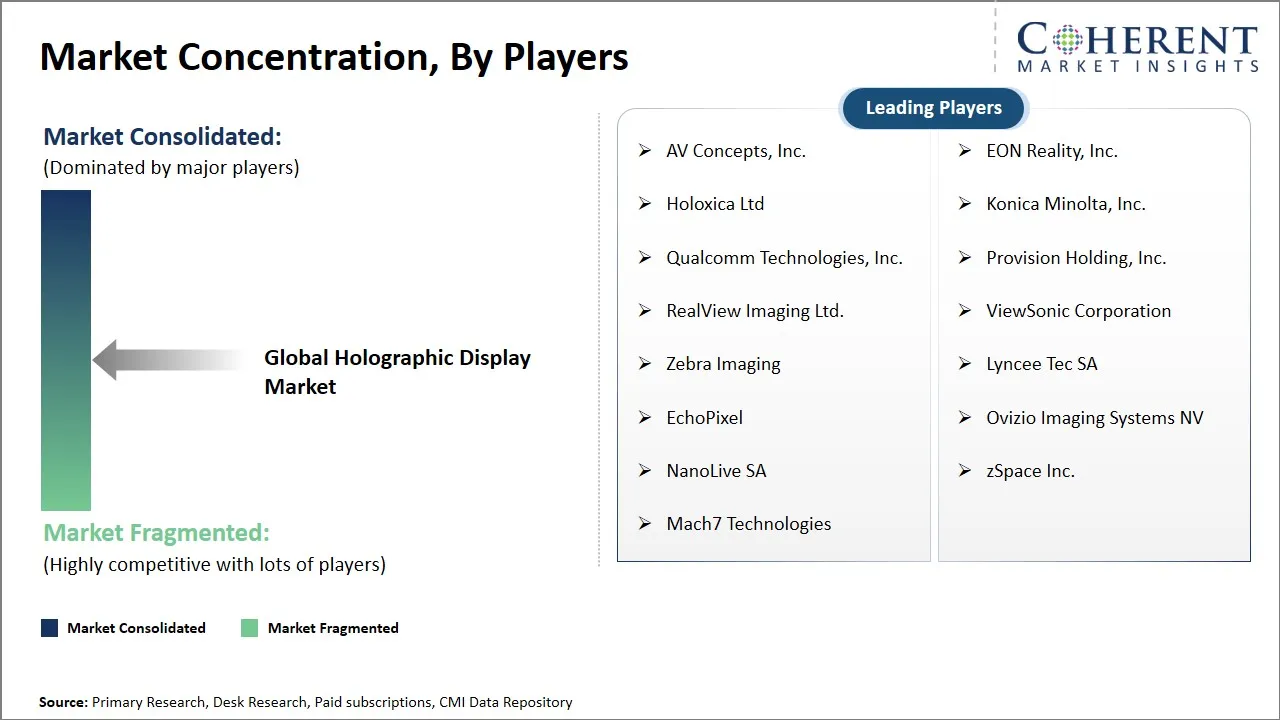
| Companies covered: | AV Concepts, Inc., EON Reality, Inc., Holoxica Ltd, Konica Minolta, Inc., Qualcomm Technologies, Inc., Provision Holding, Inc., RealView Imaging Ltd., ViewSonic Corporation, Zebra Imaging, Lyncee Tec SA, EchoPixel, Ovizio Imaging Systems NV, NanoLive SA, zSpace Inc., and Mach7 Technologies | ||
| Growth Drivers: |
| ||
| Restraints & Challenges: |
| ||
Market Dynamics
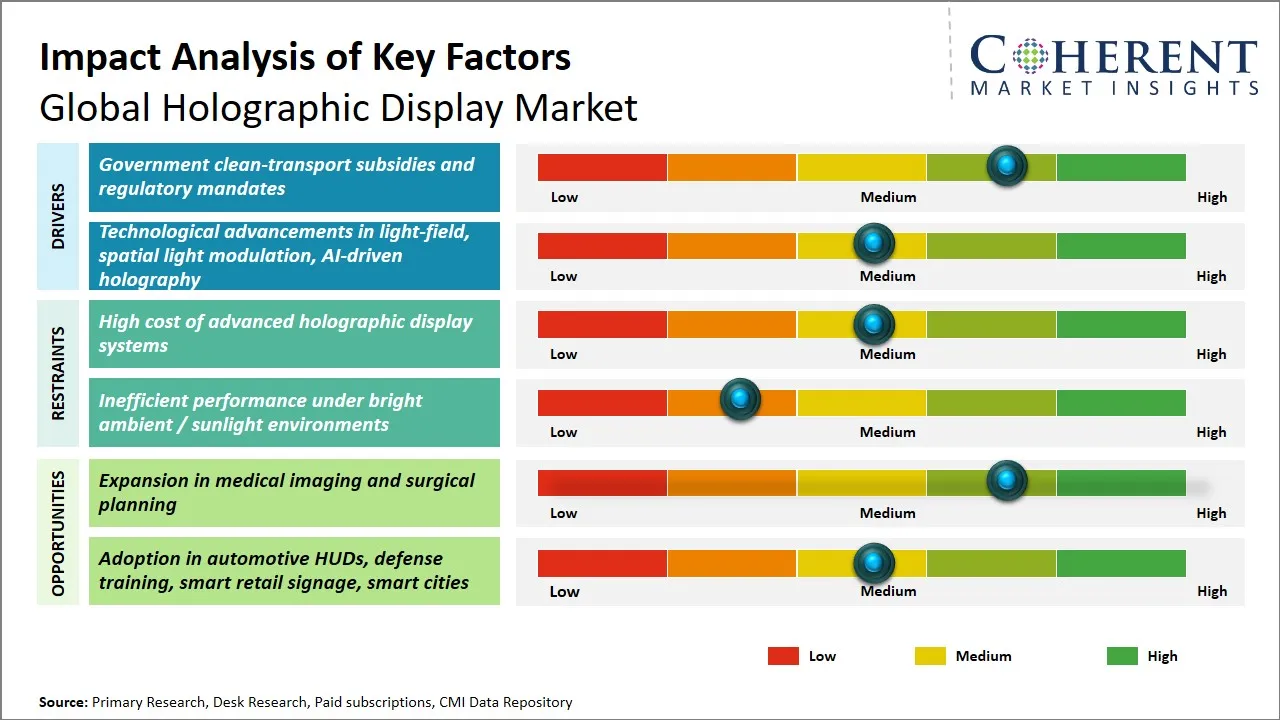
Global Holographic Display Market Driver - Government Clean ‑ transport Subsidies and Regulatory Mandates
Increasing governmental support through clean-transport subsidies and stringent regulatory mandates is significantly influencing the adoption of advanced display technologies, including holographic displays, across various sectors. Governments worldwide are actively promoting environmentally friendly transportation solutions to reduce carbon emissions and enhance energy efficiency. These initiatives often include subsidies for electric and autonomous vehicles, where holographic displays play a pivotal role by providing enhanced driver information systems and augmented reality interfaces.
Furthermore, regulatory mandates aimed at improving road safety and driver experience are accelerating investments in cutting-edge display technologies that offer clearer, real-time visualizations without distracting the driver. In January 2025, Proto Hologram partnered with Hologram Media Network to launch the world’s first 3D holographic advertising network across 30 Simon Malls in the U.S.
Global Holographic Display Market Opportunity – Expansion in Medical Imaging and Surgical Planning
With the increasing complexity of medical procedures and the rising demand for precision and accuracy, holographic displays offer a transformative approach by providing three-dimensional, interactive visualizations of anatomical structures. These displays enable surgeons and medical professionals to examine detailed holograms of organs, tissues, and vascular systems, facilitating enhanced pre-operative planning and reducing the margin of error during surgeries. RealView Imaging, an Israeli company, deployed its HOLOSCOPE-i system—a real-time, interactive 3D holographic visualization platform—at major hospitals in the U.A.E in 2024–25. The device allows surgeons to manipulate 3D holograms of a patient’s organs without glasses or headsets, supporting complex interventional procedures.
The technology’s ability to present data in a spatial context improves understanding of patient-specific conditions, promoting personalized treatment strategies. Furthermore, advancements in real-time holographic imaging are contributing to more effective intraoperative navigation, helping surgeons make informed decisions on the spot. The integration of holographic displays with existing diagnostic tools such as MRI and CT scans amplifies their utility, making complex data more accessible and interpretable.
Analyst Opinion (Expert Opinion)
- Once confined to research labs, holographic medical imaging is now entering real-world operating rooms and diagnostic centers. Technologies like RealView Imaging’s HOLOSCOPE-i are enabling cardiologists and surgeons to interact with 3D anatomical models in real-time, improving precision during minimally invasive procedures. As hospitals seek safer, more efficient workflows, holography is no longer futuristic—it’s fast becoming a clinical imperative in high-value healthcare environments.
- Retailers are embracing holography to deliver attention-grabbing, interactive content that static signage simply can’t match. The launch of the world’s first 3D holographic ad network by Proto and Hologram Media Network in U.S. malls signals a paradigm shift: holography is not just display—it’s digital storytelling in motion. Brands are now measuring engagement in dwell time and emotional response, and holograms are setting a new standard for what immersive retail experiences can look like.
- Driven by needs for tactical visualization, battlefield planning, and remote collaboration, defense agencies are investing in holographic technologies that enhance situational awareness. Programs like the U.S. Department of Defense’s Integrated Visual Augmentation System (IVAS) and EON Reality’s launch of Spatial AI Military Academy illustrate how holography is enabling lifelike simulation training, reducing risk while improving readiness. This use-case not only supports national security but catalyzes broader innovation in simulation, education, and urban planning sectors.
Speak to the analyst
Want personalized insights?
Take the findings above to one of our principal consultants, or have the report rebuilt around the segments, geographies and competitors you actually track.
Market Segmentation
- Technology Insights (Revenue, USD Bn, 2021 - 2033)
- Electro-holographic
- Touchable
- Laser
- Piston
- Regional Insights (Revenue, USD Bn, 2021 - 2033)
- North America
- U.S.
- Canada
- Latin America
- Brazil
- Argentina
- Mexico
- Rest of Latin America
- Europe
- Germany
- U.K.
- Spain
- France
- Italy
- Russia
- Rest of Europe
- Asia Pacific
- China
- India
- Japan
- Australia
- South Korea
- ASEAN
- Rest of Asia Pacific
- Middle East
- GCC Countries
- Israel
- Rest of Middle East
- Africa
- South Africa
- North Africa
- Central Africa
- North America
- Key Players Insights
- AV Concepts, Inc.
- EON Reality, Inc.
- Holoxica Ltd
- Konica Minolta, Inc.
- Qualcomm Technologies, Inc.
- Provision Holding, Inc.
- RealView Imaging Ltd.
- ViewSonic Corporation
- Zebra Imaging
- Lyncee Tec SA
- EchoPixel
- Ovizio Imaging Systems NV
- NanoLive SA
- zSpace Inc.
- Mach7 Technologies
Sources
Primary Research Interviews
Stakeholders
- Consumer Electronics Manufacturers (e.g., Product Development Managers, R&D Heads)
- Display Technology Firms and Optoelectronics Specialists
- Healthcare Technology Providers (e.g., Radiologists, Surgical Visualization Experts)
- Defense Technology Integrators (e.g., Simulation Engineers, Tactical Systems Leads)
- Retail Tech Companies and Experiential Marketing Agencies
- XR and Spatial Computing Developers (AR/VR/Holography)
- Academic Researchers in Imaging, Light-Field Tech, and Human-Computer Interaction
Databases
- U.S. Patent and Trademark Office (USPTO)
- European Patent Office (EPO)
- International Trade Centre (ITC) – Display Trade Analytics
- OECD Innovation and Technology Outlook
- Global Electronics Statistical Index (GESI)
- World Intellectual Property Organization (WIPO)
Magazines
- NextGen Display Weekly
- Immersive Tech Review
- AV Magazine (Audio Visual Technology)
- Digital Signage World
- Medical Imaging Tech Monthly
- Defense Simulation & Training News
Journals
- Journal of Lightwave Technology
- IEEE Transactions on Visualization and Computer Graphics
- Journal of Holography and Optical Imaging
- Medical Image Analysis Journal
- Display and Imaging Research Journal
- International Journal of Human–Computer Interaction
Newspapers
- The Tech Herald
- Electronics Business Daily
- Arab News – Tech & Innovation Section
- The Economic Times (India)
- The Verge (Tech News)
- The National (UAE) – Business Innovation
Associations
- International Society for Optical Engineering (SPIE)
- Society for Information Display (SID)
- Medical Imaging & Technology Alliance (MITA)
- Virtual Reality and Immersive Media Association (VRIMA)
- Augmented Reality Enterprise Alliance (AREA)
- Advanced Display Technology Consortium (ADTC)
Public Domain Sources
- World Bank Open Data
- EUROSTAT
- U.S. Census Bureau
- UNESCO Science Report
- ITU ICT Development Index
- ResearchGate
Proprietary Elements
- CMI Data Analytics Tool
- Proprietary CMI Existing Repository of information for last 8 years
Get access to 250+ pages report
Every segment, forecast, competitor profile and data table behind the analysis above — available for instant download.
- ESOMAR Member
- ISO 9001:2015 Certified
- D-U-N-S Registered
- GDPR & CCPA Compliant
Missing comfort of reading report in your local language? Find your preferred language:
Transform your Strategy with Exclusive Trending Reports
Frequently Asked Questions
The global holographic display market is estimated to be valued at USD 16.83 billion in 2026 and is expected to reach USD 66.16 billion by 2033.
The CAGR of the global holographic display market is projected to be 21.6% from 2026 to 2033.
Government clean‑transport subsidies and regulatory mandates and technological advancements in light‑field, spatial light modulation, AI‑driven holography are the major factors driving the growth of the global holographic display market.
High cost of advanced holographic display systems and inefficient performance under bright ambient sunlight environments are the major factors hampering the growth of the global holographic display market.
In terms of technology, electro-holographic is estimated to dominate the market revenue share in 2026.
Healthcare, retail, advertising, defense, and education are leading adopters of holographic display technologies.
Yes, systems like RealView Imaging’s HOLOSCOPE-i are already in use for surgical planning and medical imaging in hospitals.