

Global Medical Device Cybersecurity Market Size and Forecast – 2026 To 2033
The global medical device cybersecurity market is expected to grow from USD 8.62 Bn in 2026 to USD 17.50 Bn by 2033, registering a compound annual growth rate (CAGR) of 10.6% from 2026 to 2033. The global market for medical device cybersecurity is expected to grow significantly during the forecast period, owing to the growing number of cyberattacks targeting connected medical devices and healthcare network. Such cases are contributing towards the demand for threat detection and response, network monitoring, and device vulnerability management.
According to the U.S. Department of Health and Human Services, between 2022 and 2023, data breaches increased by around 3.8%, but the number of affected individuals increased by more than 193%, highlighting the increasing need for better cybersecurity across the interconnected healthcare environments. (Source: The HIPAA Journal)
Key Takeaways of the Global Medical Device Cybersecurity Market
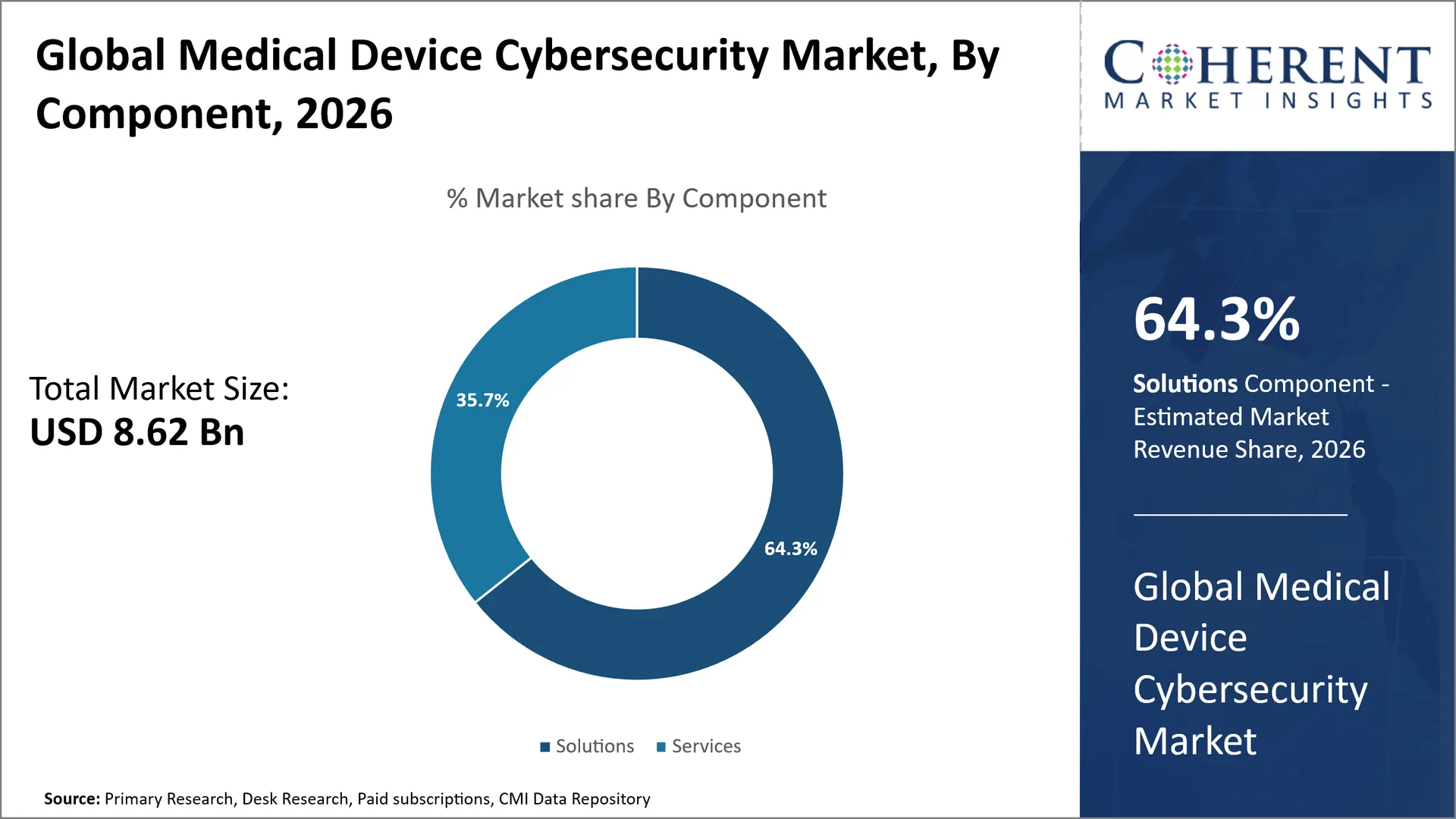
- Solutions are projected to hold 64.3% of the global medical device cybersecurity market share in 2026, making it dominant component segment, across North America due to the mature healthcare IT infrastructure, integration of medical devices and their adoption, along with the rising focus on cybersecurity across the device lifecycle. For instance, the U.S. Food and Drug Administration (FDA) updated guidance document in February 2026, which defined cybersecurity recommendations for medical device design, labeling, and premarket submissions.
- Network and IoMT security is projected to hold 34.6% of the global medical device cybersecurity market share in 2026, making it dominant security type segment, across Asia Pacific due to the increasing deployment of connected medical devices in the healthcare ecosystem and rising government initiatives to improve security of network-enabled devices in healthcare infrastructure. For instance, Singapore launched its Cybersecurity Labelling Scheme for Medical Devices in October 2024, to demonstrate secure product design and accelerate cybersecurity awareness among consumers and the healthcare workforce.
- Hospital medical devices are projected to hold 46.2% of the global medical device cybersecurity market share in 2026, making it dominant device type segment, across Europe driven by hospital digitization along with the growing interconnectedness of clinical devices and regional efforts toward improving healthcare cybersecurity. - For instance, in July 2026, the European Union Agency for Cybersecurity (ENISA) issued a set of procurement guidelines to enable hospitals and healthcare organizations incorporate cybersecurity requirement into their procurement processes.
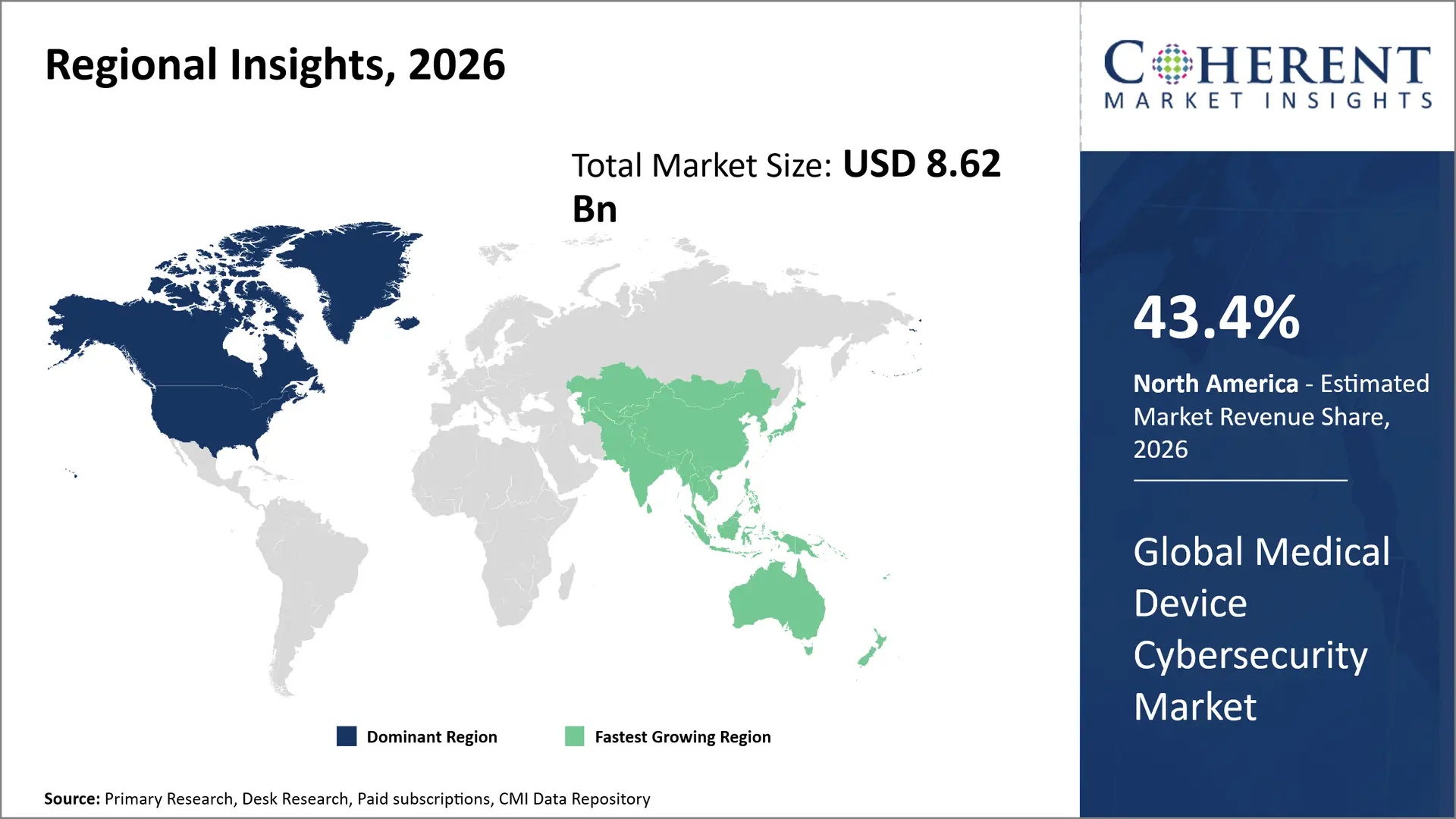
- North America market maintains dominance with an expected share of 43.4% in 2026, primarily because of a well-established healthcare cybersecurity ecosystem, high volume of connected healthcare devices, and government initiatives to increase the cybersecurity preparedness of healthcare organizations. For instance, in March 2026, U.S. Department of Health and Human Services (HHS) released a cybersecurity module in the Risk Identification and Site Criticality (RISC) 2.0 Toolkit to help healthcare facilities assess their cyber risks and improve their cyber resiliency during disruptions.
- Asia Pacific is expected to exhibit the fastest growth in the global medical device cybersecurity market, registering an estimated CAGR of 17.2% during 2026–2033, attributed to the surging use of connected medical devices and increasing regulatory focus on device security across the entire life cycle. For instance, in August 2026, Japan’s Ministry of Health, Labor and Welfare published its first ‘Software Bill of Materials’ (SBOM) implementation and operation guidelines for medical devices to enable greater software component transparency and improved vulnerability management.
Segmental Insights
Why Do Solutions Dominate the Global Medical Device Cybersecurity Market?
Solutions are projected to hold the market share of 64.3% in 2026, due to the high adoption of integrated solutions such as platform which includes device discovery, vulnerability scanning, threat monitoring and incident response. Healthcare providers are more inclined to adopt integrated products that protect connected medical devices, hospital networks, and patient data, rather than relying on individual security services. For instance, in October 2024, the Global Digital Health Partnership of national governments and WHO issued its Guidance for Medical Device Cybersecurity. The guidance outlines cybersecurity measures for medical device manufacturers and health purchasers, which are focused on improving device security during deployment and utilization.
- Current Industry Events of 2026
- Market Size Estimation
- Regional Breakdown
- Competitive Landscape
- Customer Intelligence
- Segmental Analysis
- Pricing Analysis
- Key Market Drivers, Challenges & Future Trends
- Customized Insights Section
Why Do Network and IoMT Security Represent the Largest Security Type Segment in the Medical Device Cybersecurity Market?
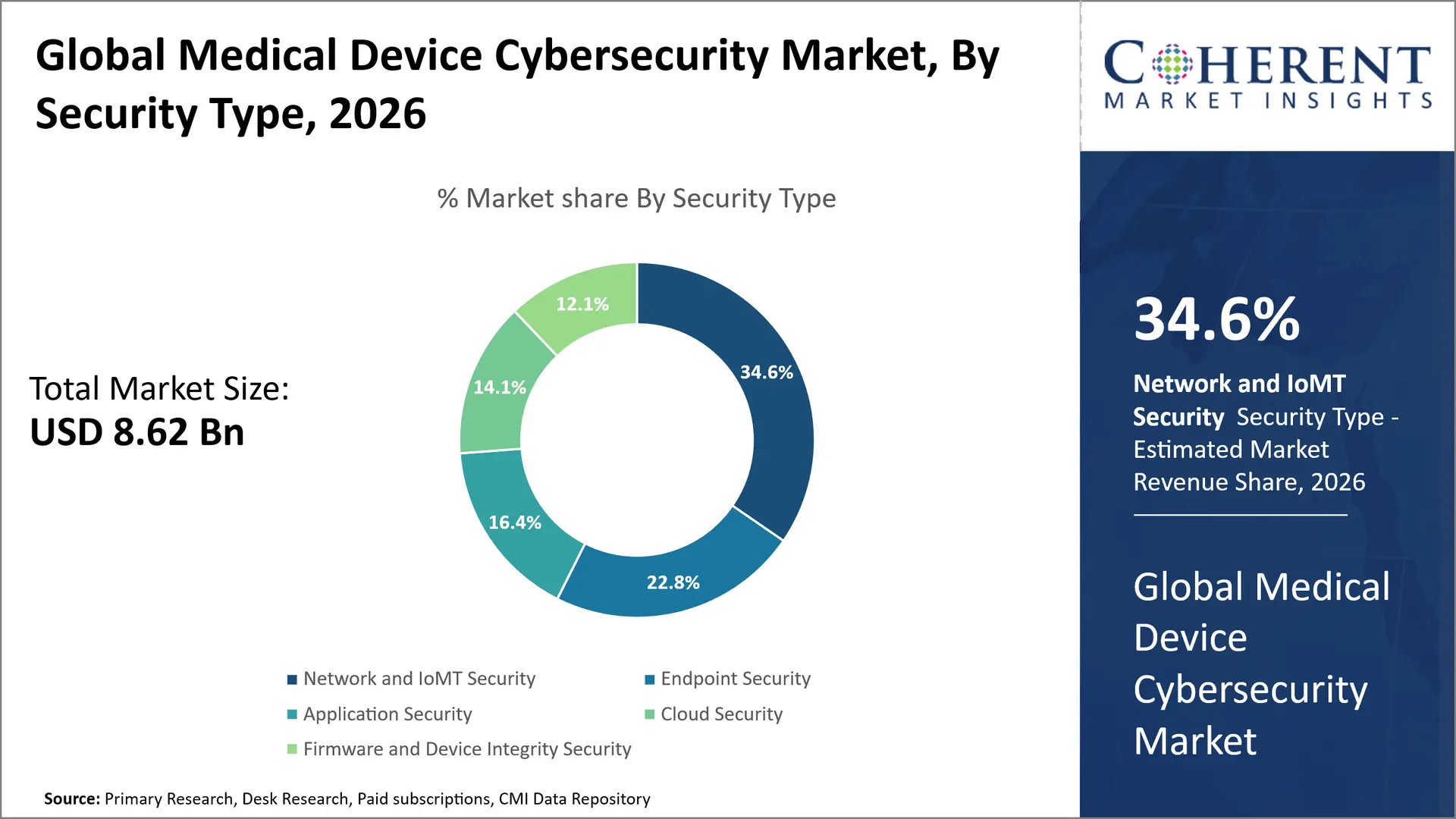
Network and IoMT security is projected to hold a market share of 34.6% in 2026, due to the rising adoption of connected medical devices in hospital networks and cloud-connected health systems, and non-trusted environments which lead to unauthorized access, malware, and network attacks. Healthcare companies are adopting network segmentation, access controls, and real-time monitoring solutions to secure device communications and data. For instance, Singapore's Ministry of Health includes medical device and operational technology security mandates in the Health Tech Instruction Manual. The manual highlights the need for medical device asset management, secure network configuration and the obligation for IT asset security updates on an ongoing basis in public healthcare facilities.
Hospital Medical Devices Segment Dominates the Global Medical Device Cybersecurity Market
The hospital medical devices segment is projected to hold a market share of 46.2% in 2026, due to their crucial role in monitoring, diagnosing, and treating patients, as well as the connectivity with hospital systems and clinical information systems for the risk posed by cyber-attacks to jeopardize these mission-critical devices. Healthcare facilities are expected to focus on device-level security, network security, and vulnerability management. For instance, in March 2026, Japan’s Ministry of Health, Labour and Welfare published a notice reiterating the role that cybersecurity measures play in connection with virtual private network (VPN) and other network equipment that is connected with medical devices, highlighting the need to secure hospital device connectivity.
Current Events and their Impact
Current Events | Description and its Impact |
U.S. FDA and University of California San Diego Established Collaboration to Strengthen Medical Device Cybersecurity (September 2026) |
|
U.S. HHS Issued Cybersecurity Advisory on Protecting Healthcare Operational Technology and IoMT Devices (December 2024) |
|
Medical Device Cybersecurity Market Dynamics
Market Drivers
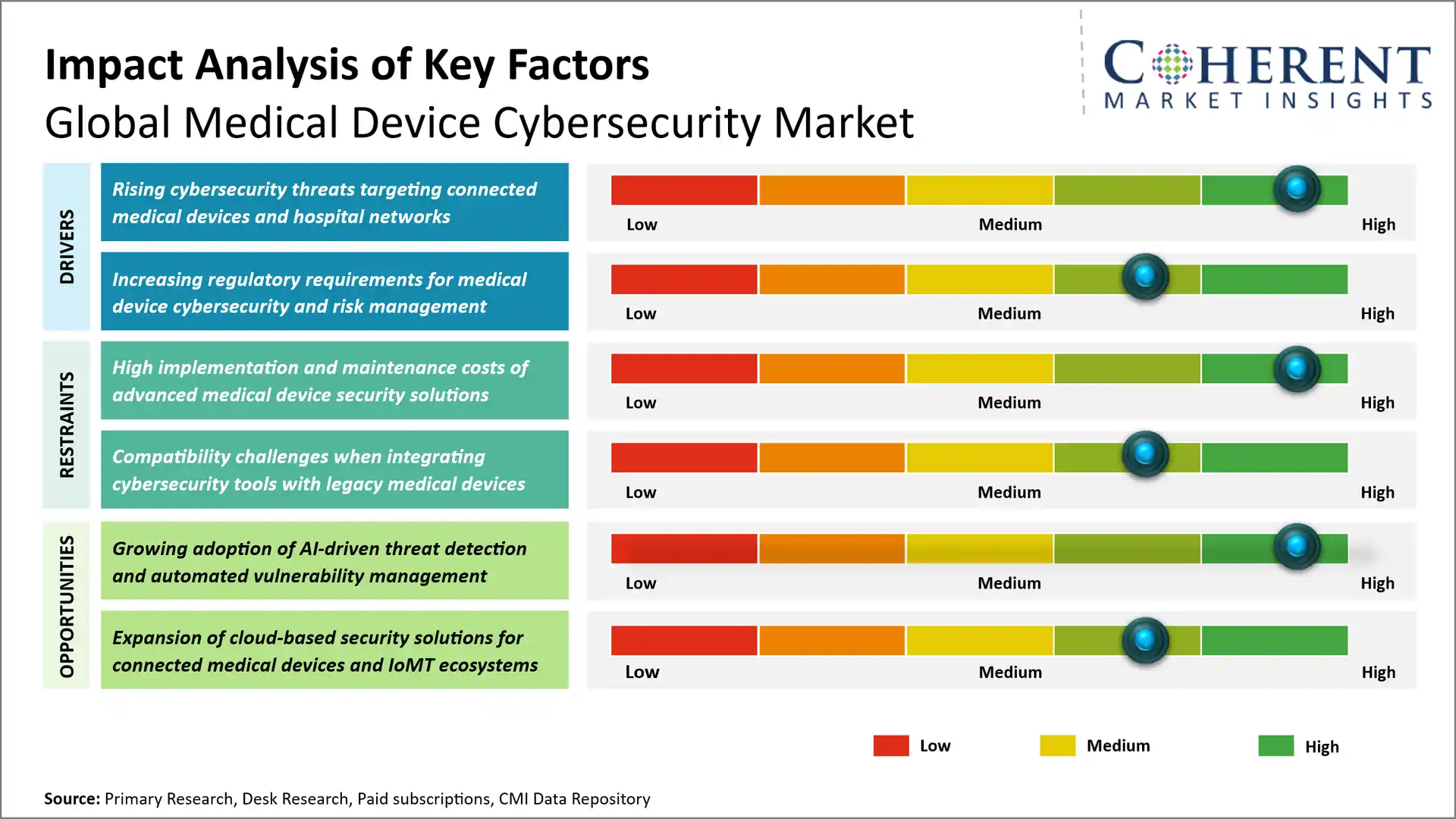
- Rising cybersecurity threats targeting connected medical devices and hospital networks: Increasing connectivity of patient monitors, infusion pumps, imaging systems and other devices is opening up medical networks to breaches, theft of data and control of devices. For instance, in January 2025, the U.S. Food and Drug Administration (FDA) issued a safety communication regarding cybersecurity vulnerabilities in Contec CMS8000 and Epsimed MN-120 patient monitors. This communication warned that unauthorized individuals could remotely control the monitors and access confidential patient information after these devices were connected to the internet.
- Increasing regulatory requirements for medical device cybersecurity and risk management: The latest cybersecurity regulations are forcing medical device manufacturers to build cybersecurity into the design, development and post-market of their products. For instance, in February 2026, the U.S. Food and Drug Administration (FDA) released revised guidance on cybersecurity for medical devices. The updates recommended that device manufacturers develop a documented risk assessment, plan for managing vulnerabilities, and software bill of materials (SBOM), along with a plan for providing security updates.
- Growing digitalization of healthcare infrastructure and connected care systems: The rise in electronic health records, interoperable hospital solutions, telehealth, connected healthcare and health tech is creating an unprecedented level of personal health information being transferred on an interconnected grid. This highlights the importance of dedicated cybersecurity infrastructure in connected healthcare. For instance, India’s Ministry of Health and Family Welfare had collected more than 1 billion (100 crore) health records with Ayushman Bharat Health Accounts (ABHA) in May 2026. The agency has also successfully onboarded more than 450 public and private health tech solutions on the digital health ecosystem.
Emerging Trends
- AI-Driven Medical Device Threat Detection: The use of artificial intelligence and machine learning across a cybersecurity platform can enable an automatic detection of unusual network activity, weaknesses in endpoints, and new cyber threats.
- Impact: Use of AI monitoring will speed up discovery of threats and will encourage the proactive identification of potential security breaches. Furthermore, it will reduce dependence on manual security assessment and will provide faster incident response.
- Market Relevance: The adoption of AI-enabled security platform is projected to increase and will help in fueling demand from hospitals and medical device manufacturers for more sophisticated solutions. This will help to enhance Intelligent threat detection and automated vulnerability management capabilities.
- Software Bill of Materials (SBOM) Adoption for Medical Device Security: Medical device companies are adopting SBOM practices to have more insight into the software component, track down third-party libraries that are susceptible and better define the software security risks.
- Impact: Through SBOMs, users are able to quickly and efficiently pinpoint software vulnerabilities and better coordinate security incidents. In addition, SBOMs enable ongoing tracking of device software throughout its lifetime.
- Market Relevance: As the importance of transparency for software increases, sales opportunities will arise for security offerings that provide vulnerability management, software composition analysis, and risk analysis
Regional Insights
Why is North America a Strong Market for Medical Device Cybersecurity?
The North America region is expected to dominate the global medical device cybersecurity market with an estimated market share of 43.4% in 2026. due to strong healthcare infrastructure, high regulatory obligations and focus on the security of connected devices. The U.S. is leading the region in adoption over lifecycle-based cybersecurity regulations and significant government funding programs that drive the creation of leading cybersecurity capabilities for healthcare devices.
For instance, in November 2025, the U.S. Advanced Research Projects Agency for Health (ARPA-H) launched UPGRADE, with a commitment of up to USD 43 million to develop automated vulnerability detection, remediation, and security patching of connected medical devices at hospitals. Furthermore, continued government focus, along with rising investment in IoMT security, vulnerability management and endpoint protection continue to sustain North America's dominance in the market.
Why Does Asia Pacific Medical Device Cybersecurity Market Exhibit High Growth?
The Asia Pacific region is projected to grow at the highest CAGR of 17.2% in the global medical device cybersecurity market during the forecast period (2026–2033). The region is projected to contribute 22.1% of the global market in 2026, owing to rapid digitization of healthcare, proliferating manufacturing of medical devices, and growing government focus on healthcare IT security. Growing adoption of connected medical devices in countries such as China, India, Japan, and South Korea will create a substantial demand for network security, threat protection & vulnerability management, and IoMT security.
Additionally, government-supported digital health transformation programs and increased need for the creation of more secured cybersecurity infrastructure are likely to help augment investments in digital health security. For instance, in June 2026, the Australian Government launched the Horizon 2 Action Plan under the 2023-2030 Australian Cyber Security Strategy. The plan involves growing the number of members of the Health Cyber Security Network to 60 members, accounting for more than 600 health sites. The aim is to improve sharing of threat intelligence, vulnerability management and cybersecurity resilience of the healthcare assets.
Global Medical Device Cybersecurity Market Outlook for Key Countries
Why is the U.S. Leading Innovation and Adoption in the Medical Device Cybersecurity Market?
The U.S. has the most comprehensive cybersecurity ecosystem for medical devices, spanning specialized IoMT security vendors, existing healthcare cyber security suppliers and emerging medical-device technology providers. Section 524B of the Food and Drug Administration (FDA) is critical in cementing the importance of cybersecurity in connected device development, for vulnerability management, SBOM, and post-market security updates.
Is Japan a Favorable Market for Medical Device Cybersecurity Market?
Japan is an attractive market for medical device cybersecurity driven by its advanced technology sector, increasing use of connected medical devices, and the regulatory framework around device security. Japan requires connected medical device to perform cyber security risk assessment and lifecycle-based device security management. Article 12, Paragraph 3, Essential Principles for Medical Devices states: The demand for vulnerability management, hospital network security, and software security also offers a scope for better Medical Internet of Things (IoMT), SBOM, and device monitoring solutions.
Is China Emerging as a Key Growth Hub for the Medical Device Cybersecurity Market?
China is becoming a major growth market for medical device cybersecurity due to high adoption of connected medical devices in hospitals, commercialization of hospital digitization & implementation of cybersecurity requirements. Deployment of network security, device vulnerability management and software security solutions is opening doors for cybersecurity players in China's emerging healthcare technology industry.
Why Does Germany Top the European Medical Device Cybersecurity Market?
Germany exhibits a strong presence in the European medical device cybersecurity market owing to its large medical device manufacturing sector, hospital infrastructure and high cybersecurity policies for healthcare facilities. The Federal Office for Information Security (BSI) in Germany detects cyber security gaps in networked medical devices. Additionally, the cybersecurity policies in healthcare in the country drives the strength of cybersecurity measures for healthcare devices and IT network. Therefore, it brings the demand for IoMT cybersecurity, device vulnerabilities testing, and a lifecycle-centric cybersecurity.
Is Medical Device Cybersecurity Market Developing in UK?
The UK remains an emerging healthcare market for medical device cybersecurity, increasingly well-placed for cybersecurity spending as the NHS pushes for better security across connected medical devices in hospitals and other healthcare networks. The emphasis on safety around connected device risk and secure procurement, protecting aging hardware, and addressing vulnerabilities to close the gap in hospital and device-level risk, brings opportunities for providers of IoMT cybersecurity and real-time device monitoring services.
Cybersecurity Risk Exposure Across Major Medical Device Categories
Medical Device Category | Key Cybersecurity Risks | Recommended Security Measures |
Patient Monitoring Systems | Network Intrusion, Unauthorized Access, Data Interception | Access Controls, Network Segmentation, Encryption |
Infusion Pumps | Dosage Alteration, Remote Manipulation, Software Vulnerabilities | Continuous Monitoring, Device Authentication, Firmware Protection |
Implantable and Wearable Devices | Software Exploitation, Wireless Attacks, Data Interception, | Authentication, Secure Wireless Connectivity, Encryption |
Medical Imaging Systems | Unauthorized System Access, Ransomware, Data Breaches, | Network Security, Endpoint Protection, Vulnerability Patching |
Ventilators and Respiratory Devices | Unauthorized Configuration Changes, Device Disruption, | Secure Communication Protocols, Access Management |
How is the growing adoption of AI-driven threat detection and automated vulnerability management creating new growth opportunities in the medical device cybersecurity market?
As the connected ecosystem of medical devices became complex, healthcare organizations are looking for new cybersecurity solutions with artificial intelligence to enable real-time threat detection, incident response, automated vulnerability assessment and monitoring, and anomaly detection, in order to improve healthcare organizations' incident response. For instance, in July 2026, CERT-In announced the deployment of artificial intelligence-based tool for malicious activity detection, AI-enabled vulnerability assessment and automated cyber threat intelligence sharing, while cyber security drills will include the health sector. (Source: Press Information Bureau)
Market Players, Key Development, and Competitive Intelligence
Key Developments
- In October 2026, Qualysec Technologies launched Medysec, a new cybersecurity practice targeting medical device manufacturers and Health Tech companies, providing medical device penetration testing, firmware and application security testing, threat modelling, and cyber security support for FDA.
- In June 2026, Siemens Healthineers entered into a USD 6.9 million research contract with the US Advanced Research Projects Agency for Health (ARPA-H) to participate in the UPGRADE program (aimed to improve the security of medical devices). The SHIELD project aims to create AI tools for malware detection, determining critical security patches, andautomating cybersecurity updates for hospital devices.
Competitive Landscape
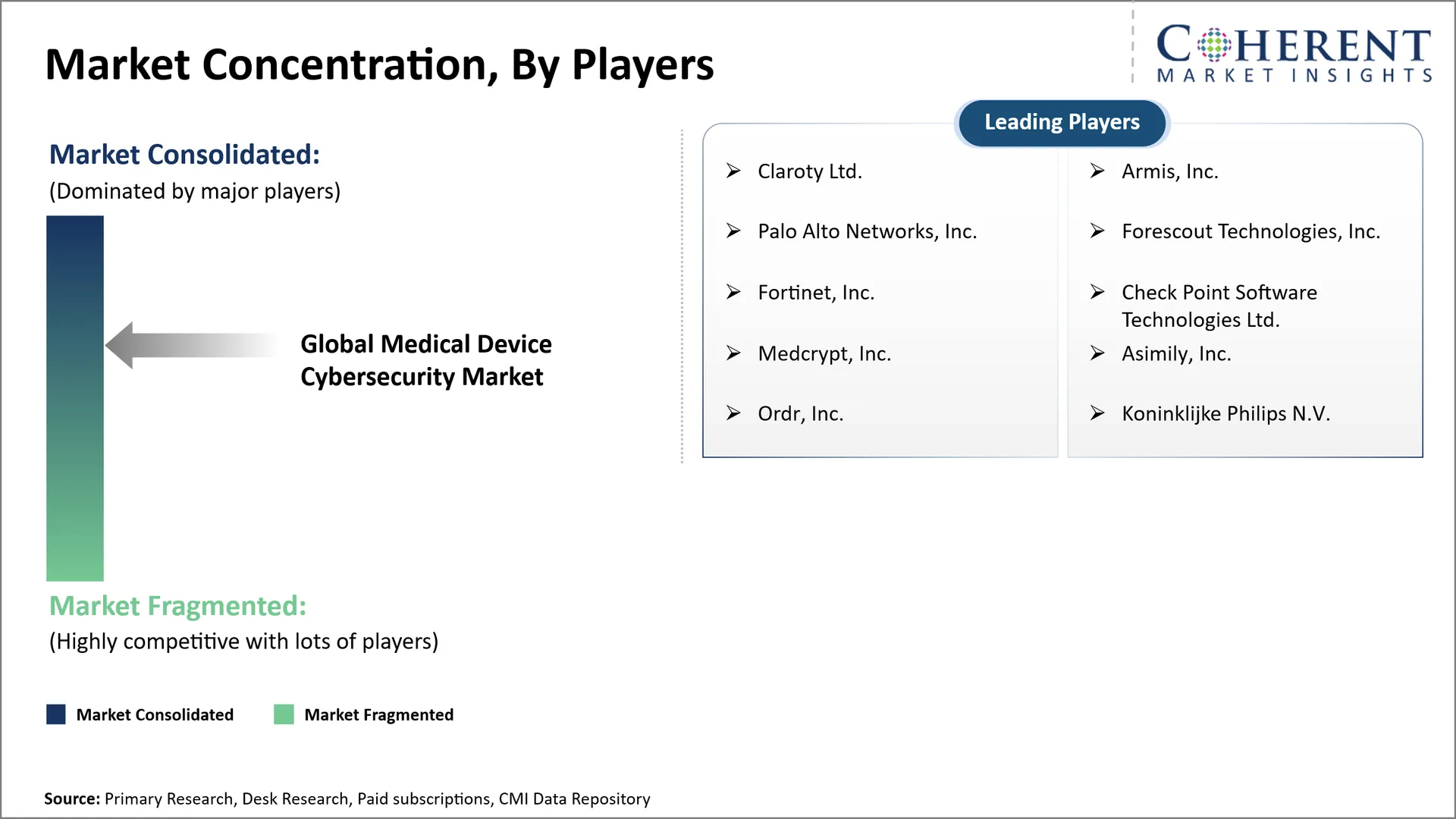
The global medical device cybersecurity market is highly competitive and fragmented with the presence of several players. The market consists of large security vendors, healthcare IoMT cybersecurity companies, and niche medical device security players. The competition in this market is evident from the rising number of security vendors involved in connecting and protecting the hospital, medical devices, and patient data. Key focus areas include:
- Development of dedicated cybersecurity platforms for connected devices for medical systems, IoMT Networks, and hospital IT environments
- Combining device discovery, asset inventory, vulnerability management, and risk-based prioritization in detecting and mitigating risks in medical devices.
- Artificial intelligence-enabled threat detection, behavioral analytics, and continuous monitoring of networks.
Market Report Scope
Global Medical Device Cybersecurity Market Report Coverage | |||
Report Coverage | Details | ||
Base Year | 2025 | Market Size in 2026: | USD 8.62 Bn |
Historical Data For: | 2020 To 2024 | Forecast Period: | 2026 To 2033 |
Forecast Period 2026 To 2033 CAGR: | 10.6% | 2033 Value Projection: | USD 17.50 Bn |
Geographies covered: |
| ||
Segments covered: |
| ||
Companies covered: | Claroty Ltd., Armis, Inc., Palo Alto Networks, Inc., Forescout Technologies, Inc., Fortinet, Inc., Check Point Software Technologies Ltd., Medcrypt, Inc., Asimily, Inc., Ordr, Inc., Koninklijke Philips N.V. | ||
Growth Drivers: |
| ||
Restraints & Challenges: |
| ||
Analyst Opinion (Expert Opinion)
- In the coming years, the global medical device cybersecurity market is expected to evolve towards perimeter-less, lifecycle-based, AI-enabled device security solutions. The rising connectedness of medical devices, remote patient monitoring, and the cloud-based healthcare system will result in more demand for monitoring of the medical devices on a continual basis, real-time detection of vulnerabilities, and an automated response to detected security threats. As such, there will be more focus on cybersecurity features in the design, procurement, deployment, and post-market maintenance of a medical device.
- The biggest market opportunity is expected to be for AI-enabled network and Internet of Medical Things (IoMT) security solutions focused on hospital medical devices, especially in the U.S. and China. Among the two countries, the U.S. is attractive due to its large installed base of connected hospital devices and matured healthcare cybersecurity ecosystem, and China due to its fast hospital digitalization and emerging connected medical devices installed base. Solutions aimed at discovery, segmentation, vulnerability management, and persistent threat detection are expected to have the most traction.
- In order to gain a competitive advantage market players should focus on all-in-one cybersecurity solutions with device identification, risk profiling, AI-based threat monitoring, and automated vulnerability management. These players should build up unique expertise around legacy devices, firmware security, and SBOM-based security to mitigate huge challenges in healthcare. Strategic partnership ecosystem creation with hospital systems, device manufacturer, and HIT players; simplification of regulatory compliance standards; and offered managed security services will help these players to scale up and retain customers.
Speak to the analyst
Want personalized insights?
Take the findings above to one of our principal consultants, or have the report rebuilt around the segments, geographies and competitors you actually track.
Market Segmentation
- Component Insights (Revenue, USD Bn, 2021 - 2033)
- Solutions
- Services
- Security Type Insights (Revenue, USD Bn, 2021 - 2033)
- Network and IoMT Security
- Endpoint Security
- Application Security
- Cloud Security
- Firmware and Device Integrity Security
- Device Type Insights (Revenue, USD Bn, 2021 - 2033)
- Hospital Medical Devices
- Wearable and External Medical Devices
- Internally Embedded Medical Devices
- Deployment Mode Insights (Revenue, USD Bn, 2021 - 2033)
- Cloud-Based
- On-Premises
- Hybrid
- End User Insights (Revenue, USD Bn, 2021 - 2033)
- Hospitals and Health Systems
- Medical Device Manufacturers
- Ambulatory Surgery Centers
- Diagnostic and Imaging Centers
- Home Healthcare Providers
- Others
- Regional Insights (Revenue, USD Bn, 2021 - 2033)
- North America
- U.S.
- Canada
- Latin America
- Brazil
- Argentina
- Mexico
- Rest of Latin America
- Europe
- Germany
- U.K.
- Spain
- France
- Italy
- Russia
- Rest of Europe
- Asia Pacific
- China
- India
- Japan
- Australia
- South Korea
- ASEAN
- Rest of Asia Pacific
- Middle East
- GCC Countries
- Israel
- Rest of Middle East
- Africa
- South Africa
- North Africa
- Central Africa
- North America
- Key Players Insights
- Claroty Ltd.
- Armis, Inc.
- Palo Alto Networks, Inc.
- Forescout Technologies, Inc.
- Fortinet, Inc.
- Check Point Software Technologies Ltd.
- Medcrypt, Inc.
- Asimily, Inc.
- Ordr, Inc.
Sources
Primary Research Interviews
- Medical device cybersecurity product managers and security architects
- Biomedical engineers specializing in connected medical devices and IoMT security
- Healthcare IT and network security specialists
- Medical device software developers and cybersecurity risk management consultants
Stakeholders
- Medical device cybersecurity solution and service providers
- Medical device manufacturers and OEMs
- Healthcare IoMT and network security technology developers
- Cybersecurity software and vulnerability management providers
- End-use Sectors
- Hospitals and integrated healthcare systems
- Diagnostic imaging and medical testing centers
- Ambulatory surgical centers and specialty clinics
- Home healthcare and remote patient monitoring providers
- Regulatory & Health Bodies
- U.S. Food and Drug Administration (FDA)
- European Commission – Medical Device Coordination Group (MDCG)
- Central Drugs Standard Control Organisation (CDSCO), India
- Health Canada
Databases
- U.S. FDA Medical Device Databases
- U.S. CISA Known Exploited Vulnerabilities (KEV) Catalog
- National Vulnerability Database (NVD)
- MITRE Common Vulnerabilities and Exposures (CVE) Database
Associations
- Association for the Advancement of Medical Instrumentation (AAMI)
- Health Information Sharing and Analysis Center (Health-ISAC)
- Healthcare and Public Health Sector Coordinating Council (HSCC)
- Healthcare Information and Management Systems Society (HIMSS)
Public Domain Sources
- U.S. Food and Drug Administration (FDA)
- Cybersecurity and Infrastructure Security Agency (CISA)
- European Union Agency for Cybersecurity (ENISA)
- International Medical Device Regulators Forum (IMDRF)
Proprietary Elements
- CMI Data Analytics Tool
- Proprietary CMI Existing Repository of information for last 10 years.
Get access to 250+ pages report
Every segment, forecast, competitor profile and data table behind the analysis above — available for instant download.
- ESOMAR Member
- ISO 9001:2015 Certified
- D-U-N-S Registered
- GDPR & CCPA Compliant
Frequently Asked Questions
The global medical device cybersecurity market is estimated to be valued at USD 8.62 Bn in 2026 and is expected to reach USD 17.50 Bn by 2033.
Solutions dominate as demand for integrated platform solutions, enabling device discovery, vulnerability management, real-time threat detection, and hospital network security for connected medical devices and IT infrastructure across healthcare systems continues to accelerate.
Medical device cybersecurity refers to technologies and measures used to protect connected medical devices and their networks, as well as patient data, from cyber-attacks and other cyber security threats.
The CAGR of global medical device cybersecurity market is projected to be 10.6% from 2026 to 2033.
Rising cybersecurity threats targeting connected medical devices and hospital networks, and increasing regulatory requirements for medical device cybersecurity and risk management are the major factors driving the growth of the global medical device cybersecurity market.
High implementation and maintenance costs of advanced medical device security solutions, and compatibility challenges when integrating cybersecurity tools with legacy medical devices are the major factors hampering the growth of the global medical device cybersecurity market.
In terms of security type, Network and IoMT Security is estimated to dominate the market revenue share in 2026.