

Infusion Pumps Market Analysis & Forecast: 2026-2033
Infusion Pumps Market is estimated to be valued at USD 12.28 Bn in 2026 and is expected to reach USD 21.88 Bn in 2033, exhibiting a compound annual growth rate (CAGR) of 8.6% from 2026 to 2033.
Key Takeaways
- By Product Type, Large Volume Infusion Pumps are expected to account for the largest market share of 28.2% in the global infusion pumps market in 2026. This segment’s growth is driven by their extensive usage in hospitals and clinics for delivering fluids, medications, and nutrients with high precision over extended periods.
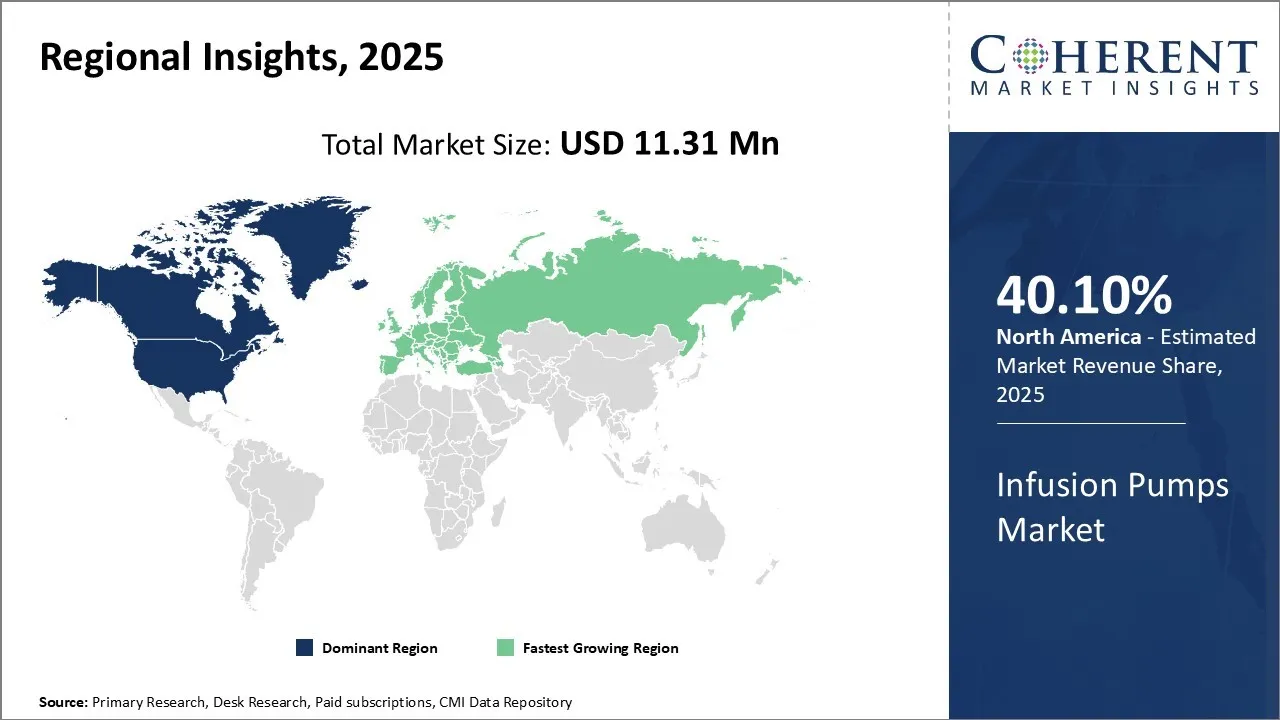
- By Region Insights: North America is projected to dominate the global infusion pumps market with a market share of 40.1% in 2026. This regional dominance is primarily due to robust healthcare infrastructure and favourable reimbursement frameworks.
Market Overview
The global Infusion Pumps Market is experiencing consistent growth, fuelled by the rising incidence of chronic diseases, surgical procedures, and demand for precise drug delivery systems. Major product categories include large volume pumps, syringe pumps, and ambulatory pumps, with large volume pumps leading due to their widespread hospital use and reliability. Technological innovations and the expansion of home-based care are driving market adoption.
Current Events and its Impact on the Infusion Pumps Market
Current Event | Description and its impact |
Technology Advancements and Innovation Impact |
|
Regulatory Shifts and Compliance Trends |
|
Product Innovation and Technological Disruption |
|
Pipeline Analysis: Infusion Pumps Market
The infusion pumps market is witnessing robust R&D activity with a strong pipeline of advanced and smart infusion devices aimed at improving drug delivery accuracy, patient safety, and connectivity. Major players like Baxter, Becton Dickinson, and ICU Medical are developing next-generation infusion systems that integrate with electronic health records (EHRs) and offer wireless connectivity for remote monitoring. Several innovations are underway, including wearable infusion pumps, closed-loop insulin delivery systems, and multi-channel devices designed for complex therapies.
Companies are also focusing on miniaturization, longer battery life, and enhanced user interfaces to support home care and ambulatory settings. Regulatory bodies, including the U.S. FDA and European Medicines Agency, are actively reviewing a growing number of pre-market submissions, reflecting increased innovation across the sector. The expanding pipeline, particularly in oncology, diabetes management, and pain therapy, underscores a strong growth trajectory for the infusion pumps market in the coming years.
- Current Industry Events of 2026
- Market Size Estimation
- Regional Breakdown
- Competitive Landscape
- Customer Intelligence
- Segmental Analysis
- Pricing Analysis
- Key Market Drivers, Challenges & Future Trends
- Customized Insights Section
Patent Landscape: Infusion Pumps Market
The patent landscape in the infusion pumps market highlights a surge of innovation, particularly in smart, connected delivery systems. In February 2024, Baxter International was granted a patent (US11992651B2) for a novel flow rate compensation system that allows stacked infusion pumps to autonomously adjust delivery rates based on spatial positioning and communication protocols including Bluetooth and Wi‑Fi.
Another recent patent (US11,911,590) enables integration of infusion pumps with remote electronic devices, facilitating enhanced remote control and monitoring via smartphones and tablets and reinforcing connectivity trends in device design.
Furthermore, Baxter’s earlier acquisition of Sigma International enabled access to Spectrum smart infusion pump platforms, focused on wireless drug library updates, improved safety algorithms, and compact design for bedside use.
Meanwhile, IRadimed holds patents (e.g. US10,617,821 B2) for wireless remote control of MRI-compatible infusion pumps, signaling ongoing emphasis on remote-enabled and specialty-device innovation.
Overall, the patent ecosystem reflects strong activity in technologies supporting flow optimization, connectivity, remote control, and smart safety features reinforcing competitive differentiation and boosting market entry barriers.
Reimbursement Scenario: Infusion Pumps Market
Reimbursement significantly influences infusion pump adoption, particularly in the U.S., Europe, and select Asia‑Pacific nations.
- United States: Under Medicare Part B, infusion pumps and related supplies are covered as durable medical equipment (DME) when prescribed for home use, with patients responsible for 20% coinsurance after meeting deductibles. Notably, Avanos Medical’s ON‑Q and ambIT infusion pumps received separate Medicare reimbursement under the NOPAIN Act as non-opioid pain management devices, each assigned unique HCPCS codes (C9804, C9806) and reimbursed up to US $2,284.98 starting January 2025.
- Europe: While coverage is universal, reimbursement is tied to strict health technology assessments. France and Germany, for instance, demand strong clinical evidence and health economic justification to grant funding for innovative infusion devices, limiting rapid access to next‑generation smart pumps.
- Asia-Pacific & Emerging Markets: Reimbursement remains fragmented. Countries like Japan and China offer limited or condition-based coverage, while many developing nations lack public reimbursement, leading to significant out-of-pocket expenses and restricted access.
Prescribers’ Preference: Infusion Pumps Market
Healthcare professionals increasingly prefer infusion pumps due to their precision, safety, and ability to streamline medication administration across various clinical settings. Among the options available, large volume infusion pumps are favoured in hospital and critical care environments for continuous drug and fluid delivery. These pumps support high-flow rates, programmable features, and compatibility with electronic medical records (EMRs), which enhances dosing accuracy and patient monitoring.
Ambulatory and smart infusion pumps are gaining preference in outpatient and home care settings, especially for pain management, chemotherapy, and chronic illness treatment, due to their portability, remote monitoring capabilities, and reduced risk of medication errors.
Prescribers value devices with integrated drug libraries, alarm systems, and connectivity features, as these minimize adverse events and improve workflow efficiency. Furthermore, the growing adoption of interoperable and wireless-enabled pumps aligns with clinicians’ increasing focus on personalized medicine and patient-centric care delivery models.
Infusion Pumps Market Trends
- Growing number of surgical procedures is a recent trend
Elastomeric pumps, also known as balloon pumps, are used to administer liquid drugs such as local anesthetics, analgesics, cytostatics, or antibiotics (depending on a therapy). They are designed for continuous drug delivery, on-demand delivery, or combination of both continuous and on-demand drug delivery. Thus, with the increasing number of surgical procedures, the use and/or demand for infusion pumps is also increasing with the rapid pace. This trend is expected to continue over the forecast period, driving the growth of the infusion pump market.
In December 2024, Healthcare IT News detailed how the Ivenix smart infusion pump system—featuring a smartphone‑style interface, automatic software updates, and streamlined administration sets—aims to reduce nurse workload and minimize medication errors. The system is being adopted across hospitals seeking enhanced operational efficiency and patient safety.
- High demand for volumetric infusion pumps is another trend
Volumetric infusion pumps have a wide range of applications in disease management as well as in parenteral nutrition compared to other pumps. The high demand for volumetric pumps is attributed to the safety, accuracy and simplicity of these pumps.
Moreover, the adoption of technologically advanced volumetric pumps with capabilities, such as electronic health record (EHR) integration, built-in security systems, and others is expected to augment the market growth. This trend is also expected to continue over the forecast period.
Opportunities in the Infusion Pumps Market
- Rising Global Demand and Smart Technology Integration Fuel Market Growth
The increase in demand for infusion pumps across the globe is expected to provide significant growth opportunities for players in the global infusion pump market. Infusion pumps are widely used to deliver nutrients or medications in small or large amounts—such as insulin or other hormones, pain relievers, antibiotics, and chemotherapy drugs.
In November 2022, Medtronic plc announced the U.S. launch of the Medtronic Extended infusion set, the first and only infusion set labelled for up to 7-day wear. An infusion set delivers insulin from an insulin pump to the body and typically requires a set change every two to three days.
A particularly growing area of interest is the use of infusion pumps in emergency settings, where rapid, accurate, and controlled drug delivery can be critical in stabilizing patients. These devices are essential in trauma care, intensive care units, and ambulances for administering life-saving medications such as vasopressors, anaesthetics, and fluids under time-sensitive conditions.
Technological advancements and the rising adoption of smart infusion pumps are also expected to offer lucrative growth opportunities for market players. Companies are increasingly focusing on developing and launching smart, technologically advanced infusion systems.
For instance, in December 2022, Baxter received 510(k) clearance for its new Novum IQ syringe infusion pump, which can fully integrate with hospital electronic medical records (EMR) through Baxter’s IQ Enterprise Connectivity Suite. Novum IQ SYR offers enhanced safety features and is designed to deliver optimal accuracy capabilities that are especially valuable in both routine care and emergency medical scenarios.
Segmental Insights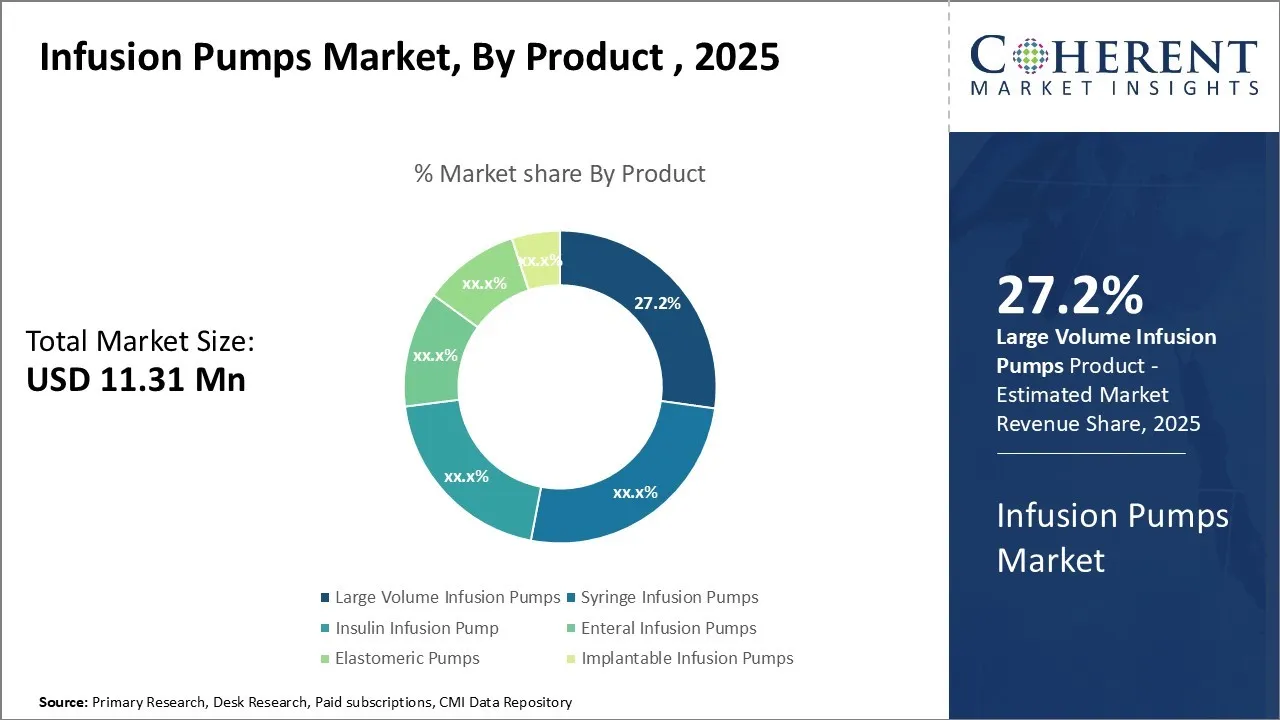
Global Infusion Pumps Market Insights, By Product Type
Among product types, Large Volume Infusion Pumps are projected to lead the global infusion pumps market, accounting for approximately 28.2% of the total market share in 2026. This dominance stems from their widespread use in hospitals and clinical settings, where they are relied upon to deliver fluids, medications, and nutrients with precision over extended durations.
These pumps are indispensable in critical care units, oncology treatments, surgical procedures, and anaesthesia administration, owing to their high flow rate capability and advanced programmable features that ensure accurate dosage control. Their integration with electronic medical records and safety alarms further enhances treatment reliability and patient safety.
Despite increasing adoption of smart and portable pumps, large volume infusion pumps remain the preferred choice in inpatient settings, especially for managing post-operative care, chronic disease therapy, and fluid management protocols, reinforcing their market dominance across both developed and emerging healthcare systems.
Infusion Pump Market Regional Insights
North America Infusion Pumps Market Trends and Analysis
North America is expected to dominate the global Infusion Pumps Market, accounting for an estimated 40.10% market share in 2026. This leadership position is driven by a combination of robust healthcare infrastructure, favourable reimbursement systems, and high adoption rates of cutting-edge medical technologies across the U.S. and Canada.
The region faces a substantial burden of chronic diseases, including diabetes, cancer, and cardiovascular conditions, all of which necessitate ongoing and precise infusion therapies. An aging population, increasing hospitalization rates, and the growing shift toward home-based care further amplify the demand for reliable infusion solutions.
A key trend shaping the market is the rising adoption of infusion pumps with Bluetooth connectivity, which allow seamless communication between devices, patients, and healthcare providers. These smart pumps enhance remote monitoring, enable real-time data transmission to electronic medical records (EMRs), and support timely clinical decisions particularly valuable in home healthcare and outpatient settings.
Additionally, major global players in the infusion pumps market have significant operations or headquarters in North America, contributing to continual innovation, FDA approvals, and the integration of smart infusion technologies. Continued investment in R&D and connected healthcare platforms reinforces the region’s strategic advantage in advancing infusion therapy solutions, including the growing deployment of Bluetooth-enabled pumps designed to improve patient outcomes and medication safety.
Infusion Pump Market Dominating Countries
United States
The United States holds the largest share of the global infusion pumps market within the North American region, which is projected to account for 40.1% of the global market in 2026. This dominance is attributed to its well-established healthcare infrastructure, advanced clinical practices, and favourable reimbursement policies from both public and private insurers.
A high incidence of chronic illnesses, such as diabetes, cancer, and heart disease, drives the need for continuous and accurate drug delivery, making infusion pumps essential in inpatient and outpatient care. The U.S. is home to several key industry players, including Baxter, Becton Dickinson, and ICU Medical, all of which are actively engaged in FDA-cleared product development and smart pump innovation. Moreover, increasing investments in home healthcare and digital infusion platforms further solidify the country’s global leadership in infusion pump adoption and innovation.
Canada
Canada is a significant contributor to the North American infusion pumps market, supported by its universal healthcare system and growing focus on chronic disease management. Canadian hospitals and home care providers are increasingly integrating infusion pumps to treat conditions like cancer, infections, and pain, particularly in the elderly population.
Government-backed reimbursement programs and strict regulatory standards ensure that only safe and high-performance devices reach patients. In addition, Canada’s expanding telehealth infrastructure is facilitating the use of smart infusion pumps in remote and rural settings, enabling timely treatment and reducing hospital readmissions. With rising investments in healthcare innovation and clinical research collaborations, Canada continues to strengthen its influence in the global infusion therapy market.
Market Report Scope
Infusion Pump Market Report Coverage
| Report Coverage | Details | ||
|---|---|---|---|
| Base Year: | 2025 | Market Size in 2026: | USD 12.28 Bn |
| Historical Data for: | 2020 To 2024 | Forecast Period: | 2026 To 2033 |
| Forecast Period 2026 to 2033 CAGR: | 8.6% | 2033 Value Projection: | USD 21.88 Bn |
| Geographies covered: |
| ||
| Segments covered: |
| ||
| Companies covered: | BD, Fresenius Kabi, ICU Medical, Smiths Medical, Medtronic, and B. Braun Melsungen, among others | ||
| Growth Drivers: |
| ||
| Restraints & Challenges: |
| ||
Analyst Viewpoint – Infusion Pump Market
- The global infusion pumps market is set for consistent expansion, driven by the rising incidence of chronic diseases, aging populations, and increasing demand for precise drug delivery systems. Analysts highlight the growing utilization of smart and ambulatory infusion pumps, especially in home healthcare and outpatient settings, as a critical growth factor amid the global shift toward value-based and remote care models.
- Technological advancements such as EMR integration, wireless connectivity, automated drug libraries, and real-time alerts are transforming infusion pumps into intelligent systems that enhance medication safety and clinical efficiency. Analysts note that manufacturers focusing on interoperability, cyber security, and AI-enabled monitoring are likely to lead the competitive landscape.
- Despite reimbursement challenges and complex regulatory pathways, the market outlook remains positive. Strategic partnerships between device manufacturers, hospitals, and digital health companies, coupled with rising R&D investments and supportive government initiatives, are expected to drive sustained market penetration and innovation-led growth.
Infusion Pump Market: Key Development
- In June 2025, The FDA flagged a serious under-infusion risk in Baxter’s Novum IQ large-volume pumps, prompting an updated Instructions for Use (IFU) notice. The correction highlights safety vigilance and may temporarily slow adoption, but reinforces Baxter’s proactive compliance and quality assurance efforts.
- In May 2025, Iradimed earned FDA 510(k) clearance for the MRidium® 3870, an MRI-safe, ultrasonic motor-powered infusion pump with intuitive touchscreen operation. This enables safe, continuous infusion during MRI procedures, expanding Iradimed's hospital applications and consolidating its MRI-compatible device leadership.
- In April 2025, ICU Medical received 510(k) clearance for its new Plum Solo™ (single-channel) and Plum Duo™ (dual-channel) precision IV pumps. These devices deliver ±3% accuracy, feature touch-screen interfaces, and integrate with EMRs via the LifeShield™ software suite. These clearance events set a new industry standard for clinical precision and data integration, boosting ICU Medical's position in the smart infusion pump segment.
- In May 2024, Moog received FDA 510(k) clearance for its CURLIN® 8000, a premium ambulatory infusion platform built for home care, featuring integrated RxManager software. This broadens Moog’s footprint in the home infusion market, improving therapy continuity and reducing reliance on clinical settings.
Market Segmentation
- Global Infusion Pump Market, By Product (Revenue, USD Bn, 2021 - 2033)
- Large Volume Infusion Pumps
- Syringe Infusion Pumps
- Insulin Pumps
- Enteral Feeding Pumps
- Elastomeric Pumps
- Implantable Pumps
- Global Infusion Pump Market, By Technology (Revenue, USD Bn, 2021 - 2033)
- Traditional
- Specialty
- Global Infusion Pump Market, By Usage (Revenue, USD Bn, 2021 - 2033)
- Stationary
- Ambulatory
- Global Infusion Pump Market, By Application (Revenue, USD Bn, 2021 - 2033)
- Oncology
- Diabetes
- Gastroenterology
- Pediatrics and Neonatology
- Pain Management
- Others
- Global Infusion Pump Market, By End User (Revenue, USD Bn, 2021 - 2033)
- Hospitals
- Home Healthcare Settings
- Nursing Homes
- Others
- Global Infusion Pump Market, By Geography (Revenue, USD Bn, 2021 - 2033)
- North America
- U.S.
- Canada
- Latin America
- Brazil
- Argentina
- Mexico
- Rest of Latin America
- Europe
- Germany
- U.K.
- Spain
- France
- Italy
- Russia
- Rest of Europe
- Asia Pacific
- China
- India
- Japan
- Australia
- South Korea
- ASEAN
- Rest of Asia Pacific
- Middle East
- GCC Countries
- Israel
- Rest of Middle East
- Africa
- South Africa
- North Africa
- Central Africa
- North America
- Company Profiles
- BD
- Fresenius Kabi
- ICU Medical
- Smiths Medical
- Medtronic
- B. Braun Melsungen
Sources
The Stakeholders Consulted
- Procurement managers and biomedical engineers at hospitals and ambulatory care centers
- Infusion pump manufacturers and component suppliers
- Healthcare IT integration consultants and EMR system specialists
- Regulatory and compliance officers from health authorities
- Research institutions specializing in drug delivery technologies and medical devices
- Government healthcare infrastructure agencies and public health procurement bodies
- End-users including anesthesiologists, oncologists, diabetologists, and critical care physicians
Databases Opened
- U.S. Food & Drug Administration (FDA) – MAUDE & 510(k) Device Approvals
- Centers for Medicare & Medicaid Services (CMS) – Reimbursement Data
- National Institutes of Health (NIH) – Clinical Trials & Technology Grants
- European Medicines Agency (EMA) – CE Mark Device Registrations
- World Health Organization (WHO) – Global Medical Device Usage Data
Magazines & Trade Publications
- MedTech Insight
- Healthcare IT News
- Fierce Biotech – Medical Devices Section
- Medical Design & Outsourcing
- MD+DI (Medical Device and Diagnostic Industry)
- HealthTech Magazine – Patient Monitoring & Drug Delivery Devices
Scientific and Industry Journals
- Journal of Biomedical Informatics
- Expert Review of Medical Devices
- International Journal of Medical Engineering and Informatics
- Journal of Controlled Release
- IEEE Transactions on Biomedical Engineering
Newspapers & Media Outlets
- The Wall Street Journal – Healthcare Technology Section
- Bloomberg – Medical Devices and Healthcare Markets
- Reuters – Global MedTech Developments
- The Economic Times – Healthcare and Life Sciences
- Business Standard – Medical Equipment and Innovation Coverage
Associations and Regulatory Bodies
- U.S. Food and Drug Administration (FDA)
- European Medicines Agency (EMA)
- Association for the Advancement of Medical Instrumentation (AAMI)
- International Medical Device Regulators Forum (IMDRF)
- Indian Pharmacopoeia Commission (IPC) – Medical Device Division
Public Domain Sources
- Centers for Disease Control and Prevention (CDC) – Infusion Safety Guidelines
- World Health Organization (WHO) – Essential Devices for Healthcare
- OECD Health Data – Medical Equipment Metrics
- National Health Service (UK) – Digital Health and Device Integration Reports
- Indian Ministry of Health and Family Welfare – Device Procurement and Regulations
Proprietary Research Elements
- CMI Medical Device Data Repository (covering the past 8 years)
- CMI Clinical Expert Interview Transcripts (focused on infusion practices, ICU workflows, and pump safety)
- CMI Regulatory Tracker for U.S., EU, and APAC Markets
- CMI Primary Surveys of Hospital Procurement Leads and Device End-users
- CMI Data Analytics Tool for Global Infusion Device Penetration & Demand Mapping
Get access to 250+ pages report
Every segment, forecast, competitor profile and data table behind the analysis above — available for instant download.
- ESOMAR Member
- ISO 9001:2015 Certified
- D-U-N-S Registered
- GDPR & CCPA Compliant
Missing comfort of reading report in your local language? Find your preferred language:
Transform your Strategy with Exclusive Trending Reports
Frequently Asked Questions
The Infusion Pumps Market size is estimated to be valued at USD 12.28 Bn in 2026, and is expected to reach USD 21.88 Bn by 2033.
The CAGR of the global Market is projected to be 8.6% from 2026 to 2033.
Growing burden of chronic disease and growing geriatric (aging) population around the world is fueling the market.
The large volume infusion pumps segment is the leading product segment in the market.
Safety issues and stringent rules and regulations and high cost of infusion pumps are major factors restraining growth of the market.
Major players operating in the market are BD, Fresenius Kabi, ICU Medical, Smiths Medical, Medtronic, and B. Braun Melsungen, among others.