

Global Methane Sulfonic Acid Market Size and Forecast – 2026 To 2033
The Methane Sulfonic Acid Market is estimated to be valued at USD 822.6 Mn in 2026 and is expected to reach USD 1,269.9 Mn by 2033, exhibiting a compound annual growth rate (CAGR) of 6.4% from 2026 to 2033. This growth reflects increasing industrial demand and the expanding application scope of methane sulfonic acid across pharmaceuticals, electroplating, chemical synthesis, industrial cleaning, and electronics-related metal surface treatment.
Methane sulfonic acid is gaining stronger commercial relevance as manufacturers seek high-performance acid systems that offer process efficiency, lower volatility, and better environmental positioning compared to several conventional mineral acids. In May 2022, BASF started up a new methane sulfonic acid plant at its Ludwigshafen Verbund site in Germany, raising site capacity to 50,000 metric tons per year to meet rising cross-industry demand for sustainable formulations. (Source: BASF)
Key Takeaways of the Global Methane Sulfonic Acid Market
- Industrial grade is expected to account for 51.6 % of the market share in 2026, supported by its broad use across chemical synthesis, industrial cleaning, biofuel production, and metal surface treatment Chemicals’ TIB KAT MSA 99 highlights methane sulfonic acid use as a catalyst and additive in the chemical industry and for different applications in electroplating baths, supporting its demand in industrial-grade applications where strong acidity, process efficiency, and metal finishing performance are required. This reinforces industrial-grade methane sulfonic acid adoption across chemical processing, electroplating, and surface treatment industries
- 70% aqueous solution is expected to hold 54.8 % of the market share in 2026, as it offers easier handling, better formulation compatibility, and suitability for catalytic and synthesis applications. In July 2026, Arkema’s product portfolio continued listing methane sulfonic acid 70% as a versatile substitute for organic and inorganic strong acids across industrial applications.
- Electroplating and surface finishing is expected to capture 32.4 % of the market share in 2026, backed by methane sulfonic acid’s role in tin plating, metal finishing, and electronics-related surface treatment. In September 2023, Quaker Houghton highlighted methane sulfonic acid-based tin-plating technology for steel substrates, emphasizing lower applied tin cost, lower environmental impact, and improved process control.
- Asia Pacific is expected to lead the market with 39.8 % of the market share in 2026, supported by large-scale electronics, electroplating, pharmaceuticals, and specialty chemical manufacturing clusters. In December 2025, China reported integrated circuit output of 386.6 billion units during January–October 2025, reinforcing the demand for high-purity process chemicals used in electronics manufacturing.
- Europe is expected to represent 27.1 % of the market share in 2026 and remain the fastest-growing region, supported by specialty chemical innovation, sustainable acid substitution, and advanced fine chemical manufacturing. In June 2025, Arkema showcased its sulfonyls range, including methane sulfonic acid, at Chemspec Europe in Germany, reflecting continued regional focus on specialty chemical solutions.
- Green Acid Substitution: Methane sulfonic acid is increasingly positioned as a preferred replacement for conventional mineral acids where buyers require lower volatility, better biodegradability, and cleaner downstream processing. This trend strengthens supplier positioning in industrial cleaning, metal treatment, catalysts, and specialty synthesis, while enabling customers to reduce handling risks, improve formulation sustainability, and align procurement with stricter environmental performance expectations.
- High-Purity and Application-Specific Formulations: Suppliers are moving from commodity acid supply toward differentiated methane sulfonic acid grades tailored for pharmaceuticals, electronics, biodiesel, and precision metal finishing. This shift improves margin potential, deepens customer lock-in, and supports technical selling models where purity, corrosion profile, application support, and process efficiency become stronger purchasing criteria than price alone.
Segmental Insights
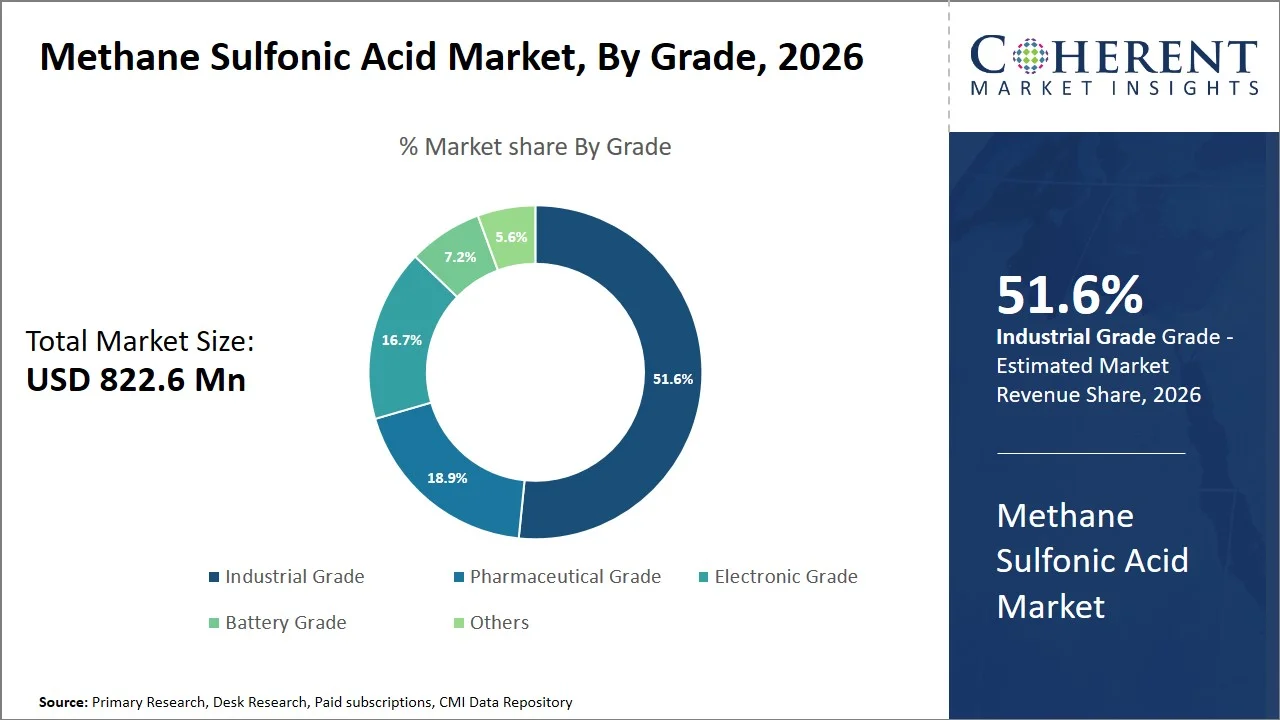
Why Does Industrial Grade Dominate the Global Methane Sulfonic Acid Market?
Industrial grade is expected to dominate the methane sulfonic acid market with 51.6% in 2026, as buyers in large-volume industrial processes prioritize acid strength, process reliability, and cost-effective specifications over ultra-high purity. This grade is widely adopted in esterification, alkylation, biodiesel-related catalysis, metal recovery, and general chemical processing were methane sulfonic acid’s non-oxidizing nature and low vapor pressure support safer plant operations. On the supply side, industrial-grade methane sulfonic acid benefits from scalable production, easier qualification requirements, and compatibility with bulk chemical distribution models. In June 2024, the Royal Society of Chemistry’s Green Chemistry published a tutorial review highlighting Methane Sulfonic Acid’s industrial relevance as a Bronsted acid catalyst, biodiesel production input, and safer alternative to conventional mineral acids. (Source: Royal Society of Chemistry)
- Current Industry Events of 2026
- Market Size Estimation
- Regional Breakdown
- Competitive Landscape
- Customer Intelligence
- Segmental Analysis
- Pricing Analysis
- Key Market Drivers, Challenges & Future Trends
- Customized Insights Section
Why Does 70% Aqueous Solution Represent the Largest Concentration Segment in the Methane Sulfonic Acid Market?
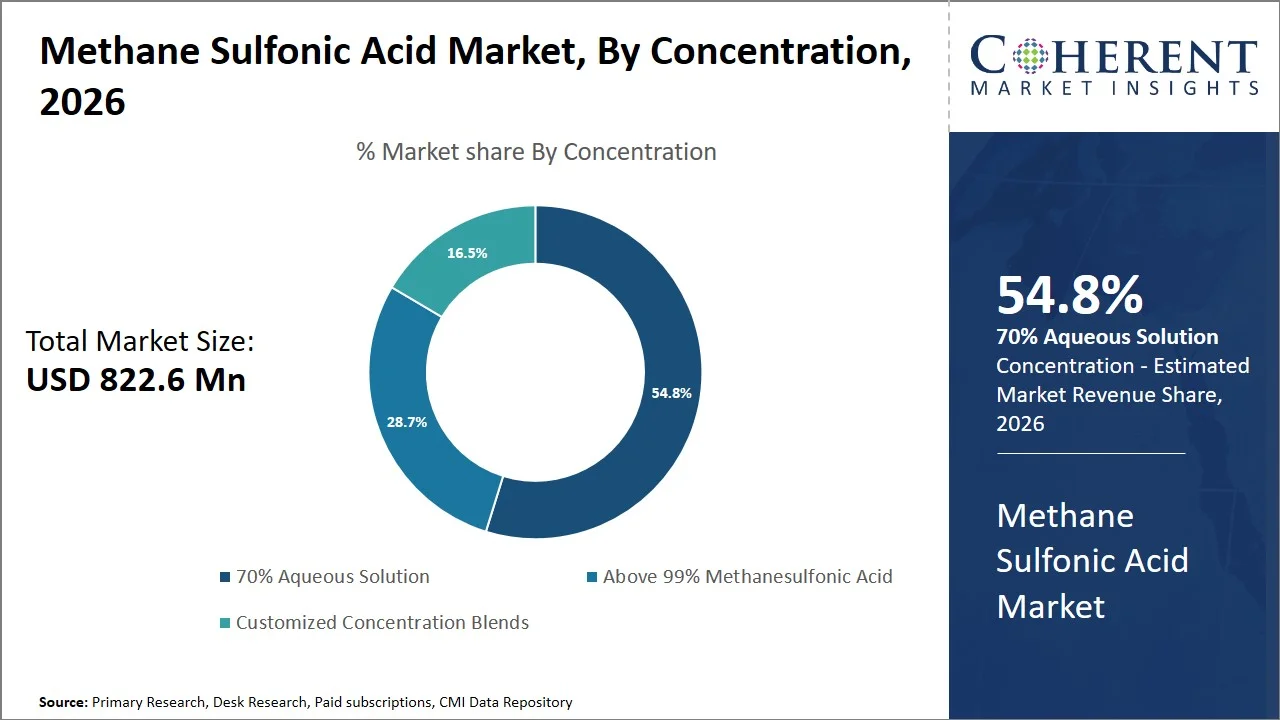
70% aqueous solution is expected to hold 54.8% of the market share in 2026, due to its stronger practical fit for industrial handling, dilution control, and direct formulation use. Compared with anhydrous or above-99% grades, 70% methane sulfonic acid reduces storage and dosing complexity while maintaining sufficient acidity for plating, detergent substitution, electropolishing, and specialty synthesis. Demand is supported by customers seeking ready-to-use liquid formats that can be integrated into existing tanks, dosing systems, and chemical blending operations with fewer conversion steps. In May 2025, Fisher Scientific listed Thermo Scientific Alfa Aesar 70% aqueous methanesulfonic acid in multiple pack sizes and described its use in tin/tin-alloy plating, detergent formulations, aluminum electropolishing, and noble-metal electroplating. (Source: Thermo Fisher Scientific Inc)
Why Does Electroplating and Surface Finishing Dominate the Methane Sulfonic Acid Market?
Electroplating and surface finishing is expected to dominate with 32.4% of the market share in 2026, as methane sulfonic acid-based systems offer strong metal-salt solubility, conductivity, and bath stability for tin, tin-alloy, lead, bismuth, cobalt, and noble-metal processes. Demand is concentrated among electronics, packaging, connectors, metal components, and precision surface-treatment users that require consistent deposit morphology and lower bath-related operating issues. Supply-side adoption is reinforced by chemical suppliers offering methane sulfonic acid-compatible salts and additives for plating baths, enabling process customization rather than simple acid substitution. In January 2024, Metals published research showing tin deposition in a Methane Sulfonic Acid system produced uniform, dense pure tin deposits and clarified the diffusion-controlled electrochemical behavior of Sn²⁺ in Methane Sulfonic Acid media. (Source: MDPI)
Methane Sulfonic Acid Market Dynamics
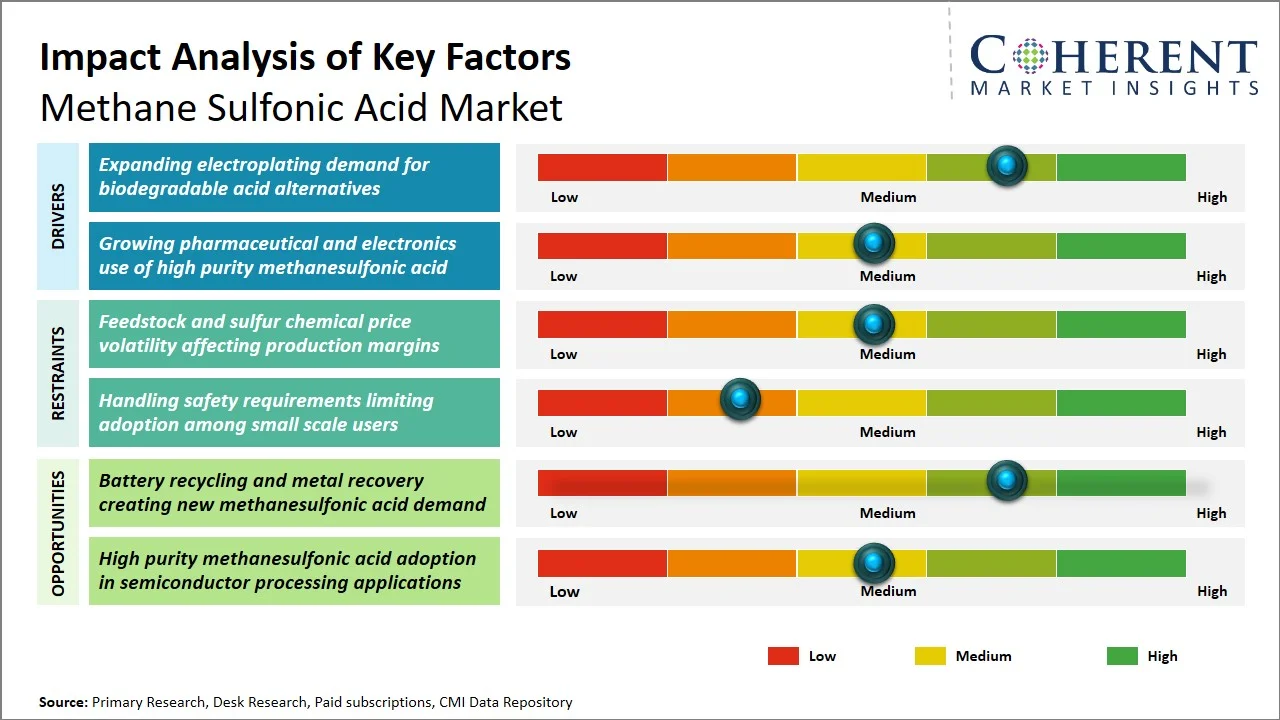
Key Market Drivers
- Expanding Electroplating Demand for Biodegradable Acid Alternatives: Electroplating remains a core growth driver for the methane sulfonic acid market as metal finishers shift toward acid systems that support bath stability, high metal solubility, and improved environmental positioning. Methane sulfonic acid is commercially attractive in tin, lead, and alloy plating because it helps maintain uniform deposition while reducing dependence on more hazardous legacy acid chemistries. Demand is especially strong from electronics connectors, automotive components, steel strip plating, and industrial surface finishing, where manufacturers require consistent coating quality and lower wastewater treatment complexity. On the supply side, specialty chemical formulators are developing methane sulfonic acid-based plating chemistries that extend bath life and improve process reliability. On June 30, 2025, InnoChem China was established in Shanghai to accelerate localization and commercialization of its methane sulfonic acid-based tin plating and metalworking technologies for Asian markets.
- Growing Pharmaceutical and Electronics Use of High-Purity Methanesulfonic Acid: High-purity methane sulfonic acid is gaining strategic importance in pharmaceutical synthesis, mesylate salt formation, electronic-grade processing, and precision chemical manufacturing. Pharmaceutical customers require controlled impurity profiles, validated supply chains, and consistent acid performance to support API intermediates and salt-based formulations. Electronics users value high-purity acid systems for metal deposition and surface preparation where contamination control directly affects yield and product reliability. This driver supports premium pricing for pharmaceutical, electronic, and above-99% grades, while pushing suppliers to invest in purification, traceability, and quality-control infrastructure. In April 2025, the U.S. FDA approved Camcevi ETM, a leuprolide mesylate injectable emulsion, for adults with advanced prostate cancer, reinforcing the continued commercial relevance of mesylate-based pharmaceutical formulations. (Source: U.S. Food & Drug Administration)
Emerging Market Trends
- Shift Toward Application-Specific Methane Sulfonic Acid Formulations: The market is moving away from standard acid supply toward application-specific methane sulfonic acid grades customized by concentration, purity, metal compatibility, and impurity control. This trend is particularly visible in electroplating, electronics, pharmaceuticals, and battery-related uses, where customers evaluate acid performance through process yield, defect reduction, bath stability, and downstream compliance rather than only price per kilogram. Suppliers that can offer technical documentation, formulation support, and customer-specific specifications are better positioned to capture high-value demand. This also encourages stronger integration between methane sulfonic acid producers, specialty chemical formulators, and end-use process engineers. As a result, value creation is shifting toward technical selling, long-term qualification, and differentiated grades that reduce switching risk for industrial customers.
- Rising Preference for Safer and Lower-Impact Acid Systems: Industrial buyers are increasingly evaluating acid systems through environmental performance, worker safety, wastewater burden, and compatibility with sustainability targets. Methane sulfonic acid benefits from this shift because it is positioned as a cleaner alternative to several conventional mineral or fluorinated acid systems used in surface treatment, catalysis, and industrial cleaning. This trend is commercially important because procurement teams in regulated industries are linking chemical selection to compliance risk, waste treatment cost, and customer sustainability expectations. For suppliers, the opportunity lies in positioning methane sulfonic acid as a performance chemical that also supports cleaner process design. The trend is expected to strengthen the demand for 70% aqueous solution, industrial grade, and specialty blends that can be directly integrated into existing production lines.
Current Events and their Impact
Current Events | Description and its Impact |
Spring 2025 / July 2026 — U.S. EPA PFAS Rulemaking for Chromium Electroplating Wastewater |
|
October 2025 — Updated EU PFAS Restriction Dossier |
|
2025 Onward — EU Batteries Regulation Carbon Footprint and Substance Rules |
|
Regional Insights
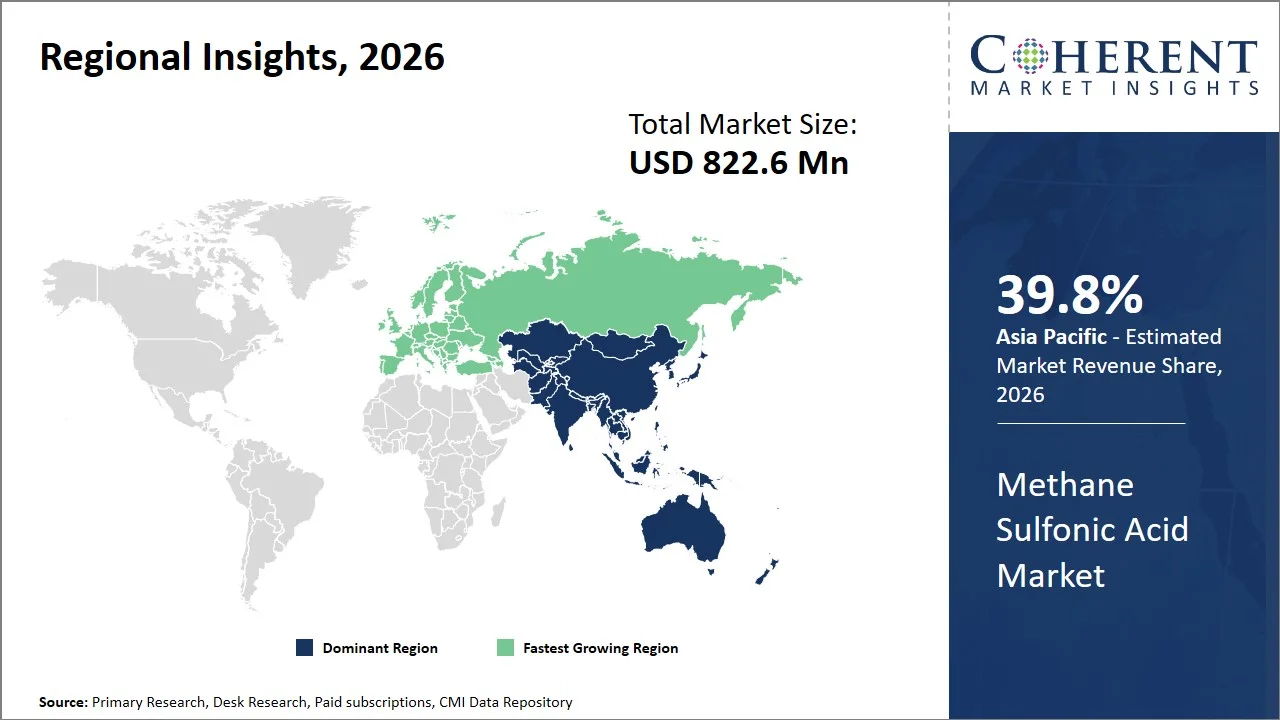
Why Does Asia Pacific Dominate the Global Methane Sulfonic Acid Market?
Asia Pacific is expected to dominate the global methane sulfonic acid market with 39.8% share in 2026, supported by strong concentration of electronics manufacturing, metal finishing, semiconductor processing, pharmaceuticals, and industrial chemical synthesis. The region’s large plating base across connectors, printed circuit boards, automotive components, and precision metal parts supports steady use of Methane Sulfonic Acid-based electrochemical systems. China, South Korea, India, and Southeast Asian manufacturing hubs also create scale demand for industrial-grade and high-purity acid formats. On the supply side, proximity to specialty chemical manufacturing and downstream electronics clusters improves bulk availability and customer qualification. In May 2026, the Semiconductor Industry Association reported that strong semiconductor sales across Asia Pacific and China supported global chip growth, reinforcing regional demand for high-purity process chemicals. (Source: Semiconductor Industry Association)
Why is Europe Emerging as the Fastest-Growing Region in the Methane Sulfonic Acid Market?
Europe is expected to emerge as the fastest-growing region with 27.1% share in 2026, supported by sustainability-led chemical substitution, advanced metal finishing, specialty pharmaceuticals, and semiconductor investment. European manufacturers are increasingly evaluating acid systems through environmental compliance, process safety, wastewater burden, and quality documentation, which strengthens the business case for methane sulfonic acid market in plating, catalysts, and precision cleaning. The region also benefits from strong technical adoption in high-purity and customized acid blends for electronics and specialty chemical applications. In February 2026, European Union launch of the USD 2.85 billion NanoIC pilot line under the EU Chips Act to support ultra-advanced semiconductor prototyping, increasing the need for high-performance process chemicals in Europe’s chip ecosystem. (Source: European Commission)
Methane Sulfonic Acid Market Outlook for Key Countries
Why is the U.S. a Key Market for the Methane Sulfonic Acid Market?
The U.S. is a key market for methane sulfonic acid market due to its strong pharmaceutical manufacturing base, semiconductor reshoring activity, specialty chemical production, and advanced surface finishing ecosystem. Demand is supported by high-purity Methane Sulfonic Acid use in API intermediates, mesylate salt chemistry, electronic-grade processing, and industrial electroplating. U.S. customers typically require stronger documentation, supplier qualification, and quality consistency, which creates opportunities for premium-grade Methane Sulfonic Acid suppliers rather than only bulk acid sellers. The domestic semiconductor investment cycle is especially relevant because new fabs require reliable supplies of process chemicals, cleaning chemistries, and materials-support infrastructure. In June 2026, NIST’s CHIPS for America program listed a USD 500 million award to SandboxAQ for AI-driven semiconductor materials discovery, highlighting continued U.S. investment in advanced chipmaking materials.
Why is India Important in the Global Methane Sulfonic Acid Market?
India is important in the methane sulfonic acid market because of its expanding pharmaceutical intermediates, agrochemical synthesis, electroplating, and electronics manufacturing base. Methane Sulfonic Acid demand is supported by India’s strong API ecosystem, growing specialty chemical exports, and rising need for cleaner acid catalysts in industrial synthesis. The country is also building semiconductor and display manufacturing capability, which can gradually support demand for higher-purity process chemicals, specialty acids, gases, and related materials. India’s cost-competitive chemical manufacturing environment provides scope for both domestic consumption and export-linked formulation opportunities. In September 2025, India’s Press Information Bureau stated that the India Semiconductor Mission aims to develop fabs, packaging units, chip design, and a trusted supply chain including raw materials, specialty chemicals, gases, and equipment.
Why Does China Support Growth in the Methane Sulfonic Acid Market?
China supports growth in the methane sulfonic acid market through its large-scale electronics manufacturing, integrated circuit production, metal finishing, battery materials, and chemical synthesis industries. Methane Sulfonic Acid adoption benefits from the country’s extensive plating and precision manufacturing base, where tin and alloy plating are used across electronics, connectors, consumer devices, and industrial components. China also has strong demand for industrial-grade methane sulfonic acid in catalysts, cleaning, and specialty chemical manufacturing, while its semiconductor ecosystem supports higher-purity grades. Large downstream scale improves procurement visibility and encourages suppliers to maintain regional availability. In January 2026, China’s State Council reported that 2025 integrated circuit output reached 484.3 billion units, while smartphone and microcomputer production remained substantial, strengthening process-chemical demand linked to electronics manufacturing.
Why is Germany a Strategic Country in the Methane Sulfonic Acid Market?
Germany is a strategic country for methane sulfonic acid market due to its advanced chemicals, automotive components, electronics, machinery, and precision surface finishing industries. German customers place high importance on process reliability, documentation, sustainability compliance, and product consistency, creating favorable conditions for high-specification methane sulfonic acid grades and customized blends. The country’s electroplating and microelectronics base supports demand for Methane Sulfonic Acid in metal deposition, electronics-related finishing, and specialty chemical processing. Germany also acts as a premium European demand center where suppliers can differentiate through technical service and compliance support. In March 2026, Germany Trade & Invest reported that Germany selected 38 semiconductor projects under IPCEI AST, with more than USD 3.42 billion committed to strengthen advanced chip technologies and production capabilities.
Why is South Korea an Important Growth Market for the Methane Sulfonic Acid Market?
South Korea is an important growth market for methane sulfonic acid because of its leadership in memory chips, advanced packaging, displays, electronics plating, and battery-related manufacturing. Methane sulfonic acid demand is closely tied to high-purity process requirements, surface finishing, and precision electrochemical applications used in semiconductor and electronics supply chains. The country’s concentration of chip fabs and electronic component suppliers supports adoption of specialty acids that can deliver stable performance and lower contamination risk. South Korea also provides strong demand visibility for suppliers serving electronics-grade and customized methane sulfonic acid formats. In June 2026, Reuters reported that South Korea announced over USD 576 billion in semiconductor and AI-related investment, led by Samsung Electronics and SK Hynix, supporting long-term demand for advanced materials and process chemicals.
Technology Adoption Landscape in the Methane Sulfonic Acid Market
Technology | Adoption Level | Key Application Area | Business Impact |
High-purity distillation and purification systems | High | Pharmaceutical and electronic-grade Methane Sulfonic Acid | Improves impurity control, supports premium-grade qualification, and enables entry into regulated end-use sectors |
Automated electroplating bath monitoring | High | Tin, alloy, and electronics plating | Enhances bath consistency, reduces defects, and improves acid dosing efficiency |
Inline concentration and conductivity control | Medium | 70% aqueous solution and customized blends | Supports precise formulation, reduces batch variation, and improves customer process reliability |
Corrosion-resistant storage and transfer systems | High | Bulk industrial-grade Methane Sulfonic Acid handling | Reduces operational risk, supports safe logistics, and improves supply reliability |
Closed-loop wastewater treatment integration | Medium | Surface finishing and metal treatment | Helps customers lower discharge risk and improve compliance with tightening effluent expectations |
How are High-Purity Grades and Cleaner Electrochemical Applications Creating New Growth Opportunities in the Global Methane Sulfonic Acid Market?
The strongest growth opportunity lies in repositioning methane sulfonic acid from a broad industrial acid to a high-value process chemical for electroplating, electronics, pharmaceuticals, and battery-related applications. Customers in these sectors require more than acidity; they need controlled purity, predictable performance, lower contamination risk, stable supply, and documentation that supports regulatory or customer audits. This creates room for suppliers to preimmunize through electronic grade, pharmaceutical grade, battery grade, above-99% methane sulfonic acid, and customized concentration blends. Electrochemical applications offer particularly strong upside because Methane Sulfonic Acid can support uniform metal deposition, bath efficiency, and cleaner process design. At the same time, pharmaceutical and electronics buyers are likely to favor suppliers with stronger quality systems, technical support, and regionally reliable distribution. Companies that invest in purification, application labs, packaging safety, and customer-specific specifications can improve margins and reduce exposure to commodity pricing pressure.
Market Players, Key Development, and Competitive Intelligence
Key Developments
- In June 2025, BASF and DR.SCHNELL adopted renewable raw materials for Methane Sulfonic Acid-based sanitary cleaners. DR.SCHNELL shifted products such as MILIZID ECO, MILIZID SHINE ECO, and EASY QUICK S to BASF’s Lutropur Methane Sulfonic Acid EcoBalanced, using the biomass-balance approach. The move strengthens methane sulfonic acid’s positioning in sustainable industrial and institutional cleaning formulations.
- In June 2025, Arkema showcased its sulfonyls range, including Methane Sulfonic Acid, at Chemspec Europe 2025 in Cologne. Arkema highlighted its sulfur and specialty chemistry portfolio for pharmaceuticals, electronics, agrochemicals, industrial cleaning, water treatment, and polymer manufacturing. This reinforces methane sulfonic acid’s role in high-value specialty chemical and process applications.
Competitive Landscape
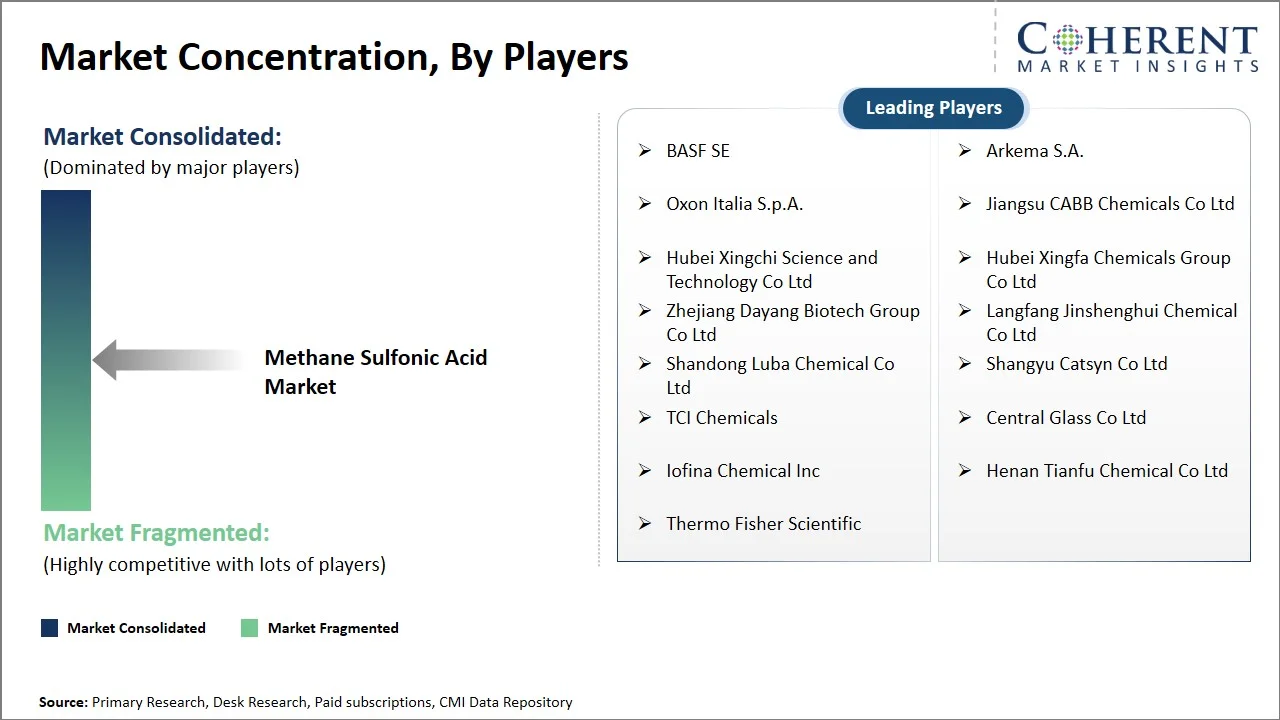
The methane sulfonic acid market is moderately competitive, with global chemical manufacturers, specialty acid suppliers, regional producers, distributors, and application-specific formulators competing across grade, purity, price, supply reliability, and technical service. Competition is stronger in industrial-grade and 70% aqueous formats, while pharmaceutical, electronic, and battery grades offer better differentiation and higher entry barriers.
Key focus areas include
- Product quality and differentiation: Suppliers compete through purity, concentration consistency, impurity profile, and application-specific performance.
- Technology adoption and process efficiency: Producers with stronger purification, blending, and quality-control systems are better positioned for premium customers.
- Pricing and cost competitiveness: Industrial-grade buyers remain price-sensitive, especially in bulk chemical synthesis and cleaning applications.
- Capacity expansion and supply reliability: Long-term customers prefer suppliers with stable production, safe logistics, and regional inventory support.
- Certifications and compliance: Pharmaceutical and electronics customers require documentation, audit readiness, and strict quality systems.
- Distribution network and customer reach: Direct sales dominate for large industrial users, while distributors support fragmented regional demand.
- Grade and specification differentiation: Electronic, pharmaceutical, battery, and customized blends create higher-margin opportunities.
- Supplier agreements and technical support: Application support, formulation assistance, and long-term supply contracts improve customer retention.
Market Report Scope
Methane Sulfonic Acid Market Report Coverage
| Report Coverage | Details | ||
|---|---|---|---|
| Base Year: | 2025 | Market Size in 2026: | USD 822.6 Mn |
| Historical Data for: | 2020 To 2024 | Forecast Period: | 2026 To 2033 |
| Forecast Period 2026 to 2033 CAGR: | 6.4% | 2033 Value Projection: | USD 1,269.9 Mn |
| Geographies covered: |
| ||
| Segments covered: |
| ||
| Companies covered: | BASF SE, Arkema S.A., Oxon Italia S.p.A., Jiangsu CABB Chemicals Co Ltd, Hubei Xingchi Science and Technology Co Ltd, Hubei Xingfa Chemicals Group Co Ltd, Zhejiang Dayang Biotech Group Co Ltd, Langfang Jinshenghui Chemical Co Ltd, Shandong Luba Chemical Co Ltd, Shangyu Catsyn Co Ltd, TCI Chemicals, Central Glass Co Ltd, Iofina Chemical Inc, Henan Tianfu Chemical Co Ltd, and Thermo Fisher Scientific | ||
| Growth Drivers: |
| ||
| Restraints & Challenges: |
| ||
Analyst Opinion (Expert Opinion)
- The methane sulfonic acid market is expected to maintain a positive growth outlook as industrial users increasingly prioritize cleaner acid systems, reliable electrochemical performance, and high-purity chemistry for regulated applications. Electroplating, chemical synthesis, pharmaceuticals, and electronics will remain the most commercially relevant demand pockets.
- The strongest growth pockets are expected in Asia Pacific for volume-driven electroplating and electronics demand, while Europe offers strong opportunity through sustainability-led substitution and regulatory-driven chemical selection. High-purity methane sulfonic acid, customized blends, and direct supply models should outperform standard commodity formats.
- Key risks include raw material cost volatility, handling and corrosion-control requirements, qualification barriers in pharmaceutical and electronics applications, and competition from lower-cost conventional acids. Market players should focus on purity differentiation, technical service, compliance documentation, and regionally resilient supply chains to strengthen competitive advantage.
Speak to the analyst
Want personalized insights?
Take the findings above to one of our principal consultants, or have the report rebuilt around the segments, geographies and competitors you actually track.
Market Segmentation
- Grade Insights (Revenue, USD Mn, 2021 - 2033)
- Industrial Grade
- Pharmaceutical Grade
- Electronic Grade
- Battery Grade
- Others
- Concentration Insights (Revenue, USD Mn, 2021 - 2033)
- 70% Aqueous Solution
- Above 99% Methanesulfonic Acid
- Customized Concentration Blends
- Application Insights (Revenue, USD Mn, 2021 - 2033)
- Electroplating and Surface Finishing
- Chemical Synthesis and Catalysts
- Pharmaceuticals
- Electronics and Semiconductor Processing
- Biodiesel and Esterification
- Industrial Cleaning and Descaling
- Others
- Sales Channel Insights (Revenue, USD Mn, 2021 - 2033)
- Direct Sales
- Distributors and Chemical Traders
- Online and Specialty Chemical Platforms
- Regional Insights (Revenue, USD Mn, 2021 - 2033)
- North America
- U.S.
- Canada
- Latin America
- Brazil
- Argentina
- Mexico
- Rest of Latin America
- Europe
- Germany
- U.K.
- Spain
- France
- Italy
- Russia
- Rest of Europe
- Asia Pacific
- China
- India
- Japan
- Australia
- South Korea
- ASEAN
- Rest of Asia Pacific
- Middle East
- GCC Countries
- Israel
- Rest of Middle East
- Africa
- South Africa
- North Africa
- Central Africa
- North America
- Key Players Insights
- BASF SE
- Arkema S.A.
- Oxon Italia S.p.A.
- Jiangsu CABB Chemicals Co Ltd
- Hubei Xingchi Science and Technology Co Ltd
- Hubei Xingfa Chemicals Group Co Ltd
- Zhejiang Dayang Biotech Group Co Ltd
- Langfang Jinshenghui Chemical Co Ltd
- Shandong Luba Chemical Co Ltd
- Shangyu Catsyn Co Ltd
- TCI Chemicals
- Central Glass Co Ltd
- Iofina Chemical Inc
- Henan Tianfu Chemical Co Ltd
- Thermo Fisher Scientific
Sources
Primary Research Interviews
- Methane Sulfonic Acid manufacturers, specialty acid producers, and sulfonic acid chemistry companies
- Industrial-grade, pharmaceutical-grade, electronic-grade, and battery-grade Methane Sulfonic Acid suppliers
- 70% aqueous Methane Sulfonic Acid solution suppliers and above 99% Methane Sulfonic Acid producers
- Electroplating chemical formulators, surface finishing companies, tin plating solution providers, and metal treatment service providers
- Pharmaceutical API manufacturers, contract development and manufacturing organizations, and mesylate salt formulation specialists
- Electronics, semiconductor, printed circuit board, and connector manufacturing companies using high-purity process chemicals
- Biodiesel producers, esterification catalyst users, and specialty chemical synthesis companies
- Industrial cleaning, descaling, and institutional cleaning formulation companies
- Chemical distributors, specialty chemical traders, and online specialty chemical platform operators
- Regulatory consultants, chemical safety experts, REACH compliance specialists, and hazardous chemical handling professionals
Stakeholders
- Methane Sulfonic Acid producers: BASF SE, Arkema S.A., Oxon Italia S.p.A., Jiangsu CABB Chemicals Co. Ltd., Hubei Xingchi Science and Technology Co. Ltd., Hubei Xingfa Chemicals Group Co. Ltd.
- Specialty chemical and industrial acid suppliers: Zhejiang Dayang Biotech Group Co. Ltd., Langfang Jinshenghui Chemical Co. Ltd., Shandong Luba Chemical Co. Ltd., Shangyu Catsyn Co. Ltd., Henan Tianfu Chemical Co. Ltd.
- Laboratory and high-purity chemical suppliers: Thermo Fisher Scientific, TCI Chemicals, Central Glass Co. Ltd., Iofina Chemical Inc.
- End-use sectors: Electroplating and surface finishing, pharmaceuticals, electronics and semiconductor processing, chemical synthesis, biodiesel production, industrial cleaning, descaling, and specialty formulations
- Supporting ecosystem: Chemical distributors, bulk chemical logistics providers, contract manufacturers, plating bath additive suppliers, laboratory testing companies, hazardous chemical storage providers, and compliance consultants
- Regulatory and certification bodies: U.S. Environmental Protection Agency, European Chemicals Agency, U.S. FDA, European Medicines Agency, Japan METI, China MIIT, BIS India, OSHA, OECD, ISO, and REACH authorities
Databases
- U.S. Environmental Protection Agency – chemical safety, environmental compliance, and industrial chemical regulatory data
- European Chemicals Agency – REACH registration, classification, labeling, and safety data for Methane Sulfonic Acid
- PubChem and NIH databases – chemical properties, safety identifiers, and toxicological reference information
- OECD eChemPortal – chemical hazard, exposure, and environmental safety data
- U.S. FDA databases – pharmaceutical approvals and mesylate-based drug formulation references
- European Medicines Agency database – pharmaceutical substances, product approvals, and regulatory assessment information
- UN Comtrade Database – trade flows for specialty chemicals, sulfonic acid derivatives, and industrial chemical categories
- ITC Trade Map – import/export analysis for chemical intermediates, organic acids, and specialty chemicals
- Eurostat – European chemical manufacturing, trade, and industrial production indicators
- U.S. Census Bureau and International Trade Administration – U.S. chemical trade and manufacturing data
- China National Bureau of Statistics and China Customs – chemical production and trade indicators
- India Ministry of Chemicals and Fertilizers and Department of Pharmaceuticals – chemical and pharmaceutical manufacturing data
Magazines / Industry Publications
- Chemical & Engineering News
- ICIS Chemical Business
- Chemical Week
- Chemical Processing
- Specialty Chemicals Magazine
- PCI Magazine
- Products Finishing
- Metal Finishing News
- Semiconductor Today
- Semiconductor Digest
- Cleanroom Technology
- Pharmaceutical Technology
- Contract Pharma
- Biofuels International
- Biodiesel Magazine
- Hydrocarbon Processing
- European Coatings
- Chemical Industry Digest
Journals
- Green Chemistry
- Journal of Cleaner Production
- Journal of Industrial and Engineering Chemistry
- Industrial & Engineering Chemistry Research
- ACS Sustainable Chemistry & Engineering
- Organic Process Research & Development
- Journal of Molecular Catalysis A: Chemical
- Catalysis Today
- Electrochimica Acta
- Journal of The Electrochemical Society
- Surface and Coatings Technology
- Transactions of the IMF
- Metals
- Applied Surface Science
- Journal of Pharmaceutical Sciences
- International Journal of Pharmaceutics
- Chemical Engineering Journal
- Separation and Purification Technology
Credible News Sources
- Financial Times – specialty chemicals, European chemical regulation, and industrial policy updates
- Bloomberg – chemical markets, commodity pricing, and industrial manufacturing developments
- The Wall Street Journal – industrial chemicals, manufacturing, and supply-chain updates
- CNBC – semiconductor manufacturing, chemical supply-chain, and industrial investment trends
- The Hindu BusinessLine – India chemical, pharmaceutical, and specialty manufacturing developments
Associations
- American Chemistry Council
- European Chemical Industry Council
- Society of Chemical Manufacturers & Affiliates
- Indian Chemical Council
- Japan Chemical Industry Association
- China Petroleum and Chemical Industry Federation
- Semiconductor Industry Association
- SEMI
- National Association for Surface Finishing
- European Association for Surface Treatment on Aluminium
- International Metal Finishing Association
- International Pharmaceutical Excipients Council
- International Council for Harmonisation
- European Federation of Chemical Engineering
- Electrochemical Society
Public Domain Sources
- U.S. Environmental Protection Agency – chemical regulation, environmental discharge rules, and industrial chemical safety guidance
- European Chemicals Agency – Methane Sulfonic Acid REACH registration, classification, labeling, and safety information
- U.S. FDA – mesylate-based drug approvals and pharmaceutical regulatory references
- European Medicines Agency – pharmaceutical product assessment and regulatory guidance
- OSHA – workplace chemical handling, exposure, and safety guidance
- OECD eChemPortal – chemical hazard and environmental safety information
- PubChem – chemical properties, identifiers, toxicity, and compound reference data
- NIST Chemistry WebBook – chemical structure, physical properties, and reference data
- European Commission – EU chemicals strategy, REACH policy, battery regulation, and sustainability requirements
- U.S. Department of Commerce – semiconductor manufacturing and specialty chemical supply-chain relevance
- China MIIT – electronics, semiconductor, and chemical manufacturing policy updates
- India Ministry of Chemicals and Fertilizers – chemical industry and domestic manufacturing data
- Japan METI – specialty chemical, semiconductor, and industrial manufacturing policy updates
- Korea MOTIE – electronics, semiconductor, and specialty chemical ecosystem data
Proprietary Elements
- CMI Data Analytics Tool, Proprietary CMI Existing Repository of information for the last 10 years
Get access to 250+ pages report
Every segment, forecast, competitor profile and data table behind the analysis above — available for instant download.
- ESOMAR Member
- ISO 9001:2015 Certified
- D-U-N-S Registered
- GDPR & CCPA Compliant
Missing comfort of reading report in your local language? Find your preferred language:
Transform your Strategy with Exclusive Trending Reports
Frequently Asked Questions
The CAGR of the methane sulfonic acid market is projected to be 6.4% from 2026 to 2033.
The 70% aqueous solution segment is expected to hold a major share in the methane sulfonic acid market due to its easier handling, safer storage, and wide use in industrial applications.
Methane sulfonic acid is mainly used in electroplating and surface finishing, where it supports metal deposition, bath stability, and cleaner acid-based processing.
The global methane sulfonic acid market is estimated to be valued at USD 822.6 million in 2026 and is expected to reach USD 1,269.9 million by 2033
Expanding electroplating demand for biodegradable acid alternatives and growing pharmaceutical and electronics use of high purity methanesulfonic acid are the major factors driving the growth of the methane sulfonic acid market.
Feedstock and sulfur chemical price volatility affecting production margins and handling safety requirements limiting adoption among small scale users are the major factors hampering the growth of the methane sulfonic acid market.
In terms of grade, industrial grade is estimated to dominate the market revenue share in 2026.