

Middle East and Saudi Arabia Pediatric Cardiology Market Size and Forecast – 2026 To 2033
The Middle East and Saudi Arabia pediatric cardiology market is expected to grow from USD 480.8 Mn in 2026 to USD 1,081.0 Mn by 2033, registering a compound annual growth rate (CAGR) of 12.3%. The Middle East and Saudi Arabia pediatric cardiology market is poised for significant expansion, fueled by the growing emphasis on early detection of congenital heart defects (CHDs).
According to the Saudi Ministry of Health, newborn cardiac diagnosis coverage increased from 20% to 90% during 2017, supporting earlier detection and treatment of congenital cardiac conditions.
Key Takeaways of the Middle East and Saudi Arabia Pediatric Cardiology Market
- Pacemaker is projected to hold 52.9 % of the Middle East and Saudi Arabia pediatric cardiology market share in 2026, making it the dominant product type segment, supported by the need for rhythm management in children with conduction abnormalities and congenital heart conditions. For instance, in November 2025, King Faisal Specialist Hospital & Research Centre successfully implanted a customized permanent pacemaker in a 2-kg newborn with a congenital heart defect and postoperative conduction disturbance, marking the first such case reported in Asia and Africa.
- Congenital heart disease is projected to hold 46.5 % of the Middle East and Saudi Arabia pediatric cardiology market share in 2026, making it the dominant disease indication segment, as complex congenital defects require early diagnosis, catheter-based intervention, and specialized surgical management. For instance, in May 2025, Saudi Arabia’s Prince Sultan Cardiac Center in Qassim performed therapeutic cardiac catheterization on nine newborns with critical congenital heart conditions, following early detection and referral.
- Hospitals are projected to hold 60.2 % of the Middle East and Saudi Arabia pediatric cardiology market share in 2026, making it the dominant end user segment, owing to their concentration of pediatric cardiologists, catheterization facilities, cardiac surgery units, and specialized neonatal care. For instance, in September 2025, the Umm Al-Qura Cardiac Center at Maternity and Children’s Hospital in Makkah performed a complex cardiac catheterization on a 10-day-old infant with critical congenital heart defects, demonstrating the role of specialized hospitals in delivering advanced pediatric cardiac interventions.
Segmental Insights
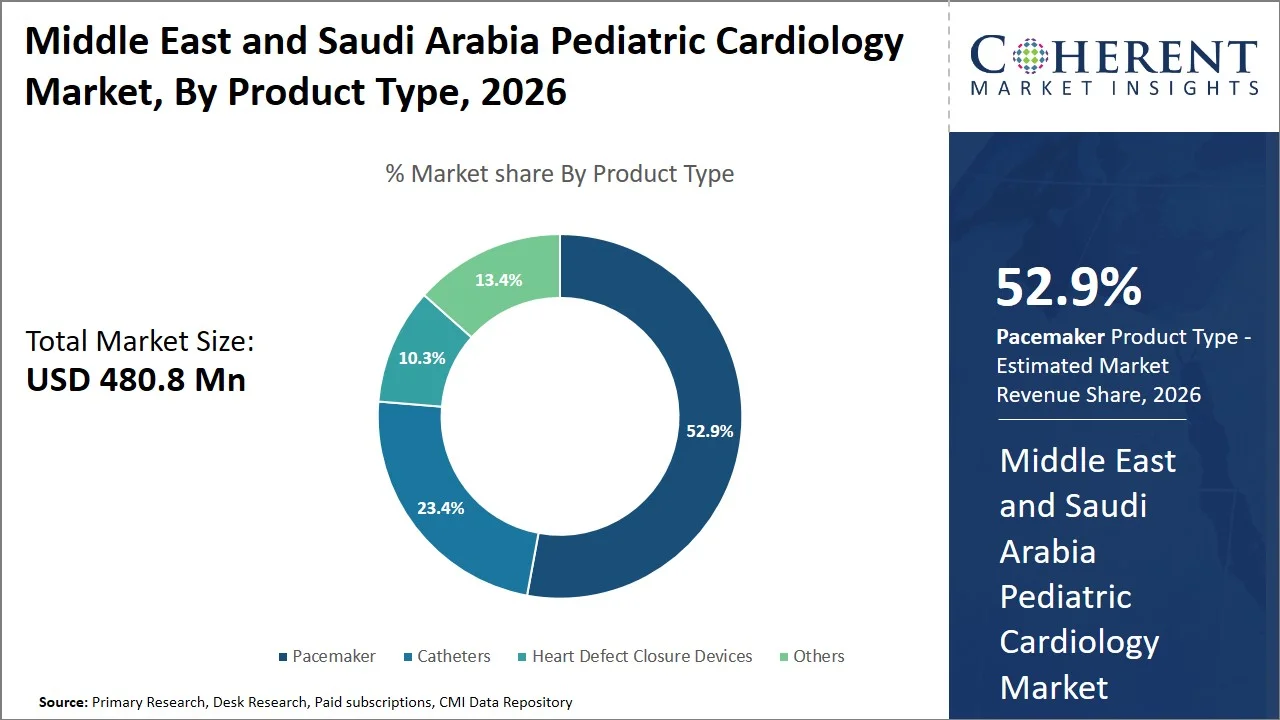
Why Do Pacemaker Dominate the Middle East and Saudi Arabia Pediatric Cardiology Market?
Pacemaker is projected to hold a market share of 52.9% in 2026, due to necessity of long-term management of abnormal cardiac rhythm for children born with a heart defect, with post operative conduction problems, as well as arrhythmia problems. Advances in smaller tailored pacing systems have increased the possibility to implant pacemakers into neonates and low-weight babies which favors the market for these specialized devices in the region. For instance, in June 2026, King Saud Medical City of Riyadh has implemented the first two Left Bundle Branch Area Pacing (LBBAP) pacemakers within a Ministry of Health facility in the Kingdom of Saudi Arabia through state-of-the-art pacing technology from BIOTRONIK, reflecting the increasing accessibility of cutting-edge pacing technologies for the cardiovascular patient in the Kingdom. (Source: Saudi Press Agency)
- Current Industry Events of 2026
- Market Size Estimation
- Regional Breakdown
- Competitive Landscape
- Customer Intelligence
- Segmental Analysis
- Pricing Analysis
- Key Market Drivers, Challenges & Future Trends
- Customized Insights Section
Why Does Congenital Heart Disease Represent the Largest Disease Indication Segment in the Middle East and Saudi Arabia Pediatric Cardiology Market?
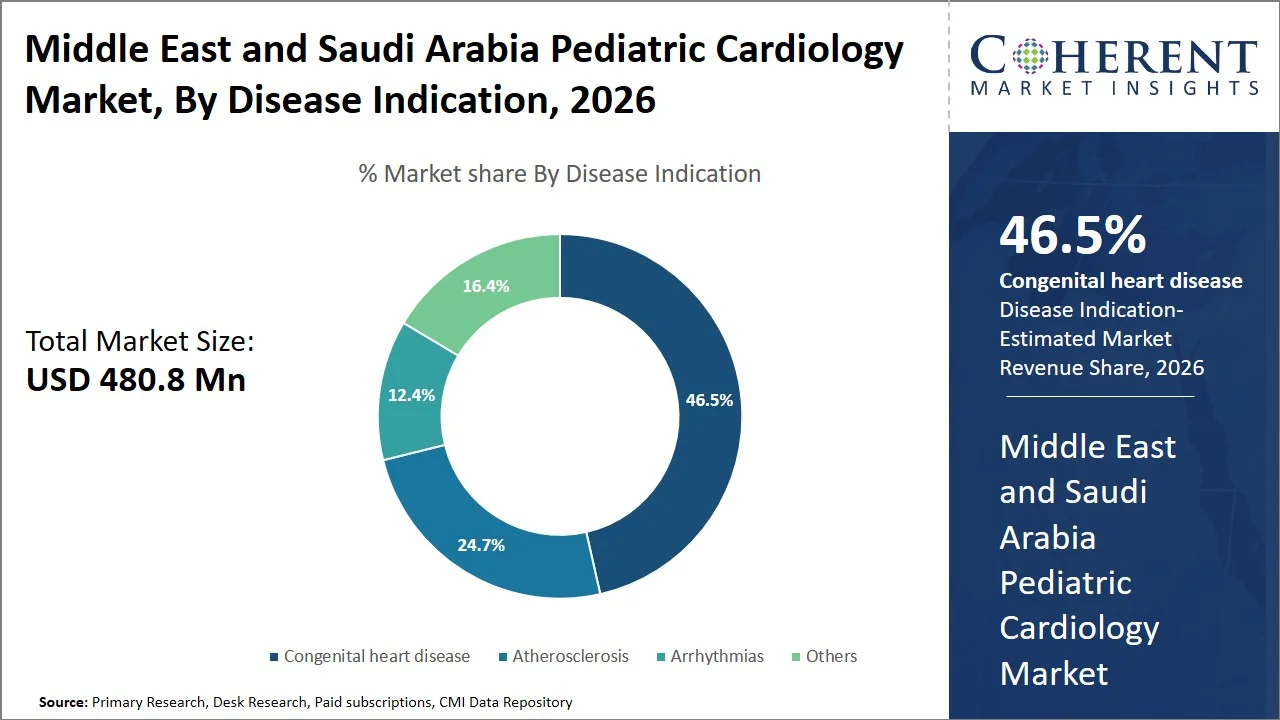
Congenital heart disease is projected to hold 46.5% of the market share in 2026, as structural cardiovascular abnormalities necessitate continued diagnosis, treatment, and surveillance from birth through the course of a person's lifetime. A continued growth in the clinical ability to support severe congenital disorders, with pediatric catheterization serve as a significant enabling technology that contribute to the persistent demand for specialized cardiac technologies across Saudi Arabia. For instance, in September 2025, the first Middle Eastern use of the Alterra Adaptive Pre-Stent in congenital structural heart disease at the Prince Sultan Cardiac Center in Riyadh was reported, illustrating the integration of state-of-the-art technology for structural heart intervention into Saudi Arabia. (Source: National Library of Medicine)
Hospitals Segment Dominates the Middle East and Saudi Arabia Pediatric Cardiology Market
The hospitals segment is expected to hold 60.2% of the Middle East and Saudi Arabia pediatric cardiology market share in 2026, by virtue of integrated facilities which host multidisciplinary capabilities for pediatric cardiac catheterization and interventional procedures, cardiac surgery, imaging, and intensive cardiac care. There is increased access to leading pediatric interventions via the spread of cardiac specialty services in centers across the Saudi territory. For instance, in October 2025, the Jeddah Health Cluster inaugurated an addition to the Specialist Heart Center of King Abdullah Medical Complex. The facility includes a second cardiac catheterization laboratory, a 24 critical care beds, and a cardiac surgical intensive care ward of 10 beds, thus enhancing hospital’s capabilities in the provision of cardiac services in the kingdom. (Source: Saudi Press Agency)
Current Events and their Impact
Current Events | Description and its Impact |
Saudi Food and Drug Authority (SFDA) Issued Guidance on Innovative Medical Devices (January 2025) |
|
Saudi Food and Drug Authority (SFDA) Strengthened Regulation of Medical Device Clinical Studies (July 2025) |
|
Middle East and Saudi Arabia Pediatric Cardiology Market Dynamics
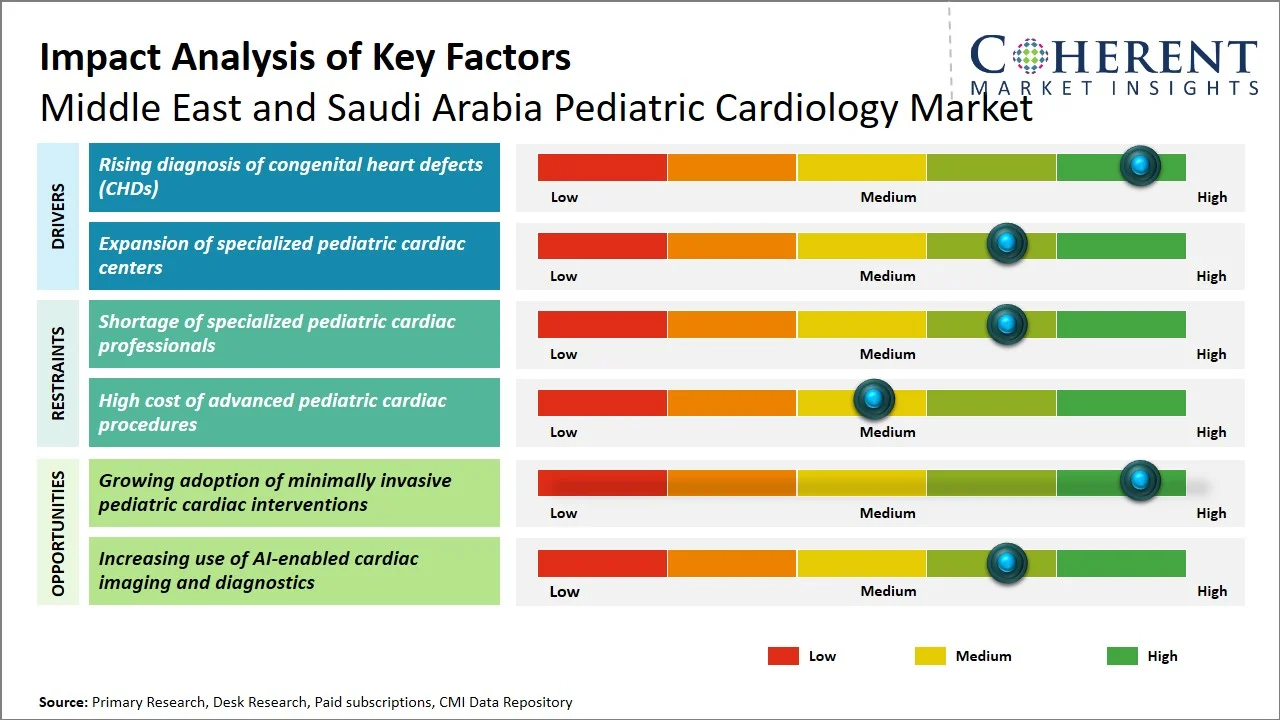
Market Drivers
- Rising diagnosis of congenital heart defects (CHDs): The market is increasingly supported by advanced genetic screening and precision diagnostic capabilities, which can enable earlier identification of inherited conditions associated with pediatric cardiac abnormalities and support timely specialist referral. Integration of genomic testing into pediatric care can also strengthen personalized risk assessment and long-term management of children with suspected hereditary cardiac conditions. For instance, in October 2025, King Faisal Specialist Hospital & Research Centre partnered with Rady Children’s Institute for Genomic Medicine to introduce a genome-based newborn screening platform capable of detecting more than 500 treatable and preventable genetic diseases, strengthening Saudi Arabia’s advanced early-diagnosis infrastructure.
- Expansion of specialized pediatric cardiac centers: The expansion of specialized pediatric cardiac centers is strengthening access to advanced diagnosis, intervention, and surgical care across Saudi Arabia. Dedicated centers enable multidisciplinary teams to manage complex congenital heart conditions while supporting the adoption of specialized catheterization and intensive-care capabilities. For instance, in September 2025, the Makkah Health Cluster reported a successful complex cardiac catheterization on a 10-day-old infant with critical congenital valve abnormalities at Umm Al-Qura Cardiac Center, demonstrating the growing capability of specialized pediatric cardiac units to manage high-risk neonatal cases locally
- Expansion of Pediatric Cardiology Workforce and Specialized Services: The expansion of specialized pediatric cardiology services and clinical expertise is improving the capacity to diagnose and manage complex congenital heart conditions across Saudi Arabia. Greater availability of pediatric cardiologists, interventional specialists, and dedicated cardiac programs can support higher procedure volumes and reduce dependence on a limited number of referral centers. For instance, in 2025, the Ministry of National Guard Health Affairs announced a pediatric cardiology fellowship at King Abdullah Specialized Hospital in Al-Qassim, supporting the development of specialized pediatric cardiac expertise within the Kingdom.
Emerging Trends
- Integration of Genetic Testing into Pediatric Cardiac Care: Genetic testing is gaining importance in evaluating children with inherited cardiac conditions and unexplained cardiomyopathies. Its integration with clinical assessment can support earlier identification of hereditary risks and more personalized management strategies.
- Growth of Digital Referral and Care-Coordination Systems: Digital referral platforms are becoming more relevant for connecting pediatric patients with specialized cardiology services and streamlining referrals across healthcare networks. This can improve coordination between primary-care providers, pediatricians, and specialist cardiac centers.
- Increasing Use of Advanced Pediatric Cardiac Imaging: Pediatric cardiac imaging is evolving toward more sophisticated image analysis, including automated interpretation, quantitative assessment, and three-dimensional visualization. These technologies can improve anatomical assessment and support treatment planning for complex congenital heart conditions.
Pediatric Cardiac Care Capacity and Disease Burden in Saudi Arabia
Metric | Saudi Arabia / Regional Indicator | Relevance to Market |
Congenital heart disease burden | Congenital Heart Disease (CHD) is a major pediatric cardiac condition in Saudi Arabia | Supports demand for diagnosis and treatment |
Newborn cardiac screening | National Critical Congenital Heart Disease (CCHD) screening program implemented before hospital discharge | Supports early diagnosis and referral |
Pediatric cardiac catheterizations | 3,399 procedures at Prince Sultan Cardiac Center, Al-Ahsa, through June 2023 | Demonstrates demand for interventional cardiology |
Cardiac surgical procedures | 427 procedures at the same center through June 2023 | Indicates requirement for pediatric cardiac surgical capacity |
Pediatric cardiac services | King Faisal Specialist Hospital & Research Centre provides advanced imaging, interventional cardiology, electrophysiology, and specialized management | Demonstrates expansion of specialized capabilities |
How is the growing adoption of minimally invasive pediatric cardiac interventions creating new growth opportunities in the Middle East and Saudi Arabia pediatric cardiology market?
The Middle East and Saudi Arabia pediatric cardiology market is increasingly moving towards the use of minimally invasive procedures (like catheter-based treatment for congenital heart diseases) as these have a potential to decrease the need for traditional open-heart procedures and to lead to quicker recoveries. The growing development of specialized pediatric catheterization services in Saudi Arabia is contributing to facilitate this shift. For instance, in October 2025, Prince Sultan Cardiac Center Al-Ahsa performed a complex pediatric cardiac procedure via entirely percutaneous intervention to correct a complex congenital cardiac abnormality in a 16-year-old avoiding traditional open-heart surgery. (Source: Saudi Press Agency)
Market Players, Key Development, and Competitive Landscape
Key Developments
- In July 2026, Saudi Arabia, through the King Salman Humanitarian Aid and Relief Centre (KSrelief), funded United Nations Office for Project Services (UNOPS) to establish a Pediatric Cardiac Surgery Department at Ibn Roshed Hospital in Aleppo, in coordination with Syria’s Ministry of Health. The initiative includes specialized medical equipment and training for healthcare and technical personnel, strengthening pediatric cardiac surgery capacity and access to specialized care in the region.
- In June 2026, Aster DM Healthcare acquired a majority stake in ProCare Hospital in Saudi Arabia’s Eastern Province, bringing the facility into its network as Aster ProCare Hospital and expanding its Saudi capacity beyond 500 beds. The expansion is relevant to pediatric cardiology as increased multispecialty hospital capacity can support the development of advanced pediatric and cardiovascular services in the Kingdom
Competitive Landscape
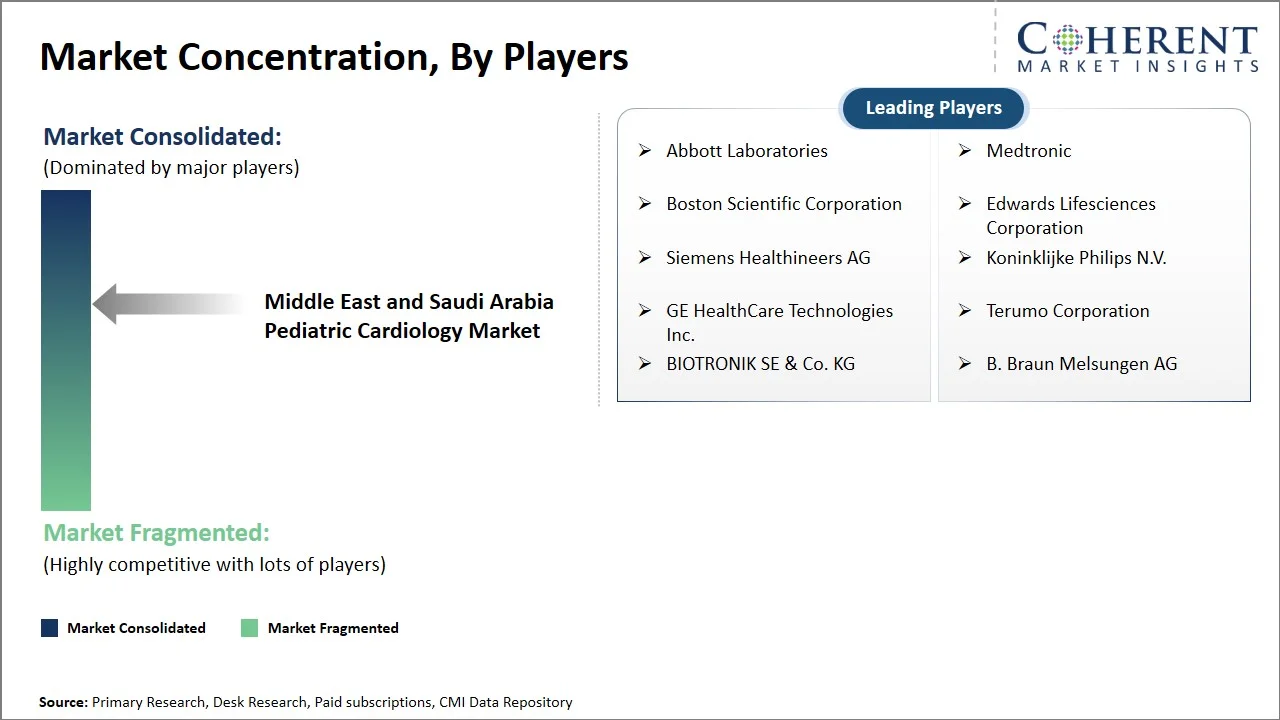
The Middle East and Saudi Arabia pediatric cardiology market is moderately consolidated, with leading companies competing through pediatric-specific cardiac devices, advanced diagnostic imaging, catheter-based interventions, and rhythm-management technologies. Market participants are focusing on product innovation, regulatory approvals, clinical validation, and partnerships with specialized cardiac centers to strengthen their regional presence. Key focus areas include:
- Development of pediatric-specific cardiac devices and minimally invasive intervention technologies
- Expansion of advanced echocardiography, cardiac imaging, and diagnostic solutions
- Investment in clinical training, physician education, and specialized pediatric cardiac programs
- Strengthening hospital partnerships, regulatory approvals, and regional distribution networks to expand access to pediatric cardiac technologies
Market Report Scope
Middle East and Saudi Arabia Pediatric Cardiology Market Report Coverage
| Report Coverage | Details | ||
|---|---|---|---|
| Base Year: | 2025 | Market Size in 2026: | USD 480.8 Mn |
| Historical Data for: | 2020 To 2024 | Forecast Period: | 2026 To 2033 |
| Forecast Period 2026 to 2033 CAGR: | 12.3% | 2033 Value Projection: | USD 1,081.0 Mn |
| Segments covered: |
| ||
| Companies covered: | Abbott Laboratories, Medtronic, Boston Scientific Corporation, Edwards Lifesciences Corporation, Siemens Healthineers AG, Koninklijke Philips N.V., GE HealthCare Technologies Inc., Terumo Corporation, BIOTRONIK SE & Co. KG, B. Braun Melsungen AG | ||
| Growth Drivers: |
| ||
| Restraints & Challenges: |
| ||
Analyst Opinion (Expert Opinion)
- The future of the Middle East and Saudi Arabia pediatric cardiology market is expected to shift toward advanced, minimally invasive, and multidisciplinary pediatric cardiac care, supported by wider use of therapeutic catheterization, advanced cardiac imaging, and specialized congenital-heart programs. Saudi Arabia is already expanding these capabilities through dedicated pediatric cardiac centers and training programs.
- The maximum growth opportunity lies within catheter-based interventions for congenital heart disease in Saudi Arabia, as Saudi centers expand minimally invasive treatment for structural defects and establish specialized pediatric catheterization services closer to patients. The launch of a dedicated pediatric cardiac catheterization program in Al-Jouf in 2025 demonstrates this regional opportunity.
- In order to create an advantage for themselves, the competitors should focus on pediatric-specific catheter-based devices, advanced imaging, and rhythm-management technologies, while partnering with Saudi cardiac centers for clinical training, physician education, and technology adoption. Localized training and referral partnerships can strengthen market access as specialized pediatric cardiac services expand beyond major Saudi cities.
Speak to the analyst
Want personalized insights?
Take the findings above to one of our principal consultants, or have the report rebuilt around the segments, geographies and competitors you actually track.
Market Segmentation
- Product Type Insights (Revenue, USD Mn, 2021 - 2033)
- Pacemaker
- Catheters
- Heart Defect Closure Devices
- Others
- Disease Indication Insights (Revenue, USD Mn, 2021 - 2033)
- Congenital Heart Disease
- Atherosclerosis
- Arrhythmias
- Others
- End User Insights (Revenue, USD Mn, 2021 - 2033)
- Hospitals
- Cardiac Catheterization
- Pediatric Cardiac Centers
- Ambulatory Surgery Centers
- Others
- Key Players Insights
- Abbott Laboratories
- Medtronic
- Boston Scientific Corporation
- Edwards Lifesciences Corporation
- Siemens Healthineers AG
- Koninklijke Philips N.V.
- GE HealthCare Technologies Inc.
- Terumo Corporation
- BIOTRONIK SE & Co. KG
- Braun Melsungen AG
Sources
Primary Research Interviews
- Pediatric Cardiologists and Pediatric Cardiac Surgeons – congenital heart disease diagnosis, surgical procedures, and treatment trends
- Pediatric Cardiac Catheterization Specialists – minimally invasive interventions and catheter-based device adoption
- Pediatric Cardiac Center Directors and Department Heads – hospital capacity, patient volumes, and infrastructure expansion
- Medical Device Manufacturers and Regional Business Executives – pediatric cardiac device adoption, distribution, and regulatory requirements
- Hospital Procurement Heads and Medical Device Purchasing Managers – procurement priorities and technology adoption
Stakeholders
- Pediatric Cardiology and Cardiac Surgery Centers
- Hospitals and Specialized Pediatric Cardiac Centers
- Pediatric Cardiac Catheterization Laboratories
- Medical Device Manufacturers and Regional Distributors
- Healthcare Provider Networks and Private Hospital Groups
- Health Insurance and Healthcare Financing Organizations
- End-use Sectors
- Hospitals
- Specialized Pediatric Cardiac Centers
- Academic and University Medical Centers
- Pediatric Cardiac Surgery Centers
- Cardiac Catheterization Centers
- Specialty Pediatric Clinics
- Regulatory & Health Bodies
- Saudi Food and Drug Authority (SFDA) – medical device registration, authorization, and post-market oversight
- Saudi Ministry of Health (MOH) – pediatric cardiac services, newborn screening, and healthcare programs
- Saudi Health Council (SHC) – national health-service coordination and cardiac-care planning
- Gulf Cooperation Council Standardization Organization (GSO) – Gulf standards for medical devices and healthcare equipment
- World Health Organization Eastern Mediterranean Regional Office (WHO EMRO) – regional cardiovascular and congenital-heart-disease evidence
Databases
- Saudi Food and Drug Authority (SFDA) – Registered Medical Devices Database
- Saudi National Medical Device Registry (MDNR)
- Saudi Ministry of Health – Health Statistics and Publications
- Saudi Health Council – National Health Information and Statistics
- WHO Global Health Observatory (GHO) – Eastern Mediterranean health data
Journals
- Saudi Heart Journal
- Eastern Mediterranean Health Journal
- Journal of the Saudi Heart Association
- Annals of Saudi Medicine
- International Journal of Pediatrics and Adolescent Medicine
Associations
- Saudi Heart Association
- Saudi Pediatric Association
- Saudi Society of Pediatric Surgery
- Arab Society of Cardiology
- Gulf Heart Association
- World Society for Pediatric and Congenital Heart Surgery
Public Domain Sources
- Saudi Ministry of Health (MOH)
- Saudi Health Council (SHC)
- Saudi Food and Drug Authority (SFDA)
- Gulf Cooperation Council Standardization Organization (GSO)
- World Health Organization Eastern Mediterranean Regional Office (WHO EMRO)
Proprietary Elements
- CMI Data Analytics Tool, Proprietary CMI Existing Repository of information for last 10 years.
Get access to 250+ pages report
Every segment, forecast, competitor profile and data table behind the analysis above — available for instant download.
- ESOMAR Member
- ISO 9001:2015 Certified
- D-U-N-S Registered
- GDPR & CCPA Compliant
Missing comfort of reading report in your local language? Find your preferred language:
Transform your Strategy with Exclusive Trending Reports
Frequently Asked Questions
The Middle East and Saudi Arabia pediatric cardiology market is estimated to be valued at USD 480.8 Mn in 2026 and is expected to reach USD 1,081.0 Mn by 2033.
Pacemaker dominate due to the need for continuous rhythm management in children with congenital heart defects, conduction abnormalities, and pediatric arrhythmias.
Pediatric cardiology is the medical specialty focused on diagnosing and treating heart conditions in infants, children, and adolescents.
The CAGR of Middle East and Saudi Arabia pediatric cardiology market is projected to be 12.3% from 2026 to 2033.
Echocardiography provides non-invasive assessment of cardiac structure, blood flow, and heart function, making it a core diagnostic tool for congenital heart conditions.
Cardiac catheterization supports both hemodynamic assessment and minimally invasive treatment of selected congenital heart defects and structural abnormalities.
Specialized centers provide access to pediatric cardiologists, cardiac surgeons, catheterization laboratories, advanced imaging, and intensive-care facilities required for complex pediatric cases.