

North America Vision Care Market is estimated to be valued at USD 7.36 Bn in 2026 and is expected to reach USD 10.15 Bn in 2033, exhibiting a compound annual growth rate (CAGR) of 4.7% from 2026 to 2033.
Key Takeaways:
- By Product Type, The Contact Lenses Segment is projected to dominate the North America vision care market with a 36.1% share in 2026.
- The United States is expected to maintain its dominance in the North America vision care market, commanding an 88.7% share in 2026.
Market Overview:
The North America Vision Care Market is witnessing sustained growth, driven by rising cases of refractive errors, increased screen time, and an aging population. Contact lenses lead the product segment, favoured for their convenience and cosmetic appeal. Technological innovations and consumer demand for personalized eye care solutions further boost market expansion. The U.S. dominates the regional market, supported by strong healthcare infrastructure and high consumer awareness. Growing online sales channels and routine eye health check-ups are expected to sustain momentum across the region.
Current Events and its Impact on the North America Vision Care Market
Current Event | Description and its impact |
Rising Incidence of Myopia and Screen-Induced Vision Disorders |
|
Technological Advancements in Smart and Customized Lenses |
|
Expansion of Vision Insurance and Eye Health Awareness Campaigns |
|
Pipeline Analysis: North America Vision Care Market
The North America vision care market pipeline is witnessing robust innovation, with a strong focus on advanced contact lenses, refractive correction technologies, and digital health integration. Several companies are developing next-generation contact lenses incorporating features like drug delivery, smart sensors for glucose monitoring, and adaptive light filtering.
Research is also progressing on myopia control lenses for children, addressing the growing prevalence of pediatric vision issues. In parallel, advancements in surgical vision correction, such as customizable intraocular lenses (IOLs) and femtosecond laser-assisted procedures, are expanding treatment options for cataracts and presbyopia.
Digital platforms offering tele-optometry, AI-based eye exams, and personalized lens recommendations are gaining momentum, streamlining access and patient engagement. With strong backing from major players and academic collaborations, the pipeline reflects a shift toward personalized, tech-enabled eye care. This innovation landscape positions North America at the forefront of global developments in vision correction and preventive ophthalmic care.
- Current Industry Events of 2026
- Market Size Estimation
- Regional Breakdown
- Competitive Landscape
- Customer Intelligence
- Segmental Analysis
- Pricing Analysis
- Key Market Drivers, Challenges & Future Trends
- Customized Insights Section
Patent Landscape: North America Vision Care Market
The North America vision care market showcases a dynamic and expanding patent landscape, driven by innovation in contact lenses, surgical devices, and digital vision technologies. A significant number of patents are being filed by leading players such as Johnson & Johnson Vision, Alcon, Bausch + Lomb, and CooperVision, focusing on advanced lens materials, antimicrobial coatings, oxygen permeability enhancements, and drug-eluting lenses.
There is a growing cluster of patents around smart contact lenses with embedded sensors for intraocular pressure monitoring and real-time diagnostics. Innovations in intraocular lenses (IOLs), particularly multifocal and toric designs, also feature prominently in the region’s intellectual property filings.
Additionally, digital health tools, including AI-powered eye screening apps and tele-optometry platforms, are contributing to a new wave of software and device-related patents. This rich patent activity not only fuels competitive advantage but also reflects North America's leadership in pioneering next-generation vision care solutions.
Reimbursement Scenario: North America Vision Care Market
The reimbursement landscape for vision care in North America varies significantly between the United States and Canada, influenced by both public health programs and private insurance coverage. In the U.S., Medicare does not typically cover routine vision services such as eye exams, eyeglasses, or contact lenses unless they are required post-cataract surgery.
However, many Medicare Advantage (Part C) plans do offer vision benefits, including annual exams and eyewear. Medicaid provides mandatory vision care for children but coverage for adults differs by state, with some offering limited services.
In Canada, vision care services are not fully covered under the publicly funded healthcare system. Provincial coverage may include eye exams for children and seniors, but most adults rely on employer-sponsored or private insurance plans to cover the cost of vision tests, glasses, or contact lenses. Supplemental insurance typically reimburses up to 80–100% of expenses. The disparity in coverage across both countries contributes to unequal access to vision care services.
Prescribers’ Preference: North America Vision Care Market
In the North America Vision Care Market, prescribers—primarily optometrists and ophthalmologists—tend to favor personalized, patient-centric solutions that combine visual performance with long-term eye health. Contact lenses are increasingly prescribed due to advancements in silicone hydrogel materials, which offer superior oxygen permeability and all-day comfort. Daily disposables are often preferred for their hygiene and convenience, especially for younger, active users and those with allergic sensitivities.
Eyeglasses remain widely recommended, particularly among older adults and patients with chronic conditions like dry eye syndrome, where contact lenses may not be ideal. Prescribers also show a growing inclination toward recommending blue-light filtering lenses due to rising screen time. Moreover, with increasing awareness of refractive surgeries, some professionals are guiding patients toward LASIK or intraocular lenses for permanent correction.
Overall, the prescriber landscape is shaped by a balance of clinical efficacy, patient lifestyle, and technological advancements, influencing product choices across various age groups and needs.
North America Vision Care Market Trends
- Increasing geriatric population
Due to increase in the age of the population, it’s become difficult to focus on objects placed nearby generally called presbyopia which is common in geriatric populations. Increase in the prevalence of technological advancements like nanotechnology to measure eye pressure for treating retina-based problems and aiding patients in speedy recovery from glaucoma.
- Increasing initiatives to raise awareness
Initiatives and raising awareness from the regulatory agencies could propel the North American market for vision care. For instance, in September 2021, AbbVie, Inc. a pharmaceutical company and REGENXBIO Inc., a biotechnology company announced a partnership to develop and commercialize RGX-314, a potential one-time gene therapy for the treatment of wet age-related macular degeneration (wet AMD), diabetic retinopathy (DR) and other chronic retinal diseases.
RGX-314 is currently being evaluated in patients with wet AMD in a pivotal trial utilizing sub-retinal delivery, and in patients with wet AMD and DR in two separate Phase II clinical trials utilizing in-office suprachoroidal delivery.
In April 2025, Reuters reported that EssilorLuxottica is evaluating shifting part of its production from Thailand and Mexico to the U.S. due to tariff pressures. The move aims to safeguard its Ray-Ban, Oakley, and prescription lens operations by bringing manufacturing closer to its largest market.
Segmentation Analysis
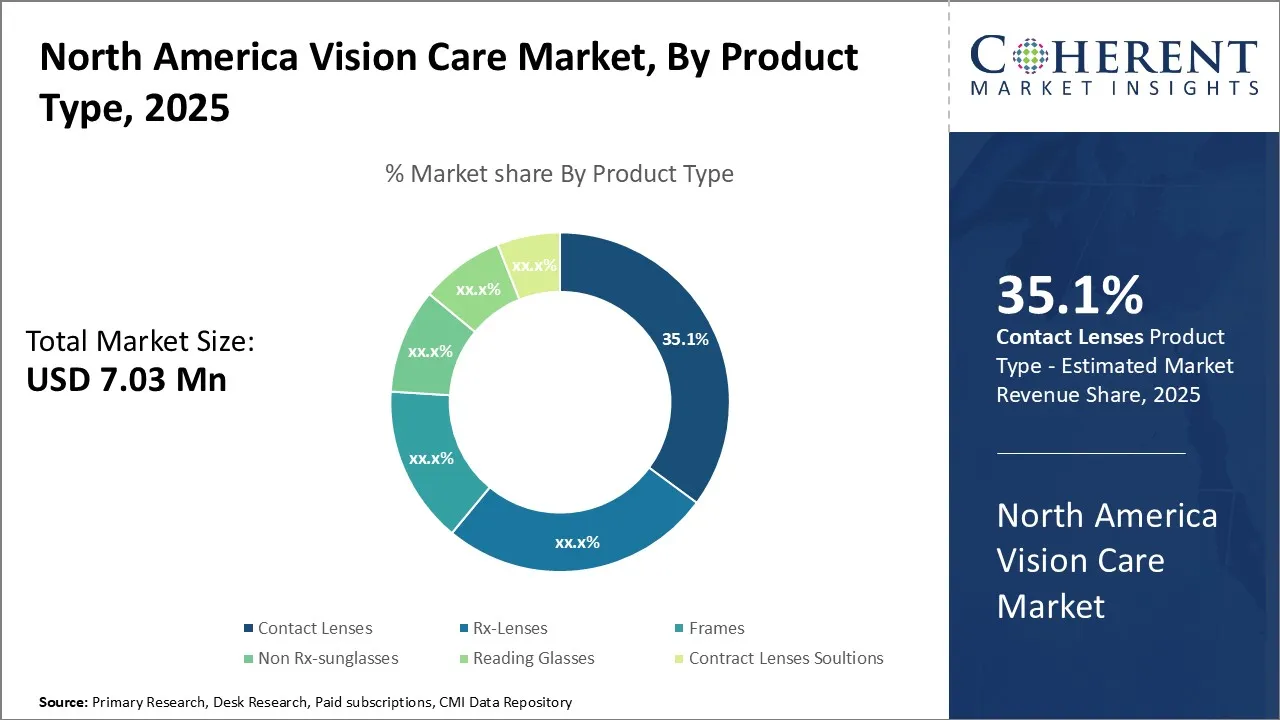
North America Vision Care Market Insights, By Product Type
The contact lenses segment is projected to lead the North America vision care market with a 36.1% share in 2026. This dominance is attributed to the rising demand for convenience, enhanced visual acuity, and aesthetic appeal among consumers. Contact lenses offer a discreet and flexible alternative to eyeglasses, particularly appealing to younger demographics and working professionals.
Technological advancements, including the development of silicone hydrogel materials, have improved comfort and oxygen permeability, making lenses suitable for extended and daily wear. Furthermore, innovations such as UV protection, moisture-retention coatings, and lenses tailored for digital eye strain continue to drive consumer interest.
The increased focus on lifestyle and fashion, along with greater awareness of refractive errors and the benefits of vision correction, further supports the segment’s growth. With ongoing R&D and marketing efforts from leading manufacturers, the contact lenses segment is set to remain the
North America Vision Care Market: Regional Insight
United States Vision Care Market Trends and Analysis
The United States is expected to maintain its leadership in the North America vision care market, commanding an impressive 88.7% share in 2026. This dominance is driven by a mature healthcare infrastructure, strong consumer awareness regarding eye health, and high per capita spending on wellness. The country has a well-established network of ophthalmologists and optometrists, along with advanced diagnostic and corrective technologies.
The increasing prevalence of refractive errors, driven by rising screen time and an aging population, continues to fuel demand for corrective solutions such as contact lenses and eyeglasses. Additionally, the growing popularity of online vision care platforms and direct-to-consumer sales channels enhances product accessibility and convenience.
The presence of major global players and ongoing R&D in lens materials and vision correction technologies further bolster the U.S.'s market strength, positioning it as the central hub for innovation and consumption in the regional vision care landscape.
North America Vision Care Market Dominating Countries:
United States and Canada
United States
The United States is the dominant force in the North America vision care market, projected to account for 88.7% of the regional share in 2026. This leadership stems from a robust and mature healthcare infrastructure, high health awareness among consumers, and substantial per capita expenditure on vision correction and eye care services. A widespread network of ophthalmologists and optometrists, combined with the availability of advanced diagnostic and corrective technologies, supports comprehensive vision care access.
The prevalence of digital eye strain and age-related vision disorders continues to fuel demand for contact lenses, eyeglasses, and refractive surgery. Furthermore, the surge in online vision care platforms and subscription-based lens delivery services enhances product accessibility. The strong presence of global market players, coupled with continuous innovation in materials and wearable technologies, secures the U.S.’s role as the epicenter of vision care advancements in North America.
Canada
Canada also plays a pivotal role in the North America vision care market, backed by a growing population with increasing eye health awareness and a steadily aging demographic. The country’s universal healthcare system ensures basic vision care services are widely accessible, while private optometry services and retail chains drive growth in vision correction products.
Rising demand for daily disposables, toric lenses for astigmatism, and blue-light blocking lenses reflects shifting consumer preferences. Canada's emphasis on preventive care and wellness aligns with increasing adoption of technologically advanced eye care solutions. Additionally, supportive regulatory frameworks and public health campaigns contribute to steady market expansion, establishing Canada as a key secondary hub in the regional vision care ecosystem.
Market Report Scope
North America Vision Care Market Report Coverage
| Report Coverage | Details | ||
|---|---|---|---|
| Base Year: | 2025 | Market Size in 2026: | USD 7.36 Bn |
| Historical Data for: | 2020 To 2024 | Forecast Period: | 2026 To 2033 |
| Forecast Period 2026 to 2033 CAGR: | 4.7% | 2033 Value Projection: | USD 10.15 Bn |
| Geographies covered: |
| ||
| Segments covered: |
| ||
| Companies covered: | Novartis AG, CooperVision, Inc., Johnson and Johnson Vision Care, Inc., Bausch Health Companies Inc., SynergEyes, Inc., Carl ZEISS AG, Essilor Internationals, Safilo Group S.P.A, Rodenstock and Luxottica. | ||
| Growth Drivers: |
| ||
| Restraints & Challenges: |
| ||
Analyst Viewpoint – North America Vision Care Market
- Analysts express a strong positive outlook on the North America Vision Care Market, driven by rising awareness of eye health, increasing prevalence of refractive errors, and advancements in vision correction technologies. They note that lifestyle shifts, particularly growing digital screen time, are accelerating demand for both contact lenses and eyeglasses across all age groups. The trend toward daily disposable lenses and blue light-blocking glasses aligns well with consumer preferences for comfort, safety, and visual performance.
- Experts highlight ongoing innovation in lens materials—such as silicone hydrogel and photochromic lenses—as key market enablers. These technologies not only improve user comfort but also address emerging health concerns like digital eye strain. Tele-optometry and online vision care platforms are also reshaping patient engagement and accessibility in the U.S. and Canada.
- Regionally, the United States continues to lead due to its robust healthcare infrastructure and high consumer spending, while Canada shows steady growth with increasing access to eye care services and rising myopia awareness.
North America Vision Care Market: Key Development
- In April 2025, the FDA approved a next-generation smart contact lens developed by Mojo Vision. These lenses are embedded with microdisplays and health sensors, aiming to support real-time vision enhancement and monitoring of ocular health. This approval marks a breakthrough in wearable eye-tech and signals a shift toward smart medical devices in vision care.
- In February 2025, CooperVision announced the expansion of its MyDay® daily disposable multifocal contact lenses across North America. This move targets the growing aging population and increasing prevalence of presbyopia, reinforcing CooperVision's presence in the premium contact lens segment.
- In April, 2025: The FDA approved Bruno Vision Care’s Deseyne contact lenses, incorporating patented Fusion Technology and Vifilcon C hydrogel. These lenses continuously release supportive tear-film components, significantly improving comfort and reducing dryness a leading cause of contact lens dropout bolstering wear compliance and innovation in next-gen lens design.
- In March, 2024: At the Netherlands Contact Lens Congress, CooperVision presented new research on factors affecting first-year contact lens wearers such as managing myopia and improving fitting experiences. Insights into early adaptation and dropout prevention are expected to enhance prescriber education and influence future lens design, helping reduce discontinuation rates and improving long-term contact lens retention.
- In January, 2024: HOYA Vision Care Canada initiated a public campaign to raise awareness about myopia progression in children and introduced MiYOSMART lenses designed to slow its development. This initiative is expanding the pediatric lens market, encouraging earlier eye exams and screenings. It also prompts optometrists to recommend myopia-control lenses more frequently, supporting healthier vision outcomes in younger populations.
Key Players Insights
- Novartis AG
- CooperVision, Inc
- Johnson and Johnson Vision Care, Inc
- Bausch Health Companies Inc
- SyergEyes, Inc
- Carl ZEISS AG
- Essilor Internationals
- Safilo Group S.P.A
- Rodenstock
- Luxottica
Sources
The Stakeholders Consulted:
- Ophthalmologists and optometrists across the U.S. and Canada
- Vision care product manufacturers and suppliers (contact lenses, eyeglasses, lens coatings, etc.)
- Hospital procurement officers and retail optical store owners
- Vision insurance providers and third-party payers
- Regulatory and reimbursement authorities (e.g., FDA, CMS)
- Healthcare IT solution providers and tele-optometry platforms
- University departments and research institutions focusing on ophthalmology and visual sciences
- Patient advocacy groups and consumer health organizations
Databases Opened:
- U.S. Food and Drug Administration (FDA) – Medical Devices & Vision Care Approvals
- Centers for Medicare & Medicaid Services (CMS) – Vision Services Reimbursement Data
- Health Canada – Licensed Medical Devices and Regulatory Updates
- World Health Organization (WHO) – Vision 2020 Global Initiative Reports
- National Eye Institute (NEI) – Statistics and Research Publications
Magazines & Trade Publications:
- Optometry Times
- Contact Lens Spectrum
- Review of Optometry
- Vision Monday
- Eyecare Business Magazine
- Modern Optometry
- Medical Device and Diagnostics Industry (MD+DI)
Scientific and Industry Journals:
- Investigative Ophthalmology & Visual Science (IOVS)
- Journal of Cataract & Refractive Surgery
- Clinical Ophthalmology
- Journal of Optometry
- Contact Lens & Anterior Eye
- American Journal of Ophthalmology
- The Ocular Surface
Newspapers & Media Outlets:
- The Wall Street Journal – Health & Wellness Section
- Bloomberg – Healthcare Industry News
- Reuters – North America Healthcare Coverage
- The New York Times – Health and Medical Technology Reports
- CBC News – Canadian Health and Vision Care Updates
- The Economic Times – Medical Devices and Health Innovation Coverage
Associations and Regulatory Bodies:
- American Optometric Association (AOA)
- Canadian Association of Optometrists (CAO)
- U.S. Food and Drug Administration (FDA) – Center for Devices and Radiological Health
- Centers for Disease Control and Prevention (CDC) – Vision Health Initiative
- World Council of Optometry (WCO)
- International Agency for the Prevention of Blindness (IAPB)
Public Domain Sources:
- National Eye Institute (NEI) – Eye Disease Statistics and Research Reports
- U.S. Census Bureau – Aging Population and Insurance Coverage Trends
- Centers for Medicare & Medicaid Services (CMS) – Coverage and Claims Data
- OECD Health Statistics – Spending on Vision Care Services
- Canadian Institute for Health Information (CIHI) – Eye Health and Access Metrics
Proprietary Research Elements:
- CMI Expert Interview Transcripts – North America Eye Care Practitioners and Retailers
- CMI Repository of Vision Care Market Data (last 8 years)
- CMI Custom Consumer Survey Results – Eyewear Usage and Preferences
- CMI Forecasting & Modelling Tools – North America Vision Care Trends and Projections
- CMI Regulatory Tracker – FDA and Health Canada Approvals and Recalls (Vision Devices)
- CMI Competitive Intelligence Notes – Product Launches, Technology Shifts, and Pricing Patterns
Get access to 250+ pages report
Every segment, forecast, competitor profile and data table behind the analysis above — available for instant download.
- ESOMAR Member
- ISO 9001:2015 Certified
- D-U-N-S Registered
- GDPR & CCPA Compliant
Missing comfort of reading report in your local language? Find your preferred language:
Transform your Strategy with Exclusive Trending Reports
Frequently Asked Questions
The North America Vision Care Market size is estimated to be valued at USD 7.36 Bn in 2026, and is expected to reach USD 10.15 Bn by 2033.
The CAGR of the North America Market is projected to be 4.7% from 2026 to 2033.
Increase in geriatric population, increasing initiatives to raise awareness, increase in adoption of lenses and increasing eye problems in youth are the major factors driving the market.
Contact lenses is the leading segment in the market.
Growing adoption of the e-commerce industry, and business practice restrictions are expected to hamper the growth of the market.
Major players operating in the market include Novartis AG, CooperVision, Inc., Johnson and Johnson Vision Care, Inc., Bausch Health Companies Inc., SynergEyes, Inc., Carl ZEISS AG, Essilor Internationals, Safilo Group S.P.A, Rodenstock and Luxottica.