

Contact Lens Market Size and Trends
The global contact lens market is estimated to be valued at USD 23.19 Bn in 2026 and is expected to reach USD 42.67 Bn by 2033, exhibiting a compound annual growth rate (CAGR) of 9.1% from 2026 to 2033.
Key Takeaways
- Based on Characteristics, the Soft Contact Lens segment is expected to capture the largest share of the market in 2026, due to their unmatched comfort, breathability, and ease of use.
- Based on Design, the Spherical Lens segment is projected to hold a 43.5% share of the market in 2026, due to their simple design, and broad suitability.
- Based on Application, the Corrective segment is expected to contribute 43.8% share in 2026, favored for their sleek, hassle-free design that supports active, stylish, and health-conscious lifestyles.
- Based on Region, North America is set to lead the global contact lens market in 2026, with 40.8% share. While, Asia Pacific is anticipated to be the fastest growing region.
Market Overview
The contact lens market has seen steady growth over the past few years driven by the rising prevalence of ocular disorders like myopia and increasing preference for colored contact lenses among youth and millennials for cosmetic purposes.
Current Events and Their Impact on the Contact Lens Market
Current Event | Description and its Impact |
Global Myopia Epidemic and Digital Screen Time Crisis |
|
Regulatory Breakthroughs in Myopia Control Technologies |
|
Role of Artificial Intelligence (AI) in Contact Lens Market
Artificial intelligence enables personalized lens recommendations by analyzing corneal topography, eye curvature, and refractive errors. It streamlines the fitting process, reducing trial-and-error and improving comfort and vision outcomes. AI also supports smart contact lens development, integrating features like health monitoring, augmented reality, and real-time data tracking. These innovations cater to complex vision needs and lifestyle preferences, boosting patient satisfaction and clinical efficiency. As AI continues to evolve, it is reshaping eye care by making contact lenses smarter, more adaptive, and tailored to individual users.
For instance, in July 2025, XPANCEO raised $250 million to develop the world’s first AI-powered smart contact lens, aiming to replace all personal devices. The deep tech company’s lens integrates extended reality, health monitoring, night vision, and zoom, offering a screenless future through an invisible interface. With 15 prototypes already built, XPANCEO is positioned to lead the next era of wearable computing.
- Current Industry Events of 2026
- Market Size Estimation
- Regional Breakdown
- Competitive Landscape
- Customer Intelligence
- Segmental Analysis
- Pricing Analysis
- Key Market Drivers, Challenges & Future Trends
- Customized Insights Section
Segmental Insights
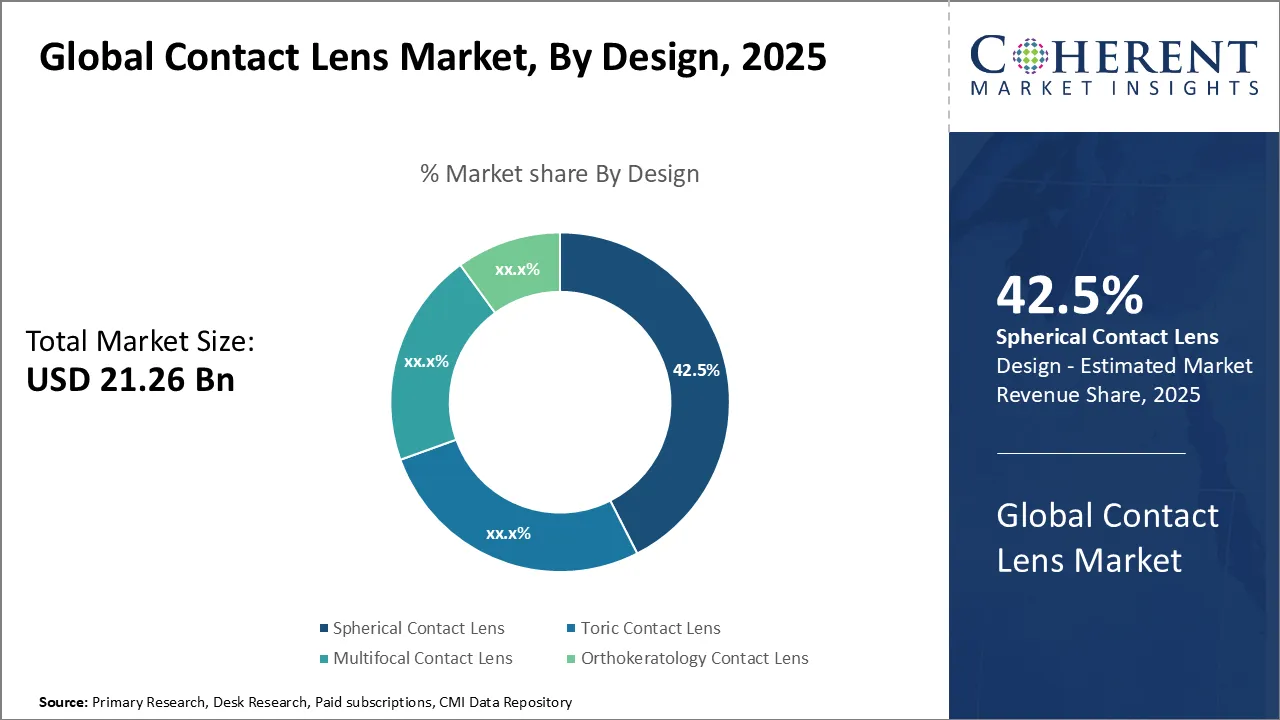
Contact Lens Market Insights, By Design: Spherical contact lenses lead the market for their simple design, easy handling, and broad suitability for basic vision correction.
In terms of design, spherical contact lens segment is expected to contribute the highest share of the market, accounting for 43.5% of the market share in 2026 due to their simple design, and it is suitable for refractive errors like myopia and hyperopia. They have a single optic zone that corrects vision evenly and is easy to use, even for people who have never used them before or who have trouble with their hands. Its simplicity eliminates the need for precise orientation, which lowers the risk of putting them in the wrong place and causing discomfort. Many people want a simple correction that is easy to use, like spherical lenses. They remain inexpensive ways to fix low to moderate vision problems, which is why so many people use them and why they still have the most market share in contact lenses.
For instance, in September 2025, Bausch + Lomb launched its ASANA gas permeable lenses in the U.S., offering advanced vision correction with enhanced comfort and durability. The new line includes spherical designs, catering to patients with standard refractive errors. ASANA lenses aim to deliver high oxygen permeability and long-term wearability.
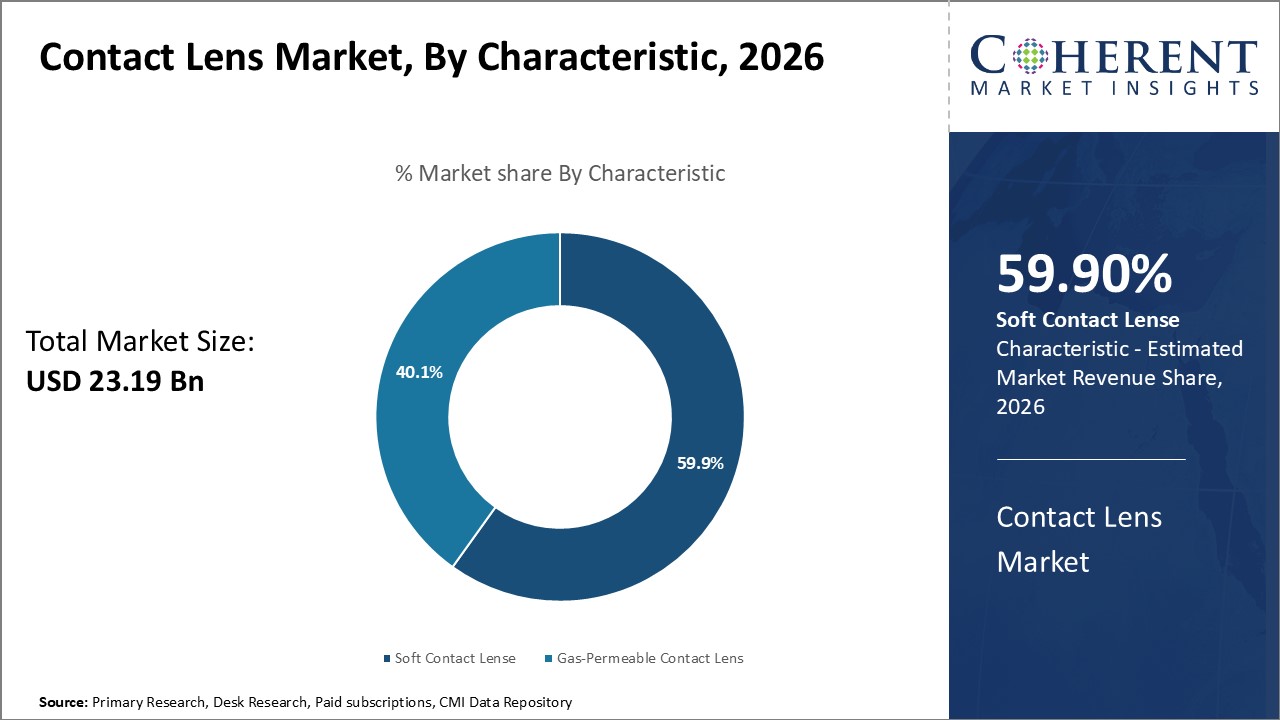
Contact Lens Market Insights, By Characteristic: Soft Contact Lenses Dominate Due To Their Unmatched Comfort, Breathability, And Ease of Use
In terms of characteristic, the soft contact lenses segment is expected to contribute the largest share of the market in 2026, due to their superior comfort, flexibility, and ease of use. Made from advanced materials like silicone hydrogel, they offer high oxygen permeability, reducing dryness and irritation. Their compatibility with daily and monthly disposable formats makes them hygienic and convenient, appealing to busy lifestyles. Soft lenses are ideal for correcting common vision issues like myopia and hyperopia, making them widely accessible. Additionally, their availability in cosmetic variants, including color-changing options, enhances aesthetic appeal. These combined benefits make soft contact lenses the preferred choice, driving their dominance in the market.
For instance, in October 2025, Johnson & Johnson Vision released new data showcasing the superior clarity and comfort of its soft contact lenses, ACUVUE OASYS MAX 1-Day, designed for astigmatism and multifocal correction. These daily disposable lenses offer enhanced visual performance and all-day comfort, reinforcing the brand’s commitment to innovation and meeting the evolving needs of modern contact lens wearers.
Contact Lens Market Insights, By Application: Corrective Contact Lenses Are Favored for Their Sleek, Hassle-Free Design That Supports Active, Stylish, And Health-Conscious Lifestyles
In terms of application, corrective contact lenses segment is expected to contribute the highest share of the market, accounting for 43.8% of the market share in 2026. A growing number of individuals seeking to correct their vision are opting for contact lenses due to the benefits they offer for their lifestyles. Unlike glasses, which can fog up, slip off, or hurt, contact lenses provide clear, unobstructed vision that is great for active lifestyles, including sports, swimming, and travel. Daily disposables and planned replacements make it easy to fix problems. Their low profile provides a clear vision without blocking the peripheral vision, making them suitable to wear in both social and professional settings. People who care about their appearance prefer contacts because they don't have frames, which makes it easier to apply makeup and enhances their facial appearance. As more people become aware of health and fitness, sleek contact lenses become more popular than glasses due to their ability to give people clear vision without sacrificing comfort.
For instance, in April 2025, Alcon launched PRECISION1 daily disposable contact lenses in India, targeting users with astigmatism. Featuring SMARTSURFACE technology, these soft corrective lenses offer enhanced moisture retention and breathability for lasting comfort and clear vision. The launch supports Alcon’s commitment to expanding access to advanced eye care solutions in India’s growing contact lens market.
Regional Insights
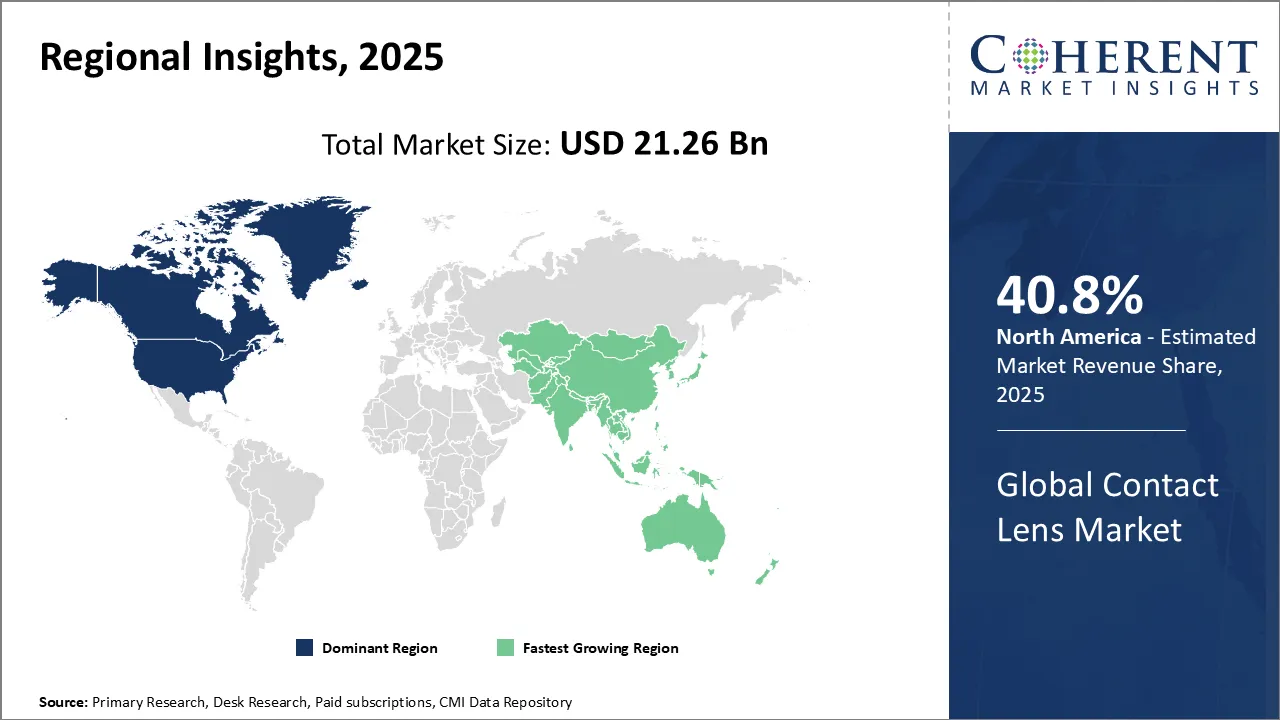
North America Contact Lens Market Analysis & Trends
North America has established itself as the most dominant region in the global contact lens market. The region is expected to hold a market share of 40.8% in 2026. The large presence of key industry players such as Johnson & Johnson, Bausch + Lomb, and CooperVision has enabled North America to enjoy easy accessibility to a wide range of contact lenses at affordable prices. These companies have been conducting extensive R&D activities to bring continuous innovation, like daily and extended-wear lenses, to cater to evolving consumer needs. Moreover, high consumer awareness regarding vision correction products and rising disposable income allow North Americans to regularly replace their existing lenses. The U.S., in particular, exhibits heavy demand for customized and specialty contact lenses.
For instance, in May 2026, Bausch + Lomb launched Zenlens Chroma HOA in the United States, a next-generation scleral lens designed to correct higher-order aberrations (HOAs). This advanced lens technology enhances visual clarity and contrast sensitivity for patients with irregular corneas. The launch marks a significant step in expanding specialty contact lens solutions for complex vision correction needs.
Asia Pacific Contact Lens Market Analysis & Trends
Asia Pacific has emerged as the fastest-growing region, primarily driven by countries like China, India, and South Korea. Rapid urbanization and economic development in these nations have improved standards of living. More people are willing to spend on quality eyecare and vision correction. Along with population growth, this has boosted the sales volume. The abundance of skilled labor at competitive prices has encouraged global contact lens manufacturers to set up production facilities in Asia Pacific. This ensures a steady supply to cater to the rising local requirements as well as exports to other regions. Several domestic players are also entering the fray, offering affordable alternatives and building domestic brands. The growing exports from Asia Pacific, especially to Latin America and Africa, are aiding the regional market expansion.
For instance, in August 2026, Japan-based contact lens manufacturer Menicon expanded its global footprint by establishing production in Malaysia. The move aims to strengthen supply chain resilience and meet growing demand across Asia. By establishing a manufacturing base in Malaysia, Menicon seeks to enhance efficiency and support its long-term growth strategy in the competitive contact lens market.
Contact Lens Market Outlook Country-Wise
The U.S. Contact Lens Market Trends
The U.S. contact lens market is driven by rising demand for convenient, comfortable vision correction options. Consumers increasingly favor daily disposable and multifocal lenses for their ease of use and adaptability to active lifestyles. Advances in soft lens technology and growing awareness of eye health also contribute to the shift from traditional eyewear to contact lenses.
For instance, in November 2024, Alcon introduced PRECISION7, a one-week replacement soft contact lens designed to offer fresh vision every week. Engineered for consistent comfort and clarity, the lens supports active lifestyles with advanced moisture retention and breathability. The launch reflects Alcon’s commitment to innovation in eye care and meeting evolving consumer preferences for convenient vision correction solutions.
Malaysia Contact Lens Market Trends
Malaysia’s contact lens market is growing due to rising eye health awareness, lifestyle shifts, and cosmetic appeal. Demand is driven by increased preference for daily disposable and colored lenses, especially among younger consumers seeking convenience and style. Urbanization, digital screen exposure, and expanding optical retail networks also contribute to the surge in corrective and cosmetic contact lens adoption.
For instance, in August 2026, Topcon Healthcare has launched the MYAH Refraction Suite in Southeast Asia, offering a comprehensive solution for myopia management and dry eye assessment. The suite integrates refraction, axial length measurement, and corneal topography, streamlining diagnostics for eye care professionals. This innovation supports early intervention and personalized treatment, addressing the region’s rising demand for advanced ophthalmic care.
Market Report Scope
Contact Lens Market Report Coverage
| Report Coverage | Details | ||
|---|---|---|---|
| Base Year: | 2025 | Market Size in 2026: | USD 23.19 Bn |
| Historical Data for: | 2020 To 2024 | Forecast Period: | 2026 To 2033 |
| Forecast Period 2026 to 2033 CAGR: | 9.1% | 2033 Value Projection: | USD 42.67 Bn |
| Geographies covered: |
| ||
| Segments covered: |
| ||
| Companies covered: | Bausch & Lomb Incorporated, Alcon Vision LLC, EssilorLuxottica, Carl Zeiss AG, Contamac Ltd, Menicon Co., Ltd., CooperVision, Johnson & Johnson Vision Care, Hoya Corporation, Ximenes S.R.L., Sky Medical For Medical Devices, Bausch Health Companies Inc., Optical Center, Alden Optical, Oculus Optikgeräte GmbH, Hanita Lenses, Mark'ennovy, Ocutec, Aveo Vision, and Dynamic Vision Systems | ||
| Growth Drivers: |
| ||
| Restraints & Challenges: |
| ||
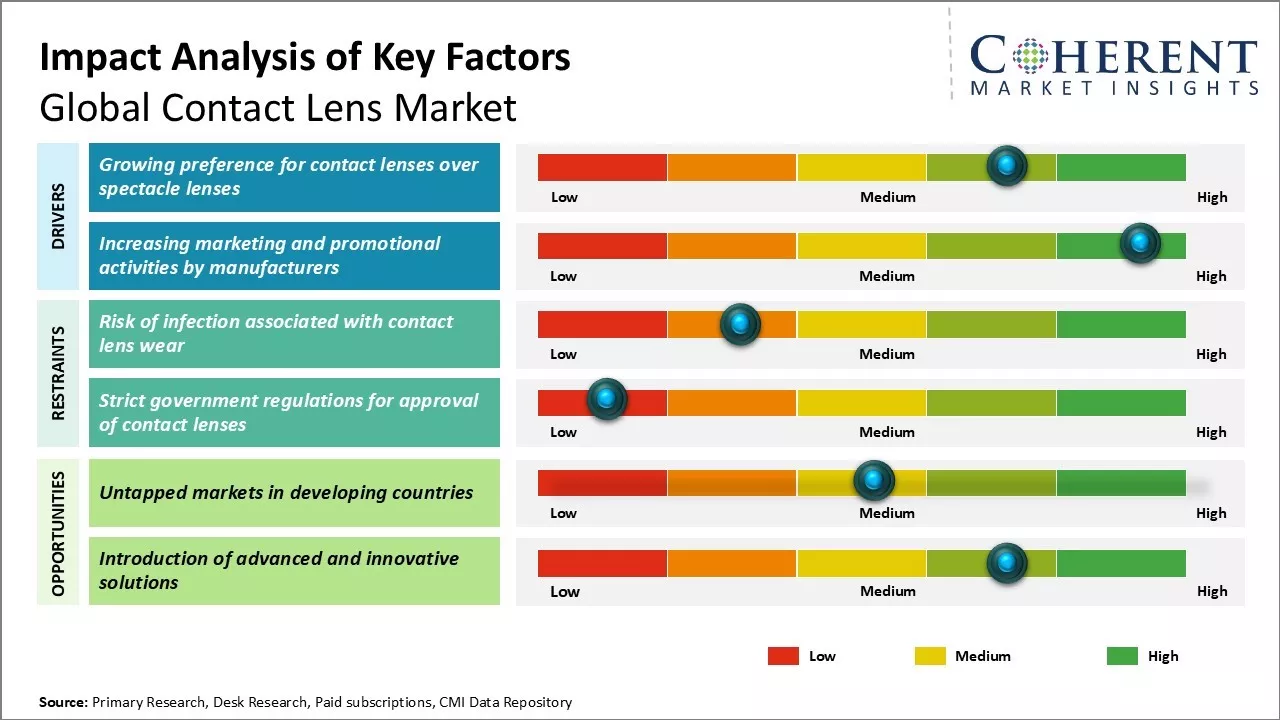
Contact Lens Market Driver
Growing preference for contact lenses over spectacle lenses
The Contact Lens Market share has grown significantly in the last few years as a growing number of individuals, especially young people who want freedom and convenience while doing things, prefer contact lens over glasses. Contact lenses offers more flexible life and get rid of the trouble of carrying glasses. New technologies, like breathable silicone hydrogel materials and disposable options, have made things more comfortable, safe, and easy to use. People who care about fashion also like lenses as they can change the color of their eyes. These functional and aesthetic benefits have made contact lenses more popular and socially acceptable, making them a stylish and useful option that has led to growth in the global Contact Lens Market.
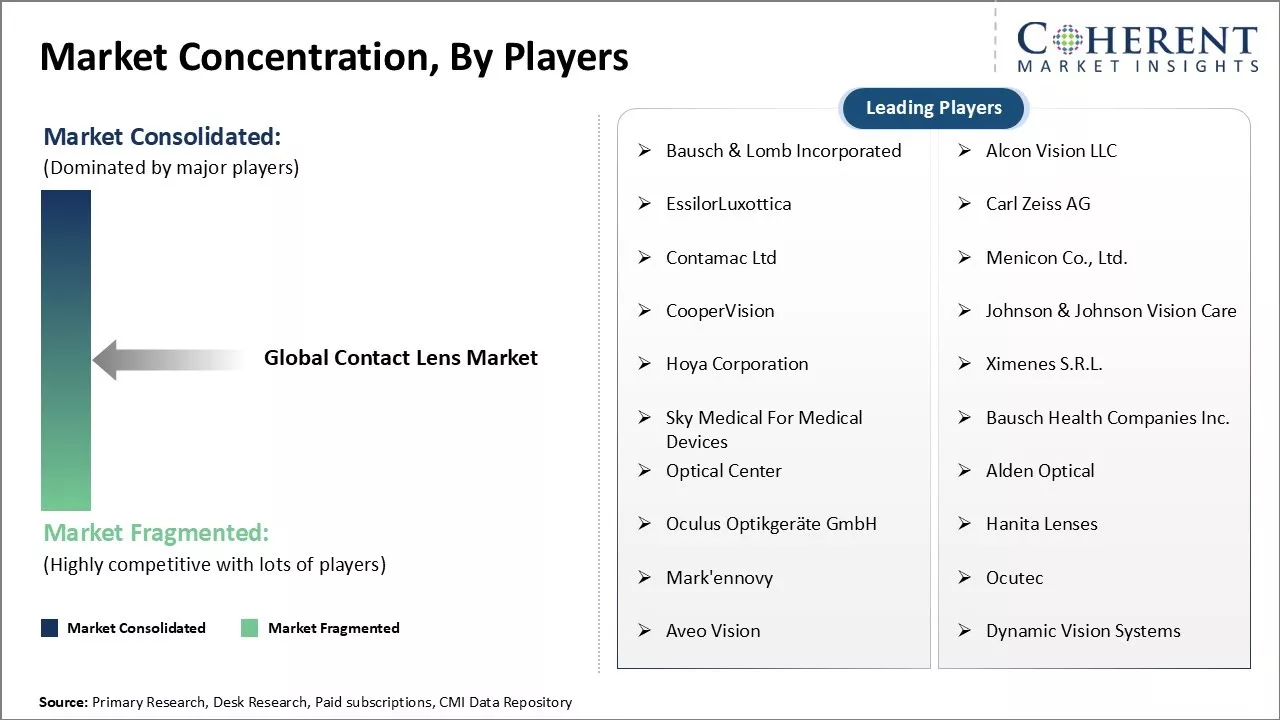
Market Concentration and Competitive Landscape
Increasing Marketing and Promotional Activities by Manufacturers
Contact lens makers are aggressive marketing which has greatly increased the content lens market demand around the world. They know how big the market could be, so they spend considerable money on multi-channel campaigns on TV, in print, online, and in eye care clinics. Discounts, cashbacks, and bundled offers are all types of promotions that encourage people to try and buy. Targeted ads, endorsements from influencers, and social media outreach all help make brands more visible, especially to young people. Educational drives, which are often backed by optometrists, clear up myths and encourage safe use. These efforts help people trust you and make them more likely to buy. Overall, strategic branding and marketing efforts have led to widespread use, higher sales, and ongoing demand for contact lenses around the world.
Contact Lens Market Opportunity
Untapped markets in developing countries
The contact lens market forecast shows the developing areas like Asia Pacific, Latin America, the Middle East, and Africa have a lot of room to grow. Many people in the area have refractory errors but are unaware about or have access to solutions. Growing incomes and a focus on health care are likely to lead to huge demand. To reach people in rural and suburban areas, market leaders need to use customized distribution and pricing strategies. Joint ventures for local manufacturing can help lower costs, and monthly disposables and multipacks are good options for people on a budget. Partnerships with eye hospitals and retail chains for marketing might assist in reaching more people. These areas offer a great chance for long-term, sustainable growth in the contact lens market.
Analyst Opinion (Expert Opinion)
The contact lens market is undergoing a notable transformation, moving beyond vision correction toward ocular health management and lifestyle enhancement. The growing preference for daily disposable lenses, which now account for over 45% of new fittings in developed markets (BCLA), reflects heightened awareness of hygiene, comfort, and convenience. Leading manufacturers such as Johnson & Johnson Vision and Alcon are capitalizing on this trend through premium, recurring revenue models.
Technological progress remains a core differentiator. Silicone hydrogel lenses, offering up to five times greater oxygen permeability than conventional materials and water gradient technology have set new comfort standards. Simultaneously, the emergence of smart lenses, with players like Mojo Vision and Samsung exploring augmented reality and biometric monitoring, signals the convergence of ophthalmic care and digital health.
The rising incidence of myopia in East Asia, affecting over 80% of teenagers in markets such as South Korea and Singapore, is spurring demand for myopia-control lenses like CooperVision’s MiSight. Meanwhile, e-commerce and subscription models are reshaping distribution, led by brands such as Hubble and Warby Parker.
Ultimately, the contact lens market value is driven by innovation, personalization, and clinical validation, positioning contact lenses as holistic vision and health solutions rather than mere optical devices.
Speak to the analyst
Want personalized insights?
Take the findings above to one of our principal consultants, or have the report rebuilt around the segments, geographies and competitors you actually track.
Contact Lens Industry News
- In June 2024, Bausch + Lomb launched INFUSE for Astigmatism, daily disposable contact lenses, with shipments to eye care professionals expected to begin in July 2024. These lenses are designed to combat common issues faced by toric lens wearers, such as dryness and blurred vision, especially in today's digital-focused lifestyles.
- In January 2024, Wöhlk unveiled the new wöhlk MULTI FEN RGP contact lens, the multifocal, dimensionally stable RGP contact lenses. It provides users with a fast and easy solution for achieving natural vision.
- In October 2023, Alcon a global leader in eye care, introduced TOTAL30 Multifocal, the first and only monthly Water Gradient multifocal contact lens.
Market Segmentation
- By Characteristic Insights (Revenue, USD Bn, 2026 - 2033)
- Gas-Permeable Contact Lens
- Soft Contact Lens
- By Design Insights (Revenue, USD Bn, 2026 - 2033)
- Spherical Contact Lens
- Toric Contact Lens
- Multifocal Contact Lens
- Orthokeratology Contact Lens
- By Application Insights (Revenue, USD Bn, 2026 - 2033)
- Corrective
- Therapeutic
- Cosmetic
- Prosthetic
- Lifestyle-oriented
- By Regional Insights (Revenue, USD Bn, 2026 - 2033)
- North America
- U.S.
- Canada
- Latin America
- Brazil
- Argentina
- Mexico
- Rest of Latin America
- Europe
- Germany
- U.K.
- Spain
- France
- Italy
- Russia
- Rest of Europe
- Asia Pacific
- China
- India
- Japan
- Australia
- South Korea
- ASEAN
- Rest of Asia Pacific
- Middle East
- GCC Countries
- Israel
- Rest of Middle East
- Africa
- South Africa
- North Africa
- Central Africa
- Key Players Insights (Revenue, USD Bn, 2021 - 2033)
- Bausch & Lomb Incorporated
- Alcon Vision LLC
- EssilorLuxottica
- Carl Zeiss AG
- Contamac Ltd
- Menicon Co., Ltd.
- CooperVision
- Johnson & Johnson Vision Care
- Hoya Corporation
- Ximenes S.R.L.
- Sky Medical For Medical Devices
- Bausch Health Companies Inc.
- Optical Center
- Alden Optical
- Oculus Optikgeräte GmbH
- Hanita Lenses
- Mark'ennovy
- Ocutec
- Aveo Vision
- Dynamic Vision Systems
Sources
Primary Research Interviews from the following stakeholders
- Interviews with ophthalmologists, optometrists, contact lens manufacturers, raw material suppliers, eye care clinics, retail optical chains, and e-commerce platform managers across major global regions.
Specific stakeholders
- Optometrists and vision care specialists from multi-chain optical clinics (e.g., Specsavers, Lenskart, Vision Express)
- Product development managers and R&D heads at lens material manufacturers (e.g., silicone hydrogel, hydrogel, PMMA materials)
- Supply chain and procurement managers at major contact lens producers (daily disposable, toric, multifocal)
- Distribution and category heads at optical retail chains and pharmacy networks (e.g., Boots Opticians, Walgreens, Apollo Pharmacy)
- E-commerce category managers for health and beauty verticals (e.g., Amazon, Flipkart, Alibaba Health)
- Eye care professionals associated with hospitals and vision correction centers
- Consumer marketing and product managers at contact lens care solution brands
- Regulatory and compliance professionals specializing in medical device certification (FDA, CE Mark, CDSCO)
Databases
- World Health Organization (WHO) – Vision and Eye Health Database
- World Trade Organization (WTO) Trade Statistics
- UN Comtrade Database
- U.S. Food and Drug Administration (FDA) – Medical Device Listings
- European Medicines Agency (EMA) – Medical Device Reports
- Eurostat
- China Customs Statistics
- Japan External Trade Organization (JETRO)
- Directorate General of Commercial Intelligence and Statistics (DGCIS), India
- National Eye Institute (NEI), U.S.
- Health Canada – Medical Device Active Licenses Database
Magazines
- Contact Lens Spectrum
- Optician Magazine
- Review of Contact Lenses
- Optometry Today
- Eyewear Intelligence
- Ophthalmology Times
- Vision Monday
- Contact Lens Update
- EyeWorld Magazine
Journals
- Contact Lens and Anterior Eye (Elsevier)
- Optometry and Vision Science (American Academy of Optometry)
- Journal of Ophthalmology
- Investigative Ophthalmology & Visual Science (IOVS)
- Clinical and Experimental Optometry
- British Journal of Ophthalmology
- Journal of Optometry
- Cornea (Lippincott Williams & Wilkins)
Newspapers
- The Wall Street Journal – Healthcare & Consumer Goods
- The Economic Times – Healthcare and Retail
- The Hindu Business Line – Life Sciences and Medical Devices
- Financial Times – Healthcare and Consumer Sectors
- Nikkei Asia – Healthcare and Manufacturing
- South China Morning Post – Medical Device & Consumer Health
- USA Today – Health and Wellness Section
Associations
- American Academy of Optometry (AAO)
- Contact Lens Manufacturers Association (CLMA)
- European Contact Lens Society of Ophthalmologists (ECLSO)
- Asia Pacific Council of Optometry (APCO)
- International Association of Contact Lens Educators (IACLE)
- All India Ophthalmological Society (AIOS)
- Opticians Association of America (OAA)
- British Contact Lens Association (BCLA)
- Indian Optometric Association (IOA)
Public Domain Sources
- World Health Organization (WHO) – Vision 2030 Initiative
- Ministry of Health and Family Welfare (Government of India)
- U.S. Centers for Disease Control and Prevention (CDC) – Vision Health Initiative
- Ministry of Economy, Trade and Industry (METI), Japan – Medical Device Data
- European Commission – Medical Device Regulations (MDR) Database
- U.S. National Institutes of Health (NIH) – Eye Health Research Reports
- Department of Pharmaceuticals (India) – Medical Device Sector Reports
- NITI Aayog – Healthcare Device Roadmap
- Reserve Bank of India (RBI) – Reports on Healthcare Imports and Consumer Goods
- EU Single Market Observatory – Health and Wellness Device Reports
Proprietary Elements
- CMI Data Analytics Tool
- Proprietary CMI Existing Repository of information for last 8 years
Definition: The global contact lens market involves the production and sale of corrective and cosmetic contact lenses worldwide. It includes soft contact lenses, rigid gas permeable lenses, planned replacement lenses, and specialty contact lenses. Key players manufacture lenses made of silicone hydrogel, polymethyl methacrylate, and other materials. The market caters to patients requiring vision correction as well as those using colored lenses for aesthetic purposes. Major companies compete based on pricing, innovative designs, comfort, and biocompatibility
Get access to 250+ pages report
Every segment, forecast, competitor profile and data table behind the analysis above — available for instant download.
- ESOMAR Member
- ISO 9001:2015 Certified
- D-U-N-S Registered
- GDPR & CCPA Compliant
Missing comfort of reading report in your local language? Find your preferred language:
Transform your Strategy with Exclusive Trending Reports
Frequently Asked Questions
The Contact Lens Market is estimated to be valued at USD 23.19 Bn in 2026, and is expected to reach USD 42.67 Bn by 2033.
The CAGR of the Contact Lens Market is projected to be 9.1% from 2026 to 2033.
Growing preference for contact lenses over spectacle lenses and increasing marketing and promotional activities by manufacturers are the major factor driving the growth of the global contact lens market.
Risk of infection associated with contact lens wear and strict government regulations for approval of contact lenses are the major factors hampering the growth of the global contact lens market.
In terms of characteristic, gas-permeable contact lens is estimated to dominate the market revenue share in 2026.
Bausch & Lomb Incorporated, Alcon Vision LLC, EssilorLuxottica, Carl Zeiss AG, Contamac Ltd, Menicon Co., Ltd., CooperVision, Johnson & Johnson Vision Care, Hoya Corporation, Ximenes S.R.L., Sky Medical for Medical Devices, Bausch Health Companies Inc., Optical Center, Alden Optical, Oculus Optikgeräte GmbH, Hanita Lenses, Mark'ennovy, Ocutec, Aveo Vision, and Dynamic Vision Systems are the major players.
North America is expected to lead the global contact lens market.