

Upper Limb Prosthetics Market Size and Forecast: 2026-2033
The Upper Limb Prosthetics Market is estimated to be valued at USD 843.4 Mn in 2026 and is expected to reach USD 926.6 Mn by 2033, exhibiting a compound annual growth rate (CAGR) of 7.2% from 2026 to 2033.
Key Takeaways
- By Device Type, Body Powdered hold the largest market share of 42.2% in 2026 owing to the affordability and lower cost of entry.
- By Component, Prosthetic Elbow expected to hold the largest market share of 36.8% in 2026 owing to its increasing above‑elbow and elbow‑level amputations.
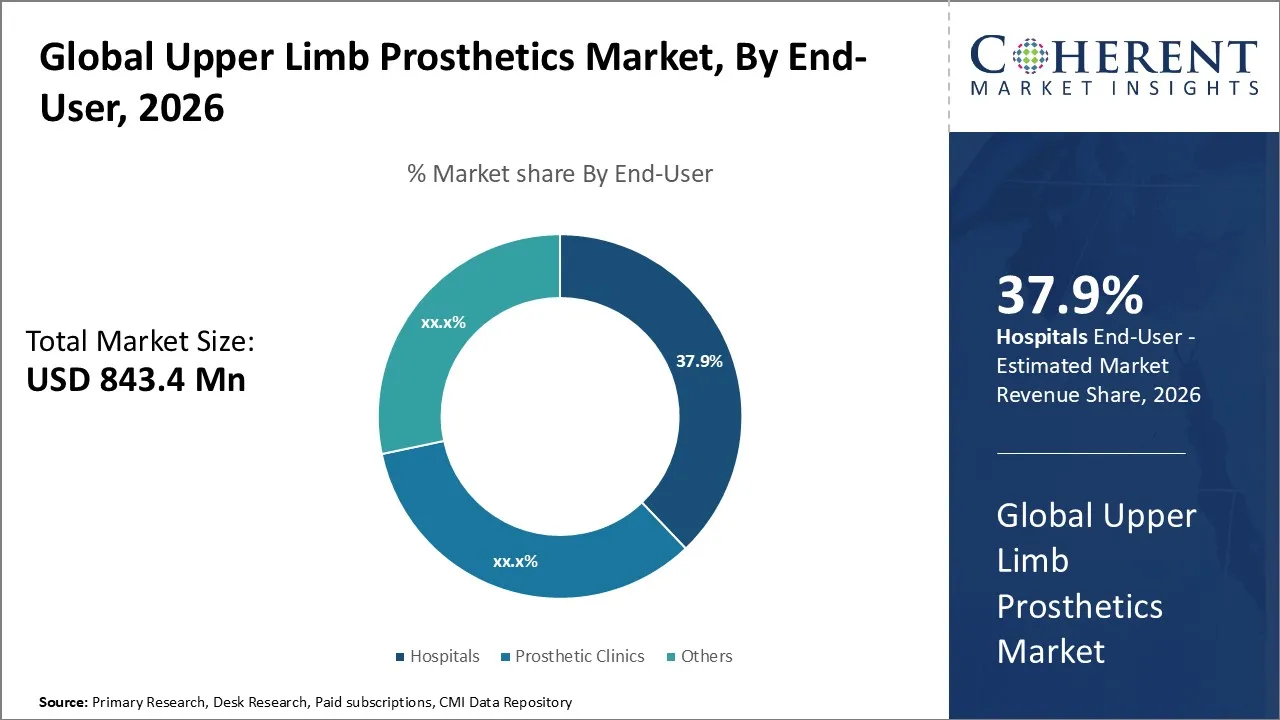
- By End-User, Hospitals acquired the prominent market share of 37.9% in 2026 owing to the hospitals as primary care & treatment hubs.
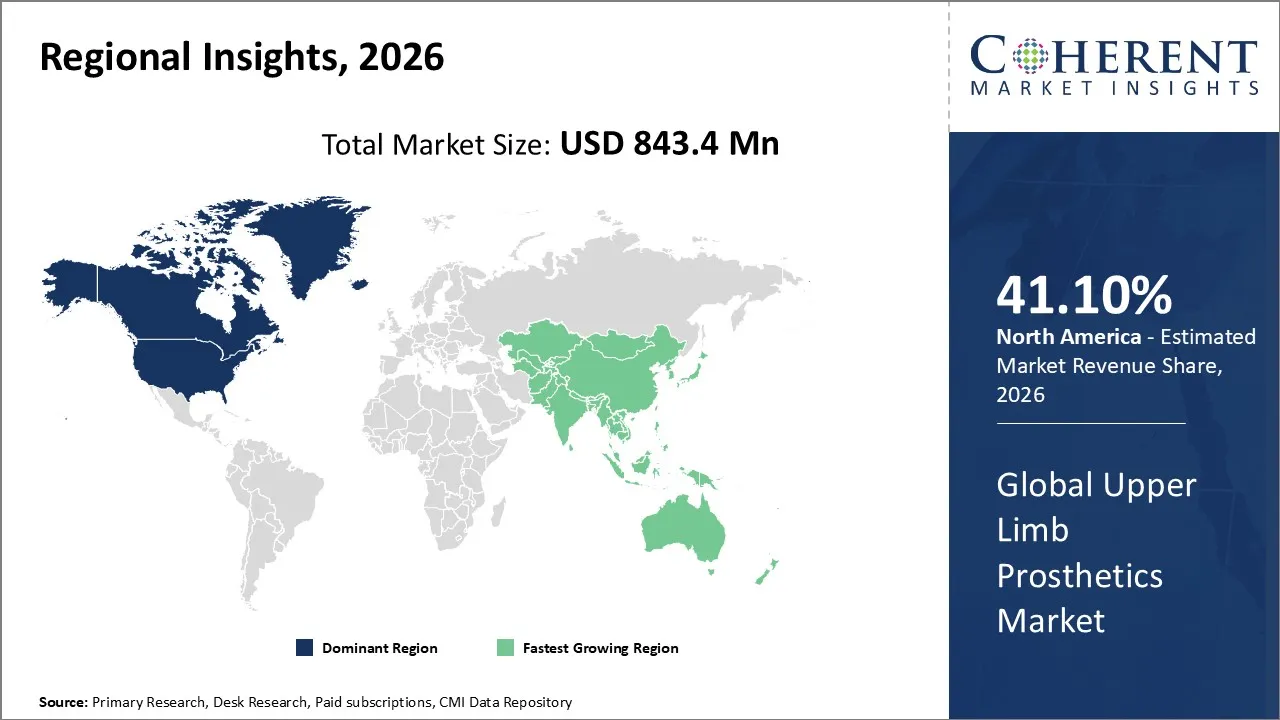
- By Region, North America dominates the overall market with an estimated share of 41.1% in 2026 owing to the well‑established healthcare infrastructure.
Market Overview
The upper limb prosthetics market develops artificial arms, hands, wrists, and related components to help patients regain function after injuries, diseases, or congenital limb differences. Rising cases of traumatic injuries, vascular and diabetic conditions, and growing awareness of rehabilitative solutions drive demand worldwide. Advances in lightweight materials, myoelectric control, sensor integration, and intuitive designs boost adoption and improve quality of life.
Current Events and their Impact on the Upper Limb Prosthetics Market
Current Events | Description and its impact |
Technological Advancements in Prosthetic Design |
|
Geopolitical and Regional Healthcare Policy Shifts |
|
Healthcare Infrastructure and Accessibility Developments |
|
Segmental Insights
- Current Industry Events of 2026
- Market Size Estimation
- Regional Breakdown
- Competitive Landscape
- Customer Intelligence
- Segmental Analysis
- Pricing Analysis
- Key Market Drivers, Challenges & Future Trends
- Customized Insights Section
Upper Limb Prosthetics Market Insights, By End-Users - Hospitals contribute the highest share of the market owing to its comprehensive care capabilities
Hospitals acquired the prominent market share of 37.9% in 2026. Hospitals expand the upper limb prosthetics market by treating amputees through surgery, post-operative care, and rehabilitation. Their multidisciplinary teams of surgeons, prosthetists, and therapists conduct thorough evaluations and fit prosthetic devices effectively. They implement advanced technologies, including myoelectric and sensor-integrated prosthetics, to enhance patient mobility and quality of life. Growing patient awareness, supportive insurance coverage, and rising cases of trauma and disease-related amputations increase demand, strengthening hospitals’ role in providing comprehensive prosthetic services.
Upper Limb Prosthetics Market Insights, By Device Type - Body Powdered contribute the highest share of the market owing to its sustained demand from large amputee populations
Body Powdered hold the largest market share of 42.2% in 2026. The body-powered segment of the upper limb prosthetics market expands as patients and providers recognize its affordability, durability, and simplicity. Mechanical prostheses use cables and harnesses to deliver reliable performance without batteries or electronics, making them suitable for everyday tasks and challenging environments. Growing patient awareness of cost-effective solutions and the desire for functional independence drive adoption. Healthcare providers appreciate their easy fitting and low maintenance, while rising cases of trauma, accidents, and amputations worldwide continue to fuel demand for body-powered prosthetic devices. For instance, in January 2026, the Metacarpal GEM, a multi-articulated, body-powered prosthetic hand, launched in the US.
Upper Limb Prosthetics Market Insights, By Component - Prosthetic Elbow contribute the highest share of the market owing to its technological advancements in elbow mechanisms
Prosthetic Elbow expected to hold the largest market share of 36.8% in 2026. The prosthetic elbow segment in the upper limb market grows as above-elbow amputees seek functional restoration. Patients demand prosthetic elbows that replicate natural bending and extension to improve daily activities and independence. Manufacturers introduce powered and multi-axis joints with intuitive control systems to enhance usability and appeal. Healthcare providers prefer devices that integrate seamlessly with advanced prosthetic arms, while increasing cases of trauma, congenital conditions, and vascular diseases expand the patient base, driving adoption and strengthening the segment’s role in comprehensive upper limb rehabilitation.
Regional Insights
North America Upper Limb Prosthetics Market Trends
North America dominates the overall market with an estimated share of 41.10% in 2026. In North America, the upper limb prosthetics market grows as clinicians and patients adopt advanced myoelectric, sensor-integrated, and AI-enabled limbs that provide more natural motion and control. Healthcare systems and extensive insurance coverage facilitate access to these sophisticated devices, while manufacturers enhance the market through customization tailored to patient needs. Increasing awareness of rehabilitation benefits and the expansion of clinical programs drive greater adoption, reinforcing the region’s leadership in modern upper limb prosthetic solutions. For instance, Mobius Bionics (Manchester, NH) unveiled the LUKE prosthetic arm, the first FDA-cleared integrated prosthetic arm, offering upper-limb amputees a transformative solution.
Asia Pacific Upper Limb Prosthetics Market Trends
In the Asia Pacific region, the upper limb prosthetics market expands as healthcare access improves across countries like China, India, and Japan, with better medical infrastructure and increased investment attracting more prosthetic users. Rising cases of traumatic injuries, diabetes, and vascular diseases drive demand for devices that aid daily activities. Patients and clinicians actively adopt advanced solutions, including myoelectric and customizable limbs, while growing awareness and enhanced rehabilitation services further promote the uptake of upper limb prosthetic devices. For instance, Social Hardware unveiled a user-repairable prosthetic hand, aiming to cut costs for Indian users, as imported parts currently make devices over six times a rural family's monthly income.
United States Upper Limb Prosthetics Market Trends
In the United States, the upper limb prosthetics market grows as patients and clinicians increasingly choose advanced devices such as myoelectric and neural-controlled prostheses that enhance motion and control. Healthcare providers expand access through robust infrastructure and widespread insurance coverage, while manufacturers develop customized solutions using innovative materials to meet varied needs. Rising amputations from trauma and chronic conditions, along with greater awareness of rehabilitation benefits, drive wider adoption of modern prosthetic arms and related components across the country.
India Upper Limb Prosthetics Market Trends
In India, the upper limb prosthetics market expands as patients increasingly seek functional solutions after trauma and amputations, supported by improving healthcare infrastructure and wider access to prosthetic services. Clinicians and users actively adopt advanced and customizable devices, while affordable solutions designed for local needs gain popularity. Manufacturers introduce technologies like 3D printing, and growing awareness of rehabilitation benefits drives adoption further, as healthcare providers and organizations continue to enhance access and support for prosthetic care across the country. For instance, in November 2025, Motorica launched the Omni Hand, the world’s first bionic prosthesis using optical myography (OMG) sensors, enabling intuitive, mind-driven control.
End-user Feedback and Unmet Needs in the Upper Limb Prosthetics Market
- Functionality and Dexterity: Users often report that prosthetic devices, particularly body-powered or basic myoelectric arms, do not fully replicate natural hand movements, limiting precision in daily tasks. Many seek improved grip strength, multi-finger coordination, and seamless elbow-wrist integration to perform complex activities with greater ease and independence.
- Comfort and Fit: Many patients highlight discomfort, skin irritation, and pressure points as significant challenges. Users desire lightweight, ergonomic sockets and adjustable fittings that reduce fatigue and allow prolonged daily use without pain, emphasizing the need for prosthetics tailored to individual limb shapes and activity levels.
- Affordability and Accessibility: Cost remains a major barrier for end-users, especially for advanced myoelectric and sensor-driven prosthetics. Patients and clinicians seek affordable, durable solutions without compromising functionality, along with wider insurance coverage and regional availability to ensure equitable access.
Upper Limb Prosthetics Market Trend
Advancement in Myoelectric and Sensor-Integrated Prosthetics
The market is witnessing rapid adoption of myoelectric and sensor-based prosthetic devices that offer more natural movement and responsive control. These advanced systems allow users to operate multiple joints and perform precise tasks, improving independence and quality of life. Manufacturers continue to innovate with lightweight materials, AI-assisted motion, and customizable options, addressing diverse patient needs. Clinics increasingly recommend these devices to enhance functional outcomes, making them a prominent trend shaping patient expectations and technology development.
Expansion of Rehabilitation and Clinical Programs
Rehabilitation services are increasingly integrated with prosthetic provision, reflecting a trend toward holistic patient care. Hospitals and clinics offer structured training, physical therapy, and follow-up support to improve adaptation and long-term device usability. This trend encourages patient confidence in using advanced prosthetics, boosts successful outcomes, and drives adoption of newer technologies. Providers also educate patients on proper maintenance, functional exercises, and occupational therapy, enhancing the effectiveness of upper limb prosthetic interventions.
Upper Limb Prosthetics Market Opportunity
Expansion of Advanced Prosthetic Technologies
The market presents significant opportunity for innovating advanced prosthetic solutions, including myoelectric, multi-articulating, and AI-enabled devices. Manufacturers can develop lighter, more responsive, and user-friendly systems that improve daily functionality. Integration of sensors, robotics, and neural control can further enhance performance. Companies investing in research, product customization, and adaptive technologies can capture growing demand from patients seeking high-functioning prosthetics that restore natural motion and independence, driving both clinical adoption and brand differentiation in the market.
Market Report Scope
Upper Limb Prosthetics Market Report Coverage
| Report Coverage | Details | ||
|---|---|---|---|
| Base Year: | 2025 | Market Size in 2026: | USD 843.4 Mn |
| Historical Data for: | 2020 To 2024 | Forecast Period: | 2026 To 2033 |
| Forecast Period 2026 to 2033 CAGR: | 7.2% | 2033 Value Projection: | USD 926.6 Mn |
| Geographies covered: |
| ||
| Segments covered: |
| ||
| Companies covered: | Open Bionics, Coapt LLC, WillowWood Global LLC, Steeper Inc., Ottobock SE & Co. KgaA, Ossur, Ortho Europe, Fillauer LLC, Protunix, and Blatchford Limited (Endolite India Ltd) | ||
| Growth Drivers: |
| ||
| Restraints & Challenges: |
| ||
Upper Limb Prosthetics Market News
- In January 2026, UK startup Metacarpal unveiled the GEM, a body-powered upper-limb prosthetic that offers fine motor control without electronics, using Reactive Grasp Technology for pinch, power, and lateral grips.
Analyst Opinion (Expert Opinion)
- The upper limb prosthetics market is transitioning from a traditionally function‑limited, cosmetic replacement space to a highly technical, performance‑oriented medical segment. Users no longer accept prostheses that merely “fill a gap” demand now centers on devices that genuinely restore function, with clinical outcomes and user satisfaction as the prime benchmarks. Advanced myoelectric and sensor‑integrated systems are gaining real traction because they deliver clearly measurable performance gains over passive devices, and the market is responding with sustained investment in innovation and clinical validation.
- Despite these advances, a persistent gap remains between technological potential and real‑world utility. Adoption hurdles still stem from usability and control limitations; even the most sophisticated myoelectric systems often leave users struggling with intuitive control, task performance under load, or long‑term comfort issues reflected in historically high abandonment rates in independent clinical observations. The challenge is not merely product sophistication, but achieving functional consistency in everyday environments rather than controlled laboratory settings.
- North America’s dominance in the upper limb prosthetics landscape is supported by structural advantages a dense ecosystem of care providers, established reimbursement pathways, and deep integration of R&D into clinical practice. Companies such as Ottobock and Össur have built competitive moats by aligning product innovation with evidence‑based outcomes, while startups like Open Bionics are demonstrating that clinically approved, 3D printed bionic hands can compete on both performance and accessibility.
Speak to the analyst
Want personalized insights?
Take the findings above to one of our principal consultants, or have the report rebuilt around the segments, geographies and competitors you actually track.
Market Segmentation
- By Device Type
- Body Powered
- Passive
- Hybrid
- Myoelectric
- By Component
- Prosthetic Elbow
- Prosthetic Wrist
- Prosthetic Arm
- Prosthetic Shoulder
- Others
- By End-User
- Hospitals
- Prosthetic Clinics
- Others
- By Regional Insights
- North America
- U.S.
- Canada
- Latin America
- Brazil
- Argentina
- Mexico
- Rest of Latin America
- Europe
- Germany
- U.K.
- Spain
- France
- Italy
- Russia
- Rest of Europe
- Asia Pacific
- China
- India
- Japan
- Australia
- South Korea
- ASEAN
- Rest of Asia Pacific
- Middle East
- GCC Countries
- Israel
- Rest of Middle East
- Africa
- South Africa
- North Africa
- Central Africa
- North America
- Key Players Insights
- Open Bionics
- Coapt LLC
- WillowWood Global LLC
- Steeper Inc.
- Ottobock SE & Co. KgaA
- Ossur
- Ortho Europe
- Fillauer LLC
- Protunix
- Blatchford Limited (Endolite India Ltd)
Sources
Primary Research interviews
- Interviews with orthopedic surgeons, rehabilitation specialists, and prosthetists
- Discussions with R&D heads of prosthetic manufacturing companies
- Feedback from end-users and patient advocacy groups
- Insights from physiotherapists and occupational therapists
Databases
- PubMed
- ClinicalTrials.gov
- Embase
- Scopus
Magazines
- Medical Device and Diagnostic Industry (MD+DI)
- Prosthetics and Orthotics International Magazine
- Rehab Management
Journals
- Journal of Prosthetics and Orthotics
- Prosthetics and Orthotics International
- Journal of Rehabilitation Research and Development
- Disability and Rehabilitation: Assistive Technology
Newspapers
- The New York Times - Health Section
- The Guardian - Science and Health
- The Wall Street Journal - Healthcare Section
Associations
- American Orthotic & Prosthetic Association (AOPA)
- International Society for Prosthetics and Orthotics (ISPO)
- European Prosthetics and Orthotics Association (EPOA)
Public Domain sources
- World Health Organization (WHO) reports on assistive devices and rehabilitation
- U.S. Food and Drug Administration (FDA) Medical Device Databases
- Government health ministry publications and annual prosthetics usage reports
- Centers for Disease Control and Prevention (CDC)
Proprietary Elements
- CMI Data Analytics Tool
- Proprietary CMI Existing Repository of information for last 8 years
Get access to 250+ pages report
Every segment, forecast, competitor profile and data table behind the analysis above — available for instant download.
- ESOMAR Member
- ISO 9001:2015 Certified
- D-U-N-S Registered
- GDPR & CCPA Compliant
Missing comfort of reading report in your local language? Find your preferred language:
Transform your Strategy with Exclusive Trending Reports
Frequently Asked Questions
The Upper Limb Prosthetics Market is estimated to be valued at USD 843.4 Mn in 2026 and is expected to reach USD 926.6 Mn by 2033.
Increase in number of road accidents/injuries and rise in number of amputations and growing geriatric population across the globe is fueling the growth of the market.
Body Powered segment is the leading device type segment in the market.
High cost of upper limb prosthetics and stringent regulatory scenario are some major factors restraining growth of the market.
Major players operating in the market are Open Bionics, Coapt LLC, WillowWood Global LLC, Steeper Inc., Ottobock SE & Co. KgaA, Ossur, Ortho Europe, Fillauer LLC, Protunix, and Blatchford Limited (Endolite India Ltd), among others.