

Global Prosthetic Arm Market Size and Forecast – 2026 to 2033
The global prosthetic arm market is estimated to be valued at USD 329.2 Mn in 2026 and is expected to reach USD 913.6 Mn by 2033, exhibiting a compound annual growth rate (CAGR) of 15.7% from 2026 to 2033. This significant growth is driven by advancements in robotic prosthetic technology and increasing demand for improved mobility solutions among amputees worldwide, highlighting the market’s promising expansion over the forecast period.
Key Takeaways of the global prosthetic arm market
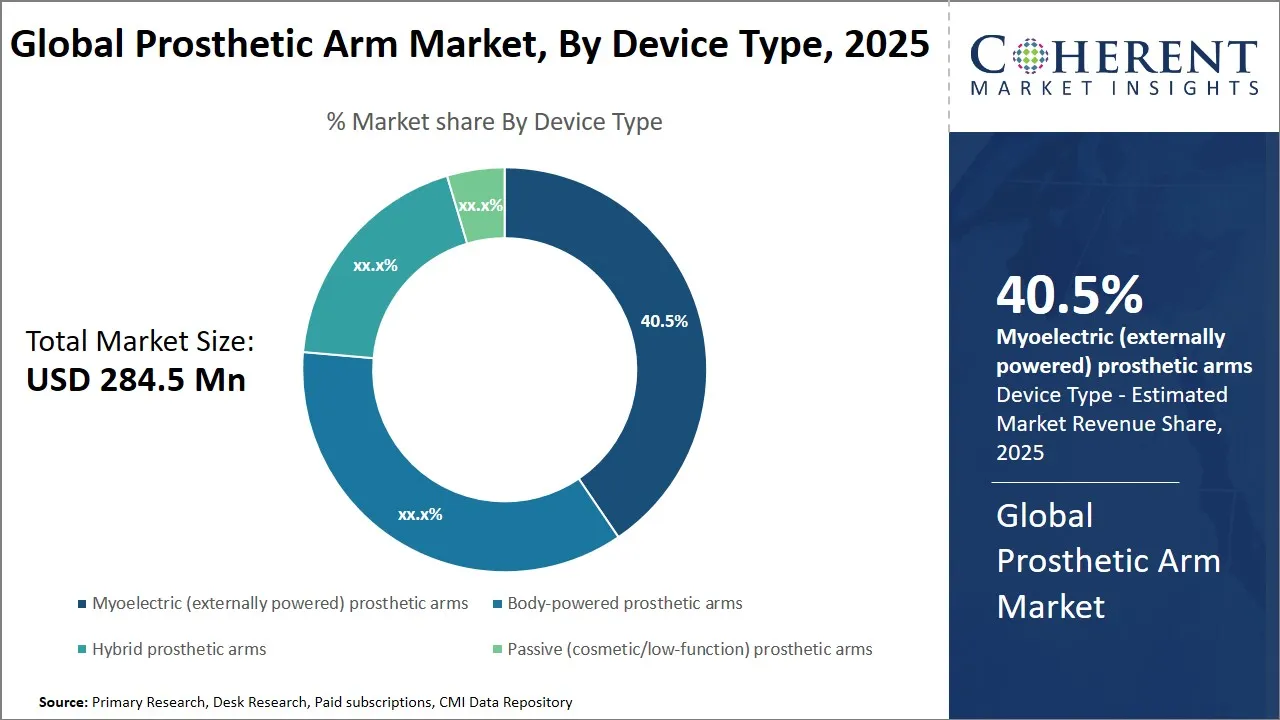
- In 2026, myoelectric (externally powered) prosthetic arms are expected to lead the global prosthetic arm market, capturing an estimated 41.5 % share.
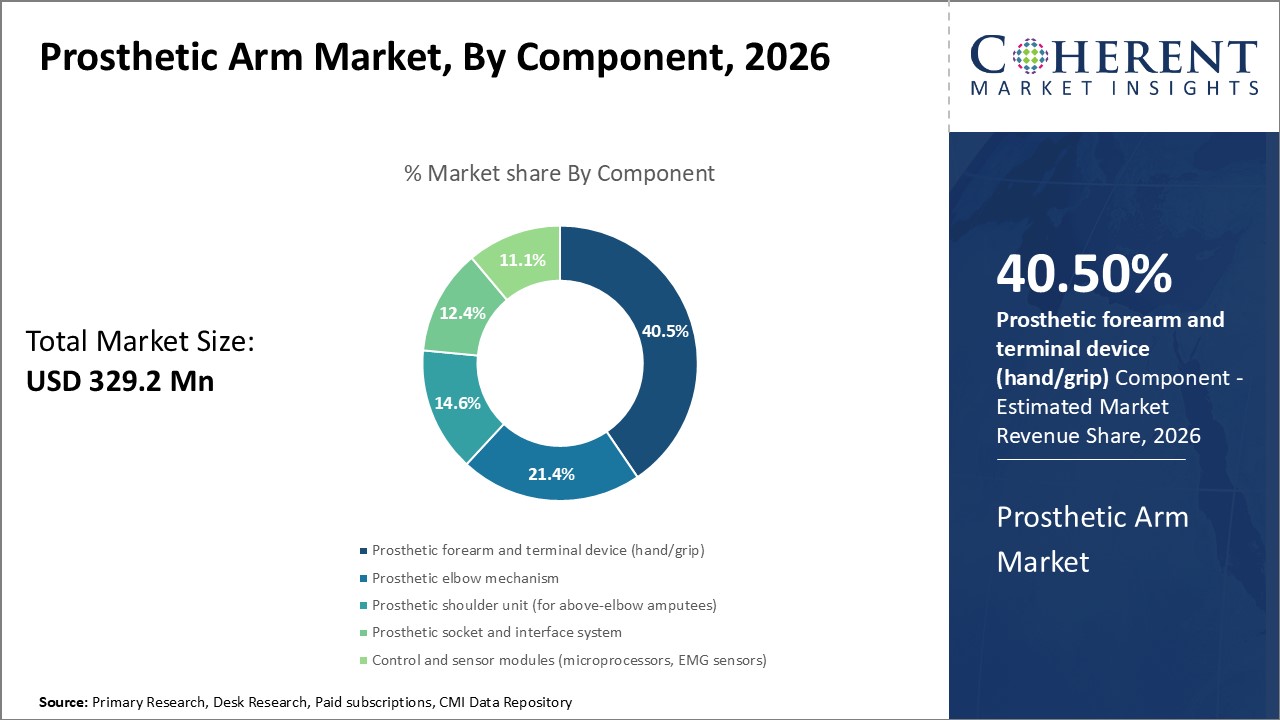
- Within the market's technological and control components, the prosthetic forearm and terminal device (hand/grip) are projected to hold the largest share, accounting for 40.5 %.
- Additionally, below-elbow (trans-radial) prosthetic arms will dominate both in volume and value, with a forecasted share of 43.3 % in 2026.
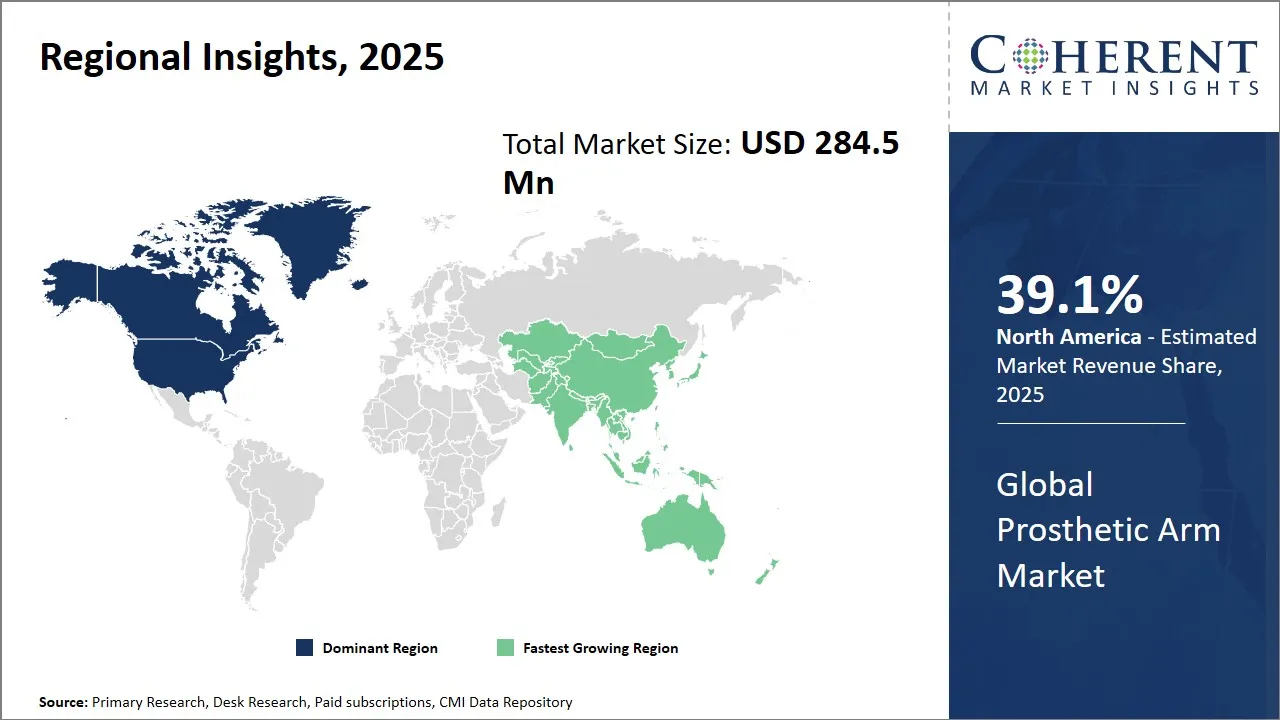
- North America is expected to lead the market, holding a share of 39.1 % in 2026. Asia Pacific is anticipated to be the fastest-growing region, with an estimated market share of 23.5% in 2026.
Market Overview
A key trend in the prosthetic arm market is the integration of smart technologies like microprocessors, AI, and myoelectric sensors, which improve functionality and user experience. Growing awareness of prosthetic benefits and increased healthcare investments in developing regions are driving market expansion. Additionally, the use of lightweight materials and customization options is enhancing comfort and enabling more natural movement. These factors are contributing to higher adoption rates across various patient demographics.
Current Events and Its Impact
Current Events | Description and its Impact |
Surge in AI-Enabled Prosthetic Arms |
|
Expansion of 3D Printing and Customization |
|
Segmental Insights
- Current Industry Events of 2026
- Market Size Estimation
- Regional Breakdown
- Competitive Landscape
- Customer Intelligence
- Segmental Analysis
- Pricing Analysis
- Key Market Drivers, Challenges & Future Trends
- Customized Insights Section
Prosthetic Arm Market Insights, By Device Type - Advanced Functionality and User Preference Drive the Dominance of Myoelectric Prosthetic Arms
The global prosthetic arm market will be dominated by myoelectric (externally powered) prosthetic arms with an estimated 41.5% share in 2026, classified as a device type. The dominance is mainly due to the superior technological and functional capabilities that Myoelectric prosthetic arms have over other types.
Myoelectric prosthetics utilize electrical signals generated by the user’s residual muscles, detected via surface electrodes, to control arm and hand movements. This intuitive control mechanism significantly improves dexterity, enabling users to perform a wider range of complex tasks with greater precision.
Prosthetic Arm Market Insights, By Component - Prosthetic Forearm and Terminal Device (Hand/Grip) Lead Due to Versatility and Essential Functionality
With the agreement of the global prosthetic arm market being technology and control components, the prosthetic forearm and terminal device (hand/grip) will have the largest share of the market with an estimated share of 40.5%. This component holds the most significant market share due to the daily necessity and the user-environment interaction that these components provide.
In October 2026, Motorica, a leading company in upper limb prosthetics, introduced a digital prosthetic arm project in India. This project employs a combination of 3D imaging, CAD, and high-precision 3D printing to improve the speed and efficiency of production for customizable prosthetic limbs. Digitally capturing the limb geometry basically eliminates the processes of traditional casting and shipping, resulting in significantly lower lead times while providing the same fit and quality.
Prosthetic Arm Market Insights, By Level of Amputation - Prevalence and Functional Demand Propel Growth of Below-Elbow (Trans-Radial) Prosthetic Arms
Below-elbow (trans-radial) prosthetic arms will dominate in volume and value, with a 43.3% share in 2026. This reflects both the high rate of this amputation level and user benefits. The demand for prosthetic solutions specifically designed for this group is on the rise because below-elbow amputations are mainly performed because of trauma and congenital anomalies.
A major factor behind demand is the preservation of the elbow joint in below-elbow amputees, which gives the amputee better control over the prosthetic due to wider movement and greater force application. The elbow's function also makes the prosthetics easier to operate and more accurate, allowing the user to perform delicate tasks without the complication of having to deal with the prosthetic elbow. This condition is practically increasing the user’s ability and comfort.
Technological Innovation in AI-Driven Prosthetics
- The prosthetic arm market is being revitalized because of the technological innovation in AI-powered prosthetics which is improving the adaptability, precision, and functionality of the arms. One of the major advantages of the technology is machine learning, which allows the prosthetics to learn and customize themselves according to the specific user’s movement patterns, thus making them perform more smoothly and naturally in different settings.
- The neural interface integration takes control to a significantly higher level by linking the prosthetic limb with the user’s nervous system so that movements can be intuitively done through either the muscle signals or the brain activity of the user. This also means that a user can perform moeilijke only with the use of a brain signal or a slight muscle contraction and restore that movement precision, thereby gaining independence and having their quality of life improved significantly, which is the case for most people with mobility impairment.
- For instance, in December 2024, researchers from Wrocław University of Science and Technology are finalizing the Bionic, Ergonomic, Economic, Polish Prosthesis (BEEPP), an AI-powered bionic hand for forearm amputees. The device uses muscle signals and AI for precise control, with sensors in the fingertips providing feedback on grip strength and contact
- In January 2025, BIONIKS, a Pakistan-based prosthetics startup established in 2016, launched a mobile AI-powered limb factory in Gaza to assist amputees affected by the ongoing conflict.
Regional Insights
North America Prosthetic Arm Market Analysis and Trends
North America is the major region in the global prosthetic arm market, with an estimated share of 39.1% in 2026. This is primarily attributed to its high-quality healthcare system and extensive R&D activities, supported by significant investments from both government and private sectors.
Global leading prosthetics players such as Össur, Ottobock, and Hanger Inc. are the ones who are the main reason that these markets are what they are today, not only providing but also making the most technical and personalized prosthetic arms.
Government policies such as reimbursement schemes that are not only beneficial but also cover veterans, mainly in the U.S., are the reasons why the usage of prosthetic devices is so widespread.
Asia Pacific Prosthetic Arm Market Analysis and Trends
The Asia Pacific region is leading the prosthetic arm market, with an estimated share of 23.5% in 2026. This growth is driven by increased healthcare spending, improved medical infrastructure, and a better understanding of prosthetic products. Urbanization and the growth of the middle class have fueled demand for high-end prosthetics in countries like China, India, and Japan.
Government efforts to improve disability care and access are conditions along with partnerships between local and international prosthetic companies that are speeding up the market's progress. Companies such as Blatchford and Steeper Group are the ones that are on the rise alongside the local players like Beijing Allmed Medical Device that are providing solutions tailored to the needs of the region's diverse population at affordable prices.
Prosthetic Arm Market Outlook for Key Countries
U.S. Prosthetic Arm Market Trends
The U.S. prosthetic arm market is a competitive battle ground where top companies such as Hanger Inc., Össur Americas, and Ottobock North America with their strong presence define the ballpark. The adoption of the technology is made easy with the help of strong government support through healthcare programs for veterans and insurance policies that cover prosthetics. The country also invests heavily in bionic research and prosthetic arms with myoelectric control, hence, product innovation is always in place.
In October 2024, SpaceX achieved a significant milestone when it successfully caught the booster stage of its Starship rocket using robotic arms, known as "chopsticks," as it fell back to the launchpad in southern Texas, U.S. This feat marked the culmination of a successful fifth test flight for the uncrewed Starship.
Germany Prosthetic Arm Market Trends
Germany is at the forefront of the prosthetic arm market in Europe, and Ottobock, one of the major companies in the sector, is located there. The country has an excellent medical device manufacturing industry, and quality standards are very high, plus there are health insurance reimbursement systems that are very supportive. Innovations and reforms in rehabilitation healthcare with government support make it easy for patients to get access to new developments. Germany's location in the middle of Europe is also an advantage for the country to do export activities, which further strengthens its market leadership.
In June 2026, NVIDIA, a global leader in AI and graphics processing, along with its partners, showcased cutting-edge robotics, automation, and AI technologies at Automatica in Munich, Germany. The event highlighted Europe’s increasing adoption of industrial AI and robotics to tackle labor shortages and drive sustainable growth. NVIDIA announced the launch of Europe’s first industrial AI cloud, which will provide manufacturers with secure AI infrastructure.
China Prosthetic Arm Market Trends
The market for prosthetic arms in China is getting bigger at a fast rate with the government’s continuous support as well as the health infrastructure being set up all around the country. Accessibility to prosthetic devices is also being increased through the government’s initiatives like national disability programs.
Allmed Medical Products Co Ltd. and international companies which are partnering with local manufacturers are among the ones that produce prosthetic arms that are cheap, efficient, and user-friendly for the considerable patients’ population. The factors that drive this market are rapid urbanization, increase in health care spending both from public and private sectors, and wider insurance coverages.
In September 2026, Roborock which is one of the leading robotics companies in China presented the Qrevo Curv 2 Pro, a mid-range vacuum robot that has improved suction power of 25,000Pa and a new AdaptiLift Chassis that guarantees no wet mopping on the carpet. Also included is a LiDAR scanner that allows for 360-degree navigation and cleaning of tight spaces.
India Prosthetic Arm Market Trends
The prosthetic arm market in India is rapidly emerging due to an increase in people's understanding of the need to manage disabilities and government initiatives that promote access to health care services in both rural and urban areas. Local manufacturers such as Secure Prosthetics and various startups are concentrating on providing affordable and culturally proper solutions designed for the different demographics. The involvement of international partnerships and NGOs is also helping to reach a wider market.
In August 2024, Robo Bionics, an innovative startup recognized by the Startup India Initiative, introduced its revolutionary GrippyTM hand, a bionic prosthetic designed to improve the lives of individuals with below-elbow amputations. Made in India, GrippyTM is a lightweight, battery-powered prosthetic offering a unique sense of touch and multi-grip control, providing an affordable and functional alternative to traditional prosthetics.
Market Players, Key Developments, and Competitive Intelligence
Key Developments
- In April 2025, Open Bionics, a British robotics company known for innovative prosthetic arms, launched its new Hero RGD and Hero PRO bionic hands in April 2025. After investing USD 2.5 million and four years in R&D, incorporating feedback from 1,000 users, these bionic arms are twice as fast as competitors and the only fully wireless and waterproof models available.
- In April 2025, Dyna Robotics, an AI-driven robotics startup, launched its new AI model, Dynamism v1 (DYNA-1. The model enables robotic arms to perform high-precision tasks for longer periods without human intervention. DYNA-1 achieved a 99% success rate in folding over 700 napkins autonomously in 24 hours, marking a major step towards commercial viability. Unlike other robotic models that require human assistance after a few hours, DYNA-1 is designed for continuous, autonomous operation.
- In October 2025, Geekplus Technology Co., Ltd. launched its Robot Arm Picking Station, the world’s first end-to-end unmanned picking solution. The system uses Geek+ Brain for intelligent SKU recognition and precise handling of diverse goods without retraining. It offers rapid deployment, ultra-efficient performance, and strong data security.
- In April 2025, Hugging Face, in collaboration with RobotStudio, has launched the SO-101, an upgraded, low-cost, 3D-printable autonomous robot arm. Priced as low as USD 130, the SO-101 improves on its predecessor, the SO-100, with easier assembly, updated motors, and better wiring. Designed to integrate with the open-source LeRobot framework, the arm can be trained for autonomous operation in minutes from a consumer desktop or laptop.
Top Strategies Followed by Global Prosthetic Arm Market Players
- The main players in the industry are investing a lot in R&D to make new prosthetic arms that have a myoelectric control, use lightweight materials, and provide improved sensory feedback. The companies are building their strategic partnerships with OEMs, healthcare providers, and tech firms to strengthen their offerings and gain a foothold in global markets, especially in emerging market
- Medtronic is a major player in the market, putting in substantial amounts of money in R&D for myoelectric prosthetics and at the same time making strategic collaborations with tech companies and healthcare providers. With their worldwide outreach, especially in India and China, the emerging markets, their position in the market becomes stronger.
- Mid-tier companies concentrate on affordable solutions and price-sensitive consumers in underdeveloped areas. They make their manufacturing process more efficient, cooperate with suppliers and contract manufacturers, and little by little, integrating new features, compete in the market by offering products that are both affordable and competitive in price.
- Ottobock is working on cost-effective solutions, and it is using existing manufacturing and suppliers in the region. The company offers advanced features at low prices, and it is targeting consumers in developing countries who are very sensitive to price.
- Small-scale players are creating the next generation of niche prosthetics, the adoption of technologies like 3D printing and AI helps them to produce highly customized solutions. They make quick decisions and are flexible; they build local partnerships with startups, healthcare organizations, and universities to be more innovative and expand their markets.
- Open Bionics makes use of 3D printing and AI to provide affordable and highly personalized prosthetic arms. They associate with universities and local healthcare providers with the aim of being innovative, and they are targeting the niche market with their lightweight and personalized solutions.
Market Report Scope
Prosthetic Arm Market Report Coverage
| Report Coverage | Details | ||
|---|---|---|---|
| Base Year: | 2025 | Market Size in 2026: | USD 329.2 Mn |
| Historical Data for: | 2020 To 2024 | Forecast Period: | 2026 To 2033 |
| Forecast Period 2026 to 2033 CAGR: | 15.7% | 2033 Value Projection: | USD 913.6 Mn |
| Geographies covered: |
| ||
| Segments covered: |
| ||
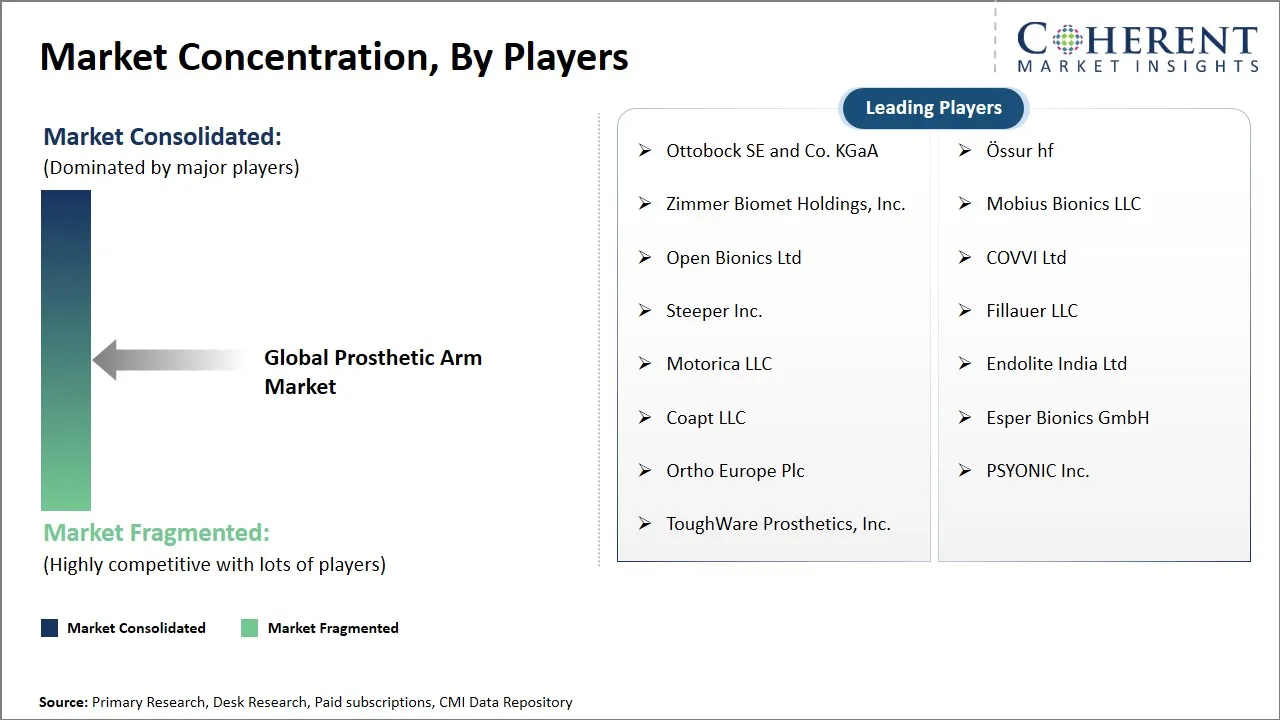
| Companies covered: | Ottobock SE and Co. KGaA, Össur hf, Zimmer Biomet Holdings, Inc., Mobius Bionics LLC, Open Bionics Ltd, COVVI Ltd, Steeper Inc., Fillauer LLC, Motorica LLC, Endolite India Ltd, Coapt LLC, Esper Bionics GmbH, Ortho Europe Plc, PSYONIC Inc., and ToughWare Prosthetics, Inc. | ||
| Growth Drivers: |
| ||
| Restraints & Challenges: |
| ||
Prosthetic Arm Market Dynamics
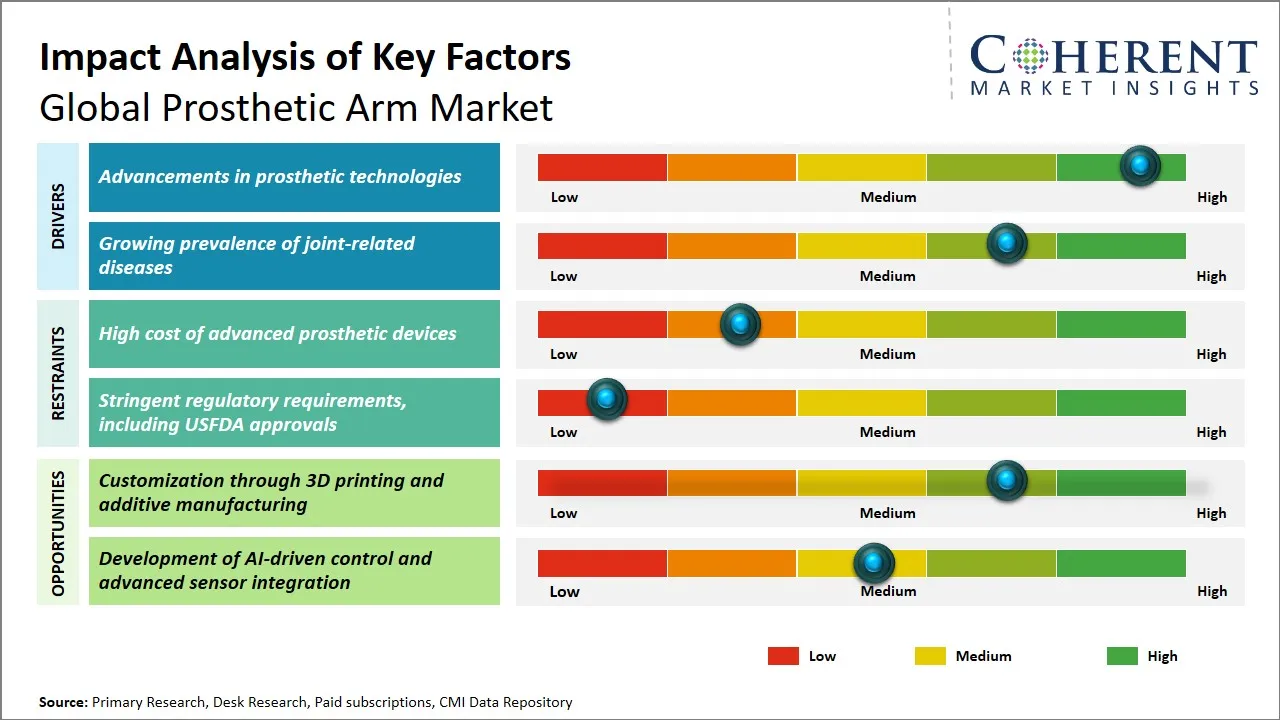
Prosthetic Arm Market Driver - Advancements in prosthetic technologies
The continuous evolution of prosthetic technologies is significantly propelling the development of the global prosthetic arm market. Innovations such as myoelectric control systems, which utilize electrical signals generated by muscle contractions to operate prosthetic limbs, have greatly improved the functionality and responsiveness of prosthetic arms, enabling users to perform complex and precise movements. Additionally, the integration of advanced materials like lightweight carbon fiber and silicone enhances comfort and durability, making prosthetics more user-friendly for extended wear.
In August 2025, Arm Dynamics, a leader in upper limb prosthetic solutions, showcased its innovative range of prosthetic devices, including passive devices like custom silicone restorations and positional digits, as well as durable body-powered prostheses ideal for rugged environments. The company also highlighted its advanced myoelectric prostheses, such as the Taska and Utah Arm, offering intuitive control and improved functionality.
Prosthetic Arm Market Opportunity - Customization through 3D Printing and Additive Manufacturing in the global prosthetic arm market
The integration of 3D printing and additive manufacturing technologies presents a significant opportunity for growth and innovation within the global prosthetic arm market. These advanced manufacturing techniques enable the production of highly customized prosthetic devices tailored to the unique anatomical and functional needs of individual users. Unlike traditional manufacturing methods, 3D printing allows for rapid prototyping and cost-effective small-batch production, which can dramatically reduce lead times and overall costs. Customization is critical in prosthetics, as comfort, fit, and functionality directly influence user satisfaction and adoption rates.
In November 2025, HP and the Limb Kind Foundation were nominated for the Formnext 2025 Design Award for their pilot project in Kenya, where they 3D printed custom prosthetic sockets using HP's Multi Jet Fusion technology. The process, which involved scanning limbs with a smartphone and creating custom designs in CAD software, reduced production time to just 36 hours—much faster than traditional methods. This innovation improves access to prosthetics for children in underserved areas, restoring mobility and independence.
Analyst Opinion (Expert Opinion)
- The prosthetic arm market is growing due to technological advancements in myoelectric and body-powered prosthetics, offering improved functionality and comfort. The aging global population and increasing cases of limb loss are driving demand, while regulatory support encourages the development of personalized, high-tech solutions. Key players are integrating robotics and AI for more natural user movement.
- Opportunities lie in affordable, customizable solutions, especially in developing regions, though high costs and limited reimbursements remain challenges. Collaborations between manufacturers and healthcare providers are addressing these issues. Events like the ISPO World Congress and AAOP Annual Meeting play a key role in knowledge-sharing and advancing technology in the sector.
Speak to the analyst
Want personalized insights?
Take the findings above to one of our principal consultants, or have the report rebuilt around the segments, geographies and competitors you actually track.
Market Segmentation
- Device Type Insights (Revenue, USD Mn, 2021 - 2033)
- Myoelectric (externally powered) prosthetic arms
- Body-powered prosthetic arms
- Hybrid prosthetic arms
- Passive (cosmetic/low-function) prosthetic arms
- Component Insights (Revenue, USD Mn, 2021 - 2033)
- Prosthetic forearm and terminal device (hand/grip)
- Prosthetic elbow mechanism
- Prosthetic shoulder unit (for above-elbow amputees)
- Prosthetic socket and interface system
- Control and sensor modules (microprocessors, EMG sensors)
- Level Of Amputation Insights (Revenue, USD Mn, 2021 - 2033)
- Below-elbow (trans-radial) prosthetic arms
- Above-elbow (trans-humeral) prosthetic arms
- Shoulder-disarticulation prosthetic arms
- Partial hand/finger prosthetic arms
- Patient Age Group Insights (Revenue, USD Mn, 2021 - 2033)
- Pediatric
- Adult
- Geriatric
- End User Insights (Revenue, USD Mn, 2021 - 2033)
- Hospitals
- Prosthetic and Orthotic clinics
- Home care/assisted-living fitting services
- Ambulatory Surgical Centers
- Regional Insights (Revenue, USD Mn, 2021 - 2033)
- North America
- U.S.
- Canada
- Latin America
- Brazil
- Argentina
- Mexico
- Rest of Latin America
- Europe
- Germany
- U.K.
- Spain
- France
- Italy
- Russia
- Rest of Europe
- Asia Pacific
- China
- India
- Japan
- Australia
- South Korea
- ASEAN
- Rest of Asia Pacific
- Middle East
- GCC Countries
- Israel
- Rest of Middle East
- Africa
- South Africa
- North Africa
- Central Africa
- North America
- Key Players Insights
- Ottobock SE and Co. KGaA
- Ossur hf
- Zimmer Biomet Holdings, Inc.
- Mobius Bionics LLC
- Open Bionics Ltd
- COVVI Ltd
- Steeper Inc.
- Fillauer LLC
- Motorica LLC
- Endolite India Ltd
- Coapt LLC
- Esper Bionics GmbH
- Ortho Europe Plc
- PSYONIC Inc.
- ToughWare Prosthetics, Inc.
Sources
Primary Research Interviews
- Industry Stakeholders
- Clinicians & Prosthetists in major rehabilitation centers
- R&D engineers at assistive-device labs
- End Users
- Individuals with upper-limb amputations fitted with myoelectric prostheses
- Patients using body-powered or hybrid prosthetic arms
Government and International Databases
- Centers for Disease Control and Prevention (CDC) amputation & prosthetics datasets
- National Institute of Standards and Technology (NIST) limb prostheses services & devices long-form report
- Veterans Health Administration upper-limb prosthesis usage study
- World Health Organization Standards for Prosthetics & Orthotics via International Society for Prosthetics and Orthotics (ISPO)
- National health-services/amputation registries (e.g., UK or Australia)
- Government reimbursement/policy documents on prosthetic coverage
Trade Publications
- American Academy of Orthotists and Prosthetists (AOPA) newsletter & conference proceedings
- The O&P EDGE Magazine (industry magazine)
- Orthotics & prosthetics trade newsletters (regional editions)
- Medical device regulatory trade journals focusing on assistive-tech
- Rehabilitation engineering trade magazines
- Assistive-technology market insight newsletters (non-firm-specific)
Academic Journals
- Prosthetics and Orthotics International
- “Advances in Upper Extremity Prosthetic Technology”
- “The Economics of Innovation in the Prosthetic and Orthotics Industry”
- “Advances in Orthotic and Prosthetic Manufacturing”
- “Limb Prostheses: Industry 1.0 to 4.0”
- Systematic technical reviews on prosthetic arms and control systems
Reputable Newspapers/Media
- Reuters report on prosthetic market/innovation (e.g., Nigeria bionic arm)
- Major national newspapers’ health-tech sections (e.g., The Guardian, The New York Times)
- National disability / health policy coverage in mainstream media
- Science-technology sections of reputable newspapers
- Trade press reporting on global prosthetic device trends
- Regional mainstream media covering prosthetics access issues in emerging markets
Industry Associations
- International Society for Prosthetics and Orthotics (ISPO)
- American Academy of Orthotists and Prosthetists (AOPA)
- National prosthetics & orthotics professional bodies (e.g., U.K., Australia)
- Rehabilitation engineering associations (e.g., IEEE-EMBS assistive technology chapters)
- Assistive-devices standardization organizations (e.g., ISO/TC 168 Prosthetics & Orthotics)
- Non-profit prosthetics advocacy networks
Proprietary Elements
- CMI Data Analytics Tool: Proprietary analytics tool to analyze real-time market trends, consumer behavior, and technology adoption in market
- Proprietary CMI Existing Repository of Information for Last 8 Years
Get access to 250+ pages report
Every segment, forecast, competitor profile and data table behind the analysis above — available for instant download.
- ESOMAR Member
- ISO 9001:2015 Certified
- D-U-N-S Registered
- GDPR & CCPA Compliant
Missing comfort of reading report in your local language? Find your preferred language:
Transform your Strategy with Exclusive Trending Reports
Frequently Asked Questions
The global prosthetic arm market is estimated to be valued at USD 329.2 Mn in 2026 and is expected to reach USD 913.6 Mn by 2033.
The CAGR of global prosthetic arm market is projected to be 15.7% from 2026 to 2033.
Advancements in prosthetic technologies and growing prevalence of joint-related diseases are the major factors driving the growth of the global prosthetic arm market.
High cost of advanced prosthetic devices and Stringent regulatory requirements, including U.S. FDA approvals are the major factors hampering the growth of the global prosthetic arm market.
In terms of device type, myoelectric (externally powered) prosthetic arms are estimated to dominate the market revenue share in 2026.
Ottobock SE and Co. KGaA, Össur hf, Zimmer Biomet Holdings, Inc., Mobius Bionics LLC, Open Bionics Ltd, COVVI Ltd, Steeper Inc., Fillauer LLC, Motorica LLC, Endolite India Ltd, Coapt LLC, Esper Bionics GmbH, Ortho Europe Plc, PSYONIC Inc., and ToughWare Prosthetics, Inc. are the major players.
North America is expected to lead the global prosthetic arm market in 2026.