

Respiratory Disease Testing Market Analysis & Forecast: 2026-2033
Respiratory Disease Testing Market is estimated to be valued at USD 3,642.6 Mn in 2026 and is expected to reach USD 4,858.3 Mn in 2033, exhibiting a compound annual growth rate (CAGR) of 4.2% from 2026 to 2033.
Key Takeaways
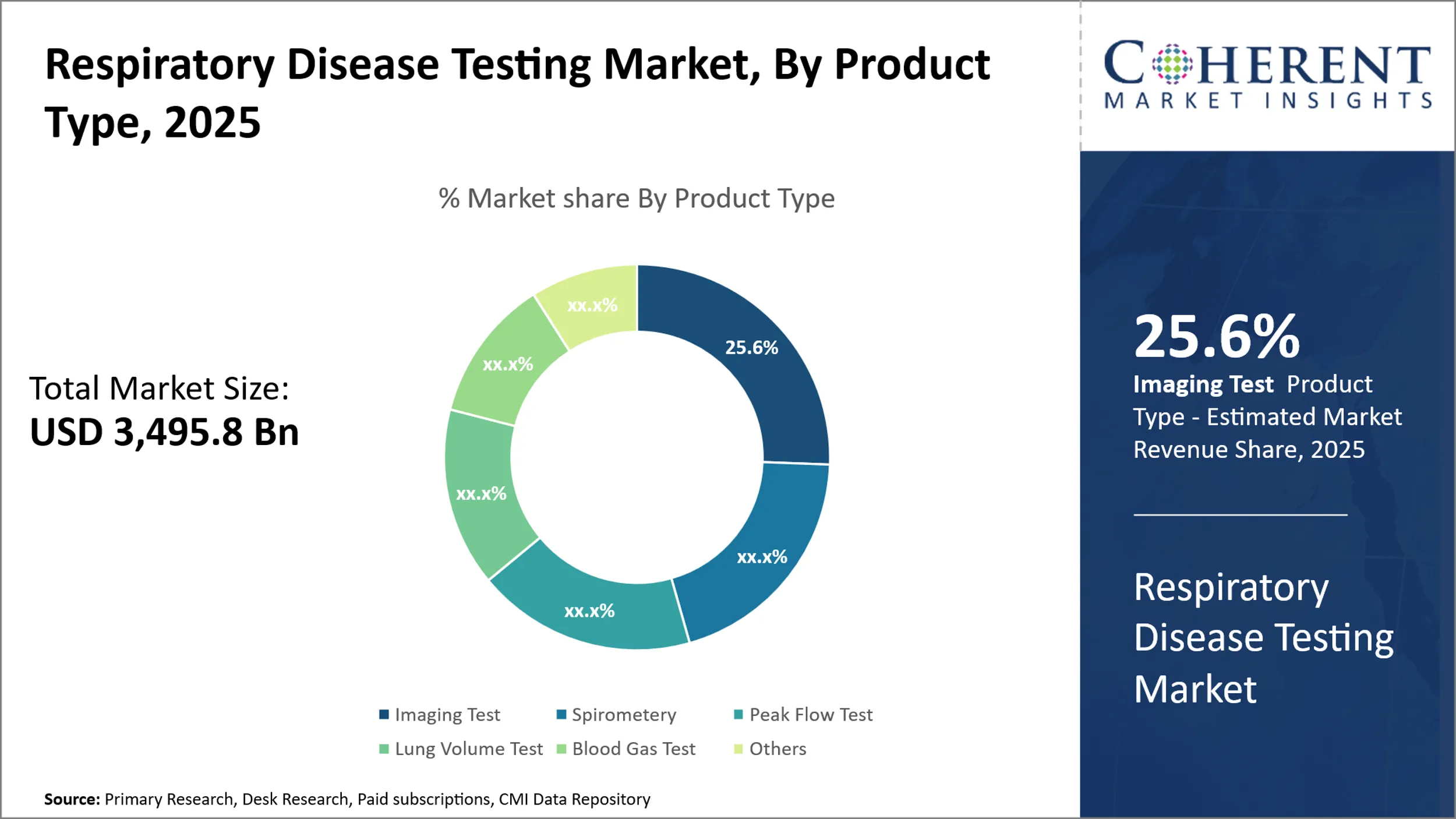
- By Product Type, Imaging tests are anticipated to account approximately 26.6% of the global market share in 2026. This substantial share is driven by the increasing reliance on chest X-rays, CT scans, and MRI for early and accurate detection of respiratory conditions.
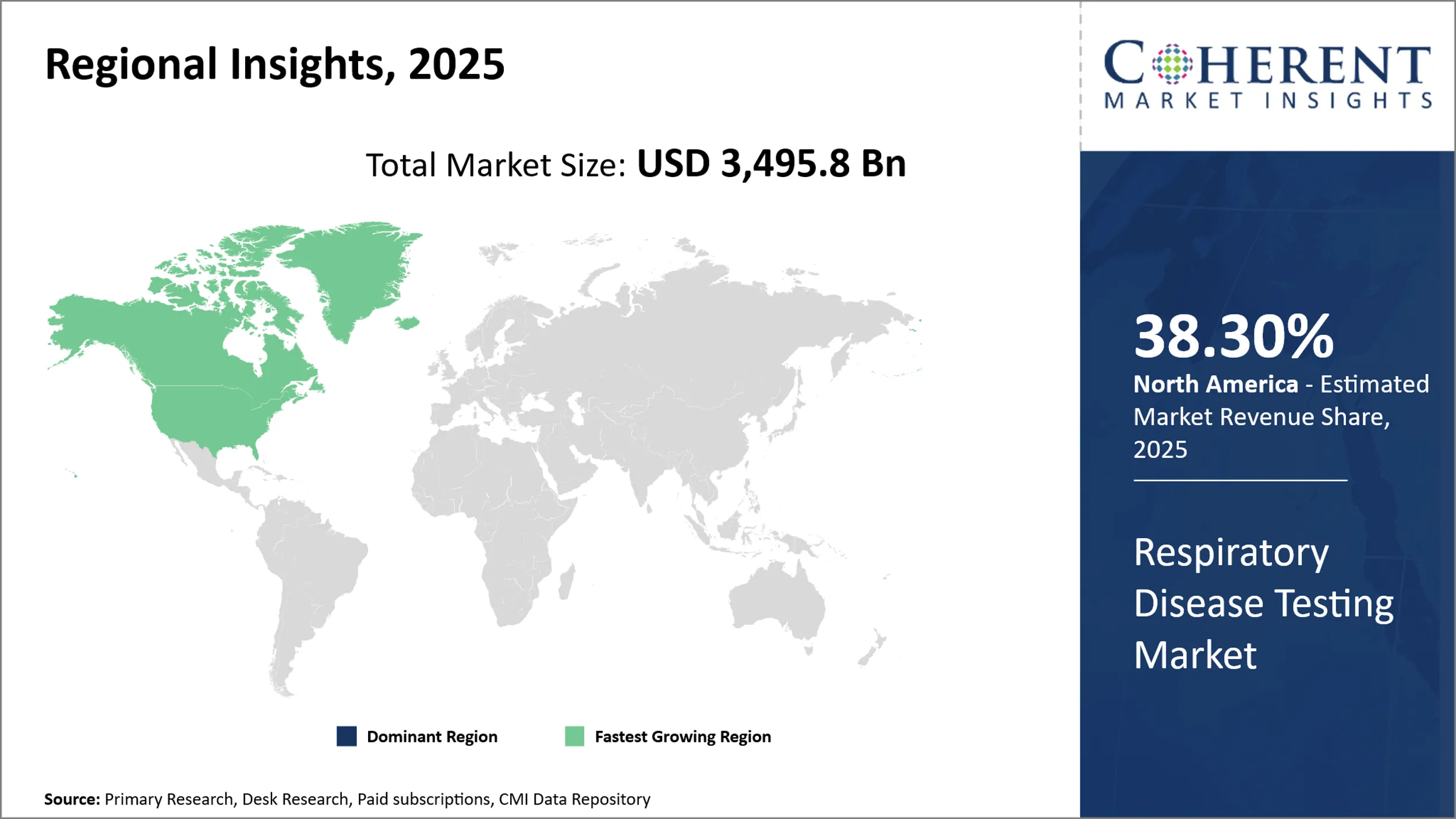
- North America is expected to lead the global respiratory disease testing market in 2026, securing approximately 38.3% of the total revenue share. This dominance is fueled by the region’s advanced healthcare ecosystem, widespread implementation of screening programs.
Market Overview
The Respiratory Disease Testing Market is experiencing consistent growth, driven by the rising global prevalence of respiratory conditions such as asthma, COPD, and tuberculosis. Imaging tests lead the product segment with a 25.6% share, owing to their critical role in early and accurate diagnosis. North America holds a dominant 38.3% regional share, supported by robust healthcare infrastructure and high diagnostic adoption. Advancements in testing technologies, increased screening initiatives, and growing awareness are shaping market trends and encouraging continuous innovation in respiratory diagnostics.
Current Events and its Impact on the Respiratory Disease Testing Market
Current Event | Description and its impact |
Technological Innovation and Diagnostic Advancements |
|
Strategic Partnerships and Market Expansion |
|
Policy Developments and Public Health Initiatives |
|
Pipeline Analysis: Respiratory Disease Testing Market
The respiratory disease testing market is witnessing a robust pipeline of innovative diagnostic solutions aimed at improving accuracy, speed, and accessibility. Several global companies are developing AI-powered imaging systems, multiplex molecular diagnostic panels, and portable testing devices tailored for point-of-care and remote settings.
Leading firms like Siemens Healthineers, Roche, and Abbott are actively investing in next-generation respiratory panels that can detect multiple pathogens, including influenza, RSV, and SARS-CoV-2, from a single sample. Additionally, AI-driven software is being integrated into CT and X-ray platforms to enable automated detection of early-stage respiratory anomalies. Clinical trials are underway to validate breath-based diagnostics and wearable sensors for continuous respiratory monitoring.
These advancements are expected to revolutionize respiratory diagnostics by enabling faster, more accurate, and decentralized testing. The ongoing innovation pipeline reflects the growing demand for smarter, scalable, and patient-friendly diagnostic solutions to meet the rising global burden of respiratory diseases.
- Current Industry Events of 2026
- Market Size Estimation
- Regional Breakdown
- Competitive Landscape
- Customer Intelligence
- Segmental Analysis
- Pricing Analysis
- Key Market Drivers, Challenges & Future Trends
- Customized Insights Section
Patent Landscape: Respiratory Disease Testing Market
The patent landscape of the respiratory disease testing market reflects a surge in innovation, particularly in AI-enabled diagnostics, molecular testing technologies, and portable testing devices. Key industry players such as Roche, Thermo Fisher Scientific, and Philips have filed numerous patents covering multiplex PCR-based assays, antigen detection kits, and digital imaging analysis tools tailored for respiratory conditions like asthma, COPD, and viral infections.
A growing number of patents also focus on integration of machine learning algorithms with imaging systems for early detection of lung abnormalities, including nodules and fibrosis. In addition, emerging technologies such as breath-based diagnostics, wearable respiratory sensors, and microfluidic lab-on-chip platforms are gaining intellectual property protection.
This competitive patent activity underscores the market’s focus on innovation, accuracy, and ease of use. The increasing volume and diversity of patents indicate a dynamic market poised for technological advancement, with strong emphasis on improving diagnostic efficiency and patient outcomes.
Reimbursement Scenario: Respiratory Disease Testing Market
The reimbursement landscape for respiratory disease testing varies significantly across regions but remains a crucial factor in market adoption. In the United States, Medicare and private insurers typically reimburse commonly used tests such as spirometry (CPT 94010), diffusion capacity (DLCO, CPT 94729), and pulse oximetry, provided they are medically necessary.
Remote physiologic monitoring for chronic respiratory conditions like COPD is also reimbursable under codes such as 99453 and 99454, supporting home-based diagnostics. Additionally, pulmonary rehabilitation programs are covered when tied to specific clinical indicators. In Europe, countries like Germany and the UK offer national health insurance coverage for key diagnostic tests, encouraging routine respiratory screening.
Australia's Medicare Benefits Schedule reimburses spirometry and more advanced tests like FeNO. Globally, reimbursement trends are shifting toward support for portable, AI-enabled, and point-of-care devices, aligning with preventive care initiatives. Favourable reimbursement policies continue to drive market growth, especially in regions with aging populations and rising chronic disease rates.
Prescribers’ Preference: Respiratory Disease Testing Market
Healthcare providers increasingly prefer diagnostic tools that offer speed, accuracy, and ease of use, especially amid the rising prevalence of chronic respiratory conditions like asthma and COPD complications. Pulmonologists, general practitioners, and primary care physicians are showing a strong inclination toward non-invasive and point-of-care diagnostic methods, such as spirometry, pulse oximetry, and portable imaging devices, which enable quicker decision-making and improved patient outcomes.
AI-integrated imaging systems and multiplex molecular test panels are gaining traction among specialists for their ability to detect multiple pathogens simultaneously and reduce diagnostic time. Additionally, the convenience of remote monitoring tools and wearable sensors is appealing in the management of chronic respiratory diseases, allowing for continuous data tracking and proactive care.
Prescribers also favour diagnostics that are easily reimbursed and compliant with evolving clinical guidelines. As healthcare shifts toward personalized and preventive care, prescribers increasingly value integrated, rapid, and reliable testing solutions.
Respiratory Disease Testing Market Trends
- Rising incidence of respiratory diseases such as asthma, chronic obstructive pulmonary diseases (COPD), and bronchitis
Rising incidence of respiratory diseases such as asthma, chronic obstructive pulmonary diseases (COPD), and bronchitis is expected to drive the market growth over the forecast period. For instance, according to the World Health Organization, report in May 2020, asthma is the most common chronic disease among children worldwide and around 339 million people were living with asthma in 2020. Similarly, according to the same source, over 80% of asthma-related deaths occur in low-and lower-middle income countries.
- Growing geriatric population
Growing geriatric population can also drive the Respiratory Disease Testing market growth. For instance, according to an article published in World Health Organisation, in November 2022, reported 1 in 6 people in the world will be aged 60 years or over. At this time the share of the population aged 60 years and over will increase from 1 billion in 2020 to 1.4 billion.
By 2050, the world’s population of people aged 60 years and older will double (2.1 billion). Non- cystic fibrosis bronchiectasis is the most common in elderly and frailer patients with estimated cases of 50% in patients over 65 years of age and 19.1% in patients over 75 years old.
Segmental Insights
Global Respiratory Disease Testing Market Insights, By Product Type
Imaging tests are projected to hold a significant share of the global respiratory disease testing market in 2026, accounting for approximately 26.6% of the total market. This prominence stems from the vital role that chest X-rays, CT scans, and MRI play in the early and accurate diagnosis of respiratory illnesses such as chronic obstructive pulmonary disease (COPD), asthma, pneumonia, and tuberculosis. These imaging modalities provide non-invasive, high-resolution visualization of lung structures, enabling clinicians to detect abnormalities, monitor disease progression, and guide treatment strategies effectively.
In parallel, Point-of-care respiratory disease testing devices are gaining traction due to their ability to deliver rapid results at or near the site of patient care. These portable, user-friendly tools are particularly valuable in primary care settings, emergency rooms, and remote locations, complementing advanced imaging techniques by enabling quicker triage and decision-making.
The integration of artificial intelligence into imaging platforms is further enhancing diagnostic precision, while the emergence of compact and mobile imaging solutions is extending access to remote and underserved populations.
The growing global prevalence of respiratory disorders driven by factors such as pollution, smoking has intensified demand for both imaging-based diagnostics and point-of-care testing solutions. Additionally, routine screening initiatives, expanding geriatric populations, and rising healthcare investments are fuelling adoption across both public and private healthcare settings.
As healthcare systems increasingly emphasize early detection and preventive care, imaging-based diagnostics, alongside point-of-care respiratory disease testing devices, are expected to remain at the forefront of the market, maintaining strong momentum through and beyond 2025.
Global Respiratory Disease Testing Market – Regional Insights
North America Respiratory Disease Testing Market Trends and Analysis
North America is expected to lead the global respiratory disease testing market in 2026, capturing approximately 38.30% of total revenue share. This regional dominance is driven by a well-established healthcare infrastructure, strong diagnostic capabilities, and the widespread adoption of routine respiratory screening programs across both public and private healthcare settings.
The region benefits from a dense network of accredited diagnostic laboratories, access to advanced imaging and molecular testing technologies, and a reimbursement framework that promotes early and frequent testing.
In addition to imaging and molecular diagnostics, biomarker testing in respiratory disease testing is emerging as a transformative tool for enhancing diagnostic accuracy, prognosis, and personalized treatment. By identifying specific biological indicators linked to respiratory pathologies, biomarker-based tests enable clinicians to differentiate between disease types, monitor inflammatory responses, and tailor therapies more precisely.
Significant investments in medical technology innovation particularly in AI-driven imaging platforms, biomarker assays, and portable testing devices are further elevating diagnostic precision and accessibility. Additionally, federal initiatives targeting respiratory health awareness, pollution reduction, and tobacco control are contributing to higher testing volumes.
With the presence of leading diagnostic equipment manufacturers and a strong focus on preventive healthcare, North America is well-positioned to sustain its leadership in the respiratory disease testing market through and beyond 2026.
Respiratory Disease Testing Market Dominating Countries
United States
The United States is the leading force in the global respiratory disease testing market, significantly contributing to North America’s projected 38.3% market share by 2026. This dominance is fuelled by a high burden of chronic respiratory conditions like asthma, COPD.
The country boasts a vast network of diagnostic laboratories, robust screening infrastructure, and early adoption of AI-enhanced imaging and molecular testing technologies. Backed by strong reimbursement policies, ongoing federal respiratory health initiatives, and major diagnostic manufacturers like Thermo Fisher Scientific and Abbott, the U.S. continues to drive innovation, accessibility, and global market influence.
Market Report Scope
Respiratory Disease Testing Market Report Coverage
| Report Coverage | Details | ||
|---|---|---|---|
| Base Year: | 2025 | Market Size in 2026: | USD 3,642.6 Mn |
| Historical Data for: | 2020 To 2024 | Forecast Period: | 2026 To 2033 |
| Forecast Period 2026 to 2033 CAGR: | 4.2% | 2033 Value Projection: | USD 4,858.3 Mn |
| Geographies covered: |
| ||
| Segments covered: |
| ||
| Companies covered: | CareFusion Corporation, Carestream Health, Inc., COSMED, Futuremed America, Inc., GE Healthcare, MGC Diagnostics Corporation, ndd Medical Technologies, Inc., Nihon Kohden Corporation, Perkin Elmer, Inc., FUJIFILM Healthcare Corporation, Philips Healthcare,Roche Healthcare, Beckton Dickinson and Company, Koninklijke Philips N.V. , ResMed Inc., Medtronic, Abbott Diagnostics, and Quest Diagnostics. | ||
| Growth Drivers: |
| ||
| Restraints & Challenges: |
| ||
Analyst Viewpoint – Respiratory Disease Testing Market
- The global respiratory disease testing market is poised for sustained growth, driven by the rising burden of chronic and infectious respiratory conditions, increasing public health awareness, and advancements in diagnostic technologies.
- Analysts highlight North America as the dominant region, backed by its strong healthcare infrastructure, widespread adoption of routine screening programs, and leadership in AI-powered imaging and molecular diagnostics.
- Industry experts point to a clear shift toward rapid, non-invasive, and portable diagnostic solutions as a defining trend. Clinicians are increasingly favouring point-of-care and home-based monitoring tools for their convenience, speed, and real-time data capabilities. The growing use of AI in imaging interpretation and multiplex testing for co-infections is further enhancing diagnostic accuracy and patient outcomes.
- While the market faces challenges such as reimbursement variability, infrastructure gaps in emerging regions, and the need for regulatory harmonization, the long-term outlook remains positive. Innovations in connected diagnostics, government screening initiatives, and rising telehealth integration are expected to shape the future of the respiratory disease testing landscape.
Respiratory Disease Testing Market: Key Development
- In April 2025, Thermo Fisher Scientific introduced a portable PCR-based respiratory diagnostic platform, capable of detecting 12 pathogens, with adoption in 32% of hospital emergency departments within its first quarter.
- In June 2024, Roche secured Emergency Use Authorization from the FDA for its cobas Liat SARS‑CoV‑2, Influenza A/B & RSV test, and a compact 4‑in‑1 RT‑PCR platform delivering results in just 20 minutes from a single nasal-swab sample. This rapid, near‑patient molecular test facilitates timely diagnosis and reduces reliance on multiple separate tests.
- In May 2024, Qiagen received FDA clearance for its QIAstat‑Dx Respiratory Panel Plus, a syndromic multiplex PCR assay capable of detecting 21 viral and bacterial pathogens in approximately one hour with minimal hands-on time (<1 minute). This tool enhances clinician decision-making through rapid, comprehensive respiratory diagnostics.
Market Segmentation
- Global Respiratory Disease Testing Market, By Test Type (Revenue, USD Mn, 2021 - 2033)
- Imaging Test
- Spirometry
- Peak Flow Test
- Blood Gas Test
- Lung Volume Test
- Others
- Global Respiratory Disease Testing Market, By End User (Revenue, USD Mn, 2021 - 2033)
- Hospitals
- Physician Offices
- Clinical Laboratories
- Global Respiratory Disease Testing Market, By Region (Revenue, USD Mn, 2021 - 2033)
- North America
- U.S.
- Canada
- Latin America
- Brazil
- Mexico
- Argentina
- Rest of Latin America
- Europe
- Germany
- U.K.
- France
- Italy
- Spain
- Russia
- Rest of Europe
- Asia Pacific
- China
- India
- Japan
- Australia
- South Korea
- ASEAN
- Rest of Asia Pacific
- Middle East
- GCC
- Israel
- Rest of Middle East
- Africa
- South Africa
- Central Africa
- North Africa
- North America
- Key Players Insights
- CareFusion Corporation
- Carestream Health, Inc.
- COSMED, Futuremed America, Inc.
- GE Healthcare
- MGC Diagnostics Corporation
- ndd Medical Technologies, Inc.
- Nihon Kohden Corporation
- Perkin Elmer, Inc.
- FUJIFILM Healthcare Corporation
- Philips Healthcare
- Roche Healthcare
- Beckton Dickinson and Company
- Koninklijke Philips N.V. ResMed Inc.
- Medtronic
- Abbott Diagnostics
- Quest Diagnostics
Sources
The Stakeholders Consulted
- Respiratory disease specialists and pulmonologists
- Hospital administrators and diagnostic laboratory directors
- Manufacturers and suppliers of respiratory diagnostic devices (imaging, molecular, and point-of-care)
- Distributors and procurement heads at hospitals and diagnostic centers
- Public health officials and policymakers in respiratory health programs
- Biomedical engineers and clinical researchers in pulmonary diagnostics
- Representatives from health ministries and national screening program coordinators
- End-users across healthcare settings including hospitals, clinics, diagnostic labs, and urgent care centers
Databases Opened
- Centers for Disease Control and Prevention (CDC) – National Respiratory and Infectious Disease Statistics
- U.S. Centers for Medicare & Medicaid Services (CMS) – Diagnostic Test Reimbursement Data
- World Health Organization (WHO) – Global Respiratory Disease Surveillance Reports
- Ministry of Health and Family Welfare (India) – National Health Mission Data
Magazines & Trade Publications
- Diagnostics World
- Clinical Lab Products Magazine
- Medical Device and Diagnostic Industry (MD+DI)
- 360Dx
- HealthTech Magazine – Diagnostics & AI
- LabPulse – Respiratory Testing Innovations
Scientific and Industry Journals
- Journal of Clinical Microbiology
- Chest (American College of Chest Physicians)
- International Journal of Chronic Obstructive Pulmonary Disease
- The Lancet Respiratory Medicine
- Respiratory Research
- Journal of Breath Research
Newspapers & Media Outlets
- The Wall Street Journal – Healthcare & Life Sciences
- Bloomberg – Medical Technology and Diagnostics
- Reuters – Health & Science
- The Economic Times – Healthtech and MedTech Updates
- Business Standard – Healthcare Innovation
Associations and Regulatory Bodies
- U.S. Food and Drug Administration (FDA) – Diagnostic Test Approvals
- European Medicines Agency (EMA) – In Vitro Diagnostic Regulation (IVDR)
- Centers for Disease Control and Prevention (CDC)
- World Health Organization (WHO) – Respiratory Health Division
- College of American Pathologists (CAP)
- Clinical and Laboratory Standards Institute (CLSI)
Public Domain Sources
- U.S. National Institutes of Health (NIH) – Pulmonary Research Programs
- European Commission – Health Technology and Disease Prevention Reports
- WHO Global Health Observatory – Respiratory Testing Trends
- Indian Council of Medical Research (ICMR) – Diagnostic Standards and Epidemiology
- UN Statistics Division – Health Sector Metrics
Proprietary Research Elements
- Internal Data Analytics Platform – Respiratory Diagnostics Demand Forecasting
- Exclusive Repository of Global Respiratory Testing Market Data (past 8 years)
- Expert Interviews with Pulmonologists, Lab Technicians, and Diagnostic Device Manufacturers
- Structured surveys across diagnostic centers and respiratory clinics
- In-house benchmarking of pricing trends, device adoption, and regulatory shifts
Get access to 250+ pages report
Every segment, forecast, competitor profile and data table behind the analysis above — available for instant download.
- ESOMAR Member
- ISO 9001:2015 Certified
- D-U-N-S Registered
- GDPR & CCPA Compliant
Missing comfort of reading report in your local language? Find your preferred language:
Transform your Strategy with Exclusive Trending Reports
Frequently Asked Questions
The Respiratory Disease Testing Market size is estimated to be valued at USD 3,642.6 Mn in 2026, and is expected to reach USD 4,858.3 Mn by 2033.
The CAGR of the global Market is projected to be 4.2% from 2026 to 2033.
Rising incidence of respiratory diseases such as asthma, chronic obstructive pulmonary diseases (COPD), and bronchitis and growing geriatric population are expected to propel growth to expand the product portfolio is expected to drive the market growth.
Imaging Test is the leading segment in the market.
Low adoption rate of digital radiography are expected to hinder the global Respiratory Disease Testing market over the forecast period.
Major players operating in the market include CareFusion Corporation, Carestream Health, Inc., COSMED, Futuremed America, Inc., GE Healthcare, MGC Diagnostics Corporation, ndd Medical Technologies, Inc., Nihon Kohden Corporation, Perkin Elmer, Inc., FUJIFILM Healthcare Corporation, Philips Healthcare,Roche Healthcare and Quest Diagnostics.
Current respiratory test kits are generally accurate, with molecular tests like RT-PCR offering high sensitivity and specificity for detecting respiratory pathogens.