

Cardiac Implants Market Size and Trends: 2026-2033
Cardiac implants market is estimated to be valued at USD 48,862 Mn in 2026 and is expected to reach USD 83,490 Mn by 2033, exhibiting a compound annual growth rate (CAGR) of 8% from 2026 to 2033.
Key Takeaways
- Based on Device Type, the Pacemaker Devices segment is expected to lead the market with 42% share in 2026, due to high prevalence of arrhythmias and widespread adoption of rhythm management devices.
- Based on Application, the Arrhythmias segment is expected to hold 33% share of the market in 2026, driven by increasing incidence of heart rhythm disorders.
- Based on End User, the Hospitals segment is projected to account for 55% share of the market in 2026, owing to availability of surgical infrastructure and advanced cardiac care facilities.
- Based on Region, North America is set to lead the cardiac implants market with 40% share in 2026. While, Asia Pacific is anticipated to be the fastest growing region.
Market Overview
Rising prevalence of cardiovascular diseases such as arrhythmias, heart failure, and myocardial infarction, demand for cardiac implants including pacemakers, ICDs, CRT devices, stents, and heart valves has been increasing recently. Furthermore, increasing awareness of advanced cardiac care and growing adoption of minimally invasive procedures have further boosted market growth. Technological innovations, such as leadless pacemakers, wireless monitoring devices, and transcatheter heart valves, are attracting the attention of hospitals and specialty clinics to adopt these solutions.
Current Events and Its Impacts on the Cardiac Implants Market
Current Events | and its impact |
Regulatory Harmonization and Approval Processes |
|
Advanced Material Science and Biocompatibility Innovations |
|
How is product innovation driving the growth in cardiac implants?
- Leadless Pacemakers: Miniature pacemakers are inserted without any leads, thus avoiding any complications during recovery.
- Wireless Monitoring Devices: The implantable hemodynamic monitors and the heart rhythm monitoring devices can be used for remote patient monitoring; thus, early detection of any complications will be possible.
- Transcatheter Heart Valves: This minimally invasive technique for valve replacement reduces risks and stays for patients.
- Implantable Cardioverter Defibrillators (ICDs) equipped with Smart Algorithm technology: Devices that monitor complex arrhythmias and deploy particular forms of therapy to prevent sudden death.
- Current Industry Events of 2026
- Market Size Estimation
- Regional Breakdown
- Competitive Landscape
- Customer Intelligence
- Segmental Analysis
- Pricing Analysis
- Key Market Drivers, Challenges & Future Trends
- Customized Insights Section
Segmental Insights
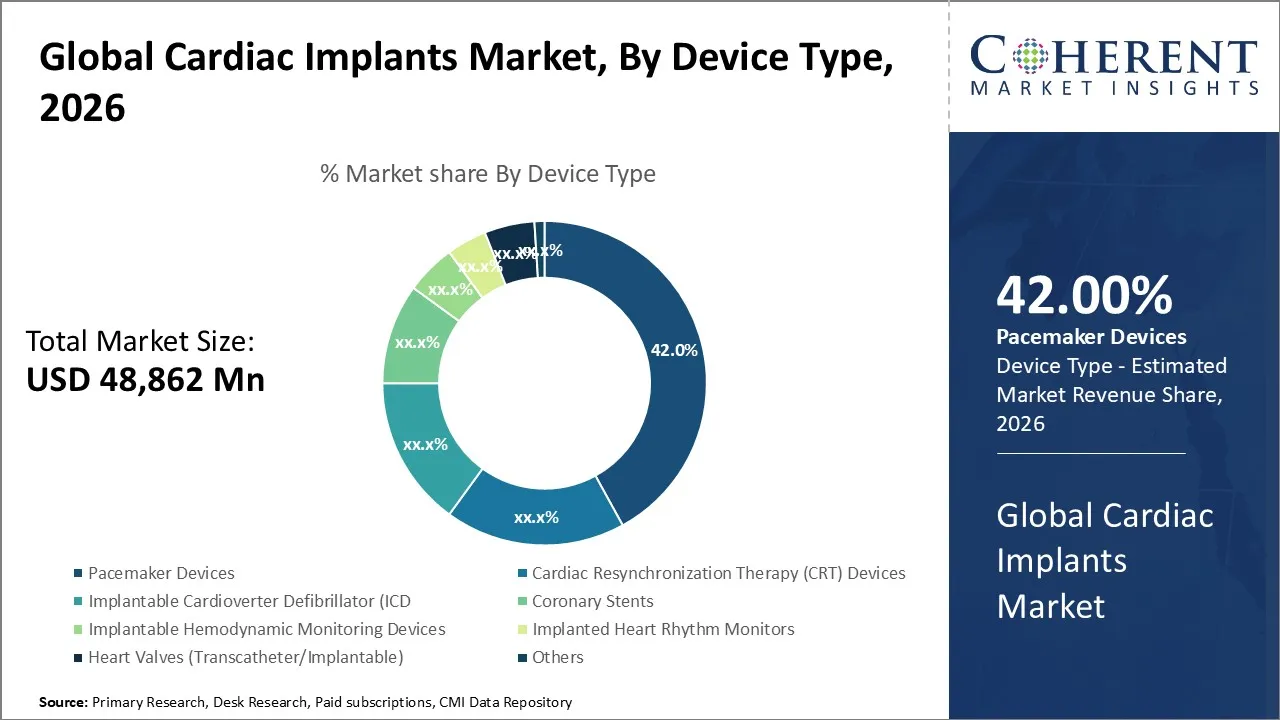
Cardiac Implants Market Insights, By Device Type – Pacemaker Devices dominate due to high prevalence of arrhythmias and widespread adoption of rhythm management devices
Based on device type, pacemaker devices are estimated to account for the highest market share of 42% in 2026, owing to their importance in controlling arrhythmias and increasing patient survival rates. Pacemakers are used to control abnormal heart rhythms, and rhythm management is essential for patients suffering from bradycardia and conduction disorders.
For instance, in October 2025, Abbott announced the commercial availability of its dual chamber leadless pacemaker system that can synchronize two small pacemakers inserted inside the patient’s heart.
Cardiac Implants Market Insights, By Application – Arrhythmias lead the market as heart rhythm disorders rise
Based on applications, the arrhythmias segment is projected to capture the highest market share of 33% by the year 2026, primarily due to the rise in instances of arrhythmia, including atrial fibrillation, ventricular tachycardia, and sudden cardiac death. In addition, awareness about the early diagnosis and the requirement for constant monitoring has also led to an increased demand for the implantation of pacemakers, ICDs, and CRTs.
For instance, in July 2025, Johnson & Johnson MedTech launched the world's first pulsed field ablation system, the VARIPULSE™ Platform, integrated with CARTO™ 3 mapping for treating atrial fibrillation, which is a common arrhythmia.
Cardiac Implants Market Insights, By End User – Hospitals lead due to advanced surgical infrastructure and cardiac care facilities
Based on end users, the hospitals segment is anticipated to generate the maximum market share of 55% by 2026 due to advanced facilities for surgeries, availability of skilled cardiologists, and comprehensive services for heart conditions. Similarly, hospitals offer full-service solutions to patients and thus remain the first choice for procedures and treatments.
For instance, in March 2025, the Melrose Wakefield Hospital, located in Massachusetts, reported the successful implementation of a leadless atrial pacemaker procedure through its cardiac catheterization laboratory.
Regional Insights
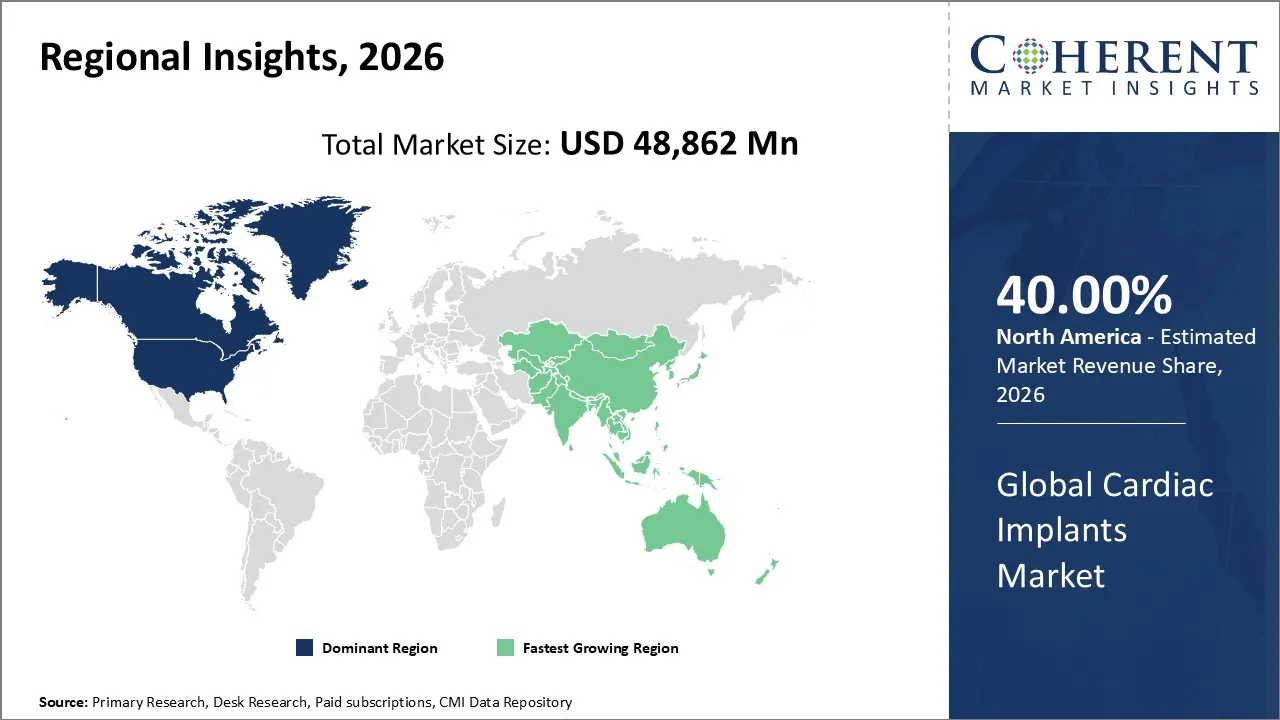
North America Cardiac Implants Market Analysis & Trends
North America is likely to account for the largest share of 40% in the cardiac implants market by 2026, due to various factors such as advanced healthcare infrastructure, high prevalence of cardiovascular diseases, strong reimbursement policies, and higher adoption of innovative implantable devices like leadless pacemakers, ICDs, and CRT systems.
For instance, in January 2026, Mission Hospital in Western North Carolina expanded its cardiac care services to install a new leadless pacemaker system with the aim of helping patients when their hearts beat slowly or irregularly, and to reduce procedural discomfort and recovery times.
Asia Pacific Cardiac Implants Market Analysis & Trends
The Asia Pacific region is expected to be the fastest-growing market for cardiac implants due to the rising incidence of cardiovascular diseases, rising healthcare spending, expanding infrastructure, and improving knowledge of advanced treatment facilities available. Increasing numbers of new hospitals and cardiac institutions are using minimally invasive cardiac implant devices, leading to improved patient care and hence expanding the cardiac implants market.
For instance, in October 2025, Apollo Hospitals Chennai completed its first leadless dual-chamber AVEIR pacemaker procedure, highlighting the rapid adoption of advanced cardiac device technology in the Asia Pacific hospital segment.
Cardiac Implants Market Outlook for Key Countries
Is the U.S. cardiac implants market maintaining growth through technology adoption and hospital infrastructure
The U.S. cardiac implants market is experiencing a high growth rate, primarily due to the high incidence rate of cardiovascular diseases, advanced healthcare facilities, and the increased use of cutting-edge devices such as leadless Pacemakers, ICDs, and CRTs in the USA. Furthermore, various hospitals and cardiovascular centers are investing heavily in minimally invasive cardiovascular implant devices.
For instance, in January 2026, the Allina Health Minneapolis Heart Institute in Minnesota became one of the first programs in the Upper Midwest to offer the OmniaSecure defibrillation lead, which is thinner and more flexible to help optimize ICD outcomes.
Is Canada’s healthcare system accelerating adoption of advanced cardiac implants?
Canada’s cardiac implants market is growing as a result of favorable public healthcare policies in the country. Additionally, growing heart health awareness and hospitals adopting the latest technology in heart treatments, such as pacemakers and defibrillators, are also boosting this market.
For instance, in February 2025, London Health Sciences Centre in Ontario became the first hospital in Canada to implant a cutting-edge extravascular ICD, marking a significant step in the adoption of minimally invasive cardiac devices in the country.
Market Report Scope
Cardiac Implants Market Report Coverage
| Report Coverage | Details | ||
|---|---|---|---|
| Base Year: | 2025 | Market Size in 2026: | USD 48,862 Mn |
| Historical Data for: | 2020 To 2024 | Forecast Period: | 2026 To 2033 |
| Forecast Period 2026 to 2033 CAGR: | 8% | 2033 Value Projection: | USD 83,490 Mn |
| Geographies covered: |
| ||
| Segments covered: |
| ||
| Companies covered: | Abbott Laboratories, B. Braun Melsungen AG, Boston Scientific Corporation, Edwards Lifesciences Corporation, Meril Life Sciences Pvt. Ltd. , Lepu Medical Technology (Beijing) Co., Ltd., BIOTRONIK SE & Co. KG, OSYPKA MEDICAL, Pacetronix.com, Vitatron, Terumo Corporation, Cordis, MicroPort Scientific Corporation. | ||
| Growth Drivers: |
| ||
| Restraints & Challenges: |
| ||
Cardiac Implants Market Driver
Rising prevalence of cardiovascular diseases and arrhythmias
Increasing incidence of cardiac-related diseases such as arrhythmias, heart failure, and myocardial infarctions, among others, is fueling the increased need for cardiac implants worldwide. Various hospitals and cardiac centers are increasingly using advanced cardiac implants such as pacemakers, ICDs, CRT, and leadless pacemakers for the management and treatment of cardiac rhythm-related disorders among their patients.
Cardiac Implants Market Opportunity
Introduction of next-generation devices and minimally invasive technologies
The market is expected to show high growth potential through the introduction of next-generation cardiac implants such as leadless pacemakers, extravascular ICDs, smart devices, etc., in the market. Additionally, the hospital industry can enhance these advanced technologies to increase the usage of next-generation cardiac implantable to enhance security, minimize procedural issues, and improve overall clinical outcomes. The device miniaturization, efficiency, and connectivity are expected to increase the potential of this market to grow in North America, Europe, and Asia Pacific.
Analyst Opinion (Expert Opinion)
- The cardiac implants market is evolving rapidly, driven by a clear shift toward hospital-led adoption of advanced, minimally invasive devices. Hospitals are increasingly favoring leadless pacemakers, extravascular ICDs, and other next-generation devices due to lower complication rates and shorter recovery times.
- Clinical trends indicate that younger patients are being treated with advanced CRT devices, reflecting a focus on proactive management of heart failure rather than reactive treatment. Post-implant monitoring using smart devices and remote telemetry has demonstrably reduced readmission rates, highlighting the real-world benefits of these innovations.
- Geographically, North America leads in clinical infrastructure and procedural adoption, while Asia Pacific is rapidly expanding as hospitals invest in modern cardiac catheterization labs and electrophysiology suites. The market is moving away from traditional, lead-based devices toward smarter, minimally invasive solutions, with hospitals acting as the primary enablers of this transformation
Speak to the analyst
Want personalized insights?
Take the findings above to one of our principal consultants, or have the report rebuilt around the segments, geographies and competitors you actually track.
Top Strategies Followed by Cardiac Implants Market Players
- Established players focus on research and clinical validation to drive innovation in next-generation implantable devices. Leading companies, such as Medtronic, Abbott, and Boston Scientific, heavily invest in R&D and rigorously test the safety, efficacy, and longevity of the device. They also carry out long-term tests to enhance various features, including a leadless pacemaker, an extravascular ICD, and remote monitoring.
- Mid-level players compete mainly in terms of cost-effectiveness and procedural support for cardiac implants, offering competitive and affordable services and devices that are compliant with government regulations, ultimately working within hospitals and clinics to give support and training for their devices, even within emerging markets.
- Small-scale or specialized companies focus their efforts on niche innovations, such as miniaturized devices, AI-enabled remote monitoring, or implantable hemodynamic sensors. Targeting underserved segments, including pediatric cardiology or highly customized devices, brings them into the view of clinicians and clinical adoption despite having limited manufacturing capacity. This segment of companies relies on partnerships with technology startups or university research labs to accelerate product development and time-to-market penetration.
Emerging Startups in the Cardiac Implants Market
- Several startups are working to develop pioneering smart implant technologies. Many organizations are developing smart implants that incorporate real-time monitoring, predictive analysis, and wireless connectivity. Such technologies have the potential to change the standard of care if implemented on a large scale.
- Sustainability and efficiency: There is a concern over sustainability and efficiency, and some organizations are looking into long-lasting batteries and biocompatible materials to prevent the replacement of devices and reduce procedural risks, fitting in with the current push to reduce readmissions and increase patient safety.
- Niche solutions help fill market gaps such as devices for certain arrhythmias, congenital heart defects, and/or minimally-invasive solutions for high-risk patients. Working with hospitals, academic centers, and digital health companies enables these new ventures to quickly secure clinical validations, approvals, and serve niche populations.
Cardiac Implants Industry News
- In October 2025, Abbott unveiled its next‑generation dual‑chamber leadless pacemaker system, enabling wireless communication and synchronization between two leadless devices for advanced rhythm management.
- In January 2026, BIOTRONIK announced successful first‑in‑human implantations of its LivIQ leadless pacemaker system, which delivers AV synchronous pacing using atrial electrical signals.
- In October 2025, MicroPort announced its coronary stent systems have surpassed 10 million global shipments and implantations, showing sustained global adoption across cardiac intervention therapies.
Market Segmentation
- Device Type Insights (Revenue, USD Mn, 2026 - 2033)
- Pacemaker Devices
- Cardiac Resynchronization Therapy Devices
- Implantable Hemodynamic Monitoring Devices
- Implanted Heart Rhythm Monitors
- Coronary Stents
- Implantable Cardioverter Defibrillator
- Heart Valve
- Others
- Application Insights (Revenue, USD Mn, 2026 - 2033)
- Arrhythmias
- Myocardial Ischemia
- Acute Myocardial Infraction
- Congestive Heart Failure
- Others
- End User Insights (Revenue, USD Mn, 2026 - 2033)
- Hospitals
- Specialty Clinics
- Others
- Regional Insights (Revenue, USD Mn, 2026 - 2033)
- North America
- U.S.
- Canada
- Latin America
- Brazil
- Argentina
- Mexico
- Rest of Latin America
- Europe
- Germany
- U.K.
- Spain
- France
- Italy
- Russia
- Rest of Europe
- Asia Pacific
- China
- India
- Japan
- Australia
- South Korea
- ASEAN
- Rest of Asia Pacific
- Middle East
- GCC Countries
- Israel
- Rest of Middle East
- Africa
- South Africa
- North Africa
- Central Africa
- North America
- Key Players Insights
- Abbott Laboratories
- Braun Melsungen AG
- Boston Scientific Corporation
- Edwards Lifesciences Corporation
- Meril Life Sciences Pvt. Ltd.
- Lepu Medical Technology (Beijing) Co., Ltd.
- BIOTRONIK SE & Co. KG
- OSYPKA MEDICAL
- Pacetronix.com
- Vitatron
- Terumo Corporation
- Cordis
- MicroPort Scientific Corporation
Sources
Primary Research Interviews
- Cardiac Implant Manufacturers & Brand Managers
- Cardiac Device Product Designers & Engineers
- Hospitals & Specialty Cardiology Clinics Procurement Heads
- Cardiologists, Electrophysiologists & Cardiac Surgeons
- Biomedical Researchers & Clinical Trial Specialists
- Medical Device Distributors & Supply Chain Managers
- Others
Databases
- Bloomberg Terminal
- Thomson Reuters Eikon
- S&P Global Market Intelligence
- Statista
- PubMed & MEDLINE
- ClinicalTrials.gov
- Others
Magazines
- Cardiovascular Business
- Medical Device & Diagnostic Industry (MD+DI)
- MedTech Insight
- Heart Rhythm News
- Cardiovascular Device News
- Others
Journals
- Journal of the American College of Cardiology (JACC)
- Circulation: Arrhythmia and Electrophysiology
- Heart Rhythm Journal
- European Heart Journal
- Pacing and Clinical Electrophysiology
- Others
Newspapers
- The Wall Street Journal (Health & Science Section)
- Financial Times (Healthcare & MedTech)
- Reuters Health
- Bloomberg News (Medical Devices & Healthcare)
- The New York Times (Health Section)
- Others
Associations
- American Heart Association (AHA)
- Heart Rhythm Society (HRS)
- European Society of Cardiology (ESC)
- World Heart Federation (WHF)
- International Society for Heart & Lung Transplantation (ISHLT)
- Others
Public Domain Sources
- FDA Device Approvals & Recalls Database
- Centers for Medicare & Medicaid Services (CMS) Reports
- National Institutes of Health (NIH) Publications & Reports
- World Health Organization (WHO) Cardiovascular Disease Reports
- Clinical trial registries & government health statistics
- Others
Proprietary Elements
- CMI Data Analytics Tool
- Proprietary CMI Existing Repository of Information for the Last 8 Years
Get access to 250+ pages report
Every segment, forecast, competitor profile and data table behind the analysis above — available for instant download.
- ESOMAR Member
- ISO 9001:2015 Certified
- D-U-N-S Registered
- GDPR & CCPA Compliant
Missing comfort of reading report in your local language? Find your preferred language:
Transform your Strategy with Exclusive Trending Reports
Frequently Asked Questions
The cardiac implants market is estimated to be valued at USD 48,862 Mn in 2026, and is expected to reach USD 83,490 Mn by 2033.
The CAGR of the cardiac implants market is projected to be 8% from 2026 to 2033.
Rising incidence of arrhythmias and heart failure, widespread adoption of advanced pacemakers, ICDs, CRT devices, and hospitals investing in modern cardiac care infrastructure are the key drivers.
High costs of implantable devices, stringent regulatory approvals, and complications associated with invasive procedures are major factors restraining growth.
The Pacemaker Devices segment is expected to dominate the market due to high prevalence of arrhythmias and strong adoption of rhythm management devices.
Abbott Laboratories, B. Braun Melsungen AG, Boston Scientific Corporation, Edwards Lifesciences Corporation, Meril Life Sciences Pvt. Ltd., Lepu Medical Technology (Beijing) Co., Ltd., BIOTRONIK SE & Co. KG, OSYPKA MEDICAL, Pacetronix.com, Vitatron, Terumo Corporation, Cordis, and MicroPort Scientific Corporation are the major players.
North America is expected to lead the cardiac implants market due to advanced healthcare infrastructure, high procedural adoption rates, and supportive regulatory frameworks.