

U.S. Hospital Emergency Department Market
U.S. Hospital Emergency Department Market is estimated to be valued at USD 196.35 Bn in 2026 and is expected to reach USD 289.44 Bn in 2033, exhibiting a compound annual growth rate (CAGR) of 5.7% from 2026 to 2033.
Key Takeaways
- Based on Insurance Type, the Medicare and Medicaid segment is expected to lead the market holding an estimated share of 66.9% in 2026, owing to the increasing penetration of healthcare insurance.
- Based on Condition, the, Infectious Conditions Segment is estimated to lead the market with largest share in 2026 due to prevalence of infectious disease.
Market Overview
The U.S. hospital emergency department market is experiencing strong growth due to the rising number of emergency department visits and rising prevalence of chronic diseases in the region. Moreover, rise in penetration of health insurance among the US population and growing geriatric population is expected to boost the market growth. However, factors such as rising preference for convenient care and high cost of emergency care are expected to hamper the market growth.
Current Events and Its Impact
Current Events | Description and its Impact |
Healthcare Workforce Shortages |
|
Telehealth Policy Shifts |
|
Role of Artificial intelligence in the U.S. Hospital Emergency Department Market
The integration of artificial intelligence into the U.S. hospital emergency department is transforming the workload of healthcare professionals by improving efficiency, accuracy and patient care. Application of AI in emergency department includes triage, diagnosis, and treatment planning. Along with that, AI also manages patient workflow and optimizes staffing. AI holds the potential to enhance triage systems, predict disease specific risk, estimate staff needs and interpret imaging findings in the ED.
In April 2025, Adventist HealthCare, based in Gaithersburg, Maryland, launched an initiate in its emergency department to help enhance patient safety and care efficacy. KATE AI, a software that helps the care term to ensure the safety and consistency of triage at Adventist HealthCare Shady Grove Medical Center, Adventist HealthCare White Oak Medical Center and Adventist HealthCare Fort Washington Medical Center. The AI tool complements the training and expertise of emergency nurses, supporting and validating their decision-making skills.
- Current Industry Events of 2026
- Market Size Estimation
- Regional Breakdown
- Competitive Landscape
- Customer Intelligence
- Segmental Analysis
- Pricing Analysis
- Key Market Drivers, Challenges & Future Trends
- Customized Insights Section
Segmental Insights
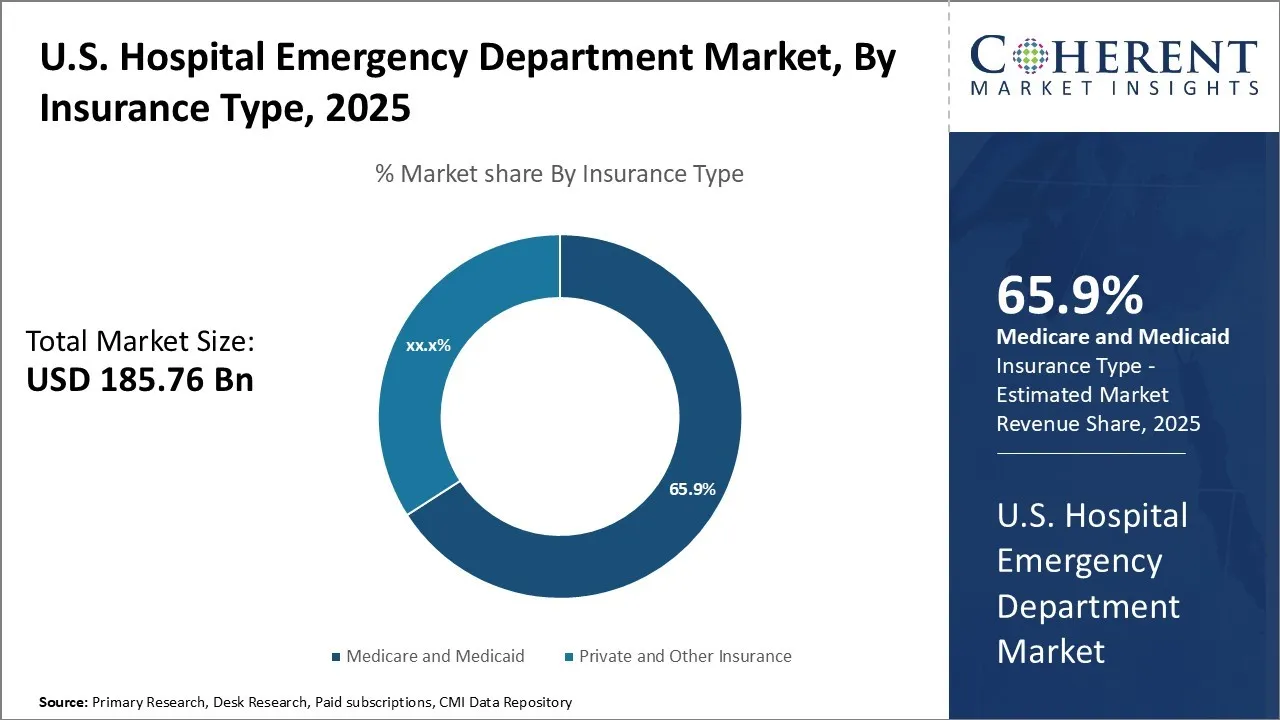
U.S. Hospital Emergency Department Market Insights, By Insurance Type - Medicare & Medicaid Dominates the Overall Market Owing to the Increasing Penetration of Health Insurance
In terms of insurance type, the Medicare & Medicaid segment is expected to dominate the U.S. hospital emergency department market with the share of 66.9% in 2026 and is anticipated to expand further during the forecast period. The growth of the segment is attributed to the increase in penetration of health insurance among the US population. The primary driver of the segment is the characteristics of providing vital health insurance coverages for specific population. Medicare offers coverage for 65 and older people and people with certain disability. While, Medicaid covers low-income individual and families. Both the programs together have the potential to significantly improve access to healthcare and provide a safety net for valuable population. According to Centers for Medicare & Medicare Service, at present, over 12.2 million Medicare-Medicaid enrollees in the United States.
In May 2025, the U.S. Centers for Medicare & Medicaid Services (CMS) announced plans to enhance oversight to prevent states from using Medicaid funds to subsidize healthcare for illegal immigrants. Medicaid, a federal health insurance program, serves over 71 million low-income Americans.
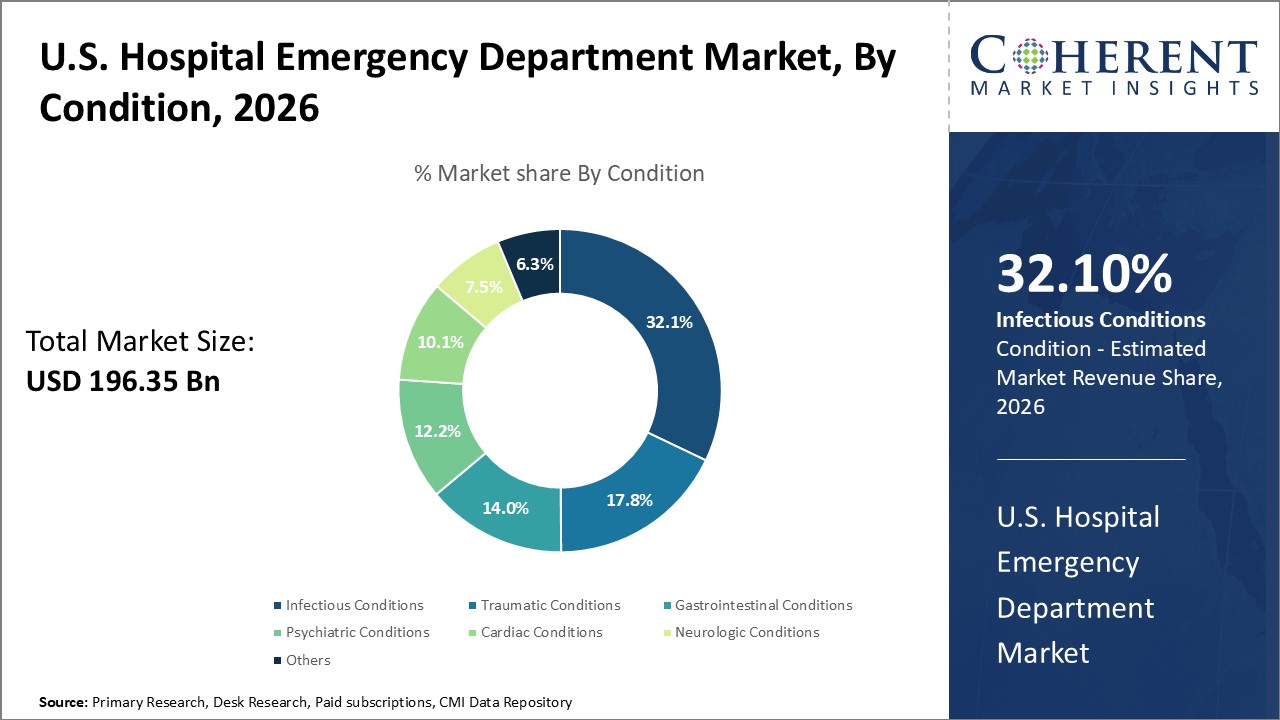
U.S. Hospital Emergency Department Market Insights, By Condition - Infectious Condition Acquires the Largest Market Share On Account of Growing Prevalence of Infection Diseases
In terms of condition, the infectious conditions segment is expected to dominate the market during the forecast period and this is attributed to the rise in burden of infectious diseases. The occurrence of patients with infectious disease are common in emergency department due to requirement for immediate evaluation and treatment. The ED encounter a wide range of infectious disease from pneumonia to potentially life-threatening conditions like septic shock. According to CDC, there are around 3.8 million emergency department visits each year where infectious and parasitic diseases are the primary diagnosis. According to National Institute of health, each year, about 23 million Americans visit a doctor’s office or clinic seeking treatment for infections. This is further adding to the U.S. hospital emergency department market share.
U.S. Hospital Emergency Department Market Trends
Rise in number of freestanding EDs is a recent trend
A freestanding emergency department is an emergency facility that is not physically connected to inpatient services, and provide emergency medical services to those in need. The ability to provide top-notch emergency treatment at even greater levels of customer service is one of the reasons why many hospitals construct freestanding EDs. Hospital-based freestanding emergency departments are a new and evolving care delivery model. There are over 500 Freestanding Emergency Centers across the U.S. This trend is expected to continue over the forecast period.
Rise in adoption of private insurance is another trend
Under the Patient Protection and Affordable Care Act (ACA) (also known as Obamacare), health insurance plans are required to cover emergency services. Private health insurance currently covers a little more than half of the U.S. population, as private insurance companies offer more advantages to the customers compared to that of Medicare/Medicaid. Moreover, extra services and facilities provided by the private insurance companies during the emergency visits has propelled the U.S. hospital emergency department market growth. This trend is also expected to continue over the forecast period.
U.S. Hospital Emergency Department Market Drivers
High number of emergency department visits to augment market growth
One of the key factors expected to augment the growth of the U.S. hospital emergency department market during the forecast period is the high number of emergency department visits. For instance, according to the Centers for Disease Control and Prevention (CDC), each year, around 136 million people in the United States visit emergency departments, with around 30% of those visits relating to injuries. Moreover, the yearly national average of emergency room patients is 42 for every 100 people or about 42 percent. Such a high number of emergency department visits is expected to fuel the growth of the U.S. hospital emergency department market.
Rise in burden of chronic diseases to underpin market growth
Another factor which is driving the growth of the U.S. hospital emergency department market is the rising demand for chronic diseases management in the region. For instance, nearly 60% of all emergency room visits are associated with people with chronic conditions. According to CDC, chronic diseases such as heart disease, cancer, and diabetes are the leading causes of death and disability in the United States. Six in ten Americans live with at least one chronic disease, such as heart disease and stroke, cancer, or diabetes. Moreover, chronic diseases account for 75% of the healthcare spending in the United States each year, according to the same source.
U.S. Hospital Emergency Department Market Opportunities
Rise in penetration of health insurance among the US population is expected to provide significant growth opportunities for players in the U.S. hospital emergency department market. For instance, insurance companies play a vital role in the market growth. Medicare and Medicaid offer insurance for emergency health services. Emergency department (ED) visits by adults over the age of 65 are by ambulance, which is covered under Medicare Part B. Part A covers a portion of the cost if the patient enters the emergency room and is admitted as an inpatient, while Part B covers the portion of the cost if the patient receives care from a doctor but is not admitted as an inpatient.
Growing geriatric (aging) population in the U.S. is expected to offer lucrative growth opportunities for players in the U.S. hospital emergency department market. For instance, the old age people are prone to various diseases and have higher chances of acquiring emergency care services. People age 65 and older are more likely than younger people to suffer from chronic disease. According to the U.S. Census Bureau, more than 56 million adults ages 65 and older live in the U.S., accounting for about 16.9% of the nation’s population. Moreover, the total number of adults ages 65 and older is expected to reach around 85 million by 2050 (22% of the overall population).
Market Report Scope
U.S. Hospital Emergency Department Market Report Coverage
| Report Coverage | Details | ||
|---|---|---|---|
| Base Year: | 2025 | Market Size in 2026: | USD 196.35 Bn |
| Historical Data for: | 2020 To 2024 | Forecast Period: | 2026 To 2033 |
| Forecast Period 2026 to 2033 CAGR: | 5.7% | 2033 Value Projection: | USD 289.44 Bn |
| Segments covered: |
| ||
| Companies covered: | Parkland Health & Hospital System, ST. Joseph's Health, Natchitoches Regional Medical Center, Montefiore Medical Center, Lakeland Regional Health, USA Health, and Schoolcraft Memorial Hospital, among others. | ||
| Growth Drivers: |
| ||
| Restraints & Challenges: |
| ||
Key Developments
- In February 2025, Braun Medical Inc. has launched the Emergency Department Single-Shot Nerve Block Tray in the U.S. market. This tray aims to enhance pain management by offering a safer alternative to opioids. It features the Ultraplex® 360 Needle, designed with echogenic 360° X-pattern technology to improve ultrasound visibility, facilitating precise nerve blocks. This innovation enhances B. Braun's commitment to advancing regional anesthesia practices in acute care settings.
- In February 2025, Doctors Hospital of Laredo inaugurated the ER Wright Ranch, a new 24/7 emergency facility located at 2801 TX-20 Loop in southeast Laredo. Spanning 11,500 square feet, the center features six exam rooms, a trauma room, a multi-patient room, a diagnostic lab, and radiology services, including CT scans and X-rays. Staffed by trained medical professionals, the ER is equipped to handle critical emergencies such as strokes, heart attacks, and severe injuries.
- In October 2024, MultiCare Health System commenced construction on a new 10,000-square-foot neighborhood emergency department in Union Gap, Washington. The facility is designed to enhance access to emergency care in Yakima County. The department will feature 10 treatment rooms, on-site radiology services, and operate 24/7, staffed by board-certified emergency physicians. This initiative aims to alleviate the high patient volume at MultiCare Yakima Memorial Hospital, which treated nearly 87,000 emergency patients last year,
- In January 2023, The Emergency Department at Owensboro Health Regional Hospital (OHRH) launched a new communication tool to improve patient experiences; a mobile platform that will help patients stay updated throughout their visit.
- In September 2022, Los Angeles-based CHA Hollywood Presbyterian Medical Center opened a fast-track emergency department to expedite care. The system is designed to expedite the treatment of those who need less care, therefore allowing space for those who require more attention.
- In August 2022, Virginia Mason Franciscan Health (VMFH) plans to build the state’s first hybrid ER/urgent care centre in Washington. It will be the first of multiple hybrid facilities VMFH plans to open in the Puget Sound region over the next four years using Intuitive Health’s innovative care model of offering emergent and urgent care in a single location.
Analyst Opinion (Expert Opinion)
The U.S. Hospital Emergency Department (ED) market is in a state of operational strain and strategic inflection. The biggest pressure point is not capacity—though many would point to boarding or hallway care—but the structural misalignment between clinical acuity and economic prioritization. In 2023, over 130 million ED visits were recorded in the U.S., yet less than 4% of hospitals reported full alignment between ED workflows and hospital-wide digital infrastructure, according to AHA surveys.
Operational inefficiency is not a systems problem—it's a leadership gap. Despite rapid digitization elsewhere in the care continuum, EDs remain digital orphans. Triage remains manually dependent in over 60% of high-volume urban hospitals, even though automated triage tools like AI-enabled EHR-integrated modules have proven to reduce average wait times by 17% in pilot deployments at systems like Mount Sinai and Banner Health.
Moreover, the myth of ED overuse by non-urgent patients is overplayed. A CDC analysis found that only 13% of ED visits were for non-urgent issues. The real challenge is the fragmentation between emergency medicine and post-acute pathways. For example, in states like Texas and Florida, more than 30% of ED discharges lack follow-up care coordination, resulting in costly return visits—often within 72 hours. The ED, in effect, is the most expensive front door to a disintegrated system.
Meanwhile, the staffing crisis is no longer cyclical—it is systemic. Over 35% of ED physicians report burnout rates exceeding 60%, according to ACEP. The new CMS staffing minimums may look good on paper, but they’re divorced from real-world resource pools, especially in rural areas where more than 600 hospitals operate without full-time ED physicians.
Investment is flowing into the wrong vectors. Capital continues to chase telehealth and urgent care satellites, which are not substitutes but diversions. Tele-ED platforms—when integrated within hospital command centers—show real promise. In states like Massachusetts, EDs using real-time virtual rounding for Level 4-5 patients have cut unnecessary imaging by 22%, lowering throughput bottlenecks without compromising care.
In sum, this market doesn’t need more beds or monitors, it needs better governance, interoperability, and alignment with primary and behavioral health systems. Without that, no amount of AI, real estate expansion, or federal funding will resolve the underlying dysfunction. This is not a technology problem, it’s a design failure.
Speak to the analyst
Want personalized insights?
Take the findings above to one of our principal consultants, or have the report rebuilt around the segments, geographies and competitors you actually track.
Market Segmentation
- U.S. Hospital Emergency Department Market, By Insurance Type (Revenue, USD Bn, 2021 - 2033)
- Medicare & Medicaid
- Private & Others
- U.S. Hospital Emergency Department Market, By Condition (Revenue, USD Bn, 2021 - 2033)
- Traumatic Conditions
- Infectious Conditions
- Gastrointestinal Conditions
- Psychiatric Conditions
- Cardiac Conditions
- Neurologic Conditions
- Others
- Key Companies Insights (Revenue, USD Bn, 2021 - 2033)
- Parkland Health & Hospital System
- ST. Joseph's Health
- Natchitoches Regional Medical Center
- Montefiore Medical Center
- Lakeland Regional Health
- USA Health
- Schoolcraft Memorial Hospital
Sources
Primary Research Interviews from the following stakeholders
Stakeholders
- Interviews with hospital administrators, ED physicians, nursing directors, healthcare IT managers, medical device suppliers, facility planners, and public health officials across major U.S. regions.
Databases
- Centers for Medicare & Medicaid Services (CMS)
- Healthcare Cost and Utilization Project (HCUP)
- National Center for Health Statistics (NCHS)
- U.S. Census Bureau – Health Insurance and Hospital Utilization Surveys
- American Hospital Association (AHA) Annual Survey Database
- Agency for Healthcare Research and Quality (AHRQ) Databases
- National Emergency Department Inventory (NEDI-USA)
- CDC WONDER Database – Emergency Room Visit Data
- National Electronic Injury Surveillance System (NEISS)
Magazines
- Modern Healthcare
- Healthcare Design Magazine
- Health Facilities Management (HFM)
- Emergency Medicine News
- Becker’s Hospital Review
- HealthTech Magazine (ED & Clinical IT section)
- Medical Construction & Design
Journals
- Annals of Emergency Medicine
- Journal of Emergency Nursing
- American Journal of Emergency Medicine
- Western Journal of Emergency Medicine
- Journal of Health Economics
- Health Affairs
- Journal of the American Medical Informatics Association (JAMIA)
Newspapers
- The New York Times – Health Section
- The Washington Post – Healthcare Policy Coverage
- The Wall Street Journal – Healthcare Markets
- Los Angeles Times – Emergency Medical Services Reports
- USA Today – Health System Capacity and Crisis Coverage
- STAT News – Emergency Medicine and Healthcare Delivery
Associations
- American College of Emergency Physicians (ACEP)
- Emergency Nurses Association (ENA)
- American Hospital Association (AHA)
- Society for Academic Emergency Medicine (SAEM)
- National Rural Health Association (NRHA)
- Institute for Healthcare Improvement (IHI)
- Healthcare Information and Management Systems Society (HIMSS)
- American Medical Informatics Association (AMIA)
Public Domain Sources
- U.S. Department of Health and Human Services (HHS)
- Centers for Disease Control and Prevention (CDC)
- Office of the National Coordinator for Health Information Technology (ONC)
- Federal Emergency Management Agency (FEMA) – Hospital Preparedness Reports
- National Institutes of Health (NIH) – Emergency Care Research
- U.S. Government Accountability Office (GAO) – Hospital Capacity & Emergency Response Reports
- State-level Departments of Health and Emergency Services
- Congressional Budget Office (CBO) – Healthcare Infrastructure Reports
Proprietary Elements
- CMI Data Analytics Tool, and Proprietary CMI Existing Repository of information for last 8 years
*Definition: An emergency department is a specific area in a hospital that is organized to provide high standard or quality of emergency care to people. It is a part of the hospital that provides 24-hour emergency care to patients who need urgent medical attention.
Get access to 250+ pages report
Every segment, forecast, competitor profile and data table behind the analysis above — available for instant download.
- ESOMAR Member
- ISO 9001:2015 Certified
- D-U-N-S Registered
- GDPR & CCPA Compliant
Missing comfort of reading report in your local language? Find your preferred language:
Transform your Strategy with Exclusive Trending Reports
Frequently Asked Questions
The U.S. Hospital Emergency Department Market is estimated to be valued at USD 196.35 Bn in 2026, and is expected to reach USD 289.44 Bn by 2033.
The CAGR of the U.S. Hospital Emergency Department Market is projected to be 5.7% from 2026 to 2033.
High number of emergency department visits and increasing prevalence of chronic diseases in the region is fueling the market.
Medicare and Medicaid segment is the leading insurance type segment in the market.
Rising preference for convenient care and high cost of emergency care are major factors restraining growth of the market.
Major players operating in the market are Parkland Health & Hospital System, ST. Joseph's Health, Natchitoches Regional Medical Center, Montefiore Medical Center, Lakeland Regional Health, USA Health, and Schoolcraft Memorial Hospital.