

Virtual Clinical Trials Market Size and Forecast – 2026 to 2033
Virtual Clinical Trials Market is estimated to be valued at USD 4,339.2 Mn in 2026 and is expected to reach USD 13,700.0 Mn in 2033, exhibiting a compound annual growth rate (CAGR) of 17.9% from 2026 to 2033.
Key Takeaways
- By Study Type, Interventional acquired the prominent share of 54.8% in 2026 on account of cost efficiency and accelerated timelines.
- By Phase, Late Stage hold the largest market share in 2026 owing to its enhanced patient recruitment and retention.
- By Company Size, Small & Mid-Size dominates the overall market share in 2026 owing to the cost efficiency and resource optimization.
- By Therapeutic area, Oncology holds the largest market share in 2026 owing to its enhanced patient access and recruitment.
- By Region, North America dominates the overall market with an estimated share of 53.8% in 2026 owing to the advanced healthcare infrastructure across the United States.
Market Overview
The global virtual clinical trials market demand is experiencing strong growth owing to the growing burden of diseases and spike in virtual clinical trials adoption across the globe. Moreover, the increasing adoption of novel technologies in clinical research is expected to propel growth of the market. However, factors such as strict rules & regulations and challenges associated with virtual clinical trials are expected to hamper the growth of the market.
Current Events and their Impact on the Virtual Clinical Trials Market
Current Events | Description and its impact |
Regulatory Advancements in Digital Health Compliance |
|
Technological Innovations in Remote Monitoring and Data Analytics |
|
Shifts in Patient and Provider Acceptance |
|
Role of Artificial Intelligence (AI) in Virtual Clinical Trials Industry
AI plays a pivotal role in virtual clinical trials by enhancing efficiency, accuracy, and participant engagement. It streamlines patient recruitment through predictive analytics and real-world data, ensuring better matching and faster enrollment. AI-powered tools automate data collection and monitoring, reducing manual errors and enabling real-time insights. Natural language processing and machine learning algorithms support remote assessments and personalized patient interactions. Additionally, AI facilitates adaptive trial designs and early detection of adverse events, improving safety and outcomes.
In June 2025, Medable Inc., a leading provider of clinical development technology, launched its new Partner Program to equip contract research organizations (CROs) and other partners with generative AI-powered, self-service eCOA build tools for digitally enabled clinical trials. Built on the Medable platform, the program streamlines processes, helping CROs reduce timelines by over 50% while offering clear, up-front pricing and operational efficiencies.
- Current Industry Events of 2026
- Market Size Estimation
- Regional Breakdown
- Competitive Landscape
- Customer Intelligence
- Segmental Analysis
- Pricing Analysis
- Key Market Drivers, Challenges & Future Trends
- Customized Insights Section
End-user Feedback and Unmet Needs in the Virtual Clinical Trials Market
- Patient Experience and Convenience: Patients appreciate the flexibility of virtual trials but often report challenges with technology use, connectivity, and understanding procedures. There is a need for more user-friendly platforms, clear instructions, and reliable tech support to enhance participation and reduce dropouts.
- Data Privacy and Security Concerns: End users express concerns about the confidentiality and security of their personal health data in virtual trials. Strengthening data encryption, transparent privacy policies, and secure data handling practices are critical to building trust and ensuring regulatory compliance.
- Technology Accessibility and Digital Divide: Some participants, especially in rural or underserved areas, face difficulties due to limited internet access or lack of compatible devices. Addressing these gaps through infrastructure improvement and providing necessary tools is essential to ensure equitable trial participation.
Segmental Insights
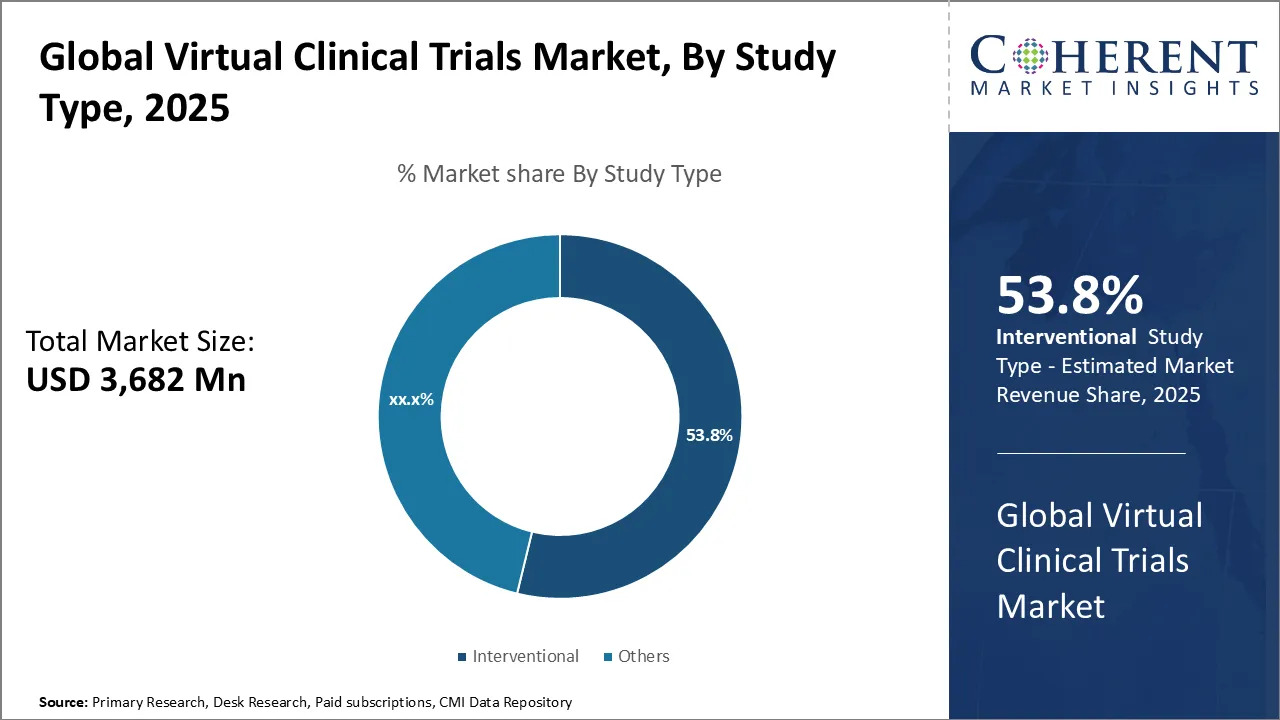
Virtual Clinical Trials Market Insights, By Study Type - Interventional contribute the highest share of the market owing to its cost efficiency and accelerated timelines
Interventional segment dominates the market with a share of 54.8%. Advancing digital health technologies, such as wearable devices and telemedicine, drive the growth of interventional virtual clinical trials by enabling real-time patient monitoring and data collection. These trials improve patient recruitment and retention by offering remote participation and greater convenience. Regulatory bodies support decentralized models, which accelerates adoption. Sponsors favor virtual trials for their cost efficiency and shorter timelines. The rising demand for patient-centric approaches also boosts engagement, allowing interventional virtual trials to deliver more efficient and scalable research outcomes. For instance, in December 2024, Edgewise Therapeutics, Inc., a biopharmaceutical company focused on muscle diseases, reported positive topline results from its Phase 2 CANYON trial of sevasemten in individuals with Becker muscular dystrophy. The trial successfully met its primary endpoint, showing a reduction in CK levels from baseline. CANYON represents the largest interventional trial conducted in Becker muscular dystrophy to date and is the first to achieve its primary endpoint in this patient population.
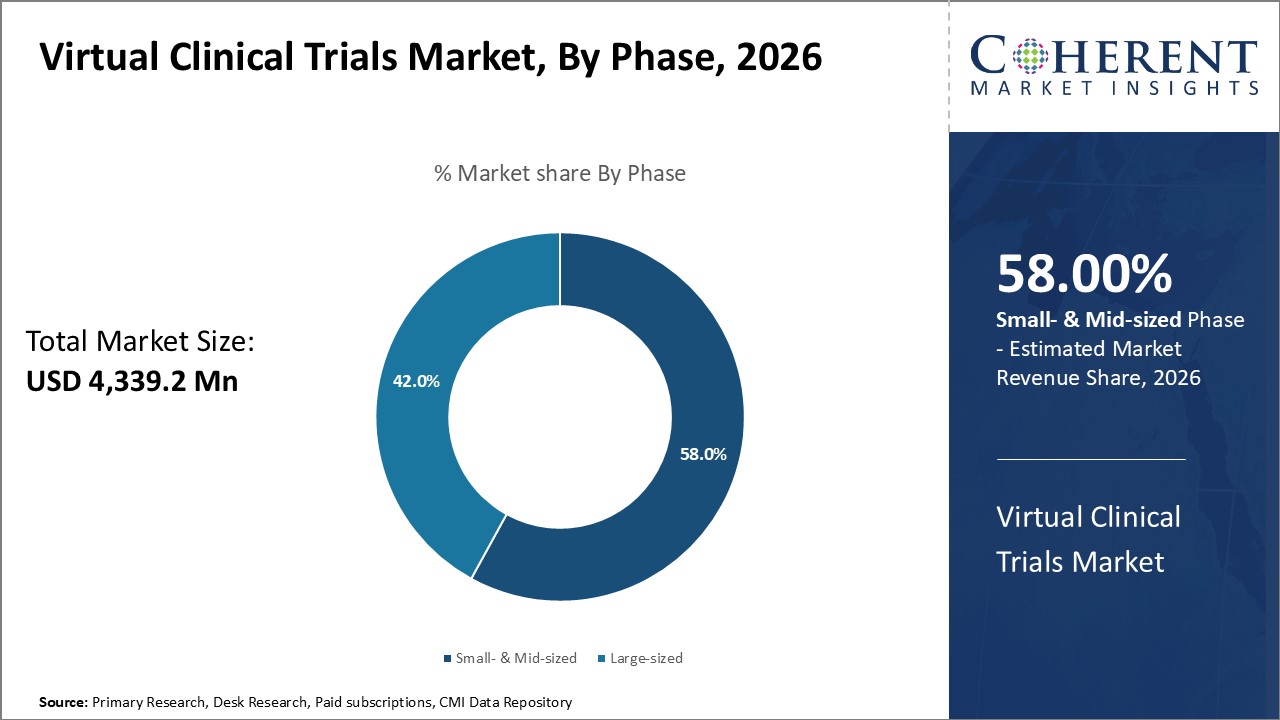
Virtual Clinical Trials Market Insights, By Phase - Late Stage contribute the highest share of the market owing to its enhanced patient recruitment and retention
Sponsors drive the growth of late-stage virtual clinical trials by cutting costs and simplifying operations, reducing the need for traditional clinical sites and easing travel demands on investigators and patients. They use advanced digital tools like electronic data capture, telehealth, and AI to accelerate recruitment, streamline consent, and manage data in large Phase III–IV studies. Regulatory agencies such as the FDA and EMA support decentralized models, further promoting adoption and enabling consistent oversight for virtual trials conducted across global regions.
Virtual Clinical Trials Market Insights, By Company Size - Small & Mid-Size contribute the highest share of the market owing to its cost efficiency and resource optimization
Small and mid-sized pharmaceutical and biotech firms are driving the adoption of virtual clinical trials by seeking cost-effective alternatives to expensive in-house infrastructure and CRO outsourcing. With limited internal resources, they turn to virtual platforms that reduce trial costs and ease financial pressure. These companies use virtual models to streamline operations and reach wider patient populations without sacrificing data quality. As activity in this segment accelerates, small and mid-sized sponsors increasingly rely on virtual trial designs as practical, efficient research solutions.
Virtual Clinical Trials Market Insights, By Therapeutic Area - Oncology contributes the highest share of the market owing to its enhanced patient access and recruitment
Pharmaceutical companies are adopting virtual oncology trials in response to the rising cancer burden and growing research demands. They use advanced digital tools—such as AI-powered patient matching, telemedicine, e-consent, and remote monitoring—to speed up recruitment, simplify enrollment, and ease participation for patients. These platforms support continuous symptom tracking and allow investigational drugs to reach patients at home, improving convenience and data quality. Regulatory bodies back decentralized approaches, which encourages further adoption and allows virtual trials to transform oncology with broader access and tailored treatment strategies.
Regional Insights
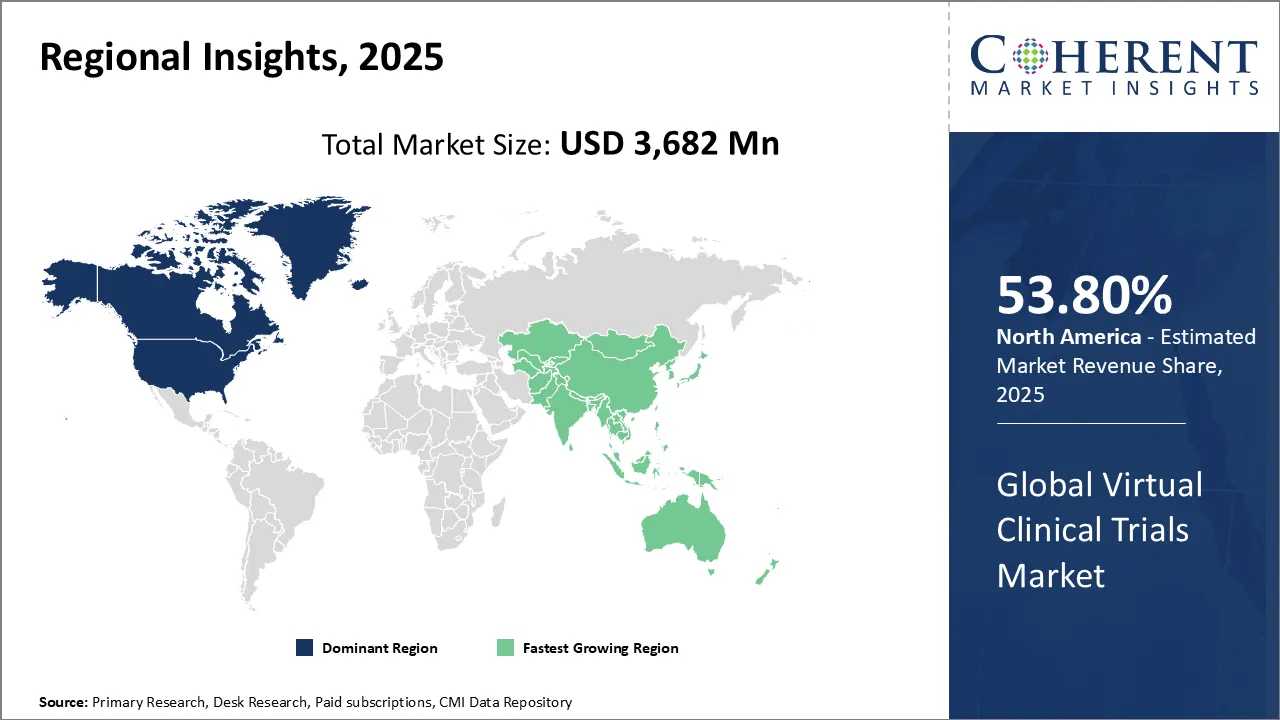
North America Virtual Clinical Trials Market Trends
North America holds the largest market share in 53.80% in 2026. In North America, strong R&D investments, broad adoption of digital health tools such as wearables, telehealth, and remote monitoring, and supportive policies from the FDA and Health Canada drive the growth of virtual clinical trials. Key companies like Parexel, Syneos Health, and Science 37 lead this shift by forming strategic partnerships and implementing hybrid and fully virtual trial designs that prioritize patient convenience and flexibility.
Asia Pacific Virtual Clinical Trials Market Trends
The Asia Pacific region is rapidly adopting digital technologies in clinical trials. Increasing smartphone use, better internet connectivity, and widespread telemedicine enable researchers to reach diverse patient populations remotely, boosting trial efficiency and patient engagement. Regulatory bodies across Asia Pacific are actively creating guidelines to support virtual clinical trials. Governments promote decentralized trial models by implementing policies that protect patient safety, ensure data privacy, and maintain trial integrity, encouraging innovation and broader acceptance of virtual methods in drug development.
United States Virtual Clinical Trials Market Trends
In the U.S., researchers are rapidly integrating digital health tools such as telehealth, mobile apps, and wearable devices into clinical trials. These technologies allow them to monitor patients remotely, streamline data collection, and boost patient adherence, accelerating the shift toward decentralized virtual trial models. Regulatory agencies, including the FDA, actively support virtual clinical trials by issuing guidance on remote data collection and patient safety. This regulatory support encourages sponsors to adopt decentralized methods while ensuring they comply with strict data privacy and quality standards.
In August 2026, Vibrent Health announced that its Digital Health Research Cloud for Government achieved FedRAMP® Moderate Authority to Operate (ATO) and is now listed on the FedRAMP Marketplace. The platform enables clinical, hybrid, decentralized, and remote health research across areas including cancer, chronic and autoimmune diseases, genomics, precision medicine, population health, and infectious diseases.
India Virtual Clinical Trials Market Trends
India is rapidly enhancing its digital infrastructure as more people gain internet access and use smartphones. This growth allows researchers to conduct virtual clinical trials by remotely monitoring patients and collecting data, especially in rural and semi-urban areas, thereby expanding access and reaching diverse populations. Increasing education and digital literacy initiatives are raising patient awareness about virtual trials. Patients are actively choosing to participate remotely, valuing the convenience and reduced travel, which helps improve recruitment and retention in virtual clinical studies.
Market Report Scope
Virtual Clinical Trials Market Report Coverage
| Report Coverage | Details | ||
|---|---|---|---|
| Base Year: | 2025 | Market Size in 2026: | USD 4,339.2 Mn |
| Historical Data for: | 2020 To 2024 | Forecast Period: | 2026 To 2033 |
| Forecast Period 2026 to 2033 CAGR: | 17.9%2033 Value Projection: | USD 13,700.0 Mn | |
| Geographies covered: |
| ||
| Segments covered: |
| ||
| Companies covered: | Delve Health, Clario, Clinical Ink, Castor, Accenture, Thread, Science 37, Medable, Dassault Systèmes, and eElinicalHealth (CLINPAL), among others. | ||
| Growth Drivers: |
| ||
| Restraints & Challenges: |
| ||
Virtual Clinical Trials Market Trend
- Expansion of Decentralized Trial Models
Virtual clinical trials are increasingly adopting decentralized models, allowing patients to participate from home or local healthcare facilities rather than centralized sites. This shift reduces patient burden, increases recruitment diversity, and accelerates trial timelines. Advances in remote monitoring, telehealth, and mobile health applications support this transition, enabling real-time data collection and continuous patient engagement. Sponsors and CROs are investing in infrastructure and partnerships to scale decentralized trials globally, improving accessibility and operational efficiency.
- Integration of Advanced Digital Technologies
The market is rapidly embracing technologies such as artificial intelligence, machine learning, wearable sensors, blockchain, and cloud computing to enhance virtual clinical trials. These tools enable better data accuracy, patient monitoring, and security while facilitating real-time analytics and adaptive trial designs. AI-powered algorithms help in patient recruitment and predicting trial outcomes. The integration of these technologies is transforming trial execution by reducing costs, minimizing errors, and improving overall data quality and regulatory compliance.
Virtual Clinical Trials Market Opportunity
- Enhancing Patient Recruitment and Diversity
Virtual clinical trials offer significant opportunities to improve patient recruitment by reaching broader and more diverse populations. Remote participation eliminates geographical barriers, making it easier to include underserved or hard-to-reach groups. This inclusivity can generate more representative clinical data and improve the generalizability of trial outcomes. Sponsors can tap into global patient pools while reducing recruitment timelines and costs, thus accelerating drug development and improving overall trial efficiency.
Virtual Clinical Trials Market News
- In March 2025, Lindus Health, known as the "anti-CRO" for conducting significantly faster and more reliable clinical trials, partnered with Tiefenbacher Group, a leading healthcare company delivering top-tier solutions across the pharmaceutical value chain. Together, they have launched a clinical trial focused on Myalgic Encephalomyelitis/Chronic Fatigue Syndrome (ME/CFS).
- In May 2025, Life science organizations from Copenhagen, Lund, Hamburg, Kiel, and Oslo launched the Nordic Virtual Office—a joint initiative aimed at giving companies in these regions direct access to the NIHR and fostering collaboration with the NHS and leading researchers based in the UK.
- In September 2024, PicnicHealth launched its Clinical Services, introducing a Virtual Clinic for patients and a Virtual Site for life sciences companies. Supported by PicnicHealth’s in-house medical team, these services aim to improve patient care management while enabling life sciences companies to conduct more efficient observational research.
Analyst Opinion (Expert Opinion)
- Virtual clinical trials (VCTs) are no longer a futuristic concept but a critical necessity reshaping drug development with unmatched speed and precision.
- Data from the Tufts Center for the Study of Drug Development underscores a glaring inefficiency in traditional trials, where approximately 30% of sites underperform or fail to enroll any patients. VCTs drastically mitigate this by removing geographic constraints—Verily’s Project Baseline study enrolled thousands nationwide using remote technologies, slashing recruitment timelines by over 50%. This demonstrates that VCTs are not just theoretical improvements but practical game changers in patient engagement.
- However, adoption is uneven, with legacy CROs and sponsors hesitating due to concerns over data integrity and regulatory uncertainty. This hesitation is misplaced. The FDA’s March 2020 guidance on decentralized trials has evolved into robust frameworks, as seen in recent approvals leveraging remote monitoring. The successful trial of Roche’s multiple sclerosis drug Ocrevus, which included remote monitoring, validated that regulators increasingly embrace virtual data as equally reliable.
- The integration of AI and wearables is creating unparalleled opportunities for real-time data analytics, enabling adaptive trial designs that were impossible a decade ago. For instance, Medable’s platform, used in over 100 decentralized trials, leverages AI to identify patient risk factors and protocol deviations early, reducing costly delays.
Speak to the analyst
Want personalized insights?
Take the findings above to one of our principal consultants, or have the report rebuilt around the segments, geographies and competitors you actually track.
Market Segmentation
- Global Virtual Clinical Trials Market, By Study Type (Revenue, USD Mn, 2021 - 2033)
- Interventional
- Others
- Global Virtual Clinical Trials Market, By Phases (Revenue, USD Mn, 2021 - 2033)
- Late Stage
- Early Stage
- Global Virtual Clinical Trials Market, By Company Size (Revenue, USD Mn, 2021 - 2033)
- Small- & Mid-sized
- Large-sized
- Global Virtual Clinical Trials Market, By Therapeutic Area (Revenue, USD Mn, 2021 - 2033)
- Oncology
- Rare & Genetic Diseases
- CNS
- Immunology
- Others
- Global Virtual Clinical Trials Market, By Geography (Revenue, USD Mn, 2021 - 2033)
- North America
- U.S.
- Canada
- Latin America
- Brazil
- Argentina
- Mexico
- Rest of Latin America
- Europe
- Germany
- U.K.
- Spain
- France
- Italy
- Russia
- Rest of Europe
- Asia Pacific
- China
- India
- Japan
- Australia
- South Korea
- ASEAN
- Rest of Asia Pacific
- Middle East
- GCC Countries
- Israel
- Rest of Middle East
- Africa
- South Africa
- North Africa
- Central Africa
- North America
- Key Players Insights
- Delve Health
- Clario
- Clinical Ink
- Castor
- Accenture
- Thread
- Science 37
- Medable
- Dassault Systèmes
- eElinicalHealth (CLINPAL)
Sources
Primary Research Interviews
- Clinical Research Organization (CRO) executives
- Clinical trial site investigators
- Regulatory affairs professionals from pharmaceutical companies
- Digital health technology vendors
- Patient advocacy group representatives
- Virtual trial platform developers
- Medical officers involved in decentralized trials
Databases
- PubMed
- ClinicalTrials.gov
- U.S. FDA Clinical Data Summary Pilot
- WHO International Clinical Trials Registry Platform (ICTRP)
- European Medicines Agency (EMA) clinical trial database
- India’s CTRI (Clinical Trials Registry – India)
Magazines
- PharmaVoice
- Applied Clinical Trials
- The Pharma Letter
- Fierce Biotech
- MobiHealthNews
Journals
- Journal of Clinical Oncology
- Contemporary Clinical Trials
- The Lancet Digital Health
- Nature Digital Medicine
- Therapeutic Innovation & Regulatory Science
- Journal of Medical Internet Research (JMIR)
Newspapers
- The New York Times (Health Section)
- The Guardian (Healthcare & Tech)
- The Hindu (Sci-Tech section)
- Financial Times (Pharma & Life Sciences coverage)
- The Washington Post (Health & Technology)
Associations
- U.S. Food and Drug Administration (FDA)
- European Medicines Agency (EMA)
- Indian Council of Medical Research (ICMR)
- Medicines and Healthcare products Regulatory Agency (MHRA)
- Society for Clinical Research Sites (SCRS)
- Drug Information Association (DIA)
- Clinical Trials Transformation Initiative (CTTI)
Public Domain Sources
- World Health Organization (WHO)
- Centers for Disease Control and Prevention (CDC)
- National Institutes of Health (NIH)
- U.S. Department of Health and Human Services (HHS)
- European Commission Public Health Portal
- Ministry of Health and Family Welfare (India)
Proprietary Elements
- CMI Data Analytics Tool, and Proprietary CMI Existing Repository of information for last 8 years
Get access to 250+ pages report
Every segment, forecast, competitor profile and data table behind the analysis above — available for instant download.
- ESOMAR Member
- ISO 9001:2015 Certified
- D-U-N-S Registered
- GDPR & CCPA Compliant
Missing comfort of reading report in your local language? Find your preferred language:
Transform your Strategy with Exclusive Trending Reports
Frequently Asked Questions
The Virtual Clinical Trials Market is estimated to be valued at USD 4,339.2 Mn in 2026, and is expected to reach USD 13,700.0 Mn by 2033.
The CAGR of the Virtual Clinical Trials Market is projected to be 17.9% from 2026 to 2033.
Growing burden of diseases and spike in virtual clinical trials across the globe is fueling the market.
The interventional segment is the leading component segment in the market.
Strict rules and regulations and challenges associated with virtual clinical trials are major factors restraining market.
Major players operating in the market are Delve Health, Clario, Clinical Ink, Castor, Accenture, Thread, Science 37, Medable, Dassault Systèmes, and eElinicalHealth (CLINPAL), among others.