

Anti-Decubitus Dynamic Mattresses Market Size and Share Analysis- 2026 To 2033
The Anti-Decubitus Dynamic Mattresses Market size is anticipated to grow at a CAGR of 6.5%, with USD 2.41 Bn in 2026, and is expected to reach USD 3.74 Bn in 2033. The primary drivers are largely defined by the rising prevalence of pressure injuries among immobile and bedridden patients, growing geriatric population, increasing hospitalization and long-term care requirements, and wider adoption of pressure-redistribution mattresses across hospitals and nursing homes. According to a systematic review and meta-analysis indexed in PubMed covering 23 studies with 70,340 elderly inpatients, about 8.2% of patients developed pressure injuries during hospitalization (2025).
Key Takeaways
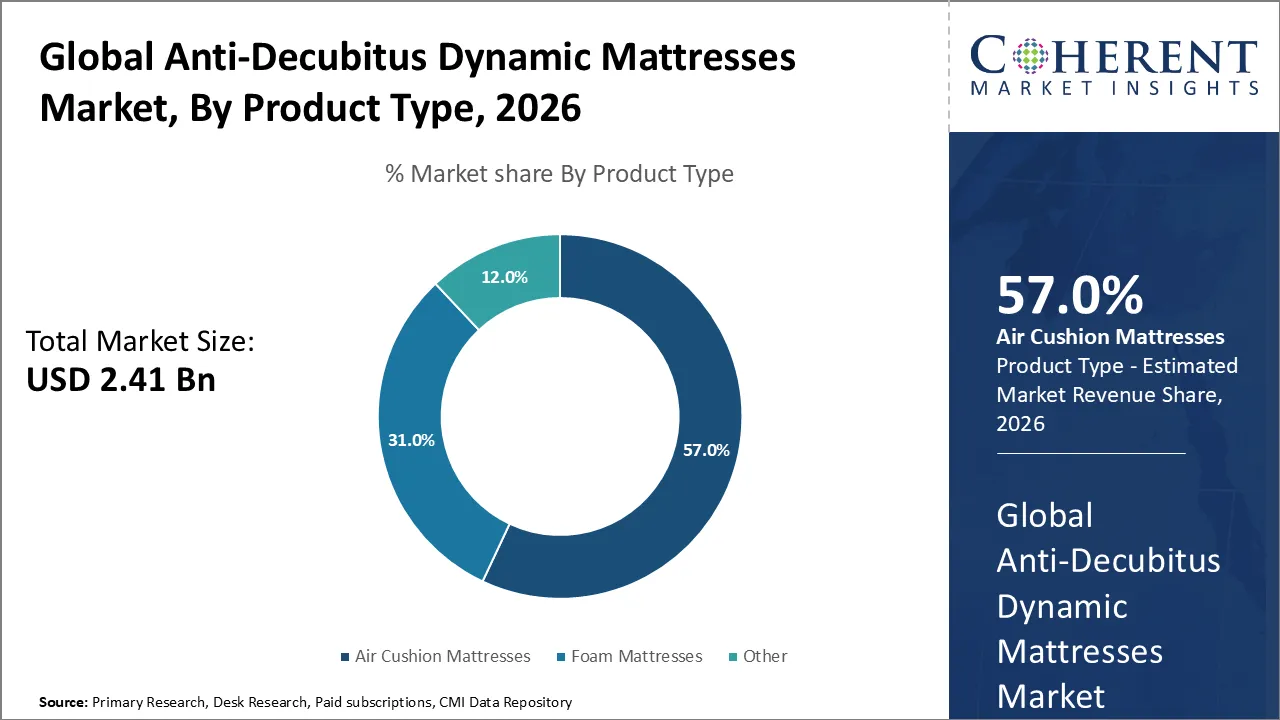
- Air cushion mattresses is expected to capture the largest market share of around 57.0% in 2026 in terms of product type segment. The segment growth can be attributed to the growing use of alternating pressure and low-air-loss systems for pressure redistribution, increasing adoption among immobile and critically ill patients, and increasing use of advanced support surfaces in intensive and long-term care. The established use of dynamic air-support technologies for pressure-injury prevention in critical care was demonstrated by a 2024 systematic review and meta-analysis of 3,308 adult ICU patients evaluating alternating-pressure and low-air-loss support surfaces.
- Hospitals are expected to lead the end user segment with approximately 61.0% in 2026. The segment’s growth is owing to the high concentration of critically ill, post-surgical, elderly, and mobility-impaired patients, increasing focus on hospital-acquired pressure-injury prevention, and wider implementation of pressure-redistribution protocols. Pressure injury occurred in 8.9% of patients using alternating-pressure surfaces compared with 10.9% using low-air-loss surfaces, highlighting the continued clinical use of advanced pressure-redistribution systems among high-risk hospitalized patients.
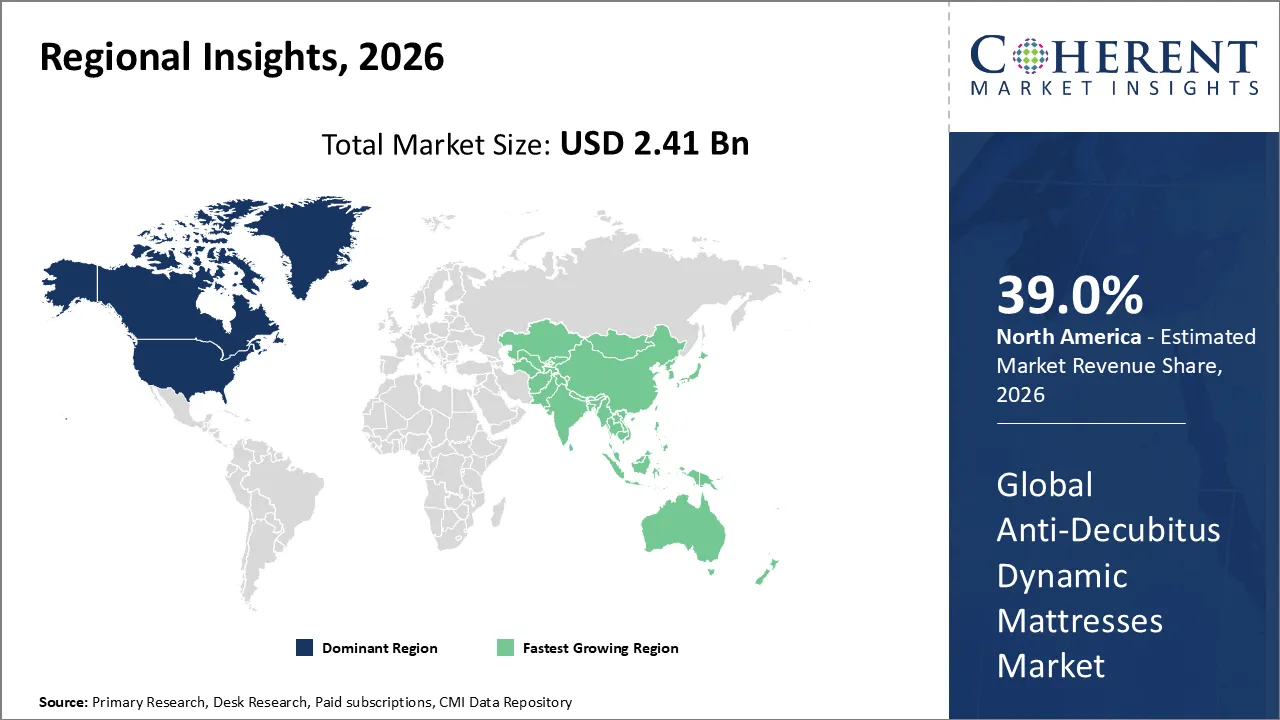
- North America is expected to acquire the prominent share of approximately 39.0% in 2026. The region’s growth is owing to advanced hospital infrastructure, high healthcare expenditure, a growing elderly population, and greater adoption of specialized pressure-management and patient-support technologies. According to the U.S. Centers for Medicare & Medicaid Services (CMS), U.S. healthcare expenditure reached USD 5.3 trillion in 2024, including approximately USD 1.63 trillion in hospital expenditures, which increased by 8.9% during the year.
Market Drivers
Rapid Growth in the Geriatric and Mobility-Impaired Population is Driving the Anti-Decubitus Dynamic Mattresses Market
The growing elderly population increases the patient pool requiring pressure-injury prevention and long-term mobility support. Older patients are more prone to decreased mobility, long periods of bed rest, chronic illnesses and longer hospital or long-term-care stays, so the clinical need for pressure redistribution with specialized mattresses is increased.
According to the World Health Organization (WHO) has estimated that by 2030, one in every six persons worldwide will be aged 60 years or older and the population in this age group will increase from about 1.0 billion in 2020 to 1.4 billion by 2030. The number is further projected to reach 2.1 billion by 2050.
Increasing Clinical Adoption of Advanced Pressure-Redistribution Surfaces is Accelerating Market Growth
Greater clinical emphasis on pressure-injury prevention is encouraging hospitals and long-term-care providers to move toward specialized support surfaces with pressure redistribution, alternating-pressure, microclimate-management, and shear-reduction capabilities. Dynamic mattresses are particularly relevant for high-risk patients with limited mobility who require continuous redistribution of interface pressure.
In 2025, the National Pressure Injury Advisory Panel (NPIAP), European Pressure Ulcer Advisory Panel (EPUAP), and Pan Pacific Pressure Injury Alliance (PPPIA) developed the International Clinical Practice Guideline, revised in August 2026, which acknowledges specialized mattresses and integrated support systems as valuable tools for pressure redistribution and the reduction of friction and shear.
Furthermore, a 2025 peer-reviewed study of four hospital mattress technologies found significant differences in interface pressure. Median peak pressure was as low as 25.7 mmHg on a powered mattress in the semi-Fowler position versus 55.5 mmHg on a non-powered hybrid mattress.
Current Events and Their Impact on the Anti-Decubitus Dynamic Mattresses Market
Current Event | Description and its Impact |
FDA Implements New Quality Management System Regulation for Medical Devices (2026) |
|
EU Makes Key EUDAMED Medical-Device Modules Mandatory (2026) |
|
- Current Industry Events of 2026
- Market Size Estimation
- Regional Breakdown
- Competitive Landscape
- Customer Intelligence
- Segmental Analysis
- Pricing Analysis
- Key Market Drivers, Challenges & Future Trends
- Customized Insights Section
Segmental Insights
Why are Air Cushion Mattresses Acquiring the Largest Share?
On the basis of product type, the air cushion mattresses segment is projected to account for the largest Anti-Decubitus Dynamic Mattresses Market share of approximately 57.0% in 2026. The segment’s growth is owing to the ability of alternating-pressure air systems to periodically redistribute body pressure, reduce prolonged loading over bony prominences, and support pressure-injury prevention among immobile and critically ill patients.
A 2026 peer-reviewed study published in Clinics found that the implementation of alternating pressure air mattresses (APAMs) in an intensive care unit reduced the overall risk of pressure injuries by 33% and the risk of severe Stage III–IV pressure injuries by 84%.
In June 2025, Stryker launched the APAISER X1 advanced ICU air mattress in India. The system incorporates independent low-air-loss technology, a 3-in-1 TrueCare alternating-pressure system, and Alternate, Static, and Constant Low Pressure care modes.
Why do Hospitals Hold the Largest Market Share?
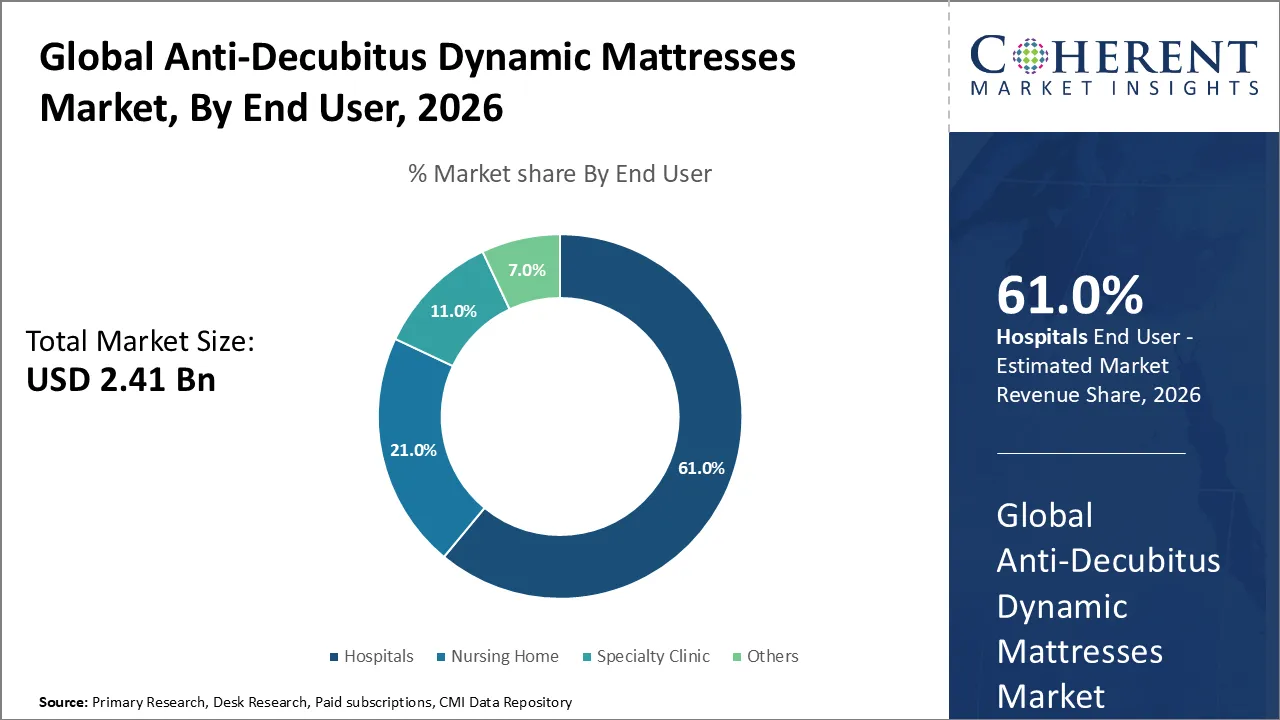
On the basis of end user, the hospitals segment is projected to lead the Anti-Decubitus Dynamic Mattresses Market with approximately 61.0% share in 2026. The segment’s growth is owing to the high concentration of critically ill, immobilized, post-operative, mechanically ventilated, and long-stay patients who require continuous pressure-injury risk assessment and pressure-redistribution support.
The U.S. Agency for Healthcare Research and Quality (AHRQ) reported that its 2025 pressure-injury chartbook analyzed 93,807 reported pressure-injury events submitted to the Network of Patient Safety Databases through December 2024.
In August 2026, Blue Chip Medical Products announced the commercial availability of its Pro-Daptive SensorCell advanced wound-care support surface, which is intended for the prevention and treatment of complex pressure injuries, including Stage III, Stage IV and unstageable wounds, as well as for post-flap and post-graft care.
Anti-Decubitus Dynamic Mattresses Market Trends
- The increasing use of adjustable alternating-pressure air systems is allowing for more customized pressure redistribution according to patient posture, tissue perfusion and clinical risk. In a randomized crossover study in 2025, sacral tissue perfusion was influenced by altering the speed of the air-inflation cycle so that with slow-cycle operation, 60%-100% of subjects had high levels of perfusion in the high-sitting position.
- Increasing adoption of sensors, patient-turn monitoring and digital pressure-injury prevention platforms is transforming dynamic mattresses from passive support surfaces to connected patient-management systems. A 2025 study at a 120-bed critical-care service line reported that implementation of wearable sensor technology to support patient repositioning was associated with a 54% reduction in hospital-acquired pressure injuries.
- The rising use of continuous bedside pressure mapping and objective mattress-performance assessment is helping hospitals select support surfaces according to individual patient risk rather than relying only on standard mattress categories. A 2026 systematic review evaluated 18 studies of continuous bedside pressure mapping across hospital and long-term-care settings, reflecting the growing clinical interest in real-time pressure-distribution monitoring.
Regional Insights
North America Dominates Owing to Advanced Healthcare Infrastructure and a Growing Elderly Patient Population
North America is expected to acquire the prominent Anti-Decubitus Dynamic Mattresses Market share of approximately 39.0% in 2026. The region’s growth is owing to its advanced hospital infrastructure, high adoption of pressure-injury prevention technologies, established medical-device industry, and large elderly and mobility-impaired patient population.
According to the U.S. Census Bureau, in June 2025, the U.S. population aged 65 years and above reached 61.2 million in 2024, increasing by 3.1% in just one year. Older adults accounted for 18.0% of the total U.S. population, compared with 12.4% in 2004. The continuing expansion of this high-risk demographic is increasing demand for pressure-injury prevention and specialized support surfaces across hospitals, nursing facilities, rehabilitation centers, and home-care settings.
In April 2026, U.S.-based Agiliti launched Capillaire, a low-profile alternating-pressure air support surface designed for surgical, perioperative, and emergency-care environments.
Asia Pacific Anti-Decubitus Dynamic Mattresses Market Trends
Asia Pacific is expected to witness the fastest growth in the Anti-Decubitus Dynamic Mattresses Market over the forecast period. The region’s growth is owing to rapid population ageing, expansion of hospital and long-term-care infrastructure, increasing awareness of pressure-injury prevention, and improving access to advanced patient-support technologies.
According to the United Nations Economic and Social Commission for Asia and the Pacific (ESCAP), in 2025, approximately 516 million people aged 65 years and above live in Asia Pacific, representing 10.8% of the region’s population. This proportion is projected to increase to 19.4% by 2050. The region already accounts for around 60% of the world’s older population, creating a substantial long-term patient base for pressure-management products.
In April 2025, China-based BEWATEC launched its Smart Alternating Pressure Air Mattress for pressure-injury prevention and management. The system provides Alternating, Static, Nursing, and Turning modes and automatically adjusts mattress pressure according to the patient’s BMI.
Large Post-Acute Care Network and Pressure-Injury Prevention Focus are Supporting the Anti-Decubitus Dynamic Mattresses Market in the United States
The U.S. Anti-Decubitus Dynamic Mattresses Market is witnessing steady growth owing to the large hospital and post-acute-care infrastructure, increasing clinical focus on preventing pressure injuries, and growing adoption of alternating-pressure, low-air-loss, and sensor-based support surfaces for immobile and high-risk patients.
According to the U.S. Centers for Disease Control and Prevention (CDC/NCHS), 18.2% of U.S. adults reported difficulty walking or climbing steps in 2024, demonstrating the substantial population affected by mobility limitations.
China Anti-Decubitus Dynamic Mattresses Market Trends
China is expected to witness strong growth in the Anti-Decubitus Dynamic Mattresses Market over the forecast period. The growth is owing to the rapid expansion of elderly-care infrastructure, increasing need for long-term care among disabled and mobility-limited elderly people, and government policies encouraging development of nursing-oriented beds and advanced elderly-care equipment.
According to China's National Bureau of Statistics, by the end of 2025 the country had approximately 39,000 elderly-care institutions and 7.68 million beds dedicated to elderly care. This large institutional care base is creating substantial demand for specialized beds and pressure-redistribution mattresses used for residents with limited mobility and prolonged bed-rest requirements.
Who are the Major Companies in Anti-Decubitus Dynamic Mattresses Industry
Some of the major key players in Anti-Decubitus Dynamic Mattresses Market are LINET, Hirtz & Co. KG, APEX MEDICAL CORP, Hill-Rom Services Inc., Drive DeVilbiss Sidhil Ltd., Malvestio, Stryker, ARDO, ROHO, EHOB, and Benmor Medical.
Key News
- In January 2026, Baxter, which owns Hillrom, announced the U.S. launch of the Dynamo Series smart stretcher, expanding its portfolio of smart beds, support surfaces, and connected-care solutions.
- In September 2024, Drive DeVilbiss Healthcare announced significant upgrades to its therapeutic support surfaces and mattress portfolio. The company introduced weldable polyurethane-coated ticking, welded seams for improved water resistance, upgraded mattress handles, and redesigned tie-down straps to reduce mattress migration.
Market Report Scope
Anti-Decubitus Dynamic Mattresses Market Report Coverage
Report Coverage | Details | ||
Base Year: | 2025 | Market Size in 2026: | USD 2.41 Bn |
Historical Data for: | 2020 to 2024 | Forecast Period: | 2026 to 2033 |
CAGR: | 6.5% | 2033 Value Projection: | USD 3.74 Bn |
Geographies covered: |
| ||
Segments covered: |
| ||
Companies covered: | LINET, Hirtz & Co. KG, APEX MEDICAL CORP, Hill-Rom Services Inc., Drive DeVilbiss Sidhil Ltd., Malvestio, Stryker, ARDO, ROHO, EHOB, and Benmor Medical. | ||
Growth Drivers: |
| ||
Restraints & Challenges: |
| ||
Analyst Opinion
- The Anti-Decubitus Dynamic Mattresses Market is expected to benefit from the growing emphasis on early pressure-injury prevention in critical-care settings. A 2025 ICU surveillance study found pressure injuries in 8.35% of patients, with 63.19% of identified injuries acquired during the ICU stay. Importantly, 70.3% of ICU-acquired pressure injuries were identified within the first five days.
- Pressure-injury prevention is increasingly moving toward structured, multi-component care protocols, providing a greater institutional role for advanced support surfaces. A 2025 systematic review and meta-analysis covering 29,572 patients across nine studies found that pressure-injury prevention care bundles significantly reduced hospital-acquired pressure injuries and were also associated with shorter hospital stays and fewer and less-severe pressure injuries.
- Hospitals are also becoming increasingly focused on measurable prevention outcomes, which is expected to favor technologically advanced mattresses over basic support surfaces in high-risk care environments. A 2025 study in a cardiothoracic ICU reported that implementation of a risk-assessment-linked pressure-injury prevention program reduced pressure-injury prevalence by 67.84% and incidence by 36.43%
Speak to the analyst
Want personalized insights?
Take the findings above to one of our principal consultants, or have the report rebuilt around the segments, geographies and competitors you actually track.
Market Segmentation
- By Product Type (Revenue, USD Bn, 2021-2033)
- Foam Mattresses
- Air Cushion Mattresses
- Other
- By End User (Revenue, USD Bn, 2021-2033)
- Hospitals
- Nursing Home
- Specialty Clinic
- Others
- By Region (Revenue, USD Bn, 2021-2033)
- North America
- U.S.
- Canada
- Latin America
- Brazil
- Mexico
- Argentina
- Rest of Latin America
- Europe
- Germany
- U.K.
- France
- Italy
- Spain
- Russia
- Rest of Europe
- Asia Pacific
- China
- India
- Japan
- Australia
- South Korea
- ASEAN
- Rest of Asia Pacific
- Middle East
- GCC
- Israel
- Rest of Middle East
- Africa
- South Africa
- Central Africa
- North Africa
- North America
Sources
Primary Research Interviews
- Wound care specialists and tissue viability nurses
- Hospital procurement and biomedical engineering managers
- ICU and critical care professionals
- Nursing home and long-term care administrators
- Pressure injury prevention specialists
- Medical mattress and support surface manufacturers
- Medical device distributors and channel partners
- Key opinion leaders (KOLs) in wound care and pressure injury management
Databases
- PubMed / National Library of Medicine
- World Health Organization (WHO)
- Centers for Medicare & Medicaid Services (CMS)
- OECD Health Statistics
- U.S. Food and Drug Administration (FDA) Medical Device Database
- Eurostat Healthcare Database
- U.S. Centers for Disease Control and Prevention (CDC)
Magazines
- Wounds International
- Wound Care Today
- McKnight’s Long-Term Care News
- Medical Device Network
- MedTech Dive
- Healthcare Purchasing News
Journals
- International Wound Journal
- Journal of Tissue Viability
- Advances in Skin & Wound Care
- Journal of Wound Care
- Wound Repair and Regeneration
- Intensive and Critical Care Nursing
Newspapers
- Reuters
- The Wall Street Journal
- Financial Times
- The New York Times
- The Guardian
- The Economic Times
Associations
- National Pressure Injury Advisory Panel (NPIAP)
- European Pressure Ulcer Advisory Panel (EPUAP)
- Pan Pacific Pressure Injury Alliance (PPPIA)
- Wound, Ostomy and Continence Nurses Society (WOCN)
- European Wound Management Association (EWMA)
- Association for the Advancement of Wound Care (AAWC)
Public Domain Sources
- Company Annual Reports and Investor Presentations
- Company Product Catalogs and Technical Specifications
- FDA 510(k) Clearances and Medical Device Classification Records
- EU MDR and EUDAMED Regulatory Publications
- Hospital and Long-Term Care Procurement Documents
- Government Healthcare and Elderly Care Statistics
- Clinical Practice Guidelines for Pressure Injury Prevention
- Peer-Reviewed Clinical Studies on Pressure-Redistribution Mattresses
- Patent Databases such as WIPO, USPTO, and Google Patents
Proprietary Elements
- CMI Data Analytics Tool
- Proprietary CMI Existing Repository of Information for the Last 10 Years
Get access to 250+ pages report
Every segment, forecast, competitor profile and data table behind the analysis above — available for instant download.
- ESOMAR Member
- ISO 9001:2015 Certified
- D-U-N-S Registered
- GDPR & CCPA Compliant
Missing comfort of reading report in your local language? Find your preferred language:
Transform your Strategy with Exclusive Trending Reports
Frequently Asked Questions
The Anti-Decubitus Dynamic Mattresses Market is expected to reach USD 3.74 Bn in 2033, increasing from USD 2.41 Bn in 2026.
Major players operating in the global Anti-Decubitus Dynamic Mattresses Market include LINET, Hirtz & Co. KG, APEX MEDICAL CORP, Hill-Rom Services Inc., Drive DeVilbiss Sidhil Ltd., Malvestio, Stryker, ARDO, ROHO, EHOB, and Benmor Medical.
The high cost of advanced dynamic mattress systems and limited affordability in low- and middle-income countries are key factors hampering market growth.
The rising prevalence of pressure injuries among bedridden and immobile patients, growing geriatric population, increasing long-term care requirements, and wider adoption of pressure-redistribution mattresses are boosting market growth.
The Anti-Decubitus Dynamic Mattresses Market is anticipated to grow at a CAGR of 6.5% between 2026 and 2033.
Among regions, North America is expected to account for the largest market share, with approximately 39.0% in 2026, supported by advanced healthcare infrastructure, high adoption of pressure-injury prevention technologies, and a large elderly population.
Asia Pacific is expected to witness the fastest growth over the forecast period owing to rapid population ageing, expanding hospital and long-term-care infrastructure, and improving access to advanced patient-support technologies.