

Scalp Microneedling Market Size and Share Analysis: 2026 - 2033
The global scalp microneedling market size is expected to reach around USD 250 Mn in 2026 and is projected to grow at a CAGR of 8.6% during the forecast period (2026-2033), surpassing USD 442.9 Mn by 2033.
Key Takeaways from the Scalp Microneedling Market Report
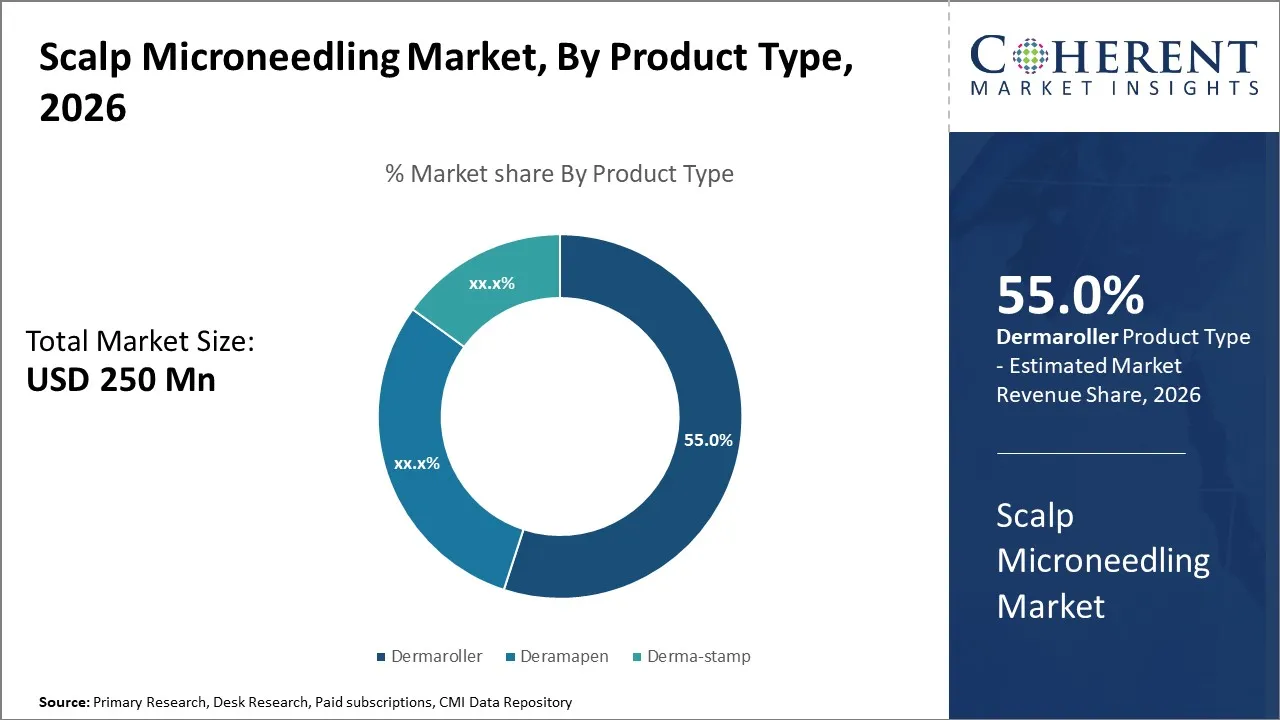
- Dermaroller is expected to remain the top-selling product type, accounting for more than 55% of market revenue in 2026, thanks to its widespread use, especially in home treatments.
- By end user, the dermatology clinics segment is slated to hold a 45% market share in 2026, driven by the growing adoption of scalp microneedling treatments.
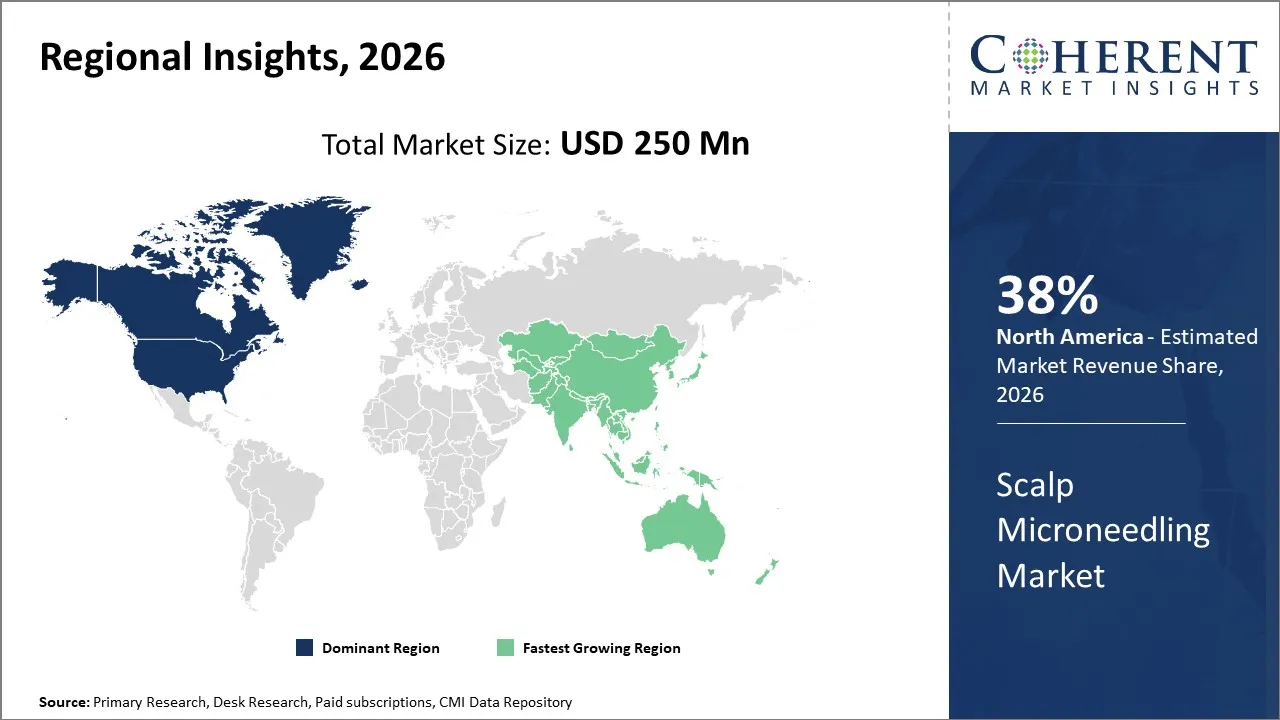
- North America is projected to account for nearly 38% of the global scalp microneedling industry in 2026. This is mostly due to strong adoption of aesthetic procedures and healthcare infrastructure.
- Asia Pacific, with a share of 20% in 2025, is poised to emerge as the fastest-growing market for scalp microneedling solutions during the forecast period.
Scalp Microneedling Market Overview
The global scalp microneedling market is expected to grow rapidly during the forecast period. This is attributable to rising prevalence of hair loss and alopecia across, increasing consumer awareness about advanced hair restoration treatments, and growing adoption of minimally invasive cosmetic procedures. In addition, technological advancements in microneedling devices, along with the integration of platelet-rich plasma (PRP) therapy and other hair growth-promoting solutions, are fueling market growth.
Scalp microneedling, also known as collagen induction therapy (CIT), is a procedure that creates controlled micro-injuries to the scalp, which can stimulate hair follicles as well as promote hair growth and improve blood circulation. It also increases collagen synthesis in the scalp and enhances the absorption of topical hair growth products. Some studies show that combining microneedling with other therapies, such as minoxidil, improves hair growth compared with using these treatments alone. The procedure is typically performed using a dermaroller or dermapen, which come in various needle sizes.
The choice of needle length depends on the scalp condition and treatment goal. These devices are usually made with fine titanium or stainless steel needles that are safe when used correctly, though improper use may lead to irritation or other side effects. Rising demand for effective and minimally invasive hair restoration solutions is expected to boost growth of the scalp microneedling market during the forecast period.
Current Events and Their Impact on the Scalp Microneedling Market
Current Event | Description and its Impact |
Rising Global Hair Loss Prevalence and Awareness |
|
Technological Advancements in Medical Aesthetics |
|
Segmental Insights
- Current Industry Events of 2026
- Market Size Estimation
- Regional Breakdown
- Competitive Landscape
- Customer Intelligence
- Segmental Analysis
- Pricing Analysis
- Key Market Drivers, Challenges & Future Trends
- Customized Insights Section
Scalp Microneedling Market Insights, By Product Type - Dermaroller Remains the Most Sought-After Product Type in the Market
By product type, dermaroller segment is expected to account for a market revenue share of 55% in 2026. This is attributable to its affordability, ease of use, and convenience for at-home treatments. They allow users to enhance the absorption of topical hair growth solutions while promoting collagen production in the scalp, making them an effective option for hair restoration.
Dermarollers are also gaining popularity due to increasing consumer awareness about hair restoration and scalp health, as well as growing endorsements by dermatologists and beauty professionals. The device works well by helping the scalp absorb topical treatments better and by boosting collagen production, which makes it more popular in the scalp microneedling market.
Scalp Microneedling Market Insights, By End User - Dermatology Clinics Continue to Lead the Scalp Microneedling Market
Based on application, dermatology clinics segment is anticipated to account for a market share of 45% market share in 2026. This is mostly due to growing preference for professional-grade treatments, increasing consumer awareness about hair restoration, and the rising number of dermatologists adopting advanced microneedling devices. Dermatology clinics offer personalized treatment plans, ensuring better efficacy and patient satisfaction. This further drives the demand for scalp microneedling procedures in clinical settings.
Regional Insights
North America Becoming a Hotbed for Scalp Microneedling Device Manufacturers
North America is expected to dominate the global scalp microneedling industry, holding a share of 38% in 2026. This is mostly due to rising demand for minimally invasive hair restoration treatments, especially in the U.S. and Canada. Increasing adoption of microneedling combined with regenerative therapies, such as stem cell-based hair rejuvenation and PRP therapies, is driving adoption among dermatologists and cosmetic specialists. In addition, the availability of FDA-approved and clinically validated devices encourages adoption of advanced scalp microneedling treatments in North America.
Asia Pacific Becoming a Hotbed for Scalp Microneedling Device Manufacturers
Asia Pacific is anticipated to account for over 20% share in the global scalp microneedling market in 2026. The growth is mostly due to increasing awareness of hair loss treatments, rise in cosmetic clinics, and growing disposable income in countries like China, Japan, and India. Technological advancements in microneedling devices, such as automated pens with adjustable needle depth and combined therapy with PRP (Platelet-Rich Plasma), are boosting adoption. Likewise, social media influence and rising popularity of aesthetic treatments among millennials and working professionals are fueling scalp microneedling market expansion in the region.
Scalp Microneedling Market Outlook – Country-wise
United States Scalp Microneedling Market Forecast
The U.S. scalp microneedling industry is growing steadily because more men and women seek minimally invasive hair restoration for thinning and hair loss. High disposable income, widespread dermatology clinics, and demand for FDA-approved microneedling devices are key growth factors. Combining microneedling with topical treatments and professional clinician training programs is shaping market trends.
China Scalp Microneedling Market Trends
The scalp microneedling market in China is expected to grow rapidly during the forecast period. This is mostly due to rising awareness of hair loss treatments and scalp health, especially among urban populations. Increasing demand for professional hair care clinics, advanced microneedling devices, and at-home treatment solutions is driving growth. Social media and beauty influencers are also encouraging adoption, while combination therapies with serums and PRP are becoming popular.
Scalp Microneedling Industry News
- In February 2026, Kaplancommunications launched its new megiwellness scalp activation derma roller. The new solution features 192 spaced needles to ensure precise scalp penetration with treatment.
- In September 2025, KeraFactor expanded its scalp microneedling portfolio with the launch of KeraRoller, a dermatologist-developed, hormone-free device. It is designed primarily for scalp revitalization while supporting overall hair health, including brows and lashes.
- In February 2023, Beauty Health Company acquired SkinStylus, an FDA‑cleared microneedling device. The SkinStylus microneedling device is cleared by the FDA to help improve the appearance of certain scars on the skin.
Market Report Scope
Scalp Microneedling Market Report Coverage
| Report Coverage | Details | ||
|---|---|---|---|
| Base Year: | 2025 | Market Size in 2026: | USD 250 Mn |
| Historical Data for: | 2020 To 2024 | Forecast Period: | 2026 To 2033 |
| Forecast Period 2026 to 2033 CAGR: | 8.6% | 2033 Value Projection: | USD 442.9 Mn |
| Geographies covered: |
| ||
| Segments covered: |
| ||
| Companies covered: | Dermapen, Dermaroller GmbH, Zcalp, Envision Medical Spa, MDPen Fractional Microdermal Needling, DermaConcepts, ConceptSkincare, Ramboll Environ, Inc., Edge Systems LLC., Weyergans High Care, and Bomtech Electronics Co., Ltd. | ||
| Growth Drivers: |
| ||
| Restraints & Challenges: |
| ||
Scalp Microneedling Market Drivers
Rising Prevalence of Hair Loss Disorders
Hair loss disorders, such as androgenetic alopecia (male and female pattern hair loss), alopecia areata, and scarring alopecia, impact millions of individuals globally. For example, the American Academy of Dermatology (AAD) reports that approximately 2% of the worldwide population suffers from alopecia areata. The increasing prevalence of these conditions is anticipated to fuel growth of the scalp microneedling market in the coming years.
Individuals experiencing hair thinning and hair loss are increasingly seeking advanced hair restoration solutions such as follicular unit transplantation (FUT), direct hair implantation, platelet-rich plasma (PRP) therapy, topical hair growth treatments, and scalp microneedling. As a result, the rising incidence of hair loss is expected to significantly drive the adoption of scalp microneedling procedures and related hair restoration treatments.
Rising Demand for Non-Surgical Hair Restoration
Consumers in the contemporary world are increasingly seeking non-invasive solutions to hair thinning and hair loss. This is making scalp microneedling a popular alternative to surgical procedures like hair transplants. Its ability to stimulate scalp blood circulation and support follicle activity boosts its appeal. Thus, rising preference for non-invasive hair treatments is expected to boost sales of scalp needling solutions during the forecast period.
Scalp Microneedling Market Trends
Rising Popularity of Combination Therapies
The shift toward combination therapies is a key growth-shaping trend in the scalp microneedling market. Clinics are increasingly integrating microneedling with adjunct treatments, especially PRP (Platelet-Rich Plasma) and hair growth serums, to enhance hair regeneration outcomes and meet patient demand for improved results. For example, a study published in the National Library of Medicine reported that combining PRP with microneedling can be effective for androgenetic alopecia. This trend of combination treatments is driving both clinician adoption and consumer interest.
Technological Advancements in Scalp Microneedling Devices
Innovations such as motorized pens, adjustable needle depths, and improved ergonomics are making scalp microneedling procedures more precise, effective, and comfortable. These technological improvements are expected to create new revenue opportunities for manufacturers of scalp microneedling solutions during the forecast period. Additionally, advancements in user-friendly design are supporting at-home scalp microneedling devices, helping to expand the market beyond clinic use.
Scalp Microneedling Market Opportunities
Increasing Awareness of Hair Health and Treatment Options
People in the contemporary world are increasingly becoming aware about the causes of hair loss and the benefits of advanced scalp therapies. This is driving higher adoption of microneedling procedures. Social media, beauty influencers, and educational campaigns by dermatology organizations are informing more consumers about this option, leading to higher scalp microneedling market demand.
Expansion of Dermatology Clinics, MedSpas and Beauty Centers
The global expansion of clinics and aesthetic service providers is improving access to microneedling treatments, especially in urban and affluent regions. Clinics often bundle scalp microneedling with other cosmetic services, boosting uptake. Thus, increasing number of dermatology clinics and other end users is expected to create growth prospects for the scalp microneedling market in the coming years.
Analyst Opinion (Expert Opinion)
- Device design and needle configuration now dictate treatment efficacy more than marketing claims. In the U.S., clinics using adjustable 0.25–1.5 mm multi-needle cartridges reported a 27% faster patient-reported improvement in hair density over single-needle rollers. Dermatologists increasingly evaluate microneedling pens by needle geometry and depth consistency rather than brand reputation.
- Combination therapies are redefining patient outcomes. Clinics in South Korea integrating microneedling with topical platelet-rich plasma (PRP) treatments observed a 33% higher follicle stimulation rate compared with standalone microneedling. This shows that procedural synergy, not the standalone device, is becoming the key metric for adoption.
- Home-use device performance is no longer secondary to clinical-grade units. Japanese consumers adopting smart microneedling pens with depth sensors and automated vibration reported a 21% higher satisfaction rate in hair regrowth surveys compared with manual rollers. This trend highlights that precise engineering in home devices is directly driving consumer loyalty.
Speak to the analyst
Want personalized insights?
Take the findings above to one of our principal consultants, or have the report rebuilt around the segments, geographies and competitors you actually track.
Scalp Microneedling Market Segmentation
- By Product Type Insights ( Revenue, USD Mn, 2020 - 2033)
- Dermaroller
- Dermapen
- Derma-stamp
- By Size Insights ( Revenue, USD Mn, 2020 - 2033)
- Under 0.25 mm
- 0.25mm-0.3mm
- 0.75mm-1.0mm
- 1.0mm-1.5mm
- Above 1.5mm
- By Needle Material Insights ( Revenue, USD Mn, 2020 - 2033)
- Silicon Microneedle
- Metal Microneedle
- Glass Microneedle
- By Application Insights ( Revenue, USD Mn, 2020 - 2033)
- Hair Regrowth
- Scalp Rejuvenation
- Others
- By End User Insights ( Revenue, USD Mn, 2020 - 2033)
- Hospitals
- Dermatology Clinics
- Others
- By Region Insights ( Revenue, USD Mn, 2020 - 2033)
- North America
- U.S.
- Canada
- Latin America
- Brazil
- Argentina
- Mexico
- Rest of Latin America
- Europe
- Germany
- U.K.
- Spain
- France
- Italy
- Russia
- Rest of Europe
- Asia Pacific
- China
- India
- Japan
- Australia
- South Korea
- ASEAN
- Rest of Asia Pacific
- Middle East & Africa
- GCC Countries
- Israel
- Rest of Middle East & Africa
- North America
- Key Players in the Scalp Microneedling Market
- Dermapen
- Dermaroller GmbH
- Zcalp
- Envision Medical Spa
- MDPen Fractional Microdermal Needling
- DermaConcepts
- ConceptSkincare
- Ramboll Environ, Inc.
- Edge Systems LLC.
- Weyergans High Care
- Bomtech Electronics Co., Ltd.
Sources
Primary Research interviews:
- Dermatologists and trichologists practicing in clinical settings
- Cosmetic surgeons with expertise in minimally invasive procedures
- Licensed scalp microneedling practitioners
- Dermatology clinic administrators
- Product development managers from skincare device manufacturers
- End‑users/patients who have undergone professional microneedling
Databases
- PubMed
- Scopus
- Web of Science
- ClinicalTrials.gov
- FDA (U.S. Food and Drug Administration) device database
- EU MDR (European Medical Device Regulation) database
Magazines
- Skin Inc. Magazine
- Dermatology Times
- Cosmetic Dermatology magazine
- Modern Aesthetics
Journals
- Journal of Cosmetic Dermatology
- Dermatologic Surgery
- Journal of Clinical and Aesthetic Dermatology
- International Journal of Trichology
- Journal of Dermatological Treatment
- Experimental Dermatology
Newspapers
- The New York Times (Health/Wellness section)
- The Guardian (Health/Beauty section)
- The Times of India (Health/Medicine section)
- The Hindu (Science & Health section)
Associations
- American Academy of Dermatology (AAD)
- International Society of Dermatology (ISD)
- British Association of Dermatologists (BAD)
- Indian Association of Dermatologists, Venereologists & Leprologists (IADVL)
- World Dermatology Organisation (WDO)
Public Domain sources
- World Health Organization (WHO) public health reports
- National Center for Biotechnology Information (NCBI)
- U.S. National Institutes of Health (NIH)
- Government health ministry portals (e.g., U.S. HHS, Indian MoHFW)
- Patent data from USPTO & WIPO
- Academic theses and dissertations available in open repositories
Proprietary Elements
- CMI Data Analytics Tool
- Proprietary CMI Existing Repository of information for last 8 years
Get access to 250+ pages report
Every segment, forecast, competitor profile and data table behind the analysis above — available for instant download.
- ESOMAR Member
- ISO 9001:2015 Certified
- D-U-N-S Registered
- GDPR & CCPA Compliant
Missing comfort of reading report in your local language? Find your preferred language:
Transform your Strategy with Exclusive Trending Reports
Frequently Asked Questions
The global market is estimated to be valued at USD 250 Mn in 2026.
The global Scalp Microneedling Market value is expected to reach USD 442.9 Mn by 2033.
The global market is poised to exhibit a CAGR of 8.6% from 2026 to 2033.
Major growth factors include rising prevalence of hair loss disorders and high cases of chemotherapy-induced hair loss.
Possible side effects associated with scalp microneedling.
Some major companies in the Scalp Microneedling Market include Dermapen, Dermaroller GmbH, Zcalp, Envision Medical Spa, MDPen Fractional Microdermal Needling, DermaConcepts, ConceptSkincare, Ramboll Environ, Inc., Edge Systems LLC., Weyergans High Care, and Bomtech Electronics Co., Ltd.
North America, with 38% share in 2026, is expected to lead the market during the forecast period.