

ENT Chairs Market Size and Forecast: 2026-2033
The ENT Chairs Market is anticipated to grow at a CAGR of 9.4% with USD 8.3 Bn share in 2026 and is expected to reach USD 12.6 Bn in 2033. Growth in ENT chairs market is driven by rising prevalence of ear, nose, and throat disorders, expanding geriatric population, increasing outpatient and ambulatory surgical centers. in 2023, approximately 87,355 individuals in the United States were living with laryngeal cancer.
Key Takeaways
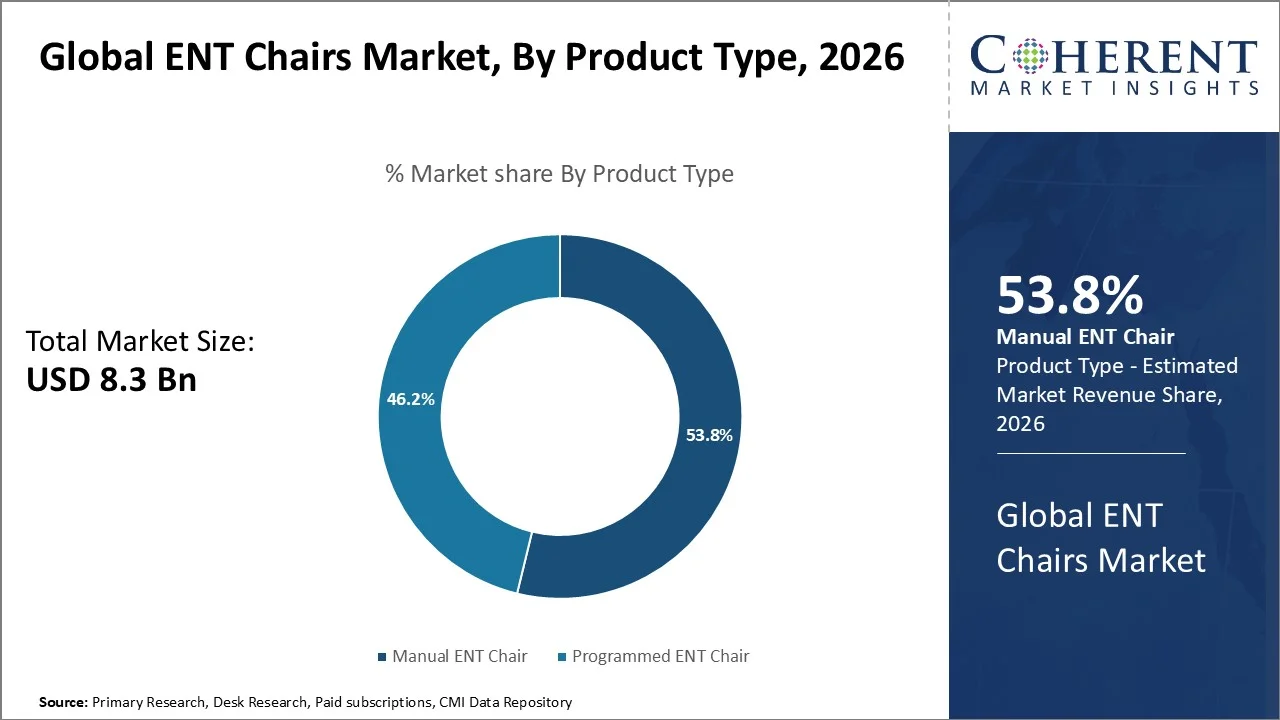
- Manual ENT Chair hold the largest market share of 53.8% in 2026 owing to the strong demand from clinics & outpatient settings.
- By End Users, Hospitals expected to hold largest market share of 54.4% in 2026 owing to its increasing ENT disease A PubMed Central survey found that 4.31% of the rural district population suffers from ENT disorders.
- By Region, North America is expected to acquire the dominant share of 39.20% in 2026 owing to the high prevalence of ENT disorders. According to the World Health Organization, over 1.5 billion people worldwide experience some degree of hearing loss, and this number could rise to 2.5 billion by 2050, significantly increasing demand for ENT examination equipment.
Current Events and Their Impact on the ENT Chairs Market
Current Event | Description and its Impact |
US–China Trade Tensions & Medical Device Tariffs (2025–2026) |
|
Expansion of ENT Care Infrastructure in Emerging Markets |
|
Segmental Insights
- Current Industry Events of 2026
- Market Size Estimation
- Regional Breakdown
- Competitive Landscape
- Customer Intelligence
- Segmental Analysis
- Pricing Analysis
- Key Market Drivers, Challenges & Future Trends
- Customized Insights Section
Why is Manual ENT Chair Acquiring the Largest Market Share?
Manual ENT chairs hold the largest market share of 53.8% in 2026. Affordability drives the demand for manual ENT chairs, enabling small clinics, rural healthcare centers, and emerging markets to adopt them widely. Their simple mechanical design ensures ease of operation, low maintenance costs, and minimal dependence on electricity, making them highly suitable for resource-limited settings.
The demand is further supported by the high burden of ENT disorders, studies indicate that 4.31% of rural populations suffer from ENT ailments, while ENT conditions account for a significant share of outpatient visits, with nearly 98.8 million ambulatory ENT visits recorded in the U.S. over a 5-year period. In tertiary care settings, ENT departments handle over 32,000 outpatient cases annually in a single hospital, highlighting the large patient volume.
Which End User segment dominates the market?
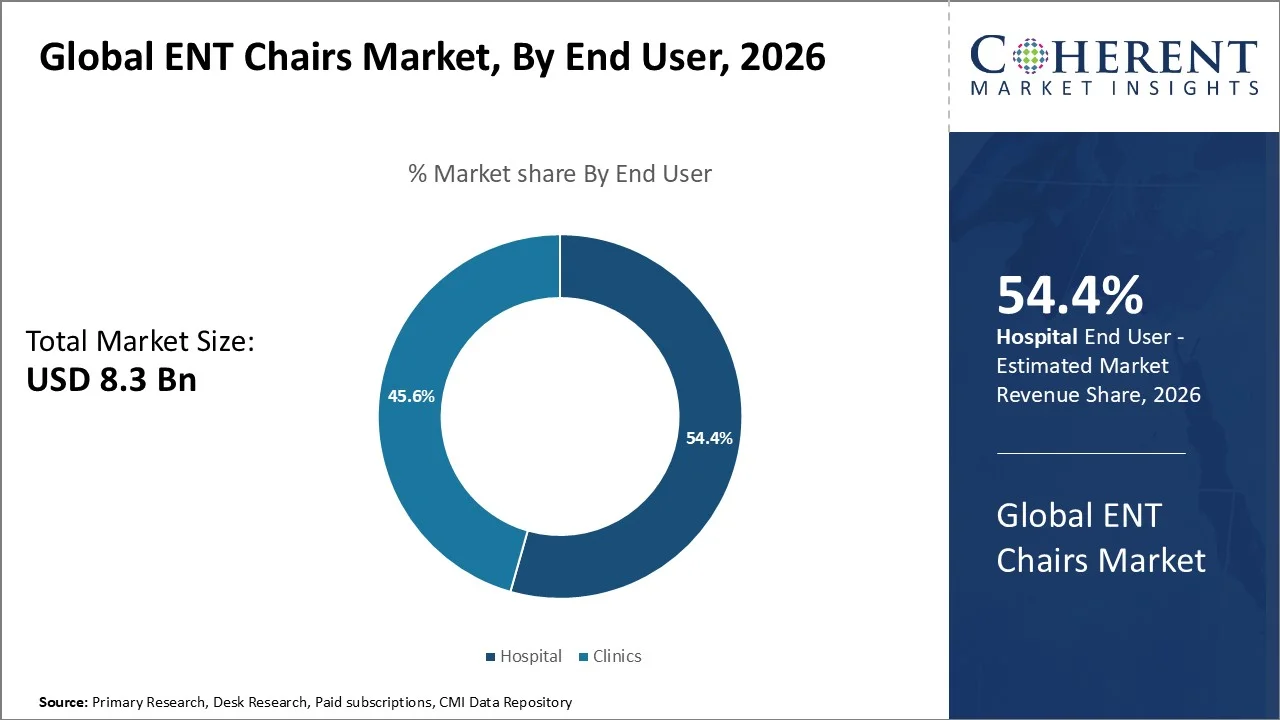
Hospitals are expected to hold the largest market share of 54.4% in 2026 owing to the expansion and modernization of hospital infrastructure. High patient volumes and the need to handle both routine and complex ENT procedures drive hospitals to adopt ENT chairs. Hospitals leverage their stronger financial capacity to invest in advanced, multifunctional chairs that improve precision, workflow efficiency, and patient comfort.
This dominance is supported by substantial patient inflow—large hospitals handle thousands of patients daily, such as SMHS Hospital, which caters to around 3,200 patients per day across departments. ENT departments alone experience significant outpatient loads; for example, Aruna Asaf Ali Government Hospital reports 100–150 ENT patients per day in OPD. Similarly, hospital data shows ENT OPD volumes exceeding 1,200–1,800 monthly cases in a single facility, highlighting sustained demand for examination infrastructure.
In addition, hospitals perform a high number of ENT procedures, Apollo Hospitals (Chennai) alone reports 2,947 ENT surgeries and over 22,800 OPD consultations annually. Over time, cumulative data from Sri Sathya Sai General Hospital shows 88,000+ ENT outpatient procedures and nearly 1,900 ENT surgeries, reflecting long-term procedural demand.
ENT Chairs Market Trends
- Rising demand for minimally invasive ENT procedures, including endoscopic sinus surgeries and microsurgeries, increases the need for precise and adjustable ENT chairs that enhance safety and reduce recovery time. ENT conditions are a major contributor to healthcare visits; for instance, acute otitis media alone accounts for 709 million cases annually worldwide, making it one of the most common reasons for ENT consultations and procedures. The growing surgical burden is accelerating the need for precision-enabled equipment.
- Growing preference for patient-centric care drives adoption of ergonomic ENT chairs designed to improve comfort, positioning accuracy, and overall treatment experience. The economic burden of untreated hearing loss is estimated at ~$980 billion globally per year, emphasizing the need for efficient, patient-focused care delivery models that improve outcomes and reduce long-term costs.
- Expanding healthcare infrastructure and supportive reimbursement policies improve access to ENT treatments, encouraging healthcare providers to invest in modern ENT chairs and upgrade existing equipment. Despite high disease burden, many countries still lack sufficient ENT care capacity and infrastructure, with significant gaps in trained personnel and equipment availability, particularly in low- and middle-income regions. This gap is driving investments in healthcare infrastructure and equipment modernization.
Regional Insights
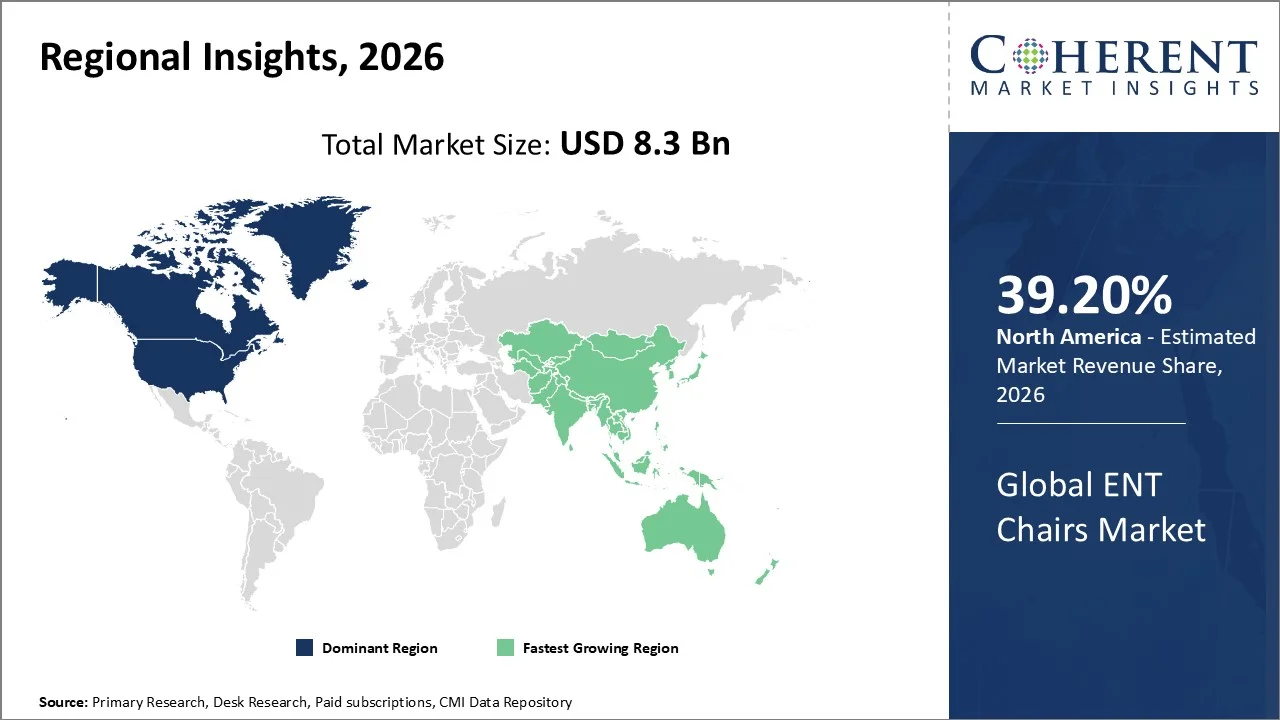
North America dominates owing to Presence of Leading Medical Device Manufacturers
North America is expected to acquire the dominant share of 39.20% in 2026. High prevalence of ENT disorders and a large patient base drive North America’s ENT chairs market by increasing the need for frequent diagnosis and treatment. Advanced healthcare infrastructure and strong healthcare spending enable hospitals and clinics to adopt technologically advanced chairs. A growing number of otolaryngologists and rising awareness of ENT conditions further support demand. An aging population and expanding access to healthcare services also accelerate the need for modern ENT examination and treatment equipment. By 2040, around 20% of the U.S. population will be aged 65 or older, compared to roughly 12.5% in 2000.
Asia Pacific ENT Chairs Market Trends
Rapid healthcare infrastructure development across emerging economies drives the ENT chairs market in Asia Pacific. Increasing patient populations and rising ENT disorder cases push demand for diagnostic and treatment equipment. In Japan, the incidence of sudden sensorineural hearing loss (SSNHL) is about 60.9 per 100,000 people, with roughly 6,205 annual ENT visits, and it rises with age, reaching a peak of 94 per 100,000 in individuals aged 60–69. Expanding hospital networks and growing investments in healthcare modernization support the adoption of advanced ENT chairs. Countries such as India, China, and Thailand strengthen demand through rising medical tourism and efficient clinical setups. Improving access to healthcare services and increasing awareness of ENT treatments further reinforce market growth across the region.
United States ENT Chairs Market Trends
Strong demand for specialized ENT care drives the United States ENT chairs market, as hospitals and specialty clinics operate a well-established healthcare network. Hospitals and clinics adopt advanced medical technologies, encouraging the use of motorized and multifunctional ENT chairs for precise procedures. A large base of trained ENT specialists increases procedural volumes and maximizes equipment utilization.
This demand is supported by a significant disease burden, approximately 15% of U.S. adults (about 37.5 million people) report hearing difficulty, a key ENT-related condition requiring frequent diagnosis and treatment. In addition, broader estimates show that around 72.8 million Americans (about 1 in 5 people) were affected by hearing loss, reinforcing the scale of ENT care demand.
Japan ENT Chairs Market Trends
Japan’s advanced healthcare system and strong focus on precision-based medical care drive the ENT chairs market. Hospitals and clinics adopt high-quality ENT equipment to enable accurate diagnosis and efficient treatment. An aging population increases demand for frequent ENT examinations and long-term care solutions. Japan has the world’s oldest population, with people aged 65 and above making up 29.3% (about 36.25 million) of the population in 2024, and this share is projected to reach nearly 40% by 2060. This demographic shift, driven by low birth rates and high life expectancy, has resulted in a shrinking workforce and a sharp increase in centenarians, with over 95,000 individuals aged 100 or more in 2025. Domestic medical device manufacturers continuously innovate, promoting the use of ergonomically advanced chairs. Strict healthcare standards and a strong emphasis on patient safety also push healthcare providers to replace outdated equipment with modern systems.
Who are the Major Companies in ENT Chairs Industry
Some of the major key players in ENT Chairs Market are Atmos Medical, Heinemann Medizintechnik, Haag Streit, Optomic, Chammed, Global Surgical, BOKEER, Mega Medical, Nagashima Medical, Arsimed Medical, Innotech Medical and Olsen.
Key News
- In August 2025, the Jammu & Kashmir National Conference MLA Ali Mohammad Sagar inaugurated a new ENT theatre at Government Gousia Hospital in Khanyar, aimed at improving access to affordable healthcare for residents of Khanyar and nearby areas.
Market Report Scope
ENT Chairs Market Report Coverage
| Report Coverage | Details | ||
|---|---|---|---|
| Base Year: | 2025 | Market Size in 2026: | USD 8.3 Bn |
| Historical Data for: | 2020 To 2024 | Forecast Period: | 2026 To 2033 |
| Forecast Period 2026 to 2033 CAGR: | 9.4% | 2033 Value Projection: | USD 12.6 Bn |
| Geographies covered: |
| ||
| Segments covered: |
| ||
| Companies covered: | Atmos Medical, Heinemann Medizintechnik, Haag Streit, Optomic, Chammed, Global Surgical, BOKEER, Mega Medical, Nagashima Medical, Arsimed Medical, Innotech Medical and Olsen. | ||
Analyst Opinion
- ENT chairs are not being adopted because of technological hype alone; they are being forced into healthcare systems by unavoidable clinical demand. ENT disorders continue to rise globally, with hearing loss alone affecting over 1.5 billion people, according to WHO estimates, creating sustained pressure on diagnostic and treatment infrastructure. This directly translates into higher utilization of ENT examination and procedure chairs, particularly in outpatient-heavy specialties like otolaryngology.
- Procedural intensity is another structural driver. For example, sinusitis affects around 10–15% of adults worldwide in chronic form, leading to millions of endoscopic sinus procedures annually. In high-volume ENT departments, a single chair is often used continuously across diagnostic exams, endoscopies, and minor interventions, making chair durability and ergonomics a clinical necessity rather than a preference.
- What is often underestimated is the scale of outpatient ENT care. In countries with advanced healthcare systems, ENT consultations rank among the most frequent specialist visits. In the United States, otolaryngology accounts for millions of outpatients encounters annually, with conditions like otitis media and allergic rhinitis driving repeat visits. This repeated procedural load forces hospitals to upgrade from basic setups to motorized, multi-position ENT chairs that reduce clinician fatigue and improve throughput efficiency.
- Aging demographics are structurally reshaping demand. Studies consistently show that hearing impairment affects over 40% of individuals above 60 years, creating a predictable, long-term rise in ENT interventions. This is not cyclical demand; it is demographic certainty. As a result, ENT chairs are becoming core infrastructure in modern ENT departments, not optional equipment upgrades.
Speak to the analyst
Want personalized insights?
Take the findings above to one of our principal consultants, or have the report rebuilt around the segments, geographies and competitors you actually track.
Market Segmentation
- By Product Type (Revenue, USD Bn, 2026-2033)
- Manual ENT Chair
- Programmed ENT Chair
- By End Users (Revenue, USD Bn, 2026-2033)
- Hospital
- Clinics
- By Region (Revenue, USD Bn, 2026-2033)
- North America
- U.S.
- Canada
- Latin America
- Brazil
- Mexico
- Argentina
- Rest of Latin America
- Europe
- Germany
- U.K.
- France
- Italy
- Spain
- Russia
- Rest of Europe
- Asia Pacific
- China
- India
- Japan
- Australia
- South Korea
- ASEAN
- Rest of Asia Pacific
- Middle East
- GCC
- Israel
- Rest of Middle East
- Africa
- South Africa
- Central Africa
- North Africa
- North America
- Key Players
- Atmos Medical
- Heinemann Medizintechnik
- Haag Streit
- Optomic
- Chammed
- Global Surgical
- BOKEER
- Mega Medical
- Nagashima Medical
- Arsimed Medical
- Innotech Medical
- Olsen
Sources
Primary Research interviews
- ENT specialists and otolaryngologists
- Hospital procurement managers and biomedical engineers
- Clinic owners and ambulatory surgical center administrators
- Medical equipment distributors and suppliers
Databases
- World Health Organization (WHO) health statistics database
- National health ministry databases (various countries)
- PubMed CENTral biomedical database
- OECD Health Statistics database
- World Bank health and infrastructure data
Magazines
- Medical Device & Diagnostic Industry (MD+DI)
- Healthcare Innovation Magazine
- Biomedical Instrumentation & Technology publications
- Clinical ENT practice magazines
Journals
- Journal of Laryngology & Otology
- Otolaryngology–Head and Neck Surgery journal
- International Journal of Medical Robotics and Computer Assisted Surgery
- Journal of Clinical Medicine (ENT-related studies)
Newspapers
- The New York Times (health section)
- The Guardian (health and science coverage)
- The Hindu (healthcare and medical infrastructure reports)
- Financial Express (healthcare developments)
Associations
- American Academy of Otolaryngology–Head and Neck Surgery (AAO-HNS)
- ENT UK (British Association of Otorhinolaryngology)
- Indian Society of Otology
- World Hearing Forum (WHO-affiliated network)
Public Domain sources
- WHO global hearing loss and ENT disorder reports
- Government healthcare policy documents
- Hospital infrastructure development reports
- Clinical trial registries and public health datasets
- Open-access medical research papers
Proprietary Elements
- CMI Data Analytics Tool
- Proprietary CMI Existing Repository of information for last 10 years
Get access to 250+ pages report
Every segment, forecast, competitor profile and data table behind the analysis above — available for instant download.
- ESOMAR Member
- ISO 9001:2015 Certified
- D-U-N-S Registered
- GDPR & CCPA Compliant
Missing comfort of reading report in your local language? Find your preferred language:
Transform your Strategy with Exclusive Trending Reports
Frequently Asked Questions
The ENT Chairs Market is anticipated to grow at a CAGR of 9.4% with USD 8.3 Bn in 2026 and is expected to reach USD 12.6 Bn in 2033.
An ENT chair is used in otolaryngology clinics and hospitals to position patients during ear, nose, and throat examinations, diagnostic procedures, and minor surgical treatments. It helps improve patient stability and clinician access.
ENT chairs provide precise positioning, better ergonomics for doctors, and enhanced patient comfort. This improves procedural accuracy, especially in endoscopic examinations and microsurgeries.
The market mainly includes manual ENT chairs and powered ENT chairs.
ENT chairs are widely used in hospitals, ENT specialty clinics, ambulatory surgical centers, and outpatient diagnostic facilities.
Modern ENT chairs often include motorized height adjustment, reclining functions, 360-degree rotation, memory presets, and compatibility with diagnostic equipment such as microscopes and endoscopes.
Demand is influenced by rising ENT disorder cases, increasing outpatient procedures, healthcare infrastructure expansion, and adoption of advanced diagnostic technologies.