

ENT Disorder Treatment Market Size and Trends - 2026 to 2033
The ENT Disorder Treatment Market is estimated to be valued at USD 36.53 Bn in 2026 and is expected to reach USD 57.30 Bn by 2033, growing at a compound annual growth rate (CAGR) of 6.6% from 2026 to 2033.
Key Takeaways
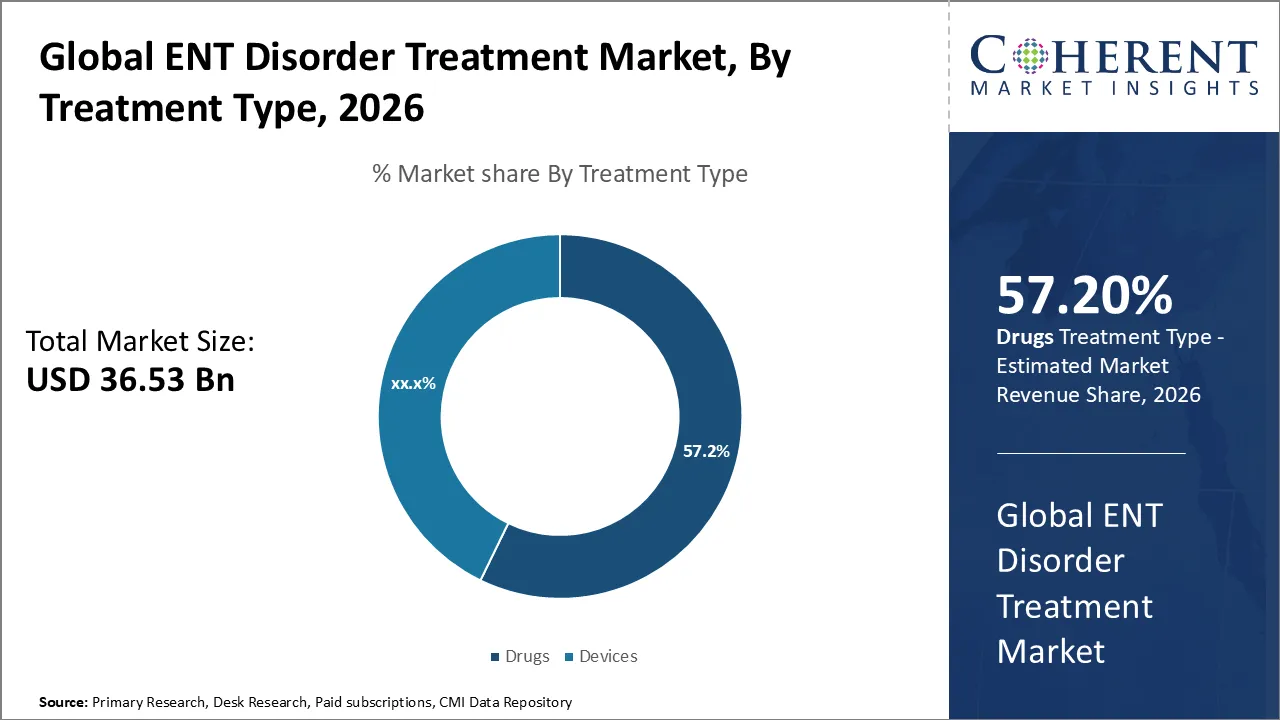
- Based on Treatment Type, the Drugs segment is expected to lead the market with 57.20% share in 2026, due to widespread prescription use for chronic and acute ENT conditions.
- Based on Organ Type, the Ears segment is expected to lead the market with 38.10% share in 2026, driven by high prevalence of hearing loss and related disorders.
- Based on End User, the Hospital segment is expected to lead the market with 44.60% share in 2026, supported by advanced treatment infrastructure.
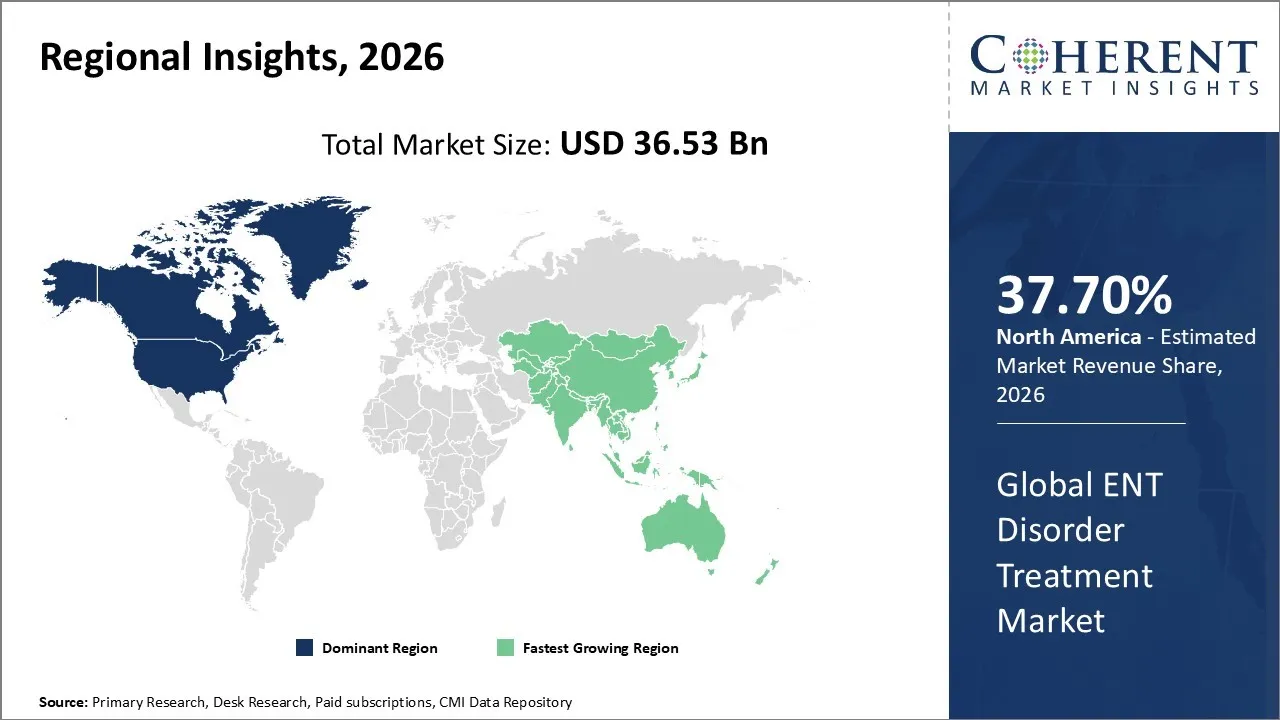
- Based on Region, North America is set to lead the market with 37.70% share in 2026. While, Asia Pacific is anticipated to be the fastest growing region.
Market Overview
The ENT disorder treatment market is advancing significantly driven by the rising global prevalence of chronic sinusitis, otitis media, and age-related hearing loss. The growing patient awareness regarding long-term respiratory health and a strategic shift toward minimally invasive surgeries are expected to propel market growth over the forecast period. The cutting-edge diagnostic and surgical devices have become the cornerstone of modern otolaryngology, moving away from traditional invasive methods toward high-precision, etch-enabled interventions.
Current Events and Its Impacts on the ENT Disorder Treatment Market
Current Event | Description and the Impact |
Technological Advancements and Innovations |
|
Public Health Trends and Epidemiological Shifts |
|
Environmental and Societal Factors |
|
Segmental Insights
- Current Industry Events of 2026
- Market Size Estimation
- Regional Breakdown
- Competitive Landscape
- Customer Intelligence
- Segmental Analysis
- Pricing Analysis
- Key Market Drivers, Challenges & Future Trends
- Customized Insights Section
ENT Disorder Treatment Market Insights, By Treatment Type – Drugs Leads Due to Widespread Prescription Use for Chronic and Acute ENT Conditions
In terms of treatment type, the drugs segment contributes the highest share of 57.20% in 2026 of the market. The growth is because pharmacological interventions remain the primary and most accessible line of defense for the majority of patients. This segment is driven by the high volume of prescriptions for common ailments such as acute sinusitis, otitis media, and allergic rhinitis, which typically require antibiotics, antihistamines, or corticosteroids rather than surgical intervention. The continual innovation in next-generation antimicrobial drug development is playing a critical role in propelling the market growth amid increasing antibiotic resistance. In addition, the affordability and ease of self-administration of drug regimens ensure their continued preference among both clinicians and patients for the management of acute and chronic ENT conditions.
ENT Disorder Treatment Market Insights, By Organ Type – Ears Leads Due to High Prevalence of Hearing Loss and Related Disorders
In terms of organ type, the ears segment contributes the highest share of 38.10% in 2026 of the market. The growth is owing to the massive global prevalence of hearing loss and auditory infections. The World Health Organization estimates that hundreds of millions of people globally require rehabilitation for disabling hearing loss, a figure that is increasing sharply due to the growing geriatric population. This demographic shift fuels a continual demand for both pharmaceutical treatments for conditions like tinnitus and medical devices like hearing aids and cochlear implants. Furthermore, the increasing exposure of younger populations to noise pollution and personal audio devices has created a new, consistent stream of patients seeking auditory care. These factors combine to make ear-related treatments the most significant revenue generator within the ENT specialty.
For instance, in July 2025, the Cochlear Limited, the worldwide pioneer in implantable hearing aids, announced that the Cochlear™ Nucleus® Nexa™ System has received approval from the U.S. Food and Drug Administration (FDA). It is acknowledged as the first and only intelligent cochlear implant system in the world.
ENT Disorder Treatment Market Insights, By End User – Hospital Leads Due to Advanced Treatment Infrastructure
In terms of end user, the hospital segment contributes the highest share of 44.60% in 2026 of the market because these institutions serve as the primary centers for complex and specialized ENT care. Hospitals possess the advanced diagnostic infrastructure, such as high-resolution imaging and robotic surgical systems, required for intricate procedures like cochlear implantation and head and neck oncology treatments. While outpatient clinics and ambulatory centers are gaining popularity for minor procedures, the comprehensive care and emergency capabilities of hospitals ensure they manage the highest volume of severe cases. In addition, long-standing reimbursement arrangements systematically favor hospital-based inpatient care, institutionalizing hospitals as the cornerstone of ENT disorder management on a global scale.
For instance, in December 2024, Apollo Hospitals has introduced an Integrated Neuro-ENT Vertigo and Balance Disorders Clinic at Apollo One. This innovative clinic brings together the expertise of neurologists and ENT specialists to provide advanced care for patients who experience vertigo, balance disorders, and a fear of falling.
Regional Insights
North America ENT Disorder Treatment Market Analysis & Trends
North America has remained the dominant region with 37.70% in 2026 of the global ENT disorder treatment market over the past decade. The growth is owing to a mature healthcare infrastructure and high public health investments. The market is marked by a high prevalence of chronic conditions like sinusitis, allergic rhinitis, and otitis media. In addition, a substantial demographic shift toward an aging population is driving sustained demand for treatments related to age-related hearing loss and balance disorders. The technological breakthroughs are pivotal in this region, with a strong emphasis on AI-powered diagnostics, robotic-assisted surgeries, and minimally invasive procedures like balloon sinuplasty that minimize patient recovery times.
The competitive landscape is dominated by established medical technology firms. These companies are placing a greater emphasis on research and development to create innovative devices like next-generation hearing aids and high-definition endoscopes. The leading firms in the region are Medtronic, Stryker, Olympus, and Cochlear Limited. The favorable reimbursement policies and heightened patient awareness regarding early diagnosis and specialized care are also contributing to the region's growth in the market.
For instance, in July 2021, McLaren and Karmanos have introduced a comprehensive ear, nose, and throat (ENT) service line. The service line is designed to offer ENT services to patients in Genesee and Lapeer Counties and beyond.
Asia Pacific ENT Disorder Treatment Market Analysis & Trends
The Asia Pacific region is recognized as the fastest-growing market for ENT disorder treatment. This growth is largely due to a large population base and an increase in healthcare spending. A rising geriatric population, particularly vulnerable to hearing loss and chronic conditions, primarily drives the rapid expansion. Additionally, increasing urbanization and pollution levels have contributed to a higher incidence of respiratory and allergic disorders, such as sinusitis and allergic rhinitis. A major trend in this market is the use of new technologies, with more and more people wanting procedures that are less invasive. These include robotic-assisted handheld surgical devices and advanced endoscopic systems, which provide shorter recovery times and enhanced precision.
The key drivers at the country level include China and Japan, which together hold a dominant share of the market. Meanwhile, India is expected to experience the highest growth rate owing to its developing healthcare infrastructure and initiatives like Ayushman Bharat. The market leadership is maintained by well-established global companies such as Cochlear Ltd, Olympus Corp, and Medtronic, which are increasingly pursuing strategic alliances and establishing local manufacturing facilities to tap into the substantial volume
ENT Disorder Treatment Market Outlook Country-Wise
The US ENT Disorder Treatment Market Trends
The US is currently at the forefront of the ENT disorder treatment market owing to a massive aging population. The chronic conditions like sinusitis create a consistent demand for both pharmacological treatments and minimally invasive surgical options. The market is shifting toward outpatient settings, where procedures like balloon sinuplasty offer faster recovery times and benefit from favorable reimbursement policies provided by Medicare and private insurance. The technological advancements are essential, particularly with the incorporation of artificial intelligence (AI) and robotics in diagnostic endoscopes and surgical navigation systems. The companies like Stryker, Olympus Corporation, and Cochlear Limited are investing in research and development, as well as pursuing strategic acquisitions to strengthen their technological advantage.
For instance, in September 2025, Olympus Corporation has introduced the VISERA™ S OTV-S500 imaging platform in the U.S. This platform combines advanced diagnostic capabilities for ear, nose, and throat (ENT) as well as urology applications, providing flexibility for use in both office and outpatient settings.
China ENT Disorder Treatment Market Trends
China is rapidly emerging as the fastest-growing market for treatments of ENT disorder treatment. The growth is owing to the country’s aging demographic and the health consequences of rapid urbanization. The demand for hearing aids and cochlear implants is surging, thereby driving the ENT device market.
The environmental factors, specifically high levels of air pollution in industrial hubs, have led to a high prevalence of chronic sinusitis and allergic rhinitis. This situation has positioned China as one of the largest consumers of nasal sprays and endoscopic surgical tools worldwide. The market is undergoing significant transformation due to the Healthy China 2030 initiative. This initiative has sped up the modernization of healthcare infrastructure and encouraged the adoption of minimally invasive procedures in tier-2 and tier-3 cities. In addition, National Medical Products Administration (NMPA) has streamlined the approval process for innovative medical devices. This has led to a significant increase in localized AI-integrated diagnostic tools and robotic-assisted ENT platforms that address China's specific clinical volume and patient needs.
According to the National Library of Medicine, by 2060, an estimated 242 million people in China will experience moderate to complete hearing loss. This is increasing the demand for growth in the China ENT Disorder Treatment Market.
Market Report Scope
ENT Disorder Treatment Market Report Coverage
| Report Coverage | Details | ||
|---|---|---|---|
| Base Year: | 2025 | Market Size in 2026: | USD 36.53 Bn |
| Historical Data for: | 2020 To 2024 | Forecast Period: | 2026 To 2033 |
| Forecast Period 2026 to 2033 CAGR: | 6.6% | 2033 Value Projection: | USD 57.30 Bn |
| Geographies covered: |
| ||
| Segments covered: |
| ||
| Companies covered: | Sanofi, AstraZeneca, Novartis AG, Pfizer Inc., Mylan N.V., Teva Pharmaceutical Industries Ltd., GlaxoSmithKline Pharmaceuticals, Otonomy Inc., Merck & Co., Dr. Reddy’s Laboratories Ltd., Allergan plc, Cochlear Ltd., Sonova Holding AG, Siemens Healthcare, Starkey Laboratories Inc., William Demant Holding A/S, Widex A/S, GN ReSound A/S, Sonic Innovations Inc., Panasonic Corp., Beltone, Rexton Inc., Avada Hearing Care, Miracle-Ear Inc., MED-EL GmbH, Nuear Hearing Aids Inc., Audiosync Inc., Bernafon, American Hearing Systems Inc., Unitron Hearing Inc., and Zounds Inc. | ||
| Growth Drivers: |
| ||
| Restraints & Challenges: |
| ||
ENT Disorder Treatment Market Drivers
Rising geriatric population
The increasing size of the global geriatric population is a major factor fueling demand within the ENT disorder treatment market. According to the World Health Organization (WHO), the proportion of the world’s population over 60 years is likely to nearly double by 2050. This demographic shift impacts healthcare because aging naturally triggers degenerative changes in the ear, nose, and throat. The high prevalence of sensory impairments, especially hearing loss, among older adults is accelerating global demand for medical interventions and assistive technologies. In addition to auditory disorders, the aging population exhibits a higher prevalence of chronic conditions such as sleep apnea and laryngeal disorders. Together, these factors are accelerating a market shift toward targeted care pathways and sophisticated diagnostic solutions for the growing aging population.
Analyst Opinion (Expert Opinion)
The ENT Disorder Treatment Market is driven by the high prevalence of ear, nose, and throat conditions and rapid adoption of advanced clinical solutions. Chronic sinusitis affects an estimated 12% of adults globally, while hearing loss impacts a significant portion of the population, particularly in aging demographics. These incidence levels support steady treatment volumes across hospitals, outpatient clinics, and specialized ENT centers.
Demographic trends further reinforce market growth. Increasing geriatric populations experience higher rates of age-related hearing impairment and chronic ENT conditions, creating demand for pharmacological therapies, surgical interventions, and rehabilitative devices. Expanding healthcare access in emerging regions also contributes to broader patient coverage and uptake of treatments.
Technological advancements are reshaping clinical management. Minimally invasive surgical techniques, endoscopic systems, image-guided procedures, and AI-enhanced hearing devices improve treatment outcomes and procedural efficiency. Non-invasive therapies, such as nasal therapeutics and allergy immunotherapy, complement device-based interventions, reflecting a diversified treatment landscape.
Regional dynamics show North America leveraging high healthcare infrastructure and spending, while Asia-Pacific markets are growing due to improved access and demographic shifts. Cost constraints and limited adoption of premium technologies in resource-constrained regions remain challenges, but overall, the market is supported by strong clinical demand, demographic momentum, and technology-driven treatment expansion.
Speak to the analyst
Want personalized insights?
Take the findings above to one of our principal consultants, or have the report rebuilt around the segments, geographies and competitors you actually track.
ENT Disorder Treatment Industry News
- In August 2024, Inspire Medical Systems, Inc. has announced that the FDA has approved the Inspire V therapy system. This system encompasses a next-generation neurostimulator, as well as a Bluetooth® patient remote and physician programmer.
- In July 2024, SoundHealth, Inc. has launched SONU, the world’s first FDA De Novo authorized, AI-enabled, wearable medical device intended for the treatment of moderate to severe nasal congestion caused by both allergic and non-allergic rhinitis.
- In September 2021, Acclarent, Inc. introduced its first AI-driven ENT technology in the US. The company is recognized as a leader in minimally invasive ENT technologies. This innovative system aims to enhance surgical planning and deliver real-time feedback during ENT navigation procedures.
- In August 2021, 3NT Medical has received FDA clearance for its Peregrine™ Drivable ENT Scope. This innovative device is intended to provide ENT surgeons with exceptional views of the sinus anatomy, thereby improving the overall surgical experience.
Market Segmentation
- Treatment Type Insights (Revenue, USD Bn, 2026 - 2033)
- By Devices
- Hearing Aid Devices
- Voice Prostheses
- Nasal Splints
- Hearing Implants
- Others
- By Drugs
- Antibiotics
- Antihistamines
- Steroids
- Anti-inflammatory Drugs
- Others
- By Devices
- Organ Type Insights (Revenue, USD Bn, 2026 - 2033)
- Ears
- Nose
- Throat
- End User Insights (Revenue, USD Bn, 2026 - 2033)
- Hospital
- Clinics
- Ambulatory Surgical Centers
- Home Care Settings
- Others
- Regional Insights (Revenue, USD Bn, 2026 - 2033)
- North America
- U.S.
- Canada
- Latin America
- Brazil
- Argentina
- Mexico
- Rest of Latin America
- Europe
- Germany
- U.K.
- France
- Italy
- Russia
- Rest of Europe
- Asia Pacific
- China
- India
- Japan
- Australia
- South Korea
- ASEAN
- Rest of Asia Pacific
- Middle East
- GCC
- Israel
- Rest of Middle East
- Africa
- North Africa
- Central Africa
- South Africa
- North America
- Key Players Insights
- Sanofi
- AstraZeneca Plc
- Novartis AG
- Pfizer, Inc.
- Mylan N.V.
- Teva Pharmceutical Industries Ltd.
- GlaxoSmithKline Plc
- Otonomy, Inc.
- Merck & Co., Inc.
- Dr. Reddy’s Laboratories Ltd.
- Allergen Plc
- Cochlear Ltd.
- Sonova Holdings AG.
- Siemens Healthineers
- Starkey Laboratories, Inc.
- William Demant Holdings, A/S
- Widex A/S
- GN Re/Sound A/S
- Sonic Innovations. Inc.
- Panasonic Corporation
- Beltone
- Rexton Inc.
- Avada Hearing Care
- Miracle-Ear., Inc.
- MED-EL GmBH
- Nuear Hearing Aids, Inc.
- AudioSync, Inc.
- Bernafon
- American Hearing Systems, Inc.
- Unitron Hearing, Inc.
- Zounds, Inc.
Sources
Primary Research Interviews
- ENT Disorder Treatment Device Manufacturers
- ENT Clinics & Hospitals
- Audiologists & Otolaryngologists
- Medical Technology Consultants
- Healthcare Service Providers
- Others
Databases
- Bloomberg Terminal
- Thomson Reuters Eikon
- Others
Magazines
- ENT Today
- Otolaryngology–Head and Neck Surgery Magazine
- Medical Device News Magazine
- Healthcare Technology Management Magazine
- Others
Journals
- Journal of Otolaryngology
- International Journal of Pediatric Otorhinolaryngology
- American Journal of Otolaryngology
- Ear, Nose & Throat Journal
- Others
Newspapers
- Financial Times
- The Wall Street Journal
- Reuters
- Bloomberg News
- Others
Associations
- American Academy of Otolaryngology–Head and Neck Surgery (AAO-HNS)
- European Academy of Otology and Neurotology (EAONO)
- International Federation of Otorhinolaryngological Societies (IFOS)
- Others
Public Domain Sources
- U.S. Food and Drug Administration (FDA)
- National Institutes of Health (NIH)
- World Health Organization (WHO)
- Centers for Disease Control and Prevention (CDC)
- Others
Proprietary Elements
- CMI Data Analytics Tool
- Proprietary CMI Existing Repository of ENT Disorder Treatment Market Information for the Last 8 Years
Definition: The ENT disorder treatment market comprises the global sector responsible for the provision of medical solutions for ear, nose, and throat conditions. The market includes the manufacturing and distribution of pharmaceutical drugs, surgical instruments, and prosthetic devices such as hearing aids and cochlear implants. It addresses a wide range of common and complex ailments, including chronic sinusitis, hearing impairment, tonsillitis, and sleep apnea. the market growth is consistently fueled by an aging global population, rising levels of environmental pollutants, and technological advancements in minimally invasive surgical techniques. Ultimately, the sector is integral to modern healthcare, supplying critical tools and therapies that restore sensory functions and meaningfully improve the daily quality of life for millions of patients worldwide.
Get access to 250+ pages report
Every segment, forecast, competitor profile and data table behind the analysis above — available for instant download.
- ESOMAR Member
- ISO 9001:2015 Certified
- D-U-N-S Registered
- GDPR & CCPA Compliant
Missing comfort of reading report in your local language? Find your preferred language:
Transform your Strategy with Exclusive Trending Reports
Frequently Asked Questions
The ENT Disorder Treatment Market is estimated to be valued at USD 36.53 Bn in 2026, and is expected to reach USD 57.30 Bn by 2033.
The CAGR of the ENT Disorder Treatment Market is projected to be 6.6% from 2026 to 2033.
Rising air and noise pollution as well as bacterial concentration in the environment leading to various infections are some of the major factors that are driving the growth of the ENT Disorder Treatment Market.
Side effects and high cost of treatment, coupled with low awareness about treatment for ENT disorders are some of the major factors that are hampering the growth of the ENT Disorder Treatment Market.
Sanofi, AstraZeneca, Novartis AG, Pfizer Inc., Mylan N.V., Teva Pharmaceutical Industries Ltd., GlaxoSmithKline Pharmaceuticals, Otonomy Inc., Merck & Co., Dr. Reddys Laboratories Ltd., Allergan plc, Cochlear Ltd., Sonova Holding AG, Siemens Healthcare, Starkey Laboratories Inc., William Demant Holding A/S, Widex A/S, GN ReSound A/S, Sonic Innovations Inc., Panasonic Corp., Beltone, Rexton Inc., Avada Hearing Care, Miracle-Ear Inc., MED-EL GmbH, Nuear Hearing Aids Inc., Audiosync Inc., Bernafon, American Hearing Systems Inc., Unitron Hearing Inc., and Zounds Inc. are the major players.
North America is expected to lead the ENT Disorder Treatment Market in 2026.