

Operating Room Equipment and Supplies Market Size and Share Analysis: 2026 - 2033
The global operating room equipment and supplies market size is estimated to reach USD 50,500 Mn in 2026 and is projected to grow at a compound annual growth rate (CAGR) of 7.4% during the forecast period (2026-2033), surpassing USD 81,000 Mn by 2033. This growth can be attributed to rising number of surgical procedures worldwide and increasing burden of chronic diseases like cardiovascular disorders, cancer, and orthopedic conditions.
Key Takeaways from the Operating Room Equipment and Supplies Market Report
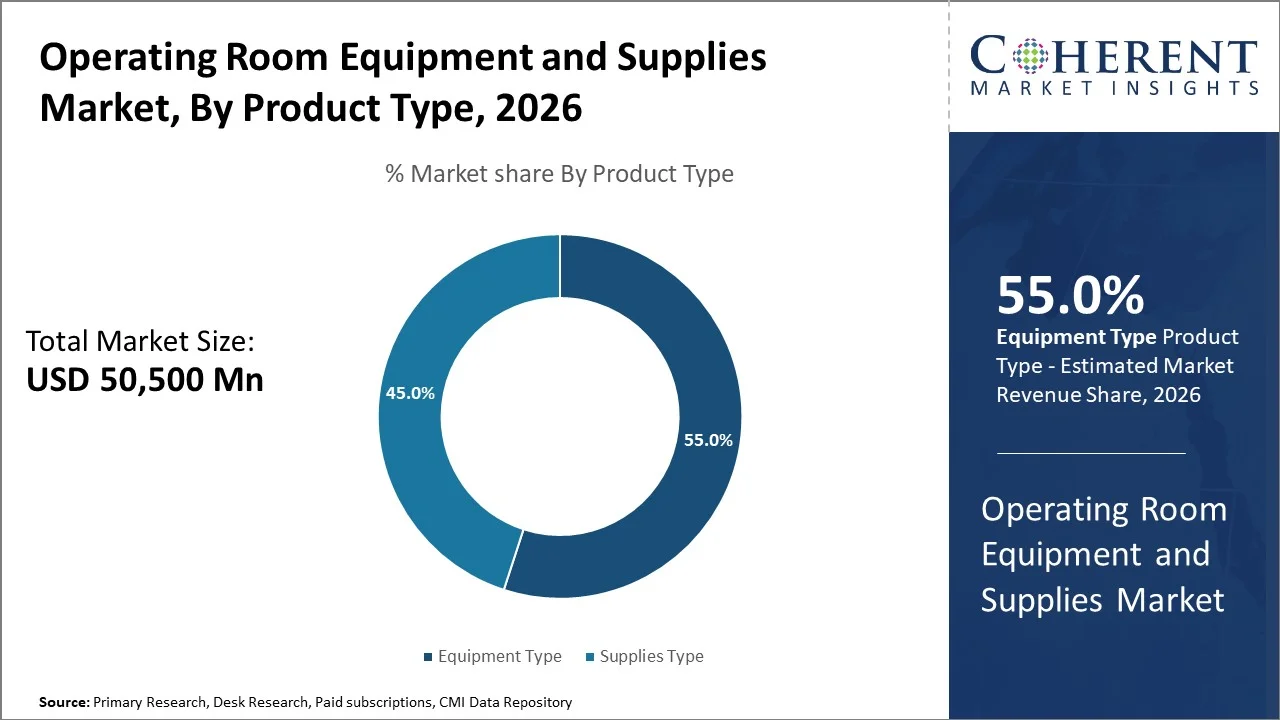
- Equipment type segment is expected to lead the market with a share of 55% in 2026. because of high-value capital devices such as anesthesia machines, surgical imaging systems, patient monitoring devices, and operating room infrastructure. For instance, in 2025, Dell Children's Medical Center deployed a $22 million intraoperative MRI surgical suite integrating a mobile 3T MRI directly into the operating room, highlighting the high spending on OR equipment compared with disposable supplies.
- General surgery segment is slated to account for the largest market share of 30.6% in 2026 due to increasing global surgical procedure volume. For example, according to the World Health Organization, more than 300 million surgical procedures are performed globally each year, with general surgery representing a major portion of overall operating room utilization and equipment demand.
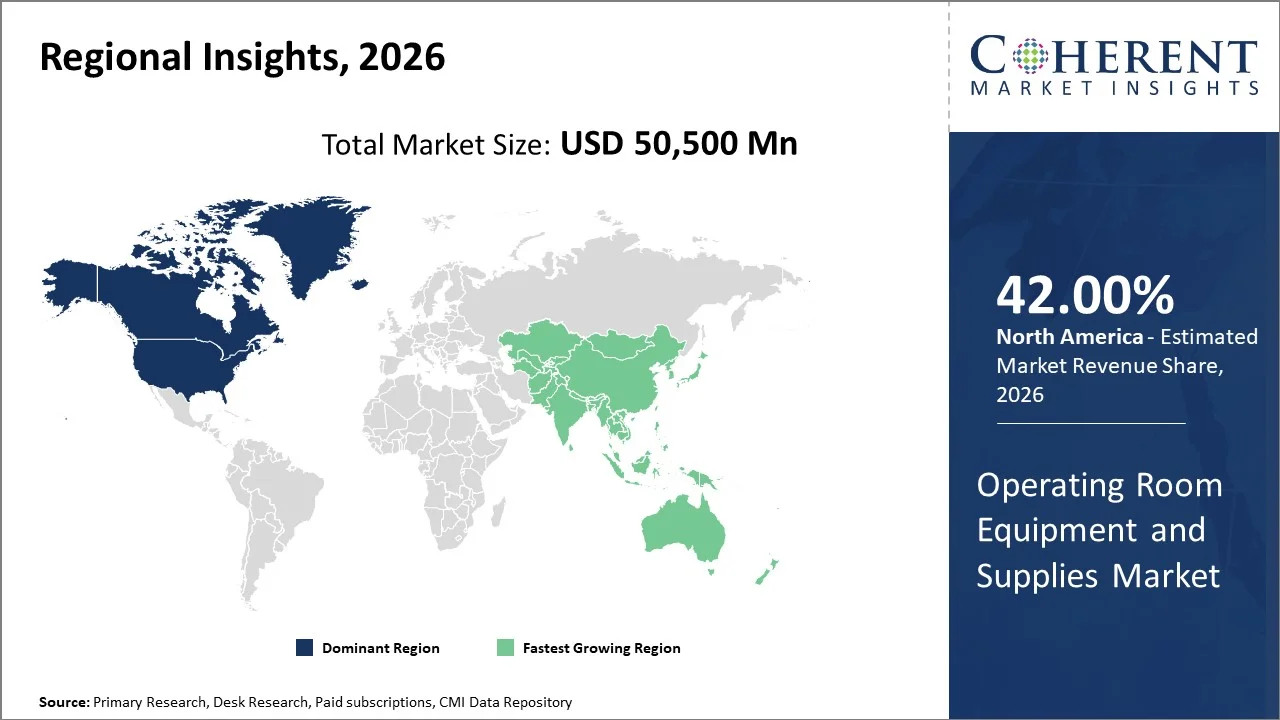
- North America is projected to dominate the global operating room equipment and supplies industry with a share of 42% in 2026, owing to high rates of OR modernization, expansion of ambulatory surgical centers, strong healthcare spending, and early adoption of advanced imaging and robotic-assisted surgical systems. For instance, the
- Asia Pacific, holding a share of 25% in 2026, is anticipated to emerge as the fastest growing market for operating room equipment and supplies during the forecast period, thanks to expanding hospital infrastructure and increasing surgical volume growth.
Operating Room Equipment and Supplies Market Overview
The global operating room equipment and supplies market is poised to exhibit steady growth during the forecast period. This is primarily due to rising prevalence of chronic diseases, increasing number of surgical procedures, growing demand for advanced diagnostic imaging expansion of healthcare infrastructure, and rising aging population that is more prone to requiring surgical interventions.
Continuous advancements in surgical procedures are increasing demand for more sophisticated and advanced operating room equipment and supplies. Minimally invasive surgeries, image-guided procedures, robotic-assisted surgeries, and telesurgery are increasingly replacing conventional surgical procedures, and these require advanced visualization systems, image-guided technologies, vascular access devices, and endoscopic surgical equipment.
The increasing complexity of surgical procedures and patient conditions has resulted in rising demand for monitoring and support systems used in specialized operating rooms. Moreover, depending on the type of surgery, the requirement for surgical equipment differs. For instance, pediatric operating rooms may require additional surgical devices such as portable surgical microscopes, pediatric monitoring systems, neonatal anesthesia equipment, and umbilical venous catheters.
Increasing geriatric population is positively impacting sales of operating room equipment and supplies. Elderly populations are more prone to chronic diseases and age-related conditions that require surgical treatment, thereby increasing demand for operating room equipment and supplies globally.
Rising focus on infection control and patient safety is fostering growth of the OR equipment and supplies market. Hospitals in the contemporary era are increasingly investing in sterile disposable supplies, antimicrobial equipment surfaces, advanced air filtration systems, and sterilization technologies to reduce hospital-acquired infections and comply with strict healthcare regulations.
Segmental Insights
Which Product Type Leads the Operating Room Equipment and Supplies Market?
Equipment Type Leads the Market with Over Half of the Market Revenue Share in 2026
According to Coherent Market Insights’ latest operating room equipment and supplies market analysis, equipment type segment is projected to lead with a share of 55% in 2026. This is attributable to increasing adoption of advanced surgical technologies and growing investments in modern operating room infrastructure across hospitals and ambulatory surgical centers.
Rising demand for minimally invasive and robotic-assisted surgeries is increasing the use of anesthesia machines, electrosurgical units, patient monitoring systems, surgical imaging devices, operating tables, and operating room lights. In addition, the increasing number of complex surgical procedures and the need for enhanced patient safety, workflow efficiency, and real-time monitoring are also supporting growth of the equipment type segment.
- Current Industry Events of 2026
- Market Size Estimation
- Regional Breakdown
- Competitive Landscape
- Customer Intelligence
- Segmental Analysis
- Pricing Analysis
- Key Market Drivers, Challenges & Future Trends
- Customized Insights Section
Which Application Holds the Largest Operating Room Equipment and Supplies Market Share?
General Surgery to Remain the Leading Application
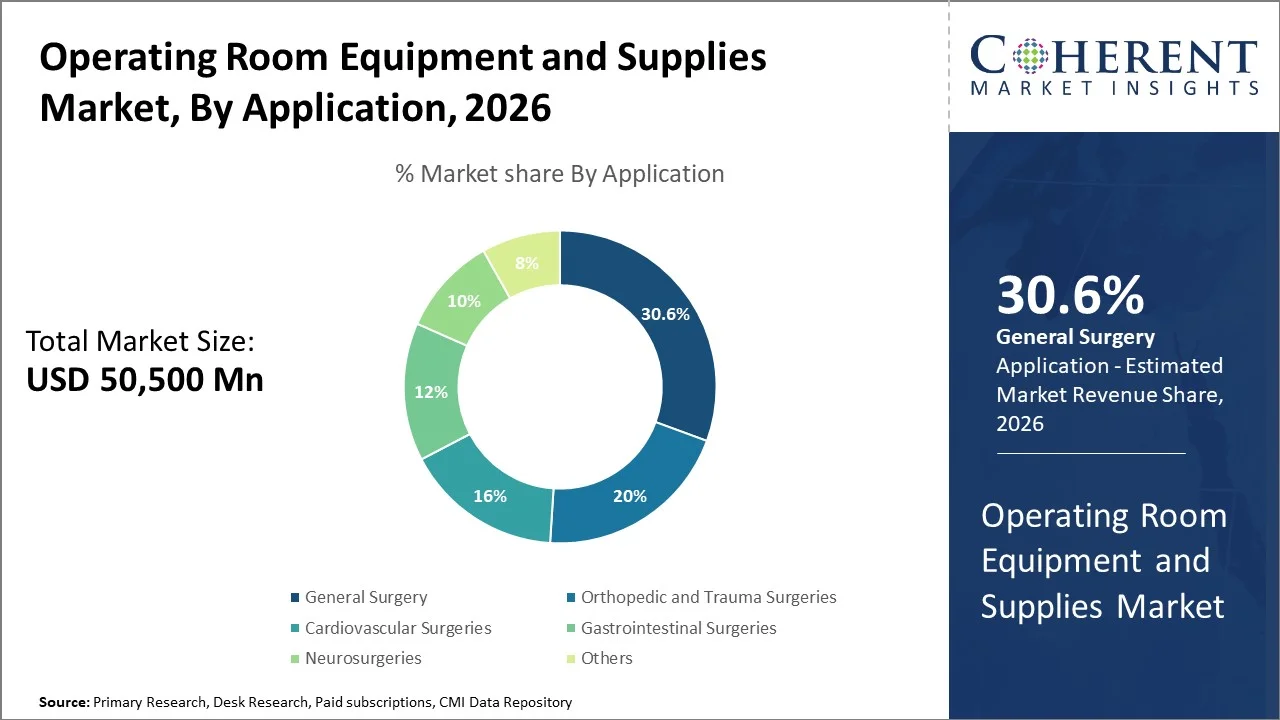
By application, general surgery segment is anticipated to account for a prominent market revenue share of 30.6% in 2026. This is mostly due to high global volume of surgical procedures, rising prevalence of chronic diseases requiring surgical intervention, and increasing demand for minimally invasive and laparoscopic surgeries.
General surgery departments utilize a wide range of operating room equipment and consumables. These include anesthesia machines, surgical lights, operating tables, electrosurgical units, disposable drapes, and surgical instruments. As a result, general surgery segment contributes significantly to operating room equipment and supplies market revenue.
Operating Room Equipment and Supplies Market Growth Drivers
Rising Number of Surgical Procedures Worldwide: Increasing volume of surgical procedures across the world is providing a strong impetus for the growth of the operating room equipment and supplies market. According to World Health Organization, more than 313 million surgical procedures are performed each year globally due to rising prevalence of cardiovascular disease, cancer, orthopaedic disorders, and obesity. the This rising surgical volume is expected to increase demand for operating room equipment and supplies during the forecast period.
Operating Room Equipment and Supplies Market Opportunities
Expansion of Hospitals and Ambulatory Surgical Centers (ASCs): Expanding healthcare infrastructure, especially hospitals, trauma care, and ambulatory surgical centers, is creating lucrative growth opportunities for the operating room equipment and supplies market.
Nations across the world are increasingly investing in healthcare infrastructure to improve access to advanced medical care as well as strengthen surgical capabilities. For instance,
- In April 2025, Novant Health announced the construction of a new ambulatory surgery center in North Carolina featuring two operating rooms and two procedure rooms to address rising surgical demand.
- In June 2025, Canada-based Vancouver Coastal Health started construction on 15 new operating rooms and one hybrid operating room at Vancouver General Hospital in 2025 to increase annual surgical capacity.
- In November, Apollo Hospitals announced a new 250-bed hospital in Pune, India, equipped with modular operating theatres and robotic surgical systems to strengthen advanced surgical care infrastructure.
This is expected to increase the procurement of operating room equipment and supplies, including anesthesia machines, surgical lights, patient monitors, and sterilization systems.
Operating Room Equipment and Supplies Market Trends
Growing Demand for Minimally Invasive and Robotic Surgeries: Shift towards minimally invasive surgeries and robotic procedures is a key growth-shaping trend in the operating room equipment and supplies market. Hospitals in the contemporary world are increasingly adopting minimally invasive and robotic-assisted surgeries because they reduce recovery time, pain, and hospital stays. These procedures require advanced operating tables, imaging systems, endoscopes, and surgical instruments.
Operating Room Equipment and Supplies Market Innovations
Technological Advancements in Operating Rooms
Adoption of integrated and hybrid operating rooms, AI-enabled monitoring systems, advanced imaging technologies, and automated surgical equipment is improving surgical precision and workflow efficiency, thereby supporting market growth. Hospitals are increasingly investing in smart operating rooms equipped with digital imaging, robotic-assisted systems, and real-time patient monitoring technologies to improve surgical outcomes and reduce procedure time. For instance,
- In January 2025, UofL Health, Jewish Hospital in the U.S., launched its first neuro-hybrid operating room equipped with advanced imaging technologies to support complex neurosurgical and cerebrovascular procedures.
- In March 2025, Artisight collaborated with KARL STORZ and NVIDIA to develop AI-driven smart operating room solutions with real-time surgical insights, automation, and advanced monitoring capabilities.
Current Events and Their Impact on the Operating Room Equipment and Supplies Market
Current Event | Description and its Impact |
Rising Adoption of Robotic-Assisted Surgeries in Hospitals |
|
Supply Shortages of Critical Surgical Consumables |
|
Regional Insights
North America Remains at the Epicenter of OR Equipment and Supplies Market Growth
North America is expected to retain its dominance over the global operating room equipment and supplies market during the forecast period, capturing a share of 42% in 2026. This can be attributed to strong healthcare infrastructure, rising surgical volumes, and increasing adoption of advanced surgical technologies are major factors driving market growth in the region.
Increasing demand for minimally invasive surgeries and growing investments in modernizing hospital operating rooms are also supporting North America operating room equipment and supplies market expansion. Similarly, technological advancements such as IoMT-enabled operating rooms, cloud-based OR management systems, smart surgical lights, and AI-assisted monitoring are improving surgical precision and operational efficiency.
Rising aging population and chronic disease burden are significantly increasing the number of surgeries performed across North America. According to the U.S. Census Bureau, the U.S. population aged 65 years and older is projected to reach nearly 82 million by 2050. Older adults are more vulnerable to cardiovascular diseases, cancer, and orthopaedic disorders, thereby increasing demand for operating room equipment and surgical supplies.
Asia Pacific to Emerge as Central Hub for OR Equipment Manufacturers
Asia Pacific is set to emerge as a hotbed for manufacturers of operating room equipment and supplies during the forthcoming period, holding a share of 25% in 2026. This is mostly due to rapid healthcare infrastructure expansion, increasing hospital admissions, and rising healthcare spending in nations like China and India.
Rising medical tourism and rising adoption of advanced surgical technologies are also expected to fuel demand for operating room equipment and supplies across Asia Pacific during the forthcoming period. In addition, rising focus on infection prevention and patient safety is driving demand for disposable surgical supplies, sterilization equipment, antimicrobial products, and advanced infection-control systems in operating rooms.
Increasing prevalence of chronic diseases is creating strong demand for surgical care and advanced operating room infrastructure in the region. According to the This is increasing the need for modern surgical facilities, operating room devices, and hospital equipment across Asia Pacific countries
Operating Room Equipment and Supplies Market Outlook – Country-wise
U.S. Operating Room Equipment and Supplies Market Trends
The United States is expected to remain a leading market for operating room equipment and supplies during the forecast period. This is attributable to advanced healthcare infrastructure, increasing surgical procedure volumes, and rapid adoption of robotic-assisted and minimally invasive surgeries. Growing investments in smart operating rooms, AI-enabled surgical systems, and advanced imaging technologies are also supporting market growth across the country.
Rising prevalence of chronic diseases is significantly increasing demand for surgical procedures and hospital-based care in the United States. According to the This is increasing the need for advanced operating room equipment, surgical instruments, anesthesia devices, and infection prevention supplies across healthcare facilities.
China Operating Room Equipment and Supplies Market Forecast
The operating room equipment and supplies market in China is expected to grow rapidly during the assessment period. This can be attributed to rapid healthcare infrastructure expansion, rising hospital admissions, and increasing demand for advanced surgical care. Government investments in hospital modernization and rising adoption of hybrid operating rooms and minimally invasive surgical technologies are also contributing to market growth in the country
Who are the Major Companies in the Operating Room Equipment and Supplies Market?
Some of the major players in Operating Room Equipment and Supplies Market are Drägerwerk AG & Co. KGaA, Fujifilm Holdings Corporation, Getinge AB, GE Healthcare, Hill-Rom Holdings, Inc., KARL STORZ GmbH & Co. KG, Mizuho OSI, Medtronic, plc, Koninklijke Philips N.V., STERIS Corporation, Stryker Corporation, and Siemens AG.
Key Strategies Adopted by Industry Players
Top operating room equipment and supplies companies are adopting various organic and inorganic strategies to strengthen their market position as well as boost revenue growth. These strategies include the development of AI-enabled and robotic-assisted surgical systems, integration of smart operating room technologies, and advancement of minimally invasive and imaging-guided surgical solutions. Similarly, inorganic strategies like collaborations, partnerships, mergers and acquisitions, regulatory approvals, and facility expansions are becoming popular in the market.
- In March 2026, Smith+Nephew showcased its latest orthopaedic technologies at the AAOS 2026 Annual Meeting. The company highlighted handheld robotics along with reconstruction and trauma solutions for orthopaedic procedures.
- In November 2024, Stryker launched the next generation of SurgiCount+. The system helps hospitals improve the standard of care in hospitals for sponge management and blood loss assessment.
- In November 2024, Stryker showcased the Oculan Lighting Platform to improve surgical visualization and illumination. The system provides consistent, high-quality lighting to support surgeons during procedures.
- In February 2024, Royal Philips launched Zenition 90 Motorized at the ECR 2024. The mobile C-arm system was designed to help surgeons deliver high-quality care and improve workflow during procedures.
- In March 2024, Getinge launched the Maquet Corin operating table for modern surgical environments. The system includes motorized positioning, surgical presets, and safety features to improve workflow in operating rooms.
Market Report Scope
Operating Room Equipment and Supplies Market Report Coverage
| Report Coverage | Details | ||
|---|---|---|---|
| Base Year: | 2025 | Market Size in 2026: | USD 50,500 Mn |
| Historical Data for: | 2020 To 2024 | Forecast Period: | 2026 To 2033 |
| Forecast Period 2026 to 2033 CAGR: | 7.4% | 2033 Value Projection: | USD 81,000 Mn |
| Geographies covered: |
| ||
| Segments covered: |
| ||
| Companies covered: | Drägerwerk AG & Co. KGaA, Fujifilm Holdings Corporation, Getinge AB, GE Healthcare, Hill-Rom Holdings, Inc., KARL STORZ GmbH & Co. KG, Mizuho OSI, Medtronic, plc, Koninklijke Philips N.V., STERIS Corporation, Stryker Corporation, and Siemens AG. | ||
| Growth Drivers: |
| ||
| Restraints & Challenges: |
| ||
Analyst Opinion (Expert Opinion)
- The operating room equipment and supplies market is growing steadily due to the rising number of surgeries worldwide. Over 300 million major surgeries are performed globally each year, creating continuous demand for operating room devices and surgical supplies.
- Hospitals are increasingly adopting advanced operating room technologies such as hybrid operating rooms, surgical imaging systems, and AI-enabled monitoring devices to improve surgical precision and patient safety.
- The increasing burden of chronic diseases including cardiovascular disorders, cancer, and orthopedic conditions is driving higher surgical volumes, which directly supports demand for anesthesia machines, electrosurgical units, and patient monitors.
- The growing focus on infection prevention in hospitals and ambulatory surgical centers is increasing the use of disposable surgical supplies and sterile operating room accessories across healthcare facilities worldwide.
Speak to the analyst
Want personalized insights?
Take the findings above to one of our principal consultants, or have the report rebuilt around the segments, geographies and competitors you actually track.
Market Segmentation
- By Product Type Insights ( Revenue, USD Mn, 2021 - 2033)
- Supplies Type
- Surgical Instruments
- Disposable Materials
- Accessories
- Others
- Equipment Type
- Anesthesia Machines
- Electrosurgical Units
- Multi-Parameter Patient Monitors
- Surgical Imaging Devices (Mobile C-arms, Mini C-arms)
- Operating Tables
- Operating Room Lights
- Other Operating Room Equipment
- Supplies Type
- By Application Insights ( Revenue, USD Mn, 2021 - 2033)
- General Surgery
- Orthopedic and Trauma Surgeries
- Neurosurgeries
- Cardiovascular Surgeries
- Gastrointestinal Surgeries
- Others
- By End User Insights ( Revenue, USD Mn, 2021 - 2033)
- Hospitals
- Ambulatory Surgical Centers
- Emergency Clinics
- Others
- By Region Insights ( Revenue, USD Mn, 2021 - 2033)
- North America
- U.S.
- Canada
- Latin America
- Brazil
- Argentina
- Mexico
- Rest of Latin America
- Europe
- Germany
- U.K.
- Spain
- France
- Italy
- Russia
- Rest of Europe
- Asia Pacific
- China
- India
- Japan
- Australia
- South Korea
- ASEAN
- Rest of Asia Pacific
- Middle East
- GCC Countries
- Israel
- Rest of Middle East
- Africa
- North Africa
- South Africa
- Central Africa
- North America
- Key Players
- Dragerwerk AG & Co. KGaA
- Fujifilm Holdings Corporation
- Getinge AB
- GE Healthcare
- Hill-Rom Holdings, Inc.
- KARL STORZ GmbH & Co. KG
- Mizuho OSI
- Medtronic, plc
- Koninklijke Philips N.V.
- STERIS Corporation
- Stryker Corporation
- Siemens AG
Sources
Primary Research interviews
- Vice Presidents, procurement managers, operating room directors, biomedical engineers, hospital administrators, surgical device distributors, anesthesia equipment suppliers, sterilization experts, healthcare consultants, and key opinion leaders from hospitals, ambulatory surgical centers, and medical device manufacturing companies.
Databases
- World Health Organization (WHO)
- Organisation for Economic Co-operation and Development (OECD)
- Centers for Disease Control and Prevention (CDC)
- National Center for Biotechnology Information (NCBI)
- Eurostat
- World Bank Data
- United Nations Data
Magazines
- Healthcare Purchasing News
- OR Manager Magazine
- Surgical Products Magazine
- Medical Design & Outsourcing
- Becker’s Hospital Review
- Healthcare Business Today
Journals
- Journal of Surgical Research
- Annals of Surgery
- The Lancet
- Journal of Clinical Anesthesia
- BMJ Surgery
- Interventions & Health Technologies
- International Journal of Surgery
- Journal of Healthcare Engineering
Newspapers
- The New York Times
- The Guardian
- Financial Times
- The Wall Street Journal
- The Economic Times
Associations
- Association of periOperative Registered Nurses (AORN)
- American College of Surgeons (ACS)
- Association for the Advancement of Medical Instrumentation (AAMI)
- World Federation of Societies of Anaesthesiologists (WFSA)
- Healthcare Information and Management Systems Society (HIMSS)
Public Domain sources
- Company annual reports
- Investor presentations
- SEC filings
- Government healthcare statistics
- Hospital procurement reports
- Healthcare ministry publications
- Regulatory authority publications
- White papers
- Clinical trial registries
- Trade data statistics
- Medical device approval databases
Proprietary Elements
- CMI Data Analytics Tool
- Proprietary CMI Existing Repository of information for last 8 years.
Get access to 250+ pages report
Every segment, forecast, competitor profile and data table behind the analysis above — available for instant download.
- ESOMAR Member
- ISO 9001:2015 Certified
- D-U-N-S Registered
- GDPR & CCPA Compliant
Missing comfort of reading report in your local language? Find your preferred language:
Transform your Strategy with Exclusive Trending Reports
Frequently Asked Questions
The global Operating Room Equipment and Supplies Market is estimated to be valued at US$ 50,500 Mn in 2026.
The global Operating Room Equipment and Supplies Market value is expected to reach US$ 81,000 Mn by 2033.
The global market is poised to exhibit a CAGR of 7.4% from 2026 to 2033.
Major growth factors include rising prevalence of chronic diseases, increasing number of surgeries, and expanding healthcare infrastructure globally.
Equipment type segment is set to lead the market with a share of 55% in 2026.
Some major companies in the Operating Room Equipment and Supplies Market include Drägerwerk AG & Co. KGaA, Fujifilm Holdings Corporation, Getinge AB, GE Healthcare, Hill-Rom Holdings, Inc., KARL STORZ GmbH & Co. KG, Mizuho OSI, Medtronic, plc, Koninklijke Philips N.V., STERIS Corporation, Stryker Corporation, and Siemens AG.
North America, with 42% share in 2026, is set to lead the market during the forecast period.