

Global Internet of Medical Things Market Size and Forecast – 2026 to 2033
The global internet of medical things market is estimated to be valued at USD 332.52 Bn in 2026 and is expected to reach USD 1,022.11 Bn by 2033, exhibiting a compound annual growth rate (CAGR) of 17.4% from 2026 to 2033. This significant growth reflects the increasing adoption of connected medical devices and innovative healthcare solutions that enhance patient monitoring, diagnosis, and treatment efficacy across healthcare systems worldwide.
Key Takeaways of the Global Internet of Medical Things Market
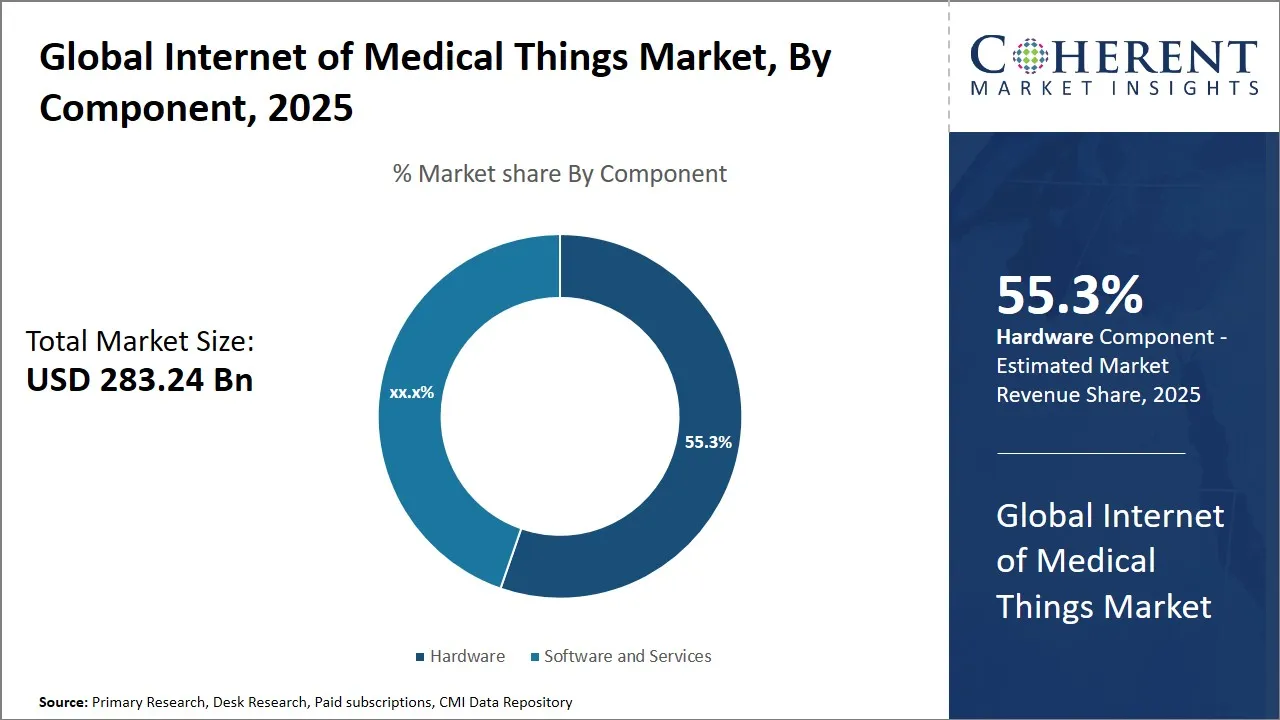
- In the global internet of medical things market, hardware is the dominant component segment, projected to account for 56.3 % of the market share in 2026.
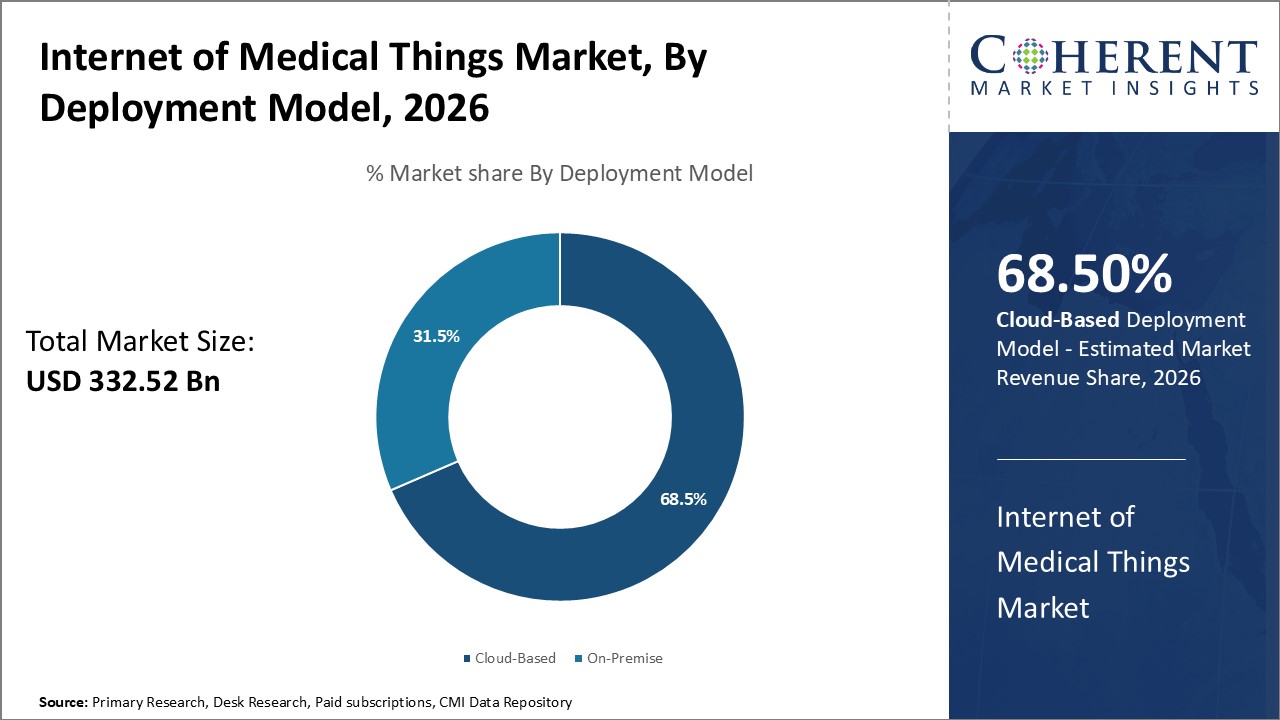
- The cloud-based segment is expected to lead the market with the largest share at 68.5 % in 2026.
- The wired segment is expected to hold the largest share at 65.4 % in 2026.
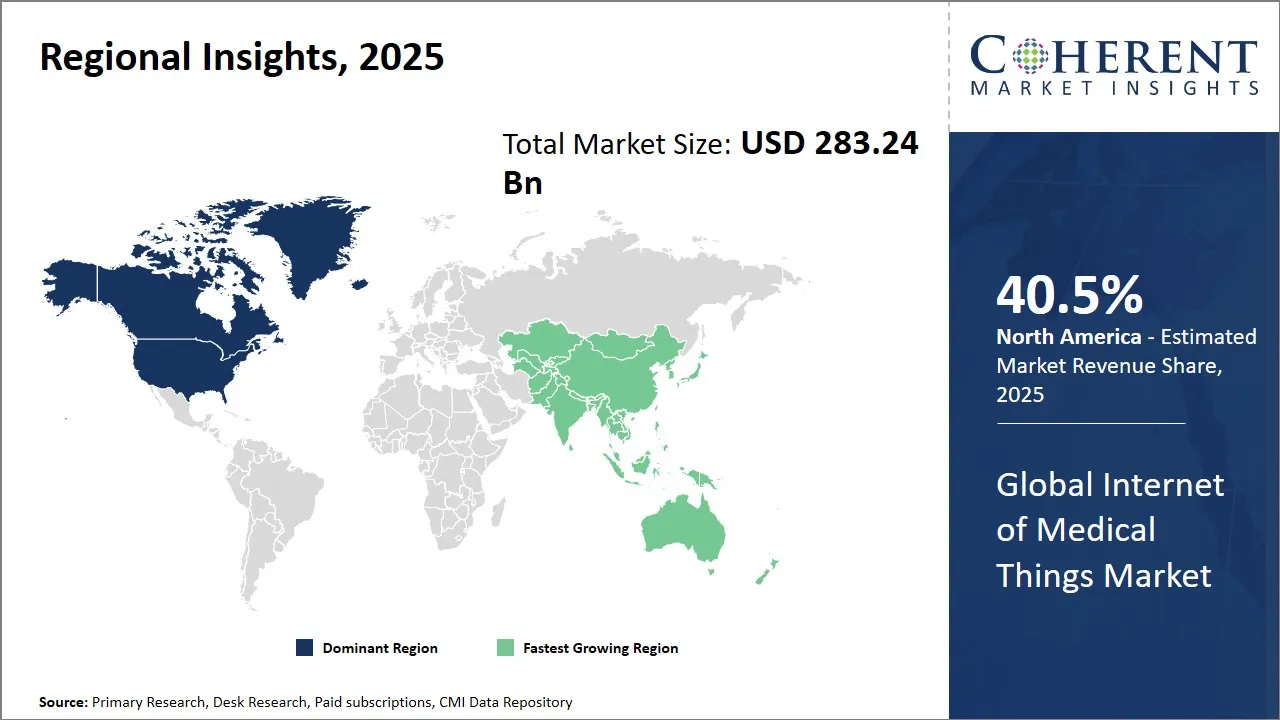
- North America is expected to lead the market, holding a share of 40.5 % in 2026. Asia Pacific is anticipated to be the fastest-growing region, with a market share of 23.8% in 2026.
Market Overview
Several key trends are driving the internet of medical things market, including the rapid integration of artificial intelligence and machine learning with connected health devices, enabling more precise and predictive healthcare management. Additionally, the rising demand for remote patient monitoring, fueled by an aging population and the need for cost-effective healthcare delivery, is propelling the market expansion. Enhanced connectivity, data analytics, and regulatory support further contribute to the widespread deployment of internet of medical things solutions globally.
Current Events and Its Impact
Current Events | Description and its Impact |
Expansion of Reimbursement for Digital Therapeutics (DTx) and Remote Monitoring |
|
Advancement of AI and Generative AI in Healthcare |
|
Segmental Insights
- Current Industry Events of 2026
- Market Size Estimation
- Regional Breakdown
- Competitive Landscape
- Customer Intelligence
- Segmental Analysis
- Pricing Analysis
- Key Market Drivers, Challenges & Future Trends
- Customized Insights Section
Internet of Medical Things Market Insights, By Component - Hardware Dominates the Global Internet of Medical Things Market Owing to Robust Device Integration and Reliability
In the global internet of medical things market, the hardware segment is the largest component segment, contributing an estimated 56.3% of the market share in 2026, with the main reason being that physical devices are crucial for connecting, collecting, and transmitting important medical data. Hardware includes products, from physiological monitor wearables to vitals monitoring stations as stationary devices, and finally implantable devices, such as pacemakers or Implantable Cardioverter Defibrillators (ICDs).
On October 14, 2025, Montana State University (MSU), a leading research institution, developed TrialWear, a wearable device designed to improve the safety of clinical trial participants. Created by MSU's assistant professor Elizabeth Johnson, the device helps maintain trial integrity by preventing treatment conflicts that could disqualify subjects.
Internet of Medical Things Market Insights, By Deployment Model – Cloud-Based Deployment is Leading the Market Driven by Scalability and Data Accessibility
In the global internet of medical things market, the cloud-based deployment model is expected to hold the largest share with 68.5% in 2026. The rapid uptake of cloud infrastructure to host IoMT platforms is mostly attributed to its scalability, flexibility, and easy data access for all stakeholders in healthcare delivery.
Cloud models facilitate the real-time collection, storage, and processing of huge amounts of medical data produced by connected devices. This is especially important for healthcare providers who have to manage patients across different locations or care facilities.
Internet of Medical Things Market Insights, By Connectivity - Wired Segment Dominates the Market Fueled by Reliability and Stability in Medical Data Transmission
In the connectivity sector of the global internet of medical things market, the wired segment is projected to hold the largest share with 65.4% in 2026. This is mainly because of the high quality of data that is required in the medical environment where device communication errors or interruptions could result in serious clinical consequences.
Wired connectivity has lower latency, higher bandwidth, and more resistance to interference compared to wireless solutions. These characteristics make it a preferred choice for stationary medical devices, vital signs monitoring stations, and other mission-critical applications where continuous, uninterrupted data flow is paramount.
Role & Adoption of Artificial Intelligence (AI) in the Global Internet of Medical Things Market
- AI is shifting the global internet of medical things market paradigm through its involvement in predictive analytics, automation, and personalized care. AI contributes to the power of the system by providing the entire process with actual insights, minimizing human error, and automating simple tasks using connected devices' enormous data. This, in turn, brings down the costs, and the outcomes of patients are improved, and the overall operational performance is increased. Philips and GE Healthcare are two examples of companies that use AI in their activities to gain more precise diagnoses and to create better customer experiences.
- The artificial intelligence is also a pioneer in making accessibility stamps like AI-powered remote monitoring and predictive healthcare. Along with personalized treatment plans, and proactive care the patient engagement also sees a rise in its numbers, which continues to happen through the AI phenomenon. However, the whole point of the data privacy and regulatory compliance aspect is a challenge that has to be faced and overcome. In order to survive, internet of medical things companies need to be making investments in reliable, scalable AI solutions that will be their ticket to the long-term growth, innovation, and competitive edge that they seek.
Regional Insights
North America Internet of Medical Things Market Analysis and Trends
North America is the largest player in the global internet of medical things market, which is expected to reach 40.5% share in 2026, due to its advanced healthcare infrastructure, new technologies, and a strong presence of leading medical devices manufacturers and technology giants. A solid market ecosystem is characterized by extensive research and development activities, collaboration between providers of healthcare and technology companies and government policies geared towards support such as the U.S. Food and Drug Administration’s (FDA) digital health policies that allow quicker approval processes for internet of medical things devices.
In April 2022, WellteQ Digital Health Inc., a provider of digital health and wellness solutions, announced the release of its IoMT HealthHub. The HealthHub, currently in beta testing with research partners, is designed as a scalable platform to integrate both medical and non-medical devices in virtual care settings across North America.
Asia Pacific Internet of Medical Things Market Analysis and Trends
The Asia Pacific region will lead the market for the internet of medical things in 2025 with an estimated share of 23.8%. This growth can be attributed to the fact that the region undergoes the fastest growth, along with rapid digitization of the healthcare sector, increasing penetration of smart medical devices, and building of medical infrastructure in the newly developed markets like India, China and Southeast Asia.
Such initiatives as China’s Healthy China 2030 Plan and India’s National Digital Health Mission that promote digitization of healthcare are the latest drivers of the market growth. Furthermore, the large numbers of patients in the area, together with the increasing awareness of healthcare issues, are among the factors that are turning the corner in the demand for IoMT solutions of the internet of medical things that are cost-effective.
Global Internet of Medical Things Market Outlook for Key Countries
U.S. Internet of Medical Things Market Analysis and Trends
The market for the internet of medical things in the U.S. is characterized by technologically sophisticated healthcare systems and the widespread use of new technologies. The leading companies, including Medtronic and IBM Watson Health, combine the use of artificial intelligence and cloud computing with the internet of medical things devices in order to deepen Remote Monitoring and Personalized Care. The U.S. government's focus on interconnecting healthcare IT systems and securing the digital data continues to promote the deployment of IoMT in both hospitals and outpatient settings, thereby solidifying the market's leading position.
In August 2024, Pfizer Inc. launched PfizerForAll, a digital platform aimed at simplifying healthcare access for millions of Americans. The platform supports individuals dealing with migraines, COVID-19, flu, and those seeking vaccinations for preventable diseases.
China Internet of Medical Things Market Analysis and Trends
The China internet of medical things market is developing quickly as a result of large-scale investments in the digitization of the healthcare sector and the introduction of smart technologies. To meet the unique healthcare requirements of the country, companies like Huawei and Alibaba Cloud are developing internet of medical things solutions that have integrated IoT and AI capabilities. Government support for smart city healthcare infrastructure and telemedicine services is accelerating the development and adoption of IoMT devices in both urban and rural areas.
On October 16, 2025, PomDoctor, a Chinese online medical services provider, raised USD 20 million in its Nasdaq debut. The company operates one of China’s largest digital platforms for chronic disease management and pharmaceutical services, connecting over 200,000 doctors and 700,000 patients.
Germany Internet of Medical Things Market Analysis and Trends
Germany, through its robust medical devices industry and constant dedication to healthcare innovation, remains the foremost country in Europe internet of medical things market. The strong presence of Siemens Healthineers and B. Braun Melsungen AG, which are the world's leading companies in the production of connected medical devices, and the support of the German government's Digital Healthcare Act for the digital health applications have led to the right conditions for the reception of IoMT technologies in clinics and hospitals, as the costs of their adoption have been reduced by the improvement of the reimbursement frameworks.
In October 2022, Henkel, a global leader in adhesives and printed electronics, extended its collaboration with Byteflies, a company specializing in remote patient monitoring solutions. The partnership aims to combine Henkel’s expertise in medical adhesives and printed electronics with Byteflies' ECG monitoring technologies to drive innovative remote patient monitoring solutions.
India Internet of Medical Things Market Analysis and Trends
The India internet of medical things market is on a fast track to expansion, powered by a combination of digital health initiatives and a robust private healthcare sector. Tata Elxsi and Philips India among others are working towards cost-effective IoMT solutions that would specifically cater to the needs of remote patient monitoring and chronic disease management. The public health program Ayushman Bharat is one of the initiatives taken by the Government to encourage digital tools uptake, which will, in turn, help overcome the accessibility problems of health care in rural areas.
In July 2025, Flipkart, one of India’s top e-commerce platforms, partnered with Pebble, a leading consumer tech brand, to launch India's first smart ring with a digital display and gesture controls. The Pebble HALO Smart Ring combines Pebble's product innovations with Flipkart’s extensive reach to make smart wearable technology accessible to Indian consumers.
Market Players, Key Development, and Competitive Intelligence
Key Developments
- In June 2025, Renalyx Health Systems Pvt Ltd, a leader in renal care technology innovation, launched India's first fully indigenous AI and cloud-enabled smart hemodialysis machine, the RENALYX – RxT 21. Priced at significantly lower than imported alternatives, the machine aims to make dialysis more affordable and accessible, particularly in semi-urban and rural areas.
- In June 2025, Cardinal Health, a global healthcare leader, launched the Kendall DL Multi System, a device for continuous monitoring of cardiac activity, blood oxygen, and temperature. This single-use system simplifies patient monitoring, reduces infection risk, and minimizes false alarms, supporting the growing Internet of Medical Things (IoMT) trend for better patient care.
- In June 2024, Apple Inc., a global leader in technology known for its innovative consumer electronics, previewed iOS 18 for the iPhone, enhancing the device's capability, security, and intelligence. A key update to the Health App includes an overhauled Medical ID feature, designed to streamline access to critical information for first responders during emergencies. The app also now offers improved functionality to support individuals during pregnancy, providing personalized insights and suggestions based on both physical and mental health changes.
- In May 2024, GE HealthCare Technologies Inc., a prominent provider of medical imaging, monitoring, and diagnostics technologies, partnered with Tampa General Hospital (TGH), a leading academic health system, to deploy GE’s Imaging and Ultrasound technology solutions in TGH Imaging’s outpatient facilities across Florida, benefiting both clinicians and patients.
Top Strategies Followed by Global Internet of Medical Things Market Players
- There are a lot of established players in the internet of medical things market who are heavily investing in research and development (R&D), while looking to innovate and create high-performance products that go along the needs of the healthcare sector and patients. Nowadays, these kinds of companies, for instance, are going for the latest technologies like AI-powered diagnostics, Wearable health devices, and complete telehealth, which keeps the companies' innovations at a high level.
- In September 2023, Microsoft Corporation, a multinational technology company renowned for its software, cloud computing, and AI advancements, entered a long-term collaboration with Mercy, a healthcare system based in the U.S. The partnership aims to leverage digital technologies, including generative AI, to enhance patient care.
- Conversely, the mid-range companies in the internet of medical things market take the cutting cost approach, yet their quality is based on reliability. Just like the top industry players, they also strike a proper balance between price and quality, thus making it possible for health clinics to act as the main users of IoT solutions while being on a tight budget.
- On October 16, 2025, emtelligent, a clinical-grade AI leader, launched its cost-effective Medical Language Engine to transform unstructured healthcare data into actionable insights. The AI solution improves clinical decision-making, operational efficiency, and supports the Internet of Medical Things for better patient care and research.
- Small-scale players operating in the field of medical IoT devices and services are able to grab their niche markets according to their own areas of expertise by focusing on novel and high-end products that solve specific clinical needs or those that are in trend with or to the future of healthcare. Moreover, to gain an edge over their bigger rivals they often employ the latest technologies, e.g. blockchain for data security, or edge computing for real-time analytics, etc.
- One example of such a company is Xenex Disinfection Services, which utilizes UV-C technology for hospital disinfecting solutions, combining IoMT with real-time data monitoring to improve patient safety. Another example is PhysIQ, which focuses on remote patient monitoring by using AI and edge computing to provide real-time analytics, especially for cardiovascular and respiratory conditions.
Market Report Scope
Internet of Medical Things Market Report Coverage
| Report Coverage | Details | ||
|---|---|---|---|
| Base Year: | 2025 | Market Size in 2026: | USD 332.52 Bn |
| Historical Data for: | 2020 To 2024 | Forecast Period: | 2026 To 2033 |
| Forecast Period 2026 to 2033 CAGR: | 17.4% | 2033 Value Projection: | USD 1022.11 Bn |
| Geographies covered: |
| ||
| Segments covered: |
| ||
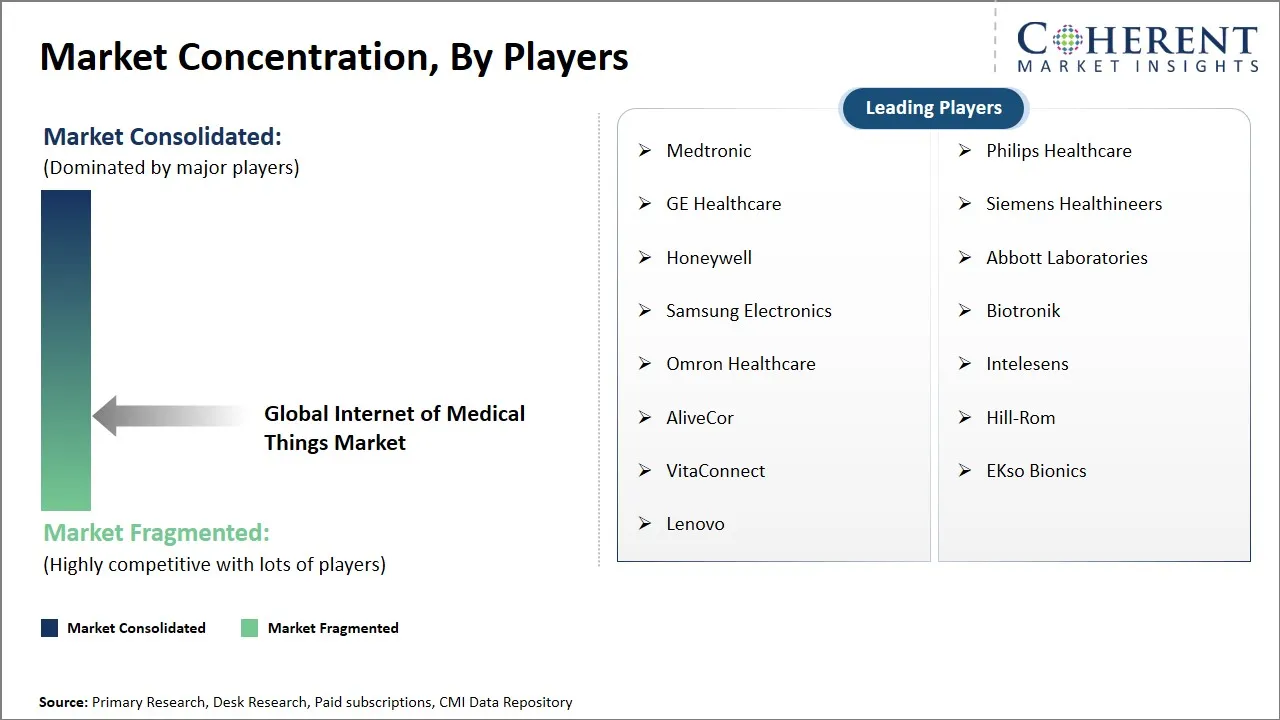
| Companies covered: | Medtronic, Philips Healthcare, GE Healthcare, Siemens Healthineers, Honeywell, Abbott Laboratories, Samsung Electronics, Biotronik, Omron Healthcare, Intelesens, AliveCor, Hill-Rom, VitaConnect, EKso Bionics, and Lenovo | ||
| Growth Drivers: |
| ||
| Restraints & Challenges: |
| ||
Market Dynamics
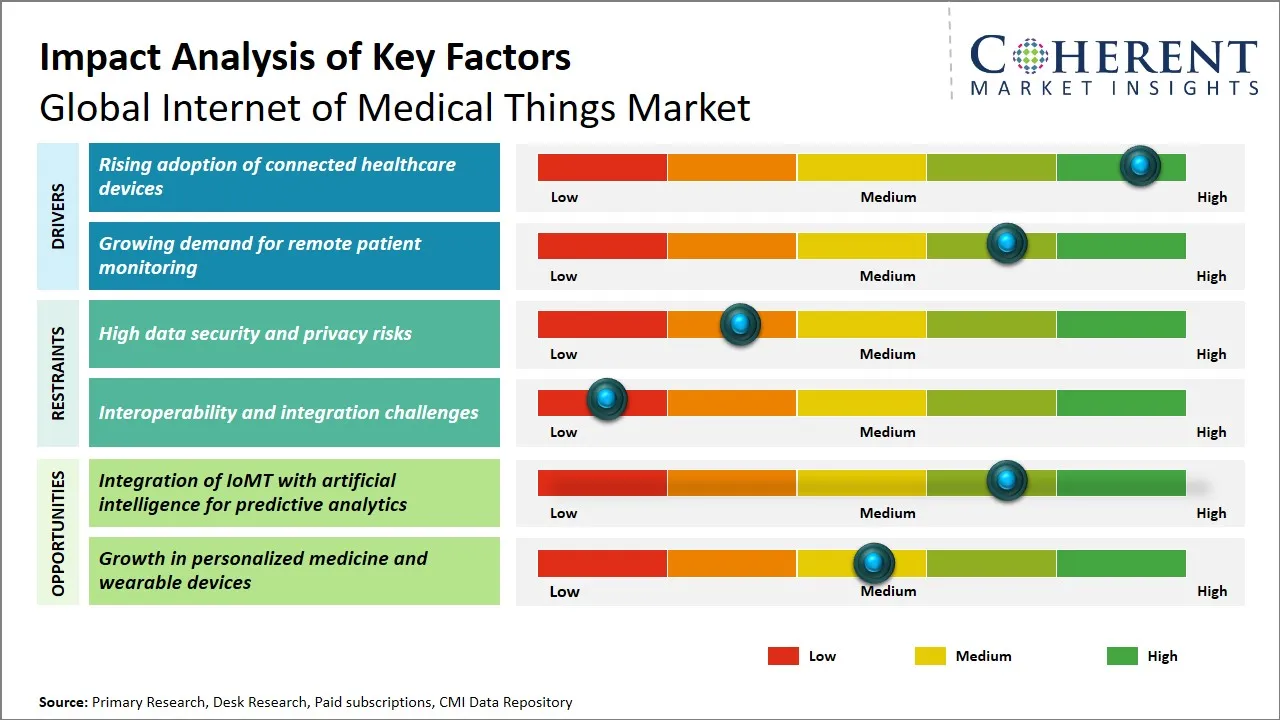
Internet of Medical Things Market Driver - Rising Adoption of Connected Healthcare Devices
The continuous and widespread use of healthcare connected devices is the chief factor driving the global internet of medical things market to a great extent. Healthcare devices such as wearable sensors, remote monitoring tools, and smart diagnostic equipment allow doctors and patients to monitor health and collect data all the time and in real-time, thus fostering better health outcomes for patients and quicker healthcare delivery. Also, the introduction of new technologies like the use of 5G networks for better connectivity and the integration of AI-driven analytics not only increase the usability but also the attractiveness of connected healthcare solutions.
In July 2025, OMRON Healthcare, a leader in innovative health technology, expanded its collaboration with Tricog Health, an AI-driven cardiac care company, to launch KeeboHealth, an advanced connected health platform. This digital health ecosystem leverages AI, real-time data analytics, and home-based monitoring to help healthcare providers and patients manage heart conditions more effectively.
Internet of Medical Things Market Opportunity - Integration of IoMT with Artificial Intelligence for Predictive Analytics
The convergence of the internet of medical things (IoMT) with Artificial Intelligence (AI) is a very big potential for growth in the health care industry to the extent that it boosts the predictive analytics abilities. IoMT devices that are used for monitoring patient's health, for example, wearable sensors, remote monitoring tools, and smart medical equipment, release massive amounts of real-time patient data. One way to look at it is that once the data is combined with the advanced AI algorithms, it can be easier to assess the data for patterns, predict health risks, and allow for early intervention so as to improve patient outcome and also cut down on healthcare costs. Furthermore, predictive analytics using AI can support medical professionals in the process of diagnosing diseases at early stages, tailoring treatment approaches, and handling chronic cases effectively.
In June 2025, SEALSQ Corp, a tech company specializing in semiconductors and post-quantum technology, expanded its security capabilities for the Internet of Medical Things (IoMT). The company introduced edge-based cryptographic authentication for AI-powered medical devices and implemented quantum-resistant algorithms to protect healthcare data, addressing cybersecurity challenges in the growing IoMT network.
Analyst Opinion (Expert Opinion)
- The global internet of medical things market is experiencing phenomenal growth led by technological innovations, a heavier reliance on digital healthcare, and friendly government regulations. The healthcare sector is now investing in IoMT technologies, as the demand for remote patient monitoring and telehealth solutions goes up. Moreover, the coupling of artificial intelligence and big data analytics with the internet of medical things devices is not only improving the current capabilities but also allowing for more personalized care and better disease management. Additionally, the governments of various countries are changing health care for the better by introducing good policies and providing financial support directed towards the development of health care infrastructure and innovation, thus contributing to a positive market situation.
- On the other hand, the challenges of data security, interoperability and the requirements of standardization remain to be significant obstacles to the positive factors bringing growth. Great events like the "Global Digital Health Summit" and the "IoT World Conference" have helped tremendously in gathering the leaders, innovators, and policymakers of the industry to talk about the evolving trends and challenges that even. Among the mentioned initiatives, the EU’s "Digital Health Action Plan" and pilot programs in India have shown the potential of real-world applications which, together with positive market trends and policy evolution, are expected to significantly drive the sector's future.
Speak to the analyst
Want personalized insights?
Take the findings above to one of our principal consultants, or have the report rebuilt around the segments, geographies and competitors you actually track.
Market Segmentation
- Component Insights (Revenue, USD Bn, 2020 - 2032)
- Hardware
- Wearable Devices (Physiological Monitors)
- Stationary Devices (Vital Signs Monitoring Stations)
- Implantable Devices (Cardiac Implants (e.g., Pacemakers, ICDs)
- Other Devices
- Software and Services
- Data Analytics Platforms
- Clinical Decision Support Systems
- Mobile Health Applications
- Others
- Hardware
- Deployment Model Insights (Revenue, USD Bn, 2020 - 2032)
- Cloud-Based
- On-Premise
- Connectivity Insights (Revenue, USD Bn, 2020 - 2032)
- Wired
- Wireless
- Application Insights (Revenue, USD Bn, 2020 - 2032)
- Remote Patient Monitoring
- Telemedicine and Virtual Consultations
- Medication Management
- Clinical Operations and Workflow Management
- Connected Imaging
- Inpatient Monitoring
- Other Applications
- End User Insights (Revenue, USD Bn, 2020 - 2032)
- Hospitals and Clinics
- Homecare Settings
- Research and Academic Institutions
- Government Authorities
- Biopharmaceutical Companies
- Diagnostic Laboratories
- Others
- Regional Insights (Revenue, USD Bn, 2020 - 2032)
- North America
- U.S.
- Canada
- Latin America
- Brazil
- Argentina
- Mexico
- Rest of Latin America
- Europe
- Germany
- U.K.
- Spain
- France
- Italy
- Russia
- Rest of Europe
- Asia Pacific
- China
- India
- Japan
- Australia
- South Korea
- ASEAN
- Rest of Asia Pacific
- Middle East
- GCC Countries
- Israel
- Rest of Middle East
- Africa
- South Africa
- North Africa
- Central Africa
- North America
- Key Players Insights
- Medtronic
- Philips Healthcare
- GE Healthcare
- Siemens Healthineers
- Honeywell
- Abbott Laboratories
- Samsung Electronics
- Biotronik
- Omron Healthcare
- Intelesens
- AliveCor
- Hill-Rom
- VitaConnect
- EKso Bionics
- Lenovo
Sources
Primary Research Interviews
Industry Stakeholders
- World Health Organization (WHO)
- European Commission – Directorate-General for Health and Food Safety
End Users
- U.S. Department of Veterans Affairs
- National Health Service (NHS) – United Kingdom
Government and International Databases
- U.S. Food and Drug Administration (FDA) – Medical Device Databases
- European Medicines Agency (EMA) – Medical Device Regulations
- Centers for Medicare & Medicaid Services (CMS) – Healthcare Data
- OECD Health Statistics
- World Bank – Health Systems Data
- United Nations – Global Health Observatory
Trade Publications
- Healthcare IT News
- MedTech Dive
- MobiHealthNews
- HealthTech Magazine
- Medical Device and Diagnostic Industry (MD+DI)
- The Medical Futurist
Academic Journals
- Journal of Medical Internet Research (JMIR)
- IEEE Journal of Biomedical and Health Informatics
- Computers in Biology and Medicine
- International Journal of Medical Informatics
- Sensors (MDPI)
- Health Informatics Journal
Reputable Newspapers
- The New York Times – Health Section
- The Guardian – Healthcare
- The Washington Post – Health
- Financial Times – Healthcare Industry
- The Times of India – Health
- The Hindu – Health
Industry Associations
- Healthcare Information and Management Systems Society (HIMSS)
- American Medical Association (AMA)
- European Society of Radiology (ESR)
- International Society for Research in Healthcare Financial Management (IRHFM)
- International Medical Informatics Association (IMIA)
- Global eHealth Innovation Network (GeHIN)
Public Domain Resources
- U.S. National Library of Medicine
- U.S. National Institutes of Health (NIH)
- World Health Organization – Global Health Observatory
- Centers for Disease Control and Prevention (CDC) – Data & Statistics
- European Centre for Disease Prevention and Control (ECDC) – Surveillance
- Open Data Portal – European Union
Proprietary Elements
- CMI Data Analytics Tool: Proprietary analytics tool to analyze real-time market trends, consumer behavior, and technology adoption in market
- Proprietary CMI Existing Repository of Information for Last 8 Years
Get access to 250+ pages report
Every segment, forecast, competitor profile and data table behind the analysis above — available for instant download.
- ESOMAR Member
- ISO 9001:2015 Certified
- D-U-N-S Registered
- GDPR & CCPA Compliant
Missing comfort of reading report in your local language? Find your preferred language:
Transform your Strategy with Exclusive Trending Reports
Frequently Asked Questions
The global internet of medical things market is estimated to be valued at USD 332.52 Bn in 2026 and is expected to reach USD 1022.11 Bn by 2033.
The CAGR of the global internet of medical things market is projected to be 17.4% from 2026 to 2033.
Rising adoption of connected healthcare devices and growing demand for remote patient monitoring are the major factors driving the growth of the global internet of medical things market.
High data security and privacy risks and interoperability and integration challenges are the major factors hampering the growth of the global internet of medical things market.
In terms of component, the hardware segment is estimated to dominate the market revenue share in 2025.
IoMT enables real-time patient monitoring, early disease detection, and personalized treatment, leading to improved patient outcomes and reduced healthcare costs.
The internet of medical things market is expected to grow significantly due to continued technological advancements, increasing demand for digital healthcare solutions, and expanding market opportunities in emerging regions.
The global internet of medical things market is estimated to be valued at USD 332.52 Bn in 2026 and is expected to reach USD 1022.11 Bn by 2033.
The CAGR of the global internet of medical things market is projected to be 17.4% from 2026 to 2033.
Rising adoption of connected healthcare devices and growing demand for remote patient monitoring are the major factors driving the growth of the global internet of medical things market.
High data security and privacy risks and interoperability and integration challenges are the major factors hampering the growth of the global internet of medical things market.
In terms of component, the hardware segment is estimated to dominate the market revenue share in 2025.
IoMT enables real-time patient monitoring, early disease detection, and personalized treatment, leading to improved patient outcomes and reduced healthcare costs.
The internet of medical things market is expected to grow significantly due to continued technological advancements, increasing demand for digital healthcare solutions, and expanding market opportunities in emerging regions.