

Land Restoration Market Size and Share Analysis - Growth Trends and Forecast (2026 - 2033)
The global land restoration market is estimated to be valued at approximately USD 16.4 Bn in 2026 and is projected to grow at a compound annual growth rate (CAGR) of 8.7% during the forecast period (2026–2033), reaching USD 29.4 Bn by 2033. This is attributable to increasing government investments in land restoration, rising adoption of sustainable land management practices, and growing focus on biodiversity conservation and carbon sequestration.
Key Takeaways from the Land Restoration Market Report
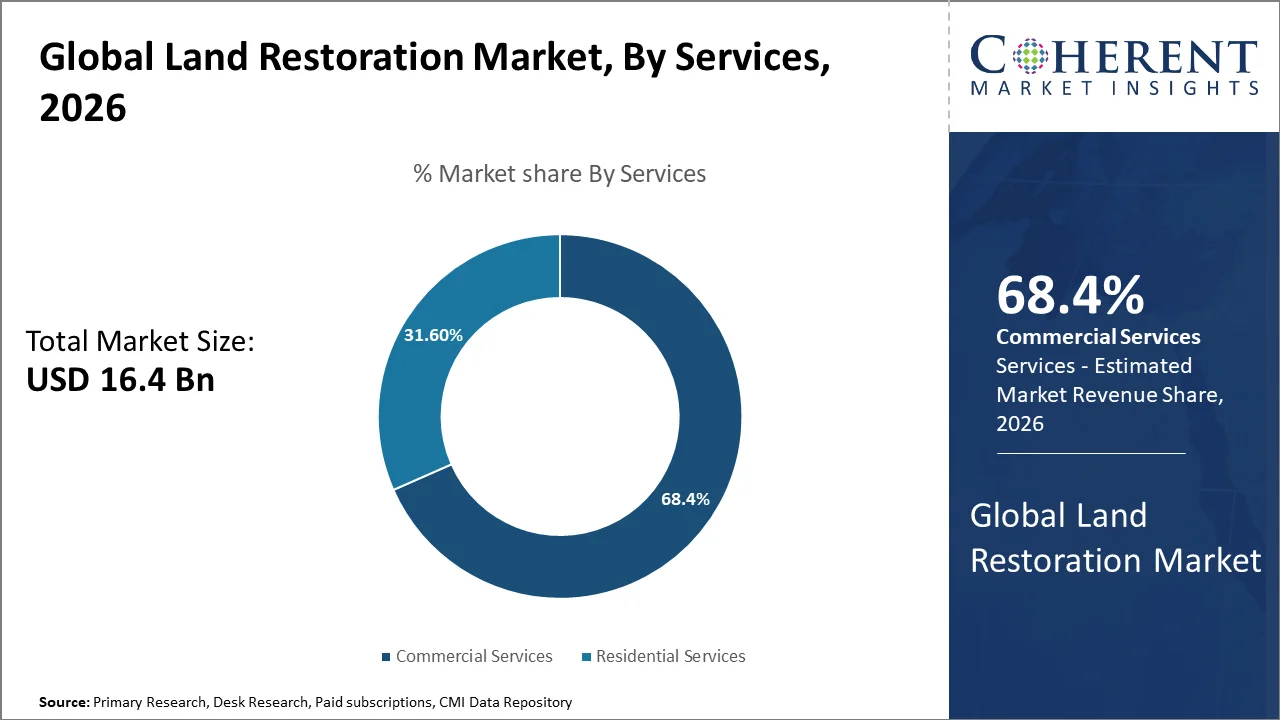
- Commercial services are expected to account for the largest revenue share of 68.4% in 2026 due to the growing number of large-scale restoration projects undertaken by governments, mining companies, infrastructure developers, utilities as well as environmental contractors. For example, the UNCCD aims to restore around 1 Bn hectares of degraded land by 2030, increasing demand for professional land restoration services.
- Agriculture is slated to lead the market with a share of 49.8% in 2026 due to increasing restoration of degraded farmland, growing adoption of regenerative agriculture practices, rising focus on improving soil fertility as well as expanding carbon farming initiatives worldwide. For example, FAO estimates that more than 1.6 Bn hectares of land globally are degraded, with over 60% affecting agricultural areas, increasing the need for restoration practices to improve soil productivity and long-term food security.
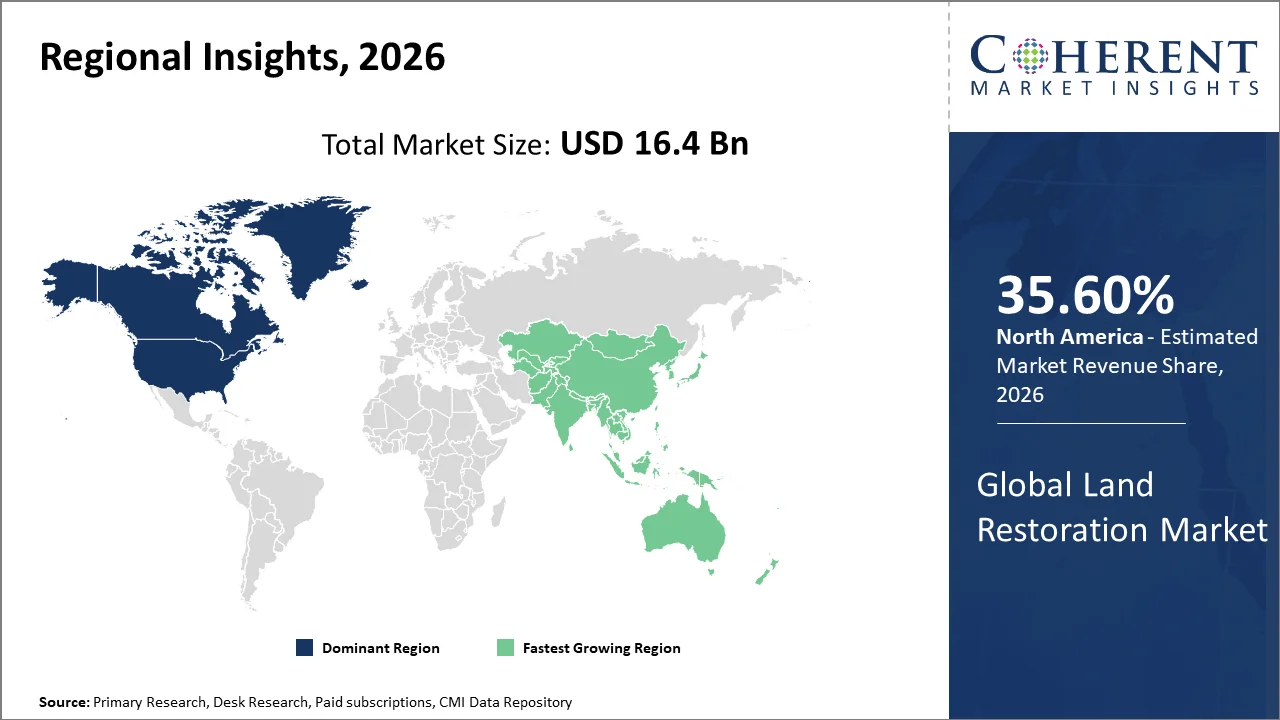
- North America is projected to dominate the global land restoration industry with a share of 35.6% in 2026 due to rising investments in land restoration and supportive government policies. For example, the U.S. Inflation Reduction Act provides USD 19.5 Bn for USDA conservation programs supporting soil health, land restoration, and sustainable management.
- Asia Pacific, registering a CAGR of 9.8%, is poised to emerge as the most lucrative market for land restoration service providers during the forecast period, owing to rising government initiatives, increasing land degradation, and expanding reforestation projects.
Land Restoration Market Overview
The global Land restoration market is poised to grow steadily during the forecast period. This growth is primarily driven by rising government initiatives for ecosystem restoration, growing concerns over land degradation and biodiversity loss, expanding investments in sustainable land management practices, and growing adoption of reforestation, afforestation, soil conservation, and regenerative agriculture projects.
Land restoration is the process of restoring degraded or damaged land ecosystems to improve their ecological health, productivity, and ability to provide essential ecosystem services. It involves activities such as reforestation, afforestation, soil rehabilitation, erosion control, wetland restoration, and sustainable land management practices.
Land restoration helps recover degraded landscapes, enhance biodiversity, improve soil quality, increase carbon storage, and restore habitats for humans, plants, and wildlife. These benefits are expected to support the growth of the land restoration market during the forecast period.
Increasing demand for repairing ecosystems by preventing and controlling pollution is one of the major factors driving market growth. Land restoration is essential for preventing and controlling pollution and plays a key role in improving the management of various socioeconomic activities. As a result, governments and international organizations are increasingly launching land restoration initiatives worldwide.
For example, in 2025, the United Nations Environment Programme (UNEP) and WWF-Armenia signed an agreement to launch the project “Land restoration and improvement of ecosystem services in Armenia through the use of the biodiversity of fruit and nut tree species.” Such projects will likely play a key role in boosting the global land restoration market revenue during the forecast period.
Rising focus on climate change mitigation is set to boost growth of land restoration market during the forecast period. Land restoration is gaining importance as a nature-based solution for reducing greenhouse gas emissions, improving carbon storage, and increasing climate resilience. Restoration activities such as reforestation, soil carbon improvement, and ecosystem rehabilitation are being adopted to support global climate goals.
Expansion of regenerative agriculture, agroforestry, conservation farming, and soil management practices is supporting market growth. Farmers are increasingly adopting restoration techniques to improve soil fertility, increase crop productivity, reduce erosion as well as strengthen resilience against droughts and climate risks.
Segmental Insights
Which is the Most Sought-After Service in the Global Land Restoration Market?
Commercial Services Lead the Global Land Restoration Market
According to Coherent Market Insights’ land restoration market analysis, commercial services are set to lead the market, accounting for a revenue share of 68.4% in 2026. This dominance can be attributed to growing adoption of large-scale land restoration projects by governments, private organizations, and environmental agencies.
Increasing investments in ecosystem restoration, sustainable land management practices, and biodiversity conservation initiatives are driving demand for commercial restoration services. These services offer specialized expertise in soil rehabilitation, reforestation, erosion control, and habitat restoration, making them essential for restoring degraded landscapes efficiently.
For example, the Global Environment Facility (GEF) reported that its land restoration projects restored 15.2 million hectares of degraded land between 2022 and 2025. These projects also supported sustainable management across 44.5 million hectares of landscapes, increasing the need for professional restoration services.
- Current Industry Events of 2026
- Market Size Estimation
- Regional Breakdown
- Competitive Landscape
- Customer Intelligence
- Segmental Analysis
- Pricing Analysis
- Key Market Drivers, Challenges & Future Trends
- Customized Insights Section
Which Application Segment Accounts for the Largest Land Restoration Market Share?
Agriculture Segment to Capture Nearly Half of the Market Share in 2026
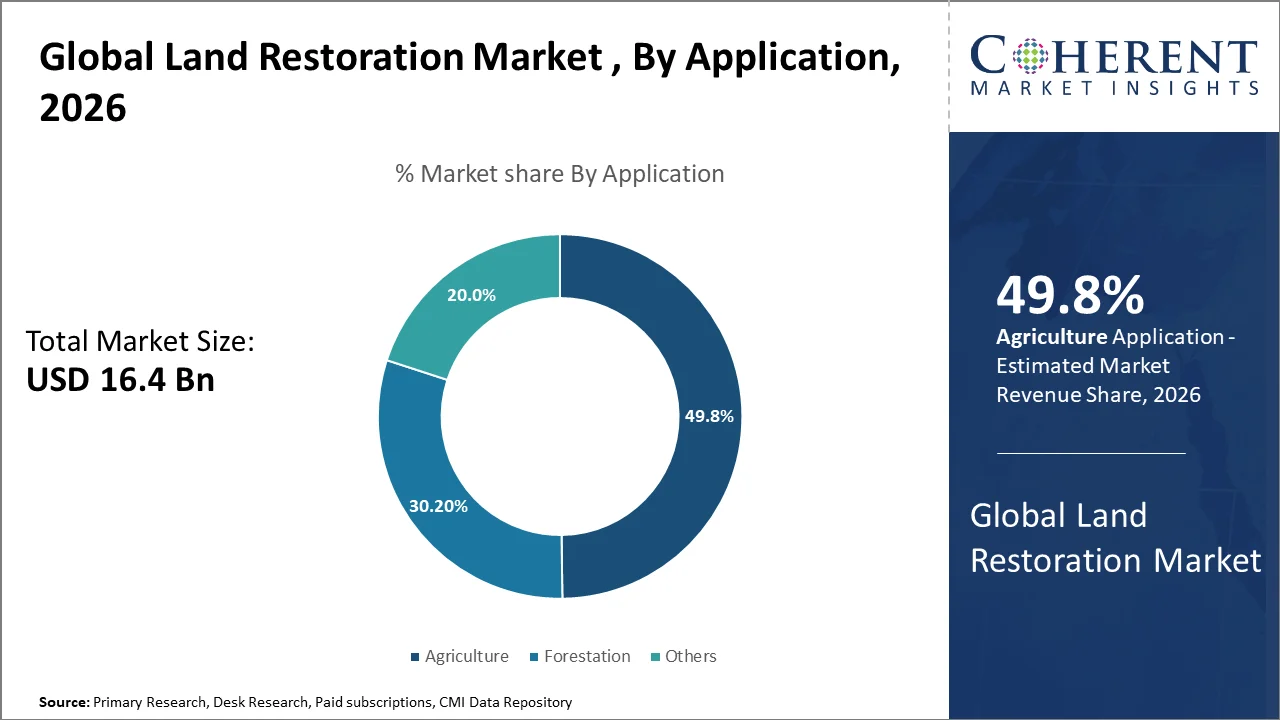
Based on application, agriculture segment is projected to account for the largest market share of 49.8% in 2026. This is mostly due to increasing need to restore degraded agricultural land, improve soil health, enhance crop productivity as well as support sustainable farming practices.
Rising concerns over soil degradation, land erosion, and declining agricultural productivity are encouraging governments and farmers to adopt land restoration solutions. In addition, growing demand for food production, climate-resilient agriculture, and regenerative farming practices is also driving adoption of land restoration services in the agriculture sector.
Land Restoration Market Growth Drivers
Increasing Land Degradation and Soil Quality Decline
Growing land degradation due to deforestation, soil erosion, overgrazing, pollution, and unsustainable farming practices is increasing demand for land restoration solutions. Around 40% of the world’s land is estimated to be degraded, affecting ecosystems, agriculture, and livelihoods. This, in turn, is driving investments in land recovery projects as well as creating favorable conditions for the growth of land restoration market.
Land Restoration Market Opportunities
Government Initiatives and Global Restoration Commitments
Governments and international organizations across the world are increasing funding and policy support for land restoration programs. Global commitments under initiatives such as the UN Convention to Combat Desertification (UNCCD), Bonn Challenge, and other restoration programs are encouraging large-scale restoration activities. Global commitments have reached around 1 billion hectares of land targeted for restoration by 2030. These initiatives are expected to create lucrative growth opportunities for the land restoration market during the forecast period.
Land Restoration Market Trends
Rising Adoption of Nature-Based Solutions
Shift towards nature-based solutions is an emerging trend in the land restoration market. The adoption of nature-based solutions, including reforestation, wetland restoration, and ecosystem rehabilitation, is increasing as governments and organizations seek sustainable approaches to address climate change, biodiversity loss, and environmental degradation. This is expected to boost the land restoration market value during the forthcoming period.
Current Events and Their Impact on the Land Restoration Market
Current Event | Description and its Impact |
India Expands Land Restoration Efforts Under Bonn Challenge Commitments (2026) |
|
UK Government Increases Funding for Peatland and Wildlife Habitat Restoration (2026) |
|
Regional Insights
North America Remains at the Epicenter of Land Restoration Market
North America is expected to lead the global land restoration market, accounting for a share of 35.60% in 2026. This dominance is attributable to increasing government investments in ecosystem restoration, rising adoption of nature-based solutions, forest rehabilitation programs as well as growing focus on biodiversity conservation and climate resilience.
Large-scale forest restoration initiatives are driving demand for restoration activities across the region. For example, the U.S. Department of Agriculture’s Natural Resources Conservation Service (NRCS) reported that its Longleaf Pine Initiative has helped restore more than 870,000 acres of longleaf pine forests on private lands since 2010. This initiative supports the recovery of degraded forest ecosystems across the southeastern United States.
Asia Pacific Emerges as the Fastest-Growing Land Restoration Market
Asia Pacific land restoration market is expected to record a CAGR of 9.8% during the forecast period. This is mostly due to increasing government-led restoration programs, rising concerns over land degradation, expansion of sustainable agriculture practices, and growing investments in forest and ecosystem rehabilitation.
Countries such as China, India, and Australia are implementing large-scale initiatives to restore degraded landscapes and improve environmental sustainability. According to the FAO’s Forest and Landscape Restoration program, 22 Asia-Pacific countries have committed to restoring at least 100 million hectares of degraded land by 2030, supporting long-term demand for restoration activities across the region.
Land Restoration Market Outlook – Country-wise
U.S. Land Restoration Market Trends
The United States is expected to remain a prominent market for land restoration solutions during the assessment period. This is mainly due to strong federal and state funding for ecosystem restoration projects, increasing reclamation of abandoned mining sites, widespread adoption of regenerative land management practices, and stricter environmental compliance requirements for industrial and infrastructure developments.
China Land Restoration Market Forecast
China’s land restoration market is projected to grow rapidly during the assessment period. This is attributable to large-scale ecological conservation programs, extensive rehabilitation of degraded agricultural land and desertified regions, government-led initiatives to improve soil quality, and rising investments in sustainable land-use planning to support long-term environmental resilience.
Who are the Major Companies in the Land Restoration Market?
Some of the major players in land restoration market are Natural Texas, Land Restoration, Adaptive Restoration LLC, Land Life Company Sanderson Environmental, Neiman Environments, Inc., Agrecol LLC, Applied Ecological Services (AES), Angi, and WinterCreek Restoration & Nursery.
Key Strategies Adopted by Industry Players
Leading land restoration service companies are adopting various organic and inorganic strategies to boost their revenue as well as gain a competitive edge in the industry. These include new service launches, partnerships, collaborations, mergers, acquisitions, and strategic investments to expand their market presence and strengthen their service capabilities.
- In June 2026, Arup acquired EnTrade to expand its nature restoration capabilities. The acquisition strengthens Arup’s ability to support biodiversity projects by connecting businesses with investment opportunities in nature recovery and ecosystem restoration.
- In April 2025, Origin Enterprises plc acquired Scott Cawley Ltd to strengthen its ecological consulting services. The acquisition expanded its capabilities in biodiversity protection, habitat management, and land restoration planning.
- In November 2025, Google LLC expanded its partnership with Mombak to support large-scale restoration of degraded Amazon land. The agreement includes the purchase of 200,000 tons of carbon removal credits generated through native forest restoration projects, helping Mombak expand its biodiversity-focused restoration activities.
Market Report Scope
Land Restoration Market Report Coverage
| Report Coverage | Details | ||
|---|---|---|---|
| Base Year: | 2025 | Market Size in 2026: | USD 16.4 Bn |
| Historical Data for: | 2020 To 2024 | Forecast Period: | 2026 To 2033 |
| Forecast Period 2026 to 2033 CAGR: | 8.7% | 2033 Value Projection: | USD 29.4 Bn |
| Geographies covered: |
| ||
| Segments covered: |
| ||
| Companies covered: | Natural Texas, Land Restoration, Adaptive Restoration LLC, Land Life Company Sanderson Environmental, Neiman Environments, Inc., Agrecol LLC, Applied Ecological Services (AES), Angi, and WinterCreek Restoration & Nursery. | ||
| Growth Drivers: |
| ||
| Restraints & Challenges: |
| ||
Analyst Opinion (Expert Opinion)
- Land restoration is becoming a global priority due to rising land degradation and climate risks. More than 3 billion people are affected by land degradation, increasing the need for restoration services such as soil recovery, reforestation, and ecosystem rehabilitation. Growing environmental challenges are expected to increase government and private investment in land restoration projects.
- Large-scale international restoration commitments are creating strong demand for restoration solutions. The Bonn Challenge aims to restore 350 million hectares of degraded and deforested land by 2030, with 257 million hectares already pledged. These commitments are supporting long-term opportunities for restoration service providers and technology companies.
- Natural-based solutions have become popular with the growing efforts of the governments towards tackling climate change. According to analysts, there will be more use of approaches like afforestation, wetland restoration and sustainable land management for the purpose of increasing carbon storage and biodiversity. With the growth in climate finance and reduction in carbon emissions, businesses are encouraged to extend restoration services.
- Land restoration is receiving more investments owing to growing economic advantages. According to United Nations, the restoration of 350 million hectares of degraded ecosystems can produce $9 trillion worth of ecosystem services by 2030. The high economic advantage will definitely encourage more investments in restoration projects.
Speak to the analyst
Want personalized insights?
Take the findings above to one of our principal consultants, or have the report rebuilt around the segments, geographies and competitors you actually track.
Market Segmentation
- By Business Function (Revenue, USD Bn, 2021-2033)
- Real Estate/Site Acquisition
- Planning Design & Engineering
- Physical Restoration
- Monitoring
- Landscaping & Other Supplies
- Financing & Legal Services
- Consulting
- Others
- By Activities (Revenue, USD Bn, 2021-2033)
- Terrestrial Habitat Restoration & Management
- Wetland Restoration & Management
- Mitigation Banking
- Enhanced Stewardship
- Invasive Species Control & Management
- Clean-ups & Contamination Management
- Species Conservation & Management
- Others
- By Services (Revenue, USD Bn, 2021-2033)
- Residential Services
- Commercial Services
- By Application (Revenue, USD Bn, 2021-2033)
- Agriculture
- Forestation
- Others
- By Region Insights ( Revenue, USD Bn, 2021 - 2033)
- North America
- U.S.
- Canada
- Latin America
- Brazil
- Argentina
- Mexico
- Rest of Latin America
- Europe
- Germany
- U.K.
- Spain
- France
- Italy
- Russia
- Rest of Europe
- Asia Pacific
- China
- India
- Japan
- Australia
- South Korea
- ASEAN
- Rest of Asia Pacific
- Middle East
- GCC Countries
- Israel
- Rest of Middle East
- Middle East & Africa
- South Africa
- North Africa
- Central Africa
Sources
Primary Research Interviews
- Interviews with industry experts, land restoration service providers, environmental consultants, government officials, NGOs, and ecosystem restoration specialists.
Databases
- Food and Agriculture Organization (FAO) databases
- United Nations Environment Programme (UNEP) databases
- World Bank DataBank
- Global Forest Watch database
- International Union for Conservation of Nature (IUCN) databases
- National government environmental and land-use databases
Magazines
- Nature Magazine
- Science Magazine
- Environmental Science & Technology Magazine
- The Ecologist
- GreenBiz
Journals
- Restoration Ecology Journal
- Journal of Applied Ecology
- Land Degradation & Development Journal
- Ecological Engineering Journal
- Environmental Research Letters
Newspapers
- The Guardian (Environment Section)
- Reuters (Climate and Environment Section)
- The New York Times (Climate Section)
- The Hindu (Environment Section)
- The Economic Times (Environment Section)
Associations
- International Union for Conservation of Nature (IUCN)
- Society for Ecological Restoration (SER)
- United Nations Convention to Combat Desertification (UNCCD)
- Food and Agriculture Organization of the United Nations (FAO)
- World Resources Institute (WRI)
- International Society for Restoration Ecology (SER)
Public Domain Sources
- United Nations Convention to Combat Desertification (UNCCD) reports
- United Nations Decade on Ecosystem Restoration reports
- Food and Agriculture Organization (FAO) publications
- United Nations Environment Programme (UNEP) reports
- World Bank environmental publications
- Government environmental policies and restoration programs
- National forestry and land management reports
Proprietary Elements
- CMI Data Analytics Tool
- Proprietary CMI Existing Repository of information for last 10 years
Get access to 250+ pages report
Every segment, forecast, competitor profile and data table behind the analysis above — available for instant download.
- ESOMAR Member
- ISO 9001:2015 Certified
- D-U-N-S Registered
- GDPR & CCPA Compliant
Missing comfort of reading report in your local language? Find your preferred language:
Transform your Strategy with Exclusive Trending Reports
Frequently Asked Questions
The land restoration market includes products, technologies, and services used to restore degraded land, forests, wetlands, grasslands, and agricultural areas. It focuses on improving soil health, biodiversity, water resources, and ecosystem resilience through sustainable restoration practices.
The global market is estimated to be valued at USD 16.4 Bn in 2026.
The global Land Restoration Market value is expected to reach USD 29.4 Bn by 2033.
The global market is poised to exhibit a CAGR of 8.7% from 2026 to 2033.
Agriculture, forestry, mining, infrastructure development, construction, and energy are among the largest end users.
Major growth factors include increasing land degradation, climate change, stricter environmental regulations, rising investments in ecosystem restoration, and global commitments to restore degraded landscapes.
Major challenges include high project costs, long restoration timelines, limited funding in developing regions, land ownership issues, and difficulties in monitoring long-term restoration outcomes.