

Global Digital Agriculture Market Size and Forecast – 2026-2033
The Global Digital Agriculture Market is estimated to be valued at USD 26.23 Bn in 2026 and is expected to reach USD 53.77 Bn by 2033, exhibiting a compound annual growth rate (CAGR) of 10.8% from 2026 to 2033.
Key Takeaways of the Digital Agriculture Market
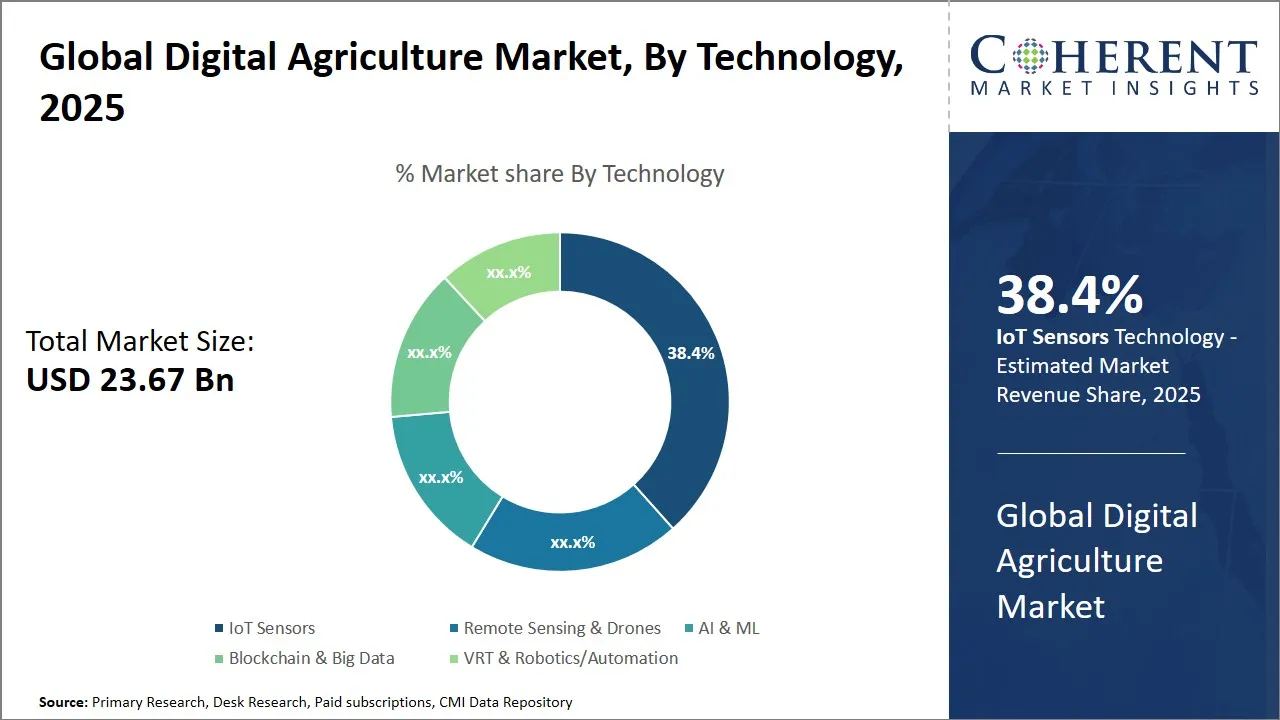
- The IoT sensors segment leads the market holding an estimated share of 39.4 % in 2026.
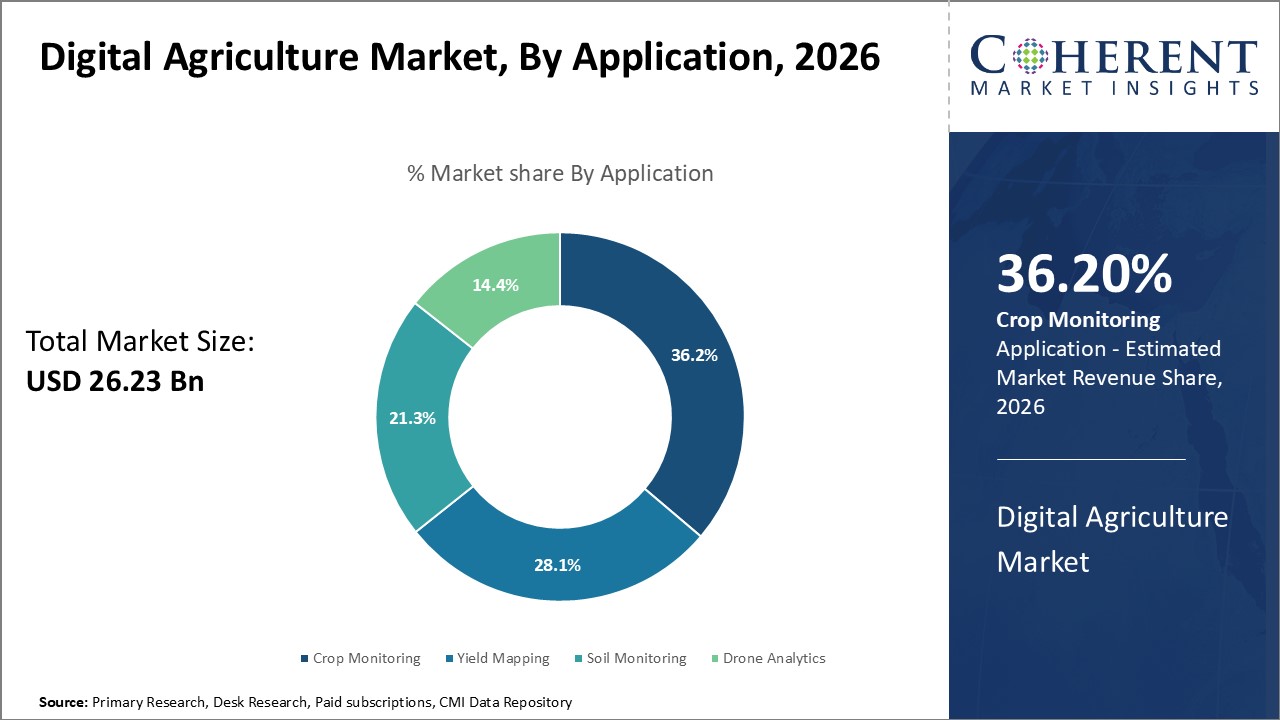
- The crop monitoring segment leads the market holding an estimated share of 36.2 % in 2026.
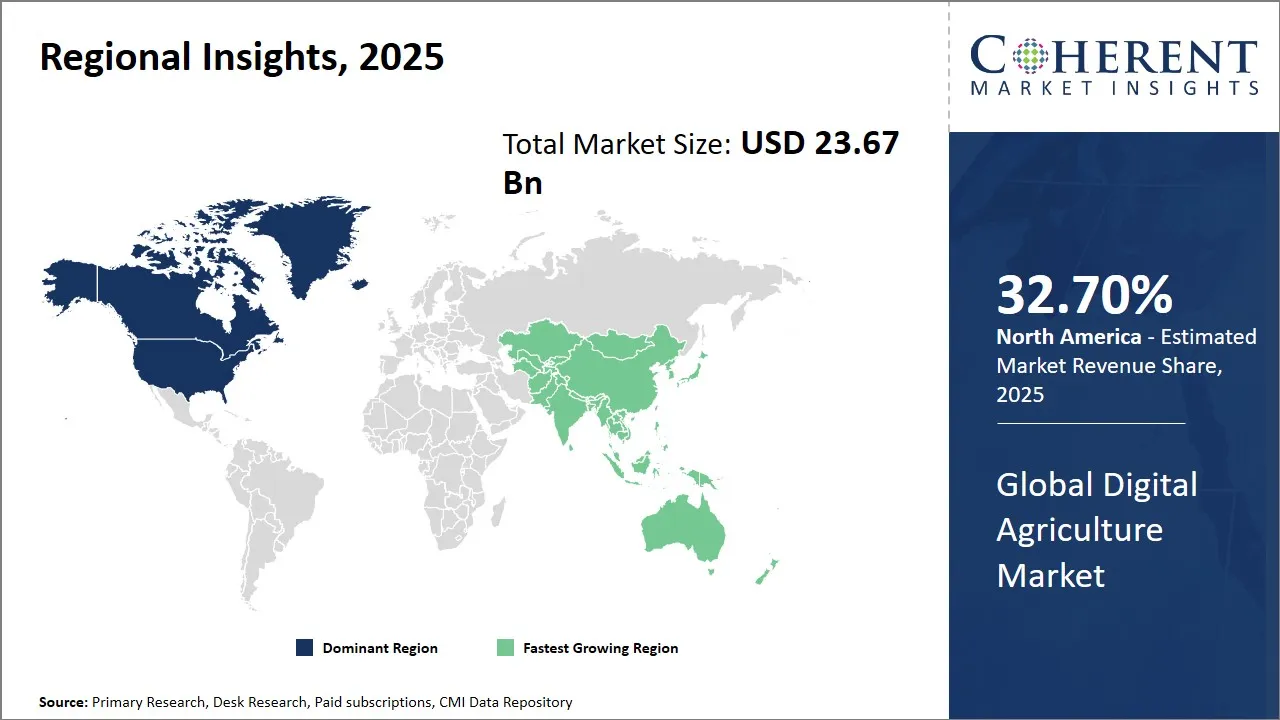
- North America is estimated to lead the market with a share of 32.7 % in 2026. Asia Pacific, holding a share of 28.2% in 2026, is projected to be the fastest growing region.
Market Overview
The market is seeing the integration of advanced technologies such as drones, satellite imaging, and AI-powered decision support systems that make possible real-time monitoring and predictive analytics. Also, the growing investments in smart irrigation systems, automated farm equipment, and Blockchain for supply chain transparency are adding to productivity and reducing environmental impact. This shift towards data-driven and automated farming practices will create market growth in the future.
Current Events and Its Impact
Current Events | Description and its impact |
Geopolitical Developments Impacting Global Supply Chains |
|
Technological Advancements and Integration |
|
Segmental Insights
- Current Industry Events of 2026
- Market Size Estimation
- Regional Breakdown
- Competitive Landscape
- Customer Intelligence
- Segmental Analysis
- Pricing Analysis
- Key Market Drivers, Challenges & Future Trends
- Customized Insights Section
Global Digital Agriculture Market Insights, by Technology – IoT Sensors Lead Owing to their Critical Role in Enhancing Data-Driven Decision Making
IoT sensors, holding an estimated share of 39.4% in 2026, can collect real-time and precise data from agricultural environments, adding to efficiency and productivity in farming practices. These sensors help farmers monitor different environmental parameters such as soil moisture, temperature, humidity, and nutrient levels, thereby making possible timely interventions and optimized resource use. One of the key factors propelling growth in this segment is the rising adoption of precision agriculture techniques. IoT sensors also allow smooth integration into smart farming systems, helping farmers gather data points that inform irrigation schedules, fertilization, and pest control measures.
Additionally, the advancement in wireless communication technologies and sensor miniaturization have made IoT Sensors more affordable and easier to deploy in remote and vast farming areas. These improvements have expanded their application beyond just basic monitoring to more sophisticated functions like automated irrigation systems and early disease detection. The ability of these sensors to transmit data in real time allows for predictive analytics, helping farmers anticipate issues before they become severe.
Global Digital Agriculture Market Insights, by Application – Crop Monitoring Dominates Owing to its Essential Role in Optimizing Agricultural Productivity and Risk Management
Crop monitoring, holding an estimated share of 36.2% in 2026, is the most significant application within the global digital agriculture market because it directly addresses the fundamental need for farmers to track crop health, growth stages, and environmental conditions to optimize yields. The driving force behind this segment’s growth lies in its ability to provide timely, accurate, and actionable insights that enable farmers to make informed decisions throughout the crop lifecycle.
The primary factor supporting crop monitoring’s dominance is the increasing use of remote sensing technologies, drones, and high-resolution imaging, which facilitate detailed surveillance of crop fields. This allows early detection of diseases, pest infestations, nutrient deficiencies, and water stress, enabling proactive interventions before substantial damage occurs. Moreover, the integration of IoT sensors within crop monitoring systems enables continuous data collection at the micro-level, allowing for granular monitoring that complements satellite or drone imagery. This multi-source data fusion boosts accuracy and provides comprehensive insights into crop status, soil health, and environmental factors impacting growth.
The growing emphasis on sustainable agriculture practices also plays a vital role in increasing the use of crop monitoring solutions. Efficient monitoring allows for optimized use of inputs such as fertilizers and pesticides, minimizing environmental impact and reducing costs. Additionally, as food traceability and quality assurance gain importance in global supply chains, crop monitoring supports certification standards by ensuring consistent quality and compliance with regulatory requirements.
The Impact of AI on the Digital Agriculture Market
The impact of Artificial Intelligence (AI) on the digital agriculture market is transformative, enabling farmers to make faster, data-driven decisions that enhance productivity and sustainability. AI-powered systems can analyze massive volumes of data from IoT sensors, satellite imagery, and weather forecasts to generate real-time insights on soil health, crop conditions, pest threats, and yield forecasts. This has led to the optimization of resource usage—such as fertilizers, water, and pesticides—thereby reducing costs and environmental impact. AI also plays a vital role in predictive analytics, enabling proactive responses to changing field conditions and market demands.
Microsoft’s AI for Earth initiative collaborates with agritech startups like Ag-Analytics and Sencrop to provide precision farming tools using machine learning and satellite imagery. These tools help farmers monitor field-level variability and predict outcomes with greater accuracy. In regions like sub-Saharan Africa, AI models are being deployed to predict locust swarms and prevent food insecurity by guiding early intervention.
Regional Insights
North America Digital Agriculture Market Analysis and Trends
North America, holding a share of 32.7% in 2026, is expected to dominate the global digital agriculture market, stemming from a highly developed agricultural ecosystem supported by advanced technological infrastructure and substantial investment in innovation. The U.S. and Canada benefit from well-established agri-tech companies, robust research institutions, and widespread adoption of precision farming techniques. Government policies, including subsidies and initiatives promoting sustainable farming, foster a conducive environment for digital agriculture solutions like IoT-enabled equipment, AI-driven analytics, and remote sensing technologies.
Key industry players such as Deere & Company, Trimble Inc., and Raven Industries contribute significantly by integrating cutting-edge technology with traditional agricultural practices, enhancing productivity and efficiency. In 2026, John Deere expanded its Startup Collaborator Program, onboarding six new ag-tech startups focused on AI, robotics, and satellite analytics. Moreover, North America’s efficient supply chains and strong trade relationships facilitate quick adoption and scaling of digital agriculture solutions across the region.
Asia Pacific Digital Agriculture Market Analysis and Trends
The Asia Pacific, holding a share of 28.2% in 2026, is expected to exhibit the fastest growth in the digital agriculture market, driven by increasing digital penetration, government support for smart farming, and urgent need to boost agricultural output to feed its vast population. In July 2026, Yara East Africa, in collaboration with Asili Agriculture, launched an Agri-Hub Knowledge Centre aimed at empowering farmers with digital tools and agronomic expertise. Nations including China, India, Japan, and Australia are rapidly adopting technologies such as drones, satellite imaging, AI, and big data analytics to optimize resource use and yield.
The increasing presence of both global and local agri-tech startups, alongside government policies aiming at rural digitization and sustainable agriculture, underpin the rapid expansion. Companies like XAG (China), Resson Aerospace (India), and AgriWebb (Australia) are pioneering innovative solutions tailored to regional farming needs, contributing to heightened adoption levels. Additionally, public-private partnerships and foreign investments further catalyze market growth in this region.
Global Digital Agriculture Market Outlook for Key Countries
U.S. Digital Agriculture Market Analysis and Trends
The U.S. is characterized by a mature digital agriculture sector supported by a comprehensive ecosystem involving major agribusinesses, technology providers, and research universities. Companies such as Deere & Company and Trimble Inc. heavily invest in AI-driven farm management software and automated machinery. Government initiatives towards sustainability and technology adoption amplify market activity. Growing emphasis on climate-smart agriculture and precision farming drives continuous innovation tailored for large-scale commercial farms, reinforcing U.S. leadership in the global market.
China Digital Agriculture Market Analysis and Trends
China digital agriculture market is rapidly evolving with strong government backing in digital agriculture as a strategic priority to enhance food security and sustainability. Significant investments in IoT, drone technology for crop management, and AI-based predictive analytics are transforming farming practices. Companies like XAG, a leading drone manufacturer, are expanding their offerings to a wide network of farmers.
India Digital Agriculture Market Analysis and Trends
India digital agriculture market growth is propelled by increasing government initiatives promoting farm digitization and smart agriculture solutions to improve productivity and reduce wastage. Startups such as Resson Aerospace and CropIn are deploying AI, remote sensing, and mobile-based farm advisory services aimed at small and marginal farmers. The market benefits from partnerships between government bodies and private players to enhance accessibility to digital tools in rural regions.
Germany Digital Agriculture Market Analysis and Trends
Germany remains a significant player in Europe digital agriculture space, propelled by strong R&D capabilities and a focus on sustainable agriculture. The government supports innovation through policies encouraging precision farming and environmentally friendly practices. Companies like CLAAS and AGCO GmbH invest extensively in automated machinery and data-driven farm management solutions.
Brazil Digital Agriculture Market Analysis and Trends
Brazil is marked by increasing adoption of digital solutions tailored to its large-scale and diverse agricultural landscape, particularly in soybean and coffee production. Local and global players such as Agrotools and Solinftec are advancing technology adoption through precision agriculture, remote sensing, and farm analytics platforms. Brazilian government support through initiatives promoting sustainable farming and exports further incentivizes investment.
Market Players, Key Development, and Competitive Intelligence
Key Developments
- On July 7, 2025, Saga Robotics, the company behind the Thorvald robot, announced a new three-way partnership in the U.K. with Bitwise Agronomy and Chambers Farm, a leading U.K. soft-fruit producer. The move will integrate Saga's Thorvald robots with Bitwose Agronomy's AI crop insights platform at Chambers Farm.
- On July 3, 2025, Deere & Company announced the names of 6 companies chosen for its 2025 Startup Collaborator program. The John Deere Startup Collaborator program was launched in 2019 to enhance and deepen the company’s interaction with startup companies whose technology could add value for agriculture and construction customers. The startups include Array Labs, Landscan, LIDWAVE, Presien, ReSim, and Witricity.
- On July 2, 2025, Bunge Global SA announced the successful closing of its previously announced merger with Viterra Limited, marking the creation of a premier global agribusiness solutions company for food, feed and fuel.
- In May 2024, Planet Labs PBC, a provider of daily data and insights about Earth, expanded its existing commercial partnership with BASF Digital Farming GmbH. Through this strategic partnership, BASF Digital Farming grew its use of Planet satellite data products to power its advanced digital farming products and services from its xarvio Digital Farming Solutions brand.
Top Strategies Followed by Digital Agriculture Market Players
- Established players dominate the landscape by heavily investing in research and development to drive continuous innovation. These companies focus on creating high-performance, technologically advanced products that address emerging agricultural challenges such as precision farming, crop monitoring, and automated machinery.
- John Deere continues to invest heavily in R&D to maintain its technological edge. In 2024–2025, the company enhanced its See & Spray Ultimate technology, which uses AI and computer vision to differentiate between crops and weeds in real time.
- Mid-level players in the digital agriculture market typically adopt a different approach, concentrating on delivering cost-effective solutions that strike a balance between affordability and quality. These companies target price-sensitive customers such as smallholder farmers and agribusinesses in developing regions, where lower-cost yet reliable digital tools are highly sought after.
- CropIn, a mid-tier agri-intelligence firm, offers SaaS-based smart farm management platforms to small and medium-sized agribusinesses across Asia and Africa.
- Small-scale players, including startups and specialized manufacturers, differentiate themselves by focusing on niche segments within the digital agriculture ecosystem. These companies emphasize innovative products with specialized features tailored to particular farming practices, crops, or regional requirements.
- Hummingbird Technologies specializes in aerial crop analytics using drone and satellite imagery. Instead of competing on full-suite solutions, it focuses on niche services like nitrogen variability mapping and disease detection using AI.
Market Report Scope
Digital Agriculture Market Report Coverage
| Report Coverage | Details | ||
|---|---|---|---|
| Base Year: | 2025 | Market Size in 2026: | USD 26.23 Bn |
| Historical Data for: | 2020 To 2024 | Forecast Period: | 2026 To 2033 |
| Forecast Period 2026 to 2033 CAGR: | 10.8% | 2033 Value Projection: | USD 53.77 Bn |
| Geographies covered: |
| ||
| Segments covered: |
| ||
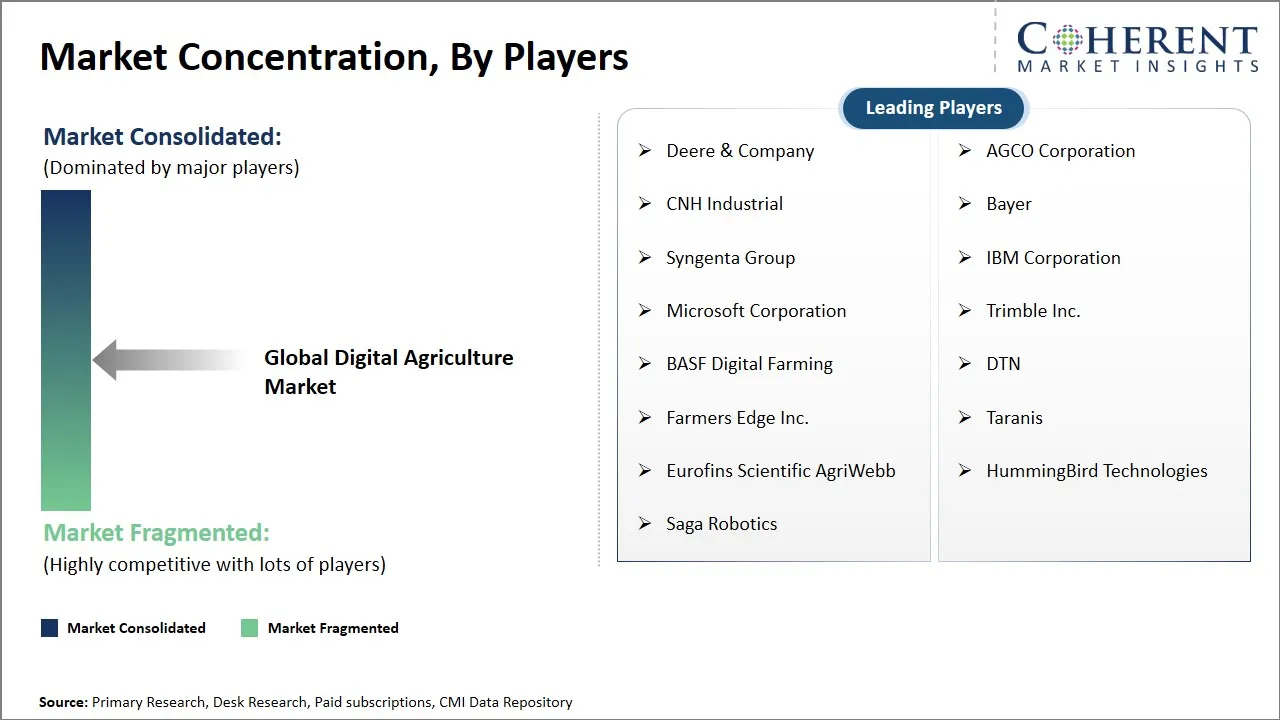
| Companies covered: | Deere & Company, AGCO Corporation, CNH Industrial, Bayer, Syngenta Group, IBM Corporation, Microsoft Corporation, Trimble Inc., BASF Digital Farming, DTN, Farmers Edge Inc., Taranis, Eurofins Scientific AgriWebb, HummingBird Technologies, and Saga Robotics | ||
| Growth Drivers: |
| ||
| Restraints & Challenges: |
| ||
Market Dynamics
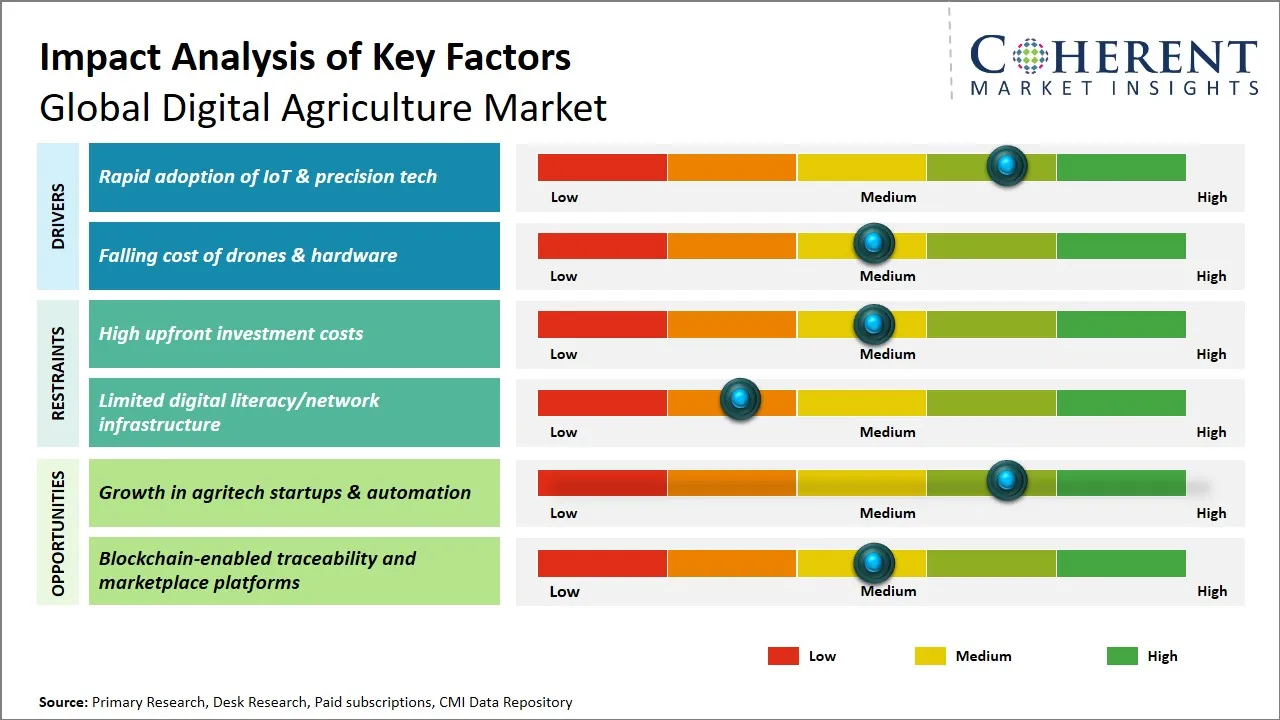
Global Digital Agriculture Market Driver - Rapid adoption of IoT & precision tech
The digital agriculture market is witnessing significant momentum primarily due to the accelerated integration of Internet of Things (IoT) devices and precision farming technologies. These advanced tools enable real-time monitoring of soil conditions, crop health, and environmental factors through interconnected sensors and satellite imagery, allowing farmers to make data-driven decisions that optimize yield and resource efficiency. In 2024, Tata Group launched a Digital Agriculture Ecosystem Platform that integrates IoT sensors, drones, and AI-powered analytics to support over 30 million farmers in India. The platform provides real-time soil moisture data, weather forecasting, and pest alerts through mobile apps and low-cost sensor devices.
IoT-enabled equipment such as automated irrigation systems and drone-based crop surveillance reduce manual effort while enhancing accuracy in field operations. Precision technologies facilitate variable rate applications of fertilizers and pesticides, minimizing waste and environmental impact. Furthermore, the increasing availability of affordable sensor technologies and improved connectivity in rural areas have lowered barriers to adoption across diverse agricultural landscapes.
Global Digital Agriculture Market Opportunity - Growth in Agritech Startups and Automation Driving Market Expansion
The global digital agriculture market is witnessing a significant opportunity fueled by the rapid growth of agritech startups and the increasing adoption of automation technologies. These startups are pioneering innovative solutions such as AI-powered crop monitoring, precision farming, and data-driven decision-making tools that are transforming traditional agricultural practices. The integration of automation technologies, including drones, autonomous tractors, and robotic harvesters, is streamlining farm operations, enhancing productivity, and reducing labor dependency. This convergence of technology and entrepreneurship is attracting substantial investment and fostering an environment of continuous innovation, which is accelerating digital adoption among farmers globally.
In April 2024, AGCO and Trimble formed a joint venture—PTx Trimble—to develop and commercialize next-generation autonomous farming systems. The JV integrates automation with data-driven decision-making tools to help growers optimize operations, from autonomous tractors to real-time variable rate application systems.
Furthermore, the demand for sustainable farming practices and the need to optimize resource use amid climate challenges are driving the development of automated irrigation, fertilization, and pest control systems. Agritech startups are also leveraging advancements in IoT and big data analytics to provide real-time insights, enabling farmers to improve yield quality and operational efficiency. Additionally, governments and private sectors are increasingly supporting these startups through funding, incubation programs, and partnerships, which is further propelling market growth.
Analyst Opinion (Expert Opinion)
- AI and machine learning are no longer auxiliary tools—they’re driving autonomous crop monitoring, disease prediction, and yield forecasting. With increasing data volumes from sensors, satellites, and weather stations, AI is turning real-time insights into proactive decisions that improve both efficiency and sustainability.
- The convergence of IoT devices with edge computing allows for instant, localized decision-making—critical in areas with limited connectivity. This shift is enabling smarter irrigation, precision spraying, and machine synchronization without reliance on constant cloud access.
- Emerging robotic solutions—from autonomous weeders to fruit-picking drones—are addressing acute labor shortages while boosting productivity. As costs decline and machine learning matures, robotic systems will move from trial phases to widespread deployment, particularly in high-value crops and large-scale farms.
Speak to the analyst
Want personalized insights?
Take the findings above to one of our principal consultants, or have the report rebuilt around the segments, geographies and competitors you actually track.
Market Segmentation
- Technology Insights (Revenue, USD Bn, 2021 - 2033)
- IoT Sensors
- Remote Sensing & Drones
- AI & ML
- Blockchain & Big Data
- VRT & Robotics/Automation
- Application Insights (Revenue, USD Bn, 2021 - 2033)
- Crop Monitoring
- Yield Mapping
- Soil Monitoring
- Drone Analytics
- Regional Insights (Revenue, USD Bn, 2021 - 2033)
- North America
- U.S.
- Canada
- Latin America
- Brazil
- Argentina
- Mexico
- Rest of Latin America
- Europe
- Germany
- U.K.
- Spain
- France
- Italy
- Russia
- Rest of Europe
- Asia Pacific
- China
- India
- Japan
- Australia
- South Korea
- ASEAN
- Rest of Asia Pacific
- Middle East
- GCC Countries
- Israel
- Rest of Middle East
- Africa
- South Africa
- North Africa
- Central Africa
- North America
- Key Players Insights
- Deere & Company
- AGCO Corporation
- CNH Industrial
- Bayer
- Syngenta Group
- IBM Corporation
- Microsoft Corporation
- Trimble Inc.
- BASF Digital Farming
- DTN
- Farmers Edge Inc.
- Taranis
- Eurofins Scientific AgriWebb
- HummingBird Technologies
- Saga Robotics
Sources
Primary Research Interviews
Stakeholders
- Large Agribusiness Corporations (e.g., Crop Managers, Tech Integration Leads)
- AgriTech Startups (e.g., Product Engineers, Founders)
- Farm Equipment Manufacturers (e.g., Deere, AGCO)
- Precision Agriculture Consultants and Field Agronomists
- Remote Sensing & Drone Service Providers
- Government Agricultural Extension Officers
- Sustainability & Food Security Experts
Databases
- National Agricultural Statistics Service (NASS – USDA)
- Indian Council of Agricultural Research (ICAR)
- AgriDataNet (Global Agri-Analytics Repository)
- Japan Smart Farm Initiative Database
- African Digital Farming Index (ADFI)
Magazines
- AgTech Review
- Smart Farming Monthly
- FutureFarms Digest
- Precision Ag Weekly
- Digital AgriTech Insights
Journals
- Journal of Precision Agriculture & Smart Farming
- AI in Agronomy Journal
- International Journal of Digital Farm Systems
- Journal of Agri-Innovation & Technology
- Sensors & Systems in Agriculture
Newspapers
- AgriBusiness Times (USA)
- The Digital Farmer (UK)
- AgTech Post (India)
- Smart Farm News Asia
- Greenfield Chronicle
Associations
- Global Alliance for Smart Agriculture (GASA)
- Digital Farming Network (DFN – Asia Pacific)
- North American AgTech Council (NAAC)
- International Society for Precision Agriculture (ISPA)
- European Smart Farming Alliance (ESFA)
Public Domain Sources
- FAO (Food and Agriculture Organization of the United Nations)
- USDA Economic Research Service
- World Bank Open Agriculture Data
- UN Food Systems Summit Reports
- ResearchGate
Proprietary Elements
- CMI Data Analytics Tool, Proprietary CMI Existing Repository of Information for the Last 8 Years
Get access to 250+ pages report
Every segment, forecast, competitor profile and data table behind the analysis above — available for instant download.
- ESOMAR Member
- ISO 9001:2015 Certified
- D-U-N-S Registered
- GDPR & CCPA Compliant
Missing comfort of reading report in your local language? Find your preferred language:
Transform your Strategy with Exclusive Trending Reports
Frequently Asked Questions
The global digital agriculture market is estimated to be valued at USD 26.23 billion in 2026 and is expected to reach USD 53.77 billion by 2033.
The CAGR of global digital agriculture market is projected to be 10.8% from 2026 to 2033.
Rapid adoption of IoT & precision tech and falling cost of drones & hardware are the major factor driving the growth of global digital agriculture market.
High upfront investment costs and limited digital literacy/network infrastructure are the major factor hampering the growth of global digital agriculture market.
In terms of technology, IoT sensors segment is estimated to dominate the market revenue share in 2026.
Deere & Company, AGCO Corporation, CNH Industrial, Bayer, Syngenta Group, IBM Corporation, Microsoft Corporation, Trimble Inc., BASF Digital Farming, DTN, Farmers Edge Inc., Taranis, Eurofins Scientific AgriWebb, HummingBird Technologies, and Saga Robotics are the major players.
North America is expected to lead the global digital agriculture market in 2026.