

France Construction Aggregates Market Size and Share Analysis - 2026 To 2033
The France construction aggregates market size is projected to grow from USD 5,374.3 Mn in 2026 to USD 5,989.4 Mn by 2033, registering a compound annual growth rate (CAGR) of 1.56% during the forecast period (2026-2033). This growth is mainly propelled by the ongoing construction projects, demands from the residential and industrial construction sector, government spending on transport infrastructure development, and the rising utilization of aggregates in sustainable construction uses in France. France's Construction PMI averaged 45.19 points between 2013 and 2026.
Key Takeaways from the France Construction Aggregates Market Report
- Crushed stones segment is likely to dominate the market, holding a share of 48.7% of the market in 2026 due to their wide range of applications in road construction, railroads, concrete production, and mega construction projects. The French National Union of Aggregate Producers (UNPG) states that aggregates are essential materials for roads, railways, industrial areas, commercial centers, housing, schools, and hospitals.
- Coarse aggregates are anticipated to dominate the market with a 61.4% share in 2026 owing to their extensive use in construction, concrete formation, and transportation applications. UNPG indicates that the segment of public work activities comprising roads and utility networks (VRD) contribute almost 80% of aggregate requirement in France, making coarse aggregates highly consumable.
- Concrete is projected to account for the largest share of 56.9% in 2026 as it continues to be the principal end-use application for aggregates in residential, commercial and infrastructure projects.
- Infrastructure is expected to capture 44.8% of the total market share owing to growing investments in the construction of roads, railways, utilities, and other infrastructural projects in 2026. The construction aggregate market in France shows that the public works and utility networks occupy a market size of 80%, making it the largest end-use industry.
Infrastructure Modernization and Transport Network Expansion Drive Construction Aggregates Demand in France
Large-scale infrastructure investments continue to strengthen demand for construction aggregates across France. Aggregates are essential materials for highways, railways, bridges, urban transit systems, and utility networks.
According to the French National Union of Aggregate Producers (UNPG), 80% of the total quantity of aggregates is utilized for public works and utility networks in France, which implies the high level of dependence of construction on aggregates.
Growing Housing Construction and Urban Development Accelerate Aggregates Consumption
The residential construction sector continues to be one of the important contributors to the France construction aggregates market. Aggregates find wide usage in concrete, foundations, roads, drainage, and construction. Urbanization of population and government policies to promote construction of houses contribute to growth in the construction industry.
According to France’s National Institute of Statistics and Economic Studies (INSEE) reports that there are over 37 million units of housing in France, generating consistent demand for renovation, maintenance, and development of new housing units. Aggregates play an important role in manufacturing concrete, which is the most popular construction material in the building of housing.
- Current Industry Events of 2026
- Market Size Estimation
- Regional Breakdown
- Competitive Landscape
- Customer Intelligence
- Segmental Analysis
- Pricing Analysis
- Key Market Drivers, Challenges & Future Trends
- Customized Insights Section
Current Events and Their Impact on the France Construction Aggregates Market
Current Event | Description and its Impact |
France's €100 Billion Railway Modernization Program |
|
Stronger Environmental Regulations on Quarrying Activities |
|
Segmental Insights
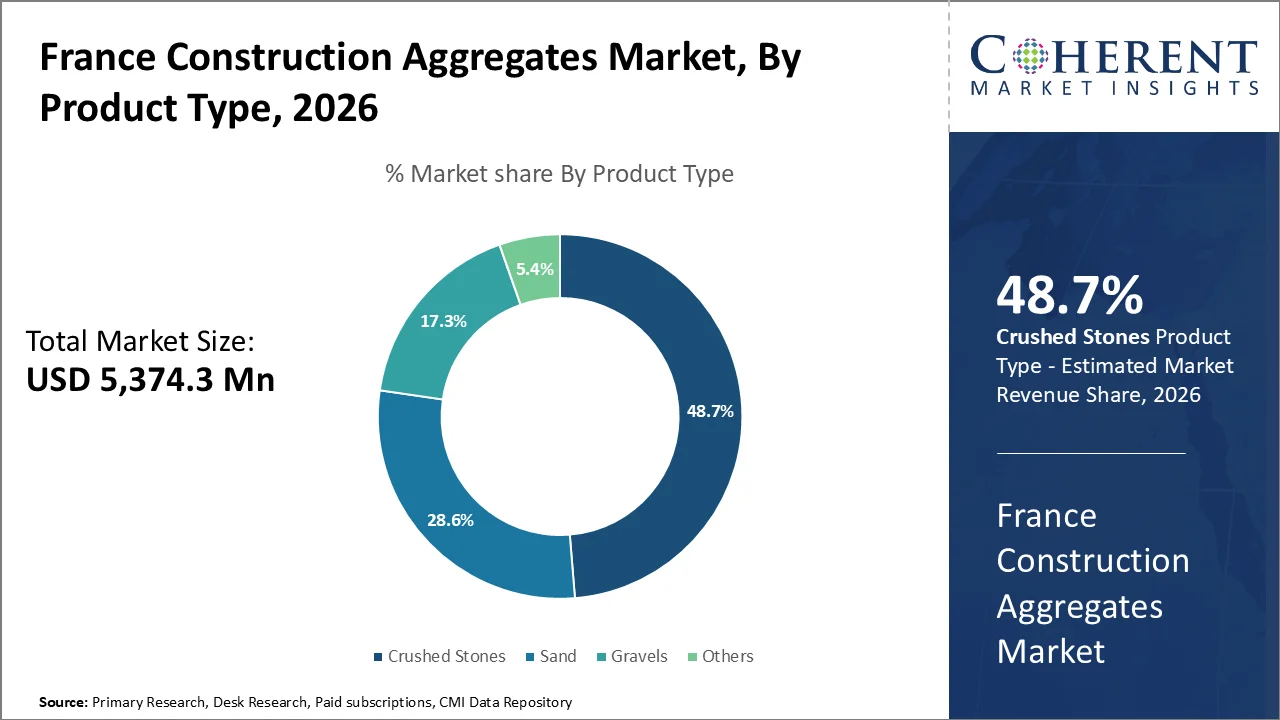
Why is Crushed Stones Acquiring the Largest Market Share?
Crushed stones are expected to hold the largest market share within the France construction aggregates market by 2026, occupying roughly 48.7% of the market revenue share. This is due to the significant usage of crushed stones in construction projects such as roads, railways, bridges, and even concrete. Crushed stones have proven to be stronger and more durable than most aggregate types, and thus are necessary for transportation purposes.
Furthermore, the increasing usage of sustainable construction methods and durable construction materials is driving the need for crushed stones in public and private construction projects.
In January 2025, Colas Group announced the creation of Nexstone, a new entity that consolidates all of its construction materials, quarrying, aggregate production, recovery, and recycling activities across France.
Which Category Segment Dominates the Market?
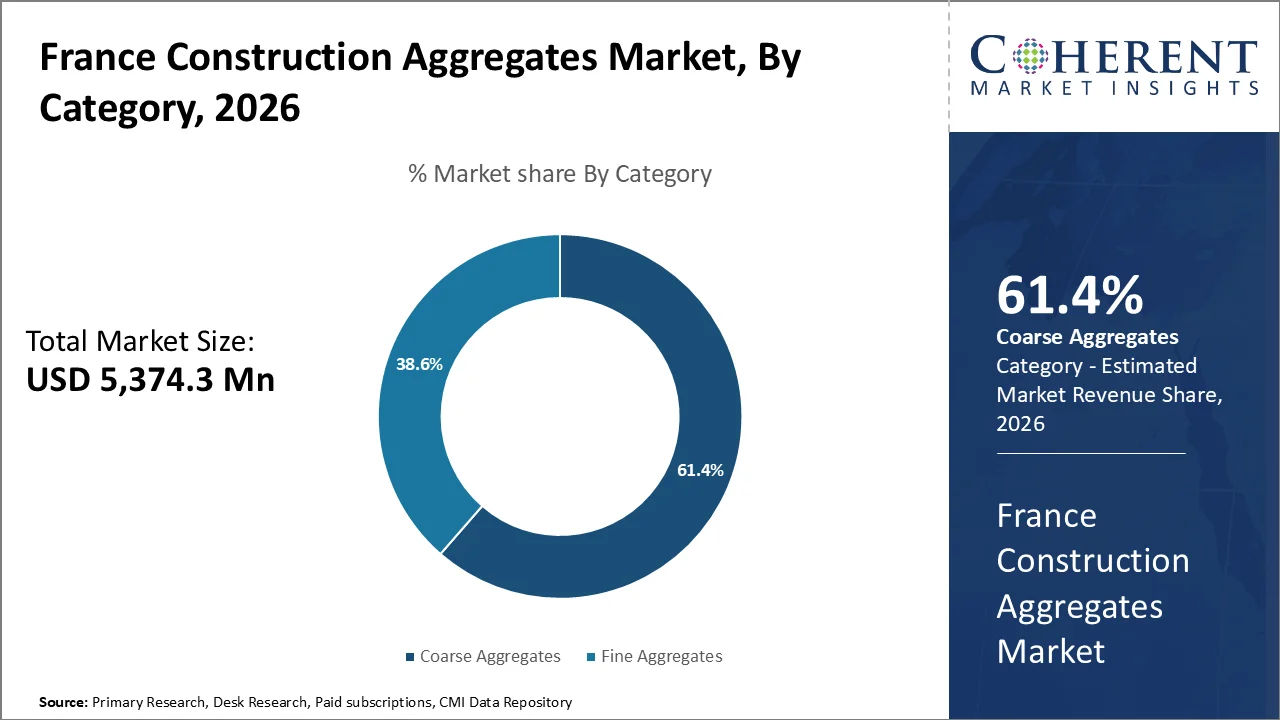
Coarse aggregates are projected to dominate the market share at 61.4% in 2026 due to their extensive use in applications involving concrete structures, roads, bridges, tunnels, and infrastructural development for transportation. The coarse aggregates find application in those regions having heavy loading conditions and provide structural integrity needed for such constructions.
Investments in road rehabilitation, railways upgrades, and construction of infrastructures will continue driving demand growth for coarse aggregate. The usage of coarse aggregate in concrete production and infrastructural development will keep its dominance during the forecast period.
In June 2025, NGE officially inaugurated its 20th REVAMA construction waste recycling platform in Aulnay-sous-Bois.
Why is Concrete Acquiring the Largest Market Share?
Concrete is expected to hold more than 56.9% of the applications market, owing to the widespread application of concrete in residential, commercial, and infrastructure structures, and the construction industry uses concrete in vast amounts. Aggregates contribute nearly 70-80% to the total volume of concrete, and hence, the concrete industry constitutes the largest consumer of construction aggregates in France.
In addition, increased investments in energy-efficient infrastructure, sustainable buildings and urban redevelopment projects are also propelling concrete demand. It is durable, versatile and cost-effective, making it the material of choice for many building applications.
In March 2025, GA Smart Building announced the expansion of its subsidiary PREGA, a specialist in low-carbon concrete systems.
Which End-use Industry Segment Dominates the Market?
The infrastructure segment holds the highest proportion of over 44.8% in 2026, due to ongoing expenditures in roads, railroads, bridges, utility networks, airports, and public works projects throughout France. Infrastructure development is still one of the greatest consumers of construction aggregates since they constitute the base of transportation and civil engineering structures.
Government-supported infrastructure modernization programmers, rail transport development projects, and urban transport development programs will probably continue contributing to aggregate demand in the forecast period. Infrastructure remains at the center of the focus of the French government because the infrastructure industry is expected to be the main end-use sector of the construction aggregates industry.
In July 2025, Philippe Tabarot, France's Minister for Transport, announced the development of a historic framework law following the conclusions of the "Ambition France Transports" conference.
France Construction Aggregates Market Trends
- An increase in the use of recycled aggregates and the circular economy is reducing dependence on new raw materials and promoting sustainability in construction.
- The well-developed transport network in France is contributing significantly to the demand for aggregates.
- The rising demand for low-carbon concrete reflects a growing focus by developers on minimizing emissions from construction. Aggregate forms 70–80% of concrete.
- The construction industry produces around 227 million tons of waste each year, promoting the need to employ recycled aggregates in constructions.
- Ballast and crushed rock aggregates are in high demand due to the development of rail transport infrastructure, where France aims to invest up to €100 billion by 2040 into its railways.
Who are the Major Companies in France Construction Aggregates Industry
Some of the major key players in France Construction Aggregates are Cementir Holding N.V., Lafarge Holcim Ltd., Heidelberg Cement Group, CEMEX S.A.B. de C.V., CRH Plc., Vicat SA, VINCI Group, and Groupe SABOULARD.
Industry News
- In January 2026, Holcim completed the acquisition of Alkern, a leading French manufacturer of precast concrete products with more than 50 production sites in France and Belgium.
- In February 2025, Heidelberg Materials continued development of carbon capture and storage (CCS) initiatives at its French cement operations as part of its net-zero strategy.
Market Report Scope
France Construction Aggregates Market Report Coverage
| Report Coverage | Details | ||
|---|---|---|---|
| Base Year: | 2025 | Market Size in 2026: | USD 5,374.3 Mn |
| Historical Data for: | 2020 To 2024 | Forecast Period: | 2026 To 2033 |
| Forecast Period 2026 to 2033 CAGR: | 1.56% | 2033 Value Projection: | USD 5,989.4 Mn |
| Segments covered: |
| ||
| Companies covered: | Cementir Holding N.V., Lafarge Holcim Ltd., Heidelberg Cement Group, CEMEX S.A.B. de C.V., CRH Plc., Vicat SA, VINCI Group, and Groupe SABOULARD | ||
| Growth Drivers: |
| ||
| Restraints & Challenges: |
| ||
Analyst Opinion
- The construction aggregate sector in France is driven by infrastructure and construction requirements rather than by economic fluctuations. Aggregates play an important role in achieving the long-term goals of the country since they are essential raw materials for roads, railroads, bridges, houses, and business premises.
- Infrastructure will play a vital role in fuelling growth in the market. The nation continues to make significant investments in its transportation infrastructure in the form of a €100 billion upgrade to its railways by 2040. This will ensure a steady flow of demand for crushed stones and gravels in the coming years.
- Sustainability is changing the rules of competition. The use of recycled materials, low-carbon concrete and circular building approaches will increase and create new opportunities for those organizations who can manage environmental compliance with reliable supply and cost efficiency.
- Aggregate consumption is expected to be resilient in the face of regulatory and environmental headwinds. France consumes more than 400 Mt of aggregates annually and demand is likely to be underpinned by continuous maintenance of its 1.1 Mn km of highways, urban renewal projects and investment in public infrastructure.
- Market efficiency should be improved by industry consolidation and investment in quarry improvement. The leading producers are putting more money into digital quarry management, recycling operations and sustainable extraction technology to enhance output and meet changing environmental demands.
Speak to the analyst
Want personalized insights?
Take the findings above to one of our principal consultants, or have the report rebuilt around the segments, geographies and competitors you actually track.
Market Segmentation
- By Product Type (Revenue, USD Mn, 2021-2033)
- Crushed Stones
- Sand
- Gravels
- Others
- By Category (Revenue, USD Mn, 2021-2033)
- Fine Aggregates
- Coarse Aggregates
- By Application (Revenue, USD Mn, 2021-2033)
- Concrete
- Road Base & Coverings
- Others
- By End-Use Industry (Revenue, USD Mn, 2021-2033)
- Commercial
- Infrastructure
- Residential & Social Buildings
Sources
Primary Research Interviews
- Construction industry consultants
- Quarry and aggregate producers
- Infrastructure project developers
- Cement and concrete manufacturers
- Government infrastructure planning officials
- Transportation and civil engineering contractors
Databases
- French National Institute of Statistics and Economic Studies (INSEE)
- Eurostat (European Commission Statistics)
- French Ministry of Ecological Transition – Transport & Construction Data
- Organisation for Economic Co-operation and Development (OECD)
- World Bank Infrastructure and Urban Development Database
Magazines
- Aggregates Business Europe
- World Cement
- International Construction Magazine
- Le Moniteur (France construction industry publication)
Journals:
- Cement and Concrete Research
- Construction and Building Materials
- Resources, Conservation & Recycling
- Journal of Cleaner Production
- Engineering Structures
Newspapers
- Les Echos
- Le Monde (Business & Economy Section)
- Financial Times
- Reuters
- Bloomberg
Associations
- UNPG – Union Nationale des Producteurs de Granulats (French National Union of Aggregate Producers)
- FIB (Fédération de l’Industrie du Béton)
- SNBPE (Syndicat National du Béton Prêt à l’Emploi)
- European Aggregates Association (UEPG)
- French Ministry of Ecological Transition (Ministère de la Transition Écologique)
Public Domain Sources
- Government infrastructure investment reports (France Transport Ministry)
- EU infrastructure and cohesion policy reports
- Company annual reports and investor presentations (Holcim, CRH, Heidelberg Materials, Vicat, CEMEX)
- Environmental and construction waste reports from ADEME
- Public procurement and infrastructure tender databases (BOAMP, TED Europa)
Proprietary Elements
- CMI Data Analytics Tool
- Proprietary CMI Existing Repository of information for last 10 years
Get access to 250+ pages report
Every segment, forecast, competitor profile and data table behind the analysis above — available for instant download.
- ESOMAR Member
- ISO 9001:2015 Certified
- D-U-N-S Registered
- GDPR & CCPA Compliant
Missing comfort of reading report in your local language? Find your preferred language:
Transform your Strategy with Exclusive Trending Reports
Frequently Asked Questions
The France construction aggregates market is expected to reach USD 5,989.4 Mn by 2033, growing from USD 5,374.3 Mn in 2026, at a CAGR of 1.56% (2026–2033).
Major players include Cementir Holding N.V., Holcim Ltd., Heidelberg Materials (Heidelberg Cement Group), CEMEX S.A.B. de C.V., CRH Plc., Vicat SA, VINCI Group, and Groupe SABOULARD.
Growth is driven by increasing infrastructure development, rising residential and commercial construction activities, government investment in transport networks, and growing demand for aggregates in sustainable construction applications.
Market growth is challenged by depletion of easily accessible aggregate reserves, strict environmental regulations, rising energy and transportation costs, and delays in quarry permitting approvals.
The market is expected to grow at a CAGR of 1.56% during 2026–2033.
Crushed stones dominate the market with a share of 48.7% in 2026, due to their extensive use in roads, railways, and large-scale infrastructure projects.
Coarse aggregates lead the market with a share of 61.4% in 2026, driven by their strong use in structural concrete and infrastructure foundations.